

Choose the Best Social Media Marketing Agency for Your Brand in 2026
Last Updated

A social media marketing agency does a lot more than just schedule a few posts. They’re the strategic partner that turns your social media channels from a simple online presence into a revenue-driving machine. Think of it this way: a basic social profile is like a shed, but an agency designs and builds a skyscraper for your business on platforms like Meta, TikTok, and LinkedIn.
What a Social Media Marketing Agency Actually Does
Many businesses wonder what really happens behind the agency curtain. It’s a world that goes far beyond just whipping up pretty graphics or thinking up a clever caption for a post. A professional agency works across several connected functions, all designed to hit tangible business goals like leads and sales—not just chase vanity metrics.
Their job is to forge real connections between your brand and your ideal customers. This specialised expertise is what helps you cut through the noise in an incredibly crowded online space. An agency’s role can be broken down into four core functions that all work together to get you results.
The Four Pillars of Agency Services
To really get the value of an agency, you need to understand how they structure their work. These aren't just separate tasks on a to-do list; they're part of a synchronised effort.
-
Strategy Development: This is the blueprint. Before anything else, an agency will dive deep into your business goals, target audience, and what your competitors are doing. From there, they build a customised plan that guides every single action.
-
Content and Creative Production: This is where the agency creates the high-quality videos, images, and copy that actually make people stop scrolling. It’s not just about making things look good; it's about producing content that resonates with your audience and tells your brand’s story effectively.
-
Paid Media Management: This pillar is all about reaching new customers with precision. Agencies manage your ad spend on platforms like Meta and LinkedIn, targeting specific demographics and interests to drive conversions as efficiently as possible.
-
Analytics and Community Management: This is where performance gets measured and relationships get built. It involves tracking the metrics that matter, delivering clear reports, and engaging with your audience to build loyalty and gather invaluable feedback.
An effective agency doesn't just manage your social media; they integrate it into your business's core growth engine. Their goal is to turn followers into customers by creating a seamless journey from initial awareness to final purchase.
This integrated approach is what separates professional management from just posting on the fly. While some businesses might try to handle one or two of these pillars in-house, an agency brings a full team of specialists to the table. This often includes strategists, copywriters, designers, and ad buyers who collaborate to make sure every piece of your social presence is optimised for success.
If you're looking for tailored guidance on your own strategy, exploring professional social media consulting can provide a clearer path forward. Ultimately, partnering with an agency gives you access to a depth of expertise and resources that is difficult to replicate internally, allowing you to focus on running your business while they handle its digital growth.
When you’re looking to hire a social media marketing agency, it’s easy to get lost in a sea of buzzwords. But a truly great agency isn’t just performing random tasks; their work is built on an integrated system designed for one thing: growth.
This system rests on four essential pillars that work together, making sure every action is deliberate and every dollar is accountable. Grasping these pillars is the key to telling the difference between an agency that just posts pretty pictures and one that actually builds brands.
These core services are the foundation of any social media campaign that successfully turns passive followers into loyal customers. Let's break down each one.
The table below gives a quick overview of what a top-tier agency actually does, connecting each service pillar to a clear business objective.
| Service Pillar | What It Involves | Primary Business Goal |
|---|---|---|
| Social Media Strategy | Deep-dive discovery, audience profiling, and competitor analysis to create a strategic roadmap. | To align all social media activity with core business objectives like sales or lead generation. |
| Content Creation | Producing a mix of high-quality, engaging assets like videos, carousels, and articles tailored to each platform. | To capture attention, build brand affinity, and provide value that moves customers through the sales funnel. |
| Paid Social Advertising | Data-driven audience targeting, full-funnel campaign management, and continuous budget optimisation. | To accelerate growth by reaching new, qualified customers immediately and maximising Return On Ad Spend (ROAS). |
| Community & Analytics | Tracking business-critical KPIs, providing actionable insights, and actively engaging with the online community. | To measure what matters, prove ROI, and build a loyal, vocal customer base. |
Now, let's explore what each of these pillars looks like in practice.
Pillar 1: Social Media Strategy
Strategy is the 'why' behind every single post, campaign, and comment. Think of it as the architectural blueprint an agency designs before laying a single digital brick. Without a solid strategy, social media marketing descends into a series of disjointed activities with no clear direction or measurable results.
A top-tier agency always begins by immersing itself in your business. This involves:
- Deep-Dive Discovery: Getting to the heart of your business objectives. Is the goal to drive e-commerce sales, generate qualified B2B leads, or build unshakeable brand authority?
- Audience Profiling: Creating detailed personas of your ideal customers—their real pain points, what truly motivates them, and where they actually spend their time online.
- Competitive Analysis: Scrutinising what your competitors are doing well, but more importantly, identifying the gaps where your brand can stand out and win.
The outcome is a strategic roadmap. It clearly defines which platforms to focus on, what messages will resonate, and exactly how success will be measured. This ensures that every piece of content and every ad dollar serves a specific purpose that’s tied directly to your business goals.
Pillar 2: Content Creation
Content is the 'what'—it’s the tangible material that stops the scroll and captures attention. In a world completely saturated with information, generic, bland content is simply invisible. An elite agency acts as your brand’s in-house creative studio, producing high-quality, engaging assets that connect with your target audience on a human level.
This goes far beyond just posting pretty pictures. It's about authentic storytelling that builds brand affinity and provides genuine value. A great agency will deliver a strategic mix of formats tailored to each platform, like compelling short-form videos for TikTok and Reels, insightful carousels for Instagram, and thought-leadership articles for LinkedIn.
For example, an e-commerce fashion brand might use a combination of user-generated content to build powerful social proof, polished studio shots for product highlights, and behind-the-scenes videos to humanise the brand. Each piece is deliberately crafted to guide the customer along their journey.
This visual shows how these core agency functions connect to drive real business growth.
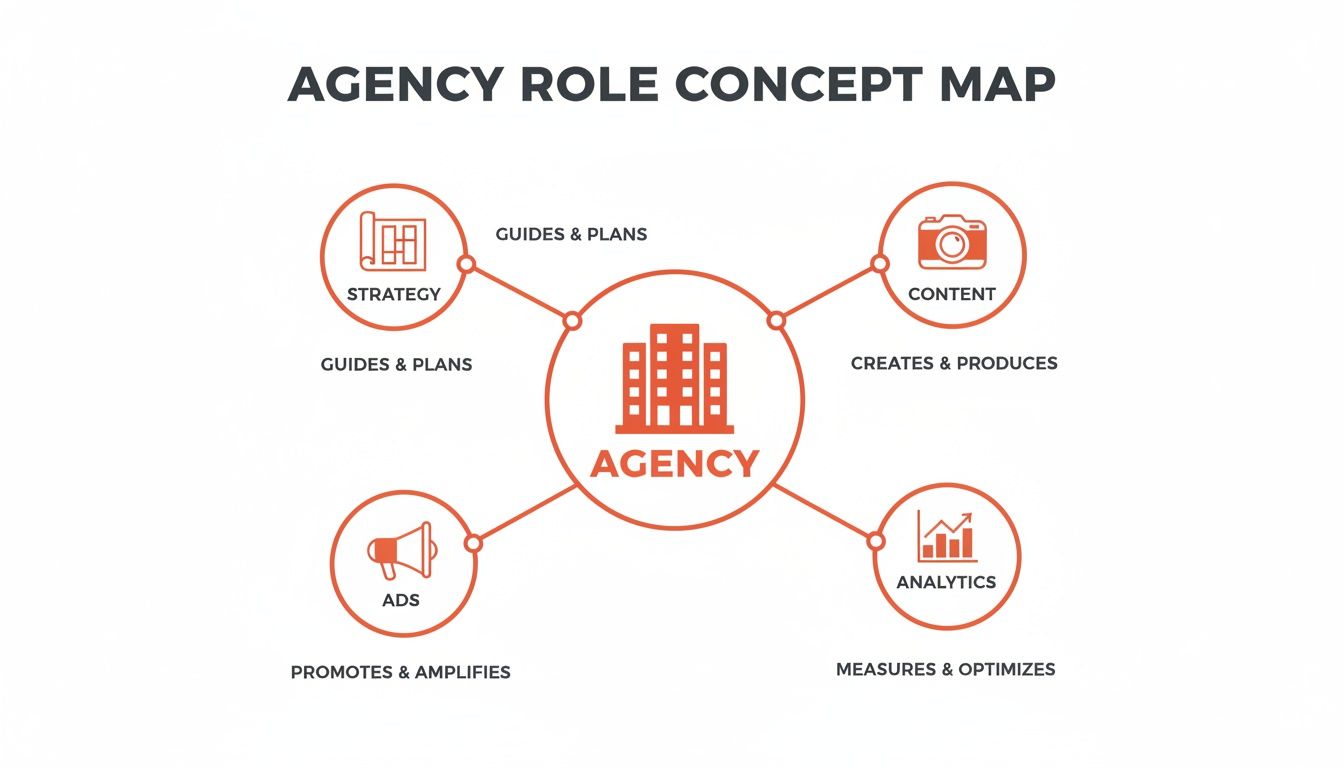
As you can see, the agency serves as the central hub, integrating strategy, content, ads, and analytics into one cohesive, powerful system.
Pillar 3: Paid Social Advertising
Paid social is the 'who' and 'where' of your marketing, acting as a powerful accelerator for growth. While organic content is great for building community over time, paid advertising lets you precisely target and reach new, qualified customers almost immediately. A skilled agency uses paid channels to put your message in front of the right people at exactly the right time.
This involves far more than just hitting the "boost post" button. It's a data-driven discipline that includes:
- Audience Targeting: Using powerful platform tools to define audiences based on demographics, interests, behaviours, and past interactions with your brand.
- Campaign Management: Structuring and managing ad campaigns across the entire sales funnel—from broad awareness campaigns that introduce your brand to laser-focused retargeting campaigns that convert warm leads.
- Budget Optimisation: Constantly monitoring performance and shifting ad spend to the most effective campaigns and audiences to maximise your Return On Ad Spend (ROAS).
A B2B tech company, for instance, would leverage LinkedIn ads to target professionals by job title and industry, driving them to a webinar registration or a whitepaper download. This precision ensures their marketing budget is spent generating qualified leads, not just chasing empty exposure.
Pillar 4: Community Management and Analytics
The final pillar is the 'how'—how you measure what’s working and how you foster true loyalty. Analytics provides the data-driven feedback loop that constantly refines your strategy, while community management transforms your social media pages from a simple broadcast channel into a vibrant, engaged community.
A proficient agency doesn't waste time on vanity metrics like likes and follower counts. They focus on the Key Performance Indicators (KPIs) that directly impact your bottom line, such as Conversion Rate, Cost Per Lead (CPL), and Customer Acquisition Cost (CAC). They provide clear, actionable reports that don't just present data but offer sharp insights and concrete recommendations for what to do next.
At the same time, active community management means responding to comments, answering questions, and proactively engaging with your audience. This two-way dialogue builds trust, gathers invaluable customer feedback, and creates a loyal following that advocates for your brand.
This level of engagement is absolutely critical, especially in a market like Australia with 21.0 million active social media users. With adults spending an average of 20.5 hours per week on social platforms and 31.3% discovering new brands through social ads, the opportunity for connection and conversion is immense. You can explore more Australian digital trends to see how they impact business strategy.
Decoding Agency Pricing and Contract Models
Talking money with a social media agency can feel a bit like learning a new language. But once you get the hang of it, you’ll be able to spot the right financial fit for your business, ensuring you invest wisely in your brand's future on social media.
Most agencies structure their fees in one of three ways. Each has its pros and cons, depending on what you’re trying to achieve. Getting your head around these models is the first step to making a confident decision, so you’re not overpaying for fluff or underinvesting where it really counts.
Monthly Retainer Model
The monthly retainer is the bread and butter of agency pricing. You pay a fixed, recurring fee each month for an agreed-upon scope of services. Think of it as having a team of social media experts on subscription, dedicated to managing and growing your presence day in and day out.
This model is a fantastic fit for businesses looking for consistent, long-term support. It makes budgeting predictable and gives the agency the runway they need to build real momentum.
- Pros: Predictable costs, continuous management and optimisation, and the chance to build a strong, evolving partnership.
- Cons: It can be a significant monthly expense, and the value might feel less immediate in the first month while the strategy is still taking shape.
A typical retainer with a social media marketing agency usually bundles everything from strategy and content creation to community management and monthly performance reports.
Project-Based Pricing
Another very common approach is project-based pricing. Here, you pay a single, flat fee for a specific project with a clear beginning, end, and deliverable. It’s perfect when you have a well-defined goal in mind.
Common projects include things like:
- A major product launch campaign.
- Building and optimising your social media profiles from the ground up.
- Creating a one-off, comprehensive social media strategy document.
This model is ideal for businesses that don’t need someone steering the ship 24/7 but require specialised expertise for a specific push. It gives you total clarity on cost and what you’ll get for your money. Understanding the different marketing agency pricing models is crucial for both sides to set clear expectations from the start.
Performance-Based Models
A less common but seriously interesting option is the performance-based model. In this setup, the agency's pay is directly linked to the results they deliver. This could be a percentage of sales driven by their campaigns or a set fee for every qualified lead they generate.
This model creates a powerful alignment of interests: the agency only makes more money when you do. It’s a true pay-for-performance partnership that holds your agency directly accountable for delivering measurable ROI.
That said, this model demands crystal-clear tracking and can be tricky to structure. It’s usually best suited for businesses with a well-oiled sales funnel and rock-solid conversion metrics, like an e-commerce store.
Before you sign anything, make sure you understand the difference between the agency management fee and your ad spend. The management fee is what you pay the agency for their time, brains, and labour. The ad spend is the separate budget that goes directly to platforms like Meta or LinkedIn to actually run your ads. Any good agency will make this distinction incredibly clear.
Finally, be wary of getting locked into long, rigid contracts. A modern, confident social media marketing agency will often propose flexible, month-to-month agreements or a short initial commitment of 3-6 months. This keeps you in the driver’s seat and proves the partnership is built on consistent value, not a piece of paper. You want a partner who’s confident enough to earn your business every single month.
How to Choose the Right Agency for Your Business

Finding the perfect social media marketing agency can feel like searching for a needle in a haystack. But if you have a structured approach, you can cut through the noise and confidently pick a partner who’ll feel like an extension of your own team.
This isn’t just about hiring someone to post a few updates. You're entrusting a piece of your brand’s future to an external team. Get it right, and you can supercharge your growth. Get it wrong, and you’re looking at wasted budgets and missed opportunities.
Let's walk through a practical framework to help you make a smart, informed decision.
Define Your Goals and Needs First
Before you even think about looking at agencies, you need to look inward. What do you actually want to achieve with social media? A vague goal like “get better at social media” just won’t cut it. You need specific, measurable objectives.
Get crystal clear on your primary aim. Are you an e-commerce brand focused on driving direct sales through Meta ads? Or are you a B2B firm trying to generate qualified leads from LinkedIn? Maybe your main goal is simply to build brand awareness in a new market.
Your goals will dictate the kind of agency you need. Some agencies are brilliant at creative content but light on performance marketing, while others are data-obsessed ad specialists. Knowing what you want to achieve is the first step in finding an agency with the right expertise to get you there.
Vet Their Experience and Case Studies
Once you've got a shortlist, it’s time to do your homework. Don't just take their word for it—look for proof. Case studies and past work are the most powerful indicators of an agency’s real-world capabilities.
But don't just look for pretty results. You need to dig deeper with these questions:
- Industry Relevance: Do they have experience in your sector (e.g., e-commerce, B2B, local services)? An agency that gets amazing results for restaurants might not understand the nuances of marketing a software company.
- Goal Alignment: Do their case studies show results that line up with your goals? If you need lead generation, look for examples where they demonstrably increased leads, not just follower counts.
- Problem Solving: A good case study doesn't just show the final numbers. It tells a story about the problem they faced, the strategy they implemented, and how they got the results.
This critical review will help you separate the agencies that talk a good game from those that actually deliver.
Evaluate Their Communication and Transparency
A partnership with a social media agency is built on trust, and that trust is built on clear communication. How an agency communicates during the sales process is often a strong indicator of what they’ll be like to work with day-to-day.
A great agency will ask you deep, thoughtful questions about your business. They’ll be more interested in your profit margins, customer lifetime value, and business challenges than in your current follower count. This shows they are thinking like a strategic partner, not just a service provider.
Pay close attention to their reporting process. Will you get a static PDF report once a month, or will you have access to a real-time dashboard? Modern, transparent agencies provide live dashboards so you can see your performance data anytime, empowering you to track progress without having to wait for a scheduled meeting.
The checklist below breaks down the key areas to investigate and the green flags to look for during your evaluation. It's a simple tool to help you ask the right questions and spot a quality partner.
Agency Evaluation Checklist
| Evaluation Area | Key Questions to Ask | What to Look For (Green Flags) |
|---|---|---|
| Strategy & Onboarding | What does your onboarding process look like? How do you develop our initial strategy? | A structured, multi-step onboarding process. They ask probing questions about your business goals. |
| Expertise & Case Studies | Can you show me results from a client similar to us? Who on your team will be working on my account? | Proven results in your industry. You get to meet the actual team, not just the sales rep. |
| Communication & Reporting | How often will we meet? What do your reports look like? Can I see a sample report? | A clear communication schedule and access to a live reporting dashboard for 24/7 transparency. |
| Contracts & Pricing | What are your contract terms? Is ad spend included in your fee? | Transparent pricing and flexible, month-to-month contracts after an initial commitment period. |
Using a checklist like this ensures you’re making a decision based on substance, not just a slick presentation.
Look for Green Flags in the Proposal
The final proposal is more than just a price tag; it’s a reflection of how well the agency understood your business. A generic, copy-paste proposal is a massive red flag. A great proposal is customised, strategic, and clearly outlines the path to achieving your specific goals.
Here are the key green flags to look for:
- A Customised Strategy: The proposal should reference your specific challenges and goals, outlining a clear plan of action from day one.
- Pricing Transparency: It must clearly separate the agency’s management fee from the ad spend budget that goes directly to the platforms.
- Clear Deliverables: You should know exactly what you’re getting for your money—for example, 12 feed posts per month, 4 video Reels, and weekly ad optimisation.
- Flexible Contracts: Look for agencies that offer a short initial trial period (e.g., 3 months) followed by a month-to-month agreement. This shows they are confident in their ability to deliver consistent value.
Choosing the right social media marketing agency is a significant business decision. By following this structured process, you can move beyond the sales pitches and find a true partner dedicated to helping you achieve real, measurable growth.
Measuring Success With KPIs That Actually Matter
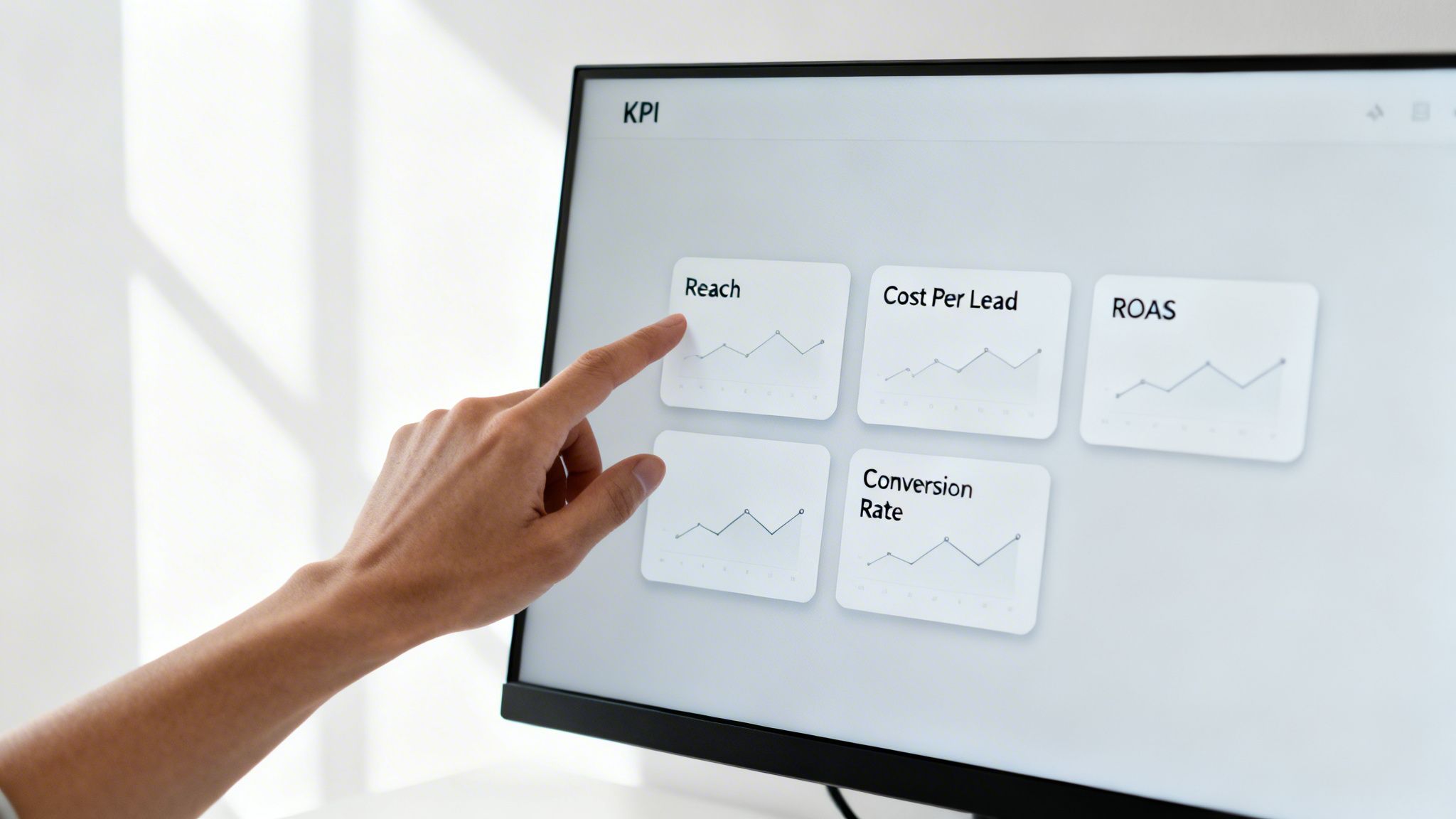
It’s easy to get caught up in follower counts and likes. They feel good, but they don't pay the bills. When you bring a social media marketing agency on board, the conversation has to move past these vanity metrics and focus on the Key Performance Indicators (KPIs) that track real business impact.
Think of it like this: your car's dashboard shows your speed, fuel, and engine temperature—not just how loud the stereo is. It’s the essential data you need to get to your destination. The right KPIs do the same for your business, telling you if your social media spend is actually driving you forward.
A non-negotiable skill for any good agency is demonstrating exactly how to measure social media ROI. It's all about connecting every post, ad, and comment back to a tangible business outcome.
Aligning KPIs With Business Objectives
The only way to track performance effectively is to organise your KPIs around what you’re trying to achieve. Not every metric is important for every business. The numbers an e-commerce brand cares about will look completely different from those of a B2B service provider.
A top-tier agency will sit down with you to identify the right KPIs for your specific goals. Generally, these fall into three main buckets: Brand Awareness, Lead Generation, and E-commerce Sales. Each one has its own set of critical metrics.
Let's break down the essential KPIs you should be tracking for each objective.
Brand Awareness Metrics
If your main goal is to get your brand name out there and introduce it to a wider audience, you’re playing at the top of the marketing funnel. Success here is measured by how many people you’re reaching and whether your content is making an impression.
- Reach: The total number of unique people who see your content. This is the most fundamental awareness metric—are you getting in front of new eyes?
- Impressions: The total number of times your content is displayed on a screen. If your impressions are high but your reach is low, it means the same people are seeing your content over and over again.
- Engagement Rate: This calculates the percentage of people who saw your post and then interacted with it (liked, commented, shared). A solid engagement rate means your content is genuinely resonating, not just being passively scrolled past.
Lead Generation Metrics
For many B2B companies and service-based businesses, social media is all about filling the sales pipeline with qualified leads. This is where the metrics start to get much closer to the money.
The focus shifts from broad visibility to efficient acquisition. You’re not just trying to be seen; you’re trying to spark an action that turns a passive browser into a potential customer.
Here are the key metrics to watch:
- Conversion Rate: The percentage of users who take a specific action after clicking on your ad, like filling out a contact form or downloading a guide. This is a direct measure of how persuasive your campaign is.
- Cost Per Lead (CPL): This calculates how much you spend, on average, to acquire one new lead. An efficient, well-targeted campaign will keep your CPL as low as possible.
- Click-Through Rate (CTR): The percentage of people who saw your ad and clicked the link. A high CTR is a great sign that your creative and copy are compelling enough to make people want to learn more. For a deeper dive, our guide on digital marketing performance metrics offers more context.
E-commerce Sales Metrics
For online stores, social media is a direct sales channel, plain and simple. The most important KPIs are the ones that measure the direct financial return on your marketing efforts.
- Return On Ad Spend (ROAS): This is the holy grail for e-commerce. It measures the total revenue you generate for every single dollar you spend on ads. For example, a 4:1 ROAS means you made $4 for every $1 spent.
- Customer Acquisition Cost (CAC): This is the total cost to acquire one new paying customer. A successful strategy will always aim for a CAC that is significantly lower than your Customer Lifetime Value (CLV).
- Average Order Value (AOV): This tracks the average dollar amount customers spend per order. A good agency will actively work to increase your AOV through tactics like upselling, cross-selling, and product bundling.
Ultimately, a report from your agency should be more than just a data dump. It needs to provide strategic insights and recommendations that explain the "why" behind the numbers. The best agencies combine live reporting dashboards with strategic monthly summaries, giving you the power to track progress in real-time while holding them accountable for delivering measurable growth.
Integrating Social Media with PPC and SEO
A winning social media strategy never works in isolation. The smartest brands know that social media, Pay-Per-Click (PPC) advertising, and Search Engine Optimisation (SEO) aren't just separate channels—they’re interconnected gears in a single growth machine. When you get them working together, the results aren't just better; they're exponential.
I often tell clients to think of their digital marketing like a sports team. SEO is your rock-solid defence, building a strong foundation and long-term authority. PPC is your star striker, engineered for quick, decisive goals. And social media? That’s your midfield, controlling the game's flow, creating opportunities, and firing up the crowd. They’re far more powerful when they play off each other.
That's why hiring a cohesive social media marketing agency that gets this interplay is so important. When these channels start sharing insights, your entire marketing effort gets smarter and more efficient.
Creating a Powerful Data Feedback Loop
The real magic happens when you build a feedback loop where data from one channel fuels the strategy for the others. This is how you make sure your marketing channels are actually talking to each other, constantly getting sharper based on how real customers behave.
For instance, a post on Instagram that gets a heap of comments and questions can shine a light on a new customer pain point you hadn't considered. That insight is gold. You can immediately spin it into a targeted blog post for SEO or a new ad campaign for Google Search that speaks directly to that need.
This cross-channel conversation flows in every direction:
- Social to SEO: Spotting popular topics and questions on social media can give you the perfect inspiration for new, keyword-rich blog content that pulls in organic search traffic.
- PPC to Social: Found some killer ad copy in your Google Ads campaigns? Don’t let it sit there. Repurpose that proven messaging for high-converting social media ads.
- SEO to Social: Your top-performing blog posts are a content goldmine. Break them down into snappy carousels for Instagram, short-form videos for TikTok, or insightful thought leadership pieces for LinkedIn.
When your channels operate in silos, you're leaving money on the table. An integrated approach ensures a consistent customer journey from the moment someone discovers you on social media to the point they find you on Google and make a purchase.
Unifying Your Customer Journey
An integrated strategy creates a seamless and consistent experience for your customers. Picture this: a user sees an engaging video ad on Meta, clicks through to your website, but then gets distracted and leaves. A few days later, they’re searching for a solution on Google, and your brand pops up at the top, thanks to a combination of smart SEO and targeted remarketing ads.
This full-funnel approach, where social, SEO, and PPC work in concert, is how you maximise your marketing ROI. It meets customers at different points in their journey, building trust and familiarity every step of the way. To get a better handle on how these channels slot together, exploring the relationship between SEM and SEO marketing offers some valuable context.
Executing this properly relies on either a full-service agency or a tight collaboration between specialists. They're the ones who ensure your messaging is consistent, your audiences are aligned, and your data is shared across all platforms. This creates a powerful flywheel effect where success in one area amplifies results everywhere else, setting your business up for sustainable, long-term growth.
Your Top Questions, Answered
Let's tackle some of the most common questions that pop up when business owners start thinking about hiring a social media marketing agency.
How Much Does a Social Media Marketing Agency Cost?
This is the big one, and the honest answer is: it varies wildly. The cost really depends on how deep you want to go.
For a basic package covering simple management, you might be looking at a starting point around $1,500 per month. But for a full-blown, comprehensive strategy—think significant ad spend, high-end video production, and multi-channel creative—costs can easily climb past $10,000 a month.
The most important thing to get straight is what’s actually included in that price. Always, always ask if the quote is just for the agency's management fee, or if it also covers your ad spend (the money that goes directly to platforms like Meta). You don't want any nasty surprises there.
How Long Until I See Results?
While a well-executed paid ad campaign can start generating some initial buzz and traffic within a few weeks, building a truly solid organic presence and genuine brand love is a longer game.
Realistically, you should expect to see meaningful, sustainable results take hold within three to six months. The first month is almost always dedicated to deep-diving into strategy, setting up accounts correctly, and running initial tests to see what resonates.
Building a powerful social media presence is a marathon, not a sprint. The initial phase establishes the foundation, but consistent execution over several months is what delivers substantial, long-term ROI and brand growth.
What Is the Difference Between an Agency and a Freelancer?
A freelancer is typically one person who specialises in a specific area, like creating content for Instagram or managing a single platform's ads. An agency, on the other hand, brings an entire team of collaborating specialists to the table.
With an agency, you’re getting a whole crew working in concert. This usually includes:
- Strategists to map out the high-level game plan.
- Copywriters to nail the messaging and voice.
- Ad managers to relentlessly optimise your campaigns for performance.
- Designers to create all the visual assets that make your brand pop.
This integrated team approach provides a far more comprehensive and robust service than a single person can generally offer. You're not just hiring a task-doer; you're hiring a brain trust.
Ready to see how a dedicated team can transform your online presence? Click Click Bang Bang offers precision-driven PPC and SEO campaigns that deliver measurable results. Discover our transparent, flexible plans at https://clickclickbangbang.com.au.
Read NeXt
Or Read Our Latest
- Manual vs Automated Bidding for PPC Success
- Conversion Tracking Setup: A Complete AU Guide
- Instagram Advertising Australia: Complete 2026 Guide
- Pay Per Click: A Beginner’s Guide for Australian Marketers
- Display Advertising on Google: The Complete Australian Guide
- Stakeholder Communication Plan How to Build One That Works
Click. CLick. Subscribe.
Get our best PPC insights, industry updates, and power moves delivered straight to your inbox. No fluff, just high-caliber strategies that actually work.
Don’t Leave Just Yet
Try Us For 30-Days,
Risk Free!!
We guarantee that you’ll love our work within the first 30 days, if not you’ll get your money back.
What have you got to lose?