

Mastering Web Content Writing for SEO in 2026
Last Updated

If you've been in the SEO game for a while, you know the old rules are dead. Gone are the days of just stuffing keywords into a page and hoping for the best. In 2026, writing web content for SEO is a whole new ball game—it’s about crafting content that genuinely connects with your audience while also satisfying the technical demands of search engines.
This isn't another guide rehashing the basics. We’re going to walk through the framework that top agencies use to create content that doesn’t just rank, but actually drives business growth—whether that's more sales for your e-commerce store, better leads for your B2B firm, or scalable success for your small business.
Why SEO Content Matters Now More Than Ever

The entire focus has shifted from simply being visible to being valuable. And in the crowded Australian digital space, that's a critical distinction.
The Content Marketing industry here has ballooned to a market size of $444.0 million in 2026. That explosion tells you everything you need to know: high-quality web content is no longer a 'nice-to-have'. It's the engine for organic traffic and conversions. You can explore more about this industry growth on IBISWorld.
Our goal here is to help you turn your content from a simple blog post or product page into a powerful, revenue-generating asset. We’ll be sharing the actionable strategies and real-world examples we use to dominate search results for our clients.
This guide will equip you to:
- Create content that both ranks and converts.
- Integrate human expertise with AI tools for maximum efficiency.
- Measure performance to ensure a real return on your content investment.
Right then, let's get started by building a rock-solid foundation for your content strategy.
Decoding Keyword Research and Audience Intent

Before you ever start writing, the real work of web content writing for SEO begins. It all comes down to figuring out two things: what your audience is searching for, and—more importantly—why they're searching for it. This isn't just about chasing high search volumes; it's about getting into your customer's head.
Think of it as the difference between casting a wide, empty net and using a spear. Effective keyword research helps you find the exact phrases your ideal customer is typing into Google when they need a solution you offer. This is how you stop just getting traffic and start capturing highly motivated buyers.
Moving Beyond Basic Keyword Metrics
It's easy to get fixated on search volume, but that metric alone doesn't paint the full picture. The real gold is in long-tail keywords. These are the longer, more specific phrases that, while having lower search volume, are packed with conversion potential.
Put yourself in the customer’s shoes. Someone searching for "shoes" is just window shopping. But someone searching for "buy waterproof vegan trail running shoes online Australia" knows exactly what they want and is pulling out their credit card. For any e-commerce store, that’s the customer you want to attract.
A B2B software company, for example, shouldn't stop at "project management software." They need to dig for gems like "project management software for small construction firms" or "how to track billable hours for a creative agency." These queries come from people with specific problems who are actively looking for a specific solution.
This strategic approach is why Aussie marketers are doubling down on content. A recent study found that 55% declared blog creation their number one inbound priority in 2026. And it makes sense—content marketing consistently generates around three times more leads than paid search. If you're interested in the local data, you can explore Australian content marketing statistics on Prosperity Media.
Mapping Keywords to Search Intent
Once you’ve got a solid list of keywords, the next crucial step is mapping them to search intent. This is all about understanding the why behind the query. Every single piece of content you create must be tailored to one of three core types of intent.
Informational Intent
These users are in research mode. They have a question or a problem and are looking for answers.
- You'll see queries like: "how to write SEO content," "benefits of sustainable footwear," or "what is a good click-through rate."
- Your job is to: Be the expert. Provide the best, most thorough answer with how-to guides, checklists, and deep-dive articles.
Navigational Intent
The user is trying to get to a specific website or page. They already know the brand and are just using Google as a shortcut.
- You'll see queries like: "Click Click Bang Bang blog," "Google Analytics login," or "Canva pricing page."
- Your job is to: Make it easy for them. Ensure your key brand and product pages are properly optimised and show up right at the top.
Transactional Intent
This user is ready to pull the trigger—make a purchase, sign up, or take a specific action. Their searches often include powerful words like "buy," "price," "discount," "trial," or "near me."
- You'll see queries like: "hire an SEO content writer," "buy eco-friendly running shoes," or "best PPC agency Melbourne."
- Your job is to: Close the deal. Create highly-optimised product pages, service pages, and landing pages with clear, unmissable calls-to-action.
By mapping your keywords to the right intent, you meet your audience exactly where they are. Trying to push a hard sell in an informational article is a recipe for failure, just as a simple blog post won’t satisfy someone who’s ready to buy. To get a better handle on how audience interests shift over time, you can also check out our guide on using Google Trends for insights.
Alright, you’ve done your keyword research and you have a solid grasp of what your audience is looking for. Now it’s time for the fun part: turning all that data into a piece of content that actually ranks and connects with readers. This is where a strategic approach to web content writing makes all the difference.
The first rule? Get straight to the point. We write using the “Inverted Pyramid” model, a classic journalistic technique that’s perfect for the web. It means you put the most critical information—the direct answer to your user’s query—right at the top. Don’t make people dig for it. In a world of endless scrolling and short attention spans, you have only a few seconds to prove your page is worth their time.
Nailing Your On-Page Fundamentals
Before a reader even sees your content, they see your digital shopfront: the title, description, and URL in the search results. These elements are your first, and sometimes only, chance to earn a click. They need to be sharp, compelling, and perfectly aligned with your target keyword.
-
H1 Title: This is your main headline and it has one job: to clearly state what the article is about. It absolutely must include your primary keyword. Aim for clarity and engagement. For example, a weak title like "Content Secrets" is far less effective than a clear, benefit-driven one like "A Guide to Web Content Writing for SEO."
-
Meta Description: Think of this as your 155-character sales pitch in the search results. While it doesn't directly impact rankings, a well-written meta description can drastically improve your click-through rate. You’ll want to include the keyword, offer a compelling reason to click, and maybe even a subtle call to action.
-
URL Slug: Keep your URLs clean and descriptive. A simple, keyword-rich slug like
yourdomain.com.au/web-content-writing-seois much better for both users and search engines than a messy string of numbers and special characters.
These on-page elements set the entire foundation for your article's success. While a recent study found that a staggering 78% of SEO issues are image-related, getting these core text elements right from the start is just as critical.
To help you stay on track, we’ve put together a quick checklist for the essential on-page SEO elements. Running through this before you hit publish can make a huge difference in your content's ranking potential and overall performance.
On-Page SEO Checklist for Every Article
| Element | Best Practice | SEO Impact |
|---|---|---|
| H1 Title Tag | One per page, contains the primary keyword, and is compelling. | High |
| Meta Description | 155-160 characters, includes keyword, and entices a click. | High (for CTR) |
| URL Slug | Short, descriptive, and contains the primary keyword. | Medium |
| Header Tags (H2, H3) | Logically structured, includes secondary keywords and LSI terms. | Medium |
| Internal Links | 2-5 relevant internal links with descriptive anchor text. | High |
| External Links | Link out to 1-2 authoritative, non-competing sources. | Low-Medium |
| Image Alt Text | Descriptive alt text on all images, including a keyword where natural. | Medium |
| Keyword Density | Use primary and secondary keywords naturally throughout the text. | Medium |
| Readability | Short paragraphs, bullet points, and bold text for scannability. | High (User Engagement) |
This checklist isn't exhaustive, but it covers the non-negotiables. By consistently applying these best practices, you give every piece of content the best possible chance to rank and engage your audience.
Structuring Content for Scannability and SEO
Let's be honest: nobody reads online content word-for-word. They scan. Your job as a writer is to embrace this behaviour and structure your content accordingly, making it effortless for readers to find what they need. A good structure also sends powerful signals to Google about the topics you’re covering.
This is where your subheadings (H2s and H3s) come into play. They act as signposts, breaking up intimidating walls of text and guiding readers through the article. Sprinkle your secondary keywords and related search queries into these subheadings to boost your SEO value while making the content clearer for the user.
For instance, if you were writing about "eco-friendly running shoes," your H2s might look something like this:
- What Makes Running Shoes Eco-Friendly?
- Top Sustainable Materials Used in Footwear
- How to Choose the Right Pair for Your Needs
This logical progression makes the information easy to digest and helps search engines recognise the depth of your content. Remember to keep your paragraphs short (just two or three sentences is perfect), and use bullet points and bold text to make key points pop.
Building Topical Authority with Semantic SEO
To really own a topic in the eyes of Google, you need to think beyond just one keyword. This is the whole idea behind semantic SEO. It's about weaving in the related terms, concepts, and synonyms that search engines expect to find in a comprehensive piece on a given subject.
Put it this way: if you’re writing about "baking a cake," Google’s algorithm anticipates seeing words like "flour," "sugar," "eggs," "oven," and "recipe." When you include these semantically related terms, you signal that your content is thorough and authoritative.
The final piece of this puzzle is aligning your content with Google's E-E-A-T (Experience, Expertise, Authoritativeness, Trustworthiness) guidelines. This isn't just a box to tick; it's about writing from a place of genuine knowledge, backing up your claims, and showing off your unique experience. When you demonstrate real expertise, you build credibility with both your readers and the search crawlers, cementing your site as a go-to resource.
Writing for Both People and Search Engines
Great web content writing for SEO isn't about choosing between writing for people or for Google. The secret is realising they both want the same thing: clear, valuable, and well-structured information.
When you nail this, an article becomes more than just words on a page; it becomes an asset. It means going beyond the basics and using strategies that improve the user experience (UX) while simultaneously building technical authority. This is how you create content that doesn’t just rank, but actually holds a reader’s attention and guides them toward a specific goal.
Build Authority With Topic Clusters and Internal Links
Think of your website as a library. A random pile of books is a mess, but a well-organised collection with clear sections and signposts is incredibly useful. Internal links are those signposts, guiding both users and search engines through your content.
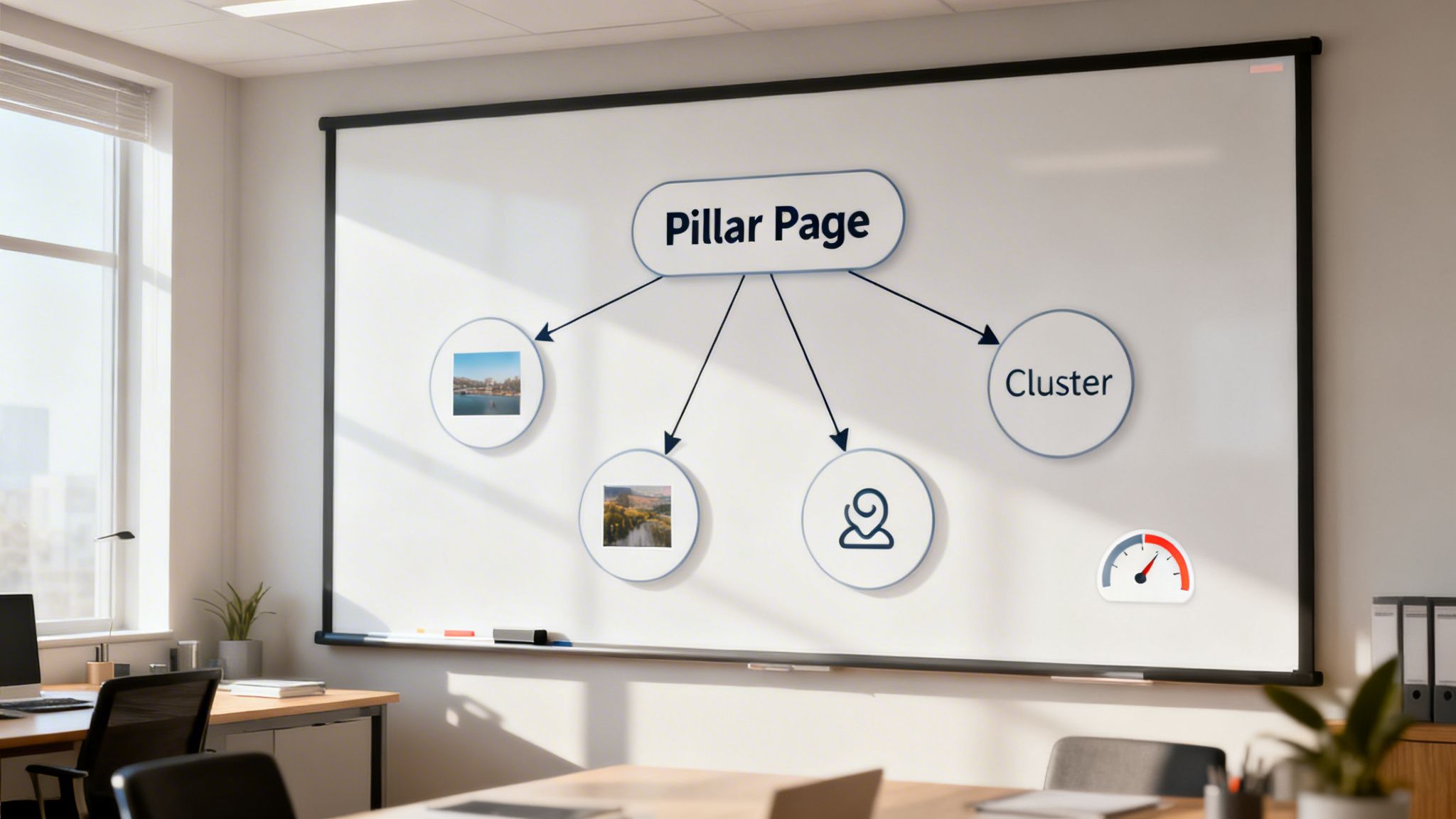
A scattered linking approach just doesn't work. You need a deliberate strategy built around a topic cluster model. Here’s how it breaks down:
- Pillar Page: This is your cornerstone guide on a broad, important topic—like this very article on web content writing. It’s comprehensive but stays at a high level.
- Cluster Content: These are more specific, focused articles that explore a subtopic in detail, like "how to write SEO meta descriptions." Each one links back to your main pillar page.
This structure does more than just organise your content. It signals to Google that you're an authority on the entire topic, not just a few keywords. The pillar acts as a central hub, while the clusters demonstrate the depth of your expertise. It's a far smarter approach than just publishing disconnected blog posts.
A well-planned internal linking strategy doesn't just boost your SEO. It keeps people on your site longer, guiding them to related, helpful information and increasing the chance they'll convert.
Of course, a consistent structure needs a consistent voice. To make sure your writing always reflects your brand’s personality, check out our guide on how to find and use your brand voice and tone.
Get the Technical Details Right for Readability and UX
Technical SEO isn’t just for developers. As a writer, you play a massive role, particularly when it comes to images and site speed. Nothing kills a user's patience faster than a slow-loading page, and massive images are often the biggest culprit.
Before you upload any image, make sure you:
- Compress the file: Use a simple tool to shrink the file size without turning your image into a blurry mess.
- Write descriptive alt text: This is crucial for accessibility and helps search engines understand what the image is about. If you can fit a keyword in naturally, do it.
Your content's structure also directly affects user experience signals like dwell time—how long someone actually stays on your page. We've seen firsthand that regularly updating older content with fresh information can lead to a 111.3% jump in organic traffic. In Australia, where 93% of online experiences start with a search engine, that’s an advantage you can’t afford to ignore.
Finally, every piece of content must have a purpose. A powerful call-to-action (CTA) isn't just tacked on at the end; it's the logical next step. Whether you want your reader to book a demo, download a guide, or make a purchase, your CTA needs to be clear, compelling, and placed right where their interest is at its peak.
Using AI as Your Content Co-Pilot
Let's be honest: in 2026, talking about web content writing for SEO without mentioning AI is like pretending aeroplanes don't exist. It's not a futuristic gimmick anymore; it's a real, practical tool for getting more done. The trick isn't to let AI fly the plane solo, but to treat it like a highly skilled co-pilot.
The real win is blending AI's incredible speed and data-crunching ability with your own irreplaceable human experience. This partnership lets you break through writer's block, publish more consistently, and produce a higher volume of content without letting quality slide.
Brainstorming and Outlining with AI
One of the best ways to get started with AI is right at the beginning, during the ideation phase. Instead of staring at a blank screen, you can feed an AI tool your main keyword and watch the ideas flow.
Imagine your topic is "eco-friendly running shoes." You could ask for:
- Ten blog post titles aimed at people just looking for information.
- A list of the most common questions people ask about sustainable footwear.
- Related subtopics to explore, like "recycled materials," "ethical manufacturing," or "brand comparisons."
Once an idea grabs you, ask the AI to spit out a structured outline. This gives you an instant skeleton for your article, complete with logical H2 and H3 headings. It’s a massive time-saver and helps ensure you’re covering the topic thoroughly right from the start.
Remember, an AI-generated outline is just a starting point, not the final map. It’s your job to refine it, inject your unique point of view, and make sure it lines up perfectly with what your audience actually needs and how your brand speaks.
With a solid foundation, you can start building content that truly connects. To really streamline your workflow and boost your content output, digging into the world of AI powered content creation is a game-changer.
The Human-in-the-Loop Workflow
A common mistake is thinking you can just set AI to "write" and walk away. The truth is, AI tools are notorious for churning out generic, soulless text that’s completely devoid of the E-E-A-T (Experience, Expertise, Authoritativeness, Trustworthiness) signals Google looks for. A much smarter approach is what we call a "human-in-the-loop" workflow.
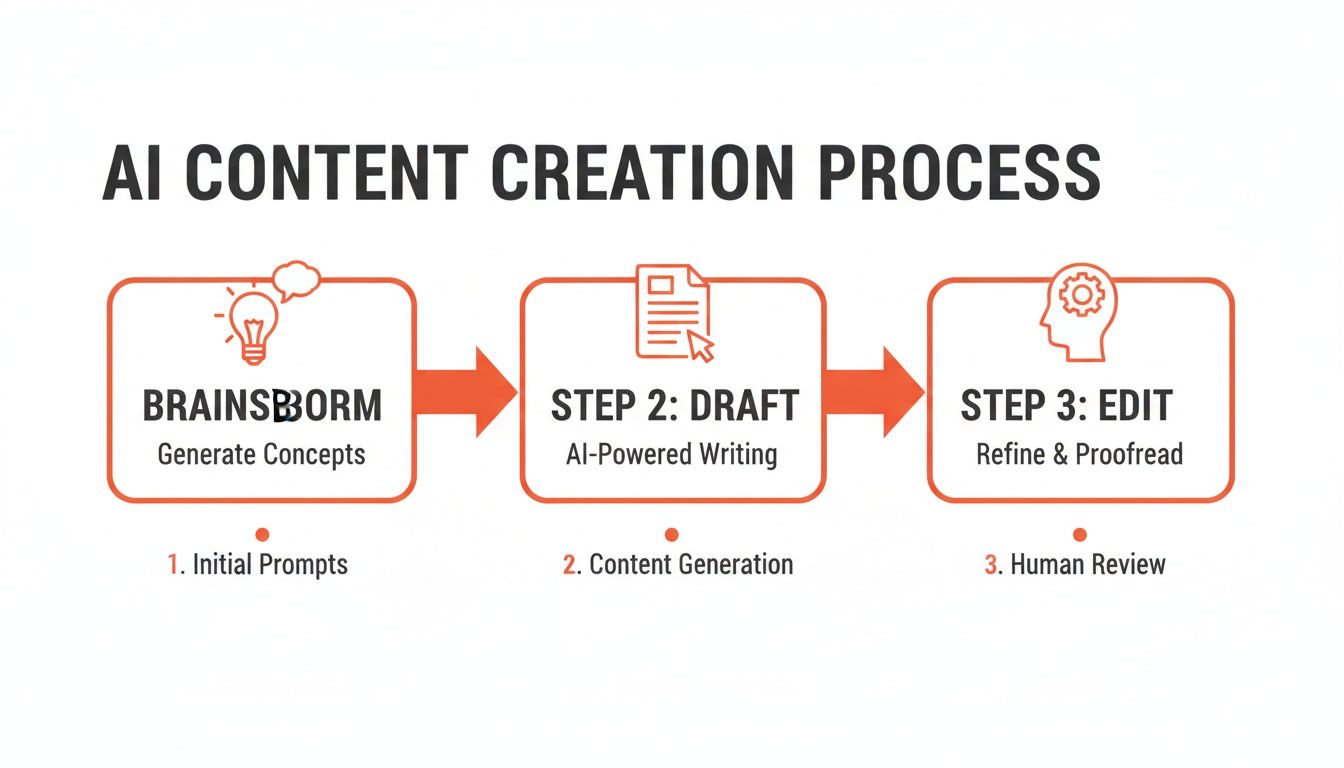
This process starts by letting the AI generate a first draft based on your detailed brief and the outline you've refined. The AI does the heavy lifting, structuring the information and covering the main points. Your role then flips from writer to expert editor.
Your mission is to go through that draft and enrich it with:
- Personal Experience: Weave in real-world stories, case studies, and personal insights that only you have.
- Brand Voice: Rework sentences and phrases until it sounds unmistakably like you.
- Factual Accuracy: Double-check every single fact, statistic, and claim. AI can "hallucinate" and state incorrect information with absolute confidence.
- Deep Expertise: Add the nuance, advanced tips, and insider knowledge that an AI could never replicate.
This method lets you scale up your content production massively while ensuring the final piece is authentic, trustworthy, and genuinely helpful. It’s the best of both worlds—machine efficiency combined with human creativity. If you’re looking to sharpen these skills, you’ll also find value in exploring different approaches to SEO and copywriting.
The Essential Human Editing Checklist
Never, ever publish AI-generated content without a thorough human review. Use this checklist to turn a generic draft into a high-performing asset that gets results.
| Checklist Item | Action Required | Why It Matters |
|---|---|---|
| Fact-Check Everything | Verify every statistic, claim, and statement against a reliable source. | AI invents facts. Getting this wrong destroys your credibility. |
| Inject Brand Voice | Edit for tone, phrasing, and personality. Does it sound like your brand? | Generic content doesn't build a loyal audience or brand. |
| Add Human Stories | Weave in personal anecdotes, customer examples, or your own experiences. | Stories create a genuine connection and prove real experience (E-E-A-T). |
| Check for Plagiarism | Run the text through a plagiarism checker before publishing. | This protects your site from penalties and ensures your content is original. |
| Refine the Flow | Read it aloud. Make sure transitions are smooth and the logic holds up. | AI-written drafts often feel disjointed and robotic. |
By treating AI as a powerful assistant rather than a full-on replacement, you can elevate your web content writing for SEO. You'll be able to produce high-quality articles at a scale that just wasn't possible before.
Measuring Content Performance and Driving Growth
Hitting ‘publish’ isn't the finish line. In fact, when it comes to web content writing for SEO, that's just the beginning. The real work—and the real results—come from what you do after your content goes live. It’s all about measuring what matters and using that data to make smart, iterative improvements.
This is where we move past the feel-good vanity metrics like social shares and start focusing on performance indicators that actually impact your business goals. We're talking about tangible results that contribute to your bottom line.
Moving Beyond Vanity Metrics
To really understand if your content is pulling its weight, you need to track metrics that show genuine engagement and, more importantly, business impact. It’s easy to get distracted by numbers that look good on paper but don't mean much. Let's concentrate on the data points that tell the full story.
Your core focus should be on:
- Organic Keyword Rankings: Are you actually climbing the search results for your target keywords? Use a rank tracker to monitor your position for the terms that matter most.
- Organic Traffic Growth: Is the article bringing more qualified visitors from search engines to your site over time? This is your top-of-funnel proof.
- User Engagement: Look at metrics like time on page and bounce rate. Are people sticking around to read what you’ve written, or are they leaving immediately?
- Conversions: This is the ultimate test. Is your content driving sign-ups, generating leads, or directly contributing to sales?
You can find all of this data inside tools like Google Analytics 4 and Google Search Console. This is the feedback loop you need to justify your content efforts and drive real growth.
The Power of the Content Refresh
Let's be honest: not every article is a home run on the first attempt. That’s perfectly fine, and it’s why the content refresh is one of the most powerful (and underrated) tactics in any content marketer's arsenal. It’s all about identifying underperforming or outdated content and giving it a new lease on life.
Don't just let old posts gather digital dust. A strategic update can be far more efficient and deliver faster results than creating something entirely new from scratch. In fact, updating and republishing old blog posts with fresh content and new images can increase organic traffic by over 100%.
A content refresh isn’t about fixing a few typos. It's a strategic overhaul designed to boost relevance, authority, and performance, ensuring your content remains a valuable asset for years.
Start by digging into your analytics. Look for articles that get a bit of traffic but have low engagement, or posts that used to rank well for valuable keywords but have slipped down the SERPs. These are your prime candidates.
Once you’ve picked a piece to update, it's time to get to work. A proper refresh should include a few key steps to maximise its impact.
- Update and Add New Information: Is the data still current? Have there been industry changes? Add fresh statistics, new insights, and more up-to-date examples to bring it into the present.
- Improve On-Page SEO: Re-evaluate your H1, meta description, and subheadings. Can you better target your primary keyword? Can you weave in more semantic terms you've discovered since the original publish date?
- Enhance Readability and Structure: Break up those long paragraphs. Add new visuals, bullet points, or blockquotes to make the content more scannable and engaging for a modern audience.
- Strengthen Internal Linking: This is crucial. Add new internal links from the refreshed article to newer, relevant content, and find opportunities on other pages to link to your updated piece. This helps spread link equity and better integrates it into your topic clusters.
This data-driven approach is what separates amateur bloggers from professional content marketers. By consistently measuring, analysing, and optimising, you ensure your investment in web content writing for SEO delivers measurable, long-term returns.
Frequently Asked Questions
Once you get your head around the theory of web content writing for SEO, the practical questions start to surface. We get it. Let’s tackle some of the most common ones we hear from clients, giving you the straight-up answers you need to put these strategies into action.
Think of this as the "now what?" part of the guide.
What Is the Ideal Word Count for an SEO Article?
There’s no single magic number here. But in our experience, longer, more comprehensive content almost always outperforms shorter, surface-level pieces. For competitive topics, you should be aiming for at least 1,000 to 2,000 words. This gives you enough room to properly unpack a subject, answer a bunch of related user questions, and naturally weave in a good range of keywords.
But let's be clear: value beats volume every time. Never add fluff just to hit a word count. A sharp, value-packed 1,200-word article will crush a weak and repetitive 2,500-word piece.
The real goal isn't just to write more words; it's to provide the single most complete and helpful answer on the web for that specific search query. Always prioritise depth over sheer length.
How Often Should I Publish New Content?
Consistency is far more important than raw frequency. Publishing one high-quality, deeply researched article every week is infinitely better than churning out three rushed, mediocre posts. The key is to find a realistic schedule you can actually stick to.
For a brand-new site, publishing a bit more frequently, say 2-3 times per week, can help build momentum and get your content indexed faster. Once your site is more established, one excellent, authoritative post per week is a solid target to maintain topical authority and keep your audience coming back.
Can I Use AI to Write My Entire Article?
You can, but you absolutely shouldn't. Relying on AI to write a full article from start to finish is a shortcut to generic, soulless content. It’s the kind of stuff that completely lacks the E-E-A-T (Experience, Expertise, Authoritativeness, Trustworthiness) signals that both Google and your readers are looking for.
Think of AI as a co-pilot, not the pilot. It’s brilliant for:
- Brainstorming topics and creating a rough initial outline.
- Generating a first draft that you then need to heavily edit and rewrite.
- Summarising dense research or just breaking through a stubborn case of writer's block.
Your job is to inject the human element: your unique insights, personal stories, and a genuine brand voice that an AI simply can't fake.
How Long Does It Take to See Results from SEO Content?
SEO is a marathon, not a sprint. It’s a long-term game. While you might see some trickles of traffic within a few weeks, it typically takes a solid 4 to 6 months to see significant, consistent results from a new content strategy.
Several factors will influence this timeline:
- Your website’s current authority and backlink profile.
- How competitive your target keywords are.
- The quality and consistency of your content production.
Patience and persistence are non-negotiable. The leads and traffic you get from a well-ranking article will continue to pay dividends for years, making the initial wait well worth it.
Speaking of questions, a well-built FAQ page is an SEO powerhouse in its own right. For a deeper dive, this guide on how to create an FAQ page is a great resource for answering customer queries and boosting your search visibility.
Ready to stop guessing and start ranking? Click Click Bang Bang specialises in data-driven, AI-first SEO strategies that deliver measurable results. Let us build a content engine that drives traffic and conversions for your business. Find out more at https://clickclickbangbang.com.au.
Read NeXt
Or Read Our Latest
- Manual vs Automated Bidding for PPC Success
- Conversion Tracking Setup: A Complete AU Guide
- Instagram Advertising Australia: Complete 2026 Guide
- Pay Per Click: A Beginner’s Guide for Australian Marketers
- Display Advertising on Google: The Complete Australian Guide
- Stakeholder Communication Plan How to Build One That Works
Click. CLick. Subscribe.
Get our best PPC insights, industry updates, and power moves delivered straight to your inbox. No fluff, just high-caliber strategies that actually work.
Don’t Leave Just Yet
Try Us For 30-Days,
Risk Free!!
We guarantee that you’ll love our work within the first 30 days, if not you’ll get your money back.
What have you got to lose?