

Scaling Your Agency With SEO White Label Software
Last Updated

Ever felt that pressure to expand your agency's services? You know you need to offer a full suite of SEO—the kind with deep-dive audits and slick client reports—but the thought of building the tech and hiring a specialised team from scratch is just overwhelming. What if you could add it all to your menu, overnight?
That's the promise of SEO white label software.
What Is SEO White Label Software
At its core, SEO white label software is a fully-developed, powerful SEO platform that your agency can rebrand and sell to clients as your very own. It's like having an entire R&D department and a team of software engineers working for you in the background, but your clients only ever see your name and your branding on the final product.
This is a game-changer for agencies looking to scale fast. Instead of sinking huge amounts of time and money into developing your own proprietary tools, you're essentially licensing a proven, battle-tested platform. This move instantly bolsters your service offering with sophisticated features that clients are looking for, such as:
- Comprehensive website audits
- Accurate keyword rank tracking
- Detailed competitor analysis
- Customisable, brandable client reporting dashboards
The whole process is incredibly straightforward. Your agency uses the unbranded software to run the analysis and generate reports, which you then deliver to your clients under your own logo.
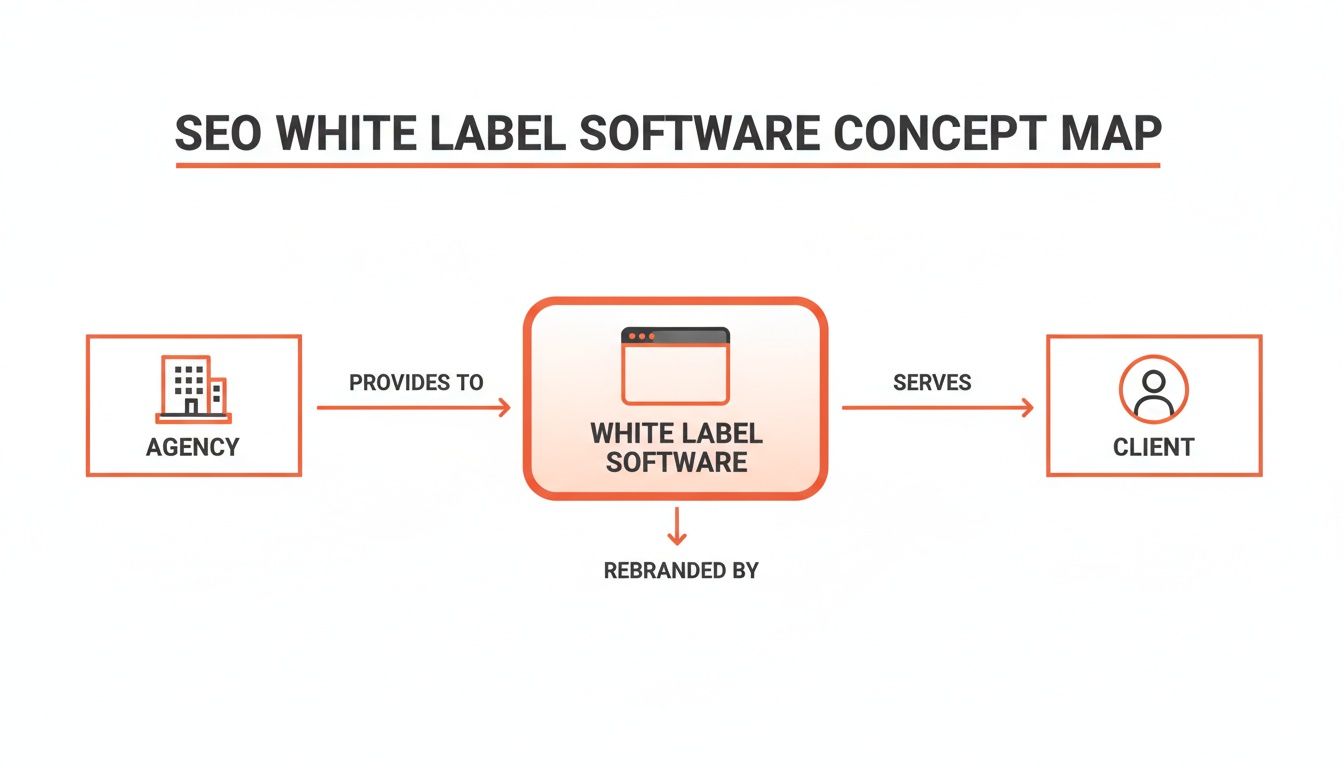
It’s all about achieving instant credibility and scalability while keeping your brand front and centre for every client interaction.
The Core Value for Growing Agencies
The biggest win here is getting to shift your focus from software development to what you do best: client strategy, relationships, and growth. The Australian digital marketing software market is exploding—it was valued at USD 1.95 billion in 2025 and is on track to hit USD 3.21 billion by 2030. A lot of this growth is fuelled by SMEs, especially with government grants that can reimburse up to 50% of software costs, making these powerful tools more accessible than ever.
By using a white label solution, an agency can immediately compete with larger firms, offering enterprise-level tools without the enterprise-level overhead. It democratises access to powerful technology.
This model isn't just for SEO, either. You can see the same principle at play with services like white label WordPress support, where agencies scale their offerings by partnering with specialists. For a digital agency, being able to rebrand and resell these tools lets you deliver a seamless, professional experience that builds client trust and makes your own operations a whole lot simpler.
If you’re keen to explore this further, you might want to check out our deeper dive into white label SEO.
Essential Features of a Winning Reseller Platform
Not all white label SEO platforms are built the same. Choosing the right one is like picking the engine for your agency’s race car—your selection directly impacts your speed, reliability, and ultimate ability to win the race for your clients. So, once you understand what these tools are, the next logical step is to pinpoint what a truly winning platform must have.

Think of the foundational features as your absolute non-negotiables. These are the core functions that let you do your job and, just as importantly, prove its value. Any platform worth your time has to deliver a solid suite of SEO tools covering the absolute essentials.
This means comprehensive site audits to unearth technical gremlins, precise rank tracking across different search engines and locations, and deep backlink analysis. Without these, you’re basically flying blind. Detailed site audits, for instance, are the bedrock of any solid SEO strategy. If you want to get a better handle on this, learning more about technical SEO audits will give you some great context on what to look for.
True White Label Customisation
The real magic of a reseller platform is in its customisation. Just slapping your logo on a generic PDF report doesn’t cut it anymore. A top-tier platform provides true white-labelling, giving you the power to craft a completely seamless and professional client experience from top to bottom.
This means you should be able to:
- Use your own custom domain: Your clients should be logging into a portal like
app.youragency.com.au, not the provider’s generic URL. - Fully brand the interface: The dashboard, reports, and client portal should all reflect your agency’s logo, colour scheme, and fonts.
- Remove all provider branding: There should be no "Powered by" footers or sneaky mentions of the original software anywhere your client might see.
A truly white-labelled platform makes it look like you’ve developed your own proprietary software. This builds immense client trust and reinforces the value of your brand with every single interaction.
Strategic Integrations and Client Management
An effective SEO white label software doesn't work in isolation. It needs to be the central nervous system of your data, pulling information from other crucial marketing tools to paint a complete picture of performance.
This is where robust integrations are absolutely essential. Look for platforms that connect effortlessly with:
- Google Analytics (GA4): To connect your SEO efforts directly to website traffic and user behaviour.
- Google Search Console: For vital data on clicks, impressions, and keyword performance straight from the source.
- CRM and Ad Platforms: To link SEO results with lead generation pipelines and paid campaign data.
On top of that, strong client management features are a must-have. The platform should give you a multi-project dashboard where you can oversee all your accounts from one central spot, with clear separation between clients and flexible user permissions. This keeps your operations organised and secure as your agency grows. Giving clients their own branded login to a dashboard where they can track their progress is an incredibly powerful retention tool.
Telling a Compelling Story With White Label Reporting
Let’s be honest: raw data is just noise. Your clients don't want a spreadsheet full of numbers and charts. Without context, it means very little to them. This is where your agency’s real value shines, and the right SEO white label software is your most powerful storytelling tool.
Great reporting moves beyond vanity metrics like raw traffic or a list of keyword positions. It’s about connecting your SEO activities to what clients genuinely care about: leads, sales, and a tangible return on their investment. Your job is to translate complex data into a compelling narrative of success, and that’s exactly what white label reporting features are designed to help you do.
From Data Points to Business Impact
The most effective reports tell a story. Instead of just showing a list of ranking improvements, you can paint a much clearer picture. You can showcase how those new rankings for high-intent keywords led directly to a 25% increase in qualified leads through a specific contact form. Now that’s a story a business owner wants to hear.
A report shouldn't just be a record of what happened; it should be a strategic document that proves your worth. It’s the bridge between your agency's work and the client's business goals, turning abstract metrics into a clear story of growth.
A winning reseller platform should also give you the tools for in-depth competitor analysis. This is crucial for both strategic planning and client reporting. It allows you to frame your wins within the competitive landscape, showing clients not just that they're growing, but that they are actively outperforming their rivals.
Automating and Customising Your Narrative
Manually building these stories for every client, every month, is incredibly time-consuming. This is where the automation and customisation features of white label software become absolutely critical.
- Automated Report Scheduling: You can set up branded reports to go out automatically—weekly or monthly—ensuring consistent communication without all the manual grunt work.
- Custom-Branded Templates: Create unique report templates for different client types. An e-commerce store cares about different metrics than a local service business, and your reports should reflect that.
- Holistic Performance Views: Pull in data from other channels, like their PPC campaigns, to present a unified view of marketing performance. This shows exactly how SEO contributes to the bigger picture.
In the competitive Australian digital marketing space, for example, white label SEO reseller services are a complete game-changer, enabling agencies to scale without needing massive in-house teams. As marketing managers demand more data-driven transparency, this model fuels growth for startups and established brands alike. You can read more about these insights for the Australian market on marketerscenter.com.
Ultimately, transforming raw numbers into a narrative of success is what builds trust, justifies your fees, and dramatically improves client retention. For more inspiration on how to visualise this, check out these marketing KPI dashboard examples that effectively tell a story with data.
Building a Profitable SEO Reseller Business Model

Choosing the right SEO white label software is just the first domino to fall. The real challenge—and where the profit lies—is building a smart business model around it. You need to stop thinking of the software as another monthly expense and start seeing it as a strategic investment. The financial structure you build will make or break its success, so it pays to get this right from day one.
The first piece of the puzzle is getting your head around your provider's pricing. Most platforms stick to a couple of common models, and each one has different implications for your agency’s cash flow and ability to scale.
- Per-Client or Per-Project Fees: This is a pay-as-you-grow model. You’re charged a set fee for each client or project you run through the platform. It’s straightforward, and your costs scale directly with your revenue.
- Tiered Subscriptions: You pay a flat monthly or annual fee for a package that covers a certain number of clients, projects, or features. This model offers predictable costs and can be more economical if you have a stable roster of clients.
Which one is for you? If you’re a newer agency just getting started, the per-client model helps keep those initial outgoings low. But for a more established agency with a full dance card, a fixed-price tiered subscription will almost certainly offer better value.
Structuring Your Client-Facing Pricing
Once you’ve got your own costs sorted, the real work begins: deciding how to price your services for your own clients to bake in a healthy profit margin. This isn't just about slapping a standard markup on top. It’s about packaging your services in a way that screams value and makes your offering a no-brainer.
The most profitable agencies don't just resell a service; they integrate it. They create irresistible service bundles that combine white label SEO with their existing core offerings, like web design or PPC management.
This approach flips the script, positioning SEO not as some optional extra, but as an essential part of a complete digital marketing solution. For example, some partners have found that by integrating white label SEO with their PPC services, they can slash campaign costs by 40%. This allows them to offer comprehensive, custom-priced packages starting from $1,500/month while delivering brilliant, holistic campaigns.
The results speak for themselves. These partners pocket a significant markup, and their clients see tangible outcomes—like ranking improvements of 15-25 positions within a few short months—all tracked transparently through their branded portal. You can find more details about these kinds of white label SEO partnerships on fourdots.com.
Think about creating tiered packages to cater to different client budgets and needs. A basic tier could offer essential rank tracking and monthly reports, perfect for local businesses. A premium tier, on the other hand, might include deep competitor analysis, backlink monitoring, and strategic consultations for larger enterprise clients.
By intelligently marking up your services and building these value-packed bundles, you transform your SEO offering from a simple line item into a major revenue engine for your agency.
Ensuring a Smooth Onboarding for Your Team and Clients
You’ve just invested in a powerful new SEO white label software. That’s great, but even the best platform is just expensive shelf-ware if your team can’t use it or your clients don’t see the value. A smooth rollout is everything. The goal here is to get your team and clients up and running with minimal friction, turning that new software investment into a revenue-generating part of your agency as fast as possible.
The first move is always internal. Before you even dream of showing this to a client, your own team needs to live and breathe the platform. This means getting their hands dirty with the core features, understanding what it can do, and just as importantly, what it can't.
Think of it as a two-pronged attack. Your account managers need to become absolute wizards at navigating the dashboard, pulling reports, and making sense of the data. At the same time, your sales team has to learn how to weave the platform's features into their pitch, transforming them from a list of functions into compelling reasons why a prospect should sign with you.
Initial Platform Setup and Branding
Once your team is up to speed, it’s time to make the software look and feel like it’s yours. This is where the “white label” part really comes to life. A proper setup makes sure every report, every dashboard, and every client login screams your brand, not the software provider’s.
Here's your initial setup checklist:
- Apply Your Branding: Get your agency’s logo uploaded, set your brand colours, and tweak the platform’s appearance to match your visual identity.
- Configure a Custom Domain: Swap out the generic software URL for a branded one that instils confidence, like
portal.youragency.com.au. - Connect Client Accounts: Start linking your first few client websites and connecting their essential data feeds like Google Analytics and Search Console.
- Run Initial Audits: Fire up the software and run the first site audit for each client. This gives you an immediate performance baseline and a stack of data to start working with.
A Proven Client Onboarding Process
With the platform branded and your team trained, you're ready to bring your clients on board. A structured, hands-on process is key to avoiding confusion and demonstrating the value you deliver right out of the gate. Whatever you do, don't just email them a login and wish them luck.
Your client onboarding process is more than a technical walkthrough. It's your first opportunity to reinforce your agency's commitment to transparency and data-driven results, setting the tone for the entire partnership.
Book a dedicated onboarding call to personally walk them through their new, custom-branded dashboard. Show them their initial performance report, but don't just point at graphs. Explain what each metric means in the context of their business goals. This guided tour transforms the dashboard from a bunch of complicated charts into their personal window into SEO success, building trust and excitement from day one.
Common Pitfalls When Reselling SEO Services

Jumping into SEO reselling can be a game-changer for your agency, but real success often comes from knowing which traps to sidestep. It’s a well-trodden path, and many agencies stumble not from a lack of effort, but by falling for a few predictable mistakes. Spotting them early can be the difference between a thriving new revenue stream and a client management nightmare.
One of the most common blunders is overpromising on results. You see a flashy demo of an SEO white label software, get excited, and start guaranteeing clients page-one rankings in a month. This almost always backfires, eroding trust when those ambitious promises inevitably fall short.
Focusing on Price Over Partnership
Another huge pitfall is choosing a software provider based purely on the price tag. While budget is always a factor, picking the cheapest option without digging into the quality of their support, data accuracy, or platform stability is a recipe for disaster.
That low-cost tool becomes a major liability the first time a report fails to generate minutes before a big client meeting. A true partnership goes way beyond the software itself.
You should be evaluating:
- Quality of Support: How fast and how knowledgeable is their support team when you’re in a jam?
- Training and Resources: Do they offer solid training to get your team up to speed and using the platform like pros?
- Product Roadmap: Is the provider actually investing in the software and keeping up with industry shifts, like the impact of AI search?
The goal is to find a provider that feels like an extension of your own team, not just another line item on your expense report. Their reliability is your reliability, so prioritising quality and support over saving a few dollars is a smart long-term move.
Neglecting Integration and Communication
Finally, many agencies fail by treating their new SEO offering like a separate, siloed service. They bolt it on but never truly integrate it into the agency's DNA. This is a classic mistake.
Suddenly, you have account managers who can't speak confidently about SEO and sales teams who have no idea how to bundle it effectively with your other services. This disconnect creates chaos.
It almost always leads to poor communication, both inside your team and with your clients. When your own people aren't on the same page, client expectations get blurry, and the value of your SEO work gets lost in translation. Building strong, trust-based client relationships depends on a proactive strategy for setting realistic goals and maintaining total transparency. That’s what turns a one-off project into a long-term partnership with recurring revenue.
Frequently Asked Questions About SEO Reselling
Dipping your toes into the world of SEO reselling? You're not alone. Agencies often have a handful of questions, whether they're just starting out with SEO white label software or looking to fine-tune an existing partnership. Getting clear on these points is the first step to building a confident and profitable service offering. Let’s tackle some of the most common queries.
The first question you'll inevitably get from a client is, "How long until we see results?" It's absolutely vital to set realistic expectations from day one. While some quick wins might pop up, real, meaningful SEO progress is a marathon, not a sprint.
As a general rule, clients can expect to see noticeable movement in their rankings and traffic within 3 to 6 months as the strategies really begin to take hold.
Is Reselling SEO an Ethical Practice?
Absolutely. Reselling SEO services is a completely standard and ethical industry practice. Think of it like a head contractor on a building site who brings in specialised electricians or plumbers to get the job done right.
Your agency owns the client relationship and the big-picture strategy. The white label provider simply acts as your expert execution team, delivering the technical work under your brand. This partnership model allows you to offer top-tier services you might not have the resources for in-house, ensuring clients always get high-quality work. Transparency isn't about revealing your provider; it's about the value you deliver in managing the entire process and driving results under your trusted brand name.
The core value of white label platforms is complete brand customisation. The entire point is to present a seamless, professional front where your clients only ever see your logo, colours, and domain.
Pricing and Branding Your Services
This brings us to branding. Can you actually put your own branding on everything? Yes, that’s the main drawcard. A genuine white label solution allows you to replace every trace of the provider's branding with your own, from the client login portal right through to the monthly PDF reports.
So, how should you price these newly branded services? There's no one-size-fits-all answer here, but a common and effective strategy is to bundle SEO with your other digital marketing offerings. First, figure out your hard cost from the white label provider. Then, apply a healthy markup that truly reflects the strategic value, account management, and expert reporting your agency provides on top.
Ready to build a more profitable and scalable agency? Click Click Bang Bang specialises in data-driven SEO and PPC strategies that deliver real results. Learn how our tailored approach can help you grow by visiting us at https://clickclickbangbang.com.au.
Read NeXt
Or Read Our Latest
- Manual vs Automated Bidding for PPC Success
- Conversion Tracking Setup: A Complete AU Guide
- Instagram Advertising Australia: Complete 2026 Guide
- Pay Per Click: A Beginner’s Guide for Australian Marketers
- Display Advertising on Google: The Complete Australian Guide
- Stakeholder Communication Plan How to Build One That Works
Click. CLick. Subscribe.
Get our best PPC insights, industry updates, and power moves delivered straight to your inbox. No fluff, just high-caliber strategies that actually work.
Don’t Leave Just Yet
Try Us For 30-Days,
Risk Free!!
We guarantee that you’ll love our work within the first 30 days, if not you’ll get your money back.
What have you got to lose?