

What is a good cost per click – what is a good cost per click guide to ad spend
Last Updated

"What's a good cost per click?""What's a good cost per click?" It’s a question every advertiser asks, but the answer isn't a single magic number. The best CPC is one that actually drives profitable growth for your business.
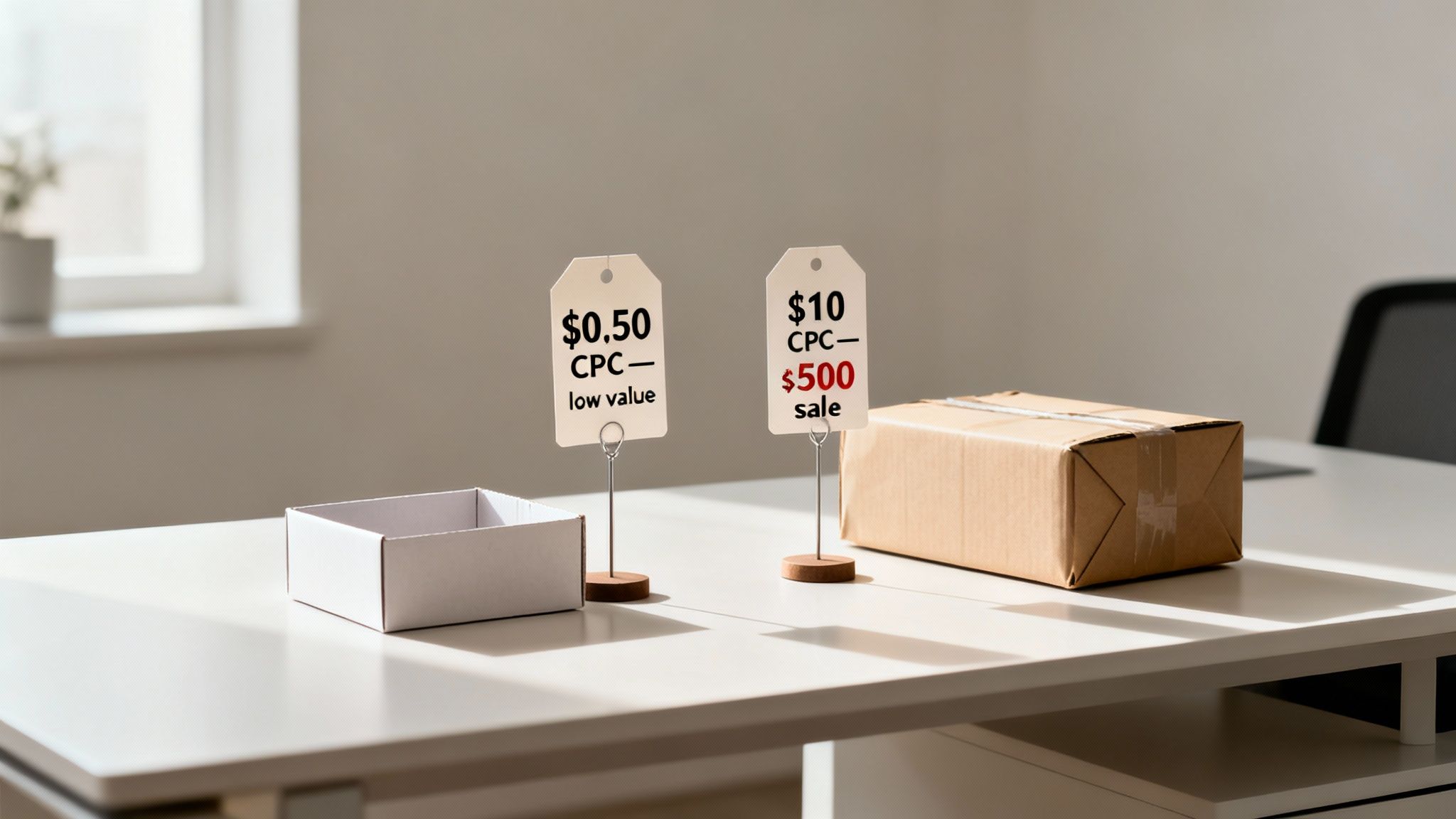
Think of it this way: a $10 CPC that leads to a $500 sale is infinitely better than a $0.50 CPC that brings in zero revenue. The real goal isn't just cheap clicks; it's profitable clicks.
Why a Good CPC Is More Than Just a Number
It’s easy to get fixated on finding the lowest possible cost per click, chasing the cheapest traffic you can find. This is a common and costly mistake. The right question isn’t “what’s a good CPC?” but rather “what’s a profitable CPC for my business?” The answer is completely relative to your specific goals, profit margins, and industry.
Viewing CPC as just another expense misses the bigger picture. It’s a strategic investment in acquiring new customers. A higher CPC might be what it takes to attract a high-intent user who’s ready to pull out their credit card, while a rock-bottom CPC might only bring in casual browsers with no intention of buying.
When you focus only on minimising cost, you often end up attracting low-quality traffic that never converts. You’re essentially wasting your budget on clicks that generate zero return.
The goal is not to win the award for the cheapest clicks. The goal is to build a sustainable and profitable business by acquiring customers at a cost that makes sense for your bottom line.
Platform Benchmarks Are a Starting Point, Not a Finish Line
To give you some context, CPCs vary wildly across different advertising platforms and industries. A click on a professional network like LinkedIn is naturally going to cost more than a click on a visual-first platform like Instagram. Understanding these general ranges helps set realistic expectations before you launch a campaign.
But remember, these are just averages. Your actual costs will be shaped by dozens of factors we’ll dive into later, like ad quality, competition, and audience targeting.
To give you a baseline, here's a quick look at typical CPC ranges you might see across major platforms in Australia.
Australian Digital Ad Platforms at a Glance
| Platform | Average CPC Range (AUD) | Best For |
|---|---|---|
| Google Search Ads | $2.00 – $4.00 | High-intent lead generation and e-commerce sales |
| Google Display Ads | $0.50 – $2.00 | Brand awareness and retargeting campaigns |
| Facebook Ads | $1.50 – $2.50 | Audience engagement and targeted e-commerce |
| Instagram Ads | $1.00 – $3.00 | Visual product marketing and brand building |
| LinkedIn Ads | $5.00 – $9.00+ | B2B lead generation and professional services |
These figures are a handy guide, but don't get too attached to them. The single most important takeaway is this: a "good" CPC is one that fits profitably into your unique business model.
The Hidden Forces Driving Your Ad Costs

If you've ever watched your cost-per-click swing wildly from one day to the next, you know how unpredictable ad pricing can feel. But it's not random. There are powerful, often hidden, forces constantly at play.
Understanding these factors is the first step toward taming your ad spend and figuring out what a "good" CPC actually means for you.
At the heart of platforms like Google Ads is a concept called Ad Rank, which determines where your ad appears and, crucially, how much you pay for a click. Think of it less like a bidding war and more like a 'relevance competition'. Your Ad Rank is calculated by multiplying your maximum bid by your Quality Score.
A high Quality Score is Google's way of telling you your ad and landing page are a great match for what someone is searching for. It’s the platform rewarding advertisers who create a genuinely good user experience.
In this competition, relevance is your superpower. A high Quality Score can earn you a better ad position for a lower price than a competitor with a bigger budget but a less relevant ad.
That's right—you can effectively get a discount on your clicks just by being the best answer to a user's question.
The Impact of Competition and Industry
Your industry has a massive influence on your CPC. If you're in a highly competitive market like legal services or finance, you're jumping into a bidding war against businesses all fighting for the same high-value customers.
It's why keywords like "personal injury lawyer" can cost a fortune. A single new client can be worth tens of thousands of dollars, so the bids reflect that.
On the other hand, industries with lower customer lifetime values—like apparel or retail—tend to have much lower CPCs. For example, the average CPC for legal services on Google Ads can soar over $6.75, while e-commerce enjoys an average closer to $1.16. It all comes down to simple supply and demand for a user’s attention.
Seasonality and Other Market Dynamics
Your ad costs also move with the rhythm of the market. Seasonality can cause dramatic CPC spikes as competition heats up around major holidays and shopping events. A click for "running shoes" in November will almost certainly cost more than it does in March, thanks to the frenzy of Black Friday and Christmas shopping.
Beyond these big seasonal trends, other factors create a constantly shifting pricing landscape:
- Geography: Targeting users in a major city like Sydney will typically be more expensive than in a smaller regional town simply due to higher competition.
- Device Targeting: Mobile clicks can sometimes be pricier, especially for local searches where user intent is high, like "plumber near me".
- Ad Network: Clicks on the Google Search Network (where users are actively searching for something) are almost always more expensive than on the Display Network (where ads appear on websites and apps).
By diagnosing these forces, you can shift from just reacting to high costs to proactively managing them. You start to see not just problems, but opportunities to find greater efficiency.
Decoding Google Ads CPC Benchmarks in Australia
When you strip away the global averages, what does a good cost-per-click look like right here in Australia? Before you spend a single dollar, it’s worth getting a realistic financial snapshot, and for that, we look at Google Ads—the undisputed king of high-intent search.
The first thing to understand is that CPCs are not created equal. A click for a commercial lawyer in Sydney will always cost dramatically more than one for a custom t-shirt business in Perth. This isn't a glitch in the system; it’s a direct reflection of value.
Why Do Industry Averages Vary So Much?
It really boils down to competition and potential payoff. In high-value industries, where a single new client could be worth tens of thousands of dollars, businesses are more than willing to bid aggressively for a click that might lead to that conversion. This simple economic principle drives the massive cost differences you see across the board.
On the flip side, you have e-commerce businesses. They often work with much thinner profit margins on each sale but chase a higher volume of transactions. For them, keeping CPCs low isn't just a goal; it's essential for survival and profitability on every item sold.
The key isn't to be terrified of a high CPC in a competitive market. It's about understanding the potential return on that investment and building a campaign that can profitably convert those expensive clicks.
So, what are the numbers? For Google Ads in Australia, a typical CPC for most industries falls somewhere between AUD 2 and AUD 4. This range is often the sweet spot for driving decent traffic without burning through your budget.
But this average hides some wild variations. Hyper-competitive sectors like insurance and legal services can see clicks skyrocket to AUD 50 or more. Meanwhile, many e-commerce stores can happily secure clicks for around AUD 1.82. The full research provides a more detailed breakdown of the average Google Ads costs in Australia.
Putting Australian CPC Benchmarks into Perspective
Knowing the numbers is one thing; applying them is another. Think of these benchmarks as a guidepost, not a rigid rule. They’re there to help you set an achievable initial budget and get a feel for the competitive heat in your market.
Instead of chasing the lowest possible cost, a much smarter approach is to focus on the quality of the conversion.
Here’s how to think about it based on your business type:
- High-Value Services (e.g., Legal, Finance): Your goal is to find the most qualified leads, period. A higher CPC is perfectly acceptable if it brings in users with genuine, urgent needs who are far more likely to become high-value clients.
- E-commerce and Retail: Efficiency is the name of the game. You need to be laser-focused on optimising for a low CPC while maintaining a strong conversion rate to protect your profit margins on every single sale.
- B2B Lead Generation: This is often a long game. A higher upfront CPC might be a necessary investment to capture a lead that could blossom into a lucrative, long-term partnership months down the track.
Ultimately, your industry's benchmark CPC gives you the context, but it's your own business metrics that define what’s truly a "good" cost. For a deeper dive, check out our complete guide on Google Ads benchmarks by industry.
Navigating CPC on Facebook and Social Media
When you move from the high-intent world of search engines to the discovery-driven feed of social media, you need a different mindset. On platforms like Facebook and Instagram, a good cost per click isn't just about bidding on the right keywords; it’s about earning someone's attention.
Here, the quality of your ad creative and the precision of your audience targeting are the two biggest forces driving your costs.
Unlike search ads, which capture existing demand, social media ads have to interrupt someone's scrolling. Success means creating an ad so compelling it stops them in their tracks. A killer video, a stunning image, or copy that speaks directly to a niche audience will be rewarded by the algorithm with a lower CPC and better reach.
This means a generic ad blasted to a broad audience will almost always cost you more—and deliver less—than a super-relevant ad shown to a smaller, more interested group. Social media advertising is a game of relevance, not just reach.
Social Media CPCs in the Australian Market
So, what should you actually expect to pay? In 2025, a solid benchmark for Facebook advertising in Australia is a cost per click of around AUD 2.10 on average. But that number is just the starting line.
The real measure of a ‘good’ CPC on social is how it connects back to your business goals. It’s all about the outcome.
To get practical, here are some outcome-based benchmarks for different campaign goals:
- E-commerce: A target cost per sale between AUD 20 and AUD 50 is a healthy range to aim for.
- Lead Generation: Aiming for AUD 10 to AUD 30 per qualified lead is a strong target.
- Local Businesses: Securing actions like bookings or calls for AUD 5 to AUD 20 shows your campaign is well-optimised.
On social media, your ad isn't just competing with other ads; it's competing with photos of a friend's new puppy and updates from family. Your creative must be good enough to win that battle for attention.
Ultimately, your campaign objective dictates what a good CPC looks like. A brand awareness campaign might happily accept a higher CPC if it’s generating massive reach. A direct sales campaign, on the other hand, has to keep costs low to protect its profit margins.
For a deeper dive into these costs, it’s worth exploring a detailed breakdown of how much Facebook advertising costs based on different objectives. Aligning your ad spend with tangible business outcomes is the key to mastering social media ads.
Calculate Your Own Profitable CPC
Enough with the industry averages. It's time to stop guessing what a good cost per click is and start calculating what a profitable CPC looks like for your business. This is where you turn CPC from a confusing expense into a powerful growth lever. The right number isn't hiding in some benchmark report; it's buried in your own business data.
The whole idea is pretty simple: you need to work backwards from what a new customer is actually worth to you. Once you get a handle on your profit margins and conversion rates, you can set a maximum CPC that pretty much guarantees every click is a worthwhile investment. This approach takes all the emotion and guesswork out of your bidding strategy.
This social CPC process flow shows the key stages, from hammering out the creative to engaging with your audience.
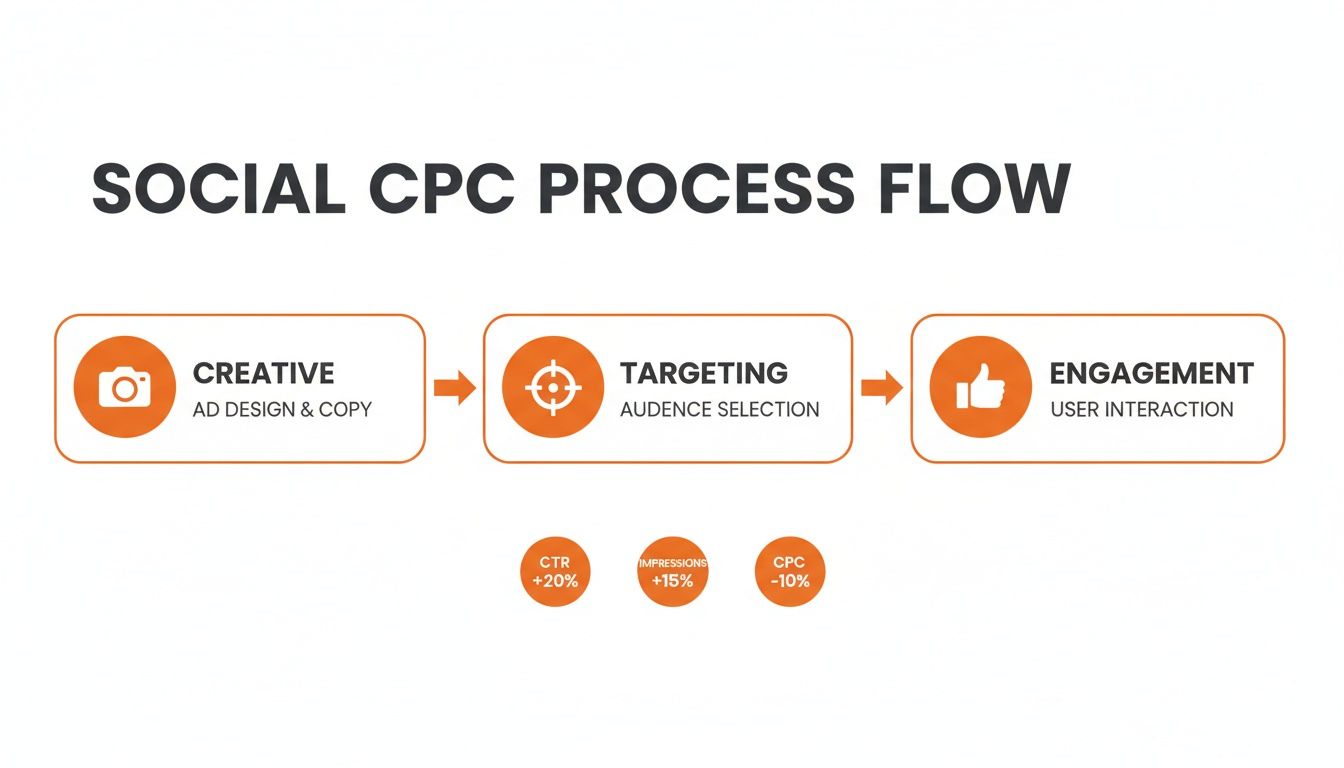
As the flow highlights, a lower CPC is almost always the result of killer creative, laser-focused targeting, and high user engagement—not just setting a low bid and hoping for the best.
The Maximum CPC Formula
At its core, the formula to figure out your break-even or profitable CPC is straightforward:
Maximum CPC = (Average Profit per Sale) x (Website Conversion Rate)
Let's break this down with a real-world example. Imagine you run an e-commerce store that sells custom leather goods.
To work out your max CPC, you'll need two key numbers from your business. First up is your Average Profit Per Sale. Let's say your average order value (AOV) is $150. If your profit margin is 40%, then your average profit per sale is $60 ($150 x 0.40). This is the absolute most you can spend to get a customer and still break even.
Next, you need your Website Conversion Rate. Dive into your analytics. If for every 100 visitors to your website, two of them end up making a purchase, your conversion rate is 2% (or 0.02).
Now, you just plug those numbers into the formula:
- Maximum CPC = $60 (Profit) x 0.02 (Conversion Rate)
- Maximum CPC = $1.20
This quick calculation tells you that you can bid up to $1.20 per click and stay in the black. If you start bidding any higher, you’re officially losing money on every new customer you bring in through that ad. Of course, you can always tweak this based on the profit margin you're aiming for.
Example Target CPC Calculation for an E-commerce Business
Here’s a table that lays out the calculation step-by-step, making it easy to follow along with your own numbers.
| Metric | Value/Formula | Explanation |
|---|---|---|
| Average Order Value (AOV) | $150 | The average amount a customer spends in one transaction. |
| Profit Margin | 40% | The percentage of revenue that is actual profit after costs. |
| Average Profit per Sale | $150 x 0.40 = $60 | This is your break-even Cost Per Acquisition (CPA). |
| Website Conversion Rate | 2% (or 0.02) | The percentage of website visitors who make a purchase. |
| Maximum CPC | $60 x 0.02 = $1.20 | The highest you can bid per click to remain profitable. |
By walking through this process, you’ve moved from a vague 'industry average' to a concrete, data-backed number that’s tailored specifically to your business's financial health.
How Does Your Number Stack Up?
Once you have your own target CPC, it’s helpful to see how it compares to the wider market. For mixed-platform ads in Australia in 2025, you'll be benchmarking against medians like Facebook's AUD 2.10 and Google's AUD 2-4. In this environment, a CPC under AUD 3 usually signals strong performance for both e-commerce and service-based businesses.
Having accurate sales forecasting is a cornerstone for determining what a truly profitable CPC looks like for your business, as it provides the revenue targets that your ad spend is measured against.
Your calculated CPC is your truth. While industry benchmarks provide context, your own data dictates your strategy. A CPC of $2.50 might be a disaster for one business but a huge success for another.
For those who want to dive even deeper into profitability metrics, our return on ad spend calculator can give you some extra clarity. When you ground your bidding strategy in your own financial reality, you empower yourself to build campaigns that aren't just running, but are genuinely profitable.
Proven Strategies to Lower Your Ad Spend
Knowing your target CPC is half the battle. The other half? Actively working to beat it. The goal isn't just to slash your budget indiscriminately; it's about making every single dollar you spend work harder for your business. It's about efficiency.
The great news is that ad platforms want to reward you for good advertising. By putting a few proven strategies into practice, you can cut down on wasted spend, dial in your campaign performance, and hit a cost per click that’s not just 'good,' but genuinely profitable.
Boost Your Quality Score
If you're on a platform like Google Ads, your Quality Score is the single most powerful lever you have for bringing costs down. Think of it as Google’s report card on your ads. A high score tells them your ad is highly relevant to what a user is searching for, and they'll reward you with a discount on your CPC and a better ad position.
The secret to a high Quality Score is alignment. Focus on creating tight-knit ad groups where your keywords, ad copy, and landing page are all perfectly in sync. If someone searches for "women's black running shoes," your ad needs to talk about them, and the landing page should show them right away. This seamless journey is what pushes your score up and your costs down.
Master Your Keyword Strategy
A scattergun approach to keywords is one of the fastest ways to burn through your budget. To really tighten up your targeting and lower your CPC, you've got to be more strategic.
- Embrace Long-Tail Keywords: Instead of duking it out on expensive, broad terms like "shoes," get specific. Target longer phrases like "waterproof trail running shoes for wide feet." These keywords have way less competition (which means lower CPCs) and are used by people who are much, much closer to making a purchase.
- Use Negative Keywords: Actively build and maintain a list of negative keywords to stop your ads from showing up for irrelevant searches. If you sell premium leather shoes, you'd add terms like "cheap," "discount," and "free" to your negative list. This stops you from paying for clicks from users who were never going to convert anyway.
Every irrelevant click you prevent is a direct saving to your bottom line. A well-maintained negative keyword list is one of the most effective cost-control tools at your disposal.
Continuously Test and Refine
The best advertisers are relentless testers. Never assume your first ad creative or audience segment is the best it can be. A/B testing is your best friend here—it's the simple process of running two similar ads against each other to see which one performs better.
You can test just about anything:
- Headlines: Does an urgent headline get more action than one that highlights a key benefit?
- Images/Videos: Does a lifestyle photo connect better than a clean product shot?
- Calls-to-Action (CTAs): Does "Shop Now" outperform "Learn More"?
Even small improvements from consistent testing add up to significant savings over time. To truly get the most from your ad spend, it’s vital to integrate your campaigns into a broader modern video content marketing strategy that helps you create more engaging and effective ad creatives.
Finally, don't forget to optimise your ad schedule. Dive into your campaign data to find the days of the week or even the hours of the day when your conversion rates are at their peak. By concentrating your budget on these prime times, you ensure you’re only paying for clicks when they are most likely to count.
A Few Common Questions, Answered
Is a Lower CPC Always Better?
Not even close. Chasing the lowest possible cost per click is one of the most common—and most expensive—mistakes you can make in PPC.
A rock-bottom CPC often means you're bidding on low-value keywords or targeting an audience that just isn't interested. This gets you a flood of cheap clicks that never, ever turn into customers. The real goal isn't finding the cheapest click; it's finding the most profitable one. You're always better off paying a bit more for a visitor who's ready to pull out their credit card than getting a bargain on a click from someone who was never going to buy.
How Long Should I Wait Before I Start Optimising My CPC?
Patience is a virtue, especially when you’re launching new campaigns. You have to resist that powerful urge to jump in and start making drastic changes after just a day or two.
A brand-new ad campaign needs at least 7-14 days to gather enough data for the platform's algorithm to find its feet and stabilise. Making big decisions based on a tiny snapshot of performance is a surefire way to waste your budget. As a general rule of thumb, wait until a campaign or ad group has racked up at least 100 clicks before you dive in and start making any major tweaks to your bidding strategy.
Making smart, data-driven decisions requires a solid amount of data. Jumping the gun and optimising too early, based on a small sample size, can often do more harm than good to your campaign’s long-term health.
Why Is My CPC So Much Higher on Mobile?
There are a few good reasons your mobile CPCs might be climbing higher than your desktop costs. First up is simple supply and demand: screen space on a smartphone is incredibly limited. That scarcity naturally cranks up the competition for those valuable top ad spots.
Secondly, user intent on mobile is often much higher and more urgent, especially for local searches like “plumber near me.” Ad platforms know this. They recognise that high-value intent and will often prioritise mobile-friendly ads, pushing up the bids for these premium placements. Make sure you're always analysing your performance by device and using bid adjustments to keep your costs in check.
Ready to stop guessing and start getting profitable results from your ad spend? Click Click Bang Bang specialises in precision-driven PPC campaigns that deliver real growth. Get your free proposal today!
Read NeXt
Or Read Our Latest
- Manual vs Automated Bidding for PPC Success
- Conversion Tracking Setup: A Complete AU Guide
- Instagram Advertising Australia: Complete 2026 Guide
- Pay Per Click: A Beginner’s Guide for Australian Marketers
- Display Advertising on Google: The Complete Australian Guide
- Stakeholder Communication Plan How to Build One That Works
Click. CLick. Subscribe.
Get our best PPC insights, industry updates, and power moves delivered straight to your inbox. No fluff, just high-caliber strategies that actually work.
Don’t Leave Just Yet
Try Us For 30-Days,
Risk Free!!
We guarantee that you’ll love our work within the first 30 days, if not you’ll get your money back.
What have you got to lose?