

how much does facebook advertising cost: quick guide
Last Updated
So, you're wondering how much it costs to run Facebook ads in Australia? It's the million-dollar question, and the honest answer is: it depends. But you need a starting point, a ballpark figure to ground your budget. Let’s get straight to it.
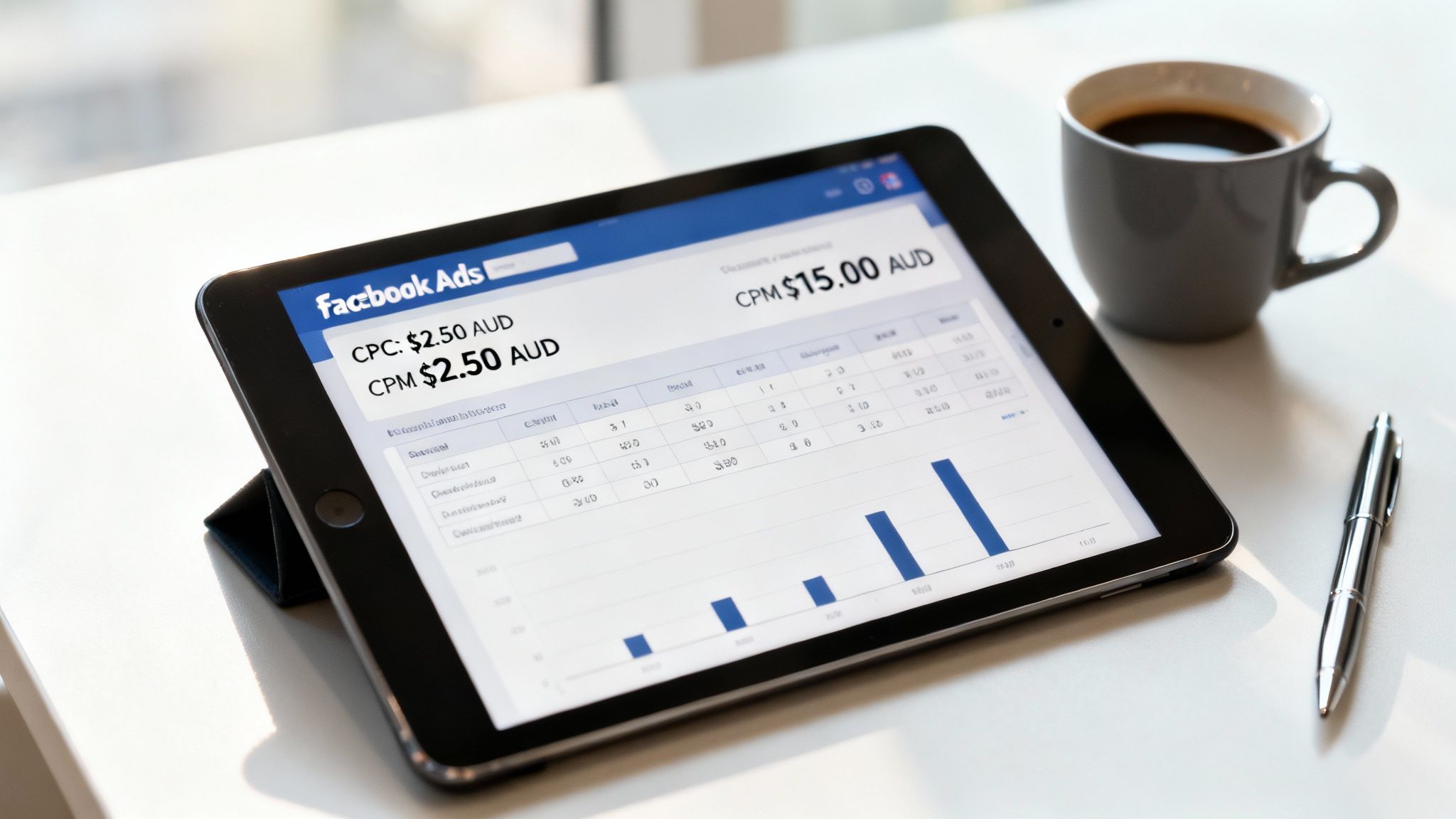
On average, you can expect the Cost Per Click (CPC) to land somewhere between AUD $1.15 to $3.20. When it comes to getting eyeballs on your ads, the average Cost Per Mille (CPM), which is the cost for 1,000 views, hovers around AUD $11.04. These numbers position Australia as a moderately priced market, but they're just the beginning of the story.
A Snapshot of Facebook Advertising Costs in Australia
Before we get tangled in the weeds of ad auctions and campaign objectives, let's establish a clear financial baseline. Understanding these average costs gives you a realistic foundation for your budget and helps set achievable goals. Think of these metrics not as fixed prices, but as reliable signposts for your initial strategy.
The two most fundamental metrics you’ll be looking at are CPC and CPM. They answer two different, but equally important, questions about where your money is going.
- Cost Per Click (CPC): This tells you exactly what you pay each time someone is interested enough to click your ad. It's a direct measure of what it costs to get someone to your website or landing page.
- Cost Per Mille (CPM): This reveals the price for every 1,000 times your ad is shown to users. This metric is your go-to for understanding the cost of brand awareness and just getting your name out there.
These averages are a valuable benchmark, but your actual costs will definitely fluctuate. A bunch of factors, from your industry to how good your ad is, will push these numbers up or down. For instance, that CPC range of AUD $1.15 to $3.20 can look very different if you're in a highly competitive space like finance or legal services, where costs often creep higher.
Similarly, the average CPM of AUD $11.04 is a pretty moderate figure, especially when you compare it to a market like the United States where it can be significantly more expensive. Getting a handle on these benchmarks is the first step to setting campaign goals that make sense. If you want to dig deeper, you can explore more about these Australian ad costs to better inform your budget.
Average Facebook Ad Costs in Australia at a Glance
To make it even simpler, here's a quick table breaking down the essential numbers. This is your at-a-glance summary for what Facebook ads typically cost for businesses targeting an Aussie audience.
| Metric | Average Cost (AUD) | What It Measures |
|---|---|---|
| Cost Per Click (CPC) | $1.15 – $3.20 | The price you pay for a single click on your ad. |
| Cost Per Mille (CPM) | $11.04 | The price for 1,000 ad impressions (views). |
Remember, these are just averages. Your goal shouldn't be to just meet these numbers, but to beat them. You do that by creating brilliant, highly relevant ads that really connect with your audience, which is the secret to driving your costs down.
With this financial snapshot, you have a solid starting point. These figures help you immediately gauge what kind of investment you might be looking at. Now, as we get into the factors that actually drive these costs, you'll learn how to start influencing them in your favour.
How the Facebook Ad Auction Really Works
https://www.youtube.com/embed/W1_gitKy5H_M
Ever notice how your Facebook advertising costs seem to bounce around from one day to the next? It’s not random. Behind every single ad you see is a lightning-fast process called the Facebook Ad Auction, and getting your head around it is the key to spending your budget wisely.
Think of it less like a traditional auction where the deepest pockets automatically win. Instead, picture it as a value contest. Facebook's number one goal is to create a good experience for its users while also delivering results for advertisers. After all, if users are bombarded with irrelevant, low-quality ads, they'll just stop scrolling.
So, Facebook doesn't just hand over the ad spot to the highest bidder. It gives it to the advertiser who creates the most overall value. This value is calculated using three core elements, and mastering them is how you win the auction without having to outspend everyone.
The Three Pillars of the Ad Auction
When you launch a campaign, you're not just competing on price. You're competing on a total value score that Facebook calculates in real-time for every single ad opportunity. This score comes down to three crucial factors.
-
Your Bid: This is the money part of the equation. It’s what you tell Facebook you're willing to pay to get your desired result, whether that’s a click, a lead, or a sale. It’s an important signal of your intent, but it's only one piece of the puzzle.
-
Estimated Action Rates: This is Facebook’s prediction of how likely a specific user is to actually take the action you want them to. The algorithm looks at that user's past behaviour, your ad's historical performance, and a thousand other signals to guess the probability of a conversion or click.
-
Ad Quality and Relevance: This is arguably the most important pillar of all. Facebook measures this by looking at user feedback, engagement (likes, comments, shares), and whether people are hiding or reporting your ad. A high-quality, relevant ad makes for a better user experience, and Facebook rewards you for that.
The big takeaway is this: A lower bid can still beat a higher bid if your ad has superior quality and a higher estimated action rate. This is fantastic news because it means you can directly lower your Facebook advertising cost by focusing on creating better ads.
Why the Highest Bidder Doesn't Always Win
Let's use a simple analogy. Imagine two cafes are bidding for a prime spot at a local market.
- Cafe A bids $100. Their coffee is just okay, and their stall looks a bit tired. The market manager figures they might sell 20 coffees.
- Cafe B bids only $70. However, they serve amazing artisanal coffee, have a beautifully designed stall, and are handing out free samples. The manager predicts they'll delight visitors and sell 100 coffees.
Who gets the spot? Cafe B, of course. They offered less money upfront but created far more value for the market's visitors. The Facebook Ad Auction works exactly the same way. An engaging, relevant ad (Cafe B) provides more value to users than a boring, expensive one (Cafe A).
This entire system is designed to incentivise advertisers to focus on quality, not just budget. When your ad resonates with your audience, it gets more engagement, which Facebook’s algorithm sees as a massive positive signal. In response, it rewards you with better ad placements at a lower cost.
Ultimately, this means the most powerful lever you have to control your ad spend isn't your wallet—it's your creativity and your deep understanding of your audience. By creating valuable content that people genuinely want to see, you're not just making better ads; you're actively making them cheaper to run.
The Key Factors That Drive Your Ad Spend
Your Facebook advertising cost isn't a fixed price on a menu. Think of it more like a live auction where the price is constantly shifting based on the choices you make. Getting a handle on these moving parts is the difference between just spending money and strategically investing it.
Every decision you make, from who you target to what your ad looks like, acts like a lever that can either crank your costs up or bring them down. Let's break down the six most important factors that really dictate what you'll end up paying.
Your Audience and Targeting Choices
Who you're trying to reach is probably the single biggest driver of your ad costs. It all comes down to supply and demand.
If you're chasing a highly specific and valuable audience—say, newly engaged couples in Melbourne or financial advisors across Australia—you're not the only one. Hundreds of other businesses are competing for that same, limited ad space. This fierce competition naturally drives up the price you have to bid.
On the flip side, targeting a massive, broad audience might get you a lower cost per click, but you'll likely waste a good chunk of your budget on people who couldn't care less about your offer. The sweet spot is finding a well-defined audience that's large enough to avoid a bidding war but specific enough to be genuinely interested in what you're selling.
Your Campaign Objective
What do you actually want people to do when they see your ad? Your answer to that question directly shapes your costs. Facebook groups its campaign objectives into a few key buckets, and each comes with a different price tag.
- Awareness: Campaigns built for Reach or Brand Awareness are usually the cheapest. You're essentially paying for eyeballs, not actions, which is a relatively easy (and therefore less expensive) goal for the algorithm to achieve.
- Consideration: Objectives like Traffic, Engagement, or Video Views sit in the middle of the cost spectrum. Getting someone to click a link or watch a video requires more intent than just scrolling past an ad, so the price goes up.
- Conversion: This is where things get pricey. Campaigns optimised for Leads, Sales, or App Installs are typically the most expensive. You're asking Facebook to find the specific people most likely to take a high-value action, and the platform charges a premium for that service.
The Quality and Relevance of Your Ad
Here’s a secret many advertisers miss: you can't just throw money at a bad ad and expect results. Facebook's entire business model relies on keeping its users happy and engaged. To do that, it wants to show them content they actually like.
The platform rewards high-quality, relevant ads with lower costs and better visibility. It measures this with metrics that contribute to a "quality ranking."
If your ad gets a lot of positive feedback—likes, comments, shares—and has a strong click-through rate, Facebook’s algorithm sees it as valuable content. In return, it will show your ad to more people for less money. But if users are hiding your ad or, worse, reporting it, your costs will go through the roof.
At its core, the lesson is simple: a well-crafted, relevant ad will always be more cost-effective than a poorly designed one, even with a massive budget behind it.
Seasonality and Timing
The advertising world runs on its own calendar, and costs fluctuate with the seasons. You'll see a natural spike in ad costs during peak shopping periods like Black Friday, Cyber Monday, and the entire Christmas lead-up. Competition becomes incredibly fierce as everyone tries to capture holiday shoppers, driving auction prices higher for the whole market.
Even the time of day can make a difference. Bids are often cheaper in the middle of the night (say, from midnight to 6 am) when fewer people are online and competition drops off. While most campaigns run 24/7, being aware of these daily and seasonal ebbs and flows can help you make smarter scheduling choices.
Your Chosen Ad Placements
Where your ad actually shows up across Meta’s network also plays a role in what you pay. Not all ad real estate is created equal.
The main Facebook and Instagram Feeds are prime territory. They get the most visibility and engagement, which also makes them the most competitive and often the most expensive placements. In contrast, placements like the Audience Network (which puts your ads on third-party apps and websites) can sometimes be cheaper, but the trade-off might be lower-quality traffic.
The Competitiveness of Your Industry
Finally, the industry you're in has a massive impact on how much your Facebook advertising will cost. Some sectors are just plain more crowded and expensive than others.
Industries with a high customer lifetime value—think finance, insurance, legal services, and real estate—typically face the highest advertising costs. In these fields, a single new customer can be worth thousands of dollars. That means businesses are willing to bid much more aggressively to get a lead, pushing up the average cost for everyone in that space.
Comparing Ad Costs Across Different Industries
Not every click is created equal. The industry you're in is one of the biggest factors that will shape your Facebook advertising bill, and the reason is simple: the potential value of a customer is wildly different from one sector to the next.
Think about it this way. An e-commerce store selling t-shirts might only clear $15 profit on a sale. Compare that to a law firm that could land a new client worth tens of thousands of dollars. It just makes sense that the law firm is willing to bid a whole lot more for a single lead, which in turn drives up ad costs for everyone else in that competitive space.
Why Industry Competition Matters
At its core, the massive cost difference comes down to competition. Industries with a high customer lifetime value (LTV)—think finance, legal services, and real estate—are notoriously expensive to advertise in. Businesses in these fields know that a single successful conversion can justify a hefty ad spend, which leads to much more aggressive bidding in the ad auction.
This creates a bit of a ripple effect. When more advertisers are fighting over the same audience, the price to get in front of them naturally goes up. On the other hand, industries like retail or food and beverage often have lower LTVs per transaction. This means less intense bidding wars and, you guessed it, lower average ad costs. Getting your head around this dynamic is the first step to setting realistic goals for your own campaigns.
This infographic breaks down some of the other key moving parts that influence your costs.
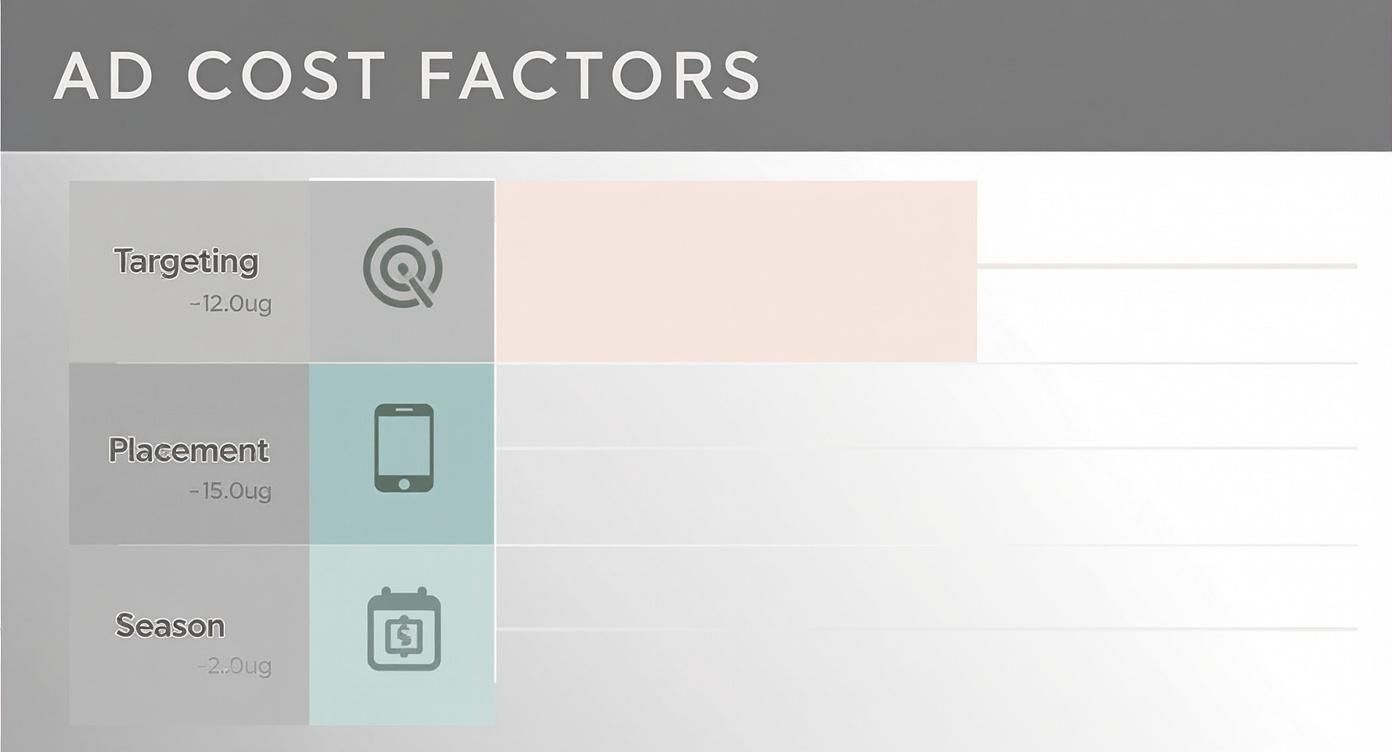
As you can see, it's not just about your industry. Things like how well you've targeted your audience, where your ads show up, and even the time of year all play a role in what you'll end up spending.
Estimated Facebook Ad Costs by Industry in Australia
So, how does this all translate into actual numbers? To give you a clearer picture, we've put together some ballpark figures for different sectors here in Australia. These numbers are a fantastic starting point, giving you a benchmark to see how your own business might stack up against the industry average.
If you're curious about how these costs compare across other platforms, check out our deep dive into social media advertising costs.
Here’s a rough guide to what you might expect to pay:
| Industry | Average CPC (AUD) | Average CPM (AUD) | Competition Level |
|---|---|---|---|
| Finance & Insurance | $1.22+ | $16.50+ | Very High |
| Real Estate | $0.91+ | $13.25+ | High |
| Health & Fitness | $0.80+ | $12.10+ | High |
| E-commerce & Retail | $0.34+ | $8.80+ | Medium |
| Restaurants & Food | $0.72+ | $10.50+ | Medium |
| Travel & Tourism | $0.51+ | $9.95+ | Medium-High |
Take these figures with a grain of salt—they're a guide, not a guarantee. Your own results will ultimately be shaped by the quality of your ads, the laser-focus of your targeting, and your overall campaign strategy.
Looking at the data, a finance company might pay nearly four times as much for a click as a retail gift shop. This isn't because their ads are bad; it's because the potential return on that single click is astronomically higher. By understanding these industry quirks, you can set a budget that makes sense for your market and stop comparing your results to businesses playing in a completely different financial league.
Proven Strategies to Reduce Your Advertising Costs
Watching your Facebook advertising costs creep up can be a bit nerve-wracking, but you have more control over your spend than you might think. Lowering your costs isn’t about slashing your budget to the bone; it’s about making smarter, more efficient choices that get you better results for less money.
Think of it like tuning a car engine. A few precise adjustments can lead to way better fuel economy without sacrificing performance. The exact same principle applies to your ad campaigns—a few strategic refinements can make every dollar work harder for you.
Fine-Tune Your Audience Targeting
The fastest way to burn through your budget is by showing your ads to the wrong people. While broad targeting might seem like a good way to cast a wide net, it almost always leads to low engagement and a painfully high cost per result. The real secret is to be specific without being too restrictive.
Instead of targeting a vague interest like "fitness," you need to narrow it down. Let's say you sell high-end yoga mats. You could target users interested in "Lululemon" and "Vinyasa yoga" who also live in affluent postcodes. That kind of precision ensures your message lands with an audience genuinely interested in what you're selling.
By focusing on a highly relevant audience, you increase the likelihood of engagement. This signals to Facebook that your ad is valuable, which can lead to the algorithm rewarding you with a lower advertising cost over time.
Don't forget to use exclusions to stop wasting your budget. If you’re trying to find new customers, make sure you exclude people who have already purchased from you. It's a simple step that stops you from paying to acquire customers you already have.
Master the Art of A/B Testing
Never, ever assume you know what will work best. A/B testing, or split testing, is your absolute best friend when it comes to optimising campaigns and driving down costs. It’s all about creating a couple of versions of an ad, changing just one thing at a time, and seeing what performs best.
You can test almost anything, but it’s smart to start with the elements that usually have the biggest impact:
- Ad Creative: Test a video against a static image, or try out different colour schemes.
- Ad Copy: Experiment with a short, punchy headline versus a longer, more descriptive one.
- Call-to-Action (CTA): Does "Shop Now" outperform "Learn More"? Only testing will tell you for sure.
By systematically testing and then shifting more of your budget to the winning variations, you continuously refine your approach. This makes sure your money is always backing the most effective creative.
Leverage the Power of Retargeting
It's a universal truth in marketing: it is far, far cheaper to convert a warm lead than a cold one. Retargeting campaigns are designed to do exactly that, showing ads specifically to people who have already interacted with your business—like visiting your website or engaging with your Instagram page.
These users are already familiar with your brand, which makes them much more likely to convert. Because the audience is so highly qualified, retargeting campaigns often deliver a much higher return on investment and a lower cost per acquisition. But for this to work effectively, solid tracking is non-negotiable. Implementing proper website conversion tracking is what allows you to build these valuable audiences in the first place.
To see the true profitability of your Facebook ad campaigns and make sure every dollar spent is generating maximum revenue, you absolutely must know how to calculate your Return on Ad Spend (ROAS). This metric is critical for understanding the direct financial impact of your advertising, helping you make data-backed decisions to refine your strategies and beef up your bottom line.
How to Set a Realistic Facebook Ads Budget
Alright, let's get down to the big question: how much should you actually spend on Facebook ads? This is where theory hits the road, and translating all those average costs into a concrete budget for your business can feel like a guessing game.
But setting a smart, realistic budget isn’t about pulling a number out of thin air. It’s about tying your ad spend directly to your business goals.
Whether you're a startup just testing the waters or an established brand ready to pour fuel on the fire, you need a clear financial framework. Without one, you’re just flying blind, spending money without a clear destination in sight. Two of the simplest and most effective ways to get started are goal-based budgeting and percentage-of-revenue budgeting.
These approaches give you a logical starting point, helping you justify the investment and measure success in a way that actually makes sense for your bottom line. Let's break down how you can use them.
Start with Your Goals
This is my favourite way to build a budget because it works backwards from what you actually want to achieve. Instead of asking, "How much can I afford to spend?" it forces you to ask, "What do I need to spend to hit my target?"
Here’s a simple way to map it out:
- Define Your Target: First, what’s the goal? Let’s say you want to generate 50 sales per month.
- Estimate Your CPL: Next, look at some industry benchmarks. If the average Cost Per Lead (CPL) in your space is around $30, that’s a decent starting point.
- Calculate Required Leads: Now, figure out your lead-to-customer conversion rate. If you know that 1 in every 10 leads turns into a paying customer (a 10% conversion rate), you’ll need 500 leads to hit your goal of 50 sales.
- Set Your Budget: Finally, do the maths. Multiply your required leads by your estimated CPL. In this case: 500 leads x $30/lead = $15,000 per month.
See how that works? This method connects your ad spend directly to tangible business results, making it much easier to justify and track.
Use a Percentage of Revenue
Another really straightforward approach is to dedicate a set percentage of your total revenue to your advertising. This method is popular because it’s dead simple to calculate and scales up or down as your business grows.
A common rule of thumb is to allocate between 5% to 15% of your gross revenue to marketing. If you’re a new business trying to grow aggressively, you might push towards the higher end of that range. For a more established business focused on maintaining market share, a figure closer to 5% might be more appropriate.
For example, if your business brings in $40,000 in monthly revenue and you decide to put 10% into marketing, your budget would be $4,000 per month. You can then decide how much of that total marketing budget goes towards Facebook Ads.
Track Your Return on Ad Spend
No matter which budgeting method you choose, your success ultimately comes down to one crucial metric: Return On Ad Spend (ROAS). This little number tells you exactly how much revenue you’re generating for every single dollar you put into your ads.
Tracking ROAS is non-negotiable. It’s the proof that your investment is actually profitable. If you want to get into the weeds on this, you can learn more by checking out our guide on what is a good ROAS.
When it comes to lead generation, Facebook Ads can be a seriously cost-effective choice in Australia. The average CPL on Facebook is approximately $27.66, which is a bargain compared to Google's average of $70.11. This makes the platform a pretty economical option, though it's worth noting that these lead costs have jumped about 21% over the last year, a sure sign of increased competition.
Got Questions? We've Got Answers.
Diving into the money side of Facebook ads can feel a bit like learning a new language. It’s normal to have questions, especially when you’re figuring out where your budget should go. Here are some quick, straight-to-the-point answers to the questions we hear most often.
Is $100 Really Enough to Get Started with Facebook Ads?
Absolutely. Think of $100 as your initial research and development budget. It’s more than enough to run a small, laser-focused campaign for a few days to see what sticks.
You can use that hundred bucks to test a specific audience, a new ad creative, or a special offer. The trick is not to spread it too thin. Use it to gather that first crucial piece of data on what your audience actually responds to, rather than trying to boil the ocean.
Why Do My Facebook Ad Costs Change So Much?
Your costs are always in flux because you're not buying a fixed-price item—you're participating in a live, real-time auction. The price tag for showing your ad changes constantly based on a few key factors:
- Competition: If more advertisers are trying to reach the same people you are, costs go up. It’s simple supply and demand.
- Seasonality: Costs almost always spike during big shopping seasons like Black Friday or Christmas. Everyone’s trying to get in front of buyers at the same time.
- Ad Quality: This is where you have some control. If your ad gets great engagement (likes, comments, clicks), Facebook's algorithm sees it as relevant and will often reward you with lower costs.
These fluctuations are a normal part of the game. Once you understand what drives them, you can start to anticipate—and even plan for—the changes.
Daily vs. Lifetime Budgets: What's the Difference?
Choosing between a daily and lifetime budget really comes down to your campaign's goals and timeline.
A daily budget tells Facebook the average amount you want to spend each day. This gives you consistent, predictable spending, which is perfect for ongoing, "always-on" campaigns where you need steady control.
A lifetime budget sets a total maximum you're willing to spend over the entire campaign. This hands the keys over to Facebook's algorithm, giving it the freedom to spend more on days it predicts will get you better results and less on slower days.
For short-term campaigns with a hard stop—like a weekend sale or an event promotion—a lifetime budget is usually the smarter choice. For long-term brand awareness or lead generation, a daily budget often provides better stability.
Getting these basics down helps take the mystery out of how much Facebook advertising costs. With this knowledge, you can start managing your ad spend with a lot more confidence.
Ready to stop guessing and start getting real results from your advertising spend? The team at Click Click Bang Bang specialises in creating data-driven PPC and SEO campaigns that maximise your return on investment. Let us build a strategy that works for your budget and business goals. Get in touch with us today!
Read NeXt
Or Read Our Latest
- Manual vs Automated Bidding for PPC Success
- Conversion Tracking Setup: A Complete AU Guide
- Instagram Advertising Australia: Complete 2026 Guide
- Pay Per Click: A Beginner’s Guide for Australian Marketers
- Display Advertising on Google: The Complete Australian Guide
- Stakeholder Communication Plan How to Build One That Works
Click. CLick. Subscribe.
Get our best PPC insights, industry updates, and power moves delivered straight to your inbox. No fluff, just high-caliber strategies that actually work.
Don’t Leave Just Yet
Try Us For 30-Days,
Risk Free!!
We guarantee that you’ll love our work within the first 30 days, if not you’ll get your money back.
What have you got to lose?