

What Is a Good Click Through Rate? Australian Benchmarks Uncovered
Last Updated

"So, what's a good click-through rate?" It's the million-dollar question, isn't it?
In Australia, a solid CTR for search ads usually lands between 2% and 5%. For social media ads, you're looking at around 1% to 2%, and for your email marketing campaigns, a healthy rate is anywhere from 2.5% to 4%. But here’s the thing: there's no single magic number. What's "good" is completely relative, depending heavily on your industry and the specific marketing channel you're using.
Your Quick Guide to Australian CTR Benchmarks
Think of your click-through rate (CTR) like a shopfront on a busy high street. The number of people who walk past your window are your impressions. The people who decide to open the door and come inside? Those are your clicks.
Your CTR is simply the percentage of people who saw your "shop" and were curious enough to step inside. Understanding what a good CTR looks like is the first step in figuring out how compelling your marketing message really is. It’s a direct signal of how well your ad copy, headlines, or email subject lines are hitting the mark with your target audience. A low CTR suggests a disconnect, while a high one is a clear sign you’ve grabbed their attention.
Setting Realistic Expectations
Of course, not every channel is created equal. A user actively searching for a solution on Google is far more likely to click an ad than someone casually scrolling through their social media feed. This difference in user intent is precisely why the benchmarks vary so much.
- High-Intent Channels (like Google Search): These platforms almost always see the highest CTRs. Why? Because people are actively looking for answers, products, or services.
- Low-Intent Channels (like Social Media): Here, your ads are an interruption. They pop up while someone is catching up with friends or watching videos, so CTRs are naturally lower and rely on seriously captivating creative to earn a click.
- Permission-Based Channels (like Email): Since subscribers have already opted in to hear from you, email CTRs often sit somewhere in the middle. You're talking to a warm audience, but they aren't always actively in a buying mindset.
The bar chart below gives you a visual on typical CTR benchmarks across these core Australian channels.
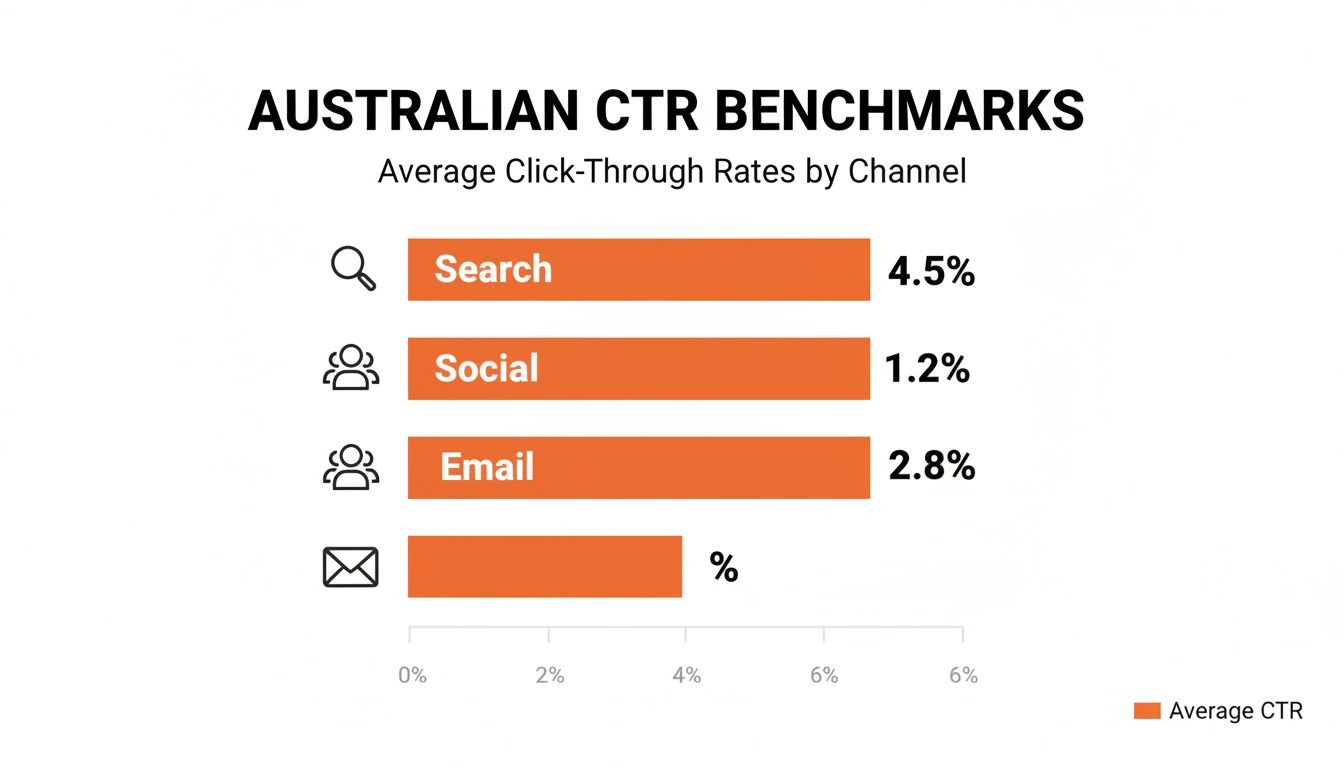
As you can see, search campaigns clearly lead the pack, which makes sense given the high-intent nature of the channel. Social media, on the other hand, requires a bit more grunt work to get that click.
For a quick reference, here's a simple table summarising those averages.
Average Australian CTR Benchmarks at a Glance
| Marketing Channel | Average CTR Benchmark (Australia) |
|---|---|
| Search Ads | 4.5% |
| Email Marketing | 2.8% |
| Social Media Ads | 1.2% |
Use these figures as your starting point, a baseline to measure against. But always remember the real goal: to continuously test, tweak, and improve upon your own results. That's how you turn a "good" CTR into a great one.
How to Calculate and Interpret Your CTR

It’s one thing to know what affects your click-through rate, but first, let's get the simple maths locked down. Calculating CTR is dead simple, giving you a clean percentage that shows audience engagement at a glance.
The formula is just basic division: you take the number of clicks your ad or link got and divide it by the number of times it was shown (impressions). Then, multiply by 100 to turn it into a percentage. Easy.
The CTR Formula:
(Total Clicks ÷ Total Impressions) × 100 = Click-Through Rate (%)
Let's say a local Sydney bakery runs a Google Ad for "artisan sourdough delivery." If the ad gets shown 5,000 times (impressions) and scores 200 clicks, the maths is just (200 ÷ 5,000) × 100. That gives them a 4% CTR.
Looking Beyond the Click
Now, this is where the real skill comes in. A 4% CTR might sound pretty good for a search ad, but that number doesn't tell you the whole story. It only measures that first spark of interest—how well your headline and ad copy convinced someone to take the next step.
A high CTR is a fantastic sign that your message is compelling, but it’s only one piece of the puzzle. What happens after that click is just as important, if not more so. Did the click lead to a sale? A newsletter sign-up? If your CTR is high but your conversion rate is in the gutter, it points to a serious disconnect.
This is why savvy marketers always analyse CTR alongside other key figures:
- Conversion Rate: The percentage of clicks that actually turn into a desired action (like a purchase or a lead). A high CTR with a low conversion rate often means your ad is promising something your landing page isn't delivering.
- Bounce Rate: The percentage of people who click your ad and then leave your site after viewing just one page. If they’re bouncing immediately, your landing page might be slow, confusing, or just not what they expected.
- Email Click-to-Open Rate (CTOR): In email campaigns, this measures clicks against opens, not just total sends. It tells you how effective your email’s content was at driving action after the subject line did its job.
Ultimately, CTR is a diagnostic tool. It helps you gauge how well your front-facing message is landing with your audience. But to see the full picture, you have to connect it to other digital marketing performance metrics that measure what happens next.
Unpacking Search CTRs in the Australian Market
When we talk about search marketing, we’re really looking at two sides of the same coin: paid search (SEM) and organic search (SEO). They both live on the same results page, but what a “good” click-through rate looks like for each can be worlds apart.
The biggest factor here is always user intent.
Think about it. If someone searches for “Click Click Bang Bang SEO services,” that’s a branded search. They already know us and what they want. It’s no surprise that the CTR on our ad or top organic result could easily hit 30% or more.
Now, flip that to a broad, discovery search like “how to improve website traffic.” The intent is informational, not commercial. For a query like that, a CTR of 2-5% would be considered pretty strong.
Paid Search vs Organic Search CTRs
Paid search campaigns are all about buying that prime real estate at the very top of the page. That instant visibility naturally leads to higher click-through rates than most of the organic results sitting below. Your ad copy, extensions, and sharp targeting all work together to grab immediate attention from users ready to act.
Organic search, on the other hand, is a long game. You're not paying per click, but you're fighting for space against ads, featured snippets, and "People Also Ask" boxes. A number one organic listing might pull in a CTR of over 20%, but that number drops off a cliff for lower positions.
A strong paid search CTR is your fastest path to qualified traffic, but a healthy organic CTR builds trust and authority over time. The goal isn't just to get the click, but to attract the right click—one that matches what the user is looking for and is more likely to convert.
Connecting CTR to Business Outcomes
A high CTR is a great start, but it's just a vanity metric if those clicks go nowhere. The real value in understanding what is a good click through rate is seeing how it kickstarts your conversion rate. It's the essential first step in your sales funnel.
This is especially true in Australia’s crowded e-commerce scene. For example, local data shows an average Australian e-commerce conversion rate of around 1.78%, with some industries pushing 2–4%. A "good" CTR, then, has to be judged on its ability to deliver traffic that actually converts within that range.
With Australian businesses forecast to spend about $1.5 billion AUD on SEO in 2025 and 97.1% of the population online, every optimised click is vital for growth.
Realistic Benchmarks for Australian Marketers
So, what numbers should you actually be aiming for? While averages are a useful starting point, performance can swing wildly depending on your industry and the keywords you’re targeting. For a deeper dive, our guide on Google Ads benchmarks by industry breaks it down in more detail.
But as a general rule of thumb, here’s a realistic look for Australian businesses:
- Branded Keywords (Paid & Organic): A CTR of 25%+ is well within reach. The user is actively looking for you, so they’re primed to click.
- Commercial Keywords (e.g., "buy running shoes online"): For paid ads, you should be aiming for 4-6%. For a top-ranking organic result, 5-10% is a solid target.
- Informational Keywords (e.g., "best running techniques"): Paid CTRs will naturally be lower here, maybe around 1-3%. A top organic spot, however, could still pull 10-15% if the title is compelling enough to beat the competition.
Ultimately, your CTR is a powerful diagnostic tool. It tells you exactly how well your message is landing on the search results page, setting the stage for everything that comes after.
Setting Realistic Social Media CTR Goals
Social media is a completely different beast to search. When someone types a query into Google, they’re actively hunting for something. On the other hand, a person scrolling through their Facebook or LinkedIn feed is there to connect, be entertained, or just kill some time. Your ad is an interruption, not an answer.
That fundamental difference means you need a whole new strategy for grabbing their attention. It also means you need to adjust your benchmarks for what is a good click through rate. A "one-size-fits-all" CTR goal is pretty much pointless here.
The platform, ad format, and your industry will cause massive swings in performance. Think about it: a retail brand showing off a new dress in an Instagram carousel ad will naturally pull in a higher CTR than a B2B firm promoting a technical whitepaper on LinkedIn. The user's mindset is worlds apart.
On social media, your CTR is a direct measure of your creative's "stopping power." It answers a simple question: was your ad compelling enough to make someone pause their scroll and actually engage?
Understanding Platform and Format Differences
Every social platform has its own vibe and ad environment, which directly shapes the CTRs you can expect. A professional network like LinkedIn encourages a more considered, deliberate click, which often leads to lower CTRs than a visual playground like Instagram.
The type of ad you run also plays a huge role. A dynamic video ad or an interactive carousel will almost always beat a simple static image because they’re just more engaging and can tell a much richer story in a few seconds.
- Video Ads: Their dynamic nature often leads to higher engagement and better CTRs.
- Carousel Ads: These let users swipe through multiple products or features, actively encouraging interaction and clicks.
- Static Image Ads: They have to work much harder, relying on a single, powerful image and punchy copy to earn that click.
Australian Social Media CTR Benchmarks
So, what should you actually aim for? While it varies, we can look at some local data to get a solid starting point. A recent Australian study shows just how high a good social media CTR can climb, especially in e-commerce.
For instance, Australian Facebook shopping campaigns hit an incredible 4.13% CTR in 2025, which was a massive 146% jump from the year before. This stellar performance was tied to a low average Cost Per Click (CPC) of just $0.34 AUD. This tells us that for visual, product-focused ads, a CTR north of 3–4% is excellent.
In contrast, service-based businesses on the same platform might find their average CTRs sitting closer to the 1.5–2.5% mark. You can dive deeper into these Facebook Ads benchmarks and their industry specifics.
This really hammers home the importance of context. Don't beat yourself up by comparing your B2B lead generation campaign to a retail brand's flashy sale ad. Set achievable goals by looking at benchmarks relevant to your specific industry, platform, and ad format. That’s how you make smarter decisions with your budget and creative strategy.
Unpacking Email Marketing CTRs in Australia
Email marketing is still one of the most reliable tools in a marketer's kit, and for good reason. It’s a direct line to an audience that has already given you permission to talk to them. You aren't just interrupting a social media feed; you're landing in their personal inbox. That's why the click-through rate here is such a powerful signal of genuine interest in what you have to say.
While open rates tell you if your subject line was catchy enough to get the door opened, the CTR tells you if the content inside actually delivered. A high open rate paired with a dismal CTR is a classic red flag. It usually means your subject line wrote a cheque that your email body couldn't cash, leaving your reader disappointed and unwilling to take the next step.
Looking Beyond the Open Rate
To get a clearer picture, savvy Australian marketers are increasingly focusing on a smarter metric: the Click-to-Open Rate (CTOR). This metric cuts through the noise by measuring the percentage of people who opened your email and then went on to click a link. It effectively isolates the performance of your email's content from the allure of its subject line.
A strong CTOR is proof that your message resonated. It shows the people who actually saw your email found the copy, design, and call-to-action persuasive enough to act on. It’s the ultimate test of your content's effectiveness.
So, what’s a "good" click-through rate for an email campaign in Australia? Looking at local data for 2025, a solid benchmark to aim for is around 2.35%. That's a decent step up from the global average of 2.00%, suggesting Aussies are a bit more responsive when the content is right. The same data shows an average Click-to-Open Rate of 5.63%, which really highlights how engaged a local audience can be. For a closer look at these numbers, you can discover more about Australian email marketing benchmarks.
Mobile Optimisation is Everything
Here’s a stat you can't ignore: roughly 55% of all emails in Australia are now opened on a mobile device. This changes everything. If your email isn’t designed for a small screen—with readable fonts, punchy copy, and big, tap-friendly buttons—you're throwing away potential clicks. A clunky mobile experience is one of the quickest ways to kill your CTR.
Industry context is also a huge piece of the puzzle. While the national average CTR is 2.35%, some sectors blow this out of the water. For instance, industries like hobbies can see CTRs as high as 4.36%, fuelled by passionate and highly engaged subscribers. This just goes to show how important it is to benchmark against your own industry, not just a broad average.
By keeping these nuances in mind—from the value of CTOR to the necessity of mobile-first design and industry standards—you can set far more realistic targets and build email campaigns that truly connect with your audience.
Actionable Strategies to Improve Your Click Through Rate
Knowing your benchmarks is one thing, but actually improving them? That’s where the real fun begins. Pushing your CTR higher is all about making your ads and organic listings so ridiculously compelling that people can't help but click. Luckily, there are a bunch of proven tactics for both paid campaigns and SEO that you can put into action right away.
For your paid search ads, it’s a battle for attention in a very crowded space. The mission is simple: make your ad the most relevant, eye-catching, and useful option on the entire page. This takes more than just a good headline.
It all starts with nailing the fundamentals. You’ve got to write ad copy that speaks directly to what your user is searching for, hitting on their specific pain points and desires. If your messaging needs a tune-up, you can check out our in-depth guide covering ad copy best practices.
Beyond great copy, a few technical tricks can give you a serious advantage:
- Go All-In on Ad Extensions: Things like sitelinks, callouts, and structured snippets literally make your ad bigger and more informative. This gobbles up precious screen real estate and shoves your competitors further down the page.
- A/B Test Relentlessly: Never assume you know what works best. Constantly test different headlines, descriptions, and calls-to-action to see what truly connects with your audience. Let the data—not your gut—make the final call.
- Wield Power Words: Sprinkle in words that create a sense of urgency or spark an emotional reaction. Terms like "Exclusive," "Limited-Time," or "Guaranteed" can give your engagement a significant lift.
Optimising For Organic Clicks
Boosting your organic CTR is a slightly different game. Here, you’re not just trying to grab attention; you're also building trust and proving your authority. The goal is to send strong signals to both users and search engines that your result is, without a doubt, the best answer to their query.
Your title tag is your single most important weapon. It needs to be magnetic, blending your target keyword with a clear promise of value. Think about formats that naturally draw the eye, like listicles ("10 Ways to…"), questions ("Are You Making This Mistake?"), or direct benefits.
A great title tag doesn't just describe what the page is about; it sells the click. It creates a curiosity gap that the user feels compelled to fill by visiting your page.
Next up is your meta description. While it’s not a direct ranking factor, it acts as your final sales pitch on the search results page. Use this space to expand on the promise you made in the title, include a clear call-to-action, and show you understand the searcher's intent. It's your last chance to convince them your content has the answers they're looking for.
Finally, implementing structured data (schema markup) can make your listings pop with rich snippets—things like star ratings, FAQs, or event details. These visual enhancements make your result stand out and seem more trustworthy, naturally pulling more clicks away from your plain-text competitors. For more ideas on boosting your online visibility, you can explore these data-backed strategies to improve your click-through rate.
CTR Optimisation Checklist for PPC and SEO
To bring it all together, here’s a quick checklist comparing how you can tackle CTR improvements across both paid and organic search. While some tactics are channel-specific, you'll notice the underlying principles of relevance and value apply everywhere.
| Optimisation Tactic | Impact on PPC (Paid Search/Social) | Impact on SEO (Organic Search) |
|---|---|---|
| Compelling Copywriting | High Impact. Direct control over headlines and descriptions. A/B testing is essential for finding winning combinations. | High Impact. Critical for crafting magnetic title tags and meta descriptions that sell the click. |
| Keyword Targeting | High Impact. Ensures ads are shown to a highly relevant audience, increasing the likelihood of a click. | High Impact. The foundation of SEO. Matching content to search intent is crucial for ranking and earning clicks. |
| Ad Extensions / Rich Snippets | High Impact. Use sitelinks, callouts, etc. to increase ad size and provide more information, boosting visibility. | High Impact. Use schema markup to earn rich snippets (stars, FAQs) that make your listing stand out visually. |
| A/B Testing | High Impact. A core practice. Constantly testing creative, offers, and CTAs is key to iterative improvement. | Medium Impact. More difficult to A/B test directly, but you can test different title/meta formats and monitor performance. |
| Call-to-Action (CTA) | High Impact. A strong, clear CTA tells users exactly what to do next, directly influencing click behaviour. | Medium Impact. Important for the meta description to encourage a click, but the title tag has a bigger initial impact. |
| Visual Elements | Medium Impact. Display & Social ads rely heavily on visuals. For search, extensions can add visual appeal. | Medium Impact. Primarily through rich snippets like image thumbnails or star ratings that draw the eye. |
Ultimately, whether you're paying for the click or earning it organically, the goal is the same: prove to the user that your link is the best possible answer to their problem. By systematically applying these tactics, you can turn more impressions into valuable clicks.
Frequently Asked Questions About CTR

As you dig into your performance metrics, a few common questions always seem to pop up. Let's get them answered so you can focus on what really matters—driving results.
Is a High CTR Always a Good Thing?
Not always. While a high CTR is a great sign that your ad or title is grabbing attention, its true worth hinges on what happens after the click. It’s only one piece of the puzzle.
Think about it: if you have a massive 10% CTR but your conversion rate is a dismal 0.5%, something’s off. It probably means your message is attracting the wrong crowd, or your landing page isn't delivering on the promise you made. The end goal is always qualified traffic that actually converts.
How Much Data Do I Need to Evaluate My CTR?
You need enough data to be confident you’re not just reacting to random noise. For a busy paid ad campaign, you might get a clear picture in just a couple of days. But for a new organic blog post, it could easily take several weeks to gather meaningful data.
As a rule of thumb, try to wait for at least 1,000 impressions before you make your first call. This helps you avoid knee-jerk reactions based on a single good or bad day.
Why Is My Organic CTR Lower Than My Paid CTR?
This is totally normal, so don't sweat it. Paid ads get prime real estate right at the top of the search results, instantly catching the user's eye.
Organic results, on the other hand, have to fight for attention against those ads, plus featured snippets, image packs, and all the other SERP features. While a strong organic CTR might look lower on paper, remember that every one of those clicks represents valuable traffic you didn't have to pay for directly.
Ready to turn clicks into customers with precision-driven campaigns? Click Click Bang Bang specialises in AI-first SEO and PPC strategies that deliver results. Get started with our risk-free trial at https://clickclickbangbang.com.au.
Read NeXt
Or Read Our Latest
- Manual vs Automated Bidding for PPC Success
- Conversion Tracking Setup: A Complete AU Guide
- Instagram Advertising Australia: Complete 2026 Guide
- Pay Per Click: A Beginner’s Guide for Australian Marketers
- Display Advertising on Google: The Complete Australian Guide
- Stakeholder Communication Plan How to Build One That Works
Click. CLick. Subscribe.
Get our best PPC insights, industry updates, and power moves delivered straight to your inbox. No fluff, just high-caliber strategies that actually work.
Don’t Leave Just Yet
Try Us For 30-Days,
Risk Free!!
We guarantee that you’ll love our work within the first 30 days, if not you’ll get your money back.
What have you got to lose?