

Master AI SEO: Boost Rankings & Revenue Today
Last Updated
Let’s cut to the chase: AI SEO is all about using artificial intelligence to power-up and automate the nitty-gritty of search engine optimisation. We’re talking about everything from uncovering killer keywords to crafting compelling content.
Think of it like swapping out your trusty old spanner set for a self-adjusting, predictive power tool. It gets the same job done, only faster, smarter, and with a whole lot more precision.
Understanding The New SEO Frontier

Welcome to where search is heading. For years, SEO pros have relied on proven methods, gut feelings, and hard-earned experience to climb the rankings. This classic approach is like using a paper map on a road trip—it's reliable and built on known routes, but it’s completely static. It can't react when there’s a sudden road closure or a faster route opens up.
AI SEO, on the other hand, is your dynamic, real-time GPS. It crunches massive amounts of live data to spot patterns, predict where the traffic is heading next, and find the most efficient path to the top of the search results. You're no longer just following the rules of the road; you're anticipating the entire traffic flow.
This isn’t just about a few shiny new tools. It represents a fundamental shift towards a more proactive, intelligent way of thinking about search.
What AI SEO Is And What It Isn't
It's easy to get caught up in the hype, so let's be clear. AI SEO is not a magic wand that makes human strategists obsolete. Far from it.
Think of it as a seriously powerful assistant. It handles the mind-numbing data analysis and repetitive jobs that eat up your day, freeing you up to focus on what humans do best: big-picture strategy, creative thinking, and making those crucial final calls.
At its heart, AI SEO is about making human experts even better, not replacing them. It gives marketers the power to make data-backed decisions with a speed and accuracy that was once unimaginable.
This technology is already changing how businesses tackle their online presence. If you want to dig a bit deeper into the practical side of things, it’s worth exploring why use AI for SEO optimization to see how it works in the real world. In short, AI helps us shift from making educated guesses to building predictive strategies.
To paint a clearer picture, let's look at how the old and new schools of SEO stack up.
Traditional SEO vs AI SEO at a Glance
This table breaks down the key differences between the manual, classic approach to SEO and the smarter, AI-driven methods taking over today.
| Aspect | Traditional SEO | AI SEO |
|---|---|---|
| Data Analysis | Manual analysis of historical data | Automated, real-time analysis of vast datasets |
| Keyword Research | Based on volume, difficulty, and past performance | Predictive analysis of emerging trends and user intent |
| Content Creation | Human-written based on research and intuition | AI-assisted content generation and optimisation |
| Strategy | Reactive, based on known ranking factors and updates | Proactive, based on predictive insights and trend forecasting |
| Pace & Scale | Limited by human capacity and time | Capable of analysing millions of data points in seconds |
| Decision Making | Experience-driven, often relies on educated guesses | Data-driven, augmented by machine learning models |
While the foundational principles remain, the execution has been completely transformed. AI brings a level of sophistication and efficiency that manual methods just can't match.
Why It's An Essential Tool Today
The online marketplace is more crowded and chaotic than ever. To stand out, you need a serious edge, and that's exactly what AI delivers. It unlocks capabilities that are simply beyond human reach.
The core principles of great search engine optimisation haven't changed, but the tools we use to get there certainly have.
Here’s what AI really brings to the table:
- Blistering Speed and Scale: AI algorithms can chew through millions of data points in the time it takes you to sip your coffee. Think competitor backlink profiles, emerging keyword trends, and technical site audits—all done in seconds.
- Predictive Crystal Ball: It can forecast search trends and shifts in user behaviour, allowing you to create content for a topic before it blows up, not after.
- Next-Level Personalisation: AI helps you understand what your audience really wants on a granular level. This means you can create content that genuinely connects with specific segments of your market.
By bringing AI into the mix, businesses are no longer just reacting to Google's latest algorithm update. They're actively building strategies that are one step ahead, perfectly aligned with the future of search.
Why AI Is Reshaping Australian SEO
Artificial intelligence isn't some far-off concept for Aussie businesses anymore. It’s right here, right now, actively changing the rules of the game for anyone trying to get found on Google. From a local shop in Perth to a national brand in Sydney, the move from old-school SEO to strategies powered by AI is a massive shift.
Why the change? It’s simple, really. AI smashes through the limits of what a human can do alone, offering a serious competitive advantage in a packed market.
Manual SEO has always been a race against time and scale. A human analyst can only dig into so many competitors, track a finite number of keywords, and make sense of so much data. AI SEO basically blows those walls down, allowing for a level of analysis and action that was previously unthinkable. It’s the difference between reacting to the market and actually getting ahead of it.
This isn’t just about saving a few hours, either. We’re talking about unlocking serious efficiency, getting a much clearer picture of what your audience really wants, and using smart predictions to stay one step ahead.
Unlocking Efficiency and Deeper Insights
One of the first things you notice when you bring AI SEO into the mix is how it handles the repetitive, soul-crushing tasks. Think about all those hours spent tweaking title tags, writing meta descriptions, or hammering out content outlines. AI can get that done in seconds. This frees up the strategists—the actual humans—to focus on what they do best: creative thinking, solving tricky problems, and building relationships.
But efficiency is just the beginning. The real magic of AI is its ability to chew through mountains of data and spot subtle patterns in how people behave online. It can figure out not just what people are searching for today, but the why behind their search and the questions they’ll be asking next week. This lets you create content that doesn't just rank, but truly connects with customers, sometimes answering needs they haven't even put into words yet.
The infographic below breaks down how these benefits build on each other.
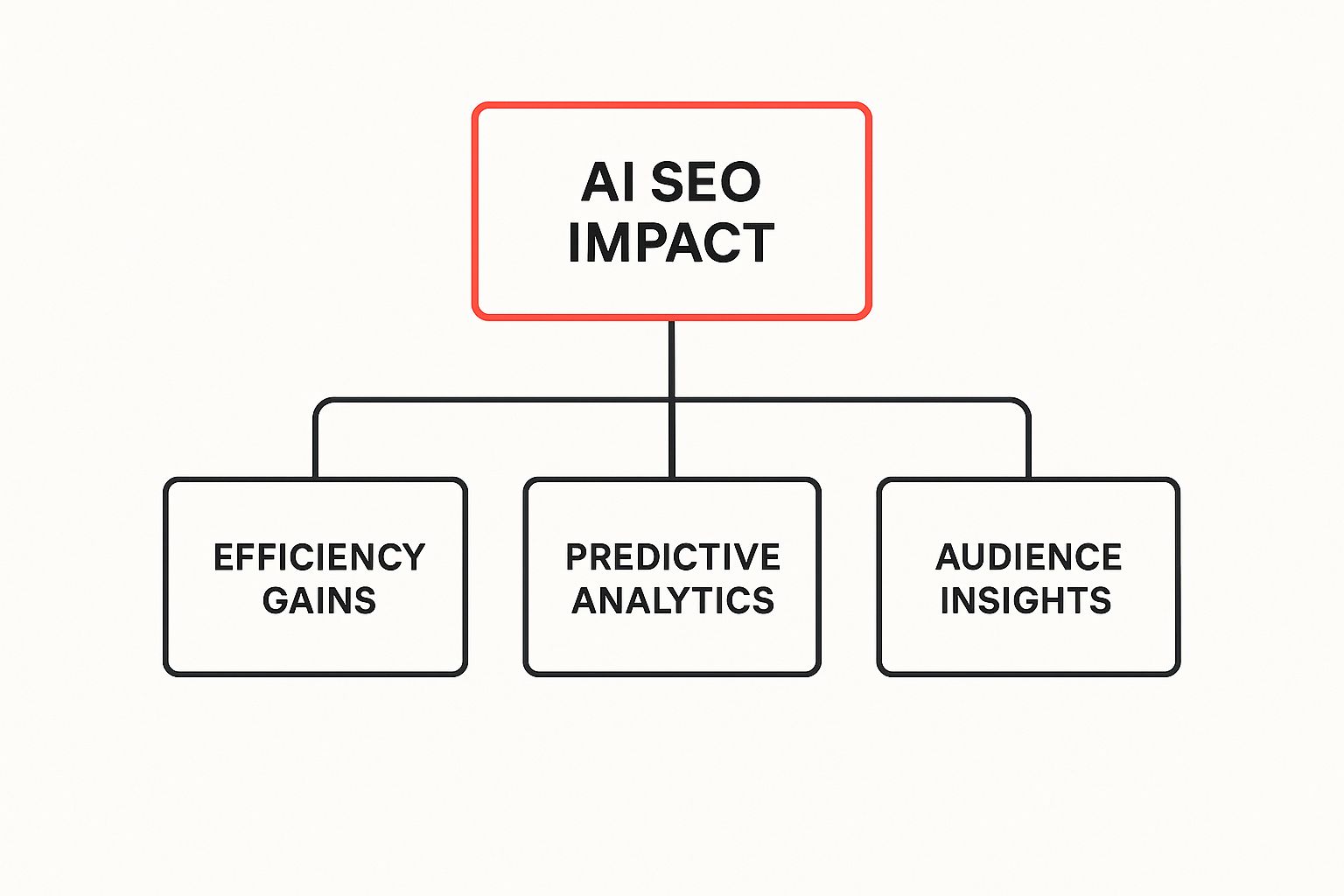
As you can see, the gains compound. More efficiency gives you the time for deeper analysis, which in turn fuels more accurate, forward-thinking strategies.
The Data Behind the Digital Shift
This isn't just a hunch; the numbers show a huge industry-wide movement in Australia. A massive 84% of content marketers and SEOs in Australia now admit that AI and automation are shaping their strategies. It’s not hard to see why, when around 65% of businesses are reporting better SEO results after adopting AI tools.
While there’s definitely a healthy dose of caution about relying solely on AI to write content, the direction is clear. A hybrid approach, where human expertise guides AI's number-crunching power, is delivering the best outcomes. For a closer look at the data, you can explore the full AI SEO statistics for Australia.
The takeaway for Australian businesses is critical. Adopting AI SEO isn’t about chasing the next shiny object anymore—it’s about staying in the race when your competitors are already using it to pull ahead.
By automating routine tasks and providing predictive insights, AI empowers SEO professionals to operate at a strategic level that was previously unattainable, focusing their expertise where it matters most.
From Reactive Tactics to Proactive Strategy
At the end of the day, the biggest change AI brings to SEO is the shift from playing defence to playing offence. Traditional SEO often felt like a game of whack-a-mole—constantly reacting to Google's algorithm updates or a competitor's latest move.
In contrast, an AI SEO approach lets you:
- Forecast Search Trends: You can spot and target emerging topics before they get crowded, giving you a valuable first-mover advantage.
- Optimise for User Intent: It's about getting beyond basic keywords to understand the why behind a search, so you can create content that genuinely solves a problem.
- Automate Site Health: AI-powered crawlers can constantly keep an eye out for technical glitches, making sure your site is always in top shape for performance.
For Aussie companies, this means spending less time playing catch-up and more time building a strong, future-proof online presence that drives real, sustainable growth.
The Core Pillars of a Winning AI SEO Strategy

To really get AI SEO working for you, it helps to stop thinking of it as one giant, complicated machine. A much better way is to see it as a solid structure built on four powerful pillars. Each pillar supports a critical part of your overall SEO efforts, and they all work together to create a strategy that isn't just strong, but genuinely intelligent.
This framework turns abstract ideas into a practical blueprint. By zeroing in on these four areas, you can systematically build a modern SEO program that drives real, measurable results.
Let's break down each one.
1. AI-Driven Content Intelligence
This is where AI really flexes its muscles. We’re moving way beyond simple keyword stuffing to a much deeper understanding of what your audience actually wants to read. Content intelligence is all about using AI to analyse top-ranking articles, pull out semantic themes, and pinpoint the exact questions your customers are asking.
Imagine you're tasked with writing an article on "eco-friendly packaging." The old-school approach would be to find some keywords and take a stab at what topics to cover. With AI, you can analyse the top 20 articles in seconds, instantly identifying common subtopics, user sentiment, and the key questions that high-performing content answers.
The result is a data-driven brief that guides your writers to create articles that are not just optimised, but genuinely comprehensive and valuable. It’s the difference between guessing what Google wants and knowing what your audience needs.
2. Predictive Keyword Analysis
For years, keyword research has been a reactive game. We’d look at historical search volumes to decide what to target tomorrow. Predictive keyword analysis flips that completely on its head, using AI to forecast which topics are about to trend before they hit the mainstream.
By identifying emerging trends and shifts in search behaviour, AI allows you to get ahead of the curve. You can create content for a growing audience, establishing authority while your competitors are still analysing last month's data.
This pillar involves using machine learning models to analyse data from social media, news sites, and forums to spot developing patterns. It identifies "keyword clusters" that are gaining momentum, giving you a crucial first-mover advantage. For any business in a fast-moving industry, this predictive power is a total game-changer.
3. Automated Technical SEO Audits
Technical SEO is the bedrock of any successful website, but doing manual audits is incredibly time-consuming and riddled with the potential for human error. A single misplaced tag or a broken redirect can silently sabotage your rankings for months without you even noticing.
This is where AI-powered automation becomes indispensable. AI crawlers can continuously monitor your site's health, running around the clock to detect critical issues like:
- Crawl Errors: Finding pages that search engines can't access.
- Slow Page Speeds: Flagging bulky assets that are bogging down the user experience.
- Broken Links: Automatically sniffing out and reporting internal and external dead links.
- Schema Markup Issues: Making sure your structured data is correctly implemented for those all-important rich snippets.
Think of this pillar as having a dedicated technical expert watching over your site 24/7. It frees up your team to focus on fixing problems instead of just finding them, ensuring your site stays in peak condition to perform. For online stores, maintaining this technical perfection is a core part of effective ecommerce SEO services, as it prevents lost sales due to easily missed site errors.
4. Data-Enhanced Link Building
Link building is still a cornerstone of SEO, but the old "spray and pray" approach is terribly inefficient and, frankly, often a waste of time. AI brings a new level of surgical precision to the process, using data to identify high-value link-building opportunities that have a much higher chance of success.
AI tools can analyse thousands of potential websites in minutes, scoring them on crucial metrics like domain authority, topical relevance, and historical traffic patterns. This means you can focus your outreach efforts on sites that are most likely to give your authority a meaningful boost.
Better yet, AI can help personalise your outreach. By analysing an author's previous articles and social media activity, it can suggest relevant angles for your pitch, dramatically increasing your chances of getting a yes. This data-enhanced approach turns link building from a numbers game into a strategic, targeted campaign. Together, these four pillars form a robust and forward-thinking AI SEO strategy.
Choosing the Right AI SEO Tools
Picking the right AI SEO tool can feel a bit like choosing the perfect knife for a chef. There are dozens of options, and they all look sharp. But the truth is, the best tool is the one that perfectly fits the job you need to do. A platform that’s a genius at creating content might be completely the wrong choice if your biggest headache is sorting out your site's technical health.
So, the first step is getting crystal clear on what you’re trying to achieve. Are you looking to pump out more high-quality content? Do you need to uncover those golden keyword opportunities your competitors have missed? Or is your main goal to put your technical audits on autopilot? Once you know your primary objective, that huge, overwhelming market of tools suddenly shrinks to a manageable handful that actually aligns with your strategy. For anyone ready to dive in, this list of the 12 best AI SEO tools is a brilliant place to start your search.
Tools for Content Optimisation and Creation
This is easily the most crowded and popular category of AI SEO tools. Why? Because they’re built to help you write content that both people and search engines will absolutely love. These platforms do way more than just check your spelling; they analyse the top-ranking pages for your target keyword and give you a data-driven blueprint for success. They’ll tell you everything from keyword usage to the ideal article structure.
Think of them as a seasoned editor sitting right next to you, giving you live feedback as you write. They help answer the questions that keep content marketers up at night:
- What subtopics are my competitors ranking for that I’ve completely missed?
- Are there common questions my audience is asking that I need to answer?
- Is my article laid out in a way that’s actually easy to read and skim?
By using AI to reverse-engineer what already works, these platforms give you a clear roadmap. You're no longer guessing; you're creating content that has a much, much higher chance of ranking from day one. It’s the perfect marriage of creative writing and cold, hard data.
Here's a look at a typical dashboard from SurferSEO, one of the big names in this space. It gives you a real-time score as you write, showing you exactly what to fix.
This kind of visual feedback is invaluable. It turns optimisation from a vague concept into a simple, actionable checklist, guiding you to make the specific tweaks that will boost your ranking potential.
Platforms for Technical Analysis and Site Health
You can have the most beautifully written, compelling content in the world, but if your website has technical problems, it’s all for nothing. If search engines can’t crawl or index your pages properly, your content might as well be invisible. This is where AI-powered technical SEO tools are absolute lifesavers. They’re like a 24/7 security guard for your site, constantly on the lookout for anything that could tank your performance.
These tools automate the soul-crushingly tedious work of checking for broken links, slow pages, crawl errors, and wonky redirects. Instead of spending hours digging through your site manually, you get instant alerts that pinpoint the exact issue the moment it pops up.
A solid technical foundation is completely non-negotiable for SEO success. AI tools make sure your site is always in top shape, letting your brilliant content shine without being dragged down by preventable tech glitches.
By taking over the relentless monitoring of your site’s health, these platforms free you up to actually focus on fixing problems instead of just finding them. It’s a proactive approach that’s essential for staying ahead of the game.
Tools for Keyword Research and Competitive Intelligence
You can’t win the SEO game if you don’t know who you’re playing against. AI-powered tools for competitive intelligence give you a massive leg up by crunching huge amounts of data to show you exactly what your competitors are doing and where the untapped opportunities lie.
These platforms have moved beyond just spitting out historical search volumes. Many now use predictive analytics to forecast which topics are about to trend. This is a game-changer. It lets you create content for keywords before they blow up and become hyper-competitive, cementing your authority early. They can also do a deep-dive analysis of your competitors’ backlink profiles, showing you precisely where they get their authority from and highlighting potential link-building targets for you.
This kind of strategic insight lets you make smarter, more calculated decisions. It’s about shifting from just reacting to what everyone else is doing to proactively carving out your own space in the market.
How to Integrate AI into Your SEO Workflow

Bringing AI SEO into your business doesn't mean you need to tear down your marketing department and start over. Far from it. The smartest teams are layering AI capabilities on top of their existing processes, not replacing them entirely.
Think of it less like a disruptive revolution and more like a phased, intelligent upgrade. You start small, target low-risk, high-impact tasks, and let your team build confidence. As they get comfortable, you can scale up to more advanced applications, creating a powerful hybrid where human strategy guides AI's incredible number-crunching power.
Start with Low-Risk Automation
The best way to get started is by handing over the repetitive, time-sucking tasks that have a low strategic risk. This is where AI delivers immediate wins, freeing up your team for the creative, big-picture thinking that actually moves the needle.
Kick things off with a few simple, well-defined jobs:
- Meta Description Generation: Use an AI tool to draft compelling meta descriptions for new blog posts or product pages. A human should always give them a final polish for brand voice, but you can cut the initial drafting time from minutes down to seconds.
- Content Brainstorming: Feed a core topic into an AI tool and ask for dozens of blog titles, subheadings, and fresh angles. It’s a brilliant way to shatter writer's block and quickly build out a content calendar.
- Image Alt Text Creation: Automate the creation of descriptive alt text for your site's images. It's a small but important SEO task that often gets pushed to the bottom of the to-do list.
By starting here, you introduce AI as a helpful assistant, not an intimidating replacement. That’s absolutely critical for getting your team on board and ensuring a smooth transition.
The goal of this first phase isn't to replace human oversight but to eliminate the tedious groundwork. By automating routine tasks, you empower your SEO experts to focus their energy on strategy, analysis, and creative problem-solving—the areas where human insight is still king.
Scale to Advanced Strategic Applications
Once your team is comfortable using AI for the smaller stuff, it's time to integrate it into the more complex, strategic parts of your AI SEO program. This is the leap from simple task automation to using AI as a genuine strategic partner.
This phased approach lets you tackle much bigger challenges:
- Predictive Content Strategy: Use AI to analyse emerging trends and forecast keyword demand. Instead of writing about what’s popular right now, you can start creating content for topics that are going to be trending in three to six months.
- Automated Internal Linking: Deploy tools that can scan your entire website and suggest relevant internal linking opportunities. This helps improve your site architecture and authority flow with very little manual effort.
- Competitor Gap Analysis: Let an AI tool analyse your top competitors’ content to pinpoint topics they rank for that you haven't even touched. This gives you a clear, data-backed roadmap for what to create next.
This natural progression helps you build a sustainable and balanced AI SEO program. It recognises that while AI is incredibly powerful, you still need human expertise to guide the strategy and make sure the final output perfectly aligns with your brand.
The growing investment in SEO services right here in Australia highlights this exact point. In 2025, Australian businesses are projected to spend a massive $1.5 billion on SEO, a 12% jump from 2024. This shows that AI isn't killing SEO at all; it's making it even more critical as businesses now have to optimise for both traditional search engines and new AI-driven platforms. You can find more valuable insights into the future of SEO in Australia and see how local companies are navigating this dual-search world.
Measuring the ROI of Your AI SEO Efforts
Bringing AI SEO into your strategy isn't just about playing with fancy new tools; it's about driving real business results. But how do you actually prove it's worth the investment? Measuring the return on investment (ROI) means looking past the usual metrics and zeroing in on the performance indicators that truly matter in this new era.
The whole point is to draw a straight line from your AI-powered activities to tangible outcomes like more leads, higher sales, and better customer engagement. You need to paint a clear picture of how AI is making your SEO more effective and efficient, justifying every dollar spent on tech and training.
Evolving Your SEO KPIs for an AI World
That classic SEO dashboard stacked with keyword rankings and backlink counts? It just doesn't cut it anymore. While those numbers are still part of the story, they don't tell you everything you need to know, especially with AI-powered search like Google's Search Generative Experience (SGE) changing the game.
Your reporting has to grow up. It’s time to track KPIs that show a much deeper understanding of how users behave and how your content is really performing.
- Topic Authority: Forget obsessing over single keywords. Start measuring your website's dominance across entire topic clusters. AI gives you the power to own a whole subject area, and this is the KPI that proves it.
- User Journey Efficiency: Look at how fast people are finding what they need on your site. AI-optimised content should slash bounce rates and pump up session times, showing that you're hitting user intent right on the head, faster.
- Conversion Rate by Intent: Don't settle for one generic conversion rate. Use AI to slice up your audience and track conversions based on what they were trying to do (e.g., informational vs. transactional searches). To really nail this, mastering website conversion tracking is a must-have skill to connect every action to a result.
Building Your AI SEO Reporting Dashboard
A great reporting dashboard does more than just show numbers; it tells a compelling story. It should clearly link the actions you're taking with AI to the results showing up on the bottom line, making it dead simple for stakeholders to see the financial impact.
The search landscape is definitely shifting. In Australia, the click-through rate (CTR) for the top spot on Google is projected to drop to around 17% by 2025, a steep fall from 34% back in 2020. This is happening largely because of AI features in search results. At the same time, over 30% of Australian web pages have been slapped with an ‘unhelpful’ label by recent algorithm updates, which really cranks up the pressure to produce high-quality, authoritative content. You can discover more Australian SEO insights to get a handle on these market changes.
Your dashboard now needs to answer a bigger question: "How is our AI strategy making users happier and driving conversions in a world where we get fewer direct clicks?" This means you need to highlight metrics like assisted conversions and engagement rates, which show AI's broader influence on the customer journey.
By focusing on these more sophisticated KPIs, you can build a rock-solid case for your AI SEO program. This data-backed approach not only proves your current success but also helps you build a strategy that’s ready for whatever search innovation comes next.
Common Questions About AI SEO Answered
Like any new tech that shakes things up, the rise of AI SEO has brought a bunch of good questions to the surface. It’s important to cut through the hype and see where the real business advantages are. Let’s tackle some of the most common queries we hear from marketers and business owners dipping their toes in the water.
The big one for many is job security. Is AI coming for the SEO expert’s job? The short answer is no. It’s just changing the job description, making it more strategic.
Will AI Replace SEO Professionals?
Absolutely not. Think of AI as an incredibly powerful co-pilot, not a replacement for the pilot. It’s brilliant at crunching massive datasets and automating the repetitive stuff with mind-boggling speed—the exact jobs that are tedious and a huge time sink for humans.
But AI just doesn’t have the human touch that’s essential for top-tier SEO. It can’t replicate strategic creativity, grasp the subtle nuances of a brand’s voice, or build the genuine relationships needed for high-quality link building. The role of an SEO professional is simply evolving. The focus is shifting to high-value tasks that machines can’t handle, like complex problem-solving and interpreting AI-driven data to make smarter strategic calls.
Can I Use AI to Write All My Content?
You technically can, but it’s a really bad idea. Relying entirely on AI to churn out your content is a risky game. This approach usually ends up producing generic, soulless, and sometimes flat-out wrong articles that completely fail to connect with your audience. Worse, it can trash your brand’s credibility and even land you penalties from search engines for low-quality, unhelpful material.
The best strategy, by far, is a hybrid one. Use AI for the initial grunt work—brainstorming ideas, creating structured outlines, and spitting out a first draft. After that, a human expert must take the wheel to edit, fact-check, and inject the content with unique insights, personal stories, and an authentic brand voice.
This partnership ensures your content isn't just optimised for search engines, but is also genuinely valuable and engaging for the people reading it.
How Much Should I Budget for AI SEO Tools?
Budgets can swing pretty wildly depending on the size of your business and what you need. For a small business or someone just getting started, a solid all-in-one tool that handles things like keyword research and content optimisation will probably run you somewhere between $50 and $200 per month.
Many of the top platforms offer free trials or limited free plans, which are perfect for kicking the tyres and seeing if a tool fits your workflow before you pull out the credit card. It’s better to see this cost not as an expense, but as an investment in efficiency and performance. It will pay for itself in saved time and better results.
Ready to put the power of AI to work for your business? At Click Click Bang Bang, we specialise in creating data-driven SEO and PPC strategies that deliver real results. Explore our AI-first approach at https://clickclickbangbang.com.au and see how we can drive your growth.
Read NeXt
Or Read Our Latest
- How to Set Up Google Ads in Australia: Complete 2026 Guide
- Google Merchant Center Setup: The Complete 2026 Guide
- Business Manager Setup Facebook: The Complete 2026 Guide
- Google Ads Account Setup: Expert Guide for 2026
- Search Ads Optimisation: A Practical Guide for 2026
- Manual vs Automated Bidding for PPC Success
Click. CLick. Subscribe.
Get our best PPC insights, industry updates, and power moves delivered straight to your inbox. No fluff, just high-caliber strategies that actually work.
Don’t Leave Just Yet
Try Us For 30-Days,
Risk Free!!
We guarantee that you’ll love our work within the first 30 days, if not you’ll get your money back.
What have you got to lose?