

Unlock AI for SEO: Boost Your Rankings with Smart Strategies
Last Updated
When people talk about AI for SEO, they’re really talking about bringing intelligent tools into their search optimisation workflow. It’s all about using artificial intelligence to analyse data, spot trends, and automate the grunt work, supercharging what a human strategist can do. The result? Faster, sharper, and incredibly data-informed SEO.
How AI Is Redefining Modern SEO

Welcome to the new frontier of search optimisation. The phrase ‘AI for SEO’ isn't just another buzzword doing the rounds; it signals a fundamental shift in how we chase digital visibility. Think of AI as a tireless research team, working 24/7 to find patterns and opportunities that a lone human could easily miss.
This technology can sift through enormous datasets—everything from competitor rankings and user behaviour to the latest search engine algorithm updates—and serve up insights you can actually use. It goes way beyond basic keyword matching to figure out the intent behind someone's search, helping you create content that genuinely connects with your audience.
AI doesn’t replace SEO experts; it gives them superpowers. It handles the repetitive, data-heavy tasks, freeing up strategists to focus on what humans do best: creativity, critical thinking, and building a powerful brand.
The Shift from Manual to Intelligent Optimisation
Traditionally, a huge chunk of SEO involved painstaking manual analysis and a fair bit of educated guesswork. It worked, but it was slow and naturally limited by human capacity. AI changes the game entirely by bringing speed and scale to the table. To really get your head around the difference, it's worth exploring the nuances between AI SEO vs. Traditional SEO.
This evolution means your strategy can finally become more proactive. Instead of just reacting to algorithm updates after they happen, AI can help you anticipate them. This modern approach to search engine optimisation leads to far more precise and impactful decisions.
Ultimately, weaving AI into your workflow gives you a clear edge:
- Deeper Insights: Uncover hidden keyword opportunities and content gaps that manual research would likely overlook.
- Increased Efficiency: Automate the time-sinks like technical audits, data analysis, and rank tracking.
- Predictive Analysis: Forecast the potential impact of content changes before you even hit publish.
- Personalised Content: Get a much better handle on user intent to create content that solves specific problems.
By embracing AI, you’re not just keeping up with the times—you're setting a new benchmark for what a truly successful SEO strategy can achieve.
Putting AI to Work in Your SEO Strategy
So, how do you actually start using AI in your day-to-day SEO? It’s not about throwing out your entire playbook for some futuristic, untested system. It’s much more practical than that. Think of it as giving your existing strategy—keyword research, content optimisation, and technical analysis—a serious upgrade. This is where AI moves from a buzzword into a tool that gets you real results.
Take keyword research, for instance. Traditionally, you might brainstorm some ideas and run them through a tool. AI for SEO flips that on its head. It can sift through thousands of competitor pages, forums, and user search patterns all at once. It doesn't just find long-tail keywords you might have missed; it figures out the intent behind them. That’s the game-changer. You end up creating content that doesn't just match a phrase but genuinely solves the user's problem.
Supercharging Your SEO Pillars with AI
The real magic happens when you apply AI across your entire strategy. It acts like an intelligent assistant, sitting on top of your current efforts and turning tedious, time-sucking tasks into automated processes that deliver sharper insights.
This shift from manual grunt work to automated intelligence gives you a massive competitive edge. The infographic below really highlights the difference between the old way and the new, AI-enhanced approach.
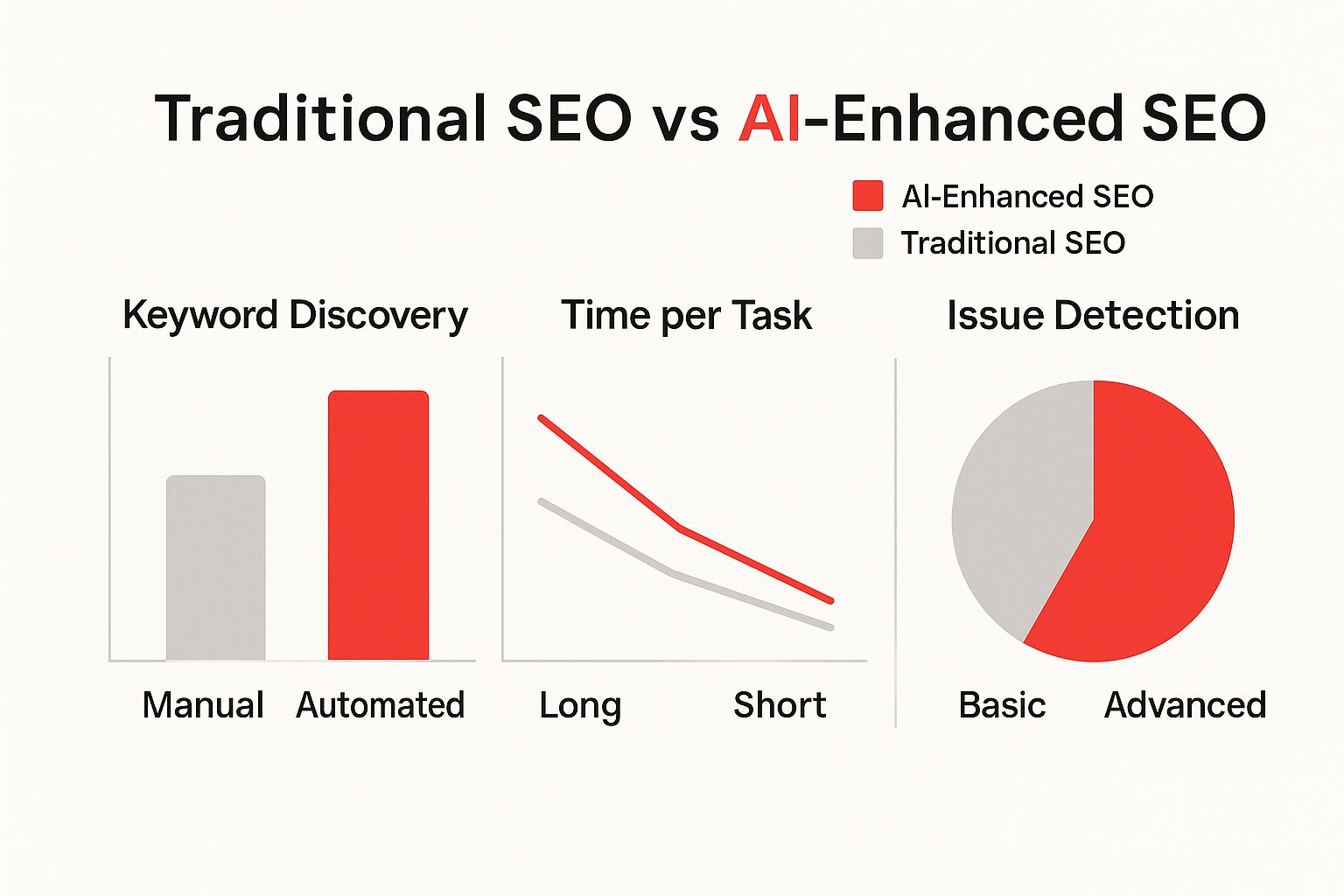
As you can see, it's not just about speed. AI deepens the level of analysis, moving you from simply spotting obvious problems to predictive optimisation that keeps you ahead of the curve.
Practical Applications Across Key SEO Tasks
AI isn’t just a one-trick pony; it has practical uses across the entire SEO spectrum. For example, AI-driven content optimisation tools can scan your draft and compare it against the top-ranking pages for your target keyword. They give you live feedback on how to improve readability, add related topics, and beef up your semantic relevance.
It makes a tangible difference in other areas, too:
- Intelligent Audits: Forget spending days on a technical audit. AI can crawl your entire site in minutes, flagging critical issues like broken links, slow pages, or dodgy schema markup that could be tanking your rankings.
- Predictive Analytics: Some of the more advanced tools use AI to forecast the potential traffic boost from specific content changes or new keywords. This helps you prioritise what to work on for the biggest impact.
- Link Building at Scale: Instead of manually digging for prospects, AI can identify high-authority, relevant websites for backlink opportunities by analysing their traffic and engagement metrics to find the real gems.
This efficiency is why we’re seeing so much investment in the space. Here in Australia, the SEO industry is on track to hit AUD 1.5 billion in market spending in 2025. This growth is being fuelled by AI adoption, with 56% of Australian businesses already using AI-driven SEO tools and reporting benefits like a 23% improvement in how fast they rank for new keywords.
To get a sense of just how different the workflow becomes, let's compare some common tasks side-by-side.
Comparing Traditional SEO vs AI-Powered SEO Tasks
The table below breaks down the difference in efficiency and capability between standard SEO practices and those boosted with AI tools. It shows how AI isn't just a faster way to do old tasks, but a way to achieve a completely different level of depth and scale.
| SEO Task | Traditional Approach | AI-Powered Approach |
|---|---|---|
| Keyword Research | Manually brainstorming, using seed keywords in tools, analysing SERPs one by one. | Analysing thousands of competitor pages and user queries to find clusters, intent, and untapped long-tail opportunities. |
| Content Optimisation | Following a checklist, manually comparing content to top competitors, guessing at semantic relevance. | Real-time analysis against top-ranking pages, with suggestions for topical depth, readability, and NLP terms. |
| Technical SEO Audit | Manually running crawls, sorting through large data exports, and prioritising issues based on experience. | Automated site crawls that instantly flag and categorise critical errors, often with predictive impact scores. |
| Link Building | Manually searching for relevant sites, vetting domain authority, and guessing at outreach potential. | Identifying contextually relevant backlink prospects based on traffic, engagement, and content analysis. |
| Performance Reporting | Pulling data from multiple sources (Analytics, Search Console), compiling into spreadsheets, and interpreting trends. | Integrating data sources to generate automated reports with predictive forecasting and actionable insights. |
What this shows is a clear evolution. The traditional approach relies heavily on manual labour and interpretation, while the AI-powered approach automates the data-heavy lifting, freeing up the strategist to focus on the bigger picture.
The goal of using AI for SEO is not to replace the strategist but to equip them with better data. It turns guesswork into data-backed decisions, ensuring your strategy is always aligned with what search engines and users want.
Ultimately, this technology gives you the power to build a more resilient and effective online presence. For some hands-on advice, check out these actionable strategies to rank in AI search results to start increasing your visibility. This is especially crucial for online stores, which is why our specialised eCommerce SEO services are built to integrate these methods from the ground up.
Choosing the Right AI SEO Tools for Your Business
Navigating the bustling marketplace of AI for SEO tools can feel a bit much. With a new platform popping up almost every week, it’s tough to sort the genuine game-changers from the fleeting trends. But here’s the thing: making the right choice isn’t about chasing the newest, shiniest object. It’s about matching the right tech to your specific business goals, budget, and how your team already works.
Think of it like building a specialised toolkit. You wouldn’t use a sledgehammer to hang a picture frame, would you? In the same way, you don’t need a massive, enterprise-level platform just to do some simple content optimisation. The key is to really understand what each tool does best and figure out how it lines up with what you actually need. Getting this right means you’ll make a smart, informed decision that delivers a real return on your investment.
Categorising Your AI Tool Options
To cut through the noise, it helps to group these tools by what they're built for. Broadly, they fall into a few key categories, each designed to tackle a different part of the SEO puzzle.
-
All-in-One Platforms: These are the Swiss Army knives of the SEO world. Tools like Semrush and Ahrefs offer a huge array of features, from AI-powered keyword research and competitor analysis to site audits and content brief generation. They're a great fit for agencies or businesses that want a single solution to manage their entire SEO strategy from one place.
-
Specialised Content Tools: Platforms like SurferSEO or Jasper are laser-focused on content creation and optimisation. They use AI to analyse the top-ranking pages for a given keyword and spit out actionable recommendations to improve your drafts, making sure they’re semantically rich and perfectly aligned with search intent.
-
Technical SEO Automators: Tools in this camp, such as Sitebulb or Deepcrawl, use AI to run deep technical audits at scale. They can automatically find and prioritise issues like crawl errors, broken links, and schema problems that could be quietly holding your site back.
This screenshot from Semrush gives you a look at a typical dashboard where you can access a bunch of different SEO tools all in one spot.
This kind of interface brings all the key metrics together, making it easy for strategists to get a quick overview of site performance before diving deeper into the weeds.
Making an Informed Decision
Of course, your budget will play a big role, with prices ranging from affordable monthly subscriptions to hefty enterprise contracts. But honestly, the most crucial factor is your specific goal.
Are you desperately trying to scale up content production? Or is your main focus fixing those persistent technical issues that just won't go away? Let your number one objective guide your choice.
Getting on board with these tools is quickly becoming standard practice. In 2025, AI-driven SEO tools are a critical piece of the puzzle for Australian businesses, with around 67% of companies now using platforms like Semrush and Ahrefs. This shift has led to some incredible efficiency gains, with businesses achieving optimisation speeds up to 200% faster than with the old manual methods. For a closer look at this trend, you can explore insights on Australian AI website optimisation.
Right, let's stop thinking about AI tools in isolation and start piecing them together into a proper workflow. This is where you really start to see the magic happen. A structured, repeatable process is what separates the dabblers from the pros, letting you scale up your content production while keeping everything perfectly aligned with what your audience—and Google—actually wants to see.
This isn't about handing the keys over to a robot and hoping for the best. It's about creating a smart partnership. Think of it as a well-oiled assembly line for brilliant content: AI does the heavy lifting at each stage, while a human expert (that's you) oversees quality control. This approach turns the often-chaotic task of content creation into a predictable, high-performance engine for growth.

Step 1: Ideation and Strategic Clustering
Every great piece of content starts with a great idea. But instead of just brainstorming single keywords, we're going to think bigger. Use your AI tools to dig into competitor content, sift through forum discussions, and analyse search trends to find the broad themes your audience is genuinely curious about.
From there, you can ask the AI to map out topic clusters—a central "pillar" topic supported by a series of related "cluster" articles. This isn't just a clever organisational trick; it has two massive benefits:
- It builds topical authority: You're sending a crystal-clear signal to Google that you're an expert on a given subject, not just a one-hit wonder.
- It hooks your readers: You create a logical hub of information that keeps people clicking, exploring, and staying on your site for longer.
For instance, if your pillar topic is "Small Business Accounting," your AI might spit out cluster ideas like "Choosing the Right Accounting Software," "Tax Deductions Every Startup Should Know," and "How to Actually Read a Balance Sheet." Instantly, you've got a content plan, not just a keyword.
Step 2: Data-Driven Content Briefing
With your topics mapped out, the next move is to create a detailed content brief. Honestly, this might be the most important step in the entire process. An AI tool can whip up a comprehensive brief in minutes by analysing what's already ranking at the top of Google for your target keywords.
A great AI-generated brief is your blueprint for success. It strips away all the guesswork, giving your writers a clear, data-backed roadmap to ensure every single piece of content is built to rank from day one.
This isn't just a list of keywords. A solid AI brief should give you:
- Target Keywords: The main keyword you're going after, plus a whole list of secondary and related LSI keywords to sprinkle in.
- Competitor Analysis: A breakdown of the key headings, topics, and angles the top-ranking pages are already covering.
- Word Count & Readability: A target length and reading level based on what's currently winning in the SERPs.
- Internal Linking Suggestions: Smart opportunities to link to other relevant articles on your own site, strengthening your site structure.
Step 3: AI-Assisted Drafting and Human Refinement
Now that you have a rock-solid brief, it's time to let the AI writer loose and generate that first draft. The goal here is pure speed—turning that structured outline into paragraphs of text. This initial output gives you a fantastic foundation and shaves countless hours off the clock compared to staring at a blank page.
But—and this is the crucial part—the human element is non-negotiable. You never, ever publish a raw AI draft. It’s on you, the human editor, to jump in and refine, polish, and enrich the content. Your job is to:
- Fact-check everything: AI can sometimes "hallucinate" facts or pull up outdated information. You need to be the source of truth.
- Inject your brand voice: This is where you add your unique personality, tone, and perspective that no machine can replicate.
- Add real-world insights: Weave in your own original examples, case studies, and expert opinions that an AI simply doesn't have.
This hybrid approach truly gives you the best of both worlds: the lightning speed of a machine combined with the irreplaceable quality and creativity of a human expert.
Common Mistakes to Avoid When Using AI for SEO
Jumping into AI for SEO can feel like you've been handed a superpower, but it's surprisingly easy to get things wrong if you're not careful. The single biggest mistake we see is treating AI as a replacement for human expertise, rather than as a hyper-efficient assistant.
If you’re just blindly publishing whatever an AI spits out, you’re on a fast track to churning out generic articles that lack a genuine brand voice and might even contain factual errors. It's a classic "set it and forget it" trap. AI tools are phenomenal at following instructions, but they can't invent your overarching strategy for you.
Without a human mind guiding the ship, you risk creating content that’s technically optimised but strategically directionless. It won’t connect with your audience or, more importantly, hit your business goals.
The real power of AI in SEO isn't just about automation; it's about augmentation. The goal is to fuse the machine's incredible speed and data-crunching ability with a human's critical thinking, creativity, and strategic insight.
Overlooking the Human Element
Another all-too-common misstep is skipping the final human review. Sure, an AI can draft an article in minutes, but it can’t inject your unique perspective, share a personal story, or make sure every claim perfectly aligns with your brand’s values. This final polish is what separates truly helpful, memorable content from forgettable filler.
This lack of oversight often bleeds into the data side, too. Relying solely on AI-driven insights without cross-referencing information or applying your own intuition can lead to some poor decisions. An AI might flag a keyword with massive search volume, for instance, but miss the crucial nuance that it attracts completely the wrong audience for your product.
To make sure your efforts are actually driving results, it's vital to have solid website conversion tracking in place. This is how you measure whether the traffic from your AI-enhanced content is turning into real leads or sales.
Ultimately, avoiding these pitfalls comes down to one core principle: use AI as a powerful tool within a human-led strategy. Let it do the heavy lifting—the data analysis, the first drafts—but always keep your hands on the steering wheel to guide the final direction, guarantee quality, and infuse your content with that irreplaceable human touch.
Frequently Asked Questions About AI in SEO
Navigating the intersection of artificial intelligence and search optimisation can bring up some important questions. We get asked these all the time, so we’ve put together some clear, direct answers to help you understand this evolving space with confidence.
Will AI Replace SEO Professionals?
Not a chance. Think of AI for SEO as a powerful assistant, not a replacement. It’s brilliant at automating the tedious, repetitive tasks that eat up our time—like churning through mountains of data or spotting keyword patterns.
This frees up human experts to focus on what we do best: strategy, creativity, and the kind of critical thinking an algorithm just can't replicate. The role is simply evolving from a task-doer to a high-level strategist who uses AI tools to make smarter decisions and get better results, faster.
Does Google Penalise AI-Generated Content?
Google's main concern is the quality and helpfulness of the content, not how it was made. Their guidelines are pretty clear: high-quality, helpful content gets rewarded, regardless of whether it was written by a human or created with AI assistance.
The key is to avoid using AI to generate low-quality, spammy content at scale. As long as your AI-assisted content is accurate, original, and gives the reader genuine value, it’s playing by Google's rules.
How Can a Small Business Start Using AI for SEO?
Diving in is easier than you think. A great starting point is to use an all-in-one SEO platform like Semrush or Ahrefs that already has AI features built in.
Start by using AI for keyword research or generating content briefs. These are quick wins that provide immediate value by saving time and sharpening your content's focus. The trick is to avoid trying to automate everything at once. Start small, measure the results, and gradually expand how you use AI as you get more comfortable.
Ready to put the power of AI to work in your SEO and PPC strategies? At Click Click Bang Bang, we build precision-driven campaigns that deliver real results. Discover how our AI-first approach can scale your business by visiting us at https://clickclickbangbang.com.au.
Read NeXt
Or Read Our Latest
- How to Set Up Google Ads in Australia: Complete 2026 Guide
- Google Merchant Center Setup: The Complete 2026 Guide
- Business Manager Setup Facebook: The Complete 2026 Guide
- Google Ads Account Setup: Expert Guide for 2026
- Search Ads Optimisation: A Practical Guide for 2026
- Manual vs Automated Bidding for PPC Success
Click. CLick. Subscribe.
Get our best PPC insights, industry updates, and power moves delivered straight to your inbox. No fluff, just high-caliber strategies that actually work.
Don’t Leave Just Yet
Try Us For 30-Days,
Risk Free!!
We guarantee that you’ll love our work within the first 30 days, if not you’ll get your money back.
What have you got to lose?