

The Attorney SEO Marketing Playbook for Australian Law Firms
Last Updated

Standard SEO advice just doesn't cut it in Australia's fiercely competitive legal market. To get real results with attorney seo marketing, you need a specialised playbook that starts with a rock-solid technical website foundation. This is all about turning your firm’s online presence from a simple digital brochure into a machine that consistently generates new clients.
Building Your Foundation for Digital Dominance
Winning online begins with nailing the basics. For a law firm, that means building your digital practice on solid ground. So many firms pour money into a slick-looking website but completely ignore the technical architecture that Google actually cares about. This is a huge missed opportunity.
Core elements like site speed, mobile-first design, and proper security aren't just fancy extras anymore. They're fundamental trust signals that directly impact your ability to show up when potential clients are searching for your help.
Trying to build a content or advertising strategy without this solid base is like building a house on sand. You need a site that not only looks professional to your clients but is also perfectly clear and easy for search engine crawlers to understand.
The Three Pillars of Legal SEO Success
A powerful attorney SEO marketing strategy is built on three pillars that all work together. Each one supports the others, creating a system that drives visibility, builds credibility, and, most importantly, brings in new client enquiries. If you neglect one, the whole structure gets wobbly, leaving you open to competitors who get it.
Here’s a practical breakdown of what’s involved in a comprehensive attorney marketing plan. We’ve summarised the core pillars, their main goals, and the key tasks for each.
Core Pillars of Attorney SEO Marketing
A summary of the essential components for a successful law firm SEO strategy and their primary objectives.
| SEO Pillar | Primary Objective | Key Activities |
|---|---|---|
| Technical SEO | Ensure the website is fast, secure, and easily crawlable by search engines. | Site speed optimisation, mobile-friendliness, HTTPS security, clean site structure, fixing crawl errors. |
| Local SEO | Dominate local search results and the map pack for geographically-targeted queries. | Google Business Profile optimisation, local citation building, managing online reviews. |
| Content & Authority | Establish the firm as a trusted expert and build credibility through external validation. | Creating service/practice area pages, writing helpful blog content, earning backlinks from reputable sites. |
Getting these three pillars right is the non-negotiable first step to creating a sustainable pipeline of new cases from your website.
This flowchart maps out how a successful campaign flows, starting with the technical groundwork and moving all the way through to building lasting authority.
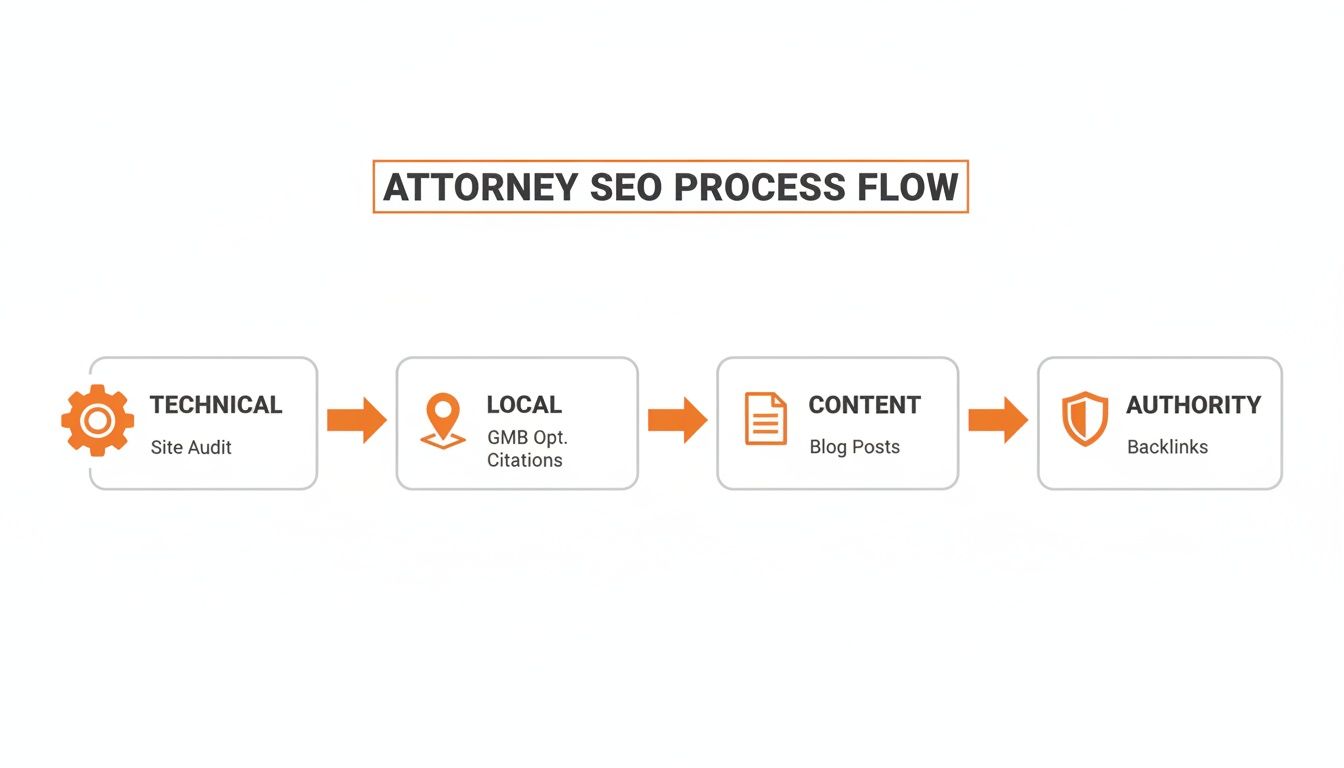
As you can see, each stage builds on the one before it, which is why a holistic strategy is the only way to get sustainable growth.
Seizing the Opportunity in the Australian Legal Market
The good news? The competitive landscape in Australia leaves a huge opening for law firms that are willing to get serious about their digital marketing.
Recent research shows that while 74% of Australian law firms have a website, only a tiny 28% actually invest in professional SEO. That leaves a massive 46% gap—a golden opportunity for firms that commit to a proper optimisation strategy to snap up high-value organic leads that keep coming long after you stop paying for ads.
By dedicating real resources to a structured SEO plan, your firm can effectively jump ahead of the majority of competitors who have a website but no real strategy to make it visible. This isn't just about ranking higher; it's about owning the digital shelf space in your practice area.
If you're just starting to wrap your head around this, a great first step is to read this complete guide on what law firm SEO is. It does an excellent job of breaking down the core concepts every lawyer should understand before investing in a campaign.
You can also dig into our broader guide on search engine optimisation to get a handle on the universal principles that drive real results.
Winning the Local Search Battle in Your Suburb
For most law firms, the big-ticket clients aren't halfway across the country; they're right around the corner, looking for legal help in their own community. Winning the local search battle isn’t just part of your attorney seo marketing strategy—it is the entire game. This is where theory gets real and starts making the phone ring.
It all kicks off with your Google Business Profile (GBP), which is hands down the most powerful local marketing tool you have. Don't think of it as just another directory listing. It's your digital storefront, where potential clients get their first impression of your practice.

Turning Your Google Business Profile Into a Client Magnet
An unoptimised GBP is a massive missed opportunity. To turn it into a genuine client-generation machine, you need to give it the same level of attention you give your actual website. This means going way beyond just plugging in your firm's name and address.
Every single field in your profile needs to be meticulously filled out, making use of every feature Google offers. Think of each section as a chance to build trust and show off your expertise before a prospect even thinks about clicking through to your site.
Here are a few immediate things you can do to make your GBP pull its weight:
- Select Hyper-Specific Categories: Don't just settle for "Law Firm." Get granular. Choose primary and secondary categories like "Family Law Attorney," "Criminal Justice Attorney," or "Personal Injury Attorney." This precision is exactly what helps Google match you with the most relevant, high-intent searches.
- Use the Q&A Feature Proactively: Don't just sit back and wait for people to ask questions. Seed this section yourself. Add common queries you get during initial consults and then post clear, helpful answers. This move instantly positions you as an authority and tackles potential client concerns head-on.
- Publish Regular GBP Posts: Keep your profile fresh by sharing firm news, recent (ethically presented) case results, or links to your latest blog articles. This activity signals to Google that your profile is active and provides new content for local searchers to see.
Your Google Business Profile is a living, breathing entity, not a set-it-and-forget-it listing. Consistent activity, updated information, and real engagement are direct signals to Google about your firm's relevance and authority right there in your local area.
This focus on local intent has never been more critical. The number of 'near me' searches has exploded by over 500% in recent years. With a huge chunk of these searches happening on mobile, being visible in your immediate area is absolutely essential for grabbing clients who are actively looking for a lawyer right now.
Geo-Targeted Content and Consistent Citations
While your GBP is the main event, your website has to back it up. The single most effective way to do this is by creating geo-targeted service pages. So, instead of a generic "Family Law Services" page, you need to build out specific pages like "Family Lawyers Parramatta" or "Criminal Defence Lawyers Geelong."
These pages let you speak directly to the unique concerns of a specific community while zeroing in on valuable, location-based keywords. Sprinkle in mentions of local landmarks, courthouses, or suburb-specific legal issues to build powerful relevance signals for Google. The thinking behind effective localised content is very similar to general strategies for SEO for small businesses, where a tight community focus is everything.
The other piece of this puzzle is building consistent NAP (Name, Address, Phone Number) citations. This just means making sure your firm's core contact details are identical across every online directory, from Yelp and Yellow Pages to industry-specific legal sites. Any inconsistencies create confusion for search engines and can chip away at the trust Google has in your location data.
Think of each consistent citation as a small vote of confidence, confirming your physical address and legitimacy. For a deeper dive into mastering local SEO for specific legal niches, it's worth checking out these Local SEO Family Law Attorney Secrets. That resource is packed with smart tactics you can adapt across different practice areas to really cement your firm's position as the go-to choice in your suburb.
Creating Content That Converts Prospects Into Clients

Getting to the top of Google is only half the battle. The real goal of any sharp attorney seo marketing strategy is to not just attract eyeballs, but to convince the right people that your firm is the best choice to solve their problem. This is where a client-focused content strategy makes all the difference, turning your website from a digital brochure into an active, trust-building powerhouse.
Great content does two things at once. First, it ticks all the boxes for search engines with the right keywords and structure. But more importantly, it answers the urgent, real-world questions of a potential client. It demonstrates your expertise and builds confidence long before they ever think about picking up the phone.
The secret is to ditch the generic legal jargon and create resources that speak directly to a person's actual situation. This means getting clear on two core types of content: your foundational practice area pages and your high-value, supportive blog posts.
Foundational Practice Area Pages
Think of your practice area pages as the core pillars of your website. These are your "money pages," laser-focused on clients who are actively looking to hire a lawyer for a specific need. A page for "Personal Injury Lawyers in Sydney" is a perfect example.
These pages need to be direct, persuasive, and incredibly easy to follow. Their one and only job is to turn a visitor into a lead.
To make them work, they absolutely must include:
- A Clear Value Proposition: Right at the top, state exactly how you help and what makes your firm different. No beating around the bush.
- Answers to Key Questions: Address the immediate concerns people have about the process, what the outcome might be, and potential costs.
- Social Proof: Build instant credibility by featuring client testimonials, case results (ethically, of course), and any awards your lawyers have won.
- Strong Calls-to-Action (CTAs): Use unmissable buttons and simple contact forms prompting visitors to "Request a Free Consultation" or "Call Us Now."
Your practice area pages are your digital sales pitch. They should be written for someone ready to make a decision, giving them every reason to feel confident choosing your firm.
The Pillar and Cluster Content Model
Beyond your core service pages, the best way to build authority and capture a much wider audience is the "pillar and cluster" model. It’s a smart, structured approach to blogging that cements your firm's reputation as a genuine expert.
Here’s the breakdown:
- Pillar Page: Start by creating a massive, ultimate guide on a broad topic within one of your core practice areas. For a family law firm, this could be something like "The Complete Guide to the Divorce Process in New South Wales." This page covers everything, but at a high level.
- Cluster Content: Next, you write a series of shorter, more specific blog posts that each dive deep into a single section of that pillar page. Following our divorce guide example, these cluster posts could be "How Is Property Divided in a Divorce?," "Understanding Child Custody Arrangements," and "What is Spousal Maintenance in Australia?"
- Internal Linking: This is the glue that holds it all together. Every cluster post links back up to the main pillar page, and the pillar page links out to all of its related cluster posts.
This structure creates a tightly organised web of content that screams expertise to Google. It also gives potential clients an incredible resource, letting them explore every angle of their legal issue on your site, which builds a huge amount of trust in the process.
Practical Keyword Research for Real Questions
The fuel for this whole content strategy is keyword research that uncovers what your ideal clients are actually asking. Stop guessing what terms people might use; the data will give you the answer.
Use simple tools to hunt down question-based keywords. Put yourself in the shoes of someone in a stressful situation. Instead of just targeting a broad term like "criminal lawyer," you’ll find high-value queries like:
- "What are my rights if I'm arrested?"
- "How much does a DUI lawyer cost in Melbourne?"
- "Can I get a conviction overturned?"
Every one of these questions is a perfect topic for a cluster blog post. Answering these specific queries directly is the fastest path to demonstrating your firm's E-E-A-T (Experience, Expertise, Authoritativeness, and Trustworthiness). You're not just selling a service; you're providing immediate value and guidance. That's the foundation of any strong client relationship. By building your content around these real questions, you meet potential clients exactly where they are on their journey.
Building Authority with Links and Digital PR
Okay, so your website's technical health is sorted and your content plan is rolling. What’s next? This is where many law firms hit a wall, but it's also where you can carve out a massive competitive advantage: building authority.
Authority, in Google's world, is all about earning high-quality backlinks. Think of them as powerful 'votes of confidence' from other reputable websites pointing back to yours.
Let's be clear: this isn't about old-school, risky tactics like buying links. That's a fast track to getting your site penalised. The modern, sustainable approach is about ethical strategies that build a genuine, defensible online reputation. You’re earning credibility, not trying to game the system.
This is the work that transforms your firm's website from just another online brochure into a recognised authority in its practice area. It's the difference between being an option and being the option.
Link Building for Lawyers That Actually Works
The trick here is to stop thinking like an SEO and start thinking like a public relations pro. Instead of just asking for links, you need to create reasons for other websites to want to link to you. For a law firm, that means packaging up your legal expertise into something valuable for a wider audience.
Here are a few proven, ethical strategies that are a perfect fit for the legal profession:
- Create Link-Worthy Legal Guides: Go deep. Develop comprehensive, well-researched guides on complex legal topics your clients care about. A detailed resource on "Navigating Commercial Lease Agreements in Victoria" is far more likely to get linked to by business publications and industry blogs than a standard service page.
- Offer Expert Commentary (Digital PR): Journalists and bloggers are constantly on the hunt for expert sources to add weight to their articles. By offering your legal take on current events or industry trends, you can land powerful backlinks from news sites and high-authority publications.
- Sponsor Local Community Events: This one's a classic for a reason. Sponsoring a local charity fun run, a school fete, or a community business awards night often comes with an authentic, high-value backlink from the event's website. These links are gold for building local relevance and showing you’re invested in the community.
The most valuable backlinks are earned, not bought. They are the natural outcome of creating genuinely useful content and being an active participant in your community, both online and off.
Getting Strategic with Digital PR
Digital PR is easily one of the most potent authority-building tools for lawyers. It's the process of actively reaching out to media outlets and offering your expert opinion, positioning you as a thought leader and generating backlinks that seriously boost your site's credibility with Google.
Here’s a real-world example: a major data breach hits the news. A privacy lawyer could pitch commentary to a tech publication on the legal fallout for consumers. When the article is published, it will likely feature a quote from the lawyer and—crucially—a link back to their firm's website. A single link like this from a respected news source is often worth more than dozens of low-quality directory links combined.
The Power of Local Links
While links from national news sites are fantastic, don't sleep on the power of your local connections. Google pays close attention to local signals, so earning links from other businesses, organisations, and institutions in your city or region is hugely important for your local search rankings.
Start by thinking about the relationships your firm already has. Do you work with accountants, real estate agents, or financial planners who might link to a relevant guide on your site? Have you provided pro bono services for a local charity that could add you to their partners page?
These existing connections are often link-building goldmines just waiting to be tapped. Every authentic local link reinforces to Google that you're a legitimate, respected member of your local business community, which directly helps you win those critical "near me" searches.
Using Paid Search to Accelerate Your SEO Wins
Why wait months for your organic SEO efforts to bear fruit when you can start landing high-intent clients today? That’s the core question a smart paid search strategy answers. Weaving Google Ads into your attorney seo marketing plan isn’t about picking one channel over the other; it’s about creating a powerful synergy where both work together for faster results and sharper insights.
While your long-term SEO is busy building foundational authority, paid search acts as a powerful accelerant. It lets you instantly show up at the top of the search results for your most valuable keywords—think "personal injury lawyer Sydney"—putting your firm right in front of people actively looking for legal help right now. This immediate visibility is a game-changer for maintaining a steady stream of leads while your organic rankings climb.
The real strength of this combined approach, though, is how the two channels feed each other. Think of your paid search campaigns as a real-time data laboratory for your entire SEO strategy.

Structuring Campaigns for Maximum Impact
Generic, one-size-fits-all campaign setups are a complete waste of money for law firms. The secret is granularity. You need to structure your Google Ads account to mirror your firm's specific practice areas, creating distinct ad groups for each service you offer.
A family law practice, for instance, should have separate ad groups for "divorce lawyers," "child custody solicitors," and "property settlement agreements." This isn't just organisational tidiness; it’s a strategic necessity.
This structure lets you write hyper-specific ad copy that speaks directly to the searcher's exact problem, leading to higher click-through rates and better Quality Scores. It also means you can send traffic to the most relevant landing page on your site, creating a seamless user experience that actually encourages conversions.
A massive part of this is the aggressive use of negative keywords. You have to be ruthless in preventing your ads from showing up for irrelevant searches. A criminal defence firm, for example, must add negative keywords like "pro bono," "free," and "jobs" to stop wasting its budget on clicks that will never, ever turn into clients.
Using PPC Data to Supercharge Your SEO
This is where the magic really happens. Your paid search campaigns will generate a treasure trove of data on what actually works in the real world. You’ll quickly find out which keywords are driving the most qualified leads and which ad copy variations get the most clicks and conversions.
This data is pure gold for your SEO content strategy.
- Discover High-Converting Keywords: If your PPC data shows that "emergency intervention order lawyer" converts like crazy, that’s a massive signal. It's time to create a detailed service page or blog post optimised for that exact term.
- Refine Your On-Page SEO: The ad copy that performs best in your campaigns often reveals the headlines and meta descriptions that will resonate most with searchers in organic results. Use these winning phrases to improve the click-through rates of your organic listings.
- Identify New Content Opportunities: Your search query reports will uncover the precise language and questions potential clients are using. These queries are an endless source of ideas for new blog posts and FAQ sections that answer real-world questions.
Think of your PPC spend as an investment in market research. It gives you immediate, real-world feedback on what your ideal clients are looking for, allowing you to fine-tune your organic strategy with hard data, not just guesswork.
SEO vs PPC Synergy for Law Firms
Combining SEO and PPC isn't just about covering all your bases; it's about making each channel stronger. The data from one informs the other, creating a feedback loop that drives better performance across the board. Here’s a quick breakdown of how they work together.
| Aspect | SEO (Organic) | PPC (Paid) | Synergistic Benefit |
|---|---|---|---|
| Speed to Results | Long-term (months to years) | Immediate (minutes to hours) | PPC provides instant leads while SEO builds sustainable, long-term authority. |
| Cost | "Free" clicks but requires investment in content & expertise. | Pay-per-click, budget-controlled. | SEO lowers long-term cost-per-acquisition; PPC can be scaled up or down as needed. |
| Keyword Insights | Identifies broad traffic opportunities. | Tests keyword conversion rates with real money. | PPC data validates which keywords are commercially viable, focusing SEO efforts on terms that convert. |
| Testing Ability | Slower; requires waiting for rankings to change. | Rapid A/B testing of ad copy, offers, and landing pages. | Winning ad copy and headlines from PPC can be directly applied to SEO titles and meta descriptions to boost organic CTR. |
| Visibility | Earned visibility in organic results. | Paid visibility at the top of the page. | Occupies more SERP real estate, increasing brand visibility and pushing competitors down the page. |
This blended approach ensures your firm is visible at every stage of a potential client's journey, from initial research to the moment they need to hire a lawyer.
This isn’t just a theoretical advantage; it has a measurable impact on the bottom line. Research consistently shows that businesses integrating SEO and PPC see around 25% more clicks and 27% higher profits than those relying on a single channel. This is especially true for Australian law firms in hyper-competitive metro areas where immediate visibility is non-negotiable.
Ultimately, combining paid search with your organic SEO ensures you are visible everywhere it matters. For a more detailed breakdown on building effective campaigns, check out our guide on how to optimise Google Ads. This integrated strategy will maximise your lead flow and deliver a far greater return on your marketing investment.
Your Attorney SEO Marketing Questions Answered
When it comes to putting real money into a proper attorney SEO marketing strategy, it's completely normal to have questions. This is a significant commitment, and you need to know what you’re getting into. Let's tackle some of the most common queries we hear from Australian legal professionals.
How Long Does SEO Take to Work for a Law Firm?
This is usually the first question on everyone's mind. The honest answer is that SEO is a long-term investment in your firm's digital assets, not an overnight fix for an empty diary.
In hyper-competitive Australian legal markets like Sydney or Melbourne, you should expect to see significant, measurable results within 6 to 12 months. That said, you won't be flying blind for half a year. Early signs of progress—like ranking improvements for less competitive search terms and a noticeable uptick in organic traffic—often appear within the first 3 to 6 months.
Of course, this timeline depends on a few things:
- Market Competitiveness: Trying to rank for "personal injury lawyer" in a major city is a whole different ball game than "conveyancing solicitor" in a regional town.
- Website Health: If your site is bogged down with technical issues, we need to sort out that foundation before we can start climbing the ranks.
- Strategy Intensity: How consistently we’re creating quality content and building your firm’s authority online plays a huge role.
Think of it as building a valuable, lead-generating asset for your practice, not just flipping a switch.
How Much Should a Law Firm Budget for SEO in Australia?
SEO investment for Australian law firms can vary quite a bit. A firm in a smaller regional area might budget between $2,000 to $4,000 AUD per month for a solid, well-run campaign.
However, for firms in major metro areas targeting high-value practice areas (think personal injury, family law, or commercial litigation), a realistic budget to actually compete and win starts at $5,000 and can easily exceed $10,000 AUD per month.
A proper SEO budget isn't just an expense; it's an investment in a predictable client acquisition channel. It should cover everything: technical SEO, high-quality content, local SEO management, and strategic link building.
What Are the Most Important SEO Metrics to Track?
It’s easy to get lost in a sea of data. Chasing vanity metrics like keyword rankings alone can be seriously misleading. The key performance indicators (KPIs) that truly matter are the ones tied directly to your firm's bottom line.
Here’s what you should be focused on:
- Organic Traffic Growth: Is your overall visibility increasing month-on-month?
- Lead Quality and Volume: How many qualified phone calls and form submissions is your SEO actually generating?
- Conversion Rate: What percentage of those organic visitors are turning into genuine enquiries?
- Local Visibility: For local firms, you absolutely need to track your rankings in the Google Maps pack and the number of "click-to-call" actions coming from your Google Business Profile.
These metrics give you a clear, no-fluff picture of your return on investment and the real-world impact of your attorney SEO marketing efforts.
In-House SEO or Hiring an Agency?
This really comes down to your firm's internal resources, expertise, and focus. Managing SEO in-house demands a dedicated person with deep, current knowledge of search algorithms, technical SEO, content strategy, and link building—that's a rare and expensive skill set to find in one person.
For the vast majority of law firms, partnering with a specialised legal SEO agency is far more effective and cost-efficient. A good agency brings a team of specialists, proven systems, and advanced tools that are nearly impossible to replicate in-house. They already understand the unique challenges and advertising rules of the legal industry, letting you focus on what you do best: practising law.
Ready to build a client acquisition engine that delivers predictable results? At Click Click Bang Bang, we specialise in data-driven SEO and PPC strategies for ambitious firms. Start your 30-day risk-free trial and see the difference a specialised agency can make.
Read NeXt
Or Read Our Latest
- Manual vs Automated Bidding for PPC Success
- Conversion Tracking Setup: A Complete AU Guide
- Instagram Advertising Australia: Complete 2026 Guide
- Pay Per Click: A Beginner’s Guide for Australian Marketers
- Display Advertising on Google: The Complete Australian Guide
- Stakeholder Communication Plan How to Build One That Works
Click. CLick. Subscribe.
Get our best PPC insights, industry updates, and power moves delivered straight to your inbox. No fluff, just high-caliber strategies that actually work.
Don’t Leave Just Yet
Try Us For 30-Days,
Risk Free!!
We guarantee that you’ll love our work within the first 30 days, if not you’ll get your money back.
What have you got to lose?