

A Practical Guide to Content Marketing for Agencies
Last Updated

Content marketing for agencies isn't just about churning out blog posts. It's the art of creating genuinely valuable content that pulls in, hooks, and keeps the right audience—ultimately, making them want to become clients.
Think of it as showcasing your agency's deep expertise through articles, sharp case studies, and insightful reports. It shifts your team's role from just another service provider to a trusted advisor. This is how you build serious brand authority and keep a steady stream of qualified leads knocking on your door.
Building Your Agency's Content Foundation
A winning content marketing strategy doesn't start with a clever idea for a blog post. It begins with a rock-solid foundation. Far too many agencies dive straight into creating content that feels random, disconnected, and ultimately fails to move the needle. A solid plan ensures every single asset you create serves a clear purpose that’s tied directly to your business goals.
This groundwork requires a bit of soul-searching and a hard look at the market. It’s about getting crystal clear on not just what you do, but who you serve best and why they should pick you over everyone else.
Define Your Ideal Client Profile
Before you write a single word, you have to know exactly who you're talking to. And I mean going way beyond basic demographics like industry or company size. You need to build out a detailed Ideal Client Profile (ICP) that gets into the nitty-gritty of their real-world headaches and goals.
- What are their biggest professional pain points? Are they wrestling with poor-quality leads, seeing terrible ROI from their ad spend, or just don't have the expertise in-house?
- What does a big win look like for them? Are they chasing ambitious revenue targets, trying to grab more market share, or just desperate for better brand recognition?
- Where do they go for answers? Are they scrolling through LinkedIn, reading specific industry publications, or are they regulars at certain conferences?
Answering these questions transforms your content from generic background noise into a targeted solution for a real person's problems. This deep understanding is the first, most crucial step in creating content that actually connects and converts.
Analyse the Competitive Landscape
Next, it's time to size up the competition. The goal here isn't to copy what they're doing, but to find the gaps they've missed. A smart competitive analysis helps you uncover a unique angle for your agency's voice.
Look for holes in their content. Are they all just publishing high-level, generic blog posts? That could be your chance to go deep with data-driven reports. Are they completely ignoring video? That might be a channel you can own. This analysis is absolutely critical for setting your agency apart and carving out your own space. For any agency looking to build a strong content foundation, developing a robust content strategy is non-negotiable.
Building your content foundation should follow a clear path from initial research, to strategic planning, and finally to identifying your core pillars.
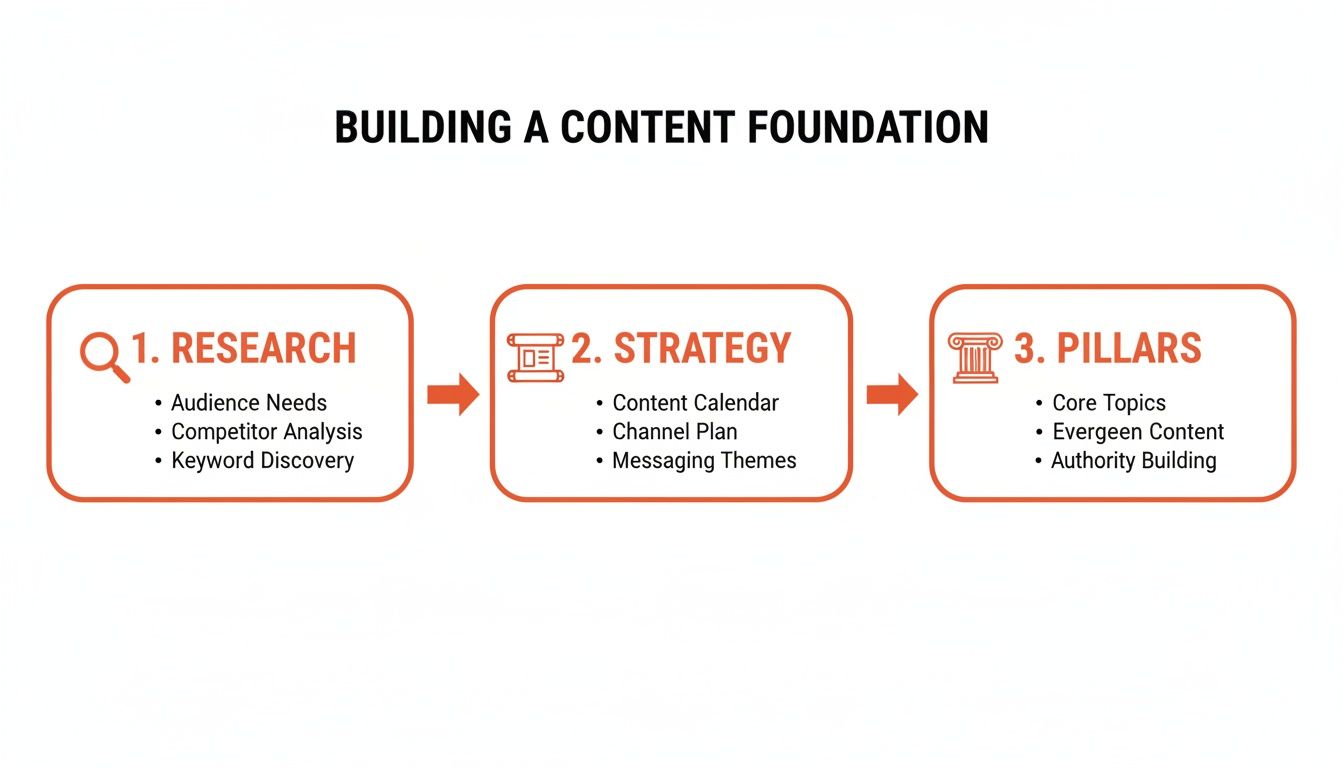
This structured approach is what separates content that's just creative from content that's purposeful and directly supports your agency's growth.
Establish Your Core Content Pillars
Once you have a sharp understanding of your audience and the competitive playing field, you can define your content pillars. These are the 2-4 core themes your agency is going to absolutely own. Your pillars should live at the sweet spot where your clients' biggest problems meet your agency's unique expertise.
To bring this to life, here’s a simple framework outlining what a focused content strategy should cover.
Core Components of an Agency Content Strategy
| Component | Objective | Key Actions |
|---|---|---|
| Ideal Client Profile (ICP) | To define the target audience with precision. | Conduct interviews, analyse client data, and create a detailed persona document outlining pain points and goals. |
| Competitive Analysis | To identify market gaps and opportunities. | Audit competitor content, identify their strengths and weaknesses, and find a unique angle for your agency. |
| Content Pillars | To establish thematic focus and authority. | Select 2-4 core topics that align with both client needs and your agency's expertise. |
| Brand Voice & Tone | To ensure consistent and recognisable messaging. | Create clear guidelines on how the agency communicates, including personality, language, and style. |
| Business Goals | To align content with tangible outcomes. | Set specific, measurable goals like lead generation targets, brand awareness metrics, or sales pipeline influence. |
This framework isn't just a checklist; it's a strategic map. Following it ensures every piece of content you produce is intentional, targeted, and working towards a real business outcome.
For example, a PPC agency might settle on pillars like "Advanced Google Ads Tactics," "E-commerce Conversion Optimisation," and "B2B Lead Generation." Every piece of content they create—from a blog post to a webinar—should fit neatly under one of these pillars.
This focused approach is also a cornerstone of any successful https://clickclickbangbang.com.au/search-engine-optimisation/ strategy, as it helps you build authority and rank for valuable keywords over time. It's about playing the long game.
This kind of disciplined planning has moved from a "nice-to-have" to a standard practice. As of 2025, an estimated 74% of Australian businesses now have a documented content marketing strategy. That’s a huge jump, signalling just how much the field has professionalised.
Creating Content That Wins Clients

Alright, with your strategy locked in, it's time to shift gears to production. This is where the magic happens—turning all those abstract ideas into tangible assets that actually attract, engage, and convert prospects into paying clients. The real trick is building a content engine that consistently pumps out high-quality, valuable resources without burning out your team.
Effective content creation isn’t just about being a good writer. It's about knowing which formats will solve your ideal client's problems most effectively. For B2B decision-makers, that usually means going deeper than surface-level blog posts and creating something with real substance and authority.
Choosing Formats That Demonstrate Expertise
Not all content is created equal, especially in the agency world where proving your expertise is everything. Your goal isn't just to write about a topic; it's to create an asset a potential client can genuinely use to solve a problem. Do that, and you become an indispensable resource long before a contract is ever signed.
Here are the formats that we see deliver the goods for agencies, time and time again:
- Deep-Dive Guides and Whitepapers: These long-form monsters let you properly unpack a complex topic tied to one of your content pillars. For example, an SEO agency could create "The Ultimate Guide to Technical SEO for E-commerce Sites." It's a beast to produce, but it offers immense value and captures highly qualified leads.
- Data-Driven Reports: Nothing screams "authority" like original research. Surveying your clients or analysing your own proprietary data can lead to a unique report like, "The State of LinkedIn Advertising for SaaS in 2025." This kind of asset gets shared, cited, and positions you as a primary source of industry insights.
- Compelling Case Studies: A well-told success story is still one of your most powerful sales tools. But don't just list results. Structure your case studies like a story: outline the client’s initial challenge, walk through your strategic approach, and then—bam—showcase the impressive, quantifiable results.
- Actionable Webinars: Webinars give you a direct line to your audience, letting you teach them something valuable in real time. A 45-minute session on "How to Cut Your Google Ads Spend by 30% Without Losing Leads" provides immediate value and builds a huge amount of trust.
These formats work because they go beyond telling prospects you're an expert; they show them. This is the very core of effective content marketing for agencies—demonstrating value, not just claiming it.
Building a Practical Editorial Calendar
An editorial calendar is the operational heart of your content strategy. It’s what turns your big-picture goals into a day-to-day, actionable plan, ensuring a steady stream of content without all the last-minute panic. A good calendar is way more than just a list of dates; it's a strategic document.
A common mistake is treating the editorial calendar as a simple to-do list. Instead, view it as your command centre for aligning content with business objectives, assigning clear ownership, and tracking every asset from idea to publication and promotion.
At a minimum, your calendar should track this key info for each piece:
- Topic Title: The working headline.
- Content Pillar: Which core theme does it support?
- Target Keyword: What’s the primary SEO keyword you're chasing?
- Format: Is it a blog post, case study, or webinar?
- Author/Owner: Who is responsible for getting it done?
- Status: (e.g., Ideation, Drafting, Review, Published)
- Publish Date: The target go-live date.
This structured approach brings predictability and accountability to your content process. It transforms what can be a chaotic creative exercise into a reliable, repeatable growth driver.
Integrating AI to Enhance Creativity, Not Replace It
The rise of AI has thrown a massive opportunity our way to scale content production, but let's be clear: its real value is in augmenting human creativity, not replacing it. Think of AI as a creative partner that can handle the tedious stuff, freeing up your team to focus on what they do best—high-level strategy and deep-domain expertise.
AI can be a seriously powerful assistant for tasks like:
- Brainstorming and Ideation: Use tools like ChatGPT or Gemini to spit out dozens of blog post ideas, headline variations, or interesting angles on a topic in minutes.
- Creating Outlines: Give it a topic and a target audience, and AI can generate a logical structure for a guide or whitepaper. Your expert can then come in and flesh it out with their unique insights and experience.
- Drafting First Versions: AI can produce a solid first draft of a blog post or social media update, which your team then edits, refines, and injects with your agency's unique voice and perspective.
The 2024 State of Marketing AI Report found that marketers who use AI effectively report significant reductions in time spent on repetitive tasks. For an agency, this translates to more time for client strategy and building relationships. The golden rule, though, is to maintain strict human oversight. Every piece of AI-assisted content must be fact-checked, edited for brand voice, and, most importantly, enriched with genuine human experience.
Mastering Content Distribution and Promotion

Creating an exceptional piece of content is only half the battle. Seriously. The most insightful whitepaper or compelling case study is worthless if it never actually reaches the decision-makers you want to influence.
This is a classic sticking point for many agencies. They treat promotion as an afterthought rather than a core part of the content strategy from day one.
It’s time to ditch the old "publish and pray" approach of just dropping a link on social media and hoping for the best. To succeed with content marketing for agencies, you need to build a powerful, multi-channel distribution machine. One designed to get your expertise in front of ideal clients, consistently and effectively.
Building Your Owned Distribution Channels
Your owned channels are the assets you control completely. This makes them the most reliable way to build relationships and nurture leads over the long haul. Think of them less as broadcast platforms and more as tools for building a loyal audience that genuinely trusts your agency’s insights.
At the very top of this list is your email newsletter. It's your direct line to prospects who have already raised their hand to say they’re interested. Your job is to treat it not as a sales tool, but as a source of exclusive, high-value content that helps them do their job better.
Then there’s your blog, which should be your engine for long-term SEO visibility. Every single guide, report, and article you publish needs to be engineered to rank for keywords your ideal clients are actively searching for. Get this right, and your website becomes a passive lead generation machine that works for you around the clock.
Engaging in Niche Online Communities
Here’s a secret: your ideal clients are already gathered in specific online communities, discussing the very problems your agency solves. Your job is to find these digital watering holes and participate authentically. This isn't about spamming links to your latest blog post; it's about adding real, tangible value.
- LinkedIn Groups: Identify and join the groups relevant to your target industries. Don’t just post—answer questions, share unique insights from your experience, and become a recognised expert.
- Industry Forums and Slack Channels: Find the specialised communities where practitioners hang out. For instance, a marketing agency targeting startups should be a regular in SaaS growth hacking forums.
- Quora and Reddit: Monitor these platforms for questions related to your content pillars. Provide detailed, helpful answers and only then, subtly link back to your content for those who want to dive deeper.
By consistently showing up and being genuinely helpful in these communities, you build brand affinity and trust. When someone in that community eventually needs agency services, yours will be the first name that comes to mind.
This approach transforms distribution from a simple broadcast activity into a targeted, relationship-building exercise.
Amplifying Reach with Strategic Paid Promotion
Organic reach is great, but it can only take you so far. To guarantee your most important content gets the attention it deserves, you need to put a smart, targeted budget behind it. This is where paid promotion becomes an indispensable part of your content marketing toolkit.
LinkedIn Ads, in particular, are incredibly powerful for B2B agencies. You can target users with surgical precision based on their job title, company size, industry, and even seniority. This allows you to place your best assets—like a data-driven report or an upcoming webinar—directly in the feed of the exact marketing director or CEO you want as a client.
The investment in paid channels is reflected across the market. The total Australian digital advertising market hit AU$19.9 billion in 2024, with social media advertising alone accounting for AU$4.26 billion. These figures highlight the massive shift towards content-led campaigns on paid platforms. You can learn more by exploring the latest research on Australian social media statistics from Meltwater. A well-managed paid campaign can drastically accelerate your results, and if you need the expertise, professional Google Ads management can be a game-changer for amplifying your best content.
The Power of Content Repurposing
Never, ever let a great piece of content be a one-hit wonder. A single cornerstone asset—like a detailed report or webinar—can be strategically repurposed into dozens of smaller pieces. This extends its lifespan and reaches different segments of your audience across various platforms. It's the absolute key to maximising your return on every content investment.
Think of it as creating a content ecosystem.
- Start with a Cornerstone Asset: Your comprehensive webinar or in-depth industry report is the sun in your solar system.
- Break It Down: Turn the webinar into a series of short, punchy video clips for LinkedIn and YouTube.
- Extract Key Insights: Create a carousel post for Instagram highlighting the most compelling stats from your report.
- Write Supporting Articles: Develop blog posts that dive deeper into specific sub-topics you only touched on in the original piece.
- Design an Infographic: Visualise the key data points from your report for easy sharing on Pinterest and other social channels.
This multi-faceted approach ensures you get maximum mileage from your best ideas, turning one major effort into a sustained campaign that engages your audience at every touchpoint.
Measuring What Matters and Proving ROI

If you can't measure it, you can’t improve it. And you certainly can't prove its value to clients or your own leadership team. For agencies, demonstrating a clear return on investment (ROI) is what separates content marketing from a 'nice-to-have' expense into an essential driver of growth.
It’s time to get brutally honest about our metrics. Impressive page view numbers and a flurry of social media likes might feel good, but they don't directly translate to revenue. The real mission is to draw a straight line from your content efforts to tangible business outcomes. That means tracking the numbers that signal genuine commercial intent and actually move the needle on the sales pipeline.
Moving Beyond Vanity Metrics
The first step is a conscious shift away from superficial numbers. We need to focus on key performance indicators (KPIs) that are truly actionable. A vanity metric makes you look busy, but an actionable KPI gives you the clarity to make smarter decisions.
This distinction is everything. An uptick in website traffic is nice, but knowing a specific whitepaper generated 10 high-quality sales calls is powerful. That's the kind of data that justifies budgets, validates your strategy, and proves your worth.
Let's break down the difference.
Key Content Marketing KPIs for Agencies
It’s easy to get lost in a sea of data. This table cuts through the noise, showing you which metrics to ignore and which to obsess over.
| Metric Category | Vanity Metric (Avoid) | Actionable KPI (Track This) | Why It Matters |
|---|---|---|---|
| Lead Generation | Total Form Submissions | Marketing Qualified Leads (MQLs) | MQLs filter for prospects who actually fit your ideal client profile, indicating much higher quality and sales-readiness. |
| Sales Impact | Content Downloads | Content-Influenced Pipeline | This tracks the total value of sales opportunities where the prospect engaged with your content, directly tying marketing to revenue. |
| Audience Engagement | Page Views | Scroll Depth & Time on Page | These metrics show if readers are genuinely consuming your content, not just clicking and bouncing away immediately. |
| Financial Health | Cost Per Lead (CPL) | Client Acquisition Cost (CAC) | CAC gives you the complete picture of what it costs to land a new paying client—the ultimate measure of financial efficiency. |
By prioritising the KPIs in that right-hand column, you start telling a compelling story about revenue and growth, not just website activity. You reframe the entire conversation around the financial impact of your work.
Setting Up Your Measurement Framework
To track these meaningful metrics, you absolutely need an integrated system. Your website analytics must talk to your customer relationship management (CRM) platform. It's the only way to close the loop between someone reading a blog post and that person becoming a paying client.
Your setup should empower you to answer critical questions like:
- Which blog posts are generating the most MQLs?
- What was the first piece of content a new client engaged with?
- What is the average pipeline value of a lead that comes from our webinar series?
Tools like Google Analytics 4 (GA4) are non-negotiable for tracking on-site behaviour. Your CRM—whether it's HubSpot or Salesforce—is where you connect that behaviour to actual leads and deals. The first job is setting up conversion goals in GA4 for key actions, like a case study download or a demo booking.
The real breakthrough happens when you can attribute closed-won deals back to the specific content that influenced them. This is the holy grail of content ROI, turning your marketing function from a perceived cost centre into a proven revenue engine.
Building Reports That Communicate Value
Once you're tracking the right data, the final piece of the puzzle is presenting it in a way that resonates. A cluttered spreadsheet isn’t going to cut it with your agency’s leadership or your clients. You need a clean, visual dashboard that tells a compelling story at a glance.
Your report should hammer home the connection between content activities and financial results. Instead of just showing a list of published articles, showcase the pipeline value they influenced or the MQLs they generated. For agencies struggling to visualise this, exploring different marketing KPI dashboard examples can provide some fantastic inspiration for building reports that stakeholders will actually understand and appreciate.
Ultimately, measuring what matters is about accountability. It's about taking ownership of business outcomes and proving, with hard data, that your agency's content marketing is a powerful investment in sustainable growth.
How to Scale Your Agency's Content Operations
There comes a point when your content marketing starts working really well. All of a sudden, you’ve got a fantastic new problem: more ideas than you can possibly execute and more demand than your team can handle.
This is the scaling challenge. How do you ramp up your output without the quality taking a nosedive or burning out your best people? The trick is to move from an ad-hoc, scrappy process to a structured, repeatable system. It all comes down to smart decisions about your team, your processes, and the tech you use to support them. Get this right, and you're building a content engine that can drive sustainable growth for years to come.
The Australian content marketing space is getting bigger and more competitive. The local market is estimated to be worth around AU$453.2 million and it's growing steadily. This means more opportunities, but it also means agencies need to be incredibly efficient to stand out. If you want to get a better sense of this landscape, you can dig into the latest findings on Australian content marketing trends.
Building Your Content Team: In-House vs. Outsourcing
One of the first big calls you'll have to make is whether to hire full-time staff or build out a network of reliable freelancers and contractors. There's no single right answer here; it really depends on your agency's specific needs, budget, and where you see yourself in a few years.
Hiring In-House:
- The upside: Team members live and breathe your agency's culture and your clients' strategies. This leads to much better brand consistency and allows you to develop deep subject matter expertise over time.
- The downside: It’s a serious financial commitment. The hiring process can be a slog, and you have less flexibility to scale up or down quickly based on project flow.
Building a Freelance Network:
- The upside: You get instant access to a massive pool of specialised talent—from niche technical writers to slick video editors—on a flexible, as-needed basis. It's often more cost-effective and lets you adapt to changing client demands in a flash.
- The downside: Keeping the brand voice tight and maintaining quality control can be a real headache. It demands top-notch project management and crystal-clear documentation to keep everyone on the same page.
A hybrid model is often the sweet spot for growing agencies. Keep your core strategic roles, like the Head of Content or a Content Strategist, in-house. Then, outsource the specialised or high-volume creation tasks to a vetted pool of freelancers you trust.
Developing Your Standard Operating Procedures (SOPs)
As your team gets bigger, you can't rely on informal chats in the hallway to keep everyone aligned anymore. Standard Operating Procedures (SOPs) are the antidote to chaos. Think of them as detailed, written playbooks that outline exactly how to execute key content tasks, ensuring consistency and quality no matter who's doing the work.
Your content SOPs should cover:
- Content Briefing: A rock-solid template detailing the goal, audience, keywords, and key messages for every single piece of content. No ambiguity.
- Brand Voice and Style Guide: Clear rules on tone of voice, grammar, and formatting so every piece sounds like it came from your agency.
- Review and Approval Workflow: A step-by-step process outlining who reviews what, what they’re looking for, and how feedback is managed.
- SEO Checklist: A non-negotiable list for on-page optimisation that has to be ticked off before anything goes live.
These documents aren't meant to kill creativity. Quite the opposite. They provide a reliable framework that frees up your team to focus on doing what they do best: producing amazing work, confident that all the foundational bits are already handled.
Leveraging Automation and Technology
Scaling isn't just about throwing more people at the problem; it’s about making your existing team more efficient. The right technology and automation are your best friends for streamlining the repetitive, low-value tasks that bog down your operations.
Look at tools that can help you automate:
- Project Management: Platforms like Asana or Trello can automate task assignments and deadline reminders, keeping your editorial calendar humming along without constant nagging.
- Content Distribution: Social media scheduling tools can automatically push out your content across multiple platforms, saving hours of mind-numbing manual work every week.
- Performance Reporting: Many analytics platforms can be set up to auto-generate and email weekly or monthly performance reports, keeping stakeholders in the loop without you lifting a finger.
By automating these processes, you unlock your team's time to focus on the high-value stuff—strategy, analysis, and creative development. These are the things that actually drive results for your agency.
Expanding Into New Content Formats
Finally, as you start scaling your operations, you earn the right to strategically expand beyond just the written word. Once you’ve built some momentum, you can deepen engagement by exploring new formats that play to different strengths.
Podcasts, for instance, are a brilliant way to build a more personal connection with your audience and showcase your team's expertise through interviews and casual discussions. In the same way, a well-produced video series or a recurring webinar can cement your agency's status as the go-to educational resource in your niche.
The key is to be intentional. Don't start a podcast just because it feels like the cool thing to do. Make sure it aligns perfectly with your content pillars and speaks directly to your ideal client profile. When you get this right, moving into new formats becomes a powerful way to reinforce your authority and support your agency's long-term growth.
Common Questions About Agency Content Marketing
Even with a solid playbook, getting into content marketing for your agency always brings up a few tricky questions. Let's tackle the common hurdles and grey areas we see pop up all the time, so you can move forward with a bit more clarity.
How Much Should an Agency Budget for Content Marketing?
This is the big one, and the honest answer is: it really depends. A good starting point is to allocate between 5% and 15% of your agency's total revenue to marketing, with a decent chunk of that going straight to content.
For a smaller or newer agency, a monthly budget of around $3,500 to $5,000 can start to create meaningful traction. That’s usually enough to cover the creation of a few high-quality blog posts, social media content for your core platforms, and a monthly email newsletter.
A mid-sized agency might be looking at $5,000 to $15,000 a month. This kind of investment allows for a higher volume of content, the development of proper lead magnets like whitepapers, and more time spent on sophisticated strategy and reporting. The key is to see it as an investment in a primary lead-generation asset, not just another operational cost.
How Long Until We See a Return on Investment?
Content marketing is a long game, not an overnight fix. While you might see some early green shoots—like a bump in website traffic or better engagement—within the first few months, a substantial, measurable ROI typically takes 6 to 12 months of consistent effort.
Why so long? Because you’re building authority and organic search rankings from scratch. The first few months are all about creating foundational content and building momentum. The real magic happens as your content library grows, starts to rank on search engines, and becomes a reliable, always-on source of inbound leads.
Patience is a non-negotiable part of a successful content marketing strategy. The agencies that win are the ones who commit to the process, understanding that the cumulative effect of consistent, high-quality content is what drives transformative results over time.
What if We Run Out of Content Ideas?
Hitting a creative roadblock is completely normal. But nine times out of ten, it’s a symptom of a weak content foundation. If you find yourself staring at a blank page, it's time to go back to your core strategic documents.
- Revisit Your Ideal Client Profile: What new challenges are they facing right now? What questions are coming up in sales calls that you haven’t written about yet?
- Analyse Competitor Content: Go look for the gaps. What topics are your competitors covering poorly, or not at all? That's your opportunity.
- Talk to Your Sales Team: They are on the front lines every single day. They have a direct pulse on the most pressing pain points and objections your prospects have. It's a goldmine.
Your content pillars should give you a nearly endless well of ideas. Each pillar can be broken down into dozens of sub-topics, ensuring your content calendar stays full and strategically aligned with what your audience actually wants to know. Your goal isn't to constantly invent brand-new topics, but to explore your core themes from every possible angle.
At Click Click Bang Bang, we specialise in building data-driven SEO and PPC strategies that turn content into a predictable revenue engine. If you're ready to move beyond questions and start seeing real results, explore our services.
Read NeXt
Or Read Our Latest
- Manual vs Automated Bidding for PPC Success
- Conversion Tracking Setup: A Complete AU Guide
- Instagram Advertising Australia: Complete 2026 Guide
- Pay Per Click: A Beginner’s Guide for Australian Marketers
- Display Advertising on Google: The Complete Australian Guide
- Stakeholder Communication Plan How to Build One That Works
Click. CLick. Subscribe.
Get our best PPC insights, industry updates, and power moves delivered straight to your inbox. No fluff, just high-caliber strategies that actually work.
Don’t Leave Just Yet
Try Us For 30-Days,
Risk Free!!
We guarantee that you’ll love our work within the first 30 days, if not you’ll get your money back.
What have you got to lose?