

Attorney SEO Services: Grow Your Australian Law Firm Today
Last Updated

Attorney SEO services are specialised digital marketing strategies designed to get your law firm seen in search engine results. The whole point is to optimise your website to pull in more of the right kind of traffic—potential clients who are right now searching for legal help online.
Why Your Law Firm Needs More Than Generic SEO
Are you struggling to get the right kind of clients through your website? The problem probably isn't SEO itself, but the kind of SEO you're using. A generic, one-size-fits-all approach is a fast way to burn through your marketing budget, failing to connect your Australian law firm with the people who actually need your help.
Think of it this way: you wouldn't ask a GP for advice on a complex corporate litigation case. While both are doctors, their expertise is worlds apart. The same logic applies to search engine optimisation.
A generic SEO agency might get more eyeballs on your website, but often it's the wrong kind—people from different states or those looking for legal help in areas you don't even practice in. This approach completely misses the critical details that make legal marketing work.
The Specialised Approach to Legal Marketing
Specialised attorney SEO services are built differently from the ground up. They're not just designed for clicks and visibility; they're engineered for precision targeting and building trust in a highly regulated industry.
This targeted strategy takes into account:
- Ethical Advertising Standards: Weaving through the strict rules that govern legal advertising in Australia to make sure every marketing move is compliant and professional.
- Client Search Intent: Getting inside the head of someone searching for "family lawyer in Sydney." They have a specific, often urgent, need, and your content has to answer their questions directly.
- Practice Area Authority: Building out deep, authoritative content around your legal specialities. This positions your firm as the go-to expert in criminal defence, property law, or personal injury.
A successful legal SEO campaign isn't just about ranking for keywords. Its real job is to establish your firm as a trusted authority, turning targeted search traffic into qualified, high-value client leads.
Connecting with Qualified Local Clients
At the end of the day, any marketing you do is about generating business. Generic SEO often falls flat because it ignores the single most important metric for a law firm: qualified local leads. A potential client in Melbourne searching for help gets zero value from a top-ranking law firm based in Brisbane.
Specialised legal SEO makes it a priority to put your firm right in front of local clients actively looking for legal help. This turns your website from a simple online brochure into a powerful, reliable client acquisition engine. And as the search world continues to change, it's vital for law firms to understand the subtle but important differences between AI SEO vs traditional SEO to keep their strategy sharp. By focusing on local signals, client intent, and building authority, you ensure your marketing budget is spent attracting the clients you can actually serve.
The Three Pillars of a Winning Legal SEO Strategy
A successful SEO campaign isn't a single action; it's a coordinated system built on three core pillars. Think of it like building a case: you need a solid foundation, compelling evidence, and a strong reputation to win. In the world of SEO, these elements work together to create a powerful, sustainable system for attracting the right clients to your firm.
Understanding how these pillars support each other is key to seeing the real value in comprehensive attorney SEO services. Each one plays a distinct but interconnected role in making your law firm visible and credible to both search engines and potential clients.
This hierarchy diagram shows how specialised legal SEO builds upon general principles to create a focused, effective strategy.
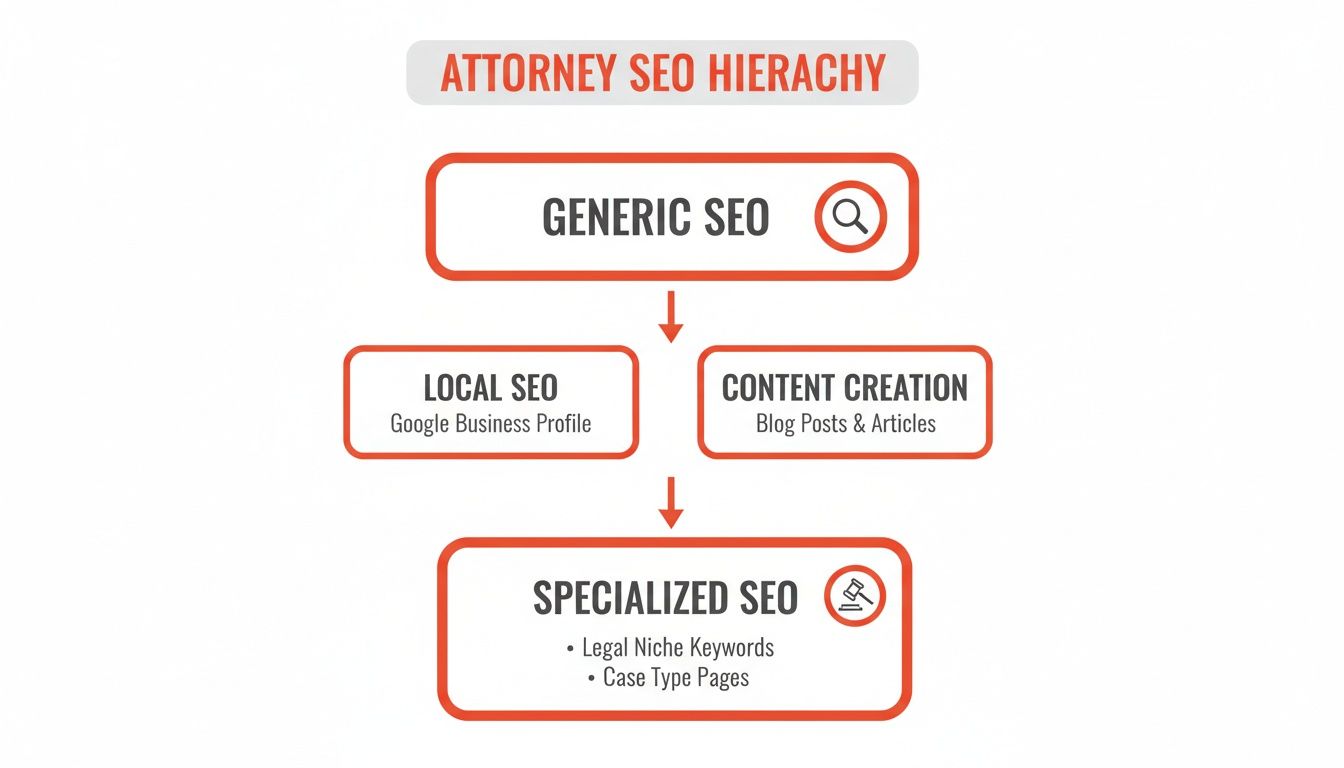
As you can see, foundational SEO is essential, but true success in the legal field requires a specialised layer tailored to the industry's unique demands.
Pillar 1: Technical SEO
Technical SEO is the engine of your website. It’s all the work done behind the scenes to ensure search engines like Google can easily find, crawl, and understand your website’s content. If your technical SEO is poor, even the most brilliantly written practice area page might never get seen.
Imagine you’ve written a groundbreaking legal argument, but it’s stored in an unlabelled, disorganised filing cabinet in a locked basement. No one will ever find it. Technical SEO is the process of organising that cabinet, labelling the files, and giving search engines a key.
Key technical tasks include things like:
- Improving Site Speed: Making sure your website loads lightning-fast for visitors. Slow sites frustrate users and rank lower.
- Mobile-Friendliness: Ensuring your site is easy to navigate on smartphones, where a majority of local searches happen.
- XML Sitemap: Creating a "map" of your website that helps search engines discover all your important pages.
- Secure Connection (HTTPS): Protecting user data and signalling trustworthiness to Google.
Pillar 2: On-Page SEO
While technical SEO ensures your website is accessible, on-page SEO focuses on the content and structure of your individual pages. This is the art of crafting compelling, informative content that directly answers the questions your potential clients are asking.
Put simply, it's about making each page a genuinely valuable resource.
This pillar involves optimising elements that visitors and search engines see directly. It’s where you align your firm’s expertise with the specific language clients use when they search for legal help.
On-page SEO is about speaking your client's language. By optimising your content for keywords like "personal injury lawyer in Melbourne," you connect your services directly to their immediate needs, establishing relevance from the first click.
Effective on-page SEO involves strategically placing keywords in page titles, headings, and body text. It also means creating in-depth practice area pages that showcase your authority and demonstrate a deep understanding of a client's legal problem.
Pillar 3: Off-Page SEO
Off-page SEO is all about building your firm’s reputation and authority across the web. While on-page SEO happens on your website, off-page SEO happens elsewhere. It involves earning signals of trust from other reputable websites, which tells Google that your firm is a credible and respected entity.
The most powerful off-page signal is backlinks—links from other websites pointing to yours.
Think of a backlink as a professional referral or a citation in a legal journal. A link from a respected legal association website carries far more weight than a link from an obscure blog.
Building a strong backlink profile is a meticulous process, but it's essential for achieving top search rankings. If you're interested in the details, you can learn more about how a professional link building seo service works to build your site's authority.
Together, these three pillars form a robust framework that drives lasting growth.
Mastering Local Search to Attract Nearby Clients
For most law firms, the best clients aren't just anywhere; they're nearby. Let's be honest, dominating local search is probably the single most important part of any digital strategy for an Australian lawyer. A potential client is far more likely to search for a "criminal lawyer in Perth" than a generic "criminal lawyer," right?
That’s because legal problems are intensely personal and always tied to a location. When someone needs representation, they want an expert who gets the local laws, courts, and procedures. Your online presence has to shout this from the rooftops, telling both Google and potential clients that your firm is the local authority in your practice area.

Optimise Your Google Business Profile
Think of your Google Business Profile (GBP) as your digital front door for anyone searching locally. It’s that info box that pops up on the right side of a Google search or in Google Maps, showing your firm’s name, address, phone number, client reviews, and opening hours. An incomplete profile is like having a blank sign on your office door. It just doesn't work.
A fully optimised GBP is non-negotiable for any firm that's serious about getting local clients. It's often the very first interaction a potential client will have with you online.
Here are the actionable steps to get it right:
- Complete Every Section: Fill out every single field with accurate, detailed information. We're talking services, business hours, accessibility details—the lot.
- Select a Precise Category: Choose "Law Firm" or, even better, something more specific like "Family Law Attorney" to immediately clarify what you do.
- Upload High-Quality Photos: Add professional shots of your office (inside and out) and your team. This stuff builds trust and makes you look real.
- Encourage and Respond to Reviews: Actively ask satisfied clients for reviews and make sure you respond professionally to all feedback, good and bad.
Build Consistent Local Citations
Beyond your GBP, Google is constantly looking for mentions of your firm's name, address, and phone number (NAP) across the web. These mentions are called citations, and they essentially act as third-party verifications that your business is legitimate and located where you say it is. Think of them as digital references backing up your physical presence.
Consistency here is absolutely critical. Any little variation in your NAP details across different online directories can confuse search engines and water down your local authority. A core part of any good attorney SEO service is running a citation audit and cleanup to make sure everything is perfectly consistent.
A consistent NAP across high-authority directories is a massive trust signal for search engines. It validates your firm’s physical location and solidifies its connection to a specific service area, boosting your visibility in local map packs and search results.
Building citations in relevant Australian legal directories is especially powerful. Getting listed on sites like the Law Society of NSW, FindLaw Australia, or even local chamber of commerce websites is pure gold. These are trusted sources, and a mention there lends serious credibility to your firm.
Creating Location-Specific Content
The final piece of the local SEO puzzle is creating content that speaks directly to the suburbs and cities you want to work in. This means developing practice area pages that are tailored to the specific locations you serve.
For example, instead of one generic "Family Law" page, a top-performing firm might create pages like:
- "Family Lawyers in Parramatta"
- "Adelaide Divorce Law Specialists"
- "Melbourne's Leading Property Settlement Experts"
This strategy achieves two things. First, it helps you rank for the highly specific, high-intent search terms your ideal clients are actually typing into Google. Second, it shows visitors that you have a deep understanding of their local area, which instantly builds rapport and trust. You can learn more about how this fits into the bigger picture by exploring our detailed guide on SEO for a lawyer.
Creating Content That Builds Trust and Generates Leads
In the legal world, your content is your digital handshake. It’s often the very first chance you get to prove your expertise, build a little trust, and show a potential client you genuinely understand their problem—long before they ever consider picking up the phone. A smart content strategy goes way beyond just writing a few blog posts; it's about building a library of genuinely valuable resources that cements your firm as the go-to authority.
This isn’t about churning out generic articles just for the sake of it. It’s about creating assets that speak directly to the anxieties and questions of people facing very real, often stressful, legal challenges. When someone is desperately searching for answers online, your content should be the clear, helpful, and reassuring voice they find.

Go Deep With Practice Area Pages
Think of your practice area pages as the absolute cornerstones of your website. They shouldn't be just brief summaries; they need to be comprehensive, in-depth guides that prove your firm's deep knowledge on the subject. These pages are your primary digital consultation rooms, where you lay out the complexities of a legal issue for a prospective client.
For example, a powerful practice area page for "property settlement lawyers" wouldn't just state that you offer the service. It would dive into the details, covering things like:
- The crucial first steps involved in a property settlement in your state.
- Common and costly pitfalls people should try to avoid during the process.
- Clear answers to frequently asked questions about asset division.
- Anonymised case studies that show what a successful outcome looks like.
This level of detail doesn't just impress potential clients. It also feeds search engines exactly what they're looking for: rich, relevant information that helps you rank for a whole host of related search terms. This is a core part of what effective attorney SEO services deliver.
Quality content answers the questions your potential clients have before they even know how to properly ask them. It transforms your website from a simple online brochure into an indispensable resource, building the kind of trust that turns searchers into clients.
Use Your Blog to Answer Specific Questions
While your practice area pages tackle the broad topics, your blog is the perfect spot to get hyper-specific and answer those long-tail questions. These are the detailed queries people type into Google when they're in the very early stages of needing legal help, like "What happens to superannuation in a divorce?" or "Can I refuse a roadside breath test in Victoria?".
Every single blog post you publish acts as another digital doorway into your firm. The stats back this up completely: firms that blog consistently get 97% more links to their websites, and those with an active blog end up with 434% more indexed pages. This massively expands your digital footprint, creating countless entry points for potential clients to find you.
By building a robust library of genuinely helpful content, you meet people at every single stage of their journey. Of course, to really make your lead-generating content sing, it's vital to optimize the user experience to boost conversions, ensuring visitors have a smooth and easy path from reading a blog post to getting in touch. This integrated approach is what turns your website into a powerful and consistent source of high-quality leads.
Measuring SEO Success with KPIs That Actually Matter
So, how do you actually know if your SEO investment is paying off? It’s easy to get lost in a sea of data, but a successful campaign isn’t measured by vanity metrics. True success is about tracking the key performance indicators (KPIs) that signal real business growth for your law firm.
Instead of getting sidetracked by raw website traffic numbers, which can be seriously misleading, the focus has to be on metrics that directly connect to your bottom line. Think of it like a court case: you don’t win with a mountain of irrelevant evidence. You win by presenting the key facts that prove your point.
The same goes for your attorney SEO services. The goal isn't just more website visitors; it's more qualified clients.
Moving Beyond Vanity Metrics
It's tempting to celebrate a huge spike in website traffic, but if those visitors aren't the right people, it means nothing. A law firm in Sydney gets zero value from a flood of traffic coming from Perth. This is exactly why a specialised legal SEO strategy zeroes in on KPIs that reflect genuine progress toward signing new clients.
Here are the metrics that truly matter:
- Growth in High-Intent Keyword Rankings: Tracking your position for terms like "family lawyer near me" or "property settlement lawyers Melbourne" is non-negotiable. These aren't just keywords; they're clear signals from someone actively looking for legal help.
- Increase in Organic Traffic from Target Suburbs: Is your website attracting more visitors from the specific geographic areas you serve? This is a great sign that your local SEO efforts are hitting the mark.
- Rise in Qualified Leads: This is the big one. A steady, noticeable increase in phone calls and contact form submissions from potential clients is the ultimate measure of success.
Tracking Conversions That Drive Revenue
In the world of SEO, a conversion is any valuable action a user takes on your website. For a law firm, the most important conversions are the ones that open a direct line of communication with a potential client. Your SEO partner should have robust tracking set up to monitor these specific actions.
An effective SEO strategy isn't just about being found; it's about being chosen. The ultimate test of your campaign is its ability to turn an anonymous online searcher into a scheduled consultation.
This means meticulously tracking:
- Phone Call Leads: Using call tracking technology to pinpoint how many calls came directly from organic search traffic.
- Form Submissions: Monitoring the number of "Contact Us" or "Request a Consultation" forms filled out by people who found you on Google.
- Google Business Profile Actions: Measuring clicks-to-call, requests for directions, and website visits that come straight from your Google Maps listing.
These are the metrics that provide clear, undeniable proof that your SEO is delivering a real return on investment.
Setting Realistic Timelines and Expectations
Finally, it’s vital to understand that SEO is a long-term investment, not an overnight fix. Building authority, earning trust with search engines like Google, and creating high-quality legal content all take time. You shouldn't expect a sudden flood of new clients in the first month.
A realistic timeline for a legal SEO campaign generally looks something like this:
- Months 1-3: This is the foundational stage, focused on technical fixes, on-page optimisation, and initial content development. You might see some early progress in technical health scores and maybe a few keyword movements.
- Months 4-6: By this point, you should see noticeable improvements in keyword rankings and a visible lift in organic traffic from your target suburbs. The groundwork is starting to pay off.
- Months 7-12: Now you should be experiencing a significant and steady flow of qualified leads. This is where the compounding effects of a solid SEO strategy really kick in.
By focusing on these meaningful KPIs and keeping a long-term perspective, you can clearly see how your SEO efforts are building a sustainable and profitable client acquisition channel for your firm.
How to Choose the Right SEO Partner for Your Firm
Picking an SEO agency is one of the biggest business decisions you’ll make. Get it right, and your partner becomes a powerful engine for client acquisition. Get it wrong, and you’ll burn through your budget and could even damage your firm’s reputation.
Arming yourself with the right questions is the key to telling the difference.
This isn’t just about finding someone who knows SEO; it's about finding an expert who genuinely understands the unique landscape of Australian legal marketing. A generic, cookie-cutter approach just won’t cut it. You need a partner who can navigate the specific challenges and ethical considerations of your industry.
Key Questions to Ask Any Potential Agency
Before you even think about signing a contract, you need to sit down with any potential agency and ask some tough, specific questions. Vague answers are a massive red flag. A true expert will welcome the scrutiny and give you clear, direct responses that prove their experience and strategic thinking.
Here’s a checklist to guide that conversation:
-
Can you show me case studies from other Australian law firms you've worked with? This is non-negotiable. You have to see proof that they understand your market and have delivered real, tangible results for firms just like yours.
-
What is your approach to link building? Listen closely here. You want to hear answers focused on earning high-quality, relevant links from legal directories and authoritative websites. If anyone mentions buying links or using private blog networks (PBNs), run for the hills. Those black-hat tactics can get your site penalised by Google.
-
How do you measure and report on success? The answer should be all about qualified leads, phone calls, and form submissions—not just traffic or rankings. A good partner will provide a transparent dashboard showing the KPIs that actually grow your firm.
-
Who will be my day-to-day contact and what is their experience? You need to know if you'll be working with a seasoned strategist or getting passed off to a junior account manager who is learning on your dime.
Red Flags to Watch Out For
Just as important as asking the right questions is knowing how to spot the warning signs of a low-quality provider. These red flags often signal a lack of experience or a reliance on outdated, risky tactics that can do more harm than good for your firm.
A classic red flag is an agency that guarantees a "#1 ranking" on Google. No ethical SEO provider can make this promise. Search engine algorithms are complex and constantly changing. Legitimate experts focus on sustainable growth and lead generation, not pie-in-the-sky guarantees.
Be wary of agencies that offer a "one-size-fits-all" strategy or are cagey about their methods. True attorney SEO services are always customised to your firm's specific practice areas, location, and business goals. If they can't explain their process clearly, it’s a sign to walk away.
Understanding what goes into a campaign is also vital, and you can learn more about what search engine optimisation costs and why cheap services almost always fail to deliver.
Got Questions About Attorney SEO? We've Got Answers
Investing in SEO is a big step for any law firm, and it's smart to have questions. To help you get the clarity you need, we’ve put together answers to the queries we hear most often from partners and decision-makers before they commit to a specialised SEO strategy.
How Much Should an Australian Law Firm Budget for SEO?
For a comprehensive SEO strategy from a specialised agency in Australia, you can expect a monthly retainer to fall somewhere between $2,500 and $7,500+. The exact figure really depends on your firm's size, the practice areas you cover, and just how competitive your local market is.
It’s tempting to go for the cheapest option, but SEO is one of those areas where you truly get what you pay for. Lower-cost services often have to cut corners, usually on critical things like the quality of your content or the strategic outreach needed to build authority. This doesn't just lead to poor results; it can even get you penalised by Google.
Think of it less as a marketing expense and more as a direct investment in your primary client acquisition channel. A proper budget ensures you get a tailored strategy that covers all the bases: technical fixes, local optimisation, genuinely helpful content, and transparent reporting.
How Long Until We See Real Results from SEO?
Patience is key here. While some quick technical wins can give you a small boost early on, the kind of results that really move the needle—like a steady stream of qualified client leads—typically take 6 to 12 months to come through. SEO is a long game; it's all about building authority and trust with search engines, and that doesn't happen overnight.
Within the first 3-6 months, you should start seeing positive signs. These are your leading indicators of success, like improved rankings for important keywords and more organic traffic coming from your target suburbs.
It's usually after the 9-month mark that you'll see a substantial, consistent flow of new client inquiries and a clear return on your investment. This is when the compounding effects of a well-executed strategy really start to kick in.
This gradual build-up is exactly what you want to see. It’s the hallmark of a healthy, sustainable campaign that’s creating a lasting asset for your firm.
Should Our Law Firm Choose SEO or PPC Advertising?
This isn't an either/or question. For most law firms, the most powerful approach is to use both SEO and PPC (Pay-Per-Click) advertising in tandem. They play different, but highly complementary, roles.
- PPC Advertising: Think of this as the fast lane. It can generate leads almost immediately, which is perfect for securing some quick wins. It's also a fantastic way to test which keywords actually convert into client consultations.
- SEO Strategy: This is your long-term investment. It builds a sustainable asset that brings in organic traffic and strengthens your firm’s credibility over time, eventually delivering "free" clicks once you achieve high rankings.
A really effective strategy is to launch a PPC campaign to get the phone ringing right away, while your SEO strategy builds momentum in the background. Better yet, the data you gather from your PPC campaigns—the keywords and ad copy that drive the most valuable leads—can be fed directly into your SEO strategy, making it smarter and more focused from day one.
Ready to turn your website into your firm's most reliable client acquisition engine? At Click Click Bang Bang, we build data-driven SEO strategies that deliver real, measurable growth for law firms. Book a no-obligation strategy session with our experts today!
Read NeXt
Or Read Our Latest
- Manual vs Automated Bidding for PPC Success
- Conversion Tracking Setup: A Complete AU Guide
- Instagram Advertising Australia: Complete 2026 Guide
- Pay Per Click: A Beginner’s Guide for Australian Marketers
- Display Advertising on Google: The Complete Australian Guide
- Stakeholder Communication Plan How to Build One That Works
Click. CLick. Subscribe.
Get our best PPC insights, industry updates, and power moves delivered straight to your inbox. No fluff, just high-caliber strategies that actually work.
Don’t Leave Just Yet
Try Us For 30-Days,
Risk Free!!
We guarantee that you’ll love our work within the first 30 days, if not you’ll get your money back.
What have you got to lose?