

Seo for a Lawyer: A Complete Guide to Local SEO (seo for a lawyer)
Last Updated

Effective SEO for a lawyer is all about getting inside the head of a potential client—understanding the exact phrases they type into Google when they’re facing a legal crisis and urgently need help. It’s a shift away from casting a wide, generic net to laser-focusing on the high-intent keywords that connect your firm with people ready to pick up the phone.
Building Your Keyword Foundation for Client Acquisition
Every successful SEO campaign I've ever built started with one thing: a deep, practical understanding of what ideal clients are searching for. If you skip this, you're just guessing. You'll end up creating content and optimising pages that might never get found by the people who actually need your expertise.
For a law firm, this means getting granular. Forget broad terms like "lawyer." We need to dig into the specific, localised, and problem-focused queries that signal a real, immediate need. This is the difference between attracting casual browsers and generating a steady stream of qualified, high-value client enquiries.
Moving Beyond Generic Legal Terms
First things first, let's brainstorm keywords that map directly to your firm's practice areas. The key is to think like a client with a pressing legal problem. They aren’t just searching for "law"; they're desperately searching for a solution.
Take family law, for instance. A potential client isn't just looking for a "family lawyer." Their search history is far more specific and revealing. They’re likely searching for things like:
divorce lawyer near mehow to get a binding financial agreementbest child custody lawyer Melbourne
These are what we call long-tail keywords. Sure, they have lower search volumes, but their power lies in their specificity. The intent behind these searches is crystal clear—the person needs help, and they need it now, which means they are much more likely to convert.
One of the biggest mistakes I see firms make is chasing high-volume, "vanity" keywords. A term like 'Sydney lawyer' gets thousands of searches, but it's incredibly competitive and the searcher's intent is all over the place. In contrast, a query like 'commercial lease lawyer Chatswood' gets far fewer searches, but you can be almost certain that the person searching is a genuine potential client.
Analysing Intent and Commercial Value
Once you’ve got a solid list of potential keywords, it’s time to put them under the microscope. This is where you’ll need some SEO tools. I personally use platforms like Ahrefs and Semrush, but even Google's free Keyword Planner can give you a good starting point. You're looking for three core metrics:
- Search Volume: How many people are searching for this term each month?
- Keyword Difficulty: Realistically, how hard will it be to rank on the first page?
- Commercial Intent: Does this query signal that the user is looking to hire a professional?
This quick process helps you discover, analyse, and target the right keywords for your firm, ensuring you're not just chasing traffic, but actual clients.
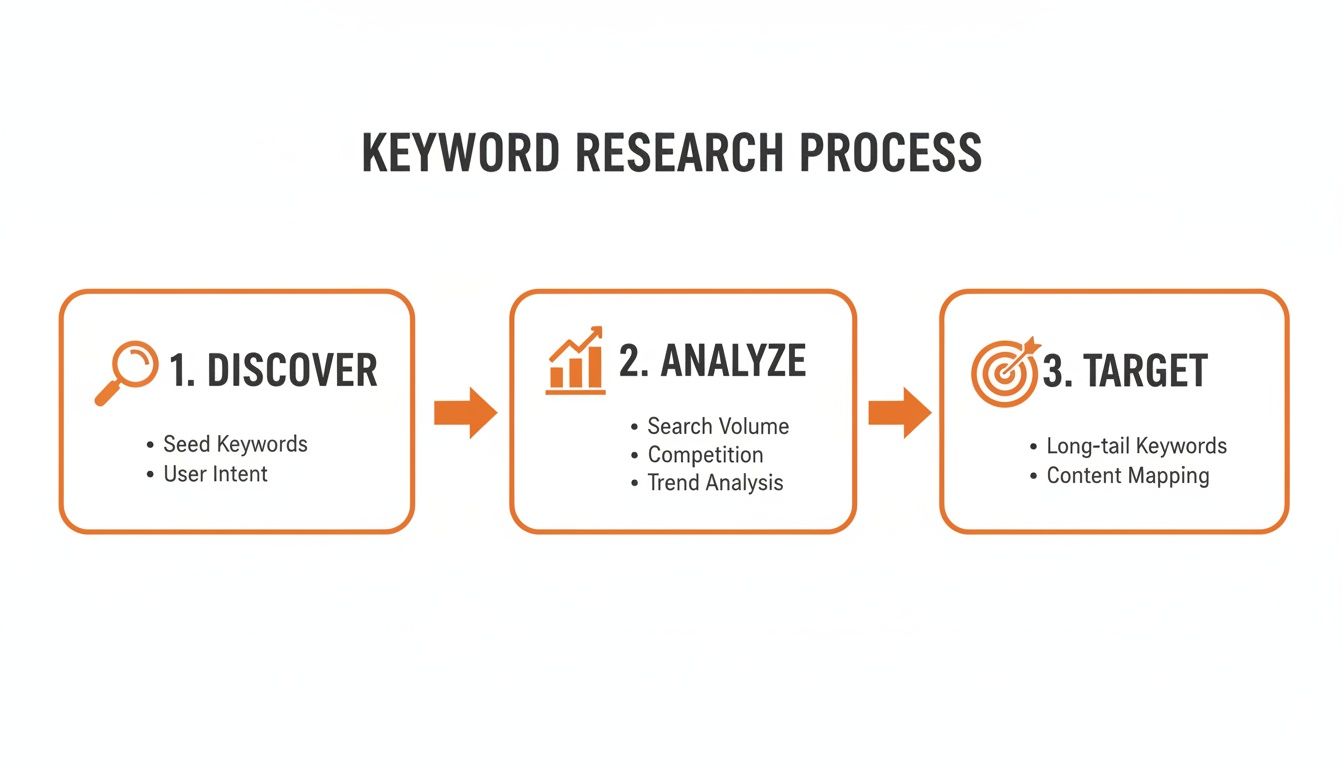
Following this simple workflow prevents you from wasting time and money on keywords that will never turn into new business. It’s a foundational step that pays dividends.
To see just how much this matters, let's run the numbers. Imagine a family lawyer in Sydney targeting 'family lawyer Sydney', a term with about 1,600 monthly searches. Ranking number one could realistically bring in 480 visitors a month (at a 30% click-through rate). If just 10% of those visitors convert into a lead, that's 48 solid enquiries. Even with a conservative 25% close rate, you're looking at 12 new clients every single month from just one keyword. That's the real-world impact of getting this right.
To really drive home the importance of intent, let's look at the difference between keywords that attract researchers versus those that attract potential clients.
High-Intent vs. Low-Intent Legal Keywords
| Keyword Type | Example | Searcher Intent | Value to a Law Firm |
|---|---|---|---|
| High-Intent | emergency family lawyer Parramatta |
Immediate Need | High: The user is actively seeking legal representation now. |
| Low-Intent | what is a de facto relationship |
Informational | Low: The user is researching, not necessarily ready to hire. |
| High-Intent | conveyancing quote Sydney |
Transactional | High: The user is in the buying cycle and comparing providers. |
| Low-Intent | how long does probate take |
Informational | Low: The user wants information, which can be useful for top-of-funnel content, but isn't a direct lead. |
This table clearly shows why focusing on commercial, high-intent keywords is critical for generating leads, while informational keywords are better suited for blog content to build authority.
Understanding Modern Search Intent
As you build out your keyword list, it’s vital to remember that Google has evolved. It no longer just matches keywords; it understands context, synonyms, and the meaning behind a query. This is a big topic, but for a deeper dive, I'd recommend reading this guide on understanding semantic search versus keyword search.
Having this knowledge helps you create content that genuinely answers a user's underlying question, rather than just stuffing a page with a target phrase. By creating a strategic map of these high-value keywords, you're setting the stage for every other SEO activity to follow, from your website content to your local optimisation efforts.
Dominating Local Search with Your Google Business Profile
For most Australian law firms, the best clients are just around the corner. When someone searches for "criminal lawyer in Brisbane" or "conveyancing services near me," they have an immediate, local problem. This is exactly why your Google Business Profile (GBP) isn't just another online listing; it's the single most powerful tool in your local SEO arsenal.
Think of it as your digital shopfront, placed right at the top of Google's search results. A well-tended GBP is your ticket to the coveted "Local Pack" or "Map Pack"—that prime real estate showing the top three local businesses. Landing here is a game-changer, often driving more direct calls and enquiries than the standard organic results further down the page.

Go Beyond the Basic Details
Just claiming your profile and walking away won't cut it. Google actively rewards profiles that are comprehensive, detailed, and regularly updated. Your mission is to fill out every single field available, giving both potential clients and Google a crystal-clear picture of what your firm does.
It's less like a listing and more like a micro-website hosted directly on Google. Here’s where to focus:
- Choose the Right Categories: Your primary category should be "Law Firm," but the real magic is in the secondary options. Add specific categories like "Family Lawyer," "Criminal Justice Attorney," or "Estate Planning Attorney" to show up for searches related to your actual practice areas.
- Write a Compelling Description: You get 750 characters to make your case. Use this space to explain who you are, the problems you solve, and who you help. Weave in your main keywords naturally, but always write for a human first. A strong call to action at the end is a must.
- Detail Your Services: Don't just list "Family Law." Break it down into the specific services you offer, like "Divorce Applications," "Child Custody Matters," and "Binding Financial Agreements." You can even add descriptions for each one, providing clarity that clients will appreciate.
- Add Plenty of Photos & Videos: High-quality photos of your office (inside and out), your team members, and professional headshots build immediate trust. They humanise your firm and make you more approachable. A short video tour of the office can also make a brilliant first impression.
The rule of thumb is simple: leave no field blank. Every piece of information you add is another signal to Google that reinforces your firm's authority and relevance for local legal searches.
The Unforgiving Rule of NAP Consistency
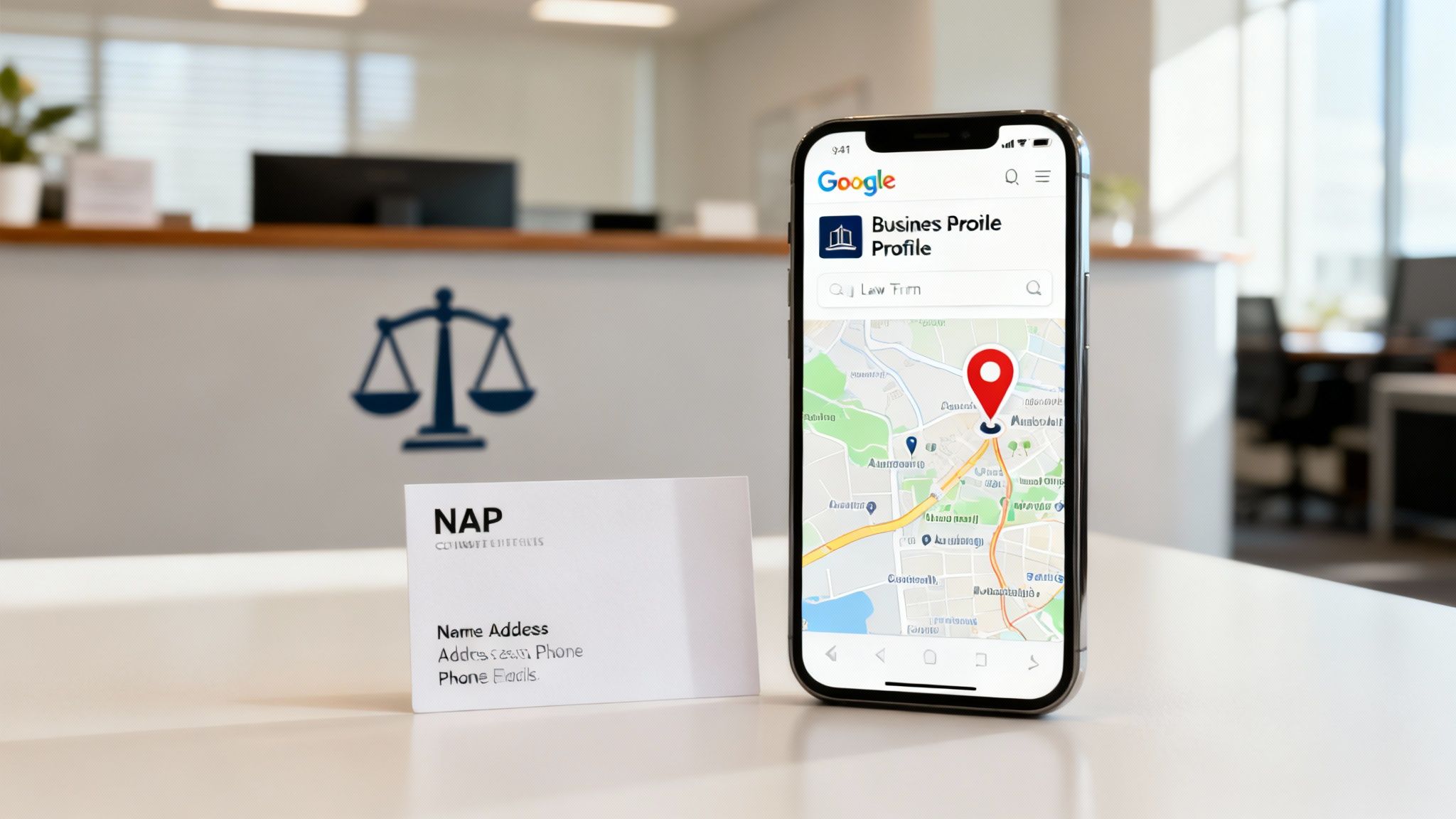
One of the bedrock principles of local SEO is NAP consistency. This acronym stands for your firm's Name, Address, and Phone number. These three details must be absolutely identical everywhere they appear online. No exceptions.
Inconsistent data is a red flag for search engines and erodes their trust in your business. For example, if one directory has you as "Smith & Jones Law" and another has "Smith and Jones Lawyers," Google might see these as two different firms, effectively splitting your authority in half. Tiny variations like "St" vs. "Street" or different phone number formats matter.
This consistency needs to be locked down across all your online properties:
- Your website’s footer and contact page.
- All social media profiles (especially LinkedIn).
- Key legal directories like FindLaw and LawConnect.
- Major Australian business directories such as Yellow Pages and TrueLocal.
Getting this right sends a powerful, clear signal to Google that your business information is accurate and reliable, which is a massive factor in your ability to rank locally. It's a fundamental concept that we explore more deeply in our comprehensive guide to SEO for small businesses.
Cultivate Reviews and Engage with Your Community
In the digital age, online reviews are word-of-mouth on steroids. A steady flow of recent, positive reviews is one of the most influential ranking factors for the local pack. In fact, research shows 88% of consumers trust online reviews as much as they trust a personal recommendation.
You can't afford to be passive here. Make asking for reviews a standard part of your process when you conclude a matter with a happy client. The key is to make it easy for them—send a direct link to your GBP review page via email or text.
Responding to all reviews is just as crucial. Thank clients for their positive feedback. For the occasional negative review, respond professionally and calmly. This public engagement shows prospective clients that you are attentive and genuinely care about client outcomes.
Finally, don't neglect the Google Q&A feature. Use it to proactively answer common questions you get from new clients. This positions you as a helpful authority before they've even picked up the phone, building trust right from the search results page.
Mastering Your Website's On-Page and Technical SEO
Think of your law firm's website as your digital front door. It doesn't matter how great your Google Business Profile is; if a potential client clicks through to a slow, confusing, or broken website, they're gone in a flash. This is where on-page and technical search engine optimisation become mission-critical. It's the architecture, the wiring, and the interior design of your online presence.
A technically sound website is the bedrock of every other SEO effort. It’s what allows search engines to easily find, crawl, and make sense of your content. More importantly, it ensures prospective clients have a smooth, professional experience. Get this right, and you're already miles ahead of many competitors.
Core Web Vitals Explained Simply
You don't need to be a web developer to understand Google's Core Web Vitals. They are simply a set of metrics Google uses to measure the real-world experience a user has on your site. It really boils down to three key things: loading speed, interactivity, and visual stability.
- Largest Contentful Paint (LCP): How fast does the most important part of your page load? Think of the main text block or a key image. You’re aiming for under 2.5 seconds.
- First Input Delay (FID): When a user clicks a button or a link, how quickly does the site respond? Anything under 100 milliseconds is the gold standard.
- Cumulative Layout Shift (CLS): Do things jump around on the screen while the page is loading? This is incredibly annoying for users, and Google rightly penalises it.
Failing these tests directly hurts your rankings and, worse, frustrates potential clients. This is a surprisingly common problem in the legal field. A recent audit of 54 top Australian law firm websites revealed that about 28% failed Google's Core Web Vitals tests. This presents a huge opportunity for firms that invest in a fast, user-friendly experience.
Structuring Your Service Pages for Success
Your service pages are your digital sales pitches. They need to be structured with absolute clarity for both people and search engines. Every single practice area page—whether it's for "Commercial Litigation" or "Wills & Estates"—needs to be meticulously optimised.
Start with a compelling page title and meta description. The title tag is a massive ranking signal and must include your target keyword and location (e.g., "Expert Family Lawyers in Melbourne | Smith & Co."). The meta description is your 155-character advertisement in the search results; make it count with persuasive language and a clear call to action.
On the page itself, use a logical heading structure. Your main title should always be an H1 tag. Subheadings should use H2s and H3s to break up the content and help Google understand the page's hierarchy.
Don't just list what you do. Your service pages must answer the key questions and address the primary pain points a potential client is facing. Use headings like "How We Handle Your Divorce Proceedings" or "The Property Settlement Process Explained" to demonstrate you understand their journey.
The Power of Internal Linking and Schema Markup
Internal linking is just what it sounds like: linking from one page on your website to another. It's a simple but incredibly potent tactic for guiding users and search engine crawlers through your site. For instance, a strong internal link from a popular blog post to your related service page can pass on SEO authority and move a reader from research mode to contact mode.
Beyond links, Schema markup is a more advanced technique that gives you a serious competitive edge. It's a type of code you add to your site that helps search engines understand the context of your content on a deeper level. For law firms, the 'LegalService' schema is a game-changer.
It lets you clearly define crucial details like:
- Your specific areas of practice (e.g., FamilyLaw, CriminalLaw).
- Your geographic service area.
- Your firm's official name, address, and phone number.
This structured data can help you earn "rich snippets" in search results, making your listing stand out with more detail. Getting your web developer to implement this is a non-negotiable part of a sophisticated SEO strategy.
Essential Technical SEO Checklist
Finally, a few technical basics must be in place. First, your site absolutely has to be mobile-friendly. With over half of all web traffic coming from mobile devices, this isn't optional anymore; it's a baseline requirement for ranking.
Second, your website needs an SSL certificate. This is a critical security feature and a confirmed Google ranking factor. A secure site (one that uses HTTPS) builds trust with users by showing their connection is private, which is essential when they're submitting sensitive information through a contact form. For a deeper dive, here's a great resource for understanding SSL and its importance.
By mastering these technical elements, you build a robust digital office that is perfectly primed to attract and convert high-value clients.
Crafting Content That Converts Visitors into Clients
Content is your firm's most powerful tool for building trust. It’s what elevates you from just another listing in a legal directory to a genuine authority in your field. This is your chance to demonstrate your expertise and connect with a potential client long before they ever think about picking up the phone.
For law firms, a successful content strategy really boils down to two key pillars working in tandem. First, you have your cornerstone service pages, which are laser-focused on capturing people ready to hire a lawyer. Then you have your authoritative blog content, which answers the questions your potential clients are asking, positioning you as the go-to expert. Get these two elements right, and your website becomes a 24/7 lead-generation machine.
Building Your High-Converting Service Pages
Think of your service pages as the most valuable real estate on your website. These aren't just fluffy descriptions of what you do; they are meticulously crafted, persuasive pages optimised for those "money" keywords we found earlier – terms like "personal injury lawyer Sydney" or "conveyancing services Melbourne."
The entire purpose of a service page is to anticipate and answer a potential client's biggest questions and overcome their hesitations. It needs to do much more than a printed brochure ever could.
A service page that actually gets the phone to ring will always include:
- A Crystal-Clear Value Proposition: Right away, tell them what problem you solve and who you solve it for.
- A Detailed Breakdown of Your Process: Walk them through what it’s like to work with your firm. What are the typical steps involved in their type of case? Demystifying the legal process is a massive trust-builder.
- Answers to Frequently Asked Questions (FAQs): Tackle their main concerns head-on. For a family law page, this means addressing questions about costs, timelines, and what the first meeting looks like.
- Social Proof: This is crucial. Weave in client testimonials, case results (where ethically permissible), and detailed lawyer profiles to prove you have a strong track record.
Your service page is essentially the initial consultation before the actual consultation. If someone reads that page and feels like you understand their problem, are confident in your expertise, and know what the next steps are, you've already won half the battle.
Writing Blog Content That Builds Authority
While your service pages are for people ready to act now, your blog content is for everyone else. It's for the people who are still in the research phase, turning to Google for answers to a problem they're facing, but not necessarily looking for a lawyer just yet. This is your golden opportunity to be the one who provides that answer.
Your blog is the perfect place to target those informational, question-based keywords. Put yourself in your ideal client's shoes. What’s keeping them up at night? What are they frantically typing into Google in a moment of stress or confusion?
A personal injury firm, for example, could create genuinely helpful articles on topics like:
- "What to Do Immediately After a Car Accident in NSW"
- "How Are Whiplash Injury Payouts Calculated in Australia?"
- "Understanding Your Rights with Workplace Injuries"
This type of content accomplishes two critical goals. First, it pulls in a huge amount of highly relevant traffic from people experiencing the exact problems you solve. Second, it positions your firm as a helpful, knowledgeable resource, not just a business trying to sell them something.
How It All Works Together: The Content Funnel
The real magic happens when you connect these two types of content.
Imagine someone is in a minor car accident. They're shaken up and confused, so they google "what to do after a car accident." They find your incredibly helpful blog post that calmly walks them through the essential steps.
Somewhere in that article, you've placed a natural, contextual internal link: "If you've been injured in the accident, it's important to understand your rights. Learn more about how our expert personal injury lawyers can help you." That link takes them straight to your powerful "Personal Injury Lawyer" service page.
See what just happened? You seamlessly guided a potential client from an informational need to a commercial solution. You built trust by helping them first, then you showed them a clear path to getting professional help.
This strategic approach turns your website into a funnel that guides potential clients on their journey.
Legal Content Funnel Example
Here's a simple breakdown of how different content types can guide a potential client from simply being aware of a problem to actively seeking your help.
| Funnel Stage | Content Type | Example Topic | Goal |
|---|---|---|---|
| Awareness | Blog Post | "How to Contest a Will in Victoria" | Attract users seeking information and establish expertise. |
| Consideration | Service Page | "Wills & Estates Litigation Services" | Detail your expertise, process, and build trust with a solution. |
| Conversion | Contact Form | "Book a Free Consultation" | Convert the informed and trusting visitor into a qualified lead. |
By taking this methodical approach, your content stops being just a collection of pages and starts becoming an active system for building your reputation and filling your pipeline with high-quality, well-informed potential clients.
Building Authority Through Links and Digital PR
In the world of SEO, not all websites are viewed as equal. Search engines, especially Google, are constantly looking for signals of authority to figure out who to trust and, ultimately, who to rank at the top. One of the most powerful signals they use is a backlink—a link from another website pointing to yours.
Think of a quality backlink as a professional referral. It's another website giving your firm a vote of confidence, telling Google that you’re a credible, respected authority in your field.
For law firms, building a strong backlink profile is all about prestige and relevance, not sheer numbers. A single link from your state's Law Society or a major legal publication is worth far more than a hundred links from irrelevant blogs. This is a crucial part of any serious SEO for a lawyer strategy; it’s about strategically earning mentions that enhance your firm’s real-world reputation online.

Pursuing High-Quality, Relevant Links
The cornerstone of any effective legal link-building campaign is a relentless focus on relevance and authority. This isn't about chasing every link you can get. It's about securing placements in the digital spaces where your potential clients and professional peers would naturally expect to find you.
Your first move should be to pick the low-hanging fruit—the foundational links within the legal industry. These are the authoritative and highly relevant sources that give your digital credibility an immediate boost.
Get started by concentrating on these key areas:
- Legal Directories and Associations: Make sure your firm is accurately listed on major directories like FindLaw, LawConnect, and your state’s Law Society or Bar Association. These are often the first and most trusted links you can secure.
- Local Business Directories: Listings on reputable Australian directories like Yellow Pages and TrueLocal don't just build links; they also reinforce your local SEO signals, helping you show up in those critical "near me" searches.
- Alumni and University Mentions: Don't forget your alma mater. Most universities have opportunities for alumni profiles or features. A link from your university's law school page is an incredibly powerful and authoritative signal.
I see too many firms treat link building like a numbers game. That's a huge mistake. In the legal sector, your backlink profile is a direct reflection of your professional reputation. One link earned from a thoughtful article on a legal news site is infinitely more valuable than dozens of spammy, low-effort directory submissions.
Embracing Digital PR for Lawyers
Once you've got the foundational links sorted, it's time to aim higher. The most impactful links come from genuine digital public relations. This means using your legal expertise to become a go-to source for journalists, writers, and industry publications. It’s about creating newsworthy content or providing expert commentary that naturally earns attention and links.
This approach elevates you from just another lawyer to a recognised thought leader in your practice area. It's a powerful way to build brand recognition while simultaneously turbo-charging your SEO authority.
Actionable Digital PR Tactics
So, how do you actually do it? Here are a few practical methods to start earning these high-authority links:
- Offer Expert Commentary: Journalists are always on the hunt for experts to quote on legal matters. Services like SourceBottle connect reporters directly with sources. Providing a timely, insightful quote on a trending news story can land you a mention—and a valuable link—in a major news publication.
- Publish Original Data or Insights: Conduct a small-scale study or analyse some data relevant to your practice area. For instance, a family law firm could analyse local divorce rate statistics and publish the findings. This creates a unique asset that other sites will want to link to when they discuss the topic. You become the source.
- Sponsor Local Events or Charities: Sponsoring a local community event, a kids' sports team, or a charity fundraiser nearly always results in a link from their website. This is a brilliant way to build goodwill in your community while also earning a valuable, locally-relevant backlink that Google loves to see.
By combining these foundational directory listings with proactive digital PR, you create a natural and authoritative backlink profile. This strategy sends a clear message to Google: your firm isn't just another website, but a trusted pillar of the legal community. And that’s what helps your entire site rank higher.
Tracking Your SEO Success and Preparing for AI
Investing in SEO without measuring the outcome is like going into court without your case notes. You're flying blind. You absolutely need to know what's working, what's not, and where your marketing dollars are actually making a difference.
This isn't about chasing vanity metrics like a general increase in website traffic. It's about zeroing in on the numbers that directly impact your firm's bottom line. Real SEO for a lawyer is a continuous loop of data, analysis, and refinement—it’s never a ‘set-and-forget’ job.
Measuring What Truly Matters
Don't get bogged down in a swamp of complicated reports. For any busy law firm, you can boil down SEO success to a handful of core metrics. These are the numbers that tell you if your investment is actually turning into new clients.
Here’s what you should be tracking relentlessly:
- Keyword Rankings for Core Services: Where are you showing up for searches like "family lawyer Parramatta" or "commercial litigation Melbourne"? A steady climb for these high-intent keywords is goal number one.
- Organic Traffic to Service Pages: Is your "Wills & Estates" page getting more clicks from Google this month than last? This is a clear sign your content is hitting the mark with the right people.
- Number of Qualified Leads: This is the ultimate test. How many phone calls, contact form submissions, and direct emails came from people who found you through a Google search?
Your entire SEO strategy should be geared towards improving these three areas. Everything else—from blog posts to technical fixes—is a tactic designed to move these specific needles. If a metric doesn't connect back to generating leads, it's a distraction.
The Rise of AI in Legal Search
The way potential clients find legal help is changing, and fast. By 2025, a game-changing statistic is set to hit Australian law firms: about 35% of Aussies will be using AI assistants to ask legal questions before they even think about clicking on a lawyer's website. This trend, powered by tools like Google's AI Overviews, is already reshaping how clients find you. You can read more about these findings in Australian law firm SEO.
What does this mean? It means your website can no longer just be a brochure. It has to be the definitive source that AI models want to cite, providing direct, clear, and authoritative answers.
Optimising for an AI-Powered Future
So, how do you adapt your strategy? The good news is that the fundamentals of solid SEO haven't changed, they've just become more important. The goal is to make your content incredibly easy for both humans and AI to understand and trust.
Start focusing on these key strategies:
- Use Natural, Conversational Language: Write your content as if you were answering a client's question face-to-face. Structure pages with clear, question-based headings, like "How Is Property Divided in a Divorce in Australia?"
- Provide Comprehensive, Clear Answers: Don't be vague. Create detailed, well-researched content that completely answers common legal questions. Use bullet points and numbered lists to make complex information easy to digest.
- Leverage Structured Data: Now more than ever, you need to implement 'LegalService' and 'FAQ' schema markup. This is basically code that spoon-feeds Google the exact details about your services, making your content a prime candidate for AI-generated answers.
Ultimately, tracking your results is what allows you to make smart, data-backed decisions. Setting up robust website conversion tracking is the essential first step to understanding which pages and keywords are actually bringing in new client enquiries. By combining precise measurement with a forward-looking strategy that embraces AI, your firm won't just compete—it will be perfectly positioned to lead the pack.
Frequently Asked Questions About Lawyer SEO
Diving into SEO for your law firm naturally brings up a lot of questions. We get it. Let's tackle some of the most common ones we hear from lawyers who are starting to focus on their online presence.
How Long Does SEO Take to Work for a Law Firm?
This is the big one, and the honest answer is: it takes patience. While you might see some small, encouraging movements in visibility within 3-4 months, don't expect to hit the front page overnight.
For competitive legal keywords, you're realistically looking at a sustained effort for 6 to 12 months to see significant, client-generating results. SEO isn't a switch you flip; it's an asset you build. The momentum comes from consistently publishing great content, improving your site's technical health, and earning quality links over time.
Can I Do SEO for My Own Law Firm?
Absolutely. There are definitely foundational pieces you can, and should, manage yourself. Getting your Google Business Profile dialled in, writing your core service pages, and starting a blog are fantastic first steps.
The challenge is that the online legal space is fiercely competitive. To really move the needle against established firms, you'll need to get into more advanced strategies. This is where technical SEO, sophisticated content planning, and strategic link building come in, which often requires a specialist's touch.
Many firms find success with a hybrid model. They handle the content creation in-house, where their legal expertise shines, and then outsource the more technical elements and the time-intensive work of link building.
Is SEO Better Than Paid Ads for Lawyers?
It’s not really a matter of one being "better" – they just have different jobs. They work brilliantly together. Paid ads, like Google Ads, are fantastic for getting immediate traffic. You can have leads coming in tomorrow, but the traffic stops the second you turn off your ad spend.
SEO, on the other hand, is the long game. It builds a sustainable source of traffic that becomes a real asset for your firm. Organic traffic often has higher trust with potential clients and, over the long term, delivers a far greater return on your investment. A smart strategy uses paid ads for quick wins while SEO builds your firm's foundational dominance.
Ready to stop guessing and start getting real, measurable results from your digital marketing? The team at Click Click Bang Bang specialises in creating data-driven SEO and PPC strategies that connect law firms with their ideal clients. Let's build a strategy for your firm.
Read NeXt
Or Read Our Latest
- Manual vs Automated Bidding for PPC Success
- Conversion Tracking Setup: A Complete AU Guide
- Instagram Advertising Australia: Complete 2026 Guide
- Pay Per Click: A Beginner’s Guide for Australian Marketers
- Display Advertising on Google: The Complete Australian Guide
- Stakeholder Communication Plan How to Build One That Works
Click. CLick. Subscribe.
Get our best PPC insights, industry updates, and power moves delivered straight to your inbox. No fluff, just high-caliber strategies that actually work.
Don’t Leave Just Yet
Try Us For 30-Days,
Risk Free!!
We guarantee that you’ll love our work within the first 30 days, if not you’ll get your money back.
What have you got to lose?