

How to Pick a Top B2B Advertising Agency for Growth
Last Updated

You’re probably dealing with a familiar mess. Google Ads says one thing, LinkedIn says another, your CRM tells a third story, and leadership still asks the same question: which part of this budget is creating revenue?
That tension is what turns “running ads” into a business problem. In B2B, buyers rarely click once and convert. They research, compare, loop in other stakeholders, disappear for weeks, then come back through a branded search or a retargeting ad. If your marketing setup treats that journey like a simple online purchase, you’ll keep paying for activity without getting clarity.
A good b2b advertising agency doesn’t just buy media. It builds a system that connects targeting, messaging, landing pages, attribution, and sales outcomes. The important distinction is partnership design. If the agency controls the accounts, hides the raw data, and reports on clicks instead of pipeline, you haven’t hired a growth partner. You’ve rented a black box.
Beyond Boosted Posts The Modern B2B Growth Challenge
The old playbook still shows up everywhere. Post on social, boost a few updates, add some search ads, send traffic to a generic service page, then hope enough leads come through to justify the spend. That approach breaks down fast in B2B because the sales cycle is slower, the deal value is higher, and more people influence the decision.
In Australia, that complexity sits inside a fast-growing market. The Australian B2B digital advertising market is projected to reach AU$18 billion by 2027, and 73% of high-quality B2B leads come from paid search, which is one reason specialist management matters so much in this category, according to Power Digital’s B2B marketing statistics.

Why broad digital tactics fall apart in B2B
B2C marketers can often get away with simpler paths. A person sees an offer, checks the product, and buys. B2B rarely works like that.
A B2B buyer may first see a LinkedIn ad, later search your category on Google, then download a guide, attend a demo, and only after several internal conversations speak to sales. If your setup only values the last click, it misses the complete path that got the deal moving.
Three problems usually show up together:
- Scattered budget allocation. Teams spread spend across Google, Meta, LinkedIn, and remarketing without a clear job for each channel.
- Weak lead quality. Forms come in, but sales says the contacts aren’t ready, aren’t relevant, or aren’t buyers.
- Unclear proof of ROI. Marketing can show clicks and impressions, but not what happened to leads after they hit the CRM.
B2B advertising works when every channel has a role in the buying journey, not when every channel is asked to do everything.
What specialised support changes
A specialised b2b advertising agency exists because modern B2B growth needs orchestration, not isolated tactics. Paid search captures demand. LinkedIn creates access to the right people. SEO builds authority around the problems buyers are already researching. Landing pages convert attention into usable sales opportunities. Attribution ties it back to revenue.
That’s the practical shift. You stop asking, “Which ads got the most clicks?” and start asking, “Which combination of channels is producing qualified pipeline we can verify?”
That’s a far better question, and it’s the one mature B2B teams eventually have to answer.
What a B2B Advertising Agency Actually Does
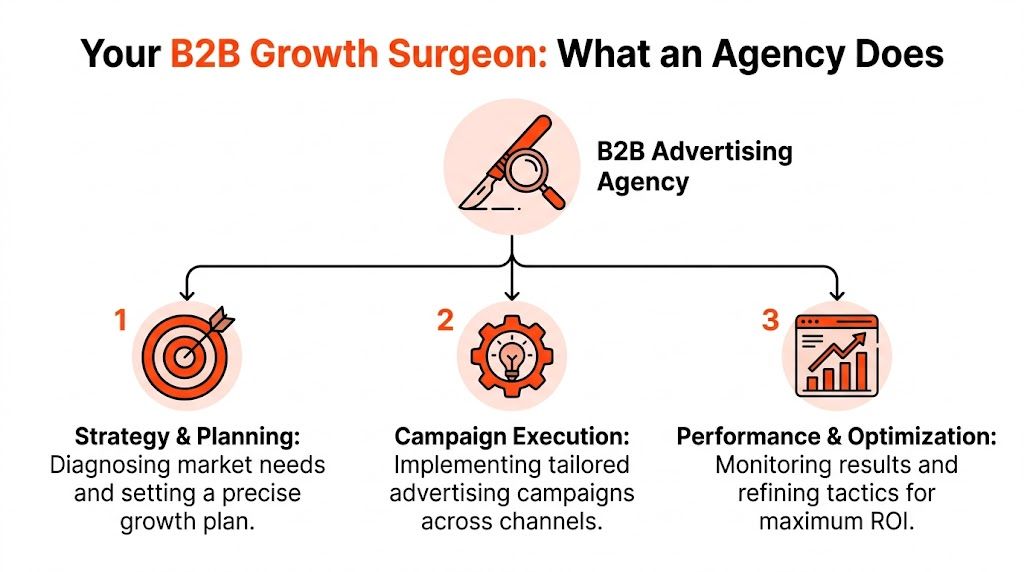
A generalist agency is like a GP. Useful for basic issues, broad advice, and light treatment. A true b2b advertising agency is closer to a specialist surgeon. It doesn’t guess. It diagnoses where growth is being lost, applies a narrow set of high-skill interventions, and measures whether the business is healthier afterwards.
That work usually rests on three pillars: paid media precision, AI-first SEO, and structured lead generation.
Precision PPC across the right platforms
In B2B, platform choice isn’t cosmetic. It affects who sees the message, what intent they have, and how much context you can use to qualify them.
Google Search captures people already looking for a solution. LinkedIn reaches people based on role, industry, company type, and seniority. Meta can support remarketing and broader audience development, but it usually needs tighter control in B2B than many teams expect.
LinkedIn matters especially when you need qualified conversations rather than volume for volume’s sake. In Australia, 65% of organisations acquired clients via LinkedIn ads in 2024, and optimised campaigns achieved an average ROI of 4.3x. Precise targeting by job seniority can also produce a 35% MQL-to-SQL conversion rate, as outlined in this review of B2B marketing evolution and performance benchmarks.
A capable agency doesn’t just launch campaigns. It decides:
- Which platform should capture demand and which should create it
- Which job titles and buying roles matter at different deal stages
- Which offer fits the traffic source, such as demo request, downloadable guide, pricing page, or call booking
- Which landing page should match each audience, rather than pushing every click to the homepage
AI-first SEO that builds commercial authority
SEO in B2B isn’t just blogging for traffic. The useful version is authority-building around commercial problems buyers are actively trying to solve.
AI-first SEO means using tools and data to uncover intent patterns, content gaps, entity relationships, and page-level optimisation opportunities. But the human part still matters more than the software. Strategy decides which topics deserve investment, how they connect to service pages, and when organic content should support paid campaigns instead of acting separately.
Think of SEO as building roads to your site before the buyer is ready to talk to sales. If the road network is shallow, only branded demand finds you. If it’s well built, your business appears around category queries, solution comparisons, and problem-specific searches that pull in future opportunities.
For teams planning channel mix, this overview of B2B digital marketing strategies is a practical reference because it shows how SEO and paid media should support each other instead of competing for budget.
Strategic lead generation from click to conversation
This is the part many businesses underestimate. Ads don’t generate revenue on their own. The funnel does.
An agency worth hiring looks past media buying and asks hard questions about the handoff:
| Funnel stage | What weak execution looks like | What strong execution looks like |
|---|---|---|
| Ad click | Broad promise with generic CTA | Message matched to intent and role |
| Landing page | Too much copy or too little clarity | Clear offer, relevant proof, simple next step |
| Form capture | Every lead treated the same | Qualification logic and routing |
| Sales follow-up | Slow or inconsistent response | Structured follow-up and CRM visibility |
That’s why tooling matters. Good teams use CRM syncing, ad platform conversions, dashboards, and practical workflows around enrichment and routing. If you’re reviewing stack options, this roundup of B2B lead generation tools is useful because it frames the tools around workflow, not hype.
Practical rule: If an agency talks mostly about impressions, audiences, and ad creative, but not pipeline stages, landing pages, and CRM feedback, it’s only handling part of the job.
One factual example of a provider in this category is Click Click Bang Bang, which offers PPC and AI-first SEO services across Google, Meta, and LinkedIn with client-facing reporting and a seven-day launch process.
Five Signs Your Business Needs a B2B Agency
Some businesses need an agency because they lack time. Others need one because the internal setup can’t handle the complexity anymore. The second group gets more value.
If any of the signs below feel uncomfortably familiar, the problem probably isn’t “we need to spend more.” It’s “we need a sharper system.”
Your lead flow is inconsistent or low quality
You might get a burst of form fills one month, then silence the next. Or sales keeps pushing back because the leads aren’t in-market, don’t fit the ICP, or don’t have enough buying influence.
That usually points to weak targeting and weak offer alignment. The campaigns may be technically live, but they aren’t engineered around the buying committee, the pain point, or the stage of intent.
Specialised agencies often solve this by narrowing the audience and message instead of widening it. In Australia, firms using Account-Based Marketing by 2018 saw 27% higher conversion rates than broader spray-and-pray tactics, according to Leadseed’s overview of B2B marketing evolution.
You can’t defend marketing spend in commercial terms
Leadership doesn’t care whether click-through rate improved if pipeline quality dropped. They want to know what marketing contributed to qualified opportunities and closed business.
If your reporting stops at top-of-funnel metrics, you’re flying with half an instrument panel. That’s when external support becomes valuable, because a good agency forces the business to define what counts as a meaningful conversion and what doesn’t.
Your sales cycle is long and leads go cold in the middle
B2B demand often goes quiet before it converts. That silence is where many in-house teams lose control of the process.
Leads download something, attend a call, or open a proposal, then disappear into a gap between marketing and sales. Without structured retargeting, nurture logic, and proper audience segmentation, those opportunities don’t stay warm.
Your in-house team is stretched thin
This one is common in growing businesses. One marketer is handling content, paid media, reporting, email, website updates, events, and sales support. Nothing is neglected on purpose. There just isn’t enough specialist time.
A b2b advertising agency adds depth where generalists usually hit their ceiling.
- Paid media depth when someone can launch campaigns but can’t troubleshoot performance swings
- Landing page expertise when traffic arrives but conversion quality stays poor
- Platform-specific experience when LinkedIn, Google, and CRM workflows need coordination
- Reporting discipline when leadership wants answers faster than the internal team can build them
You’ve already wasted budget trying to do it yourself
This is the most straightforward sign. The business tried ads, got some clicks, maybe even some leads, but the whole effort felt slippery. Nothing linked cleanly from spend to revenue.
The expensive part of DIY B2B advertising usually isn’t the media bill. It’s the months spent learning after the wrong traffic has already passed through the funnel.
At that point, the agency decision isn’t about outsourcing for convenience. It’s about bringing in a team that knows where B2B campaigns typically leak and how to stop it.
How to Evaluate a B2B Advertising Partner
Most agency selection mistakes happen before the first campaign launches. They happen in the sales process, when a business chooses the partner that sounds confident instead of the one that can prove how the system will work.
The safest way to evaluate a b2b advertising agency is to test four things: transparency, attribution, commercial alignment, and strategic depth.

Start with data ownership and reporting access
If the accounts sit under the agency’s master login and you only receive monthly screenshots or PDFs, that’s a risk. You can’t verify anything independently, and moving away later becomes painful.
Ask direct questions:
- Who owns the ad accounts
- Who owns the analytics property
- Will our team have admin access
- Can we see raw campaign data at any time
- How are conversions defined and where are they recorded
A credible partner won’t dodge those questions. It will answer them clearly and early.
Demand attribution that reflects B2B reality
B2B buyer journeys are rarely linear. For buyer journeys averaging 6 months, single-touch attribution can misattribute 30% to 50% of revenue. Australian implementations of multi-touch attribution have shown a 25% increase in pipeline velocity and an 18% reduction in CAC, based on 12A’s explanation of B2B marketing analytics and MTA.
That matters because many agencies still report like it’s 2016. They credit the last ad click and ignore all the touches that created the opportunity.
A strong agency should be comfortable discussing:
| Evaluation area | Weak answer | Strong answer |
|---|---|---|
| Attribution | “We optimise for leads” | “We map leads to pipeline stages and revenue” |
| Reporting cadence | “Monthly summary deck” | “Live dashboard plus decision-focused reviews” |
| KPI choice | “Clicks, CTR, impressions” | “SQLs, pipeline movement, CAC, ROAS” |
| CRM integration | “Optional later” | “Required for accurate measurement” |
The video below gives a useful primer on how agencies and clients should think about paid media accountability before signing anything.
Look closely at the pricing model
Cheap retainers can hide expensive incentives. If an agency only gets paid to keep campaigns active, not to improve commercial outcomes, your interests can drift apart fast.
That’s why it’s worth understanding alternative structures, including pay-for-performance marketing models, even if you don’t choose that route. They’re useful because they force a conversation about accountability, revenue alignment, and what “performance” means.
You should also ask:
- Is there a long-term lock-in
- What happens if performance is mixed in the first month
- Are landing pages, tracking, and reporting included or separate
- How often will strategy change based on results
Test for strategic depth before signing
Some agencies jump straight into media recommendations. That’s usually a warning sign.
A serious partner should want to know your deal size range, sales cycle shape, ideal customer profile, common objections, close rate by source, and what sales calls reveal about buyer intent. If they don’t ask, they can’t build a useful system.
For businesses comparing service models, this page on PPC agency support and campaign structure is the kind of benchmark worth reviewing because it shows what a dedicated paid media process should include beyond ad setup.
What to listen for: Good agencies talk about your commercial model almost as much as your campaigns.
That’s the difference between a vendor and a partner.
The First 30 Days What Onboarding Should Look Like
The first month tells you whether the agency runs a disciplined process or improvises under pressure. Good onboarding feels organised, visible, and slightly demanding. That’s a good sign, because strong work needs inputs from both sides.
A proper start doesn’t begin with ad creative. It begins with diagnosis.

Days 1 to 3 with discovery before deployment
The first conversations should dig into the business, not just the channels. Expect questions about your offer mix, margins, average deal shape, existing data, ICP segments, and what sales calls reveal about objections.
Then the technical foundation starts. That typically includes analytics review, conversion mapping, CRM checks, tracking pixel installation, audience setup, ad account access, and naming conventions that make future reporting usable.
If an agency promises quick launch without this groundwork, be careful. Fast is useful. Rushed is expensive.
Days 4 to 7 with build and launch
By this stage, you should see campaign architecture take shape. Not just “some ads are being made,” but actual decisions around campaign intent, audience groups, offer positioning, landing page alignment, and conversion events.
A healthy week-one launch usually includes:
- Clear channel roles so Google, LinkedIn, remarketing, and SEO support different parts of the journey
- Conversion definitions agreed before traffic starts flowing
- Client access to the ad accounts, analytics, and reporting environment
- Initial creative and copy direction based on audience pain points, not generic value statements
This is also where process quality becomes visible. Strong agencies explain why each campaign exists and what signal will tell them it needs adjustment.
Days 8 to 30 with optimisation and early truth
The first month isn’t long enough to judge the full value of B2B advertising, but it is long enough to judge whether the machine is working.
You should see active monitoring, search term reviews, creative testing, audience refinement, and landing-page observations tied to actual user behaviour. Just as important, you should be able to see the same data the agency sees.
A good onboarding month usually produces three things by the end:
| Area | What you should have by day 30 |
|---|---|
| Visibility | Live access to campaign and analytics data |
| Clarity | A shared view of what early signals matter |
| Control | Confidence that the accounts and data remain yours |
A professional onboarding process doesn’t just launch campaigns. It removes ambiguity about who owns the system, how success is measured, and what happens next.
When that’s in place, the relationship starts on solid ground. When it isn’t, the problems show up later as reporting confusion, attribution disputes, and trust issues.
Case Studies B2B Agency Impact in Action
Theory is useful, but the ultimate test is whether the agency can change business outcomes in situations that look like yours. The specifics vary by sector, but the pattern is consistent: tighten the targeting, repair the funnel, and stop measuring success too early.
The B2B SaaS startup with expensive leads
A SaaS company had active paid campaigns and a steady flow of form fills, but sales complained that too many leads were early-stage researchers. Marketing was buying attention. It wasn’t buying sales-ready intent.
The fix wasn’t to flood the account with more budget. The team narrowed targeting around the actual buying roles, rewrote the offer so it qualified interest better, and rebuilt the landing pages around use-case clarity rather than broad brand language. They also changed the reporting conversation. Instead of celebrating lead volume, they tracked which campaigns produced contacts that sales accepted and progressed.
The result was a healthier pipeline, not just a busier one. Fewer weak enquiries reached sales, and the qualified conversations that did come through were easier to prioritise and close.
The industrial e-commerce business that needed better business buyers
Another common case involves an e-commerce retailer selling products used by business customers. Traffic existed, but it mixed consumer curiosity with commercial demand, so the account struggled to attract higher-value B2B orders consistently.
The agency approach combined tighter paid search structure with category-focused SEO improvements and cleaner landing-page paths for trade and business buyers. Instead of pushing all visitors through the same product journey, the site separated informational intent from commercial procurement intent. Ad copy also reflected the way business buyers think: supply continuity, account support, repeat purchasing, and fit-for-purpose product detail.
That combination usually improves the quality of inbound demand because it gives serious buyers a clearer route through the site.
If you’re assessing whether an agency can do this in practice, review its B2B and performance marketing case studies and look for evidence of process quality, not just polished before-and-after claims. The best case studies show the initial problem, the strategic change, and the commercial metric that mattered.
Good case studies don’t just say performance improved. They show what was broken, what changed, and why the result became more believable.
Frequently Asked Questions About B2B Agencies
The questions below matter more than most proposal decks admit. They’re the ones that shape trust after the contract is signed.
Who owns the ad accounts and data
This should be simple. You should.
If the agency creates campaigns inside its own accounts and only shares summaries, you’re dependent on them for continuity and verification. That setup might be convenient for the agency, but it’s not good governance for the client.
This concern is widespread. A 2025 Sensis Social Media Report found that 72% of Australian SMBs distrust agencies that don’t provide raw analytics access. The issue sits inside a broader transparency problem in a market where ad fraud cases rose 29% in 2025, as discussed in this piece on how agencies underserve small and medium-sized businesses.
How much should you budget for a B2B agency
There isn’t a universal number that fits every business, and it’s better not to force one. Budget should follow your sales model, deal economics, buying cycle, and channel mix.
What matters more than the fee format is whether the structure is intelligible. Some agencies charge a retainer. Others use a percentage of ad spend. Some separate setup, creative, and landing pages. The important thing is knowing what is included, what is measured, and whether you can leave without losing your accounts or data.
A flexible arrangement is often safer in the early stage because it gives both sides room to validate fit before committing long-term.
If AI is improving so fast, do you still need an agency
Yes, but for different reasons than a few years ago.
AI can help with keyword research, content pattern analysis, bid management, creative variants, and reporting workflows. It can speed up execution. It doesn’t replace business judgement.
B2B advertising still needs humans to decide which segments matter, how to frame an offer, where to draw the line between lead volume and lead quality, and how to interpret what sales feedback is saying. AI can generate options. Strategy decides which options deserve budget.
What should the agency be accountable for
Not every agency should own every commercial result. Sales execution still matters. Product-market fit still matters. Pricing still matters.
But a strong b2b advertising agency should be accountable for the things it directly controls: campaign structure, targeting quality, tracking integrity, landing-page alignment, reporting clarity, and ongoing optimisation. If those are vague in the proposal, they’ll be vague in the relationship too.
Your Next Step to Scalable B2B Growth
Choosing a b2b advertising agency isn’t about handing off ads so your team has less to do. It’s about building a growth system that can be checked, improved, and trusted.
The right partner gives you more than campaign execution. It gives you cleaner targeting, stronger landing pages, better alignment with sales, clearer attribution, and direct access to the data behind every decision. That last part matters more than most businesses realise. If the numbers can’t be verified, the performance can’t really be trusted.
The strongest agency relationships also feel commercially adult. The reporting is visible. The accounts are client-owned. The KPIs connect to pipeline, not vanity metrics. The onboarding process is organised. And the strategy reflects how your buyers really buy, not how a platform rep says they should.
If you’re evaluating options, keep the standard high. Ask who owns the accounts. Ask how attribution works. Ask what happens in the first month. Ask what the agency will optimise for when clicks are easy but revenue is harder.
Those answers will tell you far more than a polished pitch deck.
If you want a partner that focuses on PPC and AI-first SEO with client-owned accounts, transparent reporting, flexible plans, and a 30-day risk-free start, take a look at Click Click Bang Bang.
Read NeXt
Or Read Our Latest
- Manual vs Automated Bidding for PPC Success
- Conversion Tracking Setup: A Complete AU Guide
- Instagram Advertising Australia: Complete 2026 Guide
- Pay Per Click: A Beginner’s Guide for Australian Marketers
- Display Advertising on Google: The Complete Australian Guide
- Stakeholder Communication Plan How to Build One That Works
Click. CLick. Subscribe.
Get our best PPC insights, industry updates, and power moves delivered straight to your inbox. No fluff, just high-caliber strategies that actually work.
Don’t Leave Just Yet
Try Us For 30-Days,
Risk Free!!
We guarantee that you’ll love our work within the first 30 days, if not you’ll get your money back.
What have you got to lose?