

Discover what is seo agency: Your 2026 Guide
Last Updated

Your website might look polished, your products might be strong, and your sales team might be ready. But if the right buyers can't find you on Google, you're competing with one hand tied behind your back.
That’s usually the moment people start asking, what is seo agency, and whether hiring one will change anything.
What is an SEO Agency and Why Your Business Needs One
An SEO agency helps businesses improve how they appear in search engines, especially Google. In practice, that means making your website easier to find, easier to understand, and more likely to turn search traffic into leads or sales.

For Australian businesses, this isn’t a niche service anymore. The Australian SEO services market is valued at approximately AUD 1.2 billion in 2025 and projected to reach AUD 2.5 billion by 2030, while Google holds a 93.2% search engine market share as of 2026. The same source also notes that SEO can deliver 1000%+ more traffic than organic social media. Those figures from Search Engine Journal’s overview of SEO history and market context tell you something important. Search visibility is now core business infrastructure, not a side tactic.
A good agency doesn’t just “get you ranking”. It helps you win the moments when a buyer is already looking for what you sell. That might be a local customer searching for a nearby service, an e-commerce shopper comparing products, or a B2B prospect researching solutions before filling in a form.
What businesses usually get wrong
Most businesses don’t fail because they have no website. They fail because the website isn’t built or managed for search demand.
Common problems include:
- Poor discoverability. Important pages aren’t indexed properly or don’t target the terms buyers use.
- Weak commercial intent alignment. Content attracts the wrong audience, or no audience at all.
- Technical drag. Slow pages, rendering issues, and weak site structure hold back visibility.
- No strategic owner. SEO gets treated like scattered tasks instead of an organised growth channel.
That’s where a specialist partner matters. A broader digital marketing agency may cover multiple channels, but an SEO-led engagement focuses on search as a long-term acquisition asset.
Practical rule: A website isn’t an asset if customers can’t find it. SEO turns a website from an online brochure into a demand capture system.
The Core Mission of an SEO Agency Explained
The simplest answer to what is seo agency is this. It’s a team that builds search visibility in a way that supports business growth, not just vanity rankings.
The best way to think about it is as a digital architect and city planner.
A weak SEO approach is like painting a house without checking the foundations, roads, or street signs. It might look fine for a while, but people still won’t arrive easily. A real SEO agency handles the full environment around your site so search engines can crawl it, understand it, trust it, and send the right users to it.
The architect part
An agency looks at the structure of your site first. Can Google access your pages? Are important pages connected logically? Does the site communicate what each page is about? Is the content organised around how people search, rather than how the business talks about itself?
That architectural work matters because search engines rely on structure. If your website is confusing to crawl or interpret, good content alone won’t rescue it.
The city planner part
SEO also works beyond the page. An agency plans how your brand shows up across search intent, content themes, local presence, authority signals, and buyer journeys.
That includes work such as:
- Mapping demand. Finding topics and queries that match your products, services, and sales cycle.
- Designing site pathways. Making sure visitors can move from informational pages to commercial pages without friction.
- Building trust signals. Strengthening authority through content quality, links, reviews, and brand consistency.
- Reducing dead ends. Fixing pages that attract visitors but don’t move them closer to action.
A traditional marketer might focus on traffic volume alone. A strong SEO agency focuses on the full chain from query to conversion.
Rankings matter, but rankings without relevance don’t pay wages.
The real mission
Mission isn’t “more clicks”. It’s building a predictable organic acquisition system.
That system should do three things well:
- Attract the right visitors
- Help them find what they need quickly
- Support a business outcome such as a sale, enquiry, booking, or qualified lead
That’s why SEO done properly behaves differently from short-term paid bursts. Paid media can switch demand on quickly. SEO builds a durable layer of visibility that keeps working after individual campaigns end.
A seasoned agency knows the trade-off. SEO is slower to build, but it compounds when the strategy is sound. Cheap shortcuts, thin content, and disconnected keyword work usually create noise, not growth.
A Breakdown of Core SEO Agency Services
A good SEO agency does more than chase rankings. It improves the parts of your website and search presence that influence whether Google can understand your pages, whether the right people find them, and whether those visits turn into enquiries or sales.
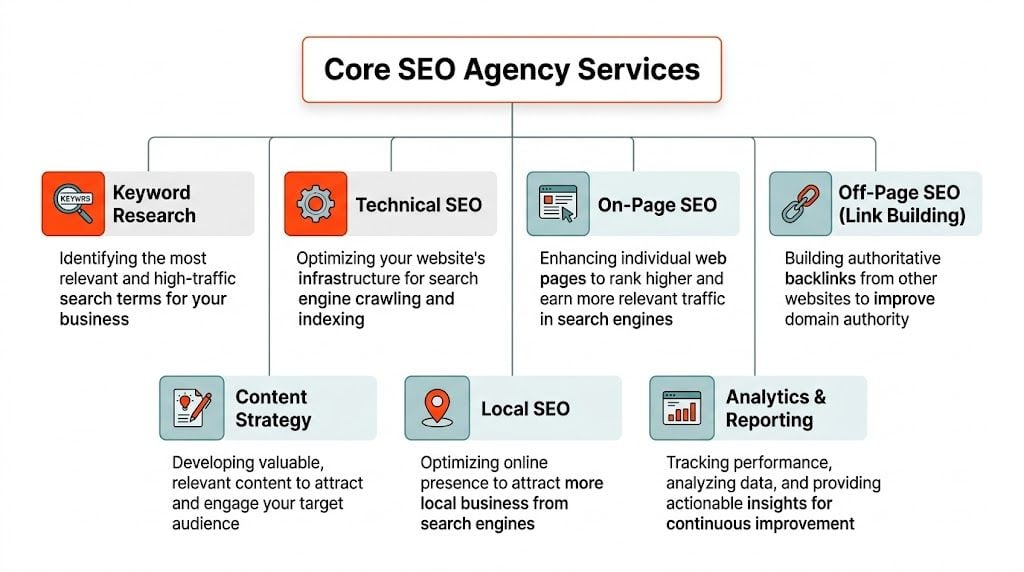
Modern agencies still cover the traditional service set. The difference is how they prioritise it. An AI-first team looks at technical health, content structure, entity clarity, internal linking, and reporting as parts of one system. That matters more now because Google often interprets and summarises pages before a user ever clicks.
Technical SEO
Technical SEO handles the site conditions that affect crawling, indexing, rendering, and performance. If those basics are weak, strong content can still underperform.
The work usually includes page speed reviews, mobile usability checks, crawl analysis, indexation control, canonical setup, structured data, duplicate content handling, redirect mapping, XML sitemaps, and internal linking paths. On larger sites, server log analysis and JavaScript rendering checks become more important because Google does not always process complex sites the way owners expect.
I usually explain technical SEO like road access to a retail store. Your signage can be excellent and your offer can be strong, but if the entrance is blocked, hard to find, or keeps changing, fewer people get in. Search works the same way.
On-page SEO
On-page SEO shapes how each page communicates its purpose.
That starts with matching the page to the query. A service page should help a buyer evaluate and act. A category page should help a shopper compare options. An informational article should answer a question clearly, then guide the visitor to the next logical page.
Good on-page work often includes:
- Search intent alignment
- Clear title tags and meta descriptions
- Useful heading hierarchy
- Copy covering the topic with depth, not repetition
- Internal links that support discovery and conversion
- Schema markup that clarifies meaning
Traditional agencies often fall behind, still optimising around isolated keywords. A modern agency optimises for topics, entities, and query context so pages have a better chance of appearing in standard results, rich results, and AI-generated answer layers.
Content strategy and content production
Content strategy decides what deserves to exist on the site in the first place.
That means choosing topics based on commercial value, search demand, competition, and the questions buyers ask before they contact sales. It also means deciding what not to publish. Many businesses do not need 200 low-value blog posts. They need 20 pages that answer the right questions, support product or service discovery, and strengthen topical authority around the offers that drive revenue.
For startups and smaller teams, that trade-off is even sharper. Budget wasted on low-intent content is budget not spent on pages that could generate pipeline. If you want a useful outside perspective on tighter planning for early-stage companies, SEO services for startups is a relevant reference.
Off-page SEO and authority building
Off-page SEO strengthens the trust signals around your business beyond your own website.
That includes earning relevant links, building brand mentions, supporting digital PR, improving citation consistency, and making sure your expertise is visible across credible third-party sites. The goal is not link volume. The goal is trusted references that reinforce your authority in a category or location.
This area has changed a lot. Low-grade directory links, generic outreach, and bulk guest posting still get sold because they are easy to package. They rarely help for long. Google is better at judging context, source quality, and whether a mention looks earned or manufactured.
Local SEO
Local SEO matters when people search with place-based intent or when proximity affects who gets the enquiry.
For Australian SMBs, that usually means Google Business Profile management, local landing pages, suburb or service-area content, review generation, local schema, and consistent business details across directories and maps. The practical goal is simple. Show up where customers are searching, and give them enough trust signals to contact you without hesitation.
A plumbing company in Brisbane and a B2B software firm selling nationally do not need the same local strategy. A capable agency adjusts the local work to the buying pattern instead of forcing every client into the same template.
Analytics and reporting
Reporting should explain what changed, why it changed, and whether it affected revenue.
Useful SEO reporting tracks page-level growth, query visibility, crawl and indexation issues, lead quality, assisted conversions, and the relationship between organic traffic and business outcomes. AI-first agencies usually go further by grouping queries into themes, identifying content gaps faster, and spotting technical issues before they spread across a site.
If you want an example of an engagement built around ongoing optimisation, technical fixes, and growth reporting, this overview of SEO services for websites shows the type of scope businesses often compare when choosing agency support.
How AI and Data Redefined the Modern SEO Agency
The old SEO playbook assumed a simple model. Publish content, target keywords, earn links, wait for rankings, collect clicks. That model hasn’t disappeared, but it no longer describes the whole search environment.

In Australia, Google’s AI Overviews now appear in 15% of searches, and 68% of e-commerce SMBs report stagnant organic traffic. The same source says AU startups using AI-first strategies see 2.5x lead growth. That framing from SEO.com’s discussion of modern SEO agencies captures the shift clearly. Search is no longer just a list of blue links. Search is becoming an AI-mediated answer layer.
Why traditional SEO is losing ground
Traditional SEO often treats content like inventory. More pages, more keywords, more chances to rank.
That approach breaks down when AI systems summarise information directly in search results, combine answers from multiple sources, and reward content that is structured around entities, clarity, and topical completeness rather than keyword repetition. Businesses can publish more and still get less.
The old signs are easy to spot:
- Blog-first strategy with no intent mapping
- Heavy reporting on rankings but weak reporting on leads
- Static keyword lists that ignore conversational search
- Content briefs built for writers, not for search models or users
- Technical work treated as a one-off clean-up instead of ongoing infrastructure
What an AI-first agency does differently
An AI-first SEO agency still handles fundamentals. It just doesn’t stop there.
It uses data and automation to improve decisions across research, content planning, internal linking, page structure, SERP analysis, and intent modelling. Teams review how search results are changing, where AI summaries are compressing clicks, and which queries still create strong commercial opportunity.
That often means:
- Modelling search intent at query-cluster level, not just page level
- Building conversational content structures that answer follow-up questions naturally
- Analysing SERP features before choosing what content should exist
- Combining SEO and PPC signals to identify terms that convert, not just terms that attract visits
- Refreshing content based on behavioural data, not fixed publishing schedules
One useful way to think about it is this. Traditional SEO often reacts to what ranked last quarter. AI-first SEO tries to predict what will deserve visibility next.
A practical overview of that shift sits in this guide on AI for SEO, which outlines how modern teams use AI as part of research and optimisation rather than as a shortcut for mass content production.
Here’s a concise explainer that helps show how the thinking has changed:
The real trade-off
AI-first doesn’t mean handing strategy to a machine. It means using AI where it improves speed, pattern detection, and decision quality, then applying human judgement where nuance matters.
Operator insight: AI can surface patterns fast. It can’t replace commercial judgement, brand positioning, or editorial standards.
Agencies that use AI well don’t flood a site with synthetic pages. They use it to sharpen prioritisation, uncover gaps, test assumptions, and adapt faster than manual workflows allow.
The SEO Agency Workflow From Onboarding to Results
A strong SEO engagement shouldn’t feel like a black box. You should know what happens, who’s doing the work, and how decisions get made.
The workflow usually starts before any optimisation happens. The first stage is discovery. The agency asks how the business makes money, which products or services matter most, who the competitors are, and what success looks like. A B2B company chasing qualified pipeline needs a different search strategy from an online retailer trying to improve product page revenue.
Stage one and the audit
Most professional engagements begin with access, auditing, and diagnosis.
That often includes reviewing:
- Google Search Console and analytics
- Current rankings and search visibility
- Technical site health
- Page templates and CMS constraints
- Existing content quality
- Conversion pathways
- Competitor search presence
This stage matters because many websites don’t have one problem. They have several smaller ones interacting at once. Thin category copy, slow templates, poor internal linking, and mismatched keywords can all suppress performance together.
Stage two and strategy
Once the audit is complete, the agency turns findings into a working plan.
That plan usually defines:
- Priority pages
- Core keyword and intent clusters
- Technical fixes
- Content opportunities
- Internal linking improvements
- Measurement criteria
Good strategy is selective. It doesn’t try to fix everything at once. It focuses first on changes most likely to influence visibility and business outcomes.
SEO works better when priorities are ruthless. A long to-do list isn’t a strategy.
Stage three and implementation
The work becomes visible. Developers may fix rendering issues or template bloat. Content teams may rewrite service pages, expand category content, or create supporting articles. SEOs may add schema, improve metadata, adjust site structure, and strengthen internal links.
The best implementations are collaborative. Agency teams need input from the people who know the product, sales objections, margins, and customer language. Search strategy becomes far stronger when subject knowledge and search data meet in the same room.
Stage four and refinement
After launch, the job isn’t done. The agency monitors indexation, rankings, page behaviour, and conversions, then refines based on what the data shows.
That’s where mature SEO differs from one-off consulting. Search changes. Competitors update pages. User behaviour shifts. Agencies keep testing and adjusting so gains don’t stall or erode.
A healthy agency relationship feels less like buying a deliverable and more like running a search programme with an external team that knows where to look when performance moves.
How to Measure SEO Success and Understand Agency Pricing
A business can spend months on SEO, watch reports fill up with ranking charts, and still have no clearer answer to a basic question. Is search producing more revenue, better leads, or stronger pipeline?
That question matters more now because Google no longer sends the same volume of clicks it used to. AI Overviews and richer search results can reduce traffic while still increasing brand visibility. A modern agency should measure both. Traditional reporting often stops at rankings and sessions. An AI-first agency tracks whether search visibility turns into qualified action.
What success should look like
Useful SEO measurement starts with business outcomes, then works backward to search signals.
For an e-commerce brand, that usually means category page growth, product page revenue, margin-aware traffic, and assisted conversions. For a B2B company, it often means demo requests, qualified enquiries, sales-accepted leads, and which pages influence those actions. For an Australian SMB, it may be simpler. More calls, more form fills, better local visibility, and stronger performance on service pages that generate work.
Rankings still have value. They help explain movement. They should not be the headline metric.
Good reporting should answer questions like these:
- Are the right pages gaining visibility for commercially relevant searches?
- Is organic traffic reaching people who can buy, book, or enquire?
- Are those visitors converting at a healthy rate?
- Is lead quality improving, not just lead volume?
- Are the changes made each month producing measurable gains?
I pay close attention to page-level performance because that is usually where weak reporting falls apart. Sitewide traffic can rise while revenue-driving pages stay flat. Blog traffic can surge while service pages underperform. On paper, the campaign looks healthy. In the business, nothing changes.
What transparent reporting includes
A good report should be readable by a marketing manager and useful to a business owner.
Look for:
- Page or cluster-level performance, so gains are tied to real assets
- Commercial context, including leads, sales, revenue, or pipeline where available
- Commentary on cause and effect, so you know what changed and why it mattered
- Completed work and next priorities, so accountability is visible
- Access to source data, not just a polished PDF
For businesses comparing delivery models, there are also reasons to consider an SEO consultant over an agency, especially when the need is senior strategic input rather than a full execution team. The right choice depends on complexity, internal resources, and how much implementation support you need.
Comparing SEO Agency Pricing Models
| Pricing Model | Typical Monthly Cost (AUD) | Best For | Pros | Cons |
|---|---|---|---|---|
| Retainer | $2,500 to $8,000 | Businesses needing ongoing SEO support | Continuous optimisation, reporting, and strategic iteration | Feels vague if scope, ownership, and deliverables are unclear |
| Project-based | Varies | Businesses needing a specific audit, migration, or site overhaul | Clear scope and timeline | Momentum often drops after delivery |
| Hourly | Varies | Businesses needing specialist input or second opinions | Flexible for defined tasks | Hard to build sustained progress |
| No-lock-in or short-term trial arrangement | Varies | SMBs wanting lower commitment risk | Easier to test fit and communication style | Short trials can limit what gets implemented and measured |
What pricing should actually reflect
Price should reflect the amount of work, the difficulty of the market, the state of the site, and how much coordination the agency is taking on.
A local services business with 30 pages is one job. A national e-commerce store with thousands of SKUs, faceted navigation, template issues, and feed dependencies is another. A B2B company with a long sales cycle, multiple buyer types, and thin category demand needs a different kind of programme again. Agencies that price all three the same are usually selling a template, not a strategy.
Clear pricing should answer a few direct questions:
- What work is included each month?
- Who is doing that work?
- How are priorities set?
- What is outside scope?
- How will performance be reported?
- What contract terms apply?
The risk is not paying more. The risk is paying for activity that never compounds into business results. In an AI-shaped search environment, that gap gets expensive fast.
Choosing the Right SEO Partner for Your Business
Choosing an agency is less about finding someone who says the right buzzwords and more about finding a team whose process matches your business reality.
A good partner should be able to explain strategy in plain language, defend priorities with evidence, and tell you what they won’t do. If every answer sounds polished but vague, that’s a warning sign.
What to ask in a consultation
Start with questions that reveal how the agency thinks.
- How do you decide which pages or opportunities to prioritise first?
- How do you measure success for a business like ours?
- What technical issues tend to hold back sites in our category?
- How do you handle content strategy and implementation?
- What does reporting look like month to month?
- How do you adapt when Google changes search layouts or AI features?
The goal isn’t to catch them out. The goal is to see whether their answers are specific, commercially aware, and grounded in process.
Red flags that usually matter
Some warning signs are consistent across the industry.
- Guaranteed rankings. No agency controls Google.
- Secret methods. Good SEO can be explained clearly.
- Vanity metric obsession. Traffic without business relevance is noise.
- One-size-fits-all packages. Different businesses need different search strategies.
- No discussion of trade-offs. Real experts speak candidly about constraints and prioritisation.
If an agency can’t explain why a tactic fits your business, they probably use the same playbook for everyone.
The right fit by business type
An e-commerce brand should listen for talk about category architecture, product schema, internal linking, crawl efficiency, and commercial landing pages. A B2B company should listen for discussion about long-tail intent, lead quality, service page depth, and content that supports longer buying journeys. A local SMB should hear about Google Business Profile, local relevance, reviews, location pages, and citation consistency.
Some businesses may also be deciding between an agency and a specialist consultant. If that’s your situation, this article on reasons to consider an SEO consultant over an agency is useful because it frames where a solo expert may suit certain business needs better.
One practical example of an agency model in this space is Click Click Bang Bang, which offers AI-first SEO alongside PPC and uses transparent reporting with no long-term commitment as part of its operating model. That kind of structure can suit businesses that want search support tied closely to performance visibility rather than a locked contract.
Common Questions About Working with an SEO Agency
How long does SEO take to work
SEO usually takes time because search engines need to crawl, process, and reassess your pages, and because competitors are also improving their sites. Some technical fixes can help sooner, while authority and content gains often take longer. The important question isn’t “how fast can we rank?” It’s whether the agency is making the right changes in the right order.
Can an agency guarantee rankings
No. Any agency promising guaranteed rankings is overselling.
Google’s results change constantly, competitors move, and search layouts now include more AI-driven features than they used to. A trustworthy agency can commit to process, rigour, transparency, and informed strategy. It can’t guarantee a specific position.
Can I do SEO myself
You can handle parts of SEO in-house, especially if your site is small and your market isn’t highly competitive. Many businesses can improve title tags, page structure, internal links, and basic content quality without outside help.
The challenge comes when SEO requires technical diagnosis, structured prioritisation, schema, log analysis, content systems, or cross-team implementation. That’s where specialist experience saves time and avoids expensive mistakes.
Is SEO still worth it with AI changing search
Yes, but the way you approach it has changed. Businesses still need visibility in search. What’s changing is how that visibility is earned and protected.
Sites that rely on outdated tactics often lose ground. Businesses that adapt to conversational search, stronger page structure, technical health, and data-led content planning are in a better position to keep winning attention.
What should I expect in the first month
You should expect questions, access requests, research, auditing, and prioritisation. A serious agency won’t guess. It will diagnose before it prescribes.
You should also expect clarity. If the first month feels fuzzy, hidden, or overloaded with jargon, the relationship may stay that way.
If you're evaluating whether an SEO partner fits your business, Click Click Bang Bang offers AI-first SEO and PPC with transparent reporting, flexible monthly plans, and a 30-day risk-free trial model that suits businesses wanting clear accountability without long-term lock-in.
Read NeXt
Or Read Our Latest
- Manual vs Automated Bidding for PPC Success
- Conversion Tracking Setup: A Complete AU Guide
- Instagram Advertising Australia: Complete 2026 Guide
- Pay Per Click: A Beginner’s Guide for Australian Marketers
- Display Advertising on Google: The Complete Australian Guide
- Stakeholder Communication Plan How to Build One That Works
Click. CLick. Subscribe.
Get our best PPC insights, industry updates, and power moves delivered straight to your inbox. No fluff, just high-caliber strategies that actually work.
Don’t Leave Just Yet
Try Us For 30-Days,
Risk Free!!
We guarantee that you’ll love our work within the first 30 days, if not you’ll get your money back.
What have you got to lose?