

A Modern B2B IT Marketing Playbook for 2026
Last Updated

Let's be honest: B2B IT marketing isn't like selling to consumers. It's a tough game of long sales cycles, navigating complex buying committees, and proving tangible business value and ROI. Success isn't about quick, transactional wins; it's about building unshakeable trust and demonstrating deep expertise.
Rethinking Your B2B IT Marketing for 2026
The path your B2B IT buyer takes is longer and more crowded than ever before. A recent Ahrefs study brought a harsh reality to light: when Google’s AI Overviews show up, click-through rates for the top organic result can plummet. This is a clear signal that the old playbook of just ranking for keywords to drive traffic and leads is officially broken.
This guide cuts through the noise. It’s a practical playbook built for the challenges we’re all facing today. We’ll move past generic advice and get into specific strategies that are actually driving growth in the tech sector, from building a rock-solid audience foundation to deploying AI-powered campaigns that convert.
Shifting from Clicks to Conviction
The fundamental challenge has changed. Your brand might get a mention in an AI-generated summary, but in that moment, you often lose the chance to:
- Give the full context of your solution and its value.
- Immerse the prospect in your carefully crafted website experience.
- Capture the behavioural data you need to understand their intent.
- Turn that initial interest directly into a lead or a sales conversation.
The game is no longer just about being seen; it's about creating content and experiences so valuable that buyers will actively hunt you down. If you don't control the platform where engagement happens, you don't control the outcome.
A Playbook for Modern Challenges
Think of this as your end-to-end resource for mastering hyper-targeted messaging, AI-first SEO, precision PPC, and strategic Account-Based Marketing (ABM). We'll dig into how leading IT firms are navigating those tricky buying committees and share actionable frameworks you can put to work immediately.
For a fresh take on engaging your audience where they already spend their time, check out these 10 B2B Social Media Marketing Strategies. Our goal is simple: to give you the tools to generate a predictable pipeline of qualified leads, even as the digital ground keeps shifting under our feet.
Decoding the Modern IT Buying Committee
If you want to succeed in B2B IT marketing, you can forget about casting a wide net. It’s all about surgical precision. Before you even think about spending a single dollar on ads, you need a crystal-clear picture of who you’re actually selling to. This means going way beyond vague ideas like "IT managers" and digging into the complex, multi-layered group we call the buying committee.
Gone are the days when a single person made a major IT purchase. Today, it’s a team sport. The decision-making process involves a whole cast of characters with vastly different priorities, technical know-how, and budget concerns. Research shows the average B2B buying journey now involves multiple stakeholders and can drag on for months, so understanding each player’s role is absolutely critical.
Mapping the Key Players
To get your message through, you need to develop detailed buyer personas. And no, these aren't just fluffy demographic snapshots. They’re deep dives into the professional lives of the people you want to reach. A great starting point is learning how to create buyer personas that drive B2B growth and then tweaking that framework for the unique IT landscape.
Let's imagine a mid-size company looking at a new cybersecurity platform. Here’s who is probably sitting around the table:
- The Chief Technology Officer (CTO): This person is all about the big picture and long-term strategy. They’re asking: Does this fit our existing tech stack? Will it scale with us? They care about vision and future-proofing the business.
- The IT Director/Manager: This is your boots-on-the-ground person, focused on implementation and day-to-day operations. Their questions sound more like: How painful will this be to deploy? How much training will my team need? They want reliability and minimal headaches.
- The Chief Financial Officer (CFO): As the guardian of the budget, the CFO’s world revolves around the numbers. They scrutinise the Total Cost of Ownership (TCO) and won't sign off without a clear Return on Investment (ROI). Your marketing has to speak their language: financial efficiency and risk reduction.
- The End-User (e.g., Solutions Architect, DevOps Engineer): This is the person whose daily work will change the most. Their focus is purely on function and usability. Will this tool make my job easier, or is it just another layer of complexity?
- The Chief Information Security Officer (CISO): For any security product, the CISO is a key decision-maker. They are laser-focused on compliance, threat mitigation, and data protection. They need to see hard evidence of robust security protocols and industry certifications.
Your marketing will fall flat if you're pushing a one-size-fits-all message. A dense, technical whitepaper might get a DevOps Engineer excited, but it will be completely ignored by the CFO, who would much rather see a simple ROI calculator.
This is why you need a coordinated approach where different tactics like targeted messaging, AI-powered SEO, and precision PPC all work together.
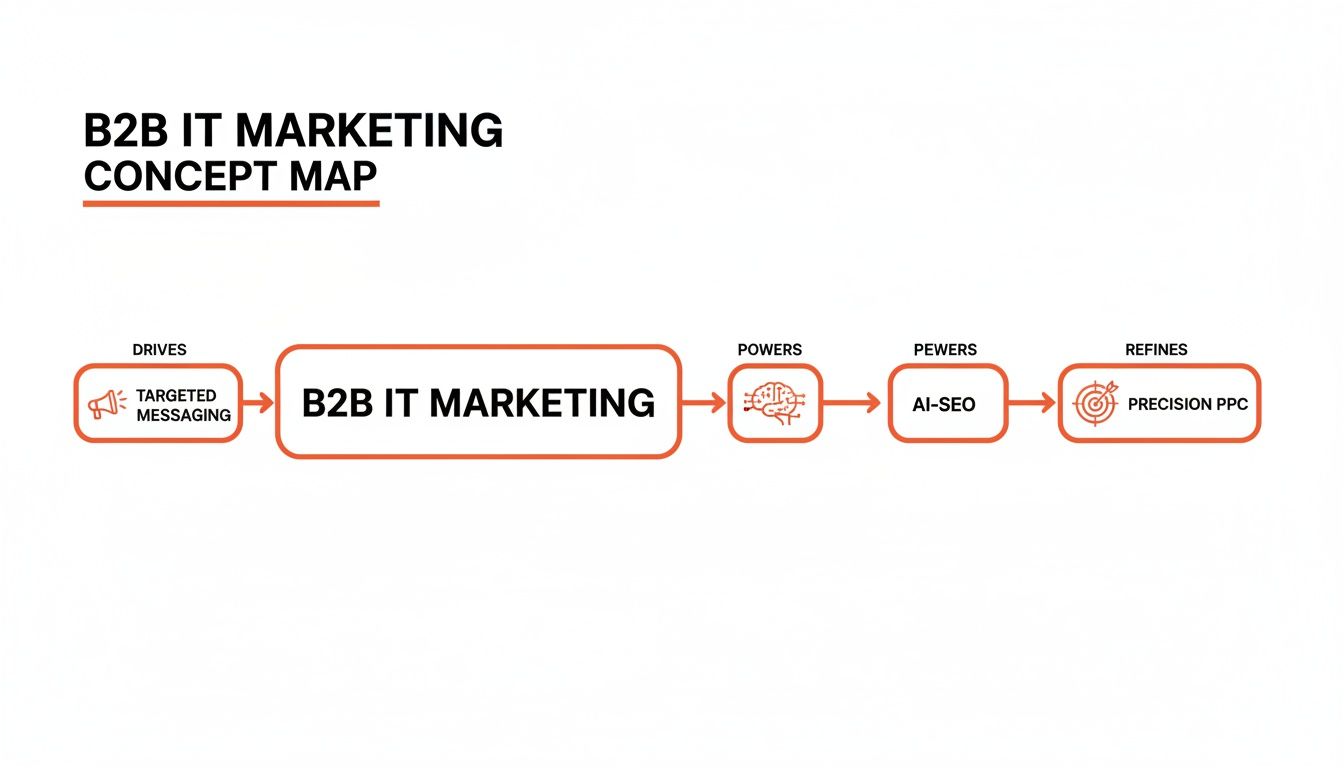
As you can see, it's about a multi-channel strategy where every piece is tailored to intercept specific personas at different points in their journey.
From Personas to Actionable Segments
Once you’ve mapped out your personas, the real work begins: turning them into actionable audience segments for your campaigns. This is where your B2B IT marketing strategy gets its power. Instead of just broad targeting, you can get hyper-specific.
The goal is to make each member of the buying committee feel like you're speaking directly to them and their most pressing concerns. This level of personalisation is what separates winning IT marketing from the noise.
For instance, you can build out completely different audiences on different ad platforms:
| Platform | Persona Target | Sample Messaging Angle |
|---|---|---|
| Google Ads | Solutions Architect | Focus on specific technical features, long-tail keywords about integration challenges, and "how-to" content. |
| LinkedIn Ads | Chief Technology Officer | Highlight strategic business outcomes, scalability, case studies from similar-sized companies, and thought leadership. |
| Display Retargeting | Chief Financial Officer | Serve ads featuring ROI data, TCO comparisons, and testimonials focused on financial benefits after they visit your pricing page. |
By meticulously decoding the buying committee and tailoring your approach, you shift your marketing from a generic broadcast into a series of meaningful, persuasive conversations. This is the foundation every successful B2B IT marketing campaign is built on.
Building an AI-Powered Content and SEO Engine
In B2B IT marketing, your content is everything. It’s how you build authority, prove your expertise, and ultimately, win deals. But it's not enough to just rank for a few keywords anymore. To stand out, you need to own the entire conversation around your core IT services, guiding buyers from their first Google search right through to signing on the dotted line.
This means building a smart, AI-assisted content strategy designed to attract and convert those high-intent IT decision-makers.
Forget just basic keyword research. While tools like Ahrefs and SEMrush are still your bread and butter, AI can help you dig so much deeper. I’m talking about using AI-powered tools to analyse what your competitors are doing and, more importantly, what they’re missing. These tools can dissect top-ranking articles to show you the exact sub-topics, questions, and themes Google expects to see. This lets you create content that isn’t just keyword-optimised, but genuinely comprehensive.
Organising Content Around Pillar Pages and Topic Clusters
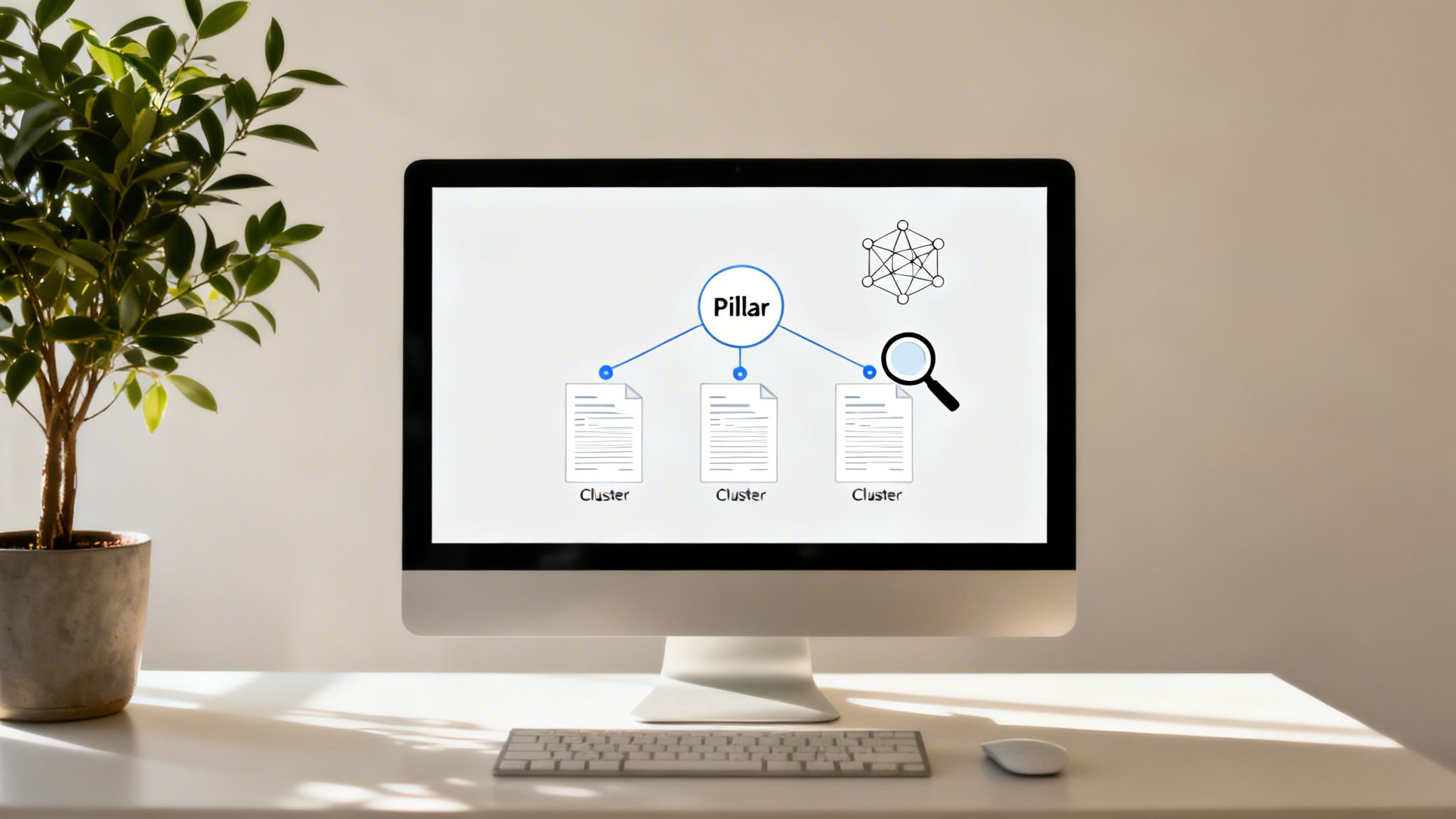
One of the most powerful ways to show Google you know your stuff is with the pillar page and topic cluster model. It's a simple, logical way to structure your content that makes it incredibly easy for both users and search engines to see your expertise.
Here’s how it works:
- Pillar Page: Think of this as your magnum opus on a broad topic. For an IT security firm, this might be "The Ultimate Guide to Enterprise Network Security." It needs to be the single most authoritative resource out there on that subject.
- Topic Clusters: These are shorter, more focused articles that dive into specific sub-topics and link back to your main pillar page. Using our network security example, your cluster articles could be things like, "How to Conduct a Network Security Audit," "Comparing Firewall Solutions for SMBs," or "Best Practices for Employee Cybersecurity Training."
This structure sends a massive signal to Google that you have deep domain authority. Every cluster post bolsters the pillar, and the pillar acts as a central hub, creating a powerful web of internal links that boosts your site’s credibility on the entire topic.
The goal is to create a content ecosystem where every piece has a job. Your pillar page is the definitive resource, while your cluster content pulls in long-tail search traffic, answers niche questions, and pulls prospects deeper into your world.
Mapping Content to the B2B Buyer’s Journey
A winning content strategy in B2B IT means creating the right asset for the right person at the right time. An IT Director just starting to realise they have a problem has completely different needs to a CFO who's about to make a final decision. You have to meet them where they are.
Top of Funnel (ToFu) – Awareness
At this stage, your audience is just becoming aware they have a challenge or an opportunity. They are nowhere near ready for a sales pitch. Your content here should be purely educational, helpful, and vendor-neutral.
- Examples: Blog posts ("5 Signs Your Data Backup Strategy Is Outdated"), technical guides, and informative webinars.
- Goal: Attract a wide audience, get your name out there, and position your company as a trusted, knowledgeable resource.
Middle of Funnel (MoFu) – Consideration
Okay, now your prospects are actively researching solutions. They're comparing different approaches, vendors, and technologies. Your content needs to help them evaluate their options and subtly show why your solution is a serious contender. If you need help creating content that truly connects at this stage, our team has deep experience in professional SEO and copywriting that drives results.
- Examples: In-depth case studies, vendor comparison sheets, whitepapers, and product demo videos.
- Goal: Nurture those leads, prove your solution’s value, and build rock-solid trust.
Bottom of Funnel (BoFu) – Decision
The buyer is on the verge of making a purchase. They just need that final piece of validation that your IT service is the right choice. Your content now has to be highly specific and laser-focused on conversion.
- Examples: ROI calculators, free trials or consultations, implementation guides, and detailed pricing pages.
- Goal: Convert those qualified leads into customers by knocking down any final barriers to purchase.
By building out this structured content machine, you stop chasing random keywords. You’re creating a systematic, repeatable process for attracting, educating, and converting your ideal IT customers, cementing your position as a trusted leader in a very noisy market.
Launching High-Precision PPC and LinkedIn Ad Campaigns
Once you’ve decoded your audience and your content engine is humming along, it’s time to hit the accelerator. In B2B IT marketing, paid advertising isn't about spraying your budget and hoping for the best. It's about surgical strikes that connect you with high-intent buyers at the exact moment they’re looking for a solution. This is where all that hard work understanding the buying committee really pays off, letting you launch campaigns on Google and LinkedIn with pinpoint accuracy.
These two platforms play very different, yet complementary, roles. Google Ads is brilliant for capturing active demand—people searching for solutions to their problems right now. LinkedIn, on the other hand, is unmatched for proactive targeting. It lets you get your message in front of specific individuals at your dream accounts before they even realise they need to start searching.
Mastering High-Intent Keywords on Google Ads
Forget bidding on broad, expensive keywords like "IT services." The competition is fierce, the intent is vague, and you’ll just burn through cash. The real ROI in B2B IT marketing comes from homing in on long-tail keywords that signal an immediate need and a deep understanding of the problem.
You have to think like your buyer personas. A solutions architect isn't going to search for "cloud computing." They'll be much more specific, typing in something like, "migrate on-premise SQL server to Azure." This kind of query tells you they aren't just browsing—they have a specific, technical project on their plate.
Your campaign structure needs to mirror this level of detail. Build tightly-themed ad groups around these specific problem-and-solution sets.
- Ad Group 1 Keyword: "managed service provider for financial firms"
- Ad Group 2 Keyword: "SOC 2 compliance automation software"
- Ad Group 3 Keyword: "disaster recovery as a service pricing"
Each of these ad groups should point to a dedicated landing page that speaks directly to that specific pain point, using the exact same language as the search query. This tight relevance between the keyword, your ad copy, and the landing page is precisely what Google rewards with higher Quality Scores and, ultimately, lower costs per click.
Surgical Targeting with LinkedIn Ads
While Google is there to capture intent, LinkedIn helps you create it. Here, you can move beyond keywords and target the actual people on your Ideal Customer Profile list. The real power of LinkedIn lies in its ability to layer multiple targeting criteria to build a highly qualified, custom audience. For a deeper dive into the platform's potential, check out our comprehensive guide to LinkedIn Ads management.
Let's imagine you sell a data analytics platform for the logistics industry. On LinkedIn, you could build an audience that includes:
- Job Titles: "Director of Operations," "Supply Chain Manager," "Logistics Coordinator"
- Industry: "Logistics and Supply Chain"
- Company Size: "501-1,000 employees"
- Geography: "Australia"
This is powerful on its own, but the real magic happens when you bring in Matched Audiences. By uploading a list of your target accounts (your ABM list), you can instruct LinkedIn to only show your ads to people with the job titles above who also work at those specific companies. This is the very definition of precision.
Creating Compelling B2B Tech Ad Copy
Your ad copy needs to hit that sweet spot—speaking to a technical but business-minded audience. Ditch the fluffy marketing-speak and focus on clear, tangible outcomes. A formula that consistently works for us is Problem + Solution + Proof.
Here’s how that might look for a cybersecurity ad:
- Problem: "Worried about ransomware attacks?"
- Solution: "Our platform detects and neutralises threats in real-time."
- Proof: "Protecting over 200 Australian financial firms. Get a free demo."
This structure is effective because it immediately qualifies the reader, presents a crystal-clear value proposition, and offers a low-risk call-to-action.
Cross-Channel Plays and Powerful Lead Magnets
Don't treat Google and LinkedIn as separate silos. When you use them together, the impact is multiplied. One of our favourite cross-channel plays is to use LinkedIn for building initial awareness and then deploying Google's Display Network for sharp, effective retargeting. For instance, someone who engaged with your LinkedIn ad about "supply chain analytics" can then be shown a specific case study banner ad as they browse other websites, keeping your solution top of mind.
Finally, your paid campaigns need to lead somewhere compelling. A standard "Contact Us" form just won't cut it anymore. For B2B IT, you need to offer high-value lead magnets that give something back.
Here are a few ideas that work wonders:
- Interactive Demos: Let prospects get their hands on a sandboxed version of your software.
- Diagnostic Tools: Offer a free tool that assesses their current security posture or analyses their cloud spending.
- ROI Calculators: Create an interactive page that helps a CFO or decision-maker model the financial impact of your solution.
These assets provide immediate value, capture critical lead information, and pre-qualify prospects far more effectively than a simple PDF download. This approach also aligns beautifully with other marketing channels. For instance, in the Australian B2B IT space, email campaigns boast an impressive average open rate of 47.69%. By integrating AI for personalisation, Australian IT firms have seen 13% higher revenue growth, proving that a strong lead magnet from a PPC campaign can fuel a highly effective and profitable email nurture sequence. You can find more insights like this in the 2026 B2B marketing statistics on Thunderbit.com.
The table below breaks down how we think about the primary channels for B2B IT marketing, their strategic purpose, and the key performance indicators (KPIs) we track to measure success.
B2B IT Marketing Channel Focus and KPIs
| Channel | Primary Goal | Key Targeting Methods | Primary KPIs |
|---|---|---|---|
| Google Ads (Search) | Capture high-intent, active demand | Long-tail keywords, In-market audiences | Cost Per Lead (CPL), Lead-to-MQL Rate, Quality Score, Conversion Rate |
| LinkedIn Ads | Proactive targeting & account penetration | Job title, industry, company size, Matched Audiences | Cost Per MQL, Audience Engagement Rate, Account-Level Impressions |
| Google Display Network | Retargeting & brand awareness | Custom audiences (site visitors), Lookalike audiences | View-Through Conversions, Click-Through Rate (CTR), Cost Per Mille (CPM) |
| Organic Search (SEO) | Build authority & attract problem-aware traffic | Topic clusters, informational keywords | Organic Traffic, Keyword Rankings, MQLs from Organic, Backlinks |
| Email Marketing | Nurture leads & drive engagement | Lead magnet downloads, webinar attendees | Open Rate, Click-to-Open Rate (CTOR), Pipeline Generated |
By keeping these goals and metrics in mind, you can ensure each channel is pulling its weight and contributing directly to your sales pipeline. This strategic focus prevents you from getting lost in vanity metrics and keeps the entire team aligned on what truly drives growth.
Deploying Account-Based Marketing That Closes Deals
While broad-reach PPC and SEO are brilliant for capturing existing demand and building awareness, they often fall short when you’re trying to land your biggest, most valuable accounts. A generic message just won't cut it for high-value enterprise clients. This is where Account-Based Marketing (ABM) stops being a buzzword and becomes a serious revenue driver for B2B IT marketing.
ABM essentially flips the traditional marketing funnel. Instead of casting a wide net and hoping for the best, you start by hand-picking a list of your dream accounts. From there, you treat each of those accounts as its own market, rolling out a highly personalised marketing and sales campaign designed specifically to win them over.
Structuring Your ABM Tiers
The reality is, not every target account warrants the same level of intense effort. A tiered ABM strategy is the smart way to allocate your resources, making sure you apply maximum pressure where it counts the most.
-
Tier 1 One-to-One: This is the top of the pyramid, reserved for a very small number of your absolute "whale" accounts. Here, your marketing and sales teams work in lockstep to create completely bespoke campaigns for individual companies, often targeting key members of the buying committee with hyper-personalised content, ads, and direct outreach.
-
Tier 2 One-to-Few: This tier is for small clusters of accounts, maybe 5-15, that share common ground—like being in the same industry or facing similar challenges. You can create lightly customised campaigns that speak directly to their shared pain points, without the massive resource drain of a full one-to-one approach.
-
Tier 3 One-to-Many: Think of this as a more programmatic approach. You use technology to deliver personalised campaigns at scale to a broader list of named accounts. This might involve targeted digital ads, customised email nurtures, or content tailored to specific industry verticals.
This tiered model helps make ABM a manageable and scalable part of your overall B2B IT marketing strategy.
Executing Your First ABM Play
Let's make this real. Imagine your Tier 1 target is a large logistics company. You’ve done your homework and identified five key decision-makers on LinkedIn: the CTO, Director of Operations, Head of Security, CFO, and a Senior Solutions Architect.
A classic ABM "play" would look something like this, with marketing and sales moving in perfect sync.
First, marketing launches a hyper-targeted LinkedIn campaign aimed exclusively at those five individuals. The ad copy isn't generic; it speaks directly to the challenges of the logistics industry and links to a case study featuring another logistics client you've helped.
At the same time, your sales development representative (SDR) starts their outreach. They might send a LinkedIn connection request with a personalised note that references the company's recent annual report or a piece of industry news.
A few days later, the SDR follows up with an email. But it's not a sales pitch. Instead, it offers a high-value, non-gated resource, like a benchmark report on "Digital Transformation in Australian Logistics." This demonstrates expertise and builds genuine goodwill.
The entire experience is seamless and coordinated. The prospect sees a relevant ad, receives a thoughtful connection request, and gets a helpful email—all reinforcing the same core message that your company understands their specific world.
This highly focused approach is transforming how Australian companies operate. In fact, Account-Based Marketing is helping mid-market firms shorten sales cycles and even double their average deal values. Insights from a 2026 guide by Marketing Eye Brisbane show this strategy boosts meetings with senior decision-makers and can improve win rates by 20-30% on targeted lists, creating a clear link between marketing activity and revenue. Find more about these findings and the growth of B2B ABM in Australia on Marketingeyebrisbane.com.au.
Aligning Sales and Marketing for Success
Here’s the thing: ABM will fail if it’s run in a silo. It absolutely demands an unbreakable partnership between your marketing and sales teams—a concept often called "smarketing." This alignment is the engine that drives any successful campaign.
Both teams need to be on the same page from the very beginning. They must agree on the target account list, the key personas within those accounts, the messaging for each persona, and the specific plays they're going to run.
Regular meetings are non-negotiable. You need a rhythm for reviewing engagement data—who's clicking the ads, who's opening the emails, who's visiting the website—and deciding on the next best action together. This collaborative feedback loop ensures no opportunity is missed and that every interaction feels like a natural continuation of the last. When done right, this alignment dramatically shortens the sales cycle and creates a far better buying experience, making it a critical part of modern IT lead generation services.
Measuring Performance and Optimising for Revenue
Let’s be honest: effective B2B IT marketing isn't about looking busy. It's about driving tangible business results. To prove your value and make smarter decisions, you have to connect every single action directly to revenue. This means finally moving past surface-level vanity metrics like impressions and clicks, and focusing on the KPIs that actually matter to the C-suite.
The first real step is establishing rock-solid conversion tracking and attribution. Your goal should be to see exactly which channels—from a specific Google Ads campaign to an ABM play on LinkedIn—are delivering qualified pipeline. Without this data, you're just flying blind, completely unable to justify your budget or scale what's working.
Key Metrics That Drive Decisions
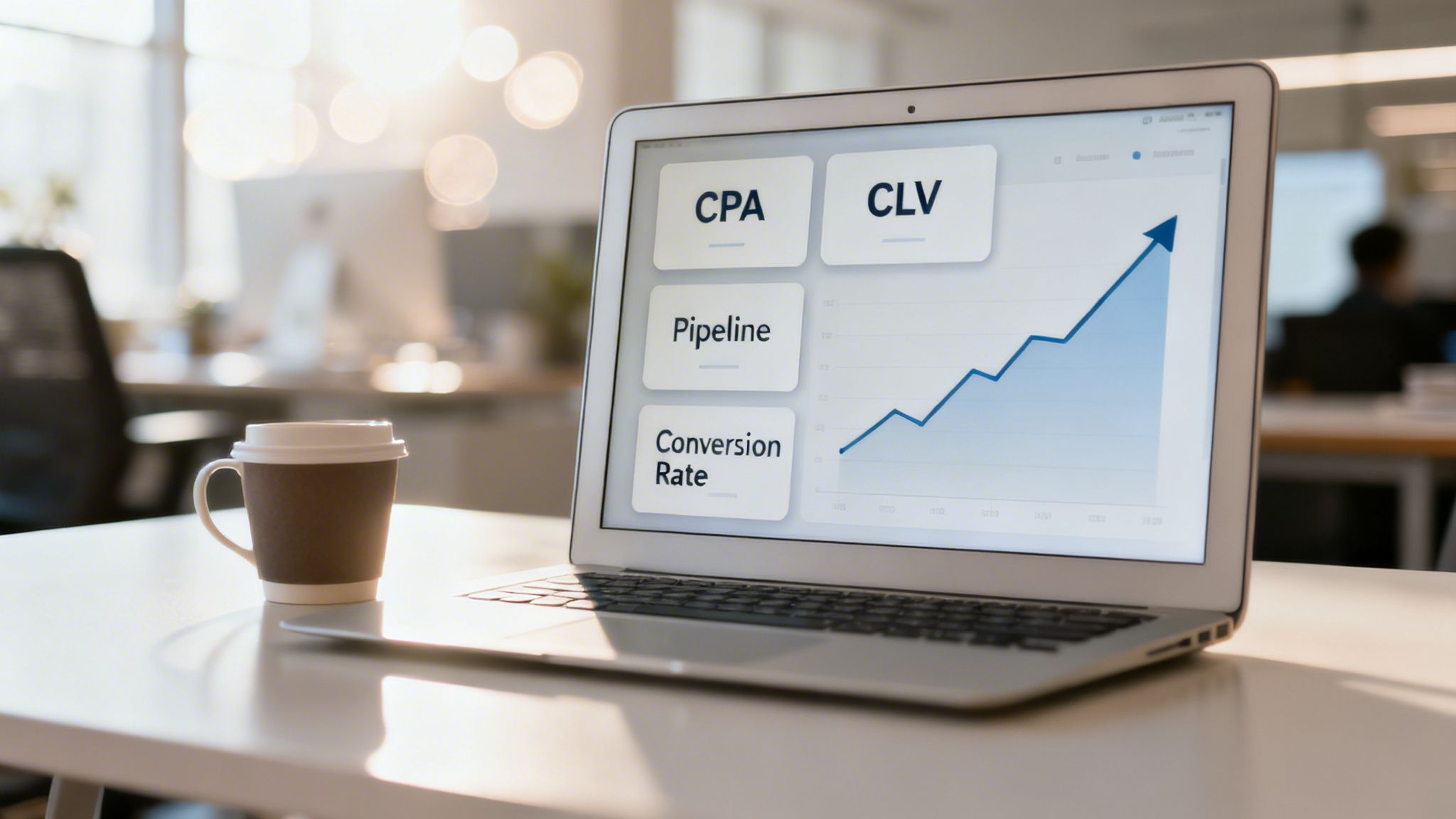
To get a real handle on performance, you need to track the metrics that reflect the financial health and profitability of your efforts. Forget simple lead counts and start measuring what truly impacts the bottom line. For any serious B2B IT marketer, these three metrics are absolutely non-negotiable.
- Cost Per Acquisition (CPA): This is the total cost of your marketing and sales efforts to acquire one new customer. It's the ultimate measure of your campaign efficiency.
- Customer Lifetime Value (CLV): CLV represents the total revenue you can expect from a single customer account over the entire life of your relationship. A high CLV is what justifies a higher CPA.
- Pipeline Velocity: This metric tells you how quickly leads are moving through your sales funnel and turning into actual revenue. A faster velocity means a more efficient and predictable sales cycle.
When you can confidently walk into a meeting and show that your average CLV is $50,000 and your CPA is only $5,000, you’ve officially built a profitable growth engine. This is the kind of data that gets you a bigger budget and a seat at the leadership table.
Building Your Revenue-Focused Dashboard
Once you've defined your key metrics, it's time to pull them all together into a dynamic dashboard. This isn't just for show; it gives you a real-time view of what’s working and what isn’t, allowing you to pivot your strategy fast. Your dashboard needs to clearly visualise the entire journey from initial click to closed deal.
For example, a typical B2B SaaS company often invests around 8% of its annual recurring revenue into marketing. By tracking these core KPIs, you can ensure that investment is consistently generating a positive return.
This data-driven approach allows you to confidently reallocate funds from underperforming campaigns to high-growth opportunities. You’re no longer guessing—you’re continuously optimising your strategy for profitable growth and proving marketing's undeniable contribution to the business.
Your B2B IT Marketing Questions, Answered
When we talk to B2B IT leaders, the same questions seem to pop up time and again. It's a complex field, and there's a lot of noise out there.
Let's cut right to it and give you some straight, no-nonsense answers to the most common challenges we see.
How Much Should We Really Be Spending on Marketing?
This is the big one, isn't it? For an established IT firm, a good rule of thumb is to earmark 5-10% of your annual revenue for marketing. If you’re a high-growth company trying to aggressively snatch up market share, that figure can climb to 15-25%.
But here's the real secret: don't just throw a percentage at the wall. The smartest way to scale is to start small and prove the model.
Pick one or two high-intent channels where you know your buyers live—think Google Ads search and LinkedIn Ads—and allocate a test budget. Measure your performance obsessively against your target Cost Per Acquisition (CPA). If your Customer Lifetime Value (CLV) is $30,000 and you can consistently acquire customers for under $3,000, you’ve got a profitable engine. Double down on that, and scale with confidence.
What's the Single Biggest Mistake IT Companies Make in Marketing?
Easy. They sell product features, not business outcomes. Your buyers aren't just looking for another piece of software or hardware. They are desperately trying to solve a critical business problem—maybe it's a glaring security risk, a bottleneck in their operations, or a roadblock to scaling.
Your marketing message absolutely must be framed around how you solve their specific pain and deliver tangible value. Always, always lead with their problem, not your product's spec sheet.
How Long Does B2B SEO Actually Take to Show Results?
Let's be clear: B2B SEO is a marathon, not a sprint. Anyone who tells you otherwise is selling you something.
You can realistically expect to see some initial traction and ranking improvements for your targeted, long-tail keywords within 3-6 months. But to achieve significant organic traffic and start dominating competitive, high-value terms, you're looking at a 6-12 month journey of consistent, high-quality effort.
This is precisely why you can't rely on SEO alone from day one. You need to pair your long-term organic strategy with faster channels like PPC to keep a steady flow of leads coming in while your SEO authority builds. It’s a two-pronged attack.
Ready to stop guessing and start getting real results from your B2B IT marketing? Click Click Bang Bang specialises in precision-driven SEO and PPC campaigns that connect you with high-intent buyers. Book your free strategy call with us today and see how our data-first approach can fuel your growth.
Read NeXt
Or Read Our Latest
- Manual vs Automated Bidding for PPC Success
- Conversion Tracking Setup: A Complete AU Guide
- Instagram Advertising Australia: Complete 2026 Guide
- Pay Per Click: A Beginner’s Guide for Australian Marketers
- Display Advertising on Google: The Complete Australian Guide
- Stakeholder Communication Plan How to Build One That Works
Click. CLick. Subscribe.
Get our best PPC insights, industry updates, and power moves delivered straight to your inbox. No fluff, just high-caliber strategies that actually work.
Don’t Leave Just Yet
Try Us For 30-Days,
Risk Free!!
We guarantee that you’ll love our work within the first 30 days, if not you’ll get your money back.
What have you got to lose?