

Unlocking SEO and Copywriting The AI-Powered Content Guide
Last Updated

SEO and copywriting are two sides of the same coin. SEO is what draws the audience in, and copywriting is what persuades them to act.
One without the other is like having a brilliant stage show with zero promotion—or a packed theatre with a terrible performance. Ultimately, modern SEO rewards exceptional copywriting, making their partnership absolutely essential for success.
Why SEO and Copywriting Are a Power Duo

Think of your website as that stage performance. SEO is the masterful promotion that sells every ticket, making sure your ideal audience finds their way to you. It’s all about understanding what people are searching for and structuring your site so that search engines like Google put you front and centre.
But what happens once the crowd arrives?
That’s where copywriting takes the spotlight. It's the captivating script, the powerful delivery, and the emotional hook that turns a curious visitor into a loyal customer. It’s the persuasive language on your pages that guides people, answers their unspoken questions, and convinces them that you have the perfect solution. Without compelling copy, all that traffic you worked so hard to get with SEO just goes to waste.
The Shift from Keywords to User Experience
In the early days of the internet, SEO was a much more mechanical game. You could often win just by stuffing pages with the right keywords. Not anymore. Today’s search engine algorithms are far more sophisticated, evolving to prioritise user satisfaction above everything else. Google’s core mission, after all, is to provide the most helpful and relevant answer to a user’s query.
This means search engines now reward content that delivers genuine value. They’re watching for signals like:
- Time on page: How long do visitors actually stick around to read what you’ve written?
- Bounce rate: Do people hit the back button a second after they arrive?
- User engagement: Are they clicking links, watching videos, or filling out forms?
Every single one of these metrics is a direct reflection of your copywriting. Persuasive, clear, and engaging writing keeps people on your site longer, which signals to Google that you’re a high-quality result worth ranking.
A New Era Demands Quality Over Quantity
The days of churning out mountains of low-value content just to target keywords are well and truly over. Recent algorithm updates have hammered this point home, penalising sites that put quantity before quality.
For instance, after Google's December 2025 Core Update, many Australian websites that relied on repetitive, templated pages saw their rankings plummet. It was a clear signal of a critical pivot towards user value and credibility, proving that strong SEO and copywriting must work in tandem. You can read more about the impact on Australian SEO strategies on ROI.com.au.
SEO gets you the click, but copywriting gets you the conversion. In a world where AI can generate endless content, the human touch—storytelling, empathy, and persuasion—is what truly sets a brand apart and drives business results.
This partnership is no longer just a good idea; it's the fundamental basis of any successful digital strategy. SEO builds the bridge, and great copywriting convinces people to cross it.
Understanding Your Audience With Keyword Intent

Great seo and copywriting doesn't start with a blank page and a list of keywords. It starts with empathy. Long before you write a single word, you need to step into your audience's shoes and figure out not just what they’re searching for, but why.
This is the whole game when it comes to keyword intent—getting to the heart of the human motivation behind every search query.
Think about someone typing "best running shoes for beginners" into Google. They aren't just looking for a product list. They're searching for confidence, a way to avoid injury, and a smooth start to a new fitness habit. Your copy needs to speak directly to those deeper needs, not just echo the search term back at them.
It's this understanding that turns generic content into a genuinely helpful conversation. You build trust, solve their real problem, and naturally guide them towards the right solution.
Decoding the Four Types of Search Intent
To really connect, you have to meet people where they are in their journey. Most searches fall into one of four main categories of intent, and each one demands a totally different approach from your copywriter.
-
Informational Intent: The user is in learning mode. They're looking for answers, typing in things like "how to choose a business loan" or "benefits of organic skincare." Your job here is to be the expert. Think comprehensive guides, helpful blog posts, or how-to articles that solve their problem without a hard sales pitch.
-
Navigational Intent: They already know where they want to go and are just using Google as a shortcut. Searches like "Click Click Bang Bang login" or "Facebook" are prime examples. The copy on these pages should be minimal, clear, and focused on helping them get their task done fast. No friction.
-
Commercial Intent: This is the research phase before a purchase. The user is weighing up their options, looking for reviews and comparisons. You'll see keywords like "Asics vs Brooks running shoes" or "best accounting software for small business." Your content needs to be persuasive, using case studies, product shootouts, and detailed reviews to build their confidence in making a choice.
-
Transactional Intent: They've got their wallet out and are ready to buy. These are highly specific, action-focused keywords like "buy iPhone 15 online" or "discount code for Canva Pro." Your landing pages and product descriptions must be laser-focused on conversion, with crystal-clear calls-to-action and punchy, benefit-driven language.
Keyword Strategy Evolution From Stuffing To Intent
The way we think about keywords has changed dramatically. We’ve moved from clumsy, machine-focused tactics to sophisticated, human-centred strategies. The table below shows just how far we've come.
| Aspect | Old SEO Tactic (Keyword Stuffing) | Modern Approach (Intent-Driven Copywriting) |
|---|---|---|
| Primary Goal | Rank #1 at all costs. | Solve the user's problem completely. |
| Keyword Focus | High-volume, exact-match keywords. | A cluster of related terms and natural language. |
| Content Quality | Thin, repetitive content designed for bots. | In-depth, valuable content written for humans. |
| User Experience | Awkward, unreadable sentences. | A smooth, conversational reading experience. |
| Success Metric | Keyword rankings. | Engagement, conversions, and user satisfaction. |
Ultimately, the modern approach recognises that Google’s algorithm is getting smarter at understanding what humans want. When you write for your audience first, the rankings tend to follow.
Building Your Customer Persona
To nail your messaging, you need to know exactly who you're talking to. A customer persona is a detailed profile of your ideal client, bringing them to life with more than just basic demographics. It’s the secret weapon for crafting copy that truly hits home.
Instead of guessing, you build a character based on real data and insights about your customers.
A well-crafted customer persona allows you to write as if you're speaking to one person, making your copy more personal, specific, and ultimately more persuasive. It’s the difference between shouting into a crowd and having a meaningful one-on-one conversation.
A solid persona should include details like:
- Demographics: Age, location (e.g., Sydney vs. regional QLD), and their job title.
- Pain Points: What are the biggest frustrations and challenges that keep them up at night?
- Goals: What are they trying to achieve, both personally and in their career?
- Motivations: What drives their decisions? Are they looking for the best price, the highest quality, or the most convenient option?
- Watering Holes: Where do they hang out online? Think LinkedIn groups, specific industry forums, or their favourite blogs.
By painting this detailed picture, you can align every piece of content—from a blog post to a product page—with the specific needs and language of your target audience. Your seo and copywriting efforts become dramatically more effective because you're no longer just chasing keywords; you're connecting with real people.
Crafting On-Page Content That Ranks and Converts
Right, you’ve figured out what your audience is searching for. Now it's time to get your hands dirty. This is where the magic of SEO and copywriting really happens—on the page itself, turning all those technical bits and pieces into persuasive content that both ranks well and convinces people to act.
It’s all about making every single element, from the hidden metadata to the body copy, work in harmony to pull in search engines and, more importantly, delight your human readers.
This whole dance actually starts before a visitor even lands on your site, right there on the search results page.
Writing Headlines That Get the Click
Your headline and meta description are your first—and often, your only—shot at making a good impression. Think of them as your digital billboard, promising a real solution to whatever problem the searcher has. A killer headline does two things perfectly: it includes your main keyword so search engines get the message, and it creates a hook so compelling that people can't help but click.
Let’s look at a quick example.
- Before (SEO-focused but dull): "SEO and Copywriting Services for Business"
- After (Compelling and optimised): "SEO and Copywriting That Drives Real Growth | See Our Results"
The "After" version is miles better, isn't it? It still has the core keyword, but it adds a tangible benefit ("Drives Real Growth") and a clear call-to-action ("See Our Results"). This makes it far more persuasive and click-worthy. The same logic applies to your meta description; it should be a short, punchy summary that builds on the headline’s promise while weaving in your keyword naturally.
The best title tags and headlines create a perfect synergy. The title tag tells Google what the page is about, while the headline grabs the reader's attention and pulls them into the content.
Once someone clicks through, it's up to your on-page structure to take over, guiding their experience and reinforcing those crucial SEO signals.
Using Subheadings to Tell a Story
Think of your subheadings (your H2s and H3s) as the chapter titles in your article. They do more than just break up walls of text; they create a logical narrative that walks the reader through your key points. For the skim-readers out there—which is most of us—they offer a quick snapshot of the page's value, keeping them engaged and on the page longer.
You can dive deeper into all these on-page factors in our guide to on-page and off-page SEO.
Well-crafted subheadings also give search engines vital context, helping them understand the hierarchy and main topics of your content. When you sprinkle secondary keywords and related phrases into your subheadings, you boost the page's topical relevance without ever sounding robotic.
Weaving in Keywords Naturally
At the heart of it all is your body text. This is where you deliver on the promise you made in your headline. Your goal should always be to write the best long-form article you possibly can, packing it with genuine value that solves the reader's problem.
The trick is to blend your primary and secondary keywords into the copy so that it feels completely natural. Sure, try to get your primary keyword in the first 100 words or so, but after that, just focus on writing clear, helpful content that speaks directly to what the user wants. Use synonyms, related concepts, and answer common questions to build a rich semantic context around your topic.
Strategic Internal Linking for User Journeys
Finally, let's talk about internal linking—a massively underrated tool in both SEO and copywriting. An internal link is simply a link from one page on your website to another.
From a copywriter’s perspective, internal links act as signposts, guiding the reader on a journey through your site. For example, linking from a blog post about "choosing a business loan" to a service page for "small business finance" is a perfectly natural next step for someone interested in that topic.
From an SEO perspective, internal links are pure gold. They help:
- Distribute page authority: Links pass some of their "link equity" or "SEO juice" from powerful pages to other pages on your site.
- Improve crawlability: They help search engine bots find and index all the fantastic content you've created.
- Establish context: The anchor text (the clickable words) tells Google exactly what the page you're linking to is about.
By mastering these on-page elements, you create a seamless experience where every word serves both the user and the search engine, ultimately driving more traffic and better conversions.
Integrating AI Into Your Content Workflow
Let's get one thing straight: Artificial Intelligence isn't here to take your job. Think of it as the ultimate creative partner in the world of SEO and copywriting. The trick is to stop seeing AI as a replacement for human skill and start treating it like a powerful assistant that handles the grunt work, freeing you up to focus on what really matters. A modern, human-led workflow treats AI as the ultimate apprentice.
You can hand off all the time-consuming groundwork to AI tools. This means brainstorming dozens of unique article angles in minutes, running deep keyword research to find those hidden gems, and structuring detailed outlines that cover every crucial subtopic. Many AI platforms can even bang out a solid first draft, saving you hours of staring at a blank page.
But that’s where the human expert steps in. An AI's first draft is just raw material; it’s generic, soulless, and lacks the strategic insight needed to actually connect with an audience and climb the search rankings.
Where Human Expertise Takes Over
Once the AI has laid the foundation, it’s the copywriter's job to turn that generic text into a high-performing asset. This is where you inject all the critical elements that an AI simply can't fake.
The process involves a few non-negotiable human touches:
- Injecting Brand Personality: Does the text sound like your brand? You’ll need to go through and edit the tone, vocabulary, and rhythm to match your unique voice.
- Adding Authentic E-E-A-T: Real experience, expertise, authoritativeness, and trustworthiness come from personal stories, original insights, and genuine case studies—not just recycled information scraped from the web.
- Creating Emotional Resonance: AI is terrible at empathy. A skilled writer knows how to connect with a reader's pain points and dreams, building a relationship that fosters trust and drives them to act.
- Weaving Compelling Stories: Storytelling is a uniquely human skill. It’s what makes complex ideas stick and keeps readers hooked from the first sentence to the last.
The infographic below shows a simple, human-driven process for refining those core on-page elements.
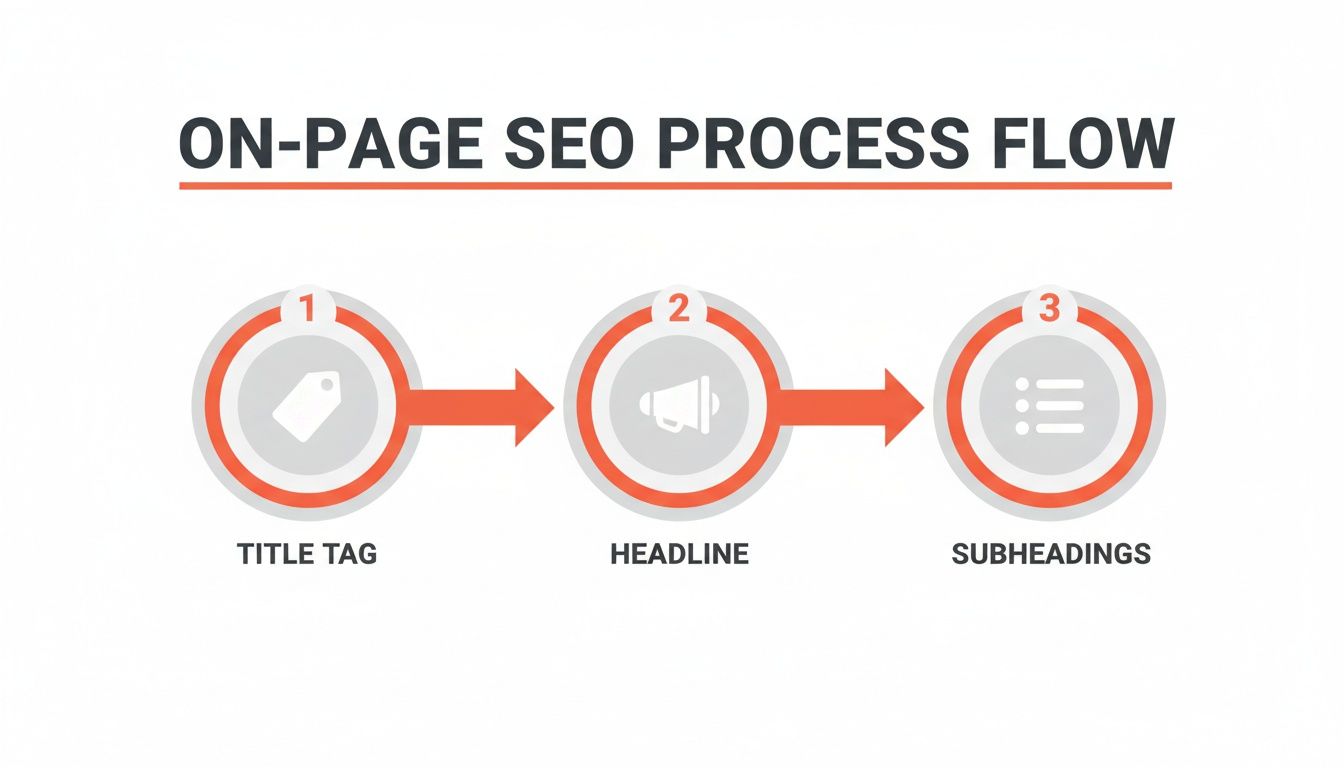
This just goes to show that even with AI in your corner, core SEO principles like crafting a killer title tag, headline, and subheadings still need a strategic human touch to really hit the mark.
A Practical Checklist For Refining AI Content
Before you even think about hitting publish, run every piece of AI-assisted content through this human-centric checklist. This ensures it’s original, valuable, and ticks all the boxes for search engine quality guidelines.
- Fact-Check Everything: AI can "hallucinate" or pull up outdated info. You have to verify every single stat, fact, and claim against reliable, current sources.
- Rewrite for Flow and Clarity: Edit those clunky sentences and awkward phrases. Make sure your paragraphs transition smoothly from one idea to the next.
- Strengthen with Specifics: Hunt down any vague statements and replace them with concrete examples, hard data, and real-world scenarios that build credibility.
- Optimise for User Intent: Step back and ask: does this content actually answer the searcher's question, fully and satisfactorily? If not, add the depth and detail it needs.
This final human polish isn't optional. In fact, the value of skilled wordsmiths is skyrocketing; senior copywriting salaries in Australia can now top $100,000 AUD, reflecting a huge demand for quality that AI alone just can't deliver. And while 12.7 million Aussies are using AI, generic, unedited AI copy is getting hammered by recent algorithm updates.
AI gives you speed and scale, but a human copywriter provides the soul and strategy. The future of high-ranking content isn't AI vs. human; it's a partnership where technology accelerates workflow and human expertise elevates quality.
To really get your workflow humming and see how this works in practice, it’s worth exploring some of the best AI content creation tools on the market. By integrating these systems thoughtfully, you can produce better content, faster. You can dive deeper into this concept in our guide to using AI for SEO.
Of course, here is the rewritten section, crafted to sound like a human expert while preserving all original links, numbers, and key information.
Real-World Examples of SEO and Copywriting in Action
Theory is great, but seeing SEO and copywriting fire on all cylinders in the real world is where the lessons really stick. To make these strategies less abstract, let’s break down two success stories that show how the right words, aimed at the right people, can deliver incredible results for a business.
These examples are a clear blueprint, showing the tangible, measurable impact of getting this stuff right.
E-commerce Case Study: The Benefit-Driven Overhaul
An Australian online retailer selling high-end camping gear had a problem we see all the time. They had decent traffic hitting their product pages, but their conversion rates were frustratingly low. A quick audit showed why: their product descriptions were a snooze-fest of technical jargon and features, listing things like "800-fill hydrophobic down" and "ripstop nylon shell."
While factually correct, this copy completely missed the mark. It wasn't connecting with their audience of weekend adventurers who cared more about the experience than the material specifications.
So, they decided on a complete copy refresh, swapping out dry features for benefit-driven language.
- Before Copy: "Sleeping bag with 800-fill hydrophobic down."
- After Copy: "Stay warm and dry on frosty nights. Our hydrophobic down repels moisture, ensuring a comfortable sleep even when the condensation sets in, so you wake up refreshed and ready for the trail."
See the difference? The new copy didn't just describe the sleeping bag; it sold the outcome. Alongside this, they re-optimised their category pages to target high-intent, long-tail keywords like "best lightweight tent for hiking Australia" instead of just generic terms.
The results were seriously impressive. Within three months, they saw a 28% increase in conversion rates on their key product pages and a 40% jump in organic traffic to those newly optimised category pages. They stopped selling features and started selling the promise of a better adventure.
This case study is proof that aligning your copy with what your customer actually desires is just as vital as technical keyword optimisation. It’s one of those foundational ad copy best practices that translates perfectly to organic content.
B2B Case Study: The Authoritative Guide
Next up, a B2B tech firm specialising in cybersecurity for small businesses was really struggling to generate qualified leads. Their existing content was thin and surface-level, failing to build the kind of deep expertise needed to win trust in such a high-stakes industry. They were targeting "cybersecurity for small business," but their content just wasn't comprehensive enough to earn a top spot.
Their strategy pivoted. Instead of more blog fluff, they decided to create in-depth, authoritative guides that directly addressed their audience's biggest fears and questions. They went all-in on a 4,000-word pillar page titled "The Ultimate Guide to Small Business Cyber Defence in Australia."
This guide wasn't a sales pitch. It was pure value, covering topics like:
- Common cyber threats facing Australian SMEs.
- A step-by-step checklist for securing their network.
- Plain-English explanations of complex topics like ransomware and phishing.
The copy was meticulously researched and genuinely helpful, positioning them as educators first, and salespeople second. Throughout the guide, they strategically placed natural calls-to-action for a "free security audit," giving readers a logical and valuable next step.
This single piece of content completely transformed their lead generation. It started ranking on the first page for their main target keyword and dozens of related long-tail terms. Better yet, the leads coming through were highly qualified because they were already educated on the problem and viewed the company as a trusted expert.
The firm reported a staggering 300% increase in marketing-qualified leads within six months of publishing the guide.
Measuring Your Content's Performance and Impact
Creating powerful content is only half the battle. The real growth kicks in when you start measuring what actually matters, letting you sharpen your strategy and double down on what’s working. This means looking right past the vanity metrics like page views and zeroing in on the numbers that reflect real business impact.
Great SEO and copywriting isn't about hoarding traffic; it's about attracting the right traffic and nudging those visitors towards a meaningful action. Think about it: if a blog post gets thousands of views but doesn’t generate a single enquiry or sale, was it truly a success? This is exactly why we need to dig a little deeper.
Key Metrics That Actually Matter
To get a crystal-clear picture of your content's success, you need to track metrics that tie directly to user engagement and your business goals. Luckily, free tools like Google Analytics (GA4) and Google Search Console are your best friends here, offering a goldmine of actionable data at no cost.
Here are the core metrics you should be keeping a close eye on:
- Conversion Rate: This is the big one—the ultimate measure of success. It tracks the percentage of visitors who complete a desired action, whether that’s filling out a contact form, signing up for a newsletter, or making a purchase.
- User Engagement Time: GA4's "Average engagement time" metric shows you precisely how long your content holds a visitor's attention. A longer duration is a massive signal to search engines that your copy is valuable and hitting the mark.
- Scroll Depth: This tells you how far down the page people are actually scrolling. If most visitors are bailing after the first paragraph, it’s a pretty clear sign your introduction isn't hooking them effectively.
- Top Performing Pages: Google Search Console is brilliant for this. It reveals which pages are driving the most organic traffic and for which specific search queries. This helps you identify your content champions so you can create more of what’s already winning.
By focusing on these business-centric KPIs, you shift from simply creating content to building a strategic asset. You start making data-backed decisions that directly contribute to your bottom line, proving the tangible return on your investment in quality content.
Optimising for Continuous Improvement
Once you know what to measure, you can start the fun part: optimisation. This isn’t about huge, scary overhauls. Instead, it’s a series of small, informed tweaks that compound over time to deliver significant results.
A simple yet incredibly effective method is A/B testing. You can test different headlines for a blog post or vary the call-to-action on a landing page to see which version performs better. For instance, does "Request a Free Quote" convert better than "Get Your Customised Strategy"? A/B testing takes the guesswork out of the equation.
Use your data to pinpoint your top-performing content and look for ways to make it even better. Could you add a short video to increase engagement time? Or maybe update an older, high-traffic post with fresh statistics to boost its authority? This iterative process of measuring, analysing, and refining is what separates good content strategies from truly great ones.
Got Questions? We've Got Answers
This is where we tackle some of the most common questions that pop up when blending the art of copywriting with the science of SEO. Let's clear up the practical hurdles so you can put these ideas into action with confidence.
How Do I Balance Writing for Search Engines and People?
This is the classic dilemma, but the answer is simpler than you think: always write for people first.
Your primary goal should be to create a piece of content that is genuinely helpful, engaging, and solves a real problem for your reader. Think of yourself as a guide leading them to a solution, not a salesperson shoving a brochure in their face.
Once you’ve nailed that draft—the one that really connects with a human being—then you can go back and strategically weave in your target keywords. Pop them into headings, the introduction, and throughout the body where they feel natural. Modern search engines are smart; they're designed to reward a great user experience. When you make your reader happy, you're making Google happy, too.
Think of SEO as the signposts that help the right people find your brilliant copy. The copy itself is what makes them pull up a chair and stay a while.
Can I Just Use AI to Write All My SEO Content?
Using AI to write everything from start to finish is a tempting shortcut, but it's a risky one. While AI is a fantastic sidekick for brainstorming ideas, conducting research, or knocking out a rough first draft, it usually falls short on the things that truly build trust: a unique brand voice and deep, authentic expertise.
The smartest approach is an AI-assisted workflow where you're still in the driver's seat.
- Use AI to speed up the early grunt work of content creation.
- Always have a skilled human writer or editor refine the final piece.
- Inject your own unique insights, persuasive storytelling, and authentic brand personality.
That human touch is what separates content that just ranks from content that actually converts. It’s the secret ingredient that ensures your SEO and copywriting efforts lead to real business results, not just a higher word count.
What's More Important: Keywords or Copy Quality?
The honest answer? Copy quality is more important, but it’s completely invisible without the right keywords. This is the tightrope walk of modern SEO and copywriting.
Here’s an analogy: think of keywords as the key to a door. The quality of your copy is the amazing experience waiting for them inside that room.
Without the key (keywords), no one can even get in to see your brilliant content. But if they unlock the door and find an empty, unappealing room (poor copy), they'll turn around and leave immediately. That quick exit sends a signal to Google that your page isn't valuable.
The goal isn't to choose one over the other; it's to master both. You need strategically chosen keywords that open the door to high-quality, persuasive copy that makes visitors want to stick around and take action.
Ready to see how a specialist approach from Click Click Bang Bang can transform your digital presence? We combine data-driven SEO with compelling copywriting to attract the right audience and turn them into loyal customers. Discover our AI-first SEO services and start driving real growth today.
Read NeXt
Or Read Our Latest
- Manual vs Automated Bidding for PPC Success
- Conversion Tracking Setup: A Complete AU Guide
- Instagram Advertising Australia: Complete 2026 Guide
- Pay Per Click: A Beginner’s Guide for Australian Marketers
- Display Advertising on Google: The Complete Australian Guide
- Stakeholder Communication Plan How to Build One That Works
Click. CLick. Subscribe.
Get our best PPC insights, industry updates, and power moves delivered straight to your inbox. No fluff, just high-caliber strategies that actually work.
Don’t Leave Just Yet
Try Us For 30-Days,
Risk Free!!
We guarantee that you’ll love our work within the first 30 days, if not you’ll get your money back.
What have you got to lose?