

Your B2B Lead Generation Agency Hiring Guide for 2026
Last Updated

You're probably in the same spot most B2B teams reach sooner or later. Pipeline target is staring at you, in-house capacity is thin, sales wants better opportunities instead of more names, and every agency says they can “generate qualified leads”.
That's exactly why hiring a B2B lead generation agency feels harder than it should. The market is full of decent media buyers, decent SDR shops, decent reporting decks, and a much smaller number of partners that can connect campaign activity to sales outcomes.
The difference matters. If an agency can't show how source becomes meeting, how meeting becomes SQL, and how SQL turns into revenue, you're not buying growth. You're renting activity.
Why Hiring a B2B Lead Generation Agency Feels Risky
Most companies don't hire an agency because things are calm. They hire because growth pressure has landed on the marketing team, the sales team, or both.
That pressure is real across the market. 91% of marketers rank lead generation as a top priority for 2025, yet 58% say it is their biggest challenge, and 79% of B2B marketers are already using AI, according to Pepper Content's 2025 lead generation statistics roundup. That combination creates a messy buying environment. Expectations are up. Tactics are changing fast. And too many agencies still sell the same old promise with new labels.
Activity is easy to buy. Revenue proof isn't.
A weak agency can always produce signs of motion:
- More lead records in the CRM
- More booked meetings on calendars
- More dashboards with channel metrics
- More AI language in proposals and reports
None of that proves commercial impact.
A good agency knows lead generation isn't just a top-of-funnel task anymore. It's a systems problem. Targeting, landing pages, qualification, handoff speed, CRM hygiene, and sales follow-up all affect whether spend turns into pipeline. If the agency only owns the first click and disappears after the form fill, you carry most of the risk.
Practical rule: If an agency sells meetings but avoids pipeline conversations, they're telling you where their accountability stops.
Why smart buyers still get burned
I've seen good businesses choose the wrong partner for predictable reasons. They buy confidence instead of evidence. They accept channel expertise without asking how reporting ties back to opportunities. They let a polished pitch distract them from missing operational detail.
The agency world rewards presentation. Revenue teams reward traceability.
That's why surface-level agency reviews rarely help much. Broad round-ups can be useful for orientation, and these online marketing gurus reviews can help you see how differently firms position themselves, but hiring decisions get better when you assess operating discipline, not personal brand.
The real shift you need to make
Don't think of this as outsourcing lead generation.
Think of it as hiring an external operator to improve one part of your revenue engine. That mindset changes the questions you ask. You stop asking, “How many leads can you get us?” and start asking, “How will you prove your work created qualified pipeline?”
That's the line between an expensive experiment and a partner worth keeping.
Laying the Groundwork Before You Search
The worst time to define what you need is after the proposal arrives.
If your brief is vague, the agency will fill the gap with its preferred channel mix, its default reporting model, and its own definition of success. That's how businesses end up paying for activity they never asked for.
In the Australian market, the more effective approach is a tightly instrumented 2 to 3 channel acquisition stack built around ICP definition, source-specific landing pages, intent scoring, and a fast sales handoff. B2B website visitor-to-lead rates are often only 2 to 3%, which is why small execution gains matter so much, as noted in Monday.com's B2B lead generation guidance.
Start with ICP, not channels
Too many teams begin with “we need LinkedIn” or “we should run Google Ads”. That's backwards.
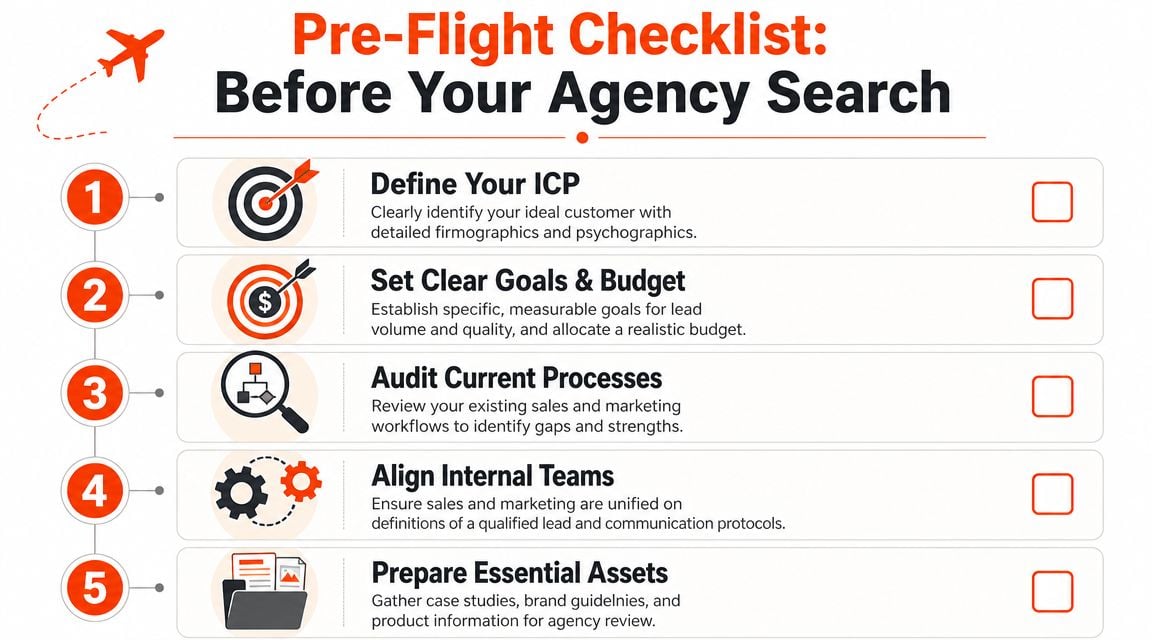
First pin down:
- Firmographics: industry, company size, geography, revenue band, team structure
- Buying context: what changed inside the account that would trigger interest
- Commercial fit: deal size, margin profile, onboarding complexity, retention quality
- Sales reality: who signs, who influences, who blocks
A usable ICP isn't just a market segment. It's a filter for budget allocation.
Build the brief your agency wishes you had
Before you speak to agencies, get your internal answers organised.
-
Define lead stages clearly
MQL, SAL, SQL, opportunity. If sales and marketing use different meanings, agency reporting will turn into politics. -
Audit response speed
If your team takes too long to respond to high-intent enquiries, no agency can fix that after the handoff. -
Review current assets
Landing pages, case studies, CRM workflows, ad accounts, analytics setup, call tracking, and sales scripts all affect campaign quality. -
Choose the narrowest viable channel mix
A focused stack usually outperforms broad-channel sprawl when you're still calibrating offer, messaging, and scoring.
For businesses refining that mix, this guide to B2B digital marketing strategies is a useful reference point because it frames channels as part of a system rather than standalone tactics.
Set goals that protect you from bad agency maths
“More leads” is not a goal. It's an invoice trap.
Use goals such as:
| Internal question | Better way to define it |
|---|---|
| Do we need leads? | Do we need qualified pipeline from a specific segment? |
| Do we need awareness? | Do we need named-account engagement that sales can action? |
| Do we need meetings? | Do we need meetings that convert into SQLs? |
| Do we need lower costs? | Do we need efficient acquisition at acceptable sales quality? |
A narrow brief often produces stronger agency work than a broad one. Constraint sharpens execution.
Know what you're asking the agency to solve
Sometimes the problem is traffic quality. Sometimes it's weak conversion architecture. Sometimes it's poor routing, weak follow-up, or no lead scoring. If you blame the top of funnel for a middle-of-funnel issue, you'll hire the wrong kind of partner.
The best prep work doesn't make the search slower. It removes the agencies that were never a fit in the first place.
How to Vet and Select the Right Agency Partner
You get off a chemistry call feeling good. The agency sounded sharp, showed polished dashboards, and promised a steady flow of meetings. Six months later, sales says the pipeline is thin, the CRM is messy, and nobody can tell which opportunities came from agency work versus branded demand or rep follow-up.
That is the primary selection risk.
A B2B lead generation agency should be able to show how its work contributes to pipeline, not just activity. If they cannot connect targeting, outreach, handoff, and reporting to revenue outcomes, you are buying motion without proof.

Lean teams feel this fastest. They do not have spare budget for “maybe.” Agencies that earn trust can trace source to meeting, meeting to accepted opportunity, and accepted opportunity to revenue inside the CRM. This Callbox piece on what lead gen agencies fail to deliver is a useful reminder that lead volume and booked appointments are easy to inflate when downstream accountability is weak.
What to ask instead of “What's your process?”
Ask for operating evidence.
Start with these:
- Show an anonymised funnel report from first touch through closed-won, including conversion rates between stages.
- Explain how you separate agency influence from existing demand when a prospect already knew the brand or was active in-market.
- Walk through the CRM fields you require to prove accepted leads, sourced pipeline, and revenue contribution.
- Describe what happens after sales rejects a lead and how that feedback changes targeting, messaging, or channel spend.
- Give one example of a campaign you reduced or stopped because it produced meetings that did not turn into pipeline.
- Explain your list-building and enrichment standards and who owns data quality when contact accuracy drops.
Weak agencies drift back to opens, clicks, and meetings booked. Strong agencies stay on acceptance rates, opportunity creation, sales-cycle quality, and attribution limits. They will also admit what they cannot control.
Use a short RFP that tests how they think
A long RFP usually produces rehearsed answers. A short one exposes whether the agency understands commercial reality.
Ask for:
| RFP item | What you're looking for |
|---|---|
| Revenue target | Can they translate pipeline goals into channel and conversion assumptions? |
| ICP definition | Do they target buying conditions, not just job titles and broad industries? |
| Attribution approach | Can they explain how sourced, influenced, and assisted pipeline are tracked? |
| Qualification rules | Do they define MQL, SAL, SQL, and rejected lead criteria clearly? |
| Reporting sample | Can they show stage-by-stage reporting instead of top-of-funnel charts? |
| Team structure | Who owns strategy, execution, QA, and reporting day to day? |
| Failure scenario | Can they say where this program could break and what they would do first? |
One of the fastest filters I use is simple. Ask them which metric they would protect if lead volume drops but pipeline quality improves. The right answer is never “all of them.”
Test whether they understand multi-touch buying, not just outbound activity
A lot of agency pitches still revolve around cold email, LinkedIn outreach, and call blocks. That can work in narrow cases. It also breaks down when your buyers research independently, revisit the site later, click retargeting, or convert through branded search after an outbound touch.
A good partner does not need to sell every channel. They do need to understand how channels interact, how intent signals change by source, and how to report contribution without claiming credit for everything. If you're reviewing the stack behind those motions, this 2026 sales outreach tools review is useful because it shows the difference between tool coverage and an actual prospecting workflow.
Ask practical questions here:
- Which channels tend to create first meetings versus later-stage influence?
- How do you report a prospect who first replies to outbound but converts after paid retargeting or branded search?
- Which buying signals change your prioritisation model?
- What do you consider a channel success if it rarely creates direct conversions but improves opportunity progression?
The answer should sound operational, not theatrical.
Red flags that should shorten the shortlist
Some agencies tell on themselves early.
- They lead with lead counts or appointment guarantees. That usually means they are protecting the easiest metric to manufacture.
- They cannot describe CRM requirements in detail. If field discipline is fuzzy, revenue proof will be fuzzy too.
- They avoid accepted-lead and rejection-rate discussions. Good agencies want sales feedback because it sharpens targeting.
- They report channel performance as if every lead source behaves the same way. It doesn't.
- They claim attribution certainty where none exists. Serious operators explain the limits.
- They talk about “their process” more than your sales motion. Templated delivery usually follows.
If the reporting demo ends at CPL, reply rate, or meetings booked, keep digging. You still do not know whether their work produces pipeline.
One question that saves time
Ask every finalist: What would make you tell us not to hire you?
The best agencies answer fast. They mention poor fit, weak follow-up from sales, missing CRM discipline, unrealistic ramp expectations, or an offer that will not convert. I trust a partner more when they can explain where their model fails.
That answer tells you whether you are talking to a service seller or a pipeline operator.
Decoding Pricing Models and Contract Terms
A cheap agency can become an expensive channel fast.
I have seen teams celebrate a low monthly fee, then spend the next two quarters arguing about lead quality, fixing broken routing, rebuilding reporting, and explaining to leadership why booked meetings never turned into pipeline. Pricing matters, but contract structure matters more because it tells you what the agency is being paid to produce.
If your business needs coordinated paid media, outreach, remarketing, landing page testing, and reporting, the commercial model has to match that operational load. A fee structure built for appointment volume usually breaks once the actual goal is sourced pipeline, influenced revenue, and clean attribution.
The three models you'll see most
Retainer
Best for programs that need strategy, execution, optimisation, reporting, and cross-channel management. It fits complex B2B work because the agency is paid to run and improve the system over time.
The trade-off is obvious. A retainer gives the agency stability, but it can also hide weak delivery if scope is vague. If you cannot point to named deliverables, reporting outputs, ownership boundaries, and decision rights, the fee is doing too much work on trust alone.
Pay per lead or pay per meeting
This model is easy to explain internally. Procurement likes it because the unit economics look clean.
The problem is incentive design. If the agency gets paid on volume, it will find the easiest path to volume. That often means softer qualification, calendar stuffing, recycled contacts, or endless disputes over whether a meeting ever had a real chance of becoming pipeline.
Hybrid
A base fee plus performance conditions is often the most workable option. It gives the agency enough cover to do the strategic and technical work, while still tying part of compensation to outcomes.
But the performance piece needs care. Tie it to accepted leads, qualified opportunities, or verified pipeline contribution where your systems can support it. Do not tie it to raw form fills or meetings booked unless your sales process is unusually tight.
What to compare beyond the monthly fee
If you're weighing service scope the same way you'd compare distribution plans, use the same discipline here. Headline price tells you very little on its own.
A lower fee may exclude tracking setup, landing page work, CRM feedback loops, creative production, list sourcing, or weekly performance reviews. Then your internal team absorbs the missing work, and your true cost jumps.
Use this checklist:
- Channel ownership: Are they running one acquisition motion or coordinating several?
- Creative production: Are copy, landing pages, ad assets, and testing included?
- RevOps support: Do they handle attribution logic, routing rules, and CRM field hygiene?
- Reporting depth: Can they show contribution to pipeline, not just lead counts and meetings?
- Governance: How often do they review lead acceptance, rejection reasons, and opportunity progression with sales?
- Data and asset ownership: Who keeps audiences, campaign history, creative files, and account access if the relationship ends?
That last point gets missed too often. If you leave and cannot take your historical data, campaign assets, and reporting setup with you, switching costs rise and performance resets.
Contract terms worth pushing on
Good contracts remove ambiguity before the work starts.
| Contract point | What good looks like |
|---|---|
| Term length | Enough time to test, learn, and improve, without trapping you in a bad fit |
| Exit clause | Clear notice period, clear offboarding steps, no confusing penalty language |
| Asset ownership | Your accounts, your data, your audiences, your creative files |
| Success definition | Written metrics tied to quality, opportunity creation, or pipeline contribution |
| Scope boundaries | A clear line between included work, change requests, and extra fees |
| Reporting requirements | Named dashboards, update cadence, and source-of-truth systems |
Push hardest on success definitions. "More leads" is not a success clause. "More meetings" is barely better. A serious agreement states how quality will be judged, who confirms it, and what happens when sales rejects volume that marketing counted as performance.
Watch for two failure patterns. The first is the long contract with a short proof window, where you are locked in before enough data exists to judge performance. The second is the flexible scope with fuzzy outcomes, where the agency stays busy but never has to prove business impact.
The right contract aligns incentives with pipeline creation. If the commercial model rewards activity while your leadership team expects revenue contribution, the relationship will turn into a reporting fight.
Your 30-60-90 Day Agency Onboarding Plan
The contract doesn't create momentum. The onboarding does.
Most agency relationships don't fail because the channel was wrong. They fail because the first three months were loose, rushed, or poorly governed. Access was delayed. Lead definitions were fuzzy. Sales feedback arrived late. Reporting never matched what leadership wanted to see.
A useful onboarding plan fixes that early.
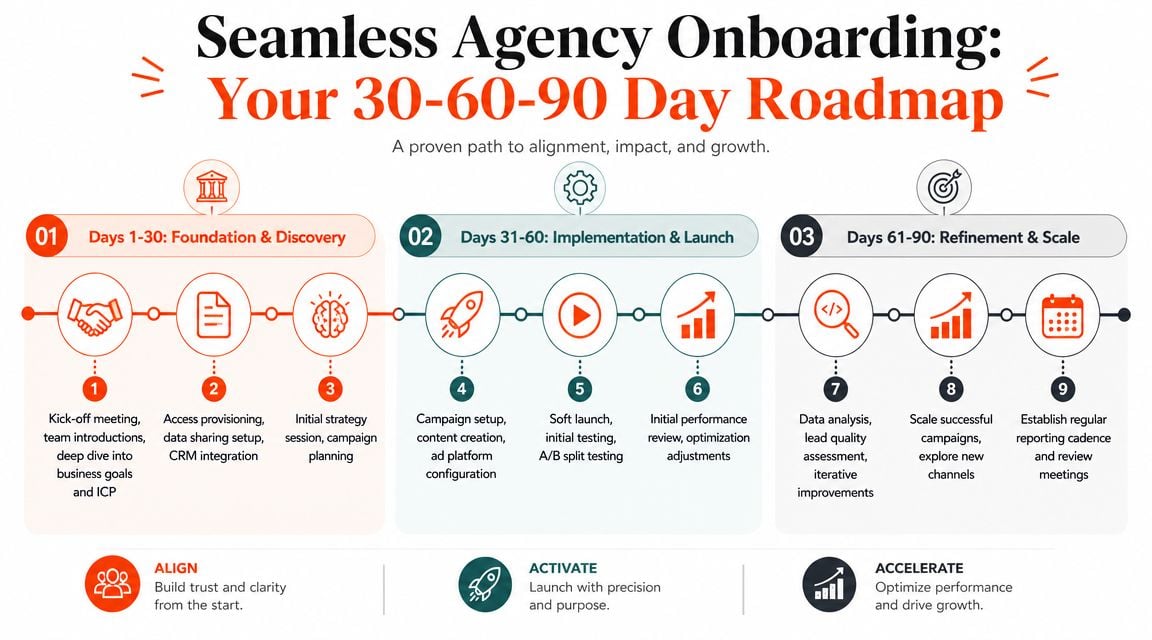
Days 1 to 30
This phase is about clarity, access, and instrumentation.
The agency should get into the operating environment. CRM stages, lifecycle definitions, existing campaigns, historical lead quality, core offers, buying objections, and sales notes all matter more now than ad creative polish.
Client responsibilities usually include:
- Granting access quickly to ad accounts, analytics, CRM, tag managers, and existing assets
- Providing real sales input from account executives, SDRs, and customer-facing leaders
- Approving lifecycle definitions so everyone uses the same language
Agency responsibilities usually include:
- Auditing the funnel path from first touch to opportunity creation
- Mapping tracking and routing so source data stays intact
- Refining campaign architecture around ICP, offer, and landing page intent
A visual roadmap helps teams stay aligned on who owns what and when.
Days 31 to 60
Now the work becomes visible. Campaigns launch, outreach starts, landing pages collect data, and the first quality signals show up.
This is when impatience usually causes damage. Teams want to judge the entire engagement from a small set of early indicators. That's a mistake. Early performance should be used to test targeting, messaging, and operational flow, not to declare victory or failure too soon.
Focus on questions like:
| Question | Why it matters |
|---|---|
| Are the right accounts responding? | Validates targeting quality |
| Are form fills or meetings matching the ICP? | Shows whether campaign intent is aligned |
| Is sales following up properly? | Prevents false negatives on channel quality |
| Are objections repeating? | Improves copy, offer, and qualification |
Early data is for diagnosis. Mature data is for scaling.
Days 61 to 90
By this stage, the agency should have enough signal to make sharper decisions.
Good partners will cut weak segments, refine messaging, improve routing rules, and reallocate budget to the combinations producing the strongest downstream response. Poor partners will still be explaining setup.
This is also the point where reporting should mature from campaign updates to business review. Not a list of tasks completed. A review of what happened, what changed, and what the team is doing next.
One practical detail matters here. Set recurring review meetings with both marketing and sales in the room. If the agency only hears from marketing, quality issues stay hidden longer than they should.
What success looks like by day 90
You don't need full program maturity by then. You do need evidence that the machine is becoming usable.
That usually looks like:
- Clear stage definitions inside the CRM
- Working attribution paths from source to later funnel stages
- A repeatable reporting rhythm for marketing and sales leaders
- Documented learnings on offers, audiences, and channel behaviour
- A decision framework for where to scale, pause, or rebuild
If those foundations aren't in place by the end of the first quarter, the issue usually isn't patience. It's execution quality.
Measuring Success and Setting Realistic KPIs
If your agency scoreboard starts and ends with lead volume, you've already made reporting too shallow.
Australian B2B teams usually operate in a multi-touch environment. 89% of B2B marketers use LinkedIn for lead generation, email is used by 87% to 88%, and over half still use events, which is why KPI design and attribution need more than a single-channel view, according to Leadspicker's B2B channel adoption summary.
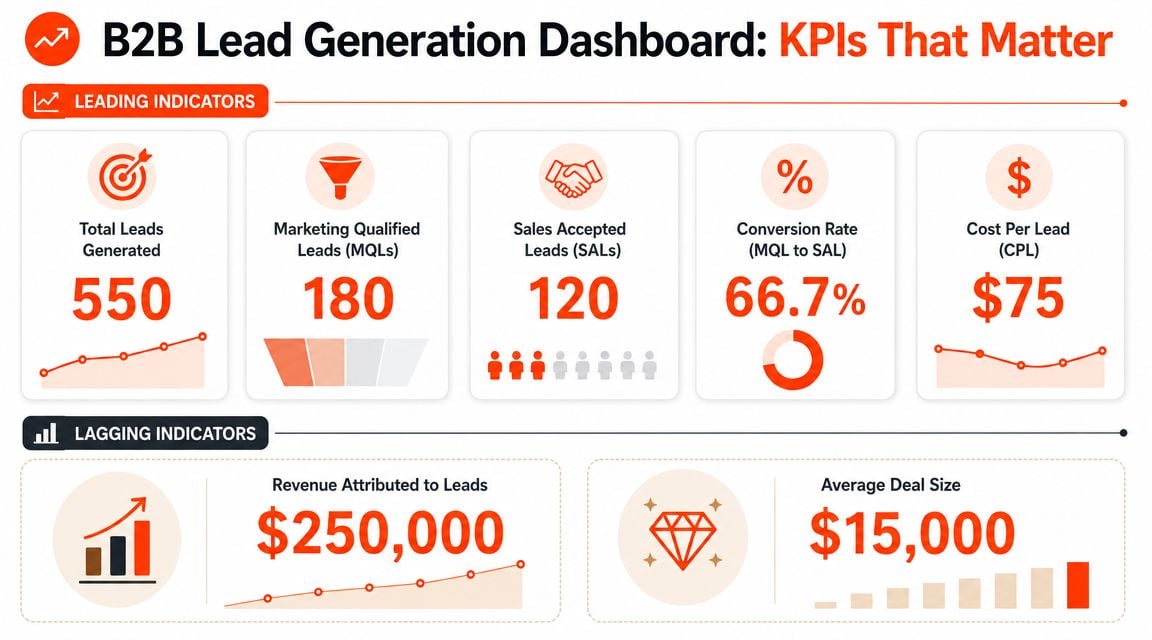
That has one practical implication. Your dashboard must separate diagnostic metrics from commercial proof.
Leading indicators tell you what needs attention
These are useful, but they are not the final verdict.
Track items such as:
- Channel response metrics for ads, forms, and landing pages
- Lead acceptance trends from sales
- Speed to contact for high-intent enquiries
- Stage conversion by source inside the CRM
These help the agency optimise. They should never be the only basis for renewal discussions.
For teams building a practical reporting view, these marketing KPI dashboard examples are helpful because they show how to structure metrics into something leaders can review.
Lagging indicators prove whether the work matters
This is the layer many agencies avoid because it exposes quality problems.
You want to know:
- Which channels create sales-accepted leads
- Which campaigns influence SQL creation
- Which source groups become opportunities
- Which agency-sourced or agency-influenced paths produce closed revenue
If attribution is messy, that's normal. But “messy” is not an excuse to stop tracking. It means you need a shared model and disciplined CRM usage.
The KPI hierarchy should narrow as commercial intent increases. Plenty of leads. Fewer accepted leads. Fewer SQLs. Fewer opportunities. Revenue at the end.
A practical KPI template
Here's a simple structure that keeps the dashboard tied to business outcomes.
| Metric Category | KPI | Example Benchmark (AU B2B) | Why It Matters |
|---|---|---|---|
| Channel engagement | LinkedIn lead generation usage | 89% use LinkedIn for lead generation | Shows why LinkedIn is a familiar and scalable B2B channel in the mix |
| Channel engagement | Email usage for lead generation | 87% to 88% use email | Confirms email is still a core channel, even when paid media expands |
| Channel mix | Event usage | Over half use events | Reinforces that attribution must account for offline and online touchpoints |
| Funnel efficiency | Website visitor to lead rate | 2% to 3% is often common | Highlights why landing page quality and handoff speed matter |
| Commercial proof | Source to meeting to SQL mapping | Qualitative benchmark only | Tells you whether the agency can trace value through the funnel |
| Commercial proof | Source to revenue reporting | Qualitative benchmark only | Separates activity reporting from real pipeline contribution |
What “good” usually looks like in practice
Not a magic CPL. Not a fixed meeting count. Not one winning channel forever.
Good looks like a reporting system where everyone can answer the same questions with the same data. Sales trusts the stage definitions. Marketing can identify source quality. Leadership can see whether the agency's work is creating pipeline, not just dashboard movement.
That's what turns an agency from a cost centre into an accountable growth partner.
If you need a partner that can run PPC and AI-first SEO with clear tracking, Click Click Bang Bang is one option to evaluate. The useful test is the same one in this guide: ask how they structure attribution, what they report beyond lead volume, and how they connect channel activity to pipeline outcomes inside your CRM.
Read NeXt
Or Read Our Latest
- How to Set Up Google Ads in Australia: Complete 2026 Guide
- Google Merchant Center Setup: The Complete 2026 Guide
- Business Manager Setup Facebook: The Complete 2026 Guide
- Google Ads Account Setup: Expert Guide for 2026
- Search Ads Optimisation: A Practical Guide for 2026
- Manual vs Automated Bidding for PPC Success
Click. CLick. Subscribe.
Get our best PPC insights, industry updates, and power moves delivered straight to your inbox. No fluff, just high-caliber strategies that actually work.
Don’t Leave Just Yet
Try Us For 30-Days,
Risk Free!!
We guarantee that you’ll love our work within the first 30 days, if not you’ll get your money back.
What have you got to lose?