

7 Testimonial Ads Examples to Inspire You in 2026
Last Updated
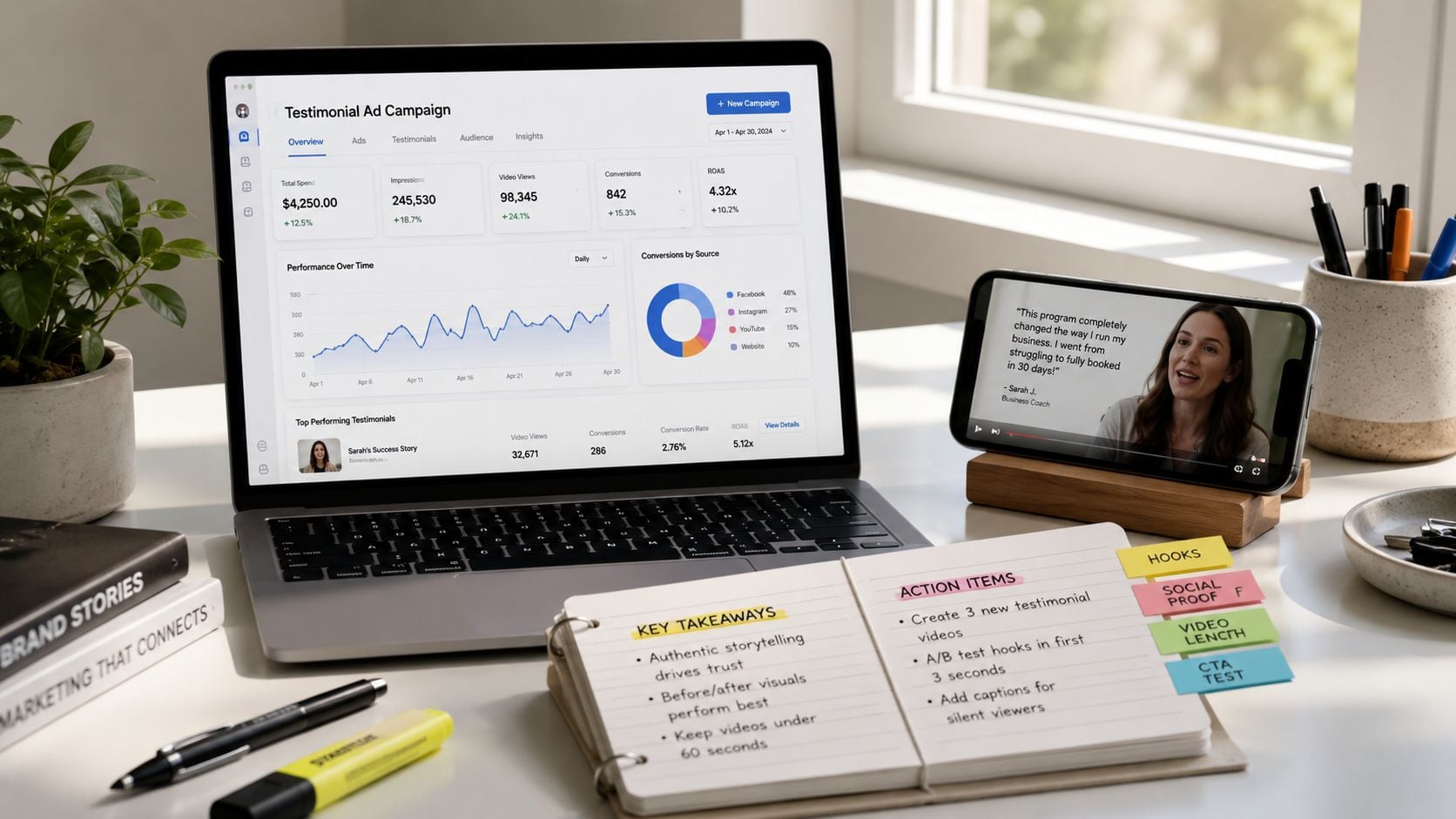
Why do so many testimonial ads examples look persuasive in a swipe file, then fail the moment they hit a live audience? The usual answer is creative quality. In practice, the gap is often platform fit and proof design. A quote that works on a pricing page can die in a Meta feed. A polished customer story that feels credible on YouTube can feel overproduced on TikTok.
That matters more in Australia than many marketers admit. The ACCC has long made it clear that businesses must not make false or misleading claims, and testimonials become risky when they aren't genuine or create a misleading impression, which changes how smart teams build testimonial creative in the first place, not just how they approve it at the end (ACCC context via Sovran). The result is that strong AU testimonial ads tend to lean on transparent formats like real customer quotes, review screenshots, and customer video with enough context to feel verifiable.
This guide treats testimonial ads examples as a multi-platform system, not a mood board. You'll find seven research tools and ad libraries that help you study what's running across Meta, LinkedIn, Google, TikTok, and broader creative archives, then turn that research into channel-specific scripts, hooks, proof structures, and testing angles. If you need the raw material first, start by learning how to capture powerful video testimonials. Then use the tools below to turn customer praise into ad conversions.
1. Meta Ad Library
If you only use one source for testimonial ads examples, start with Meta Ad Library. It's public, searchable, and close to the actual environment where most AU e-commerce brands distribute customer proof.
Meta matters because the creative bar for testimonials on Facebook and Instagram is lower than most in-house teams think. You don't need a mini documentary. You need a believable hook, a visible customer voice, and a proof layer that survives a fast thumb-stop.
What to look for in Australia
Use the Australia country filter first. Then search by product category, problem statement, or review language rather than just brand names. You'll usually find better patterns by searching phrases customers use, such as “helped with”, “I was sceptical”, “finally found”, or “works for”.
What makes Meta useful is the operational detail. You can inspect placements, start dates, and creative variants, then click through page transparency for more context on the advertiser behind the ad.
- Best use case: E-commerce and D2C teams researching live UGC, review-led carousels, and creator-style video proof
- Strategic signal: If one brand is running multiple testimonial variants, they're often testing different trust cues rather than different offers
- Main weakness: Some dynamic or experimental variants may not appear consistently
Practical rule: On Meta, the testimonial isn't the whole ad. It's the hook. The rest of the frame has to do the hard work of proving relevance fast.
How to turn library research into a live ad
For Meta, the strongest testimonial pattern is usually simple. Open with the customer's problem in their language. Show the person or a native-looking asset. Put the most concrete outcome on-screen. Then close with a low-friction CTA.
A practical build for paid social looks like this:
- Hook: “I'd tried three options before this.”
- Body: Customer clip or review screenshot paired with product-in-use footage
- Proof overlay: One visible outcome, plus a qualifier like product type or use case
- CTA: “See why customers switched” or “Shop now”
If you're balancing creative testing against budget pressure, this breakdown of Facebook advertising costs is useful context. It helps frame why testimonial variants should be treated as efficiency levers, not just trust assets.
2. TikTok Creative Center – Top Ads
TikTok Creative Center is where testimonial ads examples stop looking like ads and start looking like behaviour. That's the actual value. It shows you what native proof looks like when it's built for scroll speed, not brand polish.
For testimonial research, the Top Ads area is the most useful starting point. Filter by Australia, then narrow by objective, industry, or keyword themes. You'll quickly see that the best testimonial creative on TikTok rarely feels like a formal endorsement. It feels like a person narrating a result in a format the platform already trained users to trust.
Why TikTok changes the testimonial format
A lot of articles still treat testimonial creative as if every platform rewards the same level of finish. That's outdated. In Australia, short-form and social-style creative matter because 92% of online adults aged 18 to 64 watch online video weekly, and 81% use social media. That pushes testimonial strategy toward mobile-first, creator-led formats instead of long case-study edits.
That shift has a creative consequence. On TikTok, polished credibility often loses to recognisable authenticity. A creator pausing mid-sentence, cutting jumpily, or filming in a normal room can increase believability because the ad resembles the platform's native content grammar.
What to extract from Top Ads
Don't just save examples. Deconstruct them.
- Opening pattern: Does the ad begin with frustration, surprise, comparison, or direct recommendation?
- Proof mechanic: Is the evidence visual, verbal, or text-on-screen?
- Native cue: Does it use captions-first framing, trending audio logic, or creator eye contact?
- CTA style: Soft recommendation or hard sell?
Keyword Insights also helps you trace the language attached to winning ads. That's useful when you want to write scripts in customer language instead of brand language.
Raw beats polished on TikTok when the category is trust-sensitive and the product benefit can be shown quickly.
For marketers running cross-platform creative, TikTok often becomes the best place to identify the first three seconds, then port that opening structure into Meta Reels or Instagram Stories.
3. YouTube Ads Leaderboard
Some testimonial ads examples need breadth. Others need craft. YouTube Ads Leaderboard on Think with Google is better for the second job.
Because it's curated rather than exhaustive, you won't use it to scrape dozens of near-identical examples. You'll use it to study how strong brands structure belief over time. That makes it valuable for high-consideration products, service categories, and testimonial-led video that needs more narrative room.
Where YouTube testimonial logic is different
YouTube gives customer proof time to breathe. That doesn't mean the ad should wander. It means the testimonial can expand into a sequence: tension, context, evidence, and resolution.
A polished narrative proves its worth. A founder or customer can explain the original problem. Supporting footage can show the situation before the product. On-screen text can anchor the core takeaway. The viewer gets enough context to understand not just that someone liked the product, but why their experience should transfer to them.
A strong YouTube testimonial structure often looks like this:
- Open with tension: “We had a problem we couldn't ignore”
- Add credibility: Identify the person, role, or context
- Show the product in use: Not glamour shots. Real application
- Land on a clear shift: What changed after adoption
- Close with next step: Demo, learn more, or product page
How to use it without overproducing
The common mistake is copying the finish without copying the narrative discipline. YouTube leaderboard spots often feel polished because every scene is doing one job. If you only copy the lighting and music, you'll get a slower, prettier ad that still doesn't convert.
If you're running YouTube as part of a broader paid media mix, a specialist YouTube advertising agency perspective can help align testimonial storytelling with campaign intent, especially when the same customer story also has to feed remarketing and brand search.
4. LinkedIn Ad Library
For B2B testimonial ads examples, LinkedIn Ad Library is the fastest way to move from vague “social proof” thinking to actual purchase logic. LinkedIn makes the difference obvious. Generic praise gets ignored. Specific business outcomes earn attention.
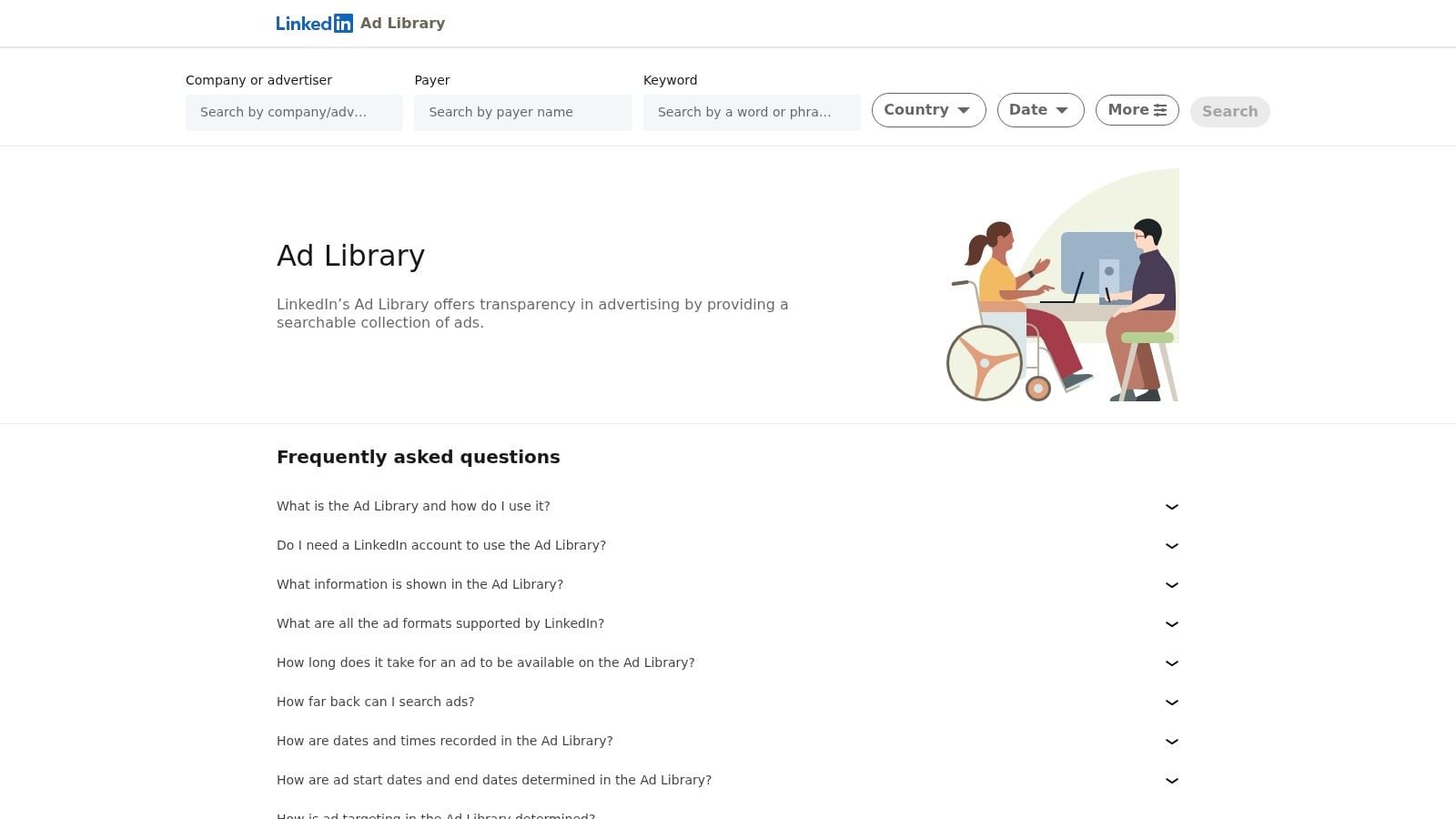
Search by company, competitor, category term, or use case. Then watch which formats repeat. You'll see single-image ads with one sharp quote, carousels that turn a case study into sequential proof, short video testimonials, and document ads that package the customer story as a deeper asset.
What strong LinkedIn testimonials usually include
Australian buyer behaviour makes this platform especially interesting. Consumer and endorsement guidance in AU points toward proof structures built around trust, relevance, and concrete evidence, which is why a customer story with one primary metric, one supporting visual, and one qualification detail is more actionable than a generic quote (AU proof structure context via Zeely).
That framework maps neatly onto LinkedIn:
- Primary metric: The one outcome the buyer will remember
- Supporting visual: Dashboard crop, result slide, or workflow graphic
- Qualification detail: Industry, company type, or timeframe context
How to adapt by funnel stage
On LinkedIn, the same testimonial shouldn't be used everywhere.
- Top of funnel: Use a short quote that names the business problem
- Mid funnel: Use a case-study carousel with one clear result per card
- Bottom of funnel: Use a lead-gen ad or landing page asset with detailed customer context
That matters for compliance too. In Australia, the ACCC explicitly warns that businesses can be liable for misleading testimonials and must not rely on reviews that create a false impression, so placement and editing decisions matter as much as the testimonial itself (AU compliance angle via Vidlo).
If you're building LinkedIn campaigns around customer proof, LinkedIn ad management support can help connect creative research with audience strategy and lead quality. For publishing and organic coordination around the same channel, teams may also look at Scheduler.social for LinkedIn.
5. BestAdsOnTV
BestAdsOnTV is the Australian archive I'd use when a team's testimonial creative is too platform-narrow. Meta and TikTok show what's live. BestAdsOnTV shows what Australian advertisers have considered strong enough to publish across video, print, outdoor, radio, and digital environments.
That matters because testimonial strategy isn't just about feed-native execution. Sometimes you need to understand the larger creative lineage behind a category. Beauty brands, health advertisers, retail chains, and service providers often recycle the same underlying proof narrative across channels, then adapt the surface execution by placement.
Why this archive is useful for strategic pattern spotting
BestAdsOnTV is less analytical than a native ad library, but that's also its advantage. It helps you step back and ask better questions.
Are brands using the customer as narrator or as evidence? Is the testimonial explicit, or embedded inside a broader story? Does the ad rely on spoken proof, supers, or visual transformation? Those decisions shape how transferable the concept is to paid social, YouTube, or landing pages.
Look for these signals:
- Category repetition: Certain sectors reuse the same trust device repeatedly
- Creative lineage: Agency and brand credits help you trace who's setting the style in a category
- Cross-media portability: A TV-grade customer story can often be cut into social proof fragments
A polished testimonial ad only helps if you can cut it into smaller proof units. If you can't, it's a film, not a conversion asset.
When to use it
Use BestAdsOnTV when you need inspiration above the ad-account level. It's especially useful in workshops, competitive audits, or when a brand wants testimonial creative that feels local to Australia rather than imported from US-style direct response patterns.
Its limitation is obvious. You won't get platform performance context. But for strategic positioning and creative taste, it's stronger than most general ad archives.
6. Ads of the World
Ads of the World is the broadest source on this list. It's not where you go to find what's running right now. It's where you go to understand how testimonial conventions shift by medium, country, and category.
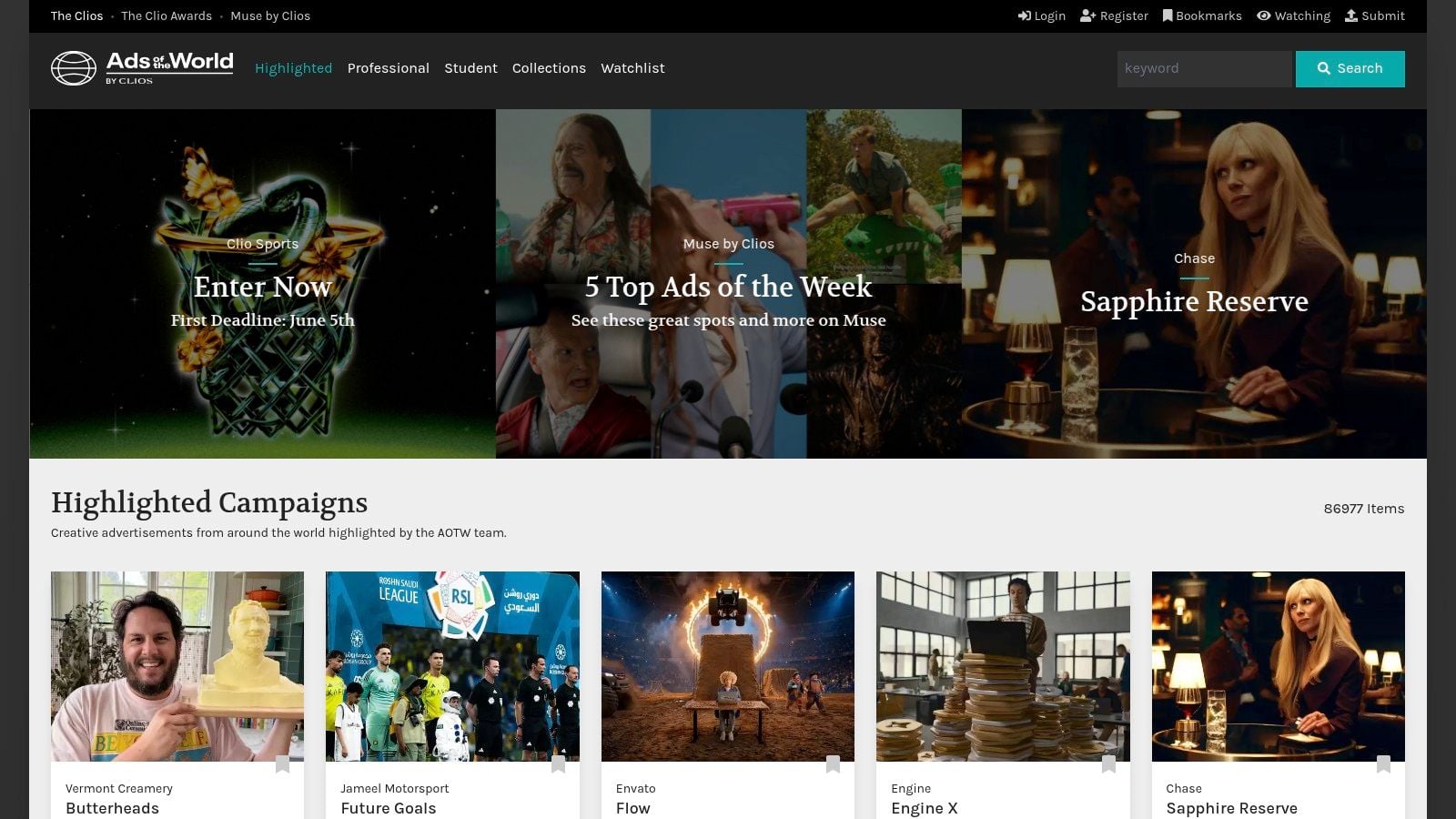
That distinction matters. Many marketers search testimonial ads examples as if they're looking for one winning template. In reality, testimonial advertising is a family of proof formats. Review aggregate, founder endorsement, customer interview, before-and-after framing, expert validation, and case-study narrative all sit inside the same broad label. Ads of the World helps you see that range clearly.
Best use for marketers who already know the basics
This archive becomes useful once your team can already identify weak and strong social proof. Then you can use its tagging and search to benchmark how sectors frame credibility.
A fintech testimonial won't handle trust the same way as a beauty testimonial. A SaaS customer quote won't work like a retail product review. If you study the category-specific differences, you stop copying aesthetics and start borrowing mechanisms.
Try filtering by:
- Medium: Video, print, digital, integrated
- Industry: SaaS, health, retail, education, finance
- Country: To compare local and global proof styles
- Tag logic: Testimonial, case study, review, customer, ambassador
The strategic takeaway
Ads of the World is best used as a reference library for concept expansion. It broadens your idea of what a testimonial can be, especially when your team keeps defaulting to the same review screenshot or talking-head video.
Its main weakness is that it won't tell you whether a creative direction is viable for your current platform economics. So use it upstream. Let it shape the concept, then validate execution in native libraries like Meta or LinkedIn.
7. SwipeWell – Marketing Examples Library
If the other tools help you discover testimonial ads examples, SwipeWell's Marketing Examples Library helps you operationalise them. It's a swipe-file system rather than a native ad platform, which makes it useful for internal teams that need a living reference library instead of one-off inspiration.
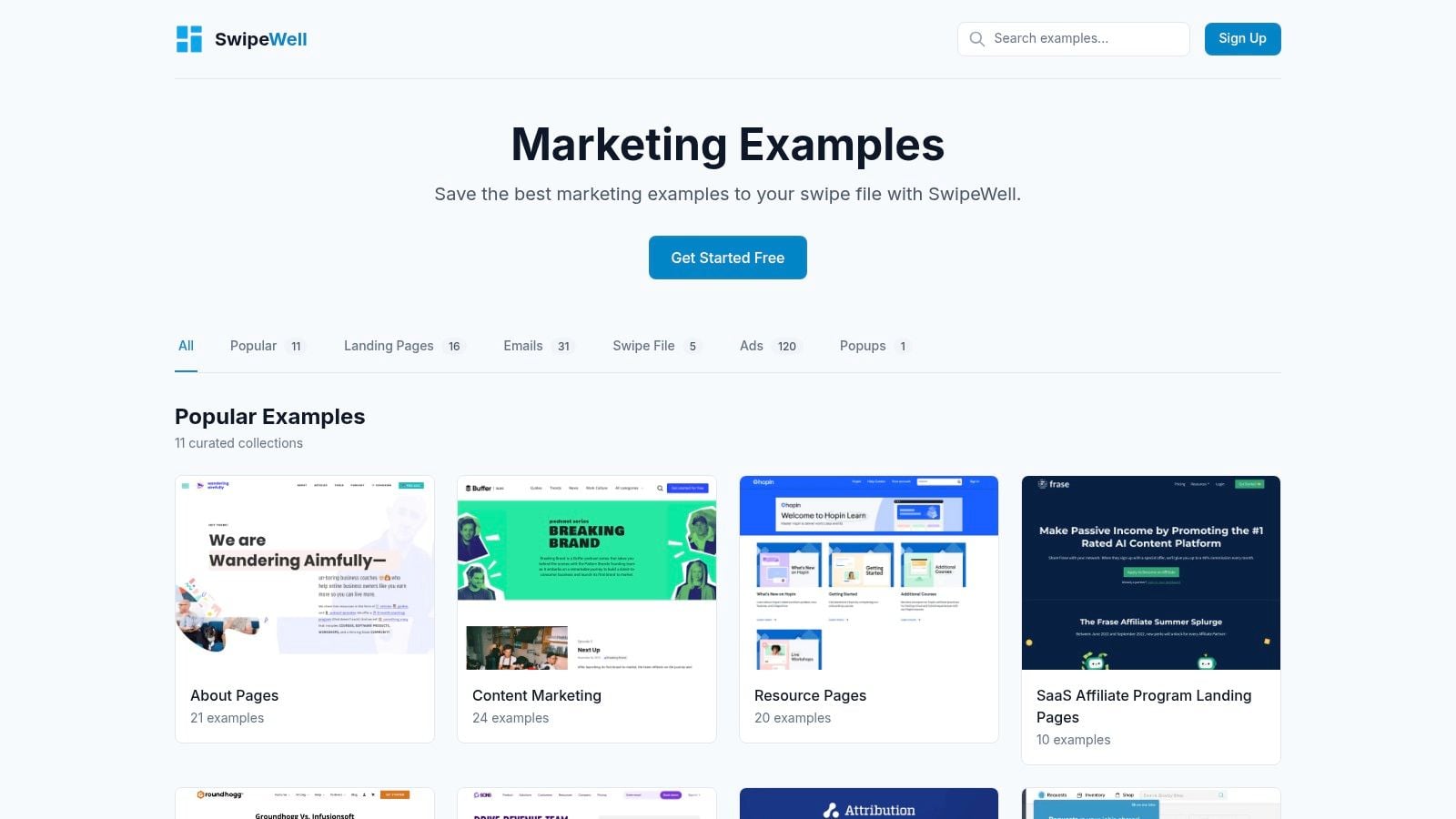
The dedicated testimonial ads category is the obvious starting point, but the bigger value is workflow. You can save examples, organise them, share them across a team, and connect ad references with landing page and email examples so the testimonial logic stays consistent after the click.
Why this matters in practice
Teams often don't struggle to find examples. They struggle to retain and reuse insights. A strategist saves one Meta ad. A designer screenshots a landing page. A media buyer bookmarks a TikTok. Three weeks later, nobody can find the pattern again.
SwipeWell solves that operational problem better than public archives do. It supports research continuity. That's useful when you're building a testimonial system with reusable modules such as hooks, proof overlays, quote formats, and CTA variants.
Useful features include:
- Dedicated testimonial collection: Faster research when you need proof-led creative
- Save and organise tools: Better than browser bookmarks for team use
- Ad Finder and remix features: Helpful for turning research into draft variants
- Team sharing: Keeps creative references attached to active work
Where to be careful
Because it isn't a native platform, SwipeWell can't replace performance context from Meta, LinkedIn, or TikTok. It's a pattern library, not a delivery environment.
That said, it's strong for codifying what your team learns. If you want a repeatable testimonial ad process, not just a folder of screenshots, that distinction matters.
7-Platform Testimonial Ads Comparison
| Tool | Complexity 🔄 | Resources ⚡ | Expected outcomes ⭐ 📊 | Ideal use cases 💡 | Key advantages ⭐ |
|---|---|---|---|---|---|
| Meta Ad Library (Facebook, Instagram, Messenger) | Low, web search + filters 🔄 | Minimal, free, no login required ⚡ | Large, current sample of live testimonial/UGC ads; placement & variant visibility ⭐📊 | E‑commerce / D2C testimonial and competitive creative scouting (AU) 💡 | Free, broad & recent coverage with page transparency links ⭐ |
| TikTok Creative Center – Top Ads | Low–Medium, curated dashboards & filters 🔄 | Low, free browsing; login improves features ⚡ | Platform-native winning creatives and hook/benefit patterns; trend guidance ⭐📊 | Short‑form UGC/testimonial hooks, trend‑driven creative ideation (AU) 💡 | Performance context, keyword insights and creative trends ⭐ |
| YouTube Ads Leaderboard (Think with Google) | Low, periodic curated lists 🔄 | Minimal, public resource, periodic updates ⚡ | High‑production storytelling and testimonial examples; high creative signal ⭐📊 | Brand films, long‑form testimonial structures and high‑craft inspiration 💡 | High‑quality, engagement‑focused exemplars with creative insights ⭐ |
| LinkedIn Ad Library | Low, searchable by company/keyword/date 🔄 | Minimal, free, public access ⚡ | B2B testimonial/case‑study ads and lead‑gen creative examples; limited metrics ⭐📊 | B2B marketers researching testimonial formats and lead‑gen creatives (AU) 💡 | Purpose‑built for B2B ad research; shows creative assets across formats ⭐ |
| BestAdsOnTV | Low–Medium, archive navigation, curated updates 🔄 | Low, public archive; professionally curated ⚡ | Polished TV/online video testimonials and cross‑media examples; agency credits ⭐📊 | TV spots, brand films and cross‑media creative benchmarking (Australia) 💡 | Deep Australian relevance and agency/brand credits for lineage tracking ⭐ |
| Ads of the World | Low, robust tagging and search 🔄 | Low, free archive, global scope ⚡ | Broad creative benchmarking across sectors and formats; not performance‑based ⭐📊 | Global creative research and sector convention studies across media 💡 | Massive, well‑tagged global archive with community credits/comments ⭐ |
| SwipeWell – Marketing Examples Library | Medium, curated repo + tools (extensions, AI) 🔄 | Moderate, free plan; paid for advanced/team features ⚡ | Fast curation and organized swipe‑files of testimonial ads; limited platform metrics ⭐📊 | Building team swipe files, competitive collection and rapid creative iteration 💡 | Save/organize examples, auto‑collect Meta ads and AI remix tools for variants ⭐ |
Your Playbook for Creating Winning Testimonial Ads
The best testimonial ads examples don't work because they include praise. They work because they package proof in the format each platform rewards. That's the pattern across these tools. Meta rewards speed and visible trust cues. TikTok rewards authenticity and native behaviour. YouTube rewards structured narrative. LinkedIn rewards relevance and business evidence.
That's also where many teams leave performance on the table. They collect one good customer quote, then force it into every channel unchanged. The stronger move is to treat each testimonial as source material. Pull out the problem statement, the emotional line, the concrete result, the qualifying detail, and the visual proof. Then rebuild the asset for the feed, funnel stage, and buying context.
In Australia, that approach isn't just smarter creative strategy. It's safer. The ACCC's position on misleading claims and testimonials means marketers need substantiation, genuine attribution, and enough context to avoid creating a false impression, especially in sectors where endorsement-led ads are common. That pushes good teams toward testimonial systems built around evidence, not decoration.
A practical workflow looks like this:
- Collect the right raw material: Ask customers for the problem, the experience, and the outcome, not just a compliment
- Choose one proof angle per ad: Don't stack five claims into one asset
- Match the format to the platform: Creator-style short video for social feeds, concise quote proof for landing pages, case-study framing for LinkedIn
- Keep attribution credible: Real names, role context, timing, and relevant qualifiers where appropriate
- Test proof presentation, not just copy: Screenshot review versus talking head, quote card versus metric overlay, founder intro versus customer-first opening
One more pattern is worth noting. Testimonial ads usually convert best when the proof appears early. On social platforms, the first seconds have to carry both attention and trust. On landing pages, the testimonial should answer the visitor's core objection, not sit as decoration below the fold.
If you're building that system across Google, Meta, LinkedIn, and remarketing, Click Click Bang Bang is one relevant option for managing the paid media side. Pair strong customer proof with the right media strategy, and testimonial creative stops being a nice-to-have brand asset. It becomes a repeatable acquisition input. For teams also shaping the sensory side of video creative, this guide to LesFM creative ad music is a useful complement.
If you want help turning customer reviews, quotes, and case studies into platform-specific PPC creative, Click Click Bang Bang offers PPC and SEO services across Google, Meta, and LinkedIn, with tracking, reporting, and campaign setup designed to support ongoing optimisation.
Read NeXt
Or Read Our Latest
- How to Set Up Google Ads in Australia: Complete 2026 Guide
- Google Merchant Center Setup: The Complete 2026 Guide
- Business Manager Setup Facebook: The Complete 2026 Guide
- Google Ads Account Setup: Expert Guide for 2026
- Search Ads Optimisation: A Practical Guide for 2026
- Manual vs Automated Bidding for PPC Success
Click. CLick. Subscribe.
Get our best PPC insights, industry updates, and power moves delivered straight to your inbox. No fluff, just high-caliber strategies that actually work.
Don’t Leave Just Yet
Try Us For 30-Days,
Risk Free!!
We guarantee that you’ll love our work within the first 30 days, if not you’ll get your money back.
What have you got to lose?