

Cross Device Tracking Your Complete Guide
Last Updated

Cross-device tracking is all about connecting the dots of a single user's journey as they jump between their phone, laptop, and tablet. Without it, you’re only seeing isolated snapshots of their activity, not the complete picture. Getting this right is the key to accurate attribution and, ultimately, smarter ad spend.
Seeing the Whole Story Across Every Screen
Imagine trying to follow a blockbuster movie by peeking through a tiny keyhole. You'd catch glimpses of the action—a character running here, an explosion there—but you’d completely miss the plot. That’s pretty much what your marketing looks like without effective cross-device tracking. You see a click on a mobile ad, a website visit on a laptop, and a final purchase on a tablet, but your analytics treat them as three separate stories from three different people.
This fragmented view creates a cascade of problems for any business running PPC or SEO campaigns.
- Misattributed Sales: The final click on the tablet gets all the credit for the sale, while the mobile ad that actually started the journey looks like a dud.
- Wasted Ad Spend: You might keep pushing ads to a customer on their phone, completely unaware that they’ve already bought the product on their desktop.
- Flawed Strategies: Your entire marketing strategy ends up being built on shaky, incomplete data, leading to poor budget decisions and a ton of missed opportunities.
In Australia, this is a huge challenge. We know consumer journeys regularly weave between mobile, desktop, and tablets before a conversion ever happens. This makes single-device reporting fundamentally broken. For marketers, the takeaway is simple: if your attribution is still tied to cookies on just one device, you are almost certainly misreading a large chunk of your conversions. As Australian agencies now realise, understanding the full customer journey isn't a "nice-to-have" anymore; it's essential infrastructure for growth. You can discover more insights about this shift on Usercentrics.com.
Ultimately, failing to connect these dots means you’re making critical business decisions based on a fraction of the real story. Adopting a cross-device perspective is the only way to truly understand performance and maximise your return on investment.
How We Connect the Dots: Deterministic vs. Probabilistic Tracking
So, how do you actually prove the same person used a smartphone, laptop, and tablet during their purchase journey? The answer lies in two core methodologies for cross-device tracking: deterministic and probabilistic matching.
Think of them as the two main tools in a detective's kit for identifying a user across screens. One approach is surgically precise, while the other relies on incredibly smart educated guesses. Understanding both is essential for building a complete, accurate picture of your customer.
Deterministic Tracking: The Fingerprint Match
Deterministic tracking is the gold standard for accuracy. It works by connecting devices using a persistent, known identifier that a user has provided with their consent. This is the digital equivalent of a perfect fingerprint match—there's no ambiguity.
The most common and reliable deterministic signal is a user login. When someone signs into your website on their phone and later on their desktop using the same email address, you can say with near-100% certainty that it’s the same person.
Other common deterministic identifiers include:
- A hashed email address from a newsletter sign-up.
- A unique customer ID from your CRM system.
- A phone number provided during checkout.
Because it’s based on first-party data that users volunteer, deterministic matching is highly accurate and far more resilient to privacy changes and cookie deprecation. Its main limitation, however, is scale; it only works for the portion of your audience that has authenticated with your brand.
Probabilistic Tracking: The Detective Work
What about the vast majority of anonymous users who browse your site without logging in? That’s where probabilistic tracking comes into play. This method is like old-school detective work—it pieces together non-personal, anonymous clues to make a highly educated guess that two or more devices belong to the same household or person.
Probabilistic tracking doesn’t know for sure; it calculates the likelihood that different sessions are linked. It analyses patterns and correlations from thousands of anonymous data points to connect the dots.
These clues can include things like a shared IP address, device type, operating system, and browser settings. By analysing these signals, the system builds a statistical model to infer connections, allowing you to get a much broader view of user behaviour than with deterministic data alone.
Deterministic vs. Probabilistic Tracking Methods Compared
To make it clearer, let's put these two methods side-by-side. Each has its own strengths and is suited for different scenarios, but seeing them compared directly helps highlight their core differences.
| Attribute | Deterministic Tracking | Probabilistic Tracking |
|---|---|---|
| Accuracy | Very high (approaching 100%) | Lower (typically 60-90%) |
| Scale | Limited to authenticated users | High reach, covers anonymous traffic |
| Data Source | First-party, user-provided data (logins, emails) | Anonymous signals (IP, browser, device type) |
| Privacy Impact | More privacy-centric (relies on consent) | Can be viewed as less transparent |
| Reliability | Consistent and stable | Can be affected by IP changes or browser updates |
Ultimately, neither method is inherently "better"—they serve different purposes. The most robust tracking solutions use a combination of both to maximise accuracy and scale.
This infographic below shows the stark difference between a fragmented, single-device view and the complete picture that cross-device tracking provides.
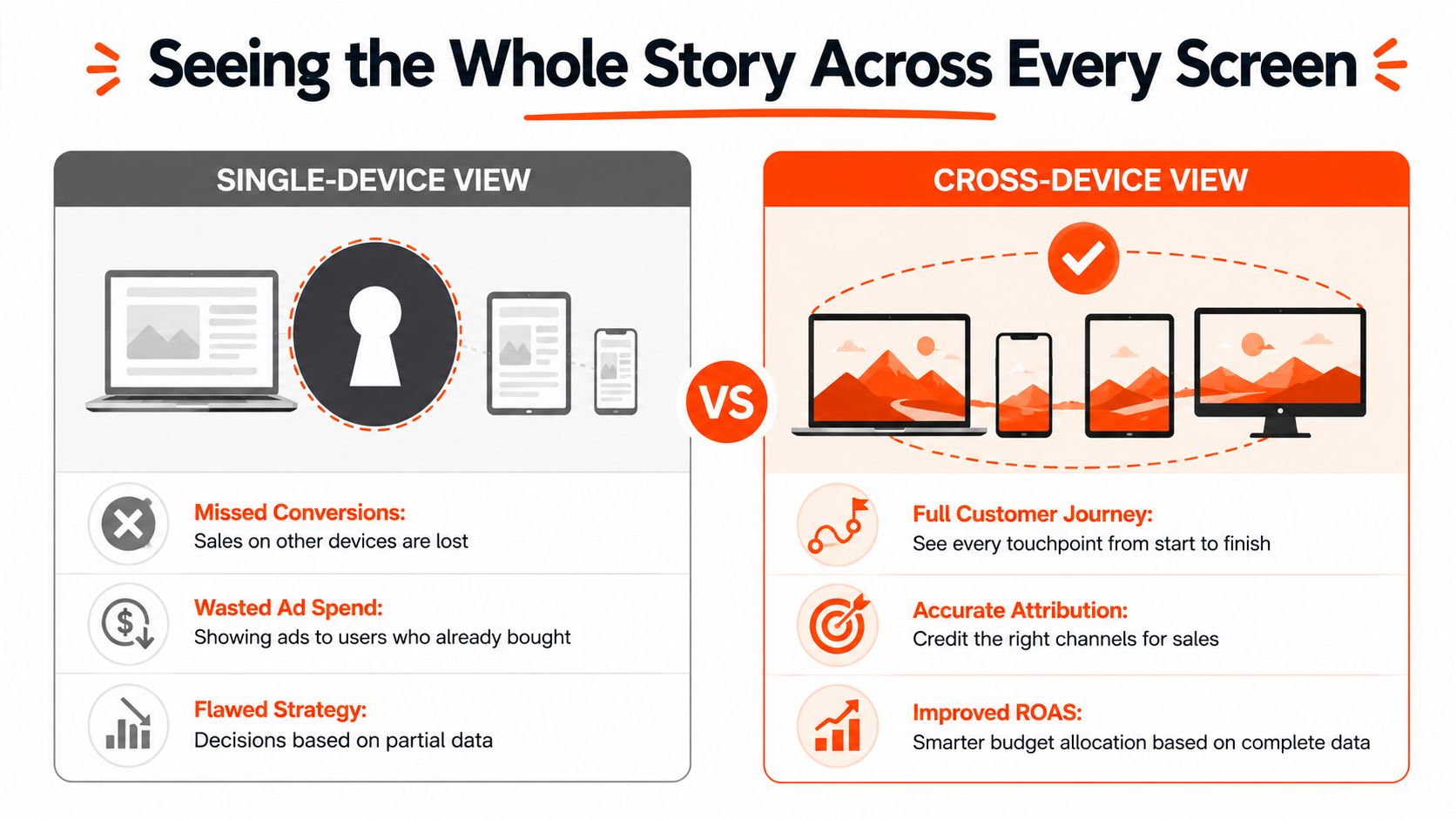
As you can see, a unified cross-device view moves you from missed opportunities and flawed data to accurate attribution and a genuine understanding of the entire customer journey.
Across the industry, modern platforms combine deterministic and probabilistic methods to balance accuracy with reach. For Australian e-commerce and B2B brands, this blended approach is crucial. Shopping journeys and lead cycles often involve multiple sessions across different devices before a conversion occurs, meaning last-click attribution can hide the value of earlier touchpoints.
As a result, Australian measurement teams increasingly use blended identity resolution and modelled conversions to reconstruct these complex user paths. You can discover more insights about this trend and what it means for 2026 at Herm.io.
Navigating the New Rules of Privacy and Consent
Trying to follow a customer's journey using cross-device tracking isn't the free-for-all it once was. We're now navigating a minefield of privacy regulations, browser lockdowns, and changing customer attitudes that dictates every move. Flying blind isn't just risky; it's a guaranteed way to make your marketing ineffective.
The days of leaning on third-party cookies to connect the dots are well and truly over. Browsers like Safari and Firefox have been blocking them for years, and with Google’s final phase-out, the writing is on the wall. For many businesses, this shift alone has blown massive holes in their attribution and retargeting capabilities.
The future of tracking isn't about finding clever workarounds. It’s about building a trustworthy, consent-based strategy that puts user privacy first and proves that effective marketing can go hand-in-hand with respecting your customers.
The Impact of Modern Privacy Regulations
Let's be clear: regulations like Europe's GDPR and California's CCPA have completely rewritten the rulebook. These laws hand consumers the keys to their personal data, meaning you need their explicit permission before you start tracking. You have to be upfront about what data you're collecting and why you need it.
On top of that, Apple’s App Tracking Transparency (ATT) framework now forces apps to ask users to opt-in to be tracked. With opt-in rates hovering at a dismal 25%, the pool of identifiable mobile users has shrunk dramatically. These changes create very real headaches for marketers:
- Fragmented Data: Without a consistent way to identify users, customer journeys shatter into disconnected, incomplete pieces.
- Weakened Attribution: It becomes incredibly difficult to prove which marketing channels are actually delivering conversions and which are just wasting budget.
- Compliance Complexity: Simply managing user consent across different devices, platforms, and legal jurisdictions is a huge operational challenge.
Adapting with a First-Party Data Focus
The only sustainable way through this maze is to shift your focus inward. Instead of chasing fragmented third-party signals, the top priority must be collecting and leveraging first-party data. This is the information your customers give you directly and willingly—things like an email address for a newsletter or login details for an account.
To learn more about this approach, check out our guide on what is first-party data.
This data isn't just more accurate; it’s built on a foundation of consent, making it a far more robust and compliant asset for your marketing. By building your cross-device tracking strategy around first-party identifiers, you create a resilient system that delivers the insights you need to grow while genuinely respecting your customers' privacy.
Your Modern Cross-Device Tracking Toolkit
Alright, enough with the theory. Let's talk about the practical side of things. Building a modern cross-device tracking setup isn't about finding one magic bullet; it's about getting the right tools to talk to each other. Here’s your blueprint for putting together a system that pieces together user journeys without falling foul of privacy rules.

The centrepiece for most marketers today is Google Analytics 4 (GA4). It was designed from the ground up with an event-based model, which is a huge leap from its predecessor. This structure makes it far better equipped to handle the messy, complex ways users jump between your website and app.
Stitching Journeys Together with GA4
GA4 doesn’t just rely on a single trick to connect the dots. Instead, it uses a smart hierarchy of identification methods, blending them together to create the most complete picture of a user’s journey it possibly can.
Here’s how it prioritises its signals:
- User-ID: This is your gold standard. When a user logs into their account, you can assign them a unique, anonymous ID. This ID sticks with them no matter what device they’re on, giving you a clean, deterministic match. It's the absolute foundation of reliable cross-device tracking.
- Google Signals: What about users who aren’t logged in? If they’re signed into their Google account and have ads personalisation turned on, Google Signals can connect their activity across devices. It’s a powerful way to broaden your view without any extra development work.
- Device ID: This is the fallback method, relying on traditional browser cookies or app instance IDs. It’s not great for tracking users across different devices by itself, but it ensures you’re still capturing individual session data.
When these signals aren't available—thanks to privacy settings or a user simply not logging in—GA4 leans on AI-powered behavioural modelling. It analyses aggregated data from users who have consented to fill in the blanks, intelligently estimating conversions you would have otherwise missed.
Advanced Strategies for Better Data
A standard GA4 setup is a great start, but to really sharpen your insights, you’ll want to layer on some more advanced techniques. This gives you far more control and richer data, which is essential for getting the most out of your PPC and SEO campaigns. Of course, a solid setup is everything, which is why a deep understanding of Google Ads conversion tracking is a non-negotiable.
Here in Australia, the changing privacy landscape has forced marketers to pivot. Cross-device tracking now leans heavily on first-party data and platform-level modelling rather than old-school browser cookies. To connect journeys across mobile, desktop, and apps, we’re now all in on tools like GA4, User-ID, and server-side tagging.
GA4's reliance on signed-in data and behavioural modelling is what makes it work in this new reality, helping to fill the gaps while keeping you compliant. For any business running ads across Google and Meta, getting this right directly impacts how accurately you attribute conversions and, ultimately, where your budget goes. You can dig deeper into how this has become standard practice over on Stape.io.
Boosting Your PPC and Attribution Models
This is where getting cross-device tracking right really starts to pay off, feeding directly into your Pay-Per-Click (PPC) performance and making your attribution models infinitely smarter. When you stop relying on a simple "last-click-wins" model, you can finally see how all your marketing channels actually work together to get a customer over the line.
Without that complete picture, you’re probably giving all the credit to the final touchpoint—maybe a brand search on a desktop—while completely ignoring the social media ad that first caught their eye on a smartphone. It’s a flawed view that leads to dodgy budget decisions and leaving growth opportunities on the table.

Driving Smarter Ad Spend and Higher ROAS
When you can link a single user across their devices, you unlock some very practical wins that translate directly into a better Return On Ad Spend (ROAS). For starters, you can stop wasting money showing ads for a new pair of shoes to someone who already bought them on their laptop an hour ago.
This unified view helps you manage campaigns with a lot more confidence. You can finally justify spending on those top-of-funnel awareness channels, knowing they’re playing a vital role in the journey, even if they aren't the ones landing the final conversion click.
By connecting all the touchpoints, you reveal what each channel is truly worth, not just the one that happened to be the last interaction. Industry data suggests this can slash your cost-per-action by 30–50% and boost ROAS by up to 100%.
Practical Wins from a Unified View
A clear, cross-device view delivers tangible benefits that are about more than just cleaner reports. It helps you create ads that are genuinely more effective and far less annoying for your customers.
Here are a few key advantages:
- Smarter Retargeting: You can finally stop chasing users with ads for items they’ve already purchased. Instead, you can pivot to upselling or cross-selling related products, which makes for a much better customer experience.
- Effective Frequency Capping: Control how many times one person sees your ads across all their devices. This stops ad fatigue in its tracks and makes sure your budget is spent reaching new people, not just hammering the same ones.
- Accurate Attribution: Giving proper credit to those introductory touchpoints lets you prove the value of awareness campaigns that lead to sales much later on.
At the end of the day, cross-device tracking gives you the hard data you need to prove the full value of your marketing spend. It takes attribution from a vague guessing game and turns it into something you can actually measure and defend. The path from a simple click to a final sale is messy, and understanding the evolution of PPC conversion tracking is fundamental to mastering this process.
Your Future-Proof Marketing Checklist
Alright, you’ve learned the theory behind cross-device tracking. Now, how do you turn all that knowledge into a marketing strategy that actually lasts? Simply reacting to the latest privacy update or browser change isn't a strategy—it's a recipe for constantly playing catch-up.
What you need is a proactive plan that puts user trust and data accuracy front and centre. This checklist gives you the practical steps to build a durable, privacy-first measurement system that will keep your marketing effective for years to come.
Build a Privacy-First Foundation
Your number one priority moving forward has to be collecting your own first-party data. This isn't about tricking users; it's about creating a genuine value exchange. Think exclusive offers for newsletter sign-ups or a personalised experience for creating an account. When customers willingly share their information, you get the consented identifiers that form the bedrock of reliable, deterministic matching.
Of course, collecting data is only half the battle. You absolutely must implement a robust Consent Management Platform (CMP). A good CMP is non-negotiable in 2026—it ensures you're collecting, storing, and acting on user consent correctly, which is vital for both legal compliance and building customer trust. Without explicit consent, your tracking efforts are dead in the water.
Next up, to get real control over your data and sidestep many of the browser-level restrictions, you need to adopt a server-side tagging solution.
By funnelling data through a server you control before sending it to analytics and ad platforms, you can clean, standardise, and enrich it. This makes your cross-device tracking much more accurate and strengthens your entire measurement framework.
Educate and Execute
Finally, it's time to get everyone else on board. You need to educate your stakeholders—from the C-suite to the sales team—on why multi-touch attribution matters. Use your newly unified data to show them exactly how those top-of-funnel channels contribute to the final sale, and start shifting the conversation away from that simplistic last-click mindset.
Here’s your checklist to get it done:
- Prioritise First-Party Data: Build clear strategies that give users a real reason to log in or sign up.
- Implement a CMP: Manage user consent transparently and ensure you’re compliant everywhere you operate.
- Adopt Server-Side Tagging: Take control of your data flow for better accuracy, privacy, and performance.
- Champion Multi-Touch Attribution: Use your data to show your organisation the true value of the full customer journey.
Following these steps isn’t just about adapting to the new rules. It’s about building a smarter, more resilient, and far more effective marketing engine for the future.
Frequently Asked Questions
Even after getting your head around the basics, it’s normal to have a few questions about cross-device tracking. It's a field packed with technical details and privacy implications, so let's tackle some of the most common queries to clear things up.
Is Cross-Device Tracking a Violation of Privacy?
Not on its own, but it absolutely can be if handled poorly. The line in the sand is consent. Tracking only becomes a privacy violation when it’s done sneakily, without a user's knowledge or clear permission.
Modern privacy laws like the GDPR demand transparency. As long as you have a straightforward privacy policy, use a proper consent management platform, and actually respect the choices people make, you can implement tracking ethically. The goal here is transparency, not secrecy.
How Accurate Is Probabilistic Tracking?
It’s best to view probabilistic tracking as a highly educated guess. While deterministic methods that use logins are almost perfectly accurate, probabilistic matching is all about statistical modelling.
Its accuracy typically lands somewhere between 60% and 90%. This makes it a fantastic tool for spotting trends across your anonymous audience at scale, but it's never going to be as precise as tracking a logged-in user. It’s great for broad insights, but don't treat it as a perfect match.
It's a common misconception that you need a developer on speed dial for any meaningful tracking. While complex, custom-built identity resolution systems require deep technical expertise, getting started is more accessible than ever.
Can I Do This Without a Developer?
For a basic but effective setup, yes, you can. Tools like Google Analytics 4 with Google Signals enabled give you a solid cross-device view straight out of the box, with no code required.
However, once you start moving into more advanced territory—like server-side tagging or implementing a User-ID system tied to your CRM—you will almost certainly need to bring in a developer. The foundational stuff is DIY-friendly; the powerful, customised solutions are not.
Do I Still Need UTM Parameters?
Absolutely. Don't throw them out. UTM parameters and cross-device tracking solve two different but equally important problems.
UTMs tell you where a user came from—a specific Facebook ad, an email campaign, a partner link. Cross-device tracking tells you if the person who clicked that ad on their phone is the same person who later converted on their laptop. They work together to give you the complete picture of both the traffic source and the full customer journey.
At Click Click Bang Bang, we turn complex data into clear results. If you’re ready to get a true picture of your customer journey and maximise your ad spend, our team is here to help. Explore our data-driven PPC and SEO services today.
Read NeXt
Or Read Our Latest
- How to Set Up Google Ads in Australia: Complete 2026 Guide
- Google Merchant Center Setup: The Complete 2026 Guide
- Business Manager Setup Facebook: The Complete 2026 Guide
- Google Ads Account Setup: Expert Guide for 2026
- Search Ads Optimisation: A Practical Guide for 2026
- Manual vs Automated Bidding for PPC Success
Click. CLick. Subscribe.
Get our best PPC insights, industry updates, and power moves delivered straight to your inbox. No fluff, just high-caliber strategies that actually work.
Don’t Leave Just Yet
Try Us For 30-Days,
Risk Free!!
We guarantee that you’ll love our work within the first 30 days, if not you’ll get your money back.
What have you got to lose?