

Mastering competitor analysis -parameters for SEO and PPC
Last Updated

Knowing what your competitors are up to online feels a bit like a high-stakes game of chess. Every business is fighting for the same eyeballs, and winning isn't just about having a great product—it's about having a killer strategy. This is where competitor analysis stops being a chore and becomes your roadmap to getting ahead. It’s about knowing your rival’s next move before they even make it.
The secret to a great strategy is tracking the right competitor analysis parameters. These are the specific, measurable data points that tell the story of what your rivals are doing online. They cut through the noise and give you clear signals on what’s working for them and, just as importantly, where you can find an edge.
What Exactly Are Competitor Analysis Parameters?
Think of yourself as a detective putting together clues. Each parameter is a piece of the puzzle, helping you build a complete picture of your competitor's marketing machine. These clues generally fall into a few key areas:
- SEO Performance: This is all about their organic search presence. You'll be digging into their organic traffic numbers, the keywords they rank for, and how strong their backlink profile is.
- PPC and Paid Media: This uncovers their paid advertising playbook. Key metrics here are things like their estimated ad spend, the keywords they’re bidding on, and the actual ads they’re running.
- Brand and Content Strategy: This is more on the qualitative side of things. It includes how they position themselves in the market, the voice they use, and what the user experience is like on their website.
This concept map gives you a great high-level view, breaking down competitor analysis into its three core pillars: SEO, PPC, and Brand.
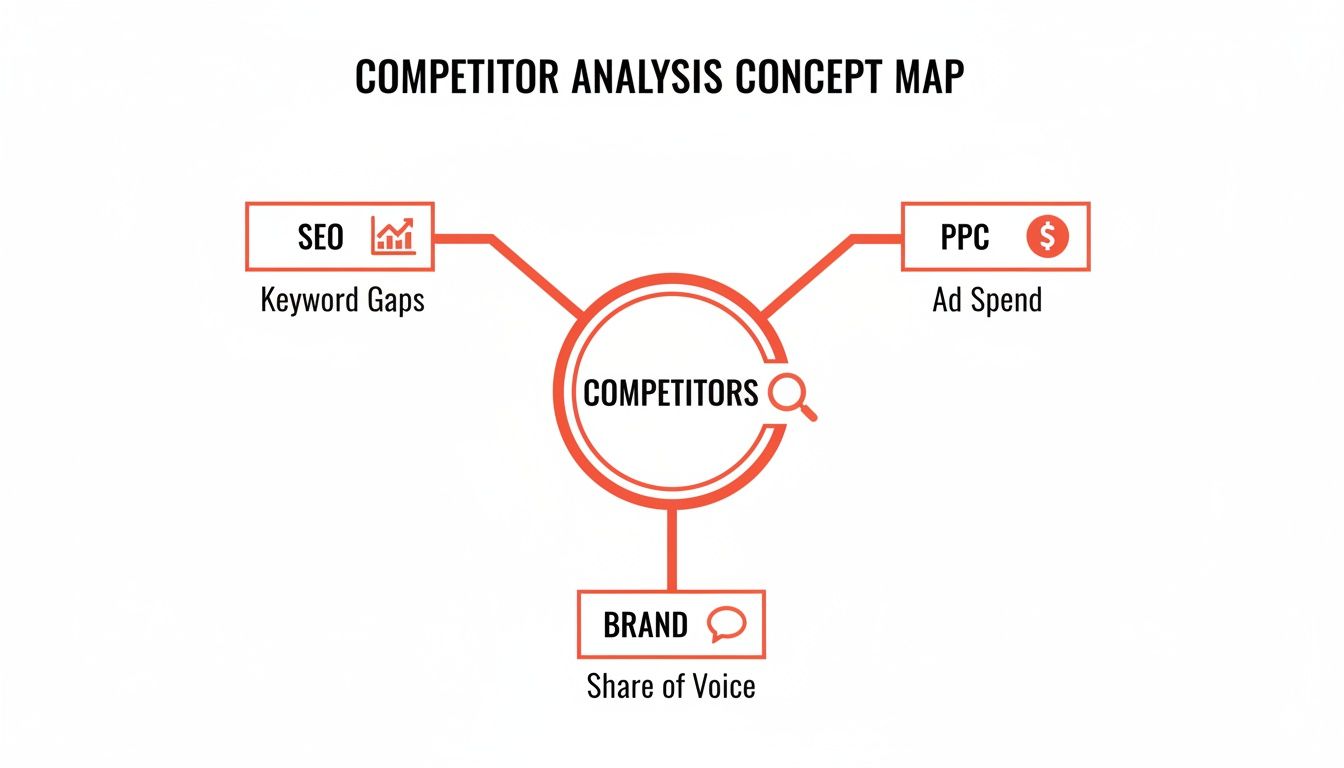
As you can see, a proper analysis means looking at the whole picture. SEO success, paid advertising budgets, and how people perceive their brand are all deeply connected.
Why You Can’t Afford to Ignore These Parameters
Just gathering all this data isn't where the magic happens. The real power is in turning these numbers and observations into smart, actionable decisions.
For example, finding out a competitor ranks for a bunch of high-value keywords but has a terrible website experience is a golden opportunity. You can swoop in with better content and a smoother user journey to steal that traffic right from under them.
By systematically analysing these parameters, you stop guessing and start making data-driven decisions. It allows you to benchmark your performance, identify strategic gaps in the market, and ultimately allocate your resources where they will have the most significant impact on your bottom line.
Whether you're running an e-commerce store or a B2B service, this process works. It gives you the intelligence you need to sharpen your SEO, get more from your PPC campaigns, and build a stronger, more resilient brand online. In the sections that follow, we'll dive into exactly how to measure and act on each of these critical parameters.
To help you get started, here's a quick summary of the key areas you'll be investigating. This table breaks down the core competitor analysis parameters, what they tell you, and the specific metrics you should keep an eye on.
Key Competitor Analysis Parameters at a Glance
| Parameter Category | What It Reveals | Key Metrics to Track |
|---|---|---|
| Organic Traffic | How much visibility they get from search engines without paying for ads. | Estimated monthly visitors, traffic trends over time, top organic pages. |
| Keyword Strategy | The specific search terms they are targeting and winning on. | Top ranking keywords, keyword difficulty, "keyword gap" (keywords they rank for that you don't). |
| Paid Ad Spend | How much they are investing in paid search and social campaigns. | Estimated monthly ad spend (e.g., on Google Ads, Meta), ad budget trends. |
| Ad Creatives | The messaging, visuals, and offers they use in their ads. | Ad copy, landing pages, visual formats (image vs. video), calls-to-action. |
| Conversion & UX | How effectively their website turns visitors into customers. | Website speed, mobile-friendliness, checkout process, lead capture forms. |
| Backlink Profile | The authority and trustworthiness of their website in the eyes of Google. | Number of referring domains, backlink quality, link acquisition velocity. |
| Pricing & Offers | Their product/service pricing structure and promotional strategies. | Price points, discounts, free trials, bundling offers, shipping costs. |
| Market Positioning | How they define their brand and differentiate from the competition. | Brand messaging, unique selling proposition (USP), target audience, share of voice. |
Think of this table as your checklist. As we go through the rest of this guide, we'll unpack each of these categories, showing you exactly how to find this data and, more importantly, what to do with it once you have it.
Reverse-Engineering Your Competitor's SEO Blueprint

To really figure out what makes a competitor tick, you’ve got to pop the bonnet and look at their SEO engine. This isn't about wild guesses; it’s about breaking down the core competitor analysis parameters that drive their organic search performance. Think of it as mapping their digital DNA to find their strengths and, more importantly, their weaknesses.
We're going to focus on four foundational pillars: their organic traffic, the keywords they’re winning, their backlink authority, and the content they’re using to do it all. By digging into each one, you’ll piece together a crystal-clear picture of how they pull in their audience from search.
Analysing Organic Traffic and Top Pages
First up is your competitor's estimated organic traffic. This number gives you a quick read on their overall visibility in search results. It answers a simple but vital question: how many people are landing on their site from Google each month without them paying a cent for ads?
Tools like Ahrefs or Semrush give you a solid estimate of monthly organic visitors. But don't just glance at the total. You need to look at the trends. Is their traffic on a steady climb, flatlining, or tanking? A sudden jump might point to a killer content campaign you can learn from, while a nosedive could signal a Google penalty you want to avoid.
Beyond the raw traffic numbers, you need to pinpoint their top-performing pages. These are the workhorses, the main entry points to their website from organic search. Analysing these pages tells you exactly which topics and content formats are hitting the mark with their audience—who, let's be honest, is also your target market.
Uncovering Their Keyword Strategy
Knowing how much traffic they get is one thing; understanding how they get it is where the real gold is. This is where keyword analysis comes into play. You need to uncover the exact search terms your competitors are ranking for, because this lays their entire content and targeting strategy bare.
The main goal here is to find the "keyword gap"—all the valuable keywords your competitors are ranking for that you aren't. These are your immediate opportunities, a ready-made to-do list for content creation to start pinching some of that search traffic.
For example, this Ahrefs screenshot shows a "Content Gap" analysis, which pinpoints the exact keywords your competitors own that your site is missing out on.
This data is incredibly powerful. It literally shows you where the low-hanging fruit is dangling in your market's search landscape.
Don't just stop at the keywords themselves. Look closer at their intent. Are they informational (like "how to clean suede shoes") or are they commercial (like "buy waterproof suede spray")? This little detail tells you a lot about their sales funnel and how they attract customers at different points in their journey.
Evaluating Their Backlink Profile
Backlinks are basically the currency of the internet. When another website links to your competitor, Google sees it as a vote of confidence, which massively boosts their authority and ranking power. A competitor with a hefty backlink profile is a force to be reckoned with in SEO.
When you're digging into their links, focus on three key things:
- Quantity of Referring Domains: How many different websites are linking to them? More is usually better.
- Quality of Backlinks: Are the links coming from authoritative, relevant sites (like major industry blogs) or from dodgy, low-quality directories? One good link from a well-known publication can be worth more than a hundred spammy ones.
- Link Velocity: How quickly are they picking up new backlinks? A steady flow shows they have an active and effective outreach or digital PR game.
A strong backlink profile is the fuel for ranking for competitive keywords. If a competitor is consistently beating you in the search results, there's a very good chance their backlink authority is a big part of the reason.
Figuring out where their best links come from also gives you a pre-vetted list of websites to target for your own link-building campaigns.
A deep dive can also reveal hidden cracks in their armour. A site might rank well but have underlying technical problems holding it back. This is why running regular checks on your own site is just as crucial; a thorough technical SEO auditing process makes sure your own house is in order before you start exploiting your competitor's weaknesses.
Decoding Paid Media and PPC Strategies
If SEO is the long-game of building organic authority, then paid media is the sprint. It’s a fast-paced battle for immediate visibility where brands pay to play, and every single click comes with a cost. Breaking down a competitor's paid strategy is like being an advertising detective, piecing together clues to figure out exactly how they capture customers and what they're willing to pay for it.
The main parameters we're investigating here are all about their pay-per-click (PPC) campaigns. We need to dig into how much they're likely spending, which keywords they're bidding on, the exact language they use in their ads, and what happens after someone clicks. This kind of insight is pure gold for optimising your own paid efforts.
Uncovering Estimated Ad Spend and Top Keywords
Your first clue lies in your competitor’s budget. While you’ll never see their exact invoices from Google, tools like SpyFu or Semrush can give you a surprisingly accurate estimate of their monthly ad spend. This figure helps you gauge just how aggressive they are on paid channels and what kind of investment you might need to make to go toe-to-toe with them.
Beyond the total spend, the real treasure is identifying their most profitable keywords. These are the search terms they consistently pour money into, month after month. If a competitor has been bidding on a keyword for a long time, that’s a massive signal that it's driving valuable conversions for them. Analysing these paid keywords reveals their highest-priority targets.
Think of a competitor’s paid keyword list as their treasure map. The terms they spend the most on are marked with a big 'X', showing you exactly where they're finding their most valuable customers. Your job is to decide whether to fight for that same treasure or find a less-guarded spot on the map.
Knowing which keywords to target is fundamental to any successful campaign. To build out your own strategy, you can explore our detailed guide on how to perform effective Google Ads keyword research. This will help you find the high-intent terms that can drive immediate results for your business.
Deconstructing Ad Copy and Creatives
Once you know what they're bidding on, the next step is to look at how they're bidding. This means diving into their ad copy—the headlines and descriptions they’ve crafted to grab attention and earn that click. Are they leading with a sharp price point, highlighting a unique feature, or trying to create a sense of urgency?
Examine the language they use and the offers they push. For an e-commerce brand, you might spot them A/B testing different discounts or free shipping offers. For a B2B company, they could be promoting different lead magnets, like a free webinar versus a downloadable whitepaper. These little variations show you what messaging is hitting the mark with your shared audience.
These insights are vital for your own campaigns. Keep an eye out for:
- Unique Selling Proposition (USP): What’s the main benefit they hammer home in their headlines?
- Call to Action (CTA): Are they using direct commands like "Shop Now" or softer invitations like "Learn More"?
- Emotional Triggers: Do they tap into pain points (e.g., "Tired of slow software?") or aspirations (e.g., "Achieve your goals faster")?
Analysing Landing Pages and Conversion Funnels
The ad is just the beginning of the user’s journey. The final—and arguably most important—piece of the puzzle is the landing page. A brilliant ad that leads to a terrible landing page is like a great movie trailer for a rubbish film; it just creates disappointment and wastes money.
Actually click on your competitors' ads and see where they send their traffic. Is it a generic homepage, or a highly optimised, campaign-specific landing page? A dedicated landing page is a dead giveaway of a sophisticated advertiser. Analyse its structure, from the headline and hero image right down to the lead capture form and CTA button. This lays out their entire customer acquisition funnel for you to see.
In the Australian market, the focus on search advertising is intense. It captured $1.896 billion in spend in a recent quarter, a 10% year-on-year jump. This highlights just how critical platforms like Google Ads are in your competitors' playbooks, making it more important than ever to analyse their every move—from keyword to landing page. You can dive into more findings from the IAB Australia Internet Advertising Revenue Report.
Analysing the Story Behind the Numbers
Metrics like traffic and keyword rankings tell you what your competitors are up to, but they don't explain why it's actually working. To get to the bottom of that, you need to step away from the spreadsheets and start analysing the things that reveal their brand's personality and how it connects with an audience.
This is where you find the strategic story they’re telling.
Think of it like the difference between reading a game's box score and watching the actual match. The stats tell you who won, sure, but watching the game shows you the strategy, the clever plays, and the momentum shifts that made it happen.
Decoding Market Positioning and Brand Messaging
Your first job is to figure out how your competitors position themselves. What’s their core promise? Are they the cheap and cheerful option, the premium choice, or the new kid on the block shaking things up?
Their brand messaging is the clearest window into this. Dive into their website homepage, their "About Us" page, and their social media bios. Hunt for recurring words, phrases, and value propositions that shout, "This is who we are!"
Doing this helps you spot the gaps in the market. If every other player in your space uses stiff, corporate jargon, adopting a friendly, human-centric voice could be your killer advantage. It's about finding a better story to tell.
Qualitative analysis is all about reading between the lines of the data. It’s how you discover if a competitor's high traffic comes from genuine brand loyalty or just aggressive, short-term discounting—a critical difference when planning your own strategy.
Evaluating Website User Experience and Conversion Pathways
A competitor's website is their digital shopfront, and its user experience (UX) is a massive piece of the puzzle. A clunky, slow, or confusing website can sink even the most brilliant SEO or PPC campaign.
Put on your customer hat and take a tour of their site. How easy is it to find what you're looking for? Is the checkout process a breeze or a nightmare? Can you find their contact details without a treasure map? A poor UX is a weakness you can exploit with a smoother, more intuitive design.
To get a handle on the data behind their performance, using effective competitor tracking software is a game-changer. These qualitative factors are key to improving your own results. You can check out our guide on key digital marketing performance metrics to see exactly how UX connects to conversion rates and other vital numbers.
Gauging Customer Sentiment and Social Proof
Finally, it's time to listen to what actual customers are saying. Customer reviews on sites like Google and ProductReview.com.au, along with social media comments, are a goldmine of unfiltered feedback.
Are people constantly praising their speedy shipping but tearing their hair out over poor product quality? That tells you exactly where their strengths and weaknesses lie. Pay close attention to the language customers use—it often reveals what they truly value.
This extends to their social media presence. In Australia, social media is a huge battleground, with ad spend projected to hit AU$7.5 billion and take up 29% of the total digital ad budget. Platforms like Meta and LinkedIn are where brands fight for the attention of over 91% of the population.
By analysing how they engage with their audience here—their tone, how quickly they respond, and the content they post—you get a deep insight into their brand's true personality. This deep dive into the qualitative side of things moves you from just knowing what your rivals do to understanding how they think, operate, and connect, giving you the power to build a much stronger, more resonant brand.
Turning Competitive Insights into Action

Collecting all that competitor data is a great start, but it's only half the job. On its own, raw data is just interesting noise. It only becomes a real advantage when you translate it into a clear, strategic plan.
This is where the magic happens—where your observations become decisive actions that actually boost your SEO and PPC performance. The goal is to shift from just knowing "what they're doing" to deciding "what we're going to do about it."
Think of it this way: every weakness you find in a competitor's strategy is a golden opportunity for you to win. And every strength they have is a free lesson in what’s working in your market right now.
Forging an SEO Action Plan from Competitor Data
Your competitor’s SEO footprint is a goldmine. By picking apart their keyword strategy and backlink profile, you can build an incredibly effective, data-driven plan for your own content and outreach.
Start with that keyword gap you identified earlier. Don't just see it as a list of terms; it's a ready-made content calendar staring you in the face. Group these keywords by topic and user intent. For example, if your rival ranks for "eco-friendly packaging Sydney" but their content is thin, old, and uninspired, your opening is crystal clear.
Your move? Create the definitive guide on that topic. We’re talking a comprehensive, visually engaging article that answers every possible question a user might have. This surgical approach means your content efforts are aimed squarely at capturing valuable, qualified traffic.
Next up, their backlink profile. This is basically a pre-vetted list of websites that are already interested in your industry and are willing to link out to relevant content. Your action plan here is all about strategic outreach.
Here’s how to turn their links into your opportunities:
- Identify High-Quality Sources: Export their backlink profile and filter it down to reputable sites with solid domain authority. Ignore the junk.
- Analyse Linking Content: See exactly which pages on their site earned those links. Was it a unique data study, a super-helpful guide, or a slick infographic?
- Create Superior Content: Now, build something even better. A more up-to-date study, a more detailed guide, or a more beautifully designed visual. This is the heart of the "Skyscraper Technique."
- Conduct Targeted Outreach: Reach out to the sites linking to your competitor. Show them your superior resource and politely suggest they link to your page instead (or as an additional, more current resource).
Raw competitor data is like a pile of Lego bricks. An action plan is the instruction manual that shows you how to assemble those pieces into something that gives you a strategic advantage, whether it’s a stronger SEO presence or a more profitable ad campaign.
Crafting a Winning PPC Strategy from Rival Insights
In the fast-paced world of paid ads, competitor insights are your shortcut to more effective campaigns. Analysing their ad copy, offers, and landing pages gives you a brilliant testing ground for your own PPC efforts, helping you boost conversion rates without burning through your budget on guesswork.
If you spot a competitor consistently running ads with a "30-Day Free Trial" offer, that's a massive signal that this proposition clicks with your target audience. Your action isn't to just copy them—it's to use that insight to fuel a smart A/B test.
For instance, you could pit their offer against one of your own:
- Ad Variation A: "Start Your 30-Day Free Trial Today"
- Ad Variation B: "Get 25% Off Your First Three Months"
Running this test will quickly tell you which offer drives more clicks and, more importantly, more qualified leads for your business model.
In the same way, deconstructing their landing pages reveals their conversion funnel. If their most successful ad campaign sends users to a page with a big video testimonial and a simple, single-field form, that’s a clue. Your action is to test those very elements on your own landing pages and see if they lift your conversion rates.
Prioritising Your Actions for Maximum Impact
After your analysis, you’ll likely have a laundry list of potential actions. The final, critical step is to prioritise them, because not all opportunities are created equal. A simple but powerful framework for this is the Effort vs. Impact matrix.
Categorise each potential action by asking two simple questions:
- Impact: How much will this move the needle on our key goals (traffic, leads, sales)?
- Effort: How much time, money, and resources will this take to implement?
This approach helps you zero in on the quick wins first—the high-impact, low-effort tasks that deliver immediate results and build momentum. From there, you can map out and tackle the bigger strategic projects that require more resources but promise significant long-term gains.
It’s this structured approach that ensures your competitor analysis translates into real, measurable growth for your business.
Putting It All Into Practice: A Competitor Analysis Walkthrough
Theory is great, but seeing how this all works in the real world is where the magic happens. Let's walk through a couple of quick examples to bring these competitor analysis ideas to life. Think of these as simple, repeatable templates you can borrow for your own business.
First up, let's imagine an Australian e-commerce brand called "EcoNest," which sells sustainable home goods. They're looking to punch above their weight and need to figure out how a much larger, established competitor is dominating the market. Their mission? Find the chinks in the armour and carve out their own profitable niche.
E-Commerce Case Study: EcoNest
The EcoNest team decides to focus their energy on three core areas: SEO keyword gaps, their rival's Google Shopping strategy, and how their brand comes across on social media.
-
Finding the SEO Keyword Gap: Using an SEO tool, the team strikes gold. They find their competitor ranks really well for "bamboo bedding sets" but, surprisingly, the actual content on their site is pretty thin. It’s just a basic category page. This is a massive opportunity. The Action: EcoNest immediately plans a comprehensive pillar page, something like "The Ultimate Guide to Sustainable Bedding." The goal is to build the best resource on the topic, optimised to hoover up all that valuable long-tail keyword traffic.
-
Dissecting the Google Shopping Ads: Next, they dive into the competitor's top-performing product ads. A clear pattern emerges: the ads scream "luxury" and "premium quality," with price tags to match. The Action: EcoNest decides not to play that game. Instead, they'll compete on a completely different value proposition. Their new ad campaign will hammer home "affordability" and "eco-conscious value," targeting a more budget-aware slice of the same audience.
-
Sizing Up their Instagram Presence: Finally, a scroll through the competitor's Instagram feed reveals professionally shot, but honestly, pretty sterile product photos. The engagement is okay, but it lacks any real sense of community. The Action: EcoNest decides to lean heavily into user-generated content. They'll launch a campaign encouraging customers to share photos of EcoNest products in their real, lived-in homes. This fosters a more authentic, relatable brand image that the big guys can't easily replicate.
B2B Tech Company Case Study
Now, let's switch gears to a B2B SaaS startup. They've built some great project management software and want to figure out how a key rival is generating leads through its content and paid social channels.
To get the most out of these tactics, it's crucial to build a solid competitor analysis framework to guide the entire process.
-
Cracking the LinkedIn Ad Strategy: The team quickly discovers their rival is running LinkedIn ads targeting professionals with the job title "Operations Manager." The ads all push a downloadable "Efficiency Checklist" as the lead magnet. The Action: Instead of going head-to-head, the startup decides to target a different, often-overlooked role: the "HR Manager." They'll create a tailored lead magnet about improving employee onboarding workflows, completely sidestepping the direct competition.
-
Mapping the Lead Generation Funnel: By signing up for the competitor's checklist themselves, the team gets a firsthand look at the rival’s email nurture sequence. It’s a generic, five-email sequence that pushes for a demo almost immediately. It feels a bit desperate. The Action: They design a much more value-driven sequence. Theirs will offer a free mini-course on project management fundamentals, aiming to build trust and authority before ever asking for a demo call.
These examples show how analysing specific, targeted areas leads directly to actionable, data-backed decisions that can give you a genuine competitive edge.
Still Got Questions About Competitor Analysis?
Diving into competitor analysis often brings up a few common questions. Let's tackle them head-on, so you can fine-tune your approach and get the most out of your intelligence gathering.
Getting the frequency, tools, and targets right is what turns a one-off report into a powerful, ongoing part of your strategy.
How Often Should I Analyse My Competitors?
Think of it less like a one-off project and more like a regular health check for your strategy. A good rhythm is to conduct a deep dive quarterly on the big-picture stuff—like market positioning and core SEO content.
But for the faster-moving elements like PPC ads, social media campaigns, and promotional pricing, you'll want to be checking in at least monthly. This cadence ensures you're never caught off guard by a sudden tactical shift from a rival.
What Are the Best Free Tools for Competitor Analysis?
You absolutely don't need a massive budget to get started. Some of the most insightful tools out there are completely free.
- Google Alerts: A must-have. Set up alerts for your competitors' brand names, and you'll get real-time notifications about their mentions and new content.
- Platform Ad Libraries: The Meta Ad Library (for Facebook and Instagram) and LinkedIn Ad Library are goldmines. They let you see the exact ads your rivals are running right now.
- Freemium SEO Tools: The free versions of tools like Ubersuggest or Similarweb provide a fantastic, high-level overview of a competitor’s estimated traffic and top-performing keywords.
How Do I Choose Which Competitors to Analyse?
Picking the right competitors is half the battle. To get a truly complete picture of the market, you need to look beyond the obvious players and analyse three different types of rivals.
A classic mistake is to only watch direct competitors who sell the exact same thing. The real game-changing insights often come from analysing the indirect and aspirational players—the ones solving the same customer problem in a totally different way, or who are simply miles ahead of you in their marketing game.
Break down your focus into these three groups:
- Direct Competitors: These are the businesses selling the same product or service to the same audience as you.
- Indirect Competitors: They solve the same core problem for your customer, but with a different solution or product.
- Aspirational Competitors: These are the established market leaders. You might not compete with them head-on today, but you want to emulate their success.
At Click Click Bang Bang, we turn these competitive insights into high-performing SEO and PPC campaigns that drive real growth. Discover how our data-first approach can give you the edge. Learn more about our services.
Read NeXt
Or Read Our Latest
- Google Ads Account Setup: Expert Guide for 2026
- Search Ads Optimisation: A Practical Guide for 2026
- Manual vs Automated Bidding for PPC Success
- Conversion Tracking Setup: A Complete AU Guide
- Instagram Advertising Australia: Complete 2026 Guide
- Pay Per Click: A Beginner’s Guide for Australian Marketers
Click. CLick. Subscribe.
Get our best PPC insights, industry updates, and power moves delivered straight to your inbox. No fluff, just high-caliber strategies that actually work.
Don’t Leave Just Yet
Try Us For 30-Days,
Risk Free!!
We guarantee that you’ll love our work within the first 30 days, if not you’ll get your money back.
What have you got to lose?