

Your Guide to Conversion Rate Optimization Services in 2026
Last Updated
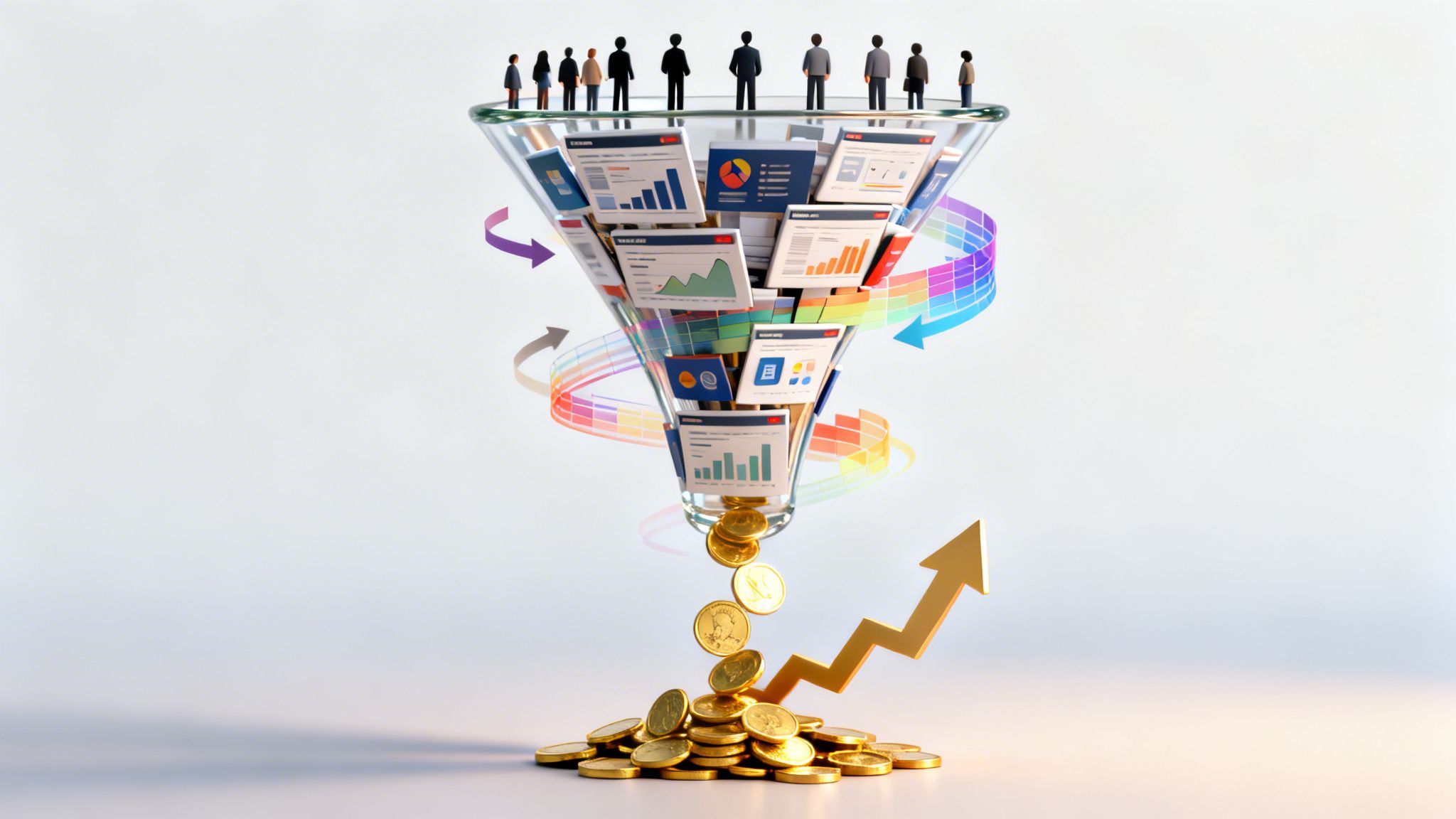
So, you’ve sunk a ton of money into ads, SEO, and social media to get people to your website. The traffic numbers look great. But what happens when they get there? If most of them leave without buying, signing up, or getting in touch, you’re just pouring water into a leaky bucket.
This is where conversion rate optimisation (CRO) services come in. It’s not about getting more traffic; it’s about getting more value from the traffic you already have.
What Are Conversion Rate Optimization Services

Think of your website as a physical retail store. You've paid for flashy ads to bring crowds through the door, but you notice most people are just browsing and walking straight back out. Frustrating, right?
Conversion rate optimisation services are like hiring a seasoned retail consultant to figure out why. This expert wouldn't just tell you to run more ads. Instead, they’d watch how customers move through the aisles, see where they get stuck, and identify what’s causing friction at the checkout.
They'd then suggest specific, testable changes—maybe redesigning the store layout, making the product signs clearer, or adding an express checkout lane. The goal is to make the entire shopping experience smoother, easier, and more persuasive.
CRO services do the exact same thing, but for your website. It’s a methodical process for turning passive visitors into active customers.
The Core Goal of CRO
At its heart, CRO is all about increasing your website’s conversion rate—the percentage of visitors who take the specific action you want them to. A "conversion" is whatever success looks like for your business. It could be:
- Making a purchase on an e-commerce site
- Filling out a contact form to generate a lead
- Subscribing to your newsletter
- Booking a demo or consultation
- Creating a new user account
The opportunity here is massive. In the Australian e-commerce market, for example, the average conversion rate sits around a measly 2.1%. That means for every 100 visitors, a staggering 98 leave without buying anything. But we've seen businesses that invest in CRO achieve conversion rate lifts of up to 30% simply by testing their landing pages and streamlining the checkout process.
A lot of people think CRO is just about A/B testing button colours. That’s a tiny piece of the puzzle. Real CRO is a deep, analytical process combining data, user psychology, and structured testing to make genuinely informed decisions.
This data-first approach takes all the guesswork out of the equation. Forget gut feelings or what some "best practice" blog post said. Every change is a hypothesis that gets tested against real user behaviour, ensuring that what you implement actually drives measurable growth.
By focusing on how to systematically improve conversion rates, you start to supercharge the return on investment (ROI) from all your marketing channels, from SEO and content to your PPC ad spend.
How a Professional CRO Program Actually Works
Great conversion rate optimisation isn't about guesswork or throwing spaghetti at the wall to see what sticks. A professional program doesn't chase trends or make random changes. Instead, it’s a science—a structured, data-driven process that turns user behaviour insights into repeatable wins.
Think of it like a clinical trial for your website. Every change is methodical and backed by evidence, not just someone's opinion. But before we get into the nitty-gritty, you need to be crystal clear on the metric you're trying to improve. A great primer on this is the article What Is Conversion Rate in Marketing Explained, which breaks down the foundational metric itself. Consider that step zero.
Once you’ve got that down, the real work begins. This isn't a one-and-done project; it’s a continuous cycle of learning and improvement.
Phase 1: Research and Discovery
The first phase is all about diagnosis. A CRO specialist plays detective, gathering clues to understand why your visitors aren't converting. This isn’t about hunches; it’s about collecting cold, hard data to find the "leaks" in your sales funnel.
This involves a mix of quantitative and qualitative analysis.
- Quantitative Data: First, we dive into tools like Google Analytics to see what is happening. We analyse user flow reports, device performance, and page exit rates to pinpoint exactly where users are dropping off.
- Qualitative Data: Then, we use tools like heatmaps and session recordings to understand why it's happening. Heatmaps show where people click and scroll, while session recordings give us a video replay of a user's entire journey, revealing their confusion and frustration in real-time.
This deep dive uncovers the specific friction points that are costing you sales or leads. It could be anything from a confusing navigation menu on mobile to an unclear value proposition on a key landing page.
Phase 2: Hypothesis and Prioritisation
Once the problems are identified, the next step is to form an educated guess about how to fix them. In CRO, we call these hypotheses. A solid hypothesis follows a clear "If-Then-Because" structure, linking a proposed change to an expected outcome and, crucially, the reasoning behind it.
For instance: "If we change the generic 'Submit' button text to 'Get My Free Quote', then we expect to see a 15% lift in form submissions because the new copy clarifies the immediate value and reduces user anxiety about what happens next."
A common mistake is to test ideas without a clear hypothesis. You might get a result, but you'll have no idea why it happened. A strong hypothesis ensures that every test—whether it wins or loses—delivers a valuable lesson.
Of course, not all ideas are created equal. A good agency will use a prioritisation framework (like P.I.E. — Potential, Importance, Ease) to score each test idea. This ensures we focus on experiments that offer the biggest potential impact for the least effort, getting you value much faster.
Phase 3: Testing and Implementation
This is where the rubber meets the road. Using A/B testing software, the proposed change (the "variant") is pitted against the current version (the "control"). We split your website traffic between the two versions and measure which one performs better against your conversion goals.
This flowchart shows the core CRO process in action.
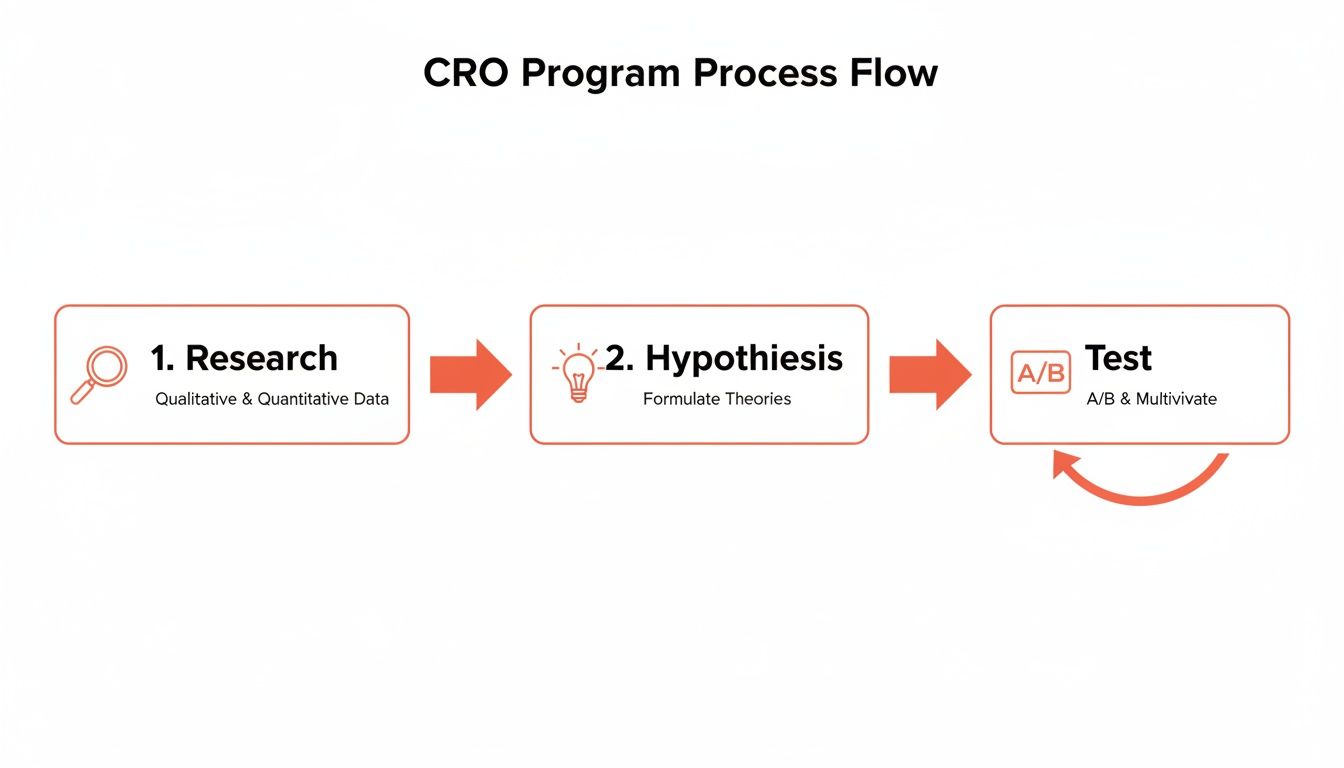
As the visual shows, it's a cycle. The results from one test feed directly into new research and future hypotheses.
If the variant wins with statistical significance, the change is implemented permanently. If it loses, the learnings are documented, and we develop a new hypothesis. For a deeper dive into improving specific pages, our comprehensive landing page optimisation checklist offers plenty of actionable steps.
This disciplined, iterative cycle is the engine that drives a successful professional conversion rate optimisation services program, turning problems into proven, profitable solutions.
Finding the Right CRO Agency for Your Business
Picking a partner for your conversion rate optimisation services is a genuinely high-stakes decision. The right agency becomes a seamless part of your team, uncovering deep truths about your customers and driving real, measurable growth.
Get it wrong, though, and you can burn through your budget fast with nothing to show for it but a few flimsy reports.
This isn’t just about buying a few A/B tests. You’re investing in a strategic partnership built on data, trust, and a shared vision for your business goals. So, how do you see past a slick sales deck and find a team that actually knows what they're doing? It all comes down to knowing what to look for and what to ask.
The Vendor Vetting Checklist
When you're sizing up potential CRO agencies, your job is to separate the true practitioners from the pretenders who just rehash common marketing tips. A top-tier agency doesn't rely on a "secret sauce"; they have a transparent, structured process that starts and ends with data.
Here’s a checklist to help you spot a quality partner:
- Data-Led Process: They should be able to walk you through a clear methodology that begins with deep research—digging into your analytics, heatmaps, and user recordings—long before they even whisper the word "test."
- Hypothesis-Driven Testing: Ask them how they build a hypothesis. A solid answer will involve an "If-Then-Because" framework that links a specific change to an expected result, all backed by a real insight into user behaviour.
- Industry and Model Experience: Have they actually worked with businesses like yours before, whether it's e-commerce, B2B lead generation, or SaaS? Their track record should line up with your customer journey and conversion goals.
- Focus on Learning, Not Just Winning: Real experts know that losing tests can be just as valuable as winning ones. Both outcomes deliver crucial insights. If an agency promises they’ll win every single test, run.
- Transparency in Reporting: You should demand clear, regular updates on the testing roadmap. What’s running now, what did we learn from the last test, and what’s coming up next?
For example, our agency homepage puts our focus on precision-driven, data-focused campaigns front and centre.
This signals a commitment to measurable results, a non-negotiable trait you should look for in any performance marketing partner.
Critical Questions to Ask Potential Agencies
Once you’ve got a shortlist, it’s time to dig in. These questions are designed to cut through the marketing fluff and show you how an agency really thinks and operates. Their answers will tell you everything you need to know.
-
Walk me through a recent losing test. What was the hypothesis, and what did you learn from the result?
This is a test of honesty and their commitment to learning. A great agency won't hesitate to break down a failed experiment, explaining the thinking behind it and the valuable insight they walked away with. -
How do you ensure test results are statistically valid and significant?
Listen for terms like sample size, test duration, and statistical significance levels (e.g., 95% confidence). It proves they understand the science of testing and won’t call a winner based on a random fluctuation.
A partner who can't explain statistical validity is just guessing with your money. Rigorous data analysis is the foundation of professional conversion rate optimisation services.
- How do you prioritise which tests to run first?
They should have a clear prioritisation framework (like P.I.E. – Potential, Importance, Ease). This shows they have a strategic plan to get you the biggest wins as quickly as possible, instead of just testing random ideas.
Measuring the True ROI of Your CRO Investment
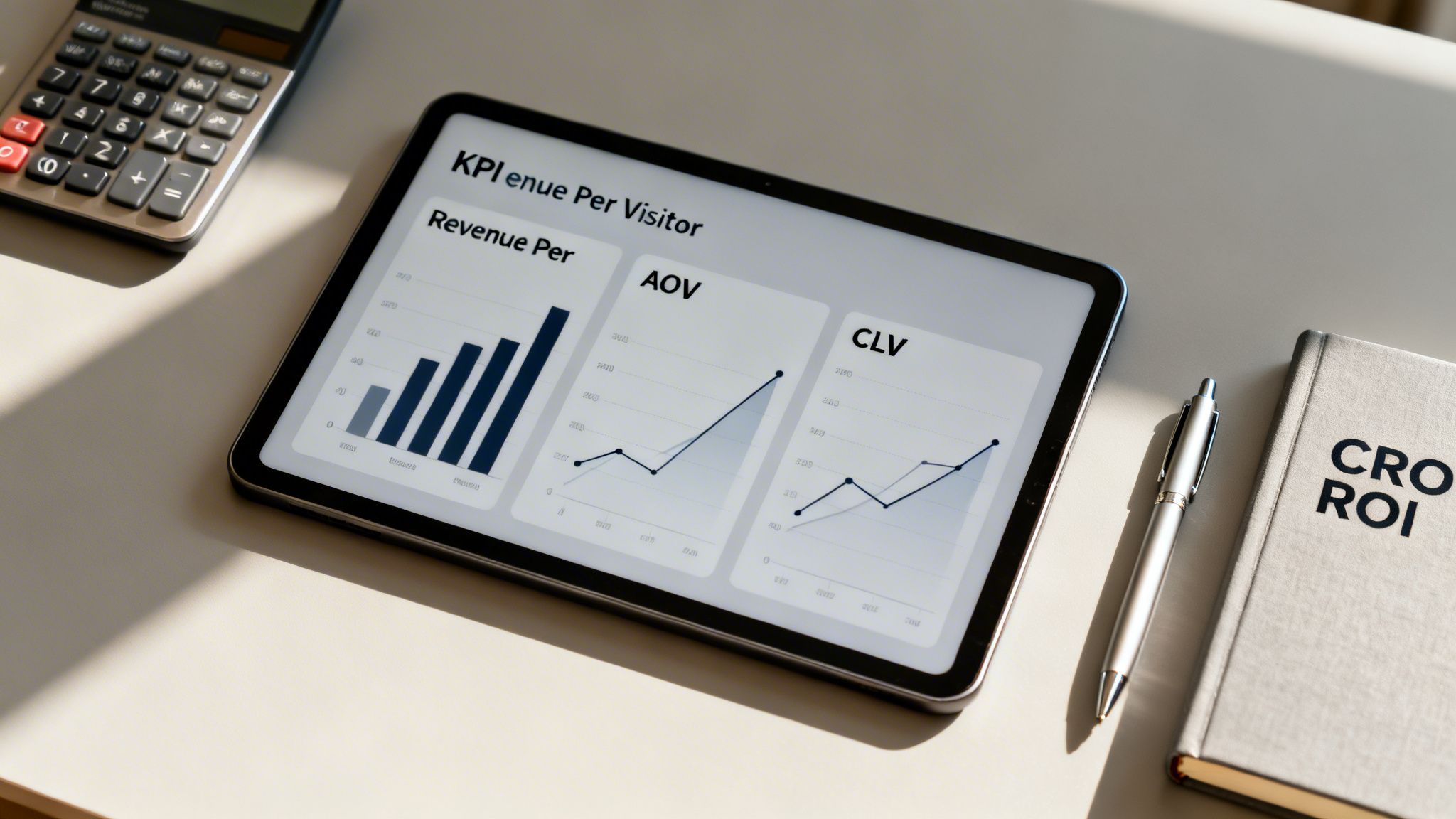
So, you’re investing in conversion rate optimisation services. How do you actually know if it's paying off? It’s easy to get fixated on the "conversion rate" metric, but that number only tells a tiny part of the story. To really get a handle on ROI, you need to look deeper at the metrics that directly impact your bottom line.
A proper CRO program isn't just about chasing more clicks or form fills. It’s about squeezing more value out of the traffic you already have. This means shifting your focus from a single, often misleading, percentage to a wider set of key performance indicators (KPIs) that truly measure profitability and customer worth.
Moving Beyond the Basic Conversion Rate
Focusing only on the raw conversion rate can be a trap. Imagine you run an e-commerce store and an A/B test bumps up your conversion rate by 10%. On the surface, that sounds like a massive win. But what if all those new sales are low-value, single-item purchases with paper-thin margins? You've technically increased conversions, but have you really grown the business?
This is where a more grown-up approach to measurement is crucial. The real goal is to draw a straight line from your CRO activities to financial outcomes, proving that the changes you're making are generating a real, tangible return. A professional agency will help you set up robust website conversion tracking to capture these richer data points.
To get the full picture of your ROI, you need to track the metrics that reflect the overall health of your business. These are the KPIs that tell you not just if more people are converting, but whether they're becoming more valuable customers in the process.
Key Metrics That Define True CRO Success
The most effective CRO programs don't just optimise for action; they optimise for profit. This means tracking metrics that go way beyond a simple transaction count.
Here are the crucial KPIs you should be measuring to gauge success:
-
Revenue Per Visitor (RPV): This is arguably the ultimate top-line CRO metric. It’s calculated by dividing your total revenue by the total number of visitors. When your RPV goes up, it’s a crystal-clear sign that your optimisation efforts are creating more value from every single person who lands on your site.
-
Average Order Value (AOV): This metric simply measures the average amount spent each time a customer places an order. A winning CRO test might involve optimising an upsell or cross-sell flow. Even if the raw conversion rate doesn't budge, a 15% increase in AOV means a 15% lift in revenue from the exact same number of customers.
-
Customer Lifetime Value (CLV): This is the long game. CLV predicts the total revenue your business can expect from a single customer over their entire relationship with you. Optimising the post-purchase experience or a newsletter sign-up flow can drive repeat purchases and dramatically lift CLV, turning one-off buyers into loyal fans.
The real power of CRO isn't just turning a "no" into a "yes." It's about turning a "$50 yes" into a "$90 yes," and turning a one-time buyer into a loyal, repeat customer. That’s where the true ROI lies.
This shift in perspective is critical. For instance, recent Australian e-commerce benchmarks showed that while raw conversion rates dipped slightly, smart, optimised stores saw their Average Order Value surge by 16.74% year-over-year to around AUD 240. This proves that building smarter funnels that encourage larger purchases often delivers a much bigger financial win than just a simple bump in transaction numbers.
Ultimately, these are the metrics that prove CRO makes all your other marketing spend work harder. By improving the efficiency of your website, you maximise the return on every dollar you pour into PPC, SEO, and social media advertising.
Tailoring CRO Strategies to Your Business Model
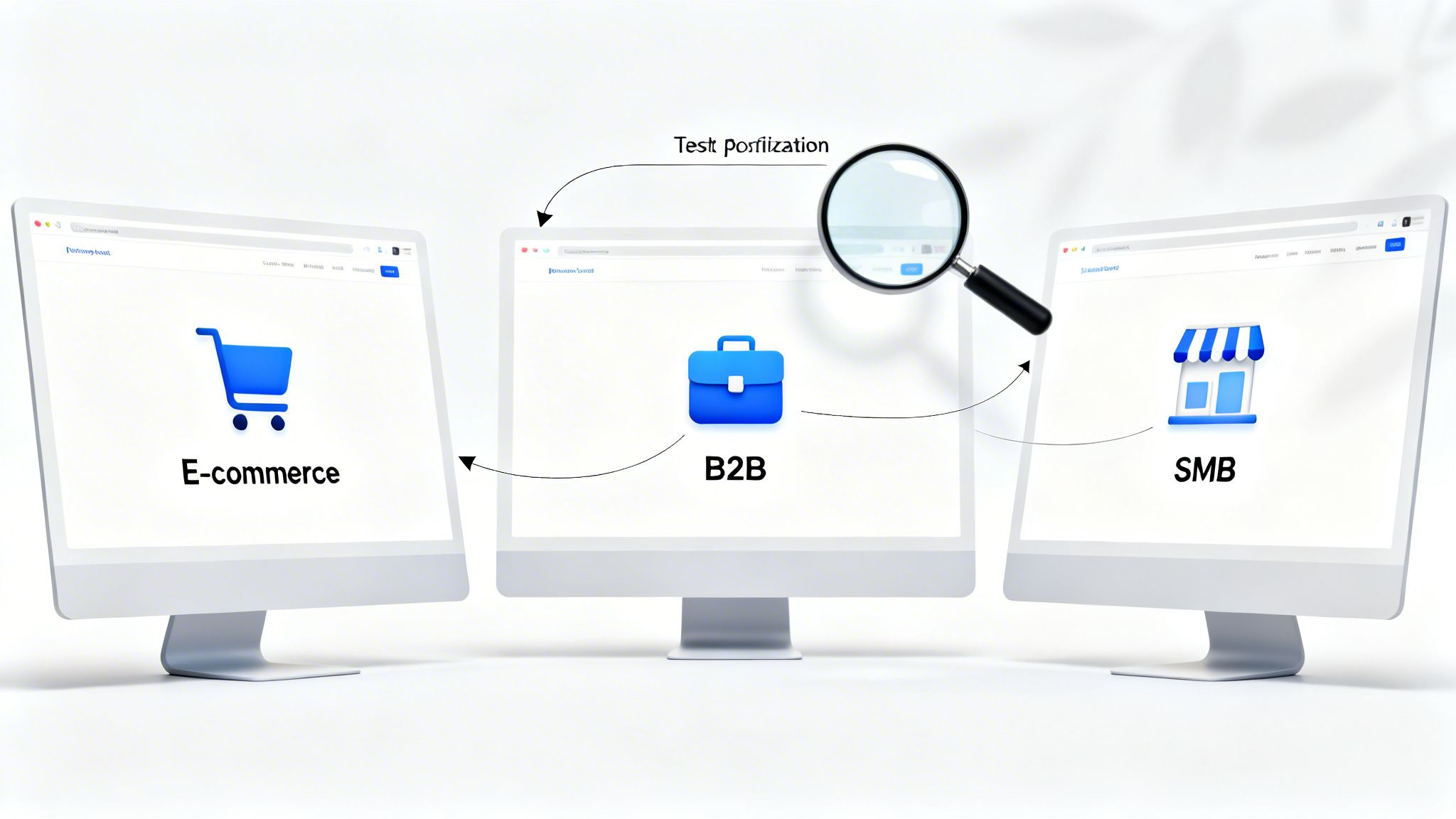
A powerful conversion rate optimisation services program is never a one-size-fits-all deal. The tactics that can double sales for an e-commerce store will completely miss the mark for a B2B company chasing high-value leads. Why? Because the goals, user mindset, and sales cycles are fundamentally different.
Effective CRO demands an approach that’s tuned to the specific mechanics of your business. It means realising that for an online retailer, a win is a completed transaction. For a software company, it might be a booked demo. Each model needs a unique optimisation lens.
By customising the strategy, you focus your efforts where they will have the most significant financial impact. This means diagnosing friction points unique to your customer’s journey, not just slapping on generic "best practices" and hoping for the best.
To help you pinpoint the most impactful strategies for your needs, this table breaks down the primary goals and tactics for different business models.
CRO Focus Areas by Business Type
| Business Type | Primary CRO Goal | Example Tactics |
|---|---|---|
| E-commerce | Increase sales and Average Order Value (AOV). | Simplify checkout, optimise product pages with social proof, improve mobile experience. |
| B2B Lead Gen | Generate high-quality leads and build trust. | Clarify value proposition, simplify forms, showcase case studies and client logos. |
| Small Business | Drive immediate, cost-effective actions (calls, quotes). | Ensure homepage clarity, simplify navigation, use strong calls-to-action (CTAs). |
Now, let's unpack what this looks like in the real world for each business type.
Optimisation for E-commerce Stores
For e-commerce businesses, the path to purchase is often emotional and immediate. The main goal of CRO here is to create a seamless, trustworthy, and persuasive shopping experience that guides a visitor from product discovery to checkout with as little friction as possible.
Your biggest enemies are cart abandonment and decision paralysis. This means your key areas of focus should be:
- Reducing Cart Abandonment: This is priority number one. Tactics involve simplifying the checkout (think guest checkout), being upfront with shipping costs, and using exit-intent popups with a last-minute discount to recapture hesitant buyers.
- Optimising Product Pages: High-quality images, compelling descriptions, clear pricing, and prominent social proof like reviews and ratings are non-negotiable. A/B testing small elements like button text—“Add to Cart” vs. “Buy Now”—can produce surprisingly big wins.
- Frictionless Mobile Checkout: With most traffic now on mobile, a clunky checkout on a small screen is a conversion killer. You need thumb-friendly buttons, auto-filled forms, and mobile payment options like Apple Pay.
If you're looking for more practical ideas, you'll find some great starting points in these 10 Proven Ecommerce Conversion Rate Optimization Tips.
Strategies for B2B Lead Generation
In the B2B world, conversions are rarely impulsive. The sales cycle is longer, decisions involve multiple stakeholders, and the goal is to kick off a relationship, not just close a one-off transaction. Here, trust and clarity are everything.
CRO for B2B shifts from optimising transactions to optimising for qualified leads.
For B2B, a conversion isn’t the end of the journey; it’s the beginning. The goal is to earn enough trust in a single session for a prospect to hand over their contact details, believing you can solve their expensive problem.
Key focus areas for B2B optimisation include:
- Clarifying the Value Proposition: Your landing page has to instantly answer "What's in it for me?" for a busy professional. Testing headlines and subheadings that speak directly to a visitor’s pain points is a high-impact activity.
- Simplifying Forms: Long, intimidating forms are a major source of friction. Only ask for what’s absolutely essential on a demo request or contact form. Every field you remove can boost submissions.
- Building Trust and Authority: B2B buyers need proof. Prominently display case studies, client logos, industry awards, and detailed testimonials to build credibility and slash perceived risk.
High-Impact CRO for Small Businesses (SMBs)
Small businesses often run on tight budgets and even tighter timelines. That means CRO efforts must be laser-focused on scalable, high-impact strategies that deliver quick wins. The goal is efficiency—getting the most leverage from the traffic you already have without needing a massive testing program.
For SMBs, the focus should be on plugging the biggest leaks in the bucket first. This includes:
- Homepage Clarity: Make sure your homepage clearly communicates who you are, what you do, and who you do it for within five seconds. No jargon, just answers.
- Simple Navigation: It should be incredibly easy for visitors to find what they're looking for, whether it's your services, pricing, or contact details.
- Action-Oriented Calls to Action (CTAs): Use clear, direct CTAs like "Get a Free Quote" or "Book a Consultation Today" on every key page to tell people exactly what to do next.
These foundational fixes often don't require complex A/B testing but can produce a significant lift in conversions. That initial ROI can then fund more advanced optimisation down the track.
Answering Your Top Questions About CRO Services
Diving into conversion rate optimisation always brings up a few big questions. It's a serious investment, so you absolutely should get the details straight before you commit. We've heard them all, so we've put together some clear, no-nonsense answers to the most common queries we get.
This is all about the practical side of things—from timelines and costs to how CRO actually plays with your other marketing efforts like SEO. Let's clear up any confusion so you can move forward confidently.
How Long Does It Take to See Results from CRO?
This is usually the first question on everyone's mind, and the honest answer has two parts. You can often score some "quick wins" from the initial audit that give you a noticeable lift within the first month. But a true CRO program is a long game—it's a marathon, not a sprint.
The time it takes to get a statistically significant result from a single A/B test really depends on your website traffic. A high-traffic e-commerce store might get enough data to call a winner in just two weeks. On the other hand, a B2B site with lower traffic might need four to six weeks for one experiment to deliver a valid conclusion.
A good agency will be upfront about this. They'll focus on building a sustainable testing roadmap that delivers small, compounding gains over time, not on promising massive, overnight results that usually aren't statistically sound or sustainable.
What Is the Difference Between SEO and CRO?
Think of SEO and CRO as two specialists on the same team, both with a crucial role to play.
-
Search Engine Optimisation (SEO) is your expert marketer. Their job is to get the right people to your website from search engines like Google. They’re focused on increasing your visibility and driving qualified traffic to your digital front door.
-
Conversion Rate Optimisation (CRO) is your expert in-store manager. CRO takes over the second those visitors land on your site. Their job is to make the website journey so smooth, intuitive, and persuasive that visitors are guided right to the action you want them to take.
In short, SEO gets them in the door; CRO convinces them to buy something or fill out a form. They're most powerful when they work together. Great SEO without CRO is like having a packed store where nobody buys anything. And great CRO without SEO is like having a perfect store with no customers.
How Much Do CRO Services Cost in Australia?
The cost for conversion rate optimisation services in Australia can vary a lot, depending on what's involved and the agency's model. It's definitely not a one-price-fits-all service, so it helps to understand the common pricing structures.
Monthly retainers are the most popular model, usually falling somewhere between $3,000 to over $10,000 AUD. This fee typically covers a full program, including:
- Deep research and data analysis.
- Building and prioritising strategic hypotheses.
- Designing and implementing tests.
- Ongoing reporting and analysis.
Some agencies might offer project-based pricing for a specific, one-off job, like a checkout optimisation project. For small to medium businesses, many modern agencies offer tiered monthly plans without locking you into long-term contracts, which gives you more flexibility.
A less common option is a performance-based model, where the agency takes a cut of the extra revenue they generate. This is usually reserved for established clients with a solid track record.
When you're looking at costs, always ask for a detailed breakdown of what's included. Get clarity on whether things like testing software licenses, developer time for implementation, and detailed reporting are bundled into the price or billed separately.
Is My Business Ready for Conversion Rate Optimisation?
CRO is an incredible growth engine, but it isn't the right first move for every business. Your business is probably ready to invest in CRO if you tick two main boxes.
First, you need consistent and sufficient website traffic. A good benchmark is at least 5,000 to 10,000 monthly visitors. You need this kind of volume to run A/B tests efficiently and get statistically significant data in a reasonable amount of time. Without enough users, tests can drag on for months, making the whole process painfully slow and impractical.
Second, you need a clear conversion goal you want to improve. Whether it's driving more e-commerce sales, generating B2B leads, or getting more newsletter sign-ups, you need a defined objective. If you're already spending money to get traffic through channels like SEO or PPC, then CRO is the logical next step to maximise the return on that investment.
If your website has very little traffic right now, your top priority should be on traffic generation first. Build your audience, then bring in the CRO experts to help you convert them.
Ready to turn more of your hard-earned traffic into customers? At Click Click Bang Bang, we specialise in precision-driven campaigns that not only attract visitors but also guide them to convert. Explore our services to see how we can help you get more value from every click. Find out more at https://clickclickbangbang.com.au.
Read NeXt
Or Read Our Latest
- Manual vs Automated Bidding for PPC Success
- Conversion Tracking Setup: A Complete AU Guide
- Instagram Advertising Australia: Complete 2026 Guide
- Pay Per Click: A Beginner’s Guide for Australian Marketers
- Display Advertising on Google: The Complete Australian Guide
- Stakeholder Communication Plan How to Build One That Works
Click. CLick. Subscribe.
Get our best PPC insights, industry updates, and power moves delivered straight to your inbox. No fluff, just high-caliber strategies that actually work.
Don’t Leave Just Yet
Try Us For 30-Days,
Risk Free!!
We guarantee that you’ll love our work within the first 30 days, if not you’ll get your money back.
What have you got to lose?