

What is first party data? A Guide to Marketing Growth
Last Updated

First-party data is, quite simply, the information you collect directly from your audience. It's the data they willingly share with you through your own website, app, or CRM. Think of it as a direct conversation with your customers about who they are and what they’re interested in.
This makes it the most valuable, accurate, and privacy-friendly data you can possibly own. It’s gold.
Defining Your Most Important Data Asset
Let’s use a simple analogy. Imagine you run a local coffee shop. The details you gather from your loyalty program members—their name, their favourite drink, how often they pop in—that’s your first-party data.
It’s built on a direct, one-to-one relationship. This information is incredibly powerful because it comes straight from the source, making it highly accurate and immediately relevant to your business.
Now, what about the other types? If a nearby bakery agrees to share its customer list with you in a partnership, that's second-party data. And if you buy a generic list of coffee drinkers in your postcode from a large data broker, that's third-party data. While these can have their uses, they just don't have the same level of trust or precision as the insights you gather yourself.
To make this distinction crystal clear, here’s a quick breakdown of the three main types of customer data.
First, Second, and Third Party Data at a Glance
| Data Type | Source | Key Characteristic | Example |
|---|---|---|---|
| First-Party | Your own channels (website, CRM, app) | Collected directly from your audience with their consent. | A customer’s purchase history from your e-commerce site. |
| Second-Party | A trusted partner | Someone else's first-party data shared directly with you. | A hotel sharing its guest list with a partner tour company. |
| Third-Party | Data aggregators | Purchased from external sources that don't have a direct relationship with the user. | A list of "in-market car buyers" from a data broker. |
This table shows why first-party data stands out—it’s the only one based on a direct relationship you control.
Why This Distinction Matters Right Now
The digital marketing world is in the middle of a huge shift. We're moving away from third-party cookies, which is making it much harder to track users across different websites. This change is forcing everyone to re-evaluate their data strategy, putting the information you collect yourself front and centre.
To manage this data effectively and get that single, unified view of every customer interaction, a solid franchise CRM system becomes essential. When you own your data, you’re no longer at the mercy of big platforms whose rules can change overnight. You’re in control.
This infographic does a great job of visualising the core differences.
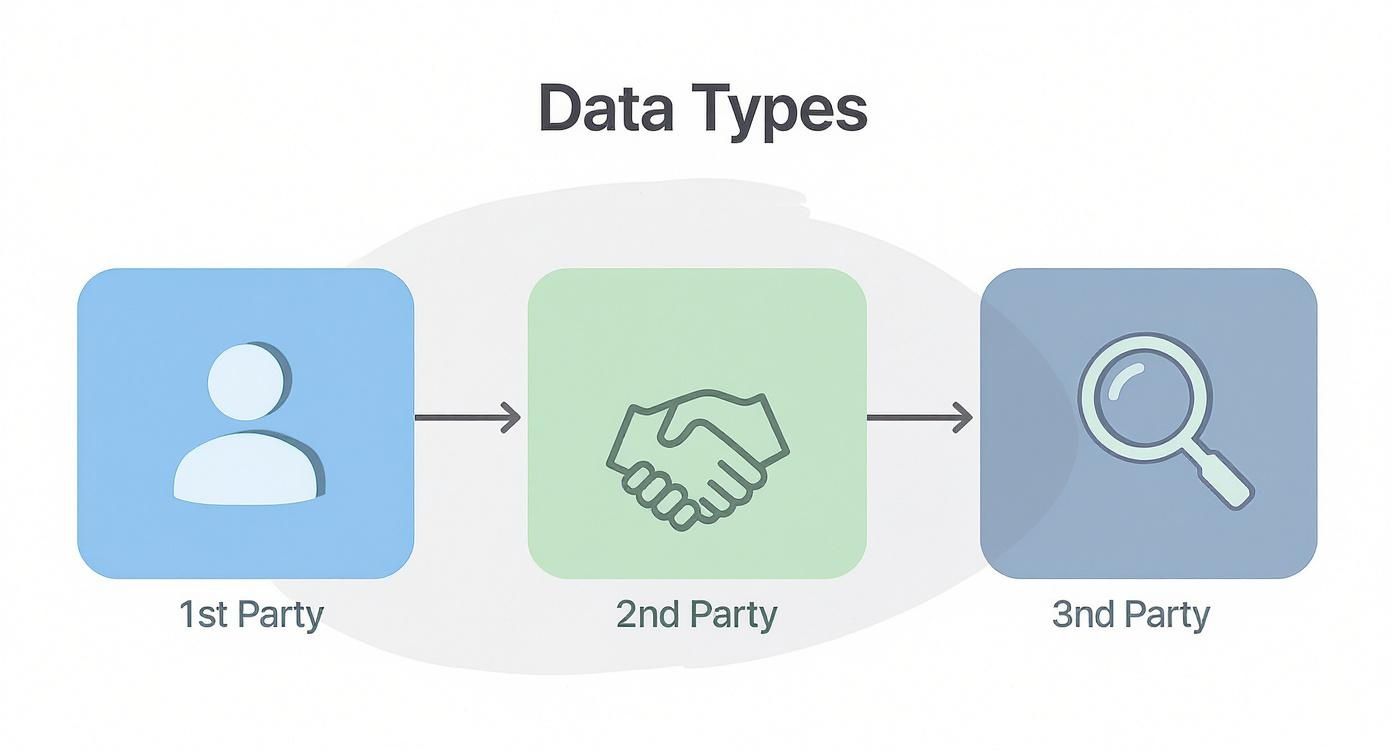
As you can see, first-party data is a direct handshake, second-party is a partnership, and third-party data is pulled together from countless unknown sources.
This isn’t just a theoretical change; it’s already reshaping the advertising industry. A 2025 study found that a massive 80% of Australian advertising decision-makers rated first-party data as either critical or very important for their campaigns. Even more telling, 61% now consider it critical. This signals a fundamental move towards building marketing strategies on a foundation of trust and direct customer consent.
In essence, first-party data is the bedrock of modern marketing. It’s the information your customers trust you with, providing the clearest path to understanding their needs and delivering personalised experiences that build lasting loyalty and drive business growth.
Why This Data Is Your Most Valuable Asset

Knowing what first-party data is sets the stage, but the real power comes from understanding why it’s the single most critical asset in your marketing toolkit. It’s not just another data stream; it's the foundation for a more resilient, efficient, and customer-focused business.
When you prioritise the information your audience shares directly with you, you gain a competitive edge that simply can’t be bought off a shelf. This direct line of communication transforms how you connect with people, moving beyond guesswork to informed, impactful decisions. It's the difference between shouting into a crowd and having a meaningful, one-on-one conversation.
Unlock Pinpoint Accuracy and Personalisation
Let's be honest, third-party data often paints a blurry, generalised picture of your audience. It lumps people into broad buckets like "in-market for a new car" based on aggregated browsing behaviour that could be weeks old. First-party data, on the other hand, gives you a high-definition snapshot of an individual’s actual interests and intentions.
Imagine you sell running shoes online. Third-party data might flag someone as a "fitness enthusiast." Yawn. But your first-party data shows you a customer named Sarah who has bought two pairs of trail running shoes in the last year, only ever clicks on emails featuring long-distance gear, and recently abandoned her cart after looking at a specific hydration pack.
Now you’re talking. With this knowledge, you can:
- Personalise Ad Creative: Show Sarah ads for new trail shoes, not generic sneakers.
- Tailor Email Offers: Send her a 15% discount on the exact hydration pack she was considering.
- Improve Website Experience: Customise the homepage to highlight trail running content when she logs in.
This level of detail is impossible with third-party sources. It allows for genuine personalisation that connects with customers, driving much higher engagement and conversion rates. Brands that get this right see a serious lift in revenue because their marketing feels less like an interruption and more like a helpful service.
Build Trust Through Transparency and Compliance
In an age of ever-increasing privacy concerns, how you handle data is a direct reflection of your brand's integrity. Consumers are more aware than ever of how their information is being used. A staggering 86% of people now say they're more concerned about their data privacy than the state of the economy.
First-party data is collected with explicit consent. This transparent value exchange—where customers willingly share information for a better experience—is the cornerstone of modern customer relationships.
By focusing on first-party collection, you aren't just gathering data; you're building trust. This approach ensures you are compliant with regulations like Australia's Privacy Act by design. Instead of seeing privacy laws as a hurdle, you can turn compliance into a competitive advantage by showing customers you respect their information and are committed to protecting it.
Forge a Strategic Competitive Moat
Perhaps the most powerful long-term benefit is creating a proprietary data asset that your competitors cannot replicate. Think about it: anyone can buy the same third-party data lists, which just leads to a crowded marketplace where everyone is targeting the same generic audiences.
Your first-party data, however, is completely unique to your business.
This exclusive insight allows you to spot market shifts, understand customer needs, and identify product opportunities faster and more accurately than anyone else. It slashes your reliance on external data brokers and ad platforms whose rules and access can change at a moment's notice. As third-party cookies are phased out, businesses without a strong first-party data strategy will find themselves scrambling to reach their audience effectively.
By investing in collecting and activating this data, you are building a strategic moat around your business—a deep, defensible understanding of your customers that powers smarter marketing, better products, and enduring brand loyalty.
How To Actually Collect First-Party Data
Knowing you should collect first-party data is easy. Building a smart, ethical system to do it consistently is the real work. The good news? You don't need to reinvent the wheel. Many of the touchpoints you already have with your customers are goldmines for data, just waiting to be tapped.
The trick is to make it a fair trade. Customers need to feel like they're getting something valuable in return for their info—better experiences, exclusive offers, genuinely useful content. Get this right, and you build trust, which is the foundation of any long-term data strategy.
Turn Your Website into a Data Hub
Think of your website as the central nervous system of your digital presence. It's hands-down your most powerful tool for gathering first-party data. Every single interaction, from a casual page view to a checkout, tells you something about what your audience wants and needs.
The most obvious starting point is your website analytics. With proper tracking, you can see which pages people visit, how long they hang around, and what actions they take. Nailing your analytics setup is the first step to truly understanding your audience. For a step-by-step guide on this, check out our article on website conversion tracking.
Beyond just watching what people do, you can actively ask for their data in a few classic ways:
- Newsletter Sign-ups: It's an oldie but a goodie for a reason. You get a direct line to their inbox and a clear signal that they’re interested in hearing from you.
- Lead Generation Forms: Whether it's for a downloadable e-book, a webinar, or a simple contact form, these are perfect opportunities to gather names, company details, and job titles.
- Interactive Quizzes and Tools: These are brilliant for collecting preference data in a fun, low-pressure way. A skincare brand, for instance, could use a quiz to ask about a customer's skin type and concerns without it feeling intrusive.
Foster Direct Customer Relationships
To get richer data, you need to build deeper relationships that go beyond your website. This is where dedicated programs and direct communication channels come in, built on a foundation of mutual benefit.
Loyalty programs are a fantastic example. When a customer signs up, they don’t just hand over their contact details; they give you permission to link every future purchase to their profile. This creates an incredibly rich history of their buying habits, preferences, and overall value to your business.
Customer surveys and feedback forms are another direct line into your audience's head. Don't just send them out after a sale. Use targeted surveys to understand why someone chose you, what problems they’re trying to solve, or what new products they’d love to see you launch.
By focusing on value-driven collection methods, you shift the dynamic from a simple transaction to a collaborative relationship. This is essential for building a sustainable data strategy that respects customer privacy while delivering business results.
This approach works especially well here in Australia. Research shows a growing number of consumers are happy to share information if it genuinely improves their experience. In fact, 4 in 5 Australians are comfortable sharing personal data if it makes the content or services they receive more useful. This makes transparent methods like loyalty programs and personalised offers a powerful play.
Below is a table that breaks down some common first-party data collection methods and their practical applications in marketing.
First Party Data Collection Methods and Use Cases
| Collection Method | Data Collected | Primary Use Case |
|---|---|---|
| Website Analytics | Behavioural data (pages visited, time on site, clicks, session duration) | Understanding user journeys, optimising website UX, identifying popular content. |
| Newsletter Sign-ups | Email address, name, consent to communicate | Building an email list for direct marketing, lead nurturing, and content distribution. |
| Lead Generation Forms | Contact details (name, email, phone), company info, job title, specific interests | Qualifying leads for sales teams, segmenting audiences for targeted campaigns. |
| Interactive Quizzes | Preferences, pain points, personal attributes (e.g., skin type, business size) | Personalising product recommendations, creating highly targeted ad segments. |
| Loyalty Programs | Purchase history, frequency, average order value, product preferences | Rewarding repeat customers, identifying high-value segments, predicting future purchases. |
| Customer Surveys | Qualitative feedback, satisfaction scores (NPS), demographic info, product ideas | Improving products/services, understanding customer sentiment, market research. |
| Customer Service Logs | Common issues, product feedback, frequently asked questions, support history | Identifying product improvement opportunities, creating helpful FAQ content. |
| Point-of-Sale (POS) System | In-store purchase data, items bought, transaction value, location | Linking offline purchases to online profiles, understanding omnichannel behaviour. |
Each method provides a different piece of the puzzle, helping you build a more complete and actionable view of your customer base.
Integrate Online and Offline Data Sources
For many businesses, the customer journey is a mix of online and offline interactions. A truly powerful first-party data strategy has to connect these dots. If you don't, you're only seeing half the picture.
Think about all the valuable data generated in the real world:
- In-Store Purchases: Your point-of-sale (POS) system is a data machine. When you can link those transactions to a loyalty account, you connect a customer’s offline spending habits with their online browsing behaviour.
- Events and Trade Shows: Every business card you collect or QR code you scan is prime first-party data. It tells you who is engaged enough with your industry to show up in person.
- Customer Service Interactions: Each phone call, email, or live chat is a source of rich, qualitative data. You learn about customer pain points, get direct product feedback, and gauge overall satisfaction.
The end goal is to funnel all these scattered data points into a single, unified customer profile, typically inside a Customer Relationship Management (CRM) platform. When you can see a customer's website activity alongside their in-store purchase history and their latest support ticket, you get that coveted 360-degree view. This unified profile is the ultimate asset for creating seamless, personalised experiences across every single channel.
Putting Your First-Party Data to Work
Collecting quality data is an essential first step, but its true power is only unlocked when you put it into action. Activating your first-party data means turning that raw information into tangible results, especially within the competitive arena of digital advertising. This is where you move from simply knowing your audience to actively engaging them with precision and relevance.
By using what your customers have directly told you, you can build advertising campaigns that feel less like an interruption and more like a helpful conversation. This direct insight allows you to craft messages that resonate, target audiences with pinpoint accuracy, and ultimately, drive a much stronger return on your ad spend.
Building Powerful Custom Audiences
The foundation of high-impact advertising is reaching the right people. First-party data allows you to move beyond the broad, often inaccurate targeting segments offered by ad platforms and build your own powerful custom audiences.
Imagine you’re an e-commerce store. You can create specific audience lists to upload directly into platforms like Google Ads and Meta based on real customer behaviour:
- High-Value Customers: A list of everyone who has spent over $500 with you in the last year. You can target them with exclusive offers or early access to new products.
- Recent Purchasers: An audience of customers who bought something in the last 30 days. You can exclude them from new customer acquisition campaigns to save money.
- Cart Abandoners: A segment of users who added an item to their cart but didn't complete the purchase. You can retarget them with a reminder ad, perhaps with a small discount.
These custom audiences are dramatically more effective than generic interest-based targeting because they are built on actual, proven actions and relationships with your brand. Once collected, you can analyse this information further in powerful analytics platforms like Google Analytics to find even more patterns.
This screenshot from Google's research highlights just how much first-party data helps close the gap between what a business thinks it knows and what customers actually do.
The insight here is that direct data provides a clear, unbiased view of the customer journey, enabling you to make smarter, evidence-based marketing decisions.
Supercharging Retargeting and Lookalike Audiences
First-party data completely changes the game for two of the most powerful advertising tactics: retargeting and lookalike modelling. Instead of just retargeting anyone who visited your homepage, you can get incredibly specific.
You can create a retargeting campaign that only shows ads to users who have previously purchased from a specific product category, ensuring your message is hyper-relevant.
This same principle applies to finding new customers. Ad platforms are exceptional at finding people who share characteristics with your existing customers. When you feed them a high-quality list of your best buyers (your first-party data), they can build a lookalike audience with incredible accuracy. This is far more effective than asking them to find users based on broad interests, as you’re starting with a proven model of what a great customer looks like for your business.
Unifying Your Data with a CDP
As your business grows, your first-party data will likely be scattered across different systems: your e-commerce platform, your email marketing software, your CRM, and your website analytics. This creates data silos that make it difficult to get a complete picture of your customer.
This is where a Customer Data Platform (CDP) comes in.
A CDP is a piece of software designed to do one thing exceptionally well: pull all your customer data from various sources into one unified, central profile for each individual. It cleans, stitches together, and organises this information, creating a single source of truth that can then be pushed out to your marketing tools.
For example, a CDP can:
- Collect purchase data from Shopify.
- Combine it with email engagement data from Mailchimp.
- Add website browsing behaviour from your analytics.
- Create a complete customer profile.
- Sync this unified profile to Google Ads and Meta for precise audience targeting.
By breaking down data silos, a CDP makes your first-party data instantly actionable across your entire marketing stack. This unified view is critical for tracking performance accurately, and building out comprehensive reporting tools like those seen in these marketing KPI dashboard examples becomes much more straightforward and insightful. Ultimately, this organised approach allows you to deliver a consistent, personalised customer experience, no matter where they interact with your brand.
Overcoming Common Data Strategy Challenges

Making the switch to a first-party data strategy is a game-changer, but let's be honest—it's rarely a straight line from A to B. Many organisations get excited about the potential, only to run into the same old roadblocks that can bring progress to a grinding halt.
Knowing what these hurdles are is the first step to building a data ecosystem that’s not just effective but also resilient. The initial buzz of a new strategy often gives way to the messy reality of clunky legacy systems, internal pushback, and a shortage of the right skills.
The good news? These challenges are completely solvable. With a clear-eyed view of what’s ahead and a solid plan, you can navigate these common obstacles and finally unlock the true power of your customer data.
Breaking Down Data Silos
One of the most stubborn problems marketers face is data silos. This is what happens when valuable customer information gets trapped in separate, disconnected systems across the business.
Your marketing team has its data locked in an email platform, the sales team has theirs in the CRM, and customer service has a completely different view in their support software. None of them talk to each other.
This creates a fractured picture of your customer. It’s how you end up sending a special offer to a loyal, high-value client, completely unaware they just had a terrible experience with your support team. It’s not just clumsy marketing; it’s the kind of thing that genuinely damages customer relationships.
The answer is integration. You don't have to boil the ocean. Start small by connecting just two key systems, like your e-commerce platform and your email marketing tool. This simple link allows you to automatically send personalised emails based on what someone buys—a quick win that proves the value of connecting the dots.
Ensuring High-Quality Data
Here's another big one: maintaining data quality. It’s one thing to collect information, but it’s useless if it isn’t accurate, current, and consistent. Bad data leads to bad insights and wasted marketing spend, pulling the rug out from under your entire strategy.
Think of it like cooking. You can be the best chef in the world, but if your ingredients are off, the final dish will be a letdown. Common issues like duplicate customer records, outdated email addresses, or messy formatting make proper segmentation almost impossible.
To get on top of this, you need a clear data governance policy. This isn't just some tech-heavy document; it's a simple set of rules for how your business collects, stores, and looks after its data. Basic habits, like standardising your web form fields and running regular data-cleansing checks, make a world of difference.
Bridging the Skills and Culture Gap
At the end of the day, technology is only half the story. The human side of the equation—your team’s skills and the company culture—is often the biggest hurdle of all. You can invest in the world’s best tools, but if your team doesn’t know how to use them or doesn’t buy into a data-first mindset, you’re going nowhere fast.
Sometimes there's just a natural resistance to change, or a genuine gap in the analytical skills needed to turn raw numbers into smart decisions. This gap between ambition and reality is something a lot of businesses struggle with. Despite knowing the benefits, over half (53%) of Australian brands admit they’re lagging in customer data management and using their first-party data effectively. This points to a massive need for better tech adoption and internal expertise, as you can learn more about from Campaign Brief's full report.
Tackling this requires a two-pronged attack:
- Invest in Training: Upskill your team with ongoing training in data analysis, privacy best practices, and how to get the most out of the specific tools you use.
- Champion a Data-Driven Culture: This has to come from the top. Leadership needs to constantly talk about the importance of first-party data and celebrate the wins that come from making data-informed decisions.
By facing these challenges—silos, data quality, and culture—head-on, you can build a solid foundation for a first-party data strategy that doesn't just work, but truly thrives.
How to Thrive in a Cookieless World
The phasing out of third-party cookies isn’t just some minor technical update; it’s a fundamental shift in how digital advertising actually works. For years, marketers have leaned on these trackers to follow users across the web, piecing together profiles to target ads.
With that entire system now crumbling, businesses without a solid first-party data strategy are about to face a serious headwind.
This change completely redraws the map for digital advertising. Campaigns that once relied on third-party data for targeting and retargeting will see their effectiveness plummet. The cost to acquire new customers will almost certainly rise as broad, less accurate targeting becomes the only option for those who are unprepared. This is exactly where owning your data becomes a game-changing advantage.
Turning Challenge into Opportunity
Businesses with strong, direct data assets aren’t just surviving this shift—they are perfectly positioned to win.
While competitors are left struggling with generic audiences, you can use your first-party data to create incredibly accurate custom audiences for platforms like Google and Meta. This allows for precise, efficient advertising that just keeps on delivering results.
The end of third-party cookies isn't a crisis. It’s an opportunity to build a more transparent, effective, and resilient marketing engine powered by authentic customer relationships and the information they willingly share with you.
This new reality puts you back in control. Your marketing becomes more ethical, built on a foundation of trust and consent. It also becomes far more effective, as your campaigns are fuelled by real, verified insights straight from the source—your actual customers.
Your Action Plan for a Cookieless Future
Getting ready for this new era demands a proactive approach. Don't wait around for your current strategies to become obsolete. The focus needs to be on strengthening your direct data collection and activation capabilities right now.
Here are the essential steps you should be taking:
-
Audit Your Data Collection: Take a hard look at every customer touchpoint, from your website forms to your in-store POS system. Pinpoint where you’re successfully gathering first-party data and, more importantly, where the opportunities are to improve.
-
Invest in the Right Tools: A robust CRM or a Customer Data Platform (CDP) is no longer a luxury. These tools are essential for pulling together scattered data into a single, actionable customer view that can be used for much smarter segmentation.
-
Refine Your Retargeting: It's time to move beyond basic website visitor lists. With first-party data, you can build powerful campaigns based on actual purchase history or specific product interests. You can find some excellent remarketing ads examples that show just how granular this can get.
-
Train Your Team: Make sure your team understands why first-party data is so important and has the skills to analyse and activate it. A data-driven culture is your greatest asset in a world without third-party cookies.
Frequently Asked Questions
Diving into the world of customer data can definitely bring up a few questions. To help you get your bearings, here are some straight answers to the most common queries we hear from marketers and business owners.
Is First-Party Data the Same as Cookies?
Not quite, though they're definitely related. Think of first-party data as the entire bucket of information you collect directly from your audience. This includes everything from email addresses and phone numbers to purchase histories and survey answers.
A first-party cookie is just one tool used to collect a specific slice of that data—namely, how a user behaves on your own website. So, while cookie data is a type of first-party data, it's just one piece of a much bigger, more valuable puzzle.
Can I Still Use Third-Party Data?
Technically, yes, but its days are numbered. The reliability and sheer availability of third-party data are plummeting as major browsers phase out third-party cookies and privacy laws get tighter. The well is drying up.
While it might still have a tiny role to play in some niche strategies, building your long-term growth on a foundation of third-party data is like building a house on sand. Your own data is the only asset you can truly depend on.
How Much First-Party Data Do I Need to Start?
You don't need a mountain of data to get going. The real key is quality over quantity, especially at the beginning. Just start by collecting the essentials from your most important customer touchpoints.
A great starting point would be focusing on:
- Email sign-ups from genuinely interested prospects.
- Purchase history from your very first customers.
- Contact form submissions flowing in from your website.
Even a small, clean dataset like this is more than enough to build your first custom audience for a PPC campaign or to personalise an email sequence. The goal is to lay a solid foundation now and then build on it as your business grows.
Ready to turn your first-party data into powerful, high-performing ad campaigns? Click Click Bang Bang specialises in data-focused PPC and SEO strategies that deliver real results. Start your risk-free trial and see the difference precision advertising can make. Learn more at https://clickclickbangbang.com.au.
Read NeXt
Or Read Our Latest
- Reporting Portal Login: Access Your Client Dashboard Fast
- How to Calculate Sample Size for A/B Tests and Campaigns
- How to Fix Google Merchant Center Errors Step by Step
- What Is Pagination and Why It Matters for AU Sites
- What Is Value Proposition? PPC & SEO Guide
- How to Choose a Google Ads Agency Australia
Click. CLick. Subscribe.
Get our best PPC insights, industry updates, and power moves delivered straight to your inbox. No fluff, just high-caliber strategies that actually work.
Don’t Leave Just Yet
Try Us For 30-Days,
Risk Free!!
We guarantee that you’ll love our work within the first 30 days, if not you’ll get your money back.
What have you got to lose?