

PPC Management Perth: Expert Strategies for 2026 Growth
Last Updated

You're probably in one of three positions right now. You've run Google Ads yourself and the spend felt easy to start, hard to control. You've spoken to a Perth agency and the proposal sounded polished, but the actual work behind “management” still felt vague. Or you've been told PPC can bring leads fast, yet nobody has explained what makes it profitable instead of expensive.
That's the gap most articles miss.
PPC management in Perth isn't just about switching campaigns on. It's about building a system that matches Perth search behaviour, local competition, your sales process, and the reality that tracking in Australia isn't as straightforward as it used to be. If an agency can't explain how it structures campaigns, measures conversions, and makes decisions when data is incomplete, you're not buying strategy. You're buying activity.
Deconstructing PPC Management What Is Actually Included
Most business owners hear “PPC management” and think it means someone writes a few ads, picks some keywords, and checks results once a month. That's the surface layer. Real management is closer to a performance system, where every moving part affects the others.
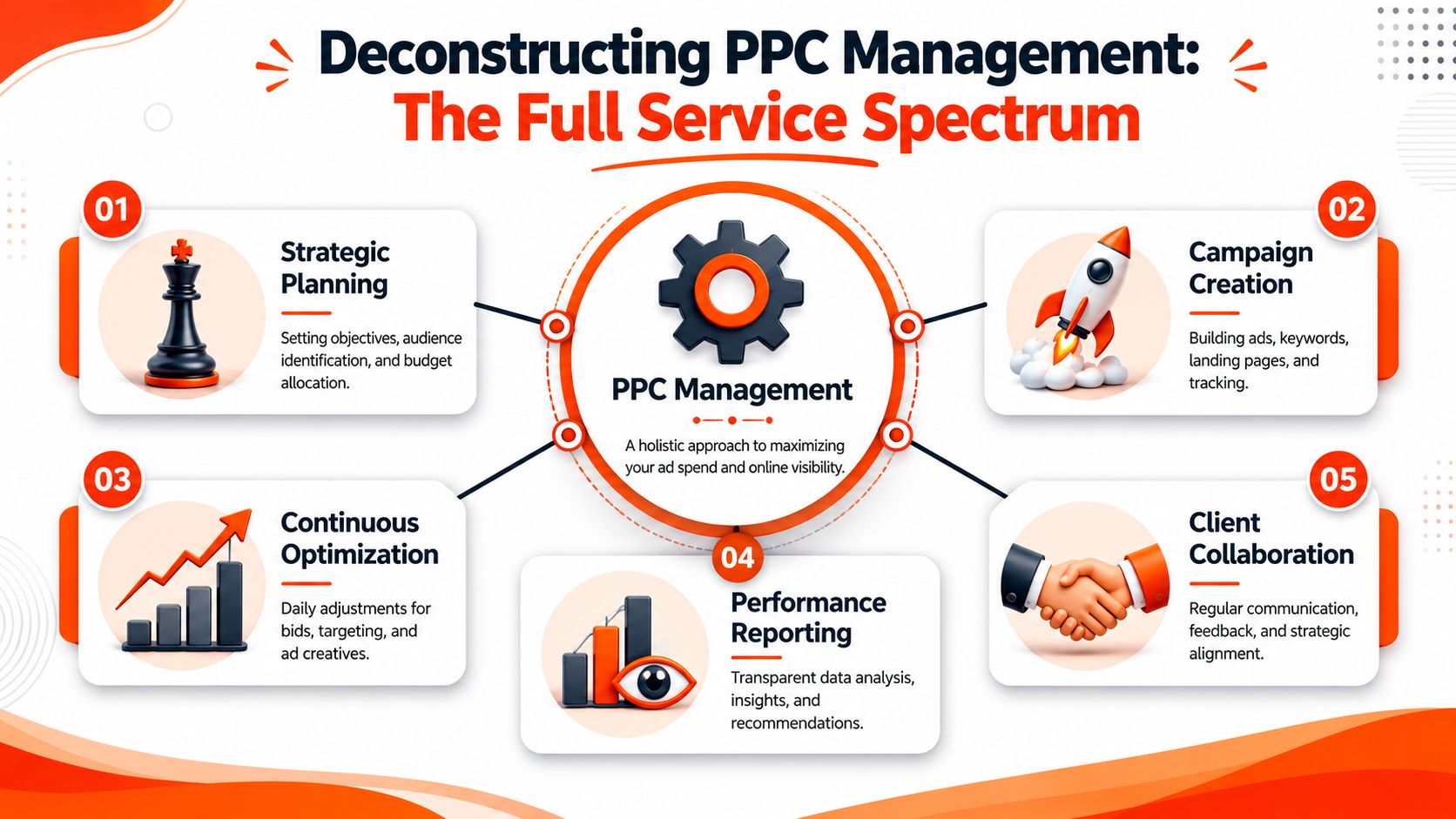
If the account structure is loose, the search terms drift. If the search terms drift, ad relevance drops. If relevance drops, click-through rate usually softens. Then the landing page has to work harder, costs rise, and the campaign starts relying on bid increases to stay visible. That's why strong PPC management doesn't begin with bids. It begins with structure.
The work behind the ads
A proper PPC program usually includes:
- Commercial keyword research that separates buying intent from browsing intent. A local emergency service business needs a very different keyword mix from a business selling considered, high-ticket products.
- Campaign architecture that keeps intent groups separate instead of lumping everything into one campaign. Such a strategy often initiates significant wasted spend.
- Ad copywriting built around the actual query, not generic brand language.
- Landing page alignment so the promise in the ad matches what the visitor sees after the click.
- Bid and budget control based on performance signals, not gut feel.
- Search term review and exclusions to stop irrelevant traffic from leaking budget.
- Conversion tracking and reporting that tells you which actions matter, not just how many clicks came through.
Practical rule: If your agency talks more about impressions and less about search intent, tracking quality, and landing-page alignment, they're probably managing the platform, not your commercial outcome.
Why Quality Score matters more than most owners realise
In Australia, auction performance in Google Ads is shaped heavily by Quality Score and ad rank. That means expected CTR, ad relevance, and landing-page experience all influence how efficiently you can buy traffic, according to Google Ads guidance discussed in this Perth PPC overview.
That point matters because many underperforming accounts try to solve weak results by raising bids. Sometimes you do need to bid more aggressively. But if the account is messy, higher bids just pay more for the same inefficiency.
What works better is tighter alignment:
What good management usually looks like in practice
-
One clear intent per ad group or tightly related cluster
This keeps the ad message specific. -
Ads written for the query, not for the boardroom
Buyers search with practical language. Your ads should too. -
Landing pages built for one job
A service page trying to rank organically, explain the brand, and convert paid traffic at the same time often does none of those jobs particularly well. -
Ongoing testing with restraint
Constant changes can break learning. Set-and-forget is worse. Good managers know the difference.
A good Perth PPC manager isn't hiding secret tricks. They're doing disciplined work, repeatedly, in the right order.
Choosing Your Arena PPC Platforms for Perth Businesses
A common mistake is choosing a platform because it's popular rather than because it fits how your customers buy. Different channels solve different problems. Search captures demand. Shopping organises products. Social creates demand or nudges warm audiences. LinkedIn can work for B2B, but only when the offer and sales process justify the cost.

Match the platform to the buying moment
Here's the simplest way to think about it.
| Platform | Best fit | Usually a poor fit when |
|---|---|---|
| Google Search | High-intent local services, urgent needs, lead generation | The market doesn't search directly for the service |
| Google Shopping | E-commerce with clear products and pricing | The catalogue is weak or the feed is unmanaged |
| Display and remarketing | Staying visible to previous visitors | You expect cold traffic to convert like branded search |
| Meta Ads | Visual products, offers, local awareness, retargeting | The business relies on immediate high-intent demand only |
| LinkedIn Ads | B2B offers with strong deal value and clear targeting | Margins are thin or the sales process is unclear |
A Joondalup plumber usually needs Google Search first because the demand already exists and speed matters. A Fremantle online retailer often gets stronger traction from Google Shopping supported by remarketing because buyers compare products visually and commercially. A CBD-based B2B firm may use LinkedIn to reach decision-makers, but it still needs a serious offer, not just a contact form and hope.
Separate campaign types or lose control
For Perth-focused campaigns, the practical benchmark is to segment by search intent and use separate budget controls for Search, Shopping, Display, and remarketing, because those campaign types behave differently on both cost and conversion, as outlined in this guide to Perth pay-per-click management.
That separation matters even more in Perth because local search volume can be limited in some categories. If you blend cold prospecting, branded traffic, and remarketing into one budget pool, the easiest conversions often mask the expensive ones. The account looks fine until you try to scale it.
Search should answer demand. Social should shape demand. Remarketing should recover demand you already paid to attract.
A practical allocation mindset
Instead of asking “Which platform is best?”, ask:
- Where is intent strongest? Start there.
- Where does the sale need more persuasion? Add that channel second.
- Where are you already getting traffic that isn't converting yet? That's where remarketing earns its keep.
- What can you measure cleanly enough to optimise? If measurement is weak, keep the setup simple.
Businesses often waste money by launching too many channels at once. A lean, controlled rollout usually beats a busy media mix.
Budgeting for Success PPC Pricing and ROI in Perth
Perth business owners usually ask the right question too late. Not “what does PPC cost?”, but “what exactly am I paying for, and what should that level of spend realistically support?”
The local benchmark is clearer than many agencies make it sound. In Perth, smaller PPC management accounts with 1 to 2 search campaigns are commonly priced at about AUD 400 to 500 per month, while more complex accounts can reach AUD 1,500 to 2,000 per month. E-commerce PPC management often starts from AUD 600 to 700 per month, based on this Perth pricing breakdown from Pitch Black.
Across the broader industry, a survey cited by Reboot Online reports that the average cost for PPC management is between USD 1,001 and USD 3,000 per month, with 21.2% of marketers spending in that range, while 39.33% of companies report average PPC costs of USD 50,000 to USD 500,000 per month as programs scale, according to Reboot Online's PPC statistics. That doesn't mean a Perth SME should spend at that level. It does show how quickly paid media becomes more operational once multiple campaigns, channels, and attribution layers are involved.
What those fees usually reflect
There are three common pricing models:
-
Flat monthly retainer
Good for predictable scope. Less ideal if the account grows far beyond the original workload. -
Percentage of ad spend
Simple, but it can create awkward incentives if spend rises faster than strategy quality. -
Hybrid model
A base management fee plus a variable component. Often the most practical if both complexity and spend are changing.
For a quick reference on how agencies structure this commercially, this guide to PPC pricing models is useful because it breaks down how retainers, spend-based fees, and hybrid arrangements differ.
Typical PPC Management Tiers in Perth (2026)
| Tier | Typical Monthly Fee (AUD) | Best For | Common Inclusions |
|---|---|---|---|
| Starter | 400 to 500 | Small local businesses running 1 to 2 search campaigns | Basic campaign management, keyword refinement, ad updates, reporting |
| Growth | 600 to 700 | E-commerce businesses with a modest catalogue or businesses needing more active optimisation | Shopping or e-commerce management, feed oversight, broader testing, ongoing optimisation |
| Complex | 1,500 to 2,000 | Multi-campaign accounts, broader targeting, or more involved lead generation programs | Multi-campaign structure, deeper optimisation, more detailed reporting, wider platform coordination |
ROI needs a business lens, not a dashboard lens
A cheap management fee can still be expensive if the account attracts poor-fit leads. A higher fee can be justified if the agency improves lead quality, sales qualification, and reporting clarity.
For B2B in particular, don't assess paid traffic only on form fills. Use a commercial framework that links lead quality to the sales pipeline. This B2B conversion rates framework is a helpful reference because it shifts the conversation from “more leads” to “better conversion paths”.
If you only measure clicks, PPC looks noisy. If you measure qualified outcomes, it becomes much easier to judge whether the spend is doing its job.
The Onboarding Roadmap From Kick-off to Live Campaigns
The fastest way to lose trust in a PPC agency is a vague onboarding process. If the first few weeks feel improvised, the campaign usually reflects it later. Strong onboarding should feel organised, practical, and slightly forensic.
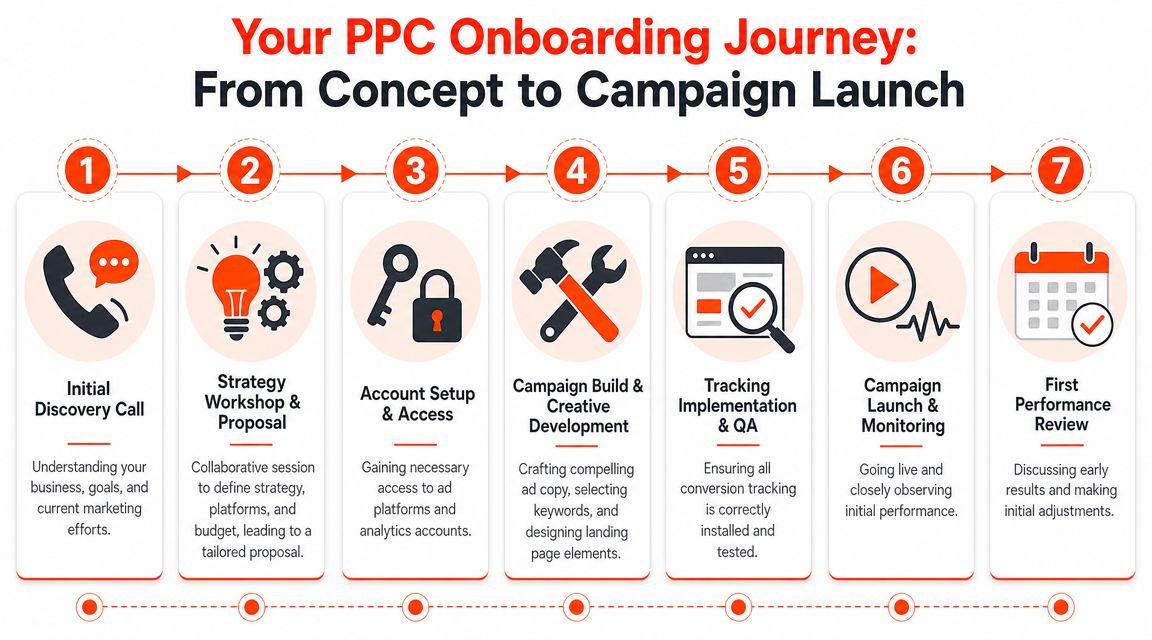
The first conversation shouldn't jump straight to ad ideas. It should clarify commercial priorities. Which services matter most. Which locations matter most. What counts as a qualified lead. Which offers convert well offline. Which enquiries waste staff time. Those answers shape the account more than most businesses expect.
What a clean start looks like
A solid onboarding flow usually follows this order:
-
Discovery and diagnosis
Review existing accounts, analytics, CRM feedback, sales friction, and any past paid media results. -
Strategy and scope confirmation
Decide which platforms come first, what success looks like, and what won't be launched yet. -
Access and asset collection
Google Ads, Analytics, tag management, Merchant Centre if relevant, landing pages, creative assets, and account ownership checks. -
Tracking setup and QA
Many campaigns falter at this stage. If forms, calls, purchases, or key events aren't measured properly, optimisation becomes guesswork.
To see what disciplined campaign planning looks like before launch, a structured Google Ads campaign structure template can help map campaigns, ad groups, intent buckets, and exclusions before anyone spends a dollar.
What happens before launch
Once access and tracking are sorted, the campaign build starts. That usually includes keyword lists, audience definitions, ad copy variants, extensions, budget allocation, device and location settings, and landing-page checks. Then comes QA. Not glamorous, but essential.
The best time to fix conversion tracking is before launch. The second-best time is immediately after discovering it was wrong.
Some businesses find it useful to see the workflow visually before committing resources. This walkthrough adds context:
The first weeks after launch
Launch day isn't the finish line. It's the start of data collection.
Expect active monitoring in the early window. Search terms need review. Bids may need trimming. Ads often need message refinement once real queries start coming through. Landing pages sometimes show friction that wasn't obvious in review. That's normal.
What's not normal is disappearing for a month and calling it optimisation.
Finding Your Match How to Vet a Perth PPC Agency
Most agency vetting advice is too soft to be useful. “Do they provide reports?” isn't a serious filter. Every agency says yes. The true test is whether they understand measurement, commercial trade-offs, and the limits of data in the current Australian environment.
One of the most overlooked issues in PPC management Perth is how agencies handle privacy and attribution. Agencies should be asked how they adapt to consent-based tracking, first-party data, and conversion attribution under the current Australian privacy environment, as discussed in this article on questions to ask before hiring a PPC agency.
Questions that actually reveal competence
Ask these instead:
-
Who owns the ad account and the data?
If the agency owns everything, switching later becomes messy. -
How do you handle missing or partial conversion data?
Good agencies won't pretend tracking is perfect. -
What does reporting include beyond top-level platform metrics?
You want decision-making context, not exported charts. -
How do you separate branded demand from non-branded acquisition?
If they can't answer cleanly, performance can be flattering but misleading. -
What happens in the first month if lead quality is poor?
The answer should include query review, exclusions, landing-page changes, and feedback loops with your sales team.
The privacy question matters now
A lot of agencies still sell PPC as if every click can be tracked neatly from ad to sale. That's not how it works anymore. Consent choices, browser limits, and platform modelling all affect what you see in reporting.
Ask an agency how it measures performance when tracking is constrained. The quality of that answer tells you more than a polished case study.
That doesn't mean PPC stops working. It means agencies need stronger operating discipline. First-party data matters more. CRM feedback matters more. Offline conversion imports can matter more. Sales teams need to tag lead quality properly. The business has to participate.
If you're comparing providers, reviewing a specialist Google PPC company can also help you benchmark what a focused paid media service should cover in terms of platform scope, management approach, and transparency.
Commercial fit matters too
The agency can be technically capable and still wrong for you.
A local service business may need fast communication, straightforward lead reporting, and tight suburb targeting. An e-commerce brand may need feed work, shopping strategy, and margin-aware optimisation. A B2B team may need lead scoring and long sales-cycle reporting. If the agency's process doesn't match your business model, capability alone won't save the relationship.
Success Stories What PPC Delivers for Local Businesses
Most “success story” sections are packed with inflated numbers, selective screenshots, and no explanation of what changed. That isn't useful. The better way to think about results is by looking at the before-and-after conditions that make campaigns work.
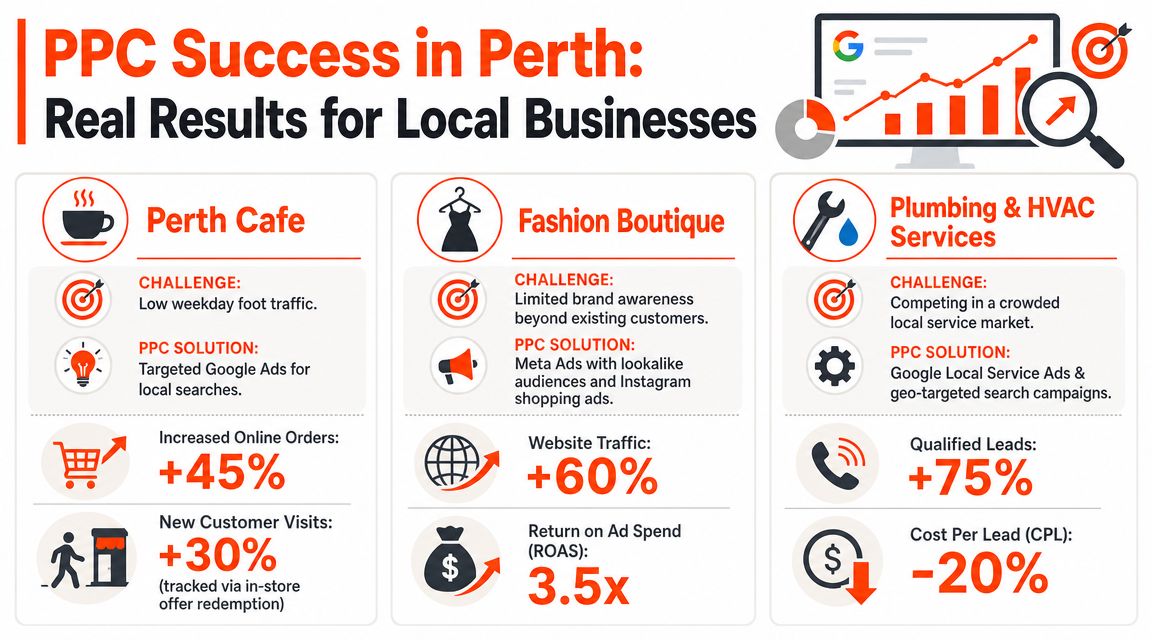
The infographic above presents example outcomes, but the more useful takeaway is the pattern behind them. Strong PPC performance usually comes from correcting mismatches between intent, message, landing page, and measurement.
Scenario one local trade services
A Rockingham trade business often starts with a common problem. Broad keywords, mixed service types in one campaign, and ads that talk about the company instead of the urgent problem the customer wants solved.
The fix is usually operational, not magical. Break urgent services away from general services. Tighten location targeting. Remove low-intent searches. Rewrite ads around immediate action. Send traffic to pages built for booking, not browsing. Add call tracking and proper lead classification.
What changes after that is often less noise, fewer irrelevant enquiries, and a clearer picture of which services deserve budget.
Scenario two e-commerce in Perth and beyond
A Fremantle or Margaret River retailer tends to face a different issue. The account might generate traffic, but product visibility is inconsistent and remarketing is either missing or too broad. Shopping campaigns can underperform when the product feed is weak, categories are too blended, or top sellers aren't given enough control.
In that case, the turnaround usually comes from:
- Feed quality improvements that make products easier for the platform to understand
- Product segmentation so higher-value lines don't get buried
- Search and Shopping separation to stop campaigns cannibalising each other
- Remarketing audiences that reflect actual product interest rather than every site visitor being treated the same
The result businesses care about isn't “more traffic”. It's more profitable traffic.
Scenario three B2B lead generation
A Perth B2B company often has the opposite problem to e-commerce. The clicks may be expensive, but the bigger issue is weak qualification. Broad messaging brings in interest. Sales teams then discover the enquiry is too small, too early, or not a fit.
That's where channel choice and conversion design matter. Search can capture active buyers. LinkedIn can support account targeting. But both need stronger filters. Better forms. Better offer framing. Better landing pages. Better handoff to sales.
Good PPC doesn't just generate leads. It helps sort serious buyers from casual interest earlier in the funnel.
Across all three scenarios, the core lesson is the same. PPC works best when the account is built around commercial clarity, not platform activity. That's what business owners in Perth should be looking for when they assess campaign performance.
Your Next Steps Towards Predictable Growth
A lot of businesses delay PPC because they think the main risk is spending money too quickly. Usually, the bigger risk is slower. It's staying in a cycle where demand already exists, competitors keep showing up for it, and your business remains hard to find at the exact moment a buyer is ready.
The answer isn't to rush into ads. It's to stop treating PPC like a black box.
If you're considering PPC management in Perth, focus on a short list of fundamentals. Can the agency explain campaign structure in plain English? Can it justify platform choice by business model? Can it show how tracking will work when data is incomplete? Can it separate useful signals from vanity metrics? Can it tell you what happens in the first few weeks after launch?
That's the standard.
You don't need a sprawling account to start. Many Perth businesses are better served by a narrow launch with clean tracking, one or two high-intent campaigns, and a disciplined review cycle. Expand after the fundamentals are stable. Not before.
The businesses that get the most from PPC usually do one thing differently. They stop asking whether ads “work” in general and start asking whether the system behind the ads is commercially sound. That's the right question, because campaigns rarely fail for one dramatic reason. They fail through small structural mistakes, weak measurement, and vague decision-making repeated over time.
If you're ready to move, start with an audit. Review the account structure, the tracking setup, the search term quality, the landing pages, and the reporting logic. Once those are clear, the next decision becomes much easier.
If you want a practical second opinion, Click Click Bang Bang offers PPC management across Google, Meta, and LinkedIn, with tracking setup, structured onboarding, and transparent reporting. A useful next step is a strategy conversation focused on your current account, your measurement gaps, and whether a tighter PPC setup would improve lead quality or sales efficiency for your business.
Read NeXt
Or Read Our Latest
- How to Set Up Google Ads in Australia: Complete 2026 Guide
- Google Merchant Center Setup: The Complete 2026 Guide
- Business Manager Setup Facebook: The Complete 2026 Guide
- Google Ads Account Setup: Expert Guide for 2026
- Search Ads Optimisation: A Practical Guide for 2026
- Manual vs Automated Bidding for PPC Success
Click. CLick. Subscribe.
Get our best PPC insights, industry updates, and power moves delivered straight to your inbox. No fluff, just high-caliber strategies that actually work.
Don’t Leave Just Yet
Try Us For 30-Days,
Risk Free!!
We guarantee that you’ll love our work within the first 30 days, if not you’ll get your money back.
What have you got to lose?