

The Process of Consumer Decision Making PPC Guide
Last Updated

The process of consumer decision making is the five-stage journey every one of your customers goes on before, during, and after they buy something. It kicks off the moment they realise they have a problem and carries them through researching, comparing, buying, and finally, thinking about their purchase.
For us advertisers, this journey isn't just theory—it's a map. Understanding it is the key to influencing choices at just the right time.
Mapping The Modern Consumer Journey
Before you even think about launching a PPC campaign, you need to get inside your customer's head. The consumer decision-making process is a practical roadmap that shows you when, where, and how to connect with your audience.
Think of it like planning a trip. A traveller doesn’t just materialise in Bali. First, they feel the itch to get away. Then they research destinations, compare flights and hotels, book the ticket, and later, reflect on how great (or not-so-great) the holiday was. Your customers follow a very similar path.
Of course, this journey is rarely a straight line anymore. Today’s buyers weave between search engines, social media feeds, and review sites, making it messy but full of opportunities. This is where an omnichannel retail strategy becomes crucial, helping you create a smooth and consistent experience no matter where they are.
The visual below breaks down the five core stages of this journey, from that first spark of a need all the way to creating a loyal, repeat customer.
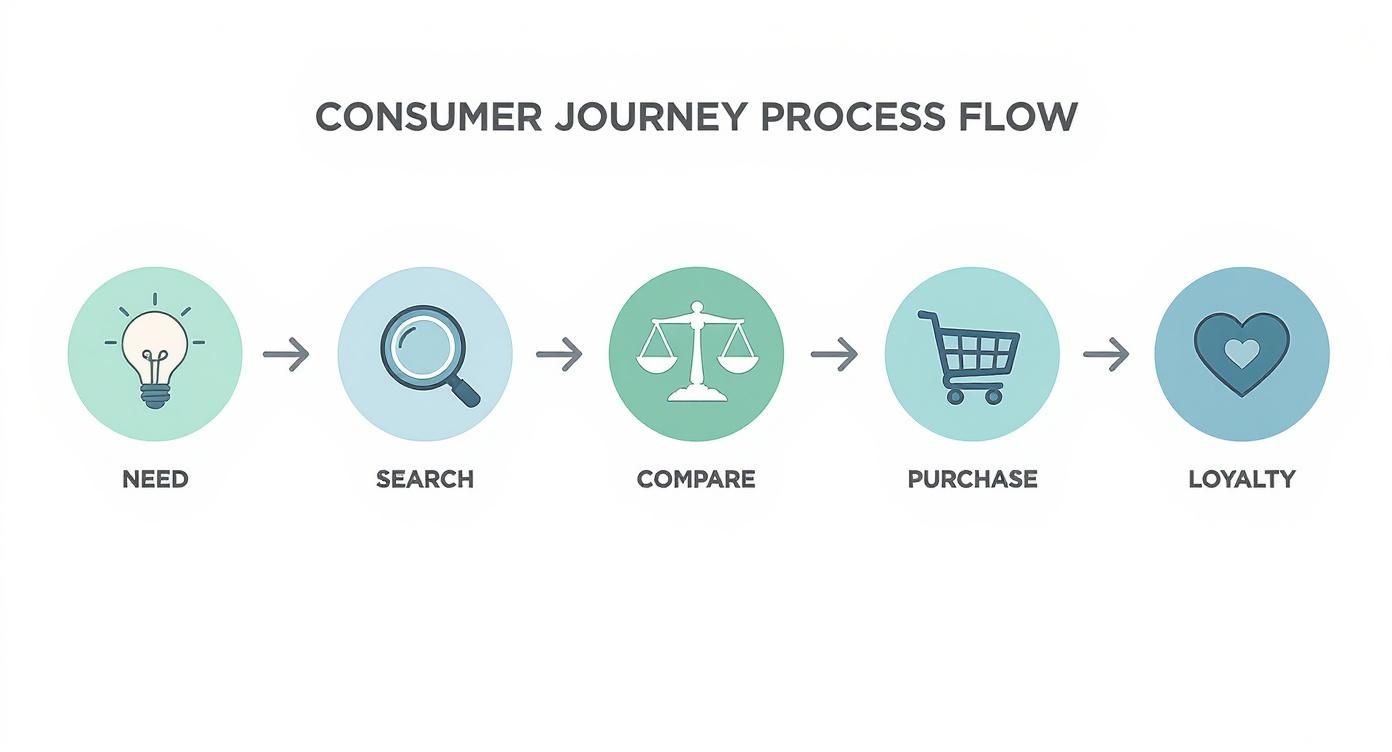
This flowchart neatly shows how a consumer moves from a vague problem to a specific solution. Each of these steps is a distinct chance for advertisers to step in and guide the way.
The Five Core Stages Explained
This framework is the foundation of all successful PPC advertising. Each phase reflects a different consumer mindset, which means each one needs a different marketing approach.
Here’s a quick overview of the consumer decision-making stages and how you should think about them from a PPC perspective.
| The 5 Stages of Consumer Decision Making at a Glance |
| :— | :— | :— |
| Stage | Consumer Mindset | PPC Goal |
| Problem Recognition | "I have a need or a problem." | Build awareness. |
| Information Search | "What are my options?" | Be the helpful answer. |
| Evaluation of Alternatives | "Which option is best for me?" | Showcase your unique value. |
| Purchase Decision | "I'm ready to buy this one." | Make it easy to convert. |
| Post-Purchase Behaviour | "Did I make the right choice?" | Foster loyalty and get reviews. |
Understanding this flow allows you to create PPC campaigns that meet buyers at the perfect moment with the perfect message.
It’s also important to remember this journey isn’t static; it’s influenced by real-world factors. For example, recent economic shifts have had a huge impact. A recent report found that 72% of Australian shoppers now prefer store-brand products due to rising inflation, a clear sign that many are prioritising value over brand loyalty right now. That kind of insight is gold when you're crafting your ad copy and offers.
Capturing Attention in Problem Recognition and Search
Every customer journey starts with a single spark: the moment someone realises they have a problem to solve or a new desire to fulfil. This is the problem recognition stage.
It’s not always some life-altering event. It can be as simple as a pair of running shoes finally giving out, the sudden panic of needing a last-minute gift, or seeing a post from an influencer about a must-have gadget. These are the small, everyday moments that kick off the entire consumer decision-making process.
Once that need surfaces, the next step is almost automatic. They move straight into the information search phase, turning to their most trusted tool: the search bar. Right now, they aren't looking for your brand specifically. They're exploring with broad, question-based searches like "best running shoes for flat feet" or "quick gift ideas for mum".
For PPC advertisers, these first two stages are a golden opportunity to make a great first impression. The goal isn't to shove a sale down their throat but to be the most helpful, visible answer to their initial questions.
Targeting Early-Stage Curiosity with PPC
At this point, your PPC strategy needs to be all about awareness and education. You want to show up right where your potential customers are looking for answers. This requires a different mindset than the hard-sell, bottom-of-funnel campaigns you might be used to.
Here are a few effective tactics for this phase:
- Broad-Match Keywords: Use broader keywords to catch those initial, exploratory searches. Instead of bidding on "buy Nike Air Zoom Pegasus," you’d target terms like "comfortable daily running shoes" to attract people who are still figuring out what they want. To really nail this, you should check out our guide on effective Google Ads keyword research.
- Problem-Solving Ad Copy: Your ads need to speak directly to the customer's pain point. A headline like "Tired of Foot Pain After a Run? Find Your Perfect Fit" will connect far better than a generic product ad ever could.
- Display Advertising: Run display ads on relevant blogs, forums, and websites in your industry. This builds brand familiarity, so when people start narrowing down their choices, your name is already one they know and trust.
Key Takeaway: The goal in these early stages isn't to shout "buy now!" but to whisper, "I can help with that." By offering value and answers upfront, you position your brand as the expert guide for the rest of their journey.
This is especially critical when targeting specific demographics. Take young Australian consumers, for example. They face unique economic pressures that heavily influence their buying habits. A recent Boston Consulting Group report found that about 25% of Australian consumers are 'younger pessimists' who are severely impacted by inflation. With 95% of this group worried about their finances, your initial messaging has to be sensitive to cost-of-living concerns just to get on their radar.
By understanding these initial triggers and tailoring your PPC campaigns to address them, you insert your brand into the conversation at the most crucial time—the very beginning. You become a helpful resource, not just another advertiser, building a solid foundation for a purchase down the track.
Influencing the Evaluation of Alternatives
Alright, so your potential customer has done their initial homework. They’ve moved past the broad, open-ended questions and have now entered what is arguably the most critical part of the process of consumer decision making: the evaluation of alternatives.
At this stage, they've got a shortlist. They're actively comparing a handful of options, weighing up the pros and cons to figure out what’s the absolute best fit for them.
Think of it like being in the final round of a job interview. The customer is the hiring manager, and your product is one of the top candidates. They're scrutinising every little detail—price, features, shipping costs, brand reputation—to see which one offers the most compelling package. This is exactly where a sharp PPC strategy can tip the scales in your favour.
Your mission here is simple: make your offering the clear, obvious choice. You need to interrupt their comparison with messaging that hammers home your unique value and dismantles any hesitations they might have.
Making Your Brand the Obvious Choice
During this phase, consumers are incredibly receptive to ads that help them make a confident decision. They’re hunting for proof, reassurance, and clear differentiators. Your PPC campaigns need to deliver exactly that, focusing on direct comparisons and your unique selling points (USPs).
Here are a few powerful tactics for this stage:
- Competitor Campaigns: Go ahead and bid on your competitors' brand names. When someone searches for a rival, hit them with an ad headline like, "Considering Brand X? See How We Compare." Then, send them to a landing page that offers a fair, side-by-side comparison.
- USP-Driven Headlines: Your unique value needs to be front and centre. Highlight what sets you apart directly in your ad copy. Think "Free Next-Day Delivery," "24/7 Aussie Support," or "Hassle-Free Returns."
- Showcase Social Proof: Use ad extensions to display your seller ratings and glowing reviews. That third-party validation is incredibly persuasive when a buyer is on the fence, weighing up their options.
To make these tactics really sing, your messaging has to be sharp and compelling. For a deeper dive into crafting ads that get the job done, check out our comprehensive guide on ad copy best practices.
To help you decide which ad types to deploy, here's a quick breakdown of how different tactics align with the goals of this stage.
PPC Tactics for the Evaluation Stage
| Ad Tactic | Primary Goal | Best Use Case |
|---|---|---|
| Competitor Bidding | Intercept competitor research & highlight your advantages. | When a competitor has high brand recognition and you have clear points of difference (price, features, service). |
| Shopping Ads with Ratings | Build trust and provide immediate social proof in SERPs. | For e-commerce brands where product ratings and price are key decision factors. |
| Remarketing Ads | Re-engage undecided visitors who have shown interest. | When you have a longer sales cycle or when users are likely to compare multiple sites before buying. |
| USP-Focused Search Ads | Make your unique value proposition impossible to ignore. | For any business in a crowded market where differentiators like free shipping, warranty, or support matter. |
Using a mix of these tactics ensures you're covering all your bases, from capturing competitor traffic to reminding previous visitors why you're the best choice.
Re-Engaging Undecided Shoppers
It's completely normal for potential customers to visit your site, browse around, and then leave to continue their research elsewhere. But this is also a crucial moment to act. Remarketing is your most powerful tool for bringing those indecisive visitors back into the fold.
A well-timed remarketing ad can be the gentle nudge a consumer needs to choose your brand. By showing them ads that reinforce your key benefits or offer a small incentive, you stay top-of-mind while they finalise their decision.
This is your chance to get in front of them with specific, benefit-led ads across the Google Display Network or on social media. Remind them of the exact product they looked at and highlight a key feature they might have missed.
Doing this effectively keeps your brand in the running until they’re ready to pull the trigger. By proactively addressing their comparisons and re-engaging them, you position your brand as the most attentive and valuable choice out there.
4. Securing the Purchase Decision
After all that searching and comparing, your customer has finally reached the tipping point. They’ve picked a winner and they’re ready to pull out their wallet. This is the fourth and arguably most crucial stage: the purchase decision. It’s the moment of truth where all your hard work either pays off or falls flat.
This is where a potential sale is at its most fragile. The slightest bit of friction—an unexpected shipping cost, a clunky checkout form, or a missing payment option—can send a would-be customer running for the hills. At this point, your PPC campaigns need to stop persuading and start facilitating. It's all about making that final step as smooth and reassuring as possible.
Eliminating Last-Minute Friction
Your primary goal now is to bulldoze every obstacle standing between the customer and the "Complete Order" button. Think of your checkout process as the final lap of a race; you don't want your runner tripping over a stray hurdle right before the finish line.
To build that crucial last-minute confidence, your PPC strategy should zero in on clarity and trust.
- Transparent Google Shopping Ads: Make sure your Shopping ads show the full, final price, including taxes where you can. Surprises are the enemy of conversions.
- Trust-Building Ad Extensions: Use ad extensions to flash your seller ratings, secure payment icons, and clear return policies. These small signals provide powerful reassurance when it matters most.
- Remarketing for Cart Abandonment: Go after users who added items to their cart but didn’t follow through. Hit them with a remarketing ad featuring a time-sensitive offer like "Complete your order now for 10% off" to create a bit of urgency and pull them back over the line.
By making the final step effortless and secure, you confirm to the buyer that they're making the right choice. Your ads should scream reliability and ease, removing any final shred of doubt that could lead to hesitation.
Adapting to Modern Payment Behaviours
Another huge factor shaping the purchase decision today is payment flexibility. The explosion of Buy-Now-Pay-Later (BNPL) services has fundamentally changed how many people, particularly younger Aussies, approach bigger purchases. Ticking this box isn't just a convenience; it's a strategic move.
The adoption of these services highlights a major shift in how we manage our money. Research from the Reserve Bank of Australia shows that consumers now hold an average of 0.7 BNPL accounts each, with this figure jumping to nearly one full account per person for those aged 18 to 39. You can read the full analysis on Australian consumer payment behaviour to dig deeper into the trends.
This data confirms that offering flexible payment solutions can be a massive conversion driver. Simply mentioning options like Afterpay or Zip directly in your ad copy can lower the perceived financial barrier, encouraging shoppers who might otherwise wait to act now. By lining up your checkout experience with modern expectations, you make the final "yes" that much easier for your customers.
Driving Loyalty with Post-Purchase Engagement
So you’ve made the sale. Great job. But the process of consumer decision making doesn't just stop when the credit card is swiped. In fact, a new, critical phase is just beginning: post-purchase behaviour. This is the moment that decides whether you've landed a one-time buyer or a loyal advocate for your brand.
It's a delicate time, often tinged with a little bit of anxiety known as 'buyer's remorse'. Did they make the right call? Was it really worth the money? Your job now is to jump in, quiet those doubts, and prove they made an excellent choice.
From a PPC advertiser's perspective, this is your golden ticket to maximising customer lifetime value. The initial conversion is just the first chapter; the real profit is in the sequels—repeat business and glowing recommendations.
A clever post-purchase strategy can transform a single transaction into a long-term relationship. This creates a powerful cycle of repeat purchases and the kind of social proof that fuels your entire marketing funnel.
Turning Customers into Brand Advocates
After the initial sale, your PPC focus needs to pivot from acquisition to retention and growth. Using the data from that first purchase, you can build hyper-relevant campaigns that not only bring customers back but also generate powerful marketing assets for the future.
Here are three effective PPC tactics for the post-purchase phase:
- Upsell with Remarketing Lists: Don't just lump all past buyers together. Create specific audience lists for customers who bought a particular product. For example, if someone just bought a new coffee machine, hit them with ads for premium coffee beans or cleaning accessories a few weeks later. It shows you understand their needs beyond the initial sale.
- Run Exclusive Loyalty Campaigns: Make your existing customers feel special. Use customer match lists to run search or social campaigns with copy like, "A Special Thank You for Our Customers" or "Early Access Just for You." This makes them feel valued and part of an exclusive club, which is a powerful driver of loyalty.
- Prompt Strategically for Reviews: Once a customer has had enough time to actually use and enjoy their product, use a low-cost display or social ad to gently ask for a review. A simple ad that says, "Loving Your New Gadget? Share Your Thoughts!" can be incredibly effective at building the social proof needed to persuade the next wave of buyers still stuck in the evaluation stage.
The most powerful marketing doesn't come from your ads; it comes from your happy customers. A thoughtful post-purchase PPC strategy is the engine that creates those advocates, turning their satisfaction into your most persuasive asset.
By nurturing the relationship after the transaction, you don't just reduce buyer's remorse—you actively build a community of loyal fans. These are the customers who are far more likely to buy again, spend more over time, and recommend you to others, making your post-purchase engagement one of the most profitable parts of your entire PPC strategy.
Building Your Full-Funnel PPC Strategy
Knowing the five stages of the consumer journey is one thing. Actually using them is another. The real magic happens when you weave them all together into a cohesive, full-funnel strategy that guides customers smoothly from their first inkling of a problem to the final purchase and beyond.
This integrated approach means you’re not just popping up at random moments. Instead, you become a consistent, helpful presence throughout their entire journey.
A winning strategy maps specific PPC campaign types to each phase. This isn't a one-size-fits-all game; you need the right tool for the right job. Think of broad Display and Video campaigns as your friendly handshake during problem recognition, while hyper-targeted Search and Shopping ads are your closing argument to seal the deal.
Mapping Campaigns to Consumer Stages
To make this practical, let's look at how different ad platforms serve each stage:
- Top Funnel (Awareness): Use YouTube and Display ads to get your brand in front of a wide audience before they're even actively searching. The goal here is simple: familiarity.
- Mid Funnel (Consideration): Now it's time to roll out non-branded search campaigns and remarketing. You're aiming to capture people as they start seriously evaluating their options. Your goal is to be the best answer to their questions.
- Bottom Funnel (Conversion): This is where you bring out the heavy hitters. Focus on branded search, Google Shopping, and targeted remarketing with sharp, specific offers to close the deal. The goal is a frictionless purchase.
This structured approach stops you from wasting ad spend and makes sure your message always aligns with where the customer is mentally. To go even deeper on this, check out this a comprehensive guide to a full-funnel marketing strategy.
The key is to see the journey as a continuous conversation. Each campaign should hand the user off to the next stage smoothly, building trust and momentum along the way.
Ultimately, building a full-funnel strategy means you have to measure success beyond just the last click. That top-of-funnel video view might not convert right away, but it primes the audience for a search they'll make two weeks later.
This holistic view is fundamental to effective PPC ad management. It forces you to attribute value across the entire decision-making process, which leads to much smarter budget allocation and, ultimately, sustainable growth.
Wrapping Up: Your Top Questions Answered
How Has Digital Marketing Changed This Process?
The internet has thrown a massive spanner in the works for the old, neat, step-by-step model. It's really supercharged the ‘Information Search’ and ‘Evaluation of Alternatives’ stages.
Think about it: consumers can now pull out their phones and get instant access to reviews, social proof, and price comparisons from anywhere. This makes the process of consumer decision making a lot messier and less linear. Marketers now need to show up and be convincing across a whole heap of digital touchpoints, not just one.
Which Stage Is Most Important for PPC Advertisers?
Look, a full-funnel strategy is always the dream, but if you're looking for the biggest immediate bang for your buck, the ‘Evaluation of Alternatives’ and ‘Purchase Decision’ stages are where it's at. At this point, buyer intent is absolutely peaking.
But there's a catch. If you only focus on the bottom of the funnel and ignore the initial awareness stages, you'll eventually find your pool of potential customers drying up. This seriously caps your long-term growth potential.
Does This Model Apply to B2B Marketing?
Absolutely. The core stages are fundamentally the same, but the B2B journey has its own unique flavour. It’s typically much longer, involves a whole committee of decision-makers, and is driven more by cold, hard logic and ROI than by emotion.
For B2B PPC, this means your tactics need to adapt. The information search might involve targeting keywords for whitepapers and case studies. The evaluation stage? That’s all about detailed comparison landing pages and demo requests. Understanding these nuances helps you tailor your campaigns for a more professional audience that responds to value, not just flashy ads.
Ready to build a PPC strategy that meets your customers at every single stage of their journey? Click Click Bang Bang specialises in creating precision-driven campaigns that get results. Explore our PPC management services today.
Read NeXt
Or Read Our Latest
- Display Advertising on Google: The Complete Australian Guide
- Stakeholder Communication Plan How to Build One That Works
- User Generated Content Strategies That Actually Convert
- Copyright and Infringement Guide for Business Marketers 2026
- What Is Brand Positioning and Why It Drives Growth
- Push vs Pull Marketing: A 2026 Decision Guide
Click. CLick. Subscribe.
Get our best PPC insights, industry updates, and power moves delivered straight to your inbox. No fluff, just high-caliber strategies that actually work.
Don’t Leave Just Yet
Try Us For 30-Days,
Risk Free!!
We guarantee that you’ll love our work within the first 30 days, if not you’ll get your money back.
What have you got to lose?