

Shopify SEO: seo services for shopify that boost traffic and sales
Last Updated
Struggling to get your Shopify store noticed? You’re not alone. The platform is fantastic for selling, but its unique structure means standard SEO tactics often just don’t cut it, leaving your products buried on page ten of Google. This is where specialised SEO services for Shopify come in—they're built from the ground up to handle Shopify's quirks, turning your store into a magnet for high-intent traffic.
Why Generic SEO Fails on Shopify
Picture your Shopify store as a high-performance race car. It’s powerful, sleek, and designed for one thing: winning sales. Now, would you take it to a general mechanic for a track-day tune-up? Not a chance. You’d want a specialised pit crew that knows every nut and bolt of that specific machine. That’s the perfect way to think about Shopify SEO.
Generic SEO strategies tend to treat every website the same, applying a one-size-fits-all approach that completely misses the mark for e-commerce. They might chase broad keywords or create content that gets clicks but doesn’t attract anyone with their wallet out. That's where the whole thing falls apart.
A standard SEO approach might get you traffic, but a specialised Shopify strategy gets you customers. The goal isn't just to rank; it's to sell.
The Shopify Difference
Shopify plays by its own rules with a unique technical architecture. A general SEO practitioner might not have a clue how to fix common, platform-specific issues that can tank your rankings. These aren’t minor details; they’re potential deal-breakers.
- Duplicate Content: Shopify’s system automatically creates multiple URLs for the same product when it appears in different collections. Without the right fix, this creates a mess that confuses search engines and splits your ranking power.
- Restricted Code Access: Unlike a platform like WordPress, you can't just dive in and edit core files. Experts know how to work within Shopify’s Liquid templating language to make the optimisations that matter, without breaking your site.
- App Overload: The wrong apps can slow your store to a crawl—and site speed is a massive ranking factor. A specialist knows which apps genuinely boost SEO and which ones are just dead weight.
A Market Built for Specialists
The need for an expert is especially clear in a competitive market like Australia. As of 2025, Shopify powers a staggering 154,625 active stores down under, making it the third-largest Shopify market in the world. This growth is driven by Australia's massive shift to online shopping, where more than half—53%—of all trackable website traffic comes from organic search. These figures make one thing crystal clear: if you want to stand out and drive sales, you can't afford to guess with your SEO. You can read the full research about Shopify statistics to get a feel for the competitive landscape.
This guide will break down the essential services that transform a Shopify store from an invisible player into a market leader. We'll get into the blend of technical precision, smart content, and deep platform knowledge required to win. You'll learn exactly what services drive sales, how to vet an agency properly, and what to expect from a partnership that delivers real, measurable results for your bottom line.
The Core Components of Shopify SEO Services
So, what are you actually paying for when you bring in a Shopify SEO specialist? It’s not some magic button or a one-off trick. It's a coordinated effort across several key areas of your store, all working together to make you more appealing to Google and, more importantly, to your customers.
Think of it as a complete performance overhaul for your online business. We're tuning the engine (technical SEO), designing irresistible product displays (on-page SEO), creating compelling reasons for people to visit (content), and building highways directly to your digital doorstep (link building). Each piece is crucial for driving real, sustainable growth.
This diagram shows how these specialised services create a direct path from being discovered in a search to ringing up sales on your Shopify store.
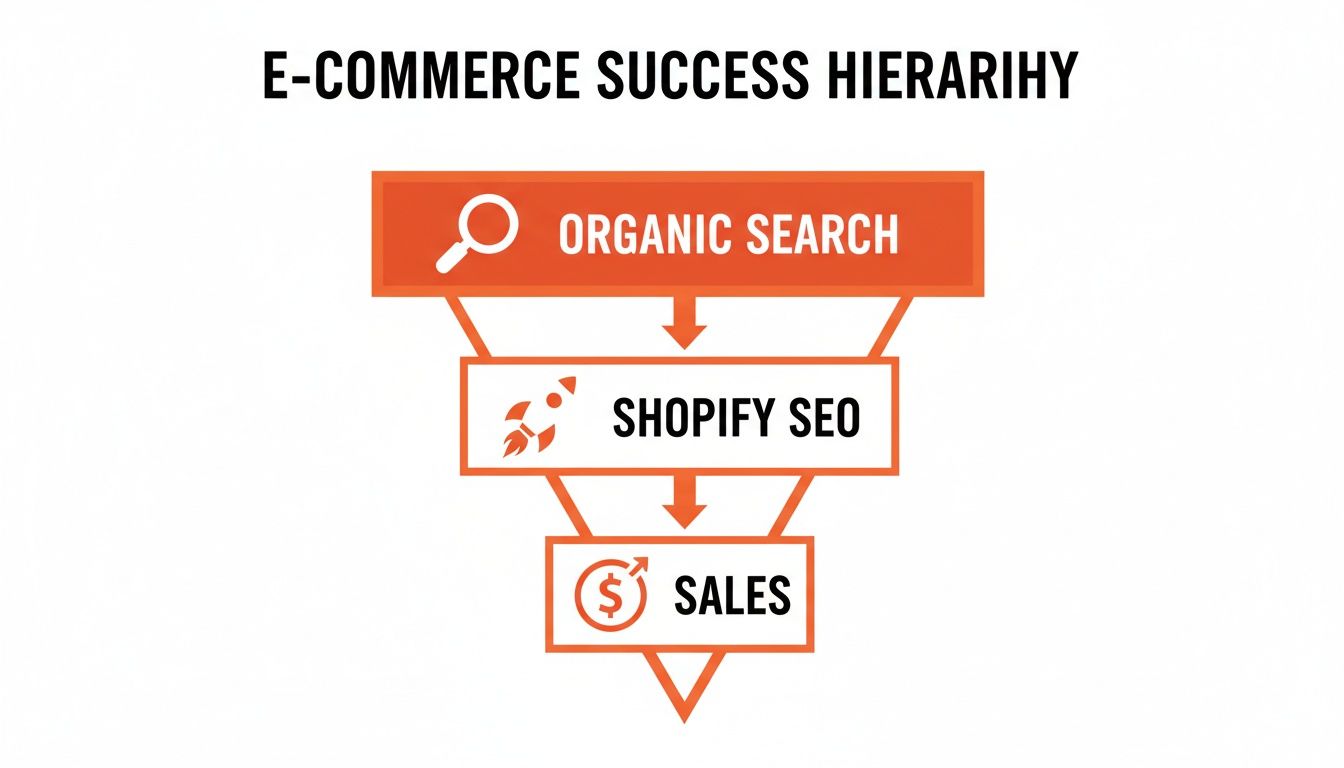
As you can see, strategic Shopify SEO is the bridge that turns the massive potential of organic search traffic into actual revenue for your business.
Let's break down exactly what that involves.
Shopify SEO Services Breakdown
Here’s a quick rundown of the key service areas that make up a comprehensive Shopify SEO strategy. Each one tackles a different part of the puzzle, but they all lead to the same goal: more organic traffic and sales.
| Service Area | What It Involves | Primary Benefit for Your Store |
|---|---|---|
| Technical SEO | Fixing site speed, mobile-friendliness, crawl errors, and duplicate content issues. It’s all the behind-the-scenes work. | Ensures Google can easily find, understand, and rank your pages, creating a solid foundation for all other SEO efforts. |
| On-Page & Schema SEO | Optimising product/collection pages, writing compelling meta titles and descriptions, and implementing schema markup. | Boosts visibility in search results with eye-catching rich snippets (like ratings and prices) and turns more clicks into sales. |
| Content Strategy | Creating useful buying guides, comparison articles, and how-to posts that answer your customers' questions. | Attracts qualified buyers who are actively researching solutions, building trust and establishing your brand as an authority. |
| Link Building | Earning high-quality backlinks from relevant blogs, review sites, and online publications in your industry. | Increases your store's domain authority, signalling to Google that you are a trustworthy source worthy of higher rankings. |
Each of these components is a discipline in itself, requiring specialised expertise to get right, especially within the unique environment of the Shopify platform. Let’s look at them a bit closer.
Technical SEO: The Foundation of Visibility
Before you can wow customers, you have to get past Google’s bouncers. Technical SEO is all the crucial, under-the-hood work that ensures search engines can find, crawl, and understand your store without hitting any roadblocks. It’s like checking the engine, brakes, and steering on a race car before the big event.
If your site is slow, broken on mobile, or a confusing mess for Google’s crawlers, it doesn't matter how great your products are. A good agency will dive deep into your store’s code and structure to get these fundamentals right.
Key technical tasks usually include:
- Improving Site Speed: Compressing images, cleaning up code, and wrangling app scripts to make pages load almost instantly. A one-second delay can tank your conversion rate.
- Mobile-First Optimisation: Making sure your store offers a flawless shopping experience on smartphones, which is where most of your customers are browsing.
- Fixing Crawl Errors: Hunting down and resolving issues like broken links (404 errors) and redirect loops that stop search engines from properly indexing your site.
- Managing Duplicate Content: Using canonical tags to tell Google which version of a product page is the "master copy" to rank. This is a common and particularly damaging issue on Shopify.
On-Page SEO for Products and Collections
With a solid technical base, the focus shifts to what your customers actually see: your product and collection pages. This is where you convince both search engines and shoppers that you have exactly what they need. It’s the digital equivalent of crafting a perfect retail display.
On-page SEO isn't just stuffing in keywords; it's about providing context. It’s about creating a clear, compelling, and user-friendly page that completely answers a searcher's needs, turning a casual click into a confident purchase.
A specialist service will optimise every critical element, from punchy titles that grab attention in search results to product descriptions that answer questions before they're even asked. This also includes implementing schema markup—a type of code that helps Google understand your page content better. The reward? Eye-catching "rich snippets" like star ratings and pricing, right there in the search results.
Content Strategy: The Fuel for Growth
Content is the engine that drives your customer acquisition. A smart content strategy goes way beyond just having a blog; it’s about creating genuinely helpful resources that attract potential buyers at every stage of their journey, from early-stage research to the final purchase decision.
For an e-commerce store, this is your chance to shine. Think about creating:
- Buying Guides: Help customers figure out which of your products is the right fit for them.
- Comparison Articles: Show how your product stacks up against the competition, highlighting its unique value.
- How-To Posts: Demonstrate creative or effective ways to use your products.
This approach does more than just attract traffic. It builds trust, positions your brand as an expert, and draws in people who are actively looking for the solutions your products provide.
Link Building: The Authority Signal
Finally, there’s link building. This is the process of earning "backlinks"—links from other reputable websites back to your store. In Google's world, every high-quality backlink acts as a vote of confidence, signalling that your store is a trustworthy and authoritative player in your niche.
Think of it like building a network of highways that all lead directly to your online store. The more high-quality roads pointing your way, the more Google trusts your site and the easier it becomes for new customers to find you. Professional SEO services for Shopify focus on earning natural, relevant links from industry blogs, product review sites, and online magazines, steadily building your store's authority and search rankings over time.
Optimising Your Site Architecture and Product Pages
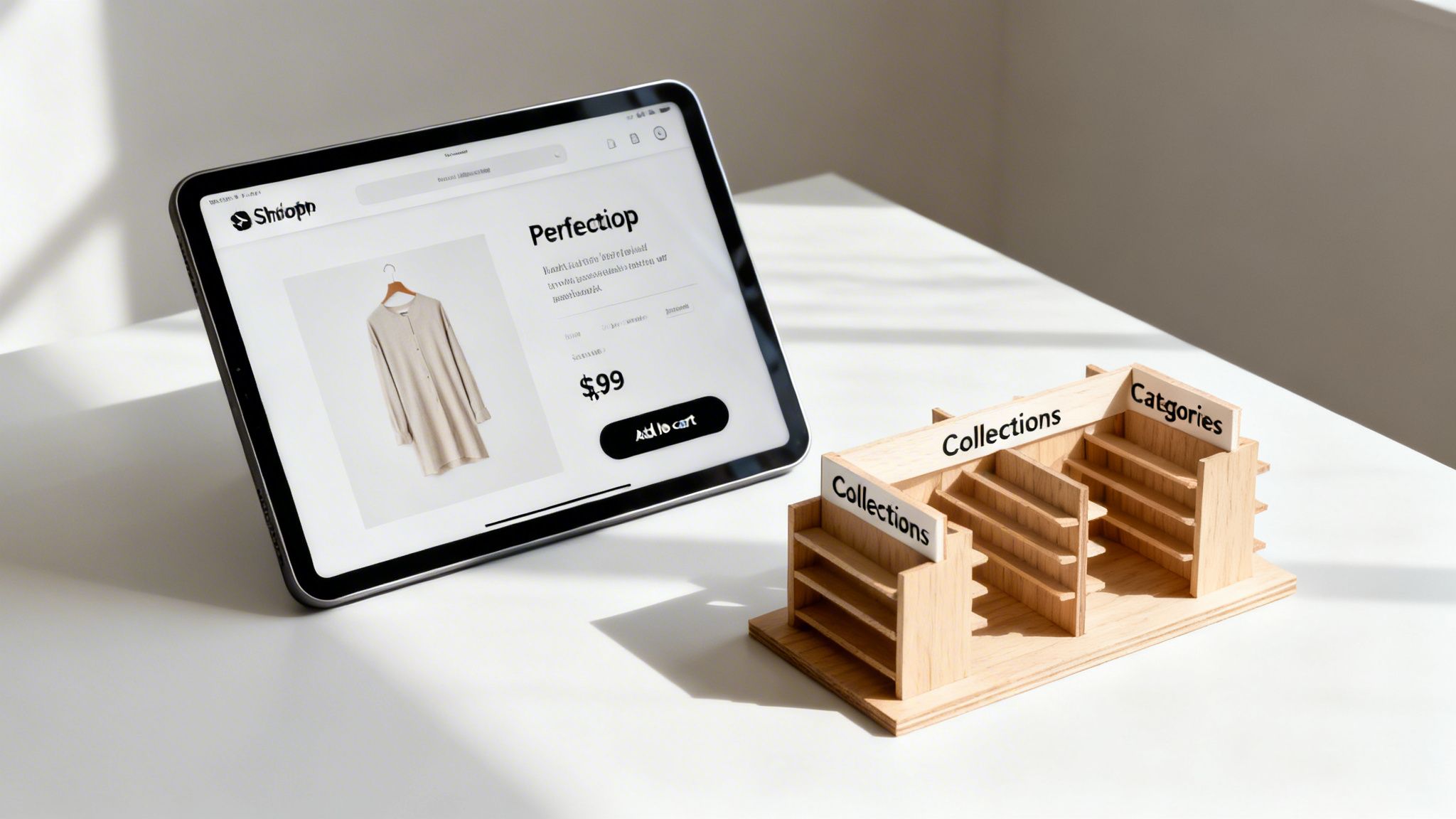
There are two areas that make or break Shopify SEO more than any other: your site architecture and your individual product pages. Get these right, and you’re building a powerful foundation for growth. Get them wrong, and even the best content or backlink strategy will struggle to deliver.
Think of your online store as a massive department store. A logical site architecture acts as the clear aisles and overhead signs. It guides shoppers effortlessly from the front door to the exact item they want, creating a smooth, intuitive experience. This clarity isn't just for customers; it's vital for search engines, too.
A clean structure helps Google’s crawlers understand how your pages relate to one another, which products are most important, and how to categorise your entire inventory. This has a direct impact on your ability to rank for those valuable product and collection keywords.
Building a Search-Friendly Site Structure
One of the most common mistakes we see is a flat or overly complicated navigation menu. The goal should be a logical hierarchy that flows from broad categories down to specific products, making sure everything is discoverable within just a few clicks.
As you work on optimising your site, implementing strong category management best practices can seriously enhance your store's discoverability and user experience.
An expert agency focusing on SEO services for Shopify will typically prioritise:
- Logical Collection Organisation: Grouping related products into intuitive collections (e.g., 'Men's Running Shoes' instead of a generic 'Shoes' bucket).
- Clean URL Structures: Making sure your URLs are short, descriptive, and actually reflect the page's content (like
/collections/mens-running-shoes). - Strategic Internal Linking: Using links within blog posts and product descriptions to pass authority to important pages and guide users through your site.
- Breadcrumb Navigation: Implementing breadcrumbs (e.g., Home > Men's > Shoes) to show users where they are and improve crawlability for Google.
This foundational work is critical, especially in a crowded market. Australia alone is home to 154,625 Shopify stores in 2025, and with organic search funnelling 20–30% of traffic to well-optimised stores, a strong structure is your first real competitive advantage.
Crafting Product Pages That Convert and Rank
Once a shopper lands on a product page, you have one job: convince them to click "Add to Cart." This is where SEO meets conversion rate optimisation. A great product page serves both search engines and human psychology, providing all the information needed to make a confident purchase decision.
Your product pages are the most valuable real estate on your site. They are your digital salespeople, working 24/7. They need to be persuasive, informative, and perfectly optimised.
The best product pages don't just describe a product; they sell the outcome. They answer a customer's unspoken questions and overcome their hesitations before they even arise.
Key elements of a high-performing product page include:
- Unique, Compelling Descriptions: Moving beyond the manufacturer's generic text to write persuasive copy that highlights benefits, not just features.
- High-Quality Image Optimisation: Using professional photos with descriptive file names and alt text to capture traffic from both regular and image searches.
- Product Schema Markup: Implementing structured data to enable rich snippets in search results, like star ratings, price, and stock availability.
- Customer Reviews and FAQs: Building trust and providing social proof while also targeting those long-tail, question-based keywords.
By mastering both the broad structure of your site and the fine details of each product page, you create a powerful engine for organic growth. For a deeper dive, check out our guide on complete e-commerce SEO marketing strategies. This integrated approach is what turns casual browsers into loyal customers.
Choosing the Right Shopify SEO Agency
Picking an agency to handle your Shopify store’s SEO can feel like navigating a minefield. The right team can be a genuine growth engine for your brand, but the wrong one can burn through your budget and leave you worse off than when you started. You're not looking for just another vendor; you're looking for a partner.
This means you’ve got to see past the flashy sales decks and zero in on real, tangible Shopify expertise. A generalist SEO agency might understand the basics, but they won't know the ins and outs of the platform—like how to deal with the duplicate content issues that product tags can create, or the right way to optimise collection page filters so search engines can actually make sense of them. A true specialist lives and breathes this stuff.
Vetting Potential Partners
Your evaluation process needs to be rigorous. Kick things off by asking for hard proof of their experience with stores just like yours. Ask for case studies that go beyond simple traffic increases. You want to see real growth in organic revenue, conversion rates, and return on investment for businesses in your niche.
Next, get under the hood of their process. A transparent agency will have no problem clearly walking you through their strategy, from the initial technical audit to their approach for content and link building. Crucially, they should be able to explain the why behind their recommendations, not just the what. That level of clarity is a massive green flag for a collaborative partnership.
Any agency that guarantees a "#1 ranking on Google" is waving a massive red flag. SEO results depend on hundreds of factors, and making promises like that isn't just unethical—it's impossible. Focus on agencies that promise a clear process and measurable business outcomes.
Agency Evaluation Checklist
Use this checklist to cut through the noise and compare potential agencies. It'll help you spot the difference between a true Shopify SEO expert and a generalist who’s just trying their luck.
| Evaluation Criteria | What to Look For | Red Flags to Avoid |
|---|---|---|
| Shopify Experience | Demonstrable experience with Shopify stores, ideally in your niche. They should understand Liquid, app integrations, and platform-specific issues. | A portfolio filled with non-e-commerce or non-Shopify websites. They might treat your store like a simple blog. |
| Process Transparency | A clear, documented process for audits, strategy, implementation, and reporting. They should be open about their methods. | Vague answers, secret "proprietary" techniques, or an unwillingness to explain their strategy in detail. |
| Reporting & KPIs | A focus on business metrics like organic revenue, conversion rate, and return on ad spend (ROAS). Reports should connect SEO activity to your bottom line. | "Vanity metrics" like keyword rankings or traffic without context. Traffic that doesn't convert is just noise. |
| Communication | A dedicated point of contact and a regular, structured communication schedule (e.g., bi-weekly calls, monthly reports). | Poor response times during the sales process. If they're slow to respond now, it will only get worse. |
A solid agency will be able to answer these questions without hesitation, giving you confidence that you're putting your store in capable hands.
Understanding Pricing and Onboarding
When it comes to pricing, most reputable agencies offering SEO services for Shopify operate on a retainer model. This monthly fee covers all the ongoing work—strategy, implementation, analysis, and reporting. It reflects the reality that SEO is a long-term investment, not a quick, one-off project. Some might also offer project-based pricing for specific tasks, like a site migration or a deep-dive technical audit.
A thorough onboarding process is absolutely non-negotiable. It should always kick off with an in-depth discovery phase where the agency gets to know every corner of your business, from your target audience and profit margins to what makes your brand unique. This initial deep dive is the foundation for a strategy that’s actually built around your commercial goals.
Finally, remember that a quality partnership is a two-way street. To learn more about what that involves from your side, you can explore our comprehensive guide to professional e-commerce SEO services, which details how to set your business up for a successful engagement. By being thorough and asking the right questions, you can find a partner who will help you scale your business and dominate your niche.
Making the Most of Shopify Apps and Analytics
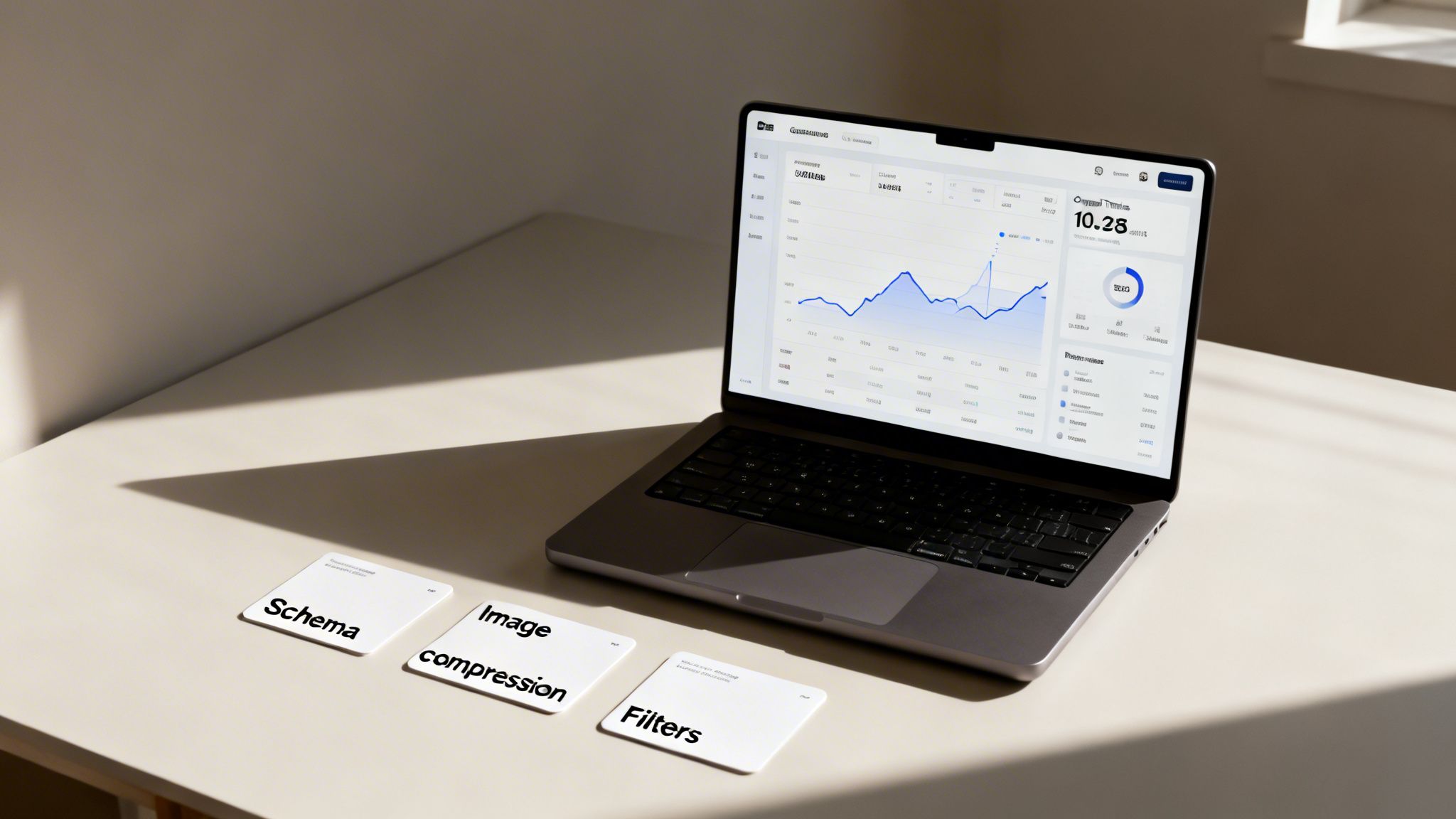
The Shopify App Store is an incredible resource for store owners, but it’s also a bit of a minefield. The right apps can automate tricky SEO tasks and give you a huge leg up on the competition. The wrong ones? They can bog your site down with clunky code, absolutely tanking your page speed and undoing all your hard SEO work.
Knowing how to navigate this is a huge part of what a professional Shopify SEO service does. A real expert won’t just go installing the most popular apps. They’ll carefully build a lean, high-performance tech stack that actually boosts your SEO without causing "app bloat." This means picking tools that are lightweight, well-coded, and solve a genuine SEO problem.
Choosing Apps That Drive Real SEO Wins
A skilled team will focus on apps that handle core SEO needs that Shopify doesn’t quite nail out of the box. Think of them as specialised tools you bring in for a specific job, not a bulky, all-in-one toolbox that just weighs everything down.
The most valuable app categories for SEO usually include:
- Schema Markup Automation: Apps that correctly add structured data to your product pages. This is what helps you earn those eye-catching rich snippets in search results, like star ratings and prices showing up right under your link.
- Advanced Image Compression: Tools that go way beyond Shopify’s basic compression. They can slash image file sizes without sacrificing quality, which is absolutely critical for site speed.
- Site Filtering and Navigation: Apps designed to improve the user experience for stores with big inventories. They allow for faceted search (think filtering by size, colour, brand) that is also crawlable by search engines.
It's a delicate balancing act. Overloading your store with too many scripts from different apps is one of the quickest ways to slow it down. A professional service will start by auditing your existing apps, ditching any that are redundant or poorly made, and only implementing what’s absolutely essential for growth.
Turning Your Data Into a Growth Roadmap
The tools are only half the story. The other half is measurement. Without accurate analytics, you're just flying blind.
A cornerstone of any good SEO service is setting up a solid tracking framework that connects your search performance directly to your sales figures. And no, this isn't just about dropping a tracking code on your site and calling it a day.
It’s about customising Google Analytics 4 (GA4) and Google Search Console specifically for an e-commerce environment. When set up properly, you can see not just how much traffic you're getting, but exactly which keywords and pages are driving actual, real-world revenue.
Data tells a story, but only if you know how to read it. The goal isn't to collect mountains of metrics, but to isolate the few key performance indicators (KPIs) that show whether your SEO investment is truly paying off.
A few essential e-commerce KPIs to track include:
- Organic Revenue: The total sales generated directly from non-paid search traffic. This is the ultimate measure of SEO success.
- Search-Driven Conversion Rate: The percentage of visitors from organic search who actually make a purchase. This shows you the quality of the traffic you're attracting.
- Keyword Performance by Collection: Tracking which search terms are driving traffic and sales to your most important product categories.
This focus on measurement is especially vital in the Australian market. With over 40% of growing AU Shopify stores installing SEO and speed apps, the competition is fierce. This adoption rate is critical because organic search delivers a significant portion of traffic and aligns with global trends where organic results are the primary traffic source. You can discover more insights about Shopify app trends on zikanalytics.com.
Ultimately, this data-driven approach turns raw numbers into a clear roadmap. By understanding what’s working, an agency can double down on successful strategies and refine those that aren't, ensuring your SEO efforts continuously adapt and get better over time. For more on this, check out our guide on how to implement proper website conversion tracking.
Your Next Steps to Shopify SEO Success
Let's pull it all together. Successful Shopify SEO isn't a one-and-done project you can tick off a list. It's much better to think of it as an ongoing investment in your store's long-term health and profitability. Just like a physical shop needs regular upkeep and marketing, your digital storefront requires constant attention to stay competitive.
The journey kicks off with a solid foundation: technical excellence, compelling content, and a smart site structure. From there, it’s all about adapting, measuring, and refining your strategy based on what the data tells you. Bringing in professional seo services for shopify is hands down the best way to manage this complex process, freeing you up to focus on what you do best—running your business.
Remember, the goal of Shopify SEO isn't just to attract more traffic; it’s to attract the right traffic. Success is measured not in clicks, but in conversions, revenue, and sustainable business growth.
Your Agency Onboarding Checklist
To make sure your partnership with an SEO agency gets off to a flying start, a little preparation goes a long way. Having this information ready from day one allows your new team to hit the ground running and start delivering results faster. It’s what they need to build a strategy that’s truly aligned with your business goals.
Before your first kickoff meeting, be ready to:
- Provide Access: Grant collaborator access to your Shopify Admin, Google Analytics (GA4), and Google Search Console. This is non-negotiable for their initial audit and ongoing performance tracking.
- Define Your Core Products: Pinpoint your best-selling products or categories. Which ones have the juiciest profit margins? This helps prioritise SEO efforts where they’ll make the biggest financial splash.
- Share Your Business Goals: Be crystal clear about what you want to achieve. Is it about boosting overall organic revenue by 30%? Or maybe you want to completely dominate search results for a brand-new product line?
- List Your Known Competitors: Who are your main rivals online? Knowing who you're up against helps your agency get a read on the competitive landscape and spot opportunities.
Having these details organised ensures your SEO partner can build a genuinely customised strategy, tailored to your brand’s unique spot in the market. Ultimately, SEO isn’t just about traffic; it’s about helping your store improve ecommerce conversion rates and drive more sales.
If you’re ready to take that step, our team of Shopify specialists is here to create a data-driven plan that turns searchers into customers.
Frequently Asked Questions
Diving into professional SEO services for your Shopify store is a big decision, and it’s completely normal to have a few questions rattling around. Let's tackle some of the most common ones we hear from store owners to give you the clarity you need.
How Long Does Shopify SEO Take to Work?
This is probably the number one question on every store owner's mind. While everyone loves the idea of instant results, SEO is a long-game strategy that builds sustainable, long-term growth. Think of it less like a light switch and more like planting a garden—it takes time and consistent effort before you see a real harvest.
You can typically expect to see the first positive signs within three to six months. This is when the foundational work—like technical audits, site structure improvements, and on-page optimisations—starts to get noticed by search engines. You might see some keywords climbing the ranks or a small but encouraging lift in organic traffic.
But the real, business-moving results? That usually happens between six and twelve months. This is when the compounding effect of ongoing content, quality backlinks, and strategic tweaks truly kicks in. You'll see a significant jump in organic revenue and a steady stream of qualified customers finding your store.
What Makes Shopify SEO Different From Regular SEO?
While the core principles of SEO—great content, solid technicals, and authority—are universal, Shopify has its own unique ecosystem. A generic SEO strategy often falls flat because it doesn't account for the platform's specific quirks, which can seriously hold a store back.
Here are a few key differences a specialist understands:
- Handling Duplicate Content: Shopify’s setup can easily create multiple URLs for the same product (like through different collection pages or product tags). A specialist knows exactly how to use canonical tags and dig into theme files to consolidate all that ranking power into a single, authoritative URL.
- Optimising Collection Pages: General SEO often overlooks the goldmine that is Shopify's collection pages. An expert treats these as powerful landing pages, optimising them for the broad, high-volume keywords that attract top-of-funnel shoppers.
- Managing Apps: That app you installed to add reviews might look great, but is it slowing your site down? A Shopify specialist can pinpoint which apps are helping your SEO and which are creating "code bloat" that hurts your site speed—a massive ranking factor.
How Much Do Shopify SEO Services Cost?
The cost of professional seo services for shopify varies quite a bit, but it's always tied to the scope of work and just how competitive your market is.
A brand-new store with zero online authority is going to need more heavy lifting than an established brand that just needs a tune-up. Likewise, getting found for "handmade leather wallets" is a completely different ball game than trying to rank for "women's running shoes." The more crowded your niche, the more investment it takes to stand out.
Think of SEO not as a monthly expense, but as an investment in a revenue-generating asset. The goal is to build a reliable channel that brings qualified customers to your digital doorstep, month after month, without you having to pay for every single click.
Finally, the comprehensiveness of the service plays a big role. A full-service plan covering technical SEO, content strategy, and link building will naturally be priced higher than a one-off project. Most agencies offer tiered monthly retainers, so you can choose an investment level that aligns with your growth ambitions and helps you improve ecommerce conversion rates.
Ready to turn your Shopify store into an organic growth machine? The team at Click Click Bang Bang specialises in data-driven SEO strategies that deliver real, measurable results. Let's build a plan to connect you with more customers and grow your bottom line.
Read NeXt
Or Read Our Latest
- How to Set Up Google Ads in Australia: Complete 2026 Guide
- Google Merchant Center Setup: The Complete 2026 Guide
- Business Manager Setup Facebook: The Complete 2026 Guide
- Google Ads Account Setup: Expert Guide for 2026
- Search Ads Optimisation: A Practical Guide for 2026
- Manual vs Automated Bidding for PPC Success
Click. CLick. Subscribe.
Get our best PPC insights, industry updates, and power moves delivered straight to your inbox. No fluff, just high-caliber strategies that actually work.
Don’t Leave Just Yet
Try Us For 30-Days,
Risk Free!!
We guarantee that you’ll love our work within the first 30 days, if not you’ll get your money back.
What have you got to lose?