

Digital marketing agency for small business: Find Your Digit
Last Updated

You’re probably in one of two situations right now.
Either you’ve tried to run Google Ads, social posts, email, and SEO yourself, and it’s become another full-time job. Or you’ve spoken with a few agencies and every proposal sounds polished, but none of them make it obvious what you’ll get, how results will be measured, or who carries the risk if tracking and compliance go wrong.
That’s where choosing the right digital marketing agency for small business gets practical very quickly. The best agency won’t just “do marketing”. It will help you decide what not to do, where to spend first, how to measure return properly, and how to avoid common mistakes that drain budget before the campaign has a real chance to work.
For Australian small businesses, that decision has a few extra layers. Privacy obligations have become harder to ignore. Regional targeting behaves differently from metro targeting. And many generic agency guides still read as if every business is based in the US and every campaign works the same in Sydney, Brisbane, Dubbo, or regional Queensland.
Why a Digital Marketing Agency Matters for Small Business
You might be answering customer enquiries in the morning, dealing with stock or fulfilment at lunch, and trying to “fix marketing” after hours. That’s normal for small business. It’s also why marketing often ends up reactive instead of organised.
In Australia, small businesses represent 97.2% of all employing businesses as of 2023-24, totalling over 2.5 million entities, yet only 17% use search engine optimization (SEO), according to small business marketing statistics. That gap matters because visibility usually doesn’t fail from lack of effort. It fails from scattered effort.

A capable agency gives a small business three things that are hard to build alone.
- Focus on the channel that matches the goal: If you need sales now, paid search may matter more than broad awareness content. If you need recurring inbound demand, SEO and landing pages may deserve more attention than constant social posting.
- Control over wasted spend: Most small businesses don’t lose money because digital channels “don’t work”. They lose money because campaigns launch without tracking, weak offers, or the wrong audience settings.
- Time back for the owner or team: Someone still needs to approve strategy, but you shouldn’t be rebuilding audiences, checking search terms, or chasing broken tags late at night.
A good agency also helps you understand channel fit. Social can support demand, but it often needs clearer creative direction and stronger follow-up than business owners expect. If you’re weighing that side of the mix, this guide to Social Media Marketing Services for Small Businesses is useful because it separates platform activity from actual business outcomes.
For a broader view of service models and channel combinations, this resource on https://clickclickbangbang.com.au/digital-marketing-for-small-business/ is worth reviewing before you take sales calls.
Practical rule: If an agency can’t explain what it will stop you spending money on, it probably isn’t strategic enough for a small business.
Identifying Your Marketing Needs
Most agency searches start too late. A business gets frustrated with poor results, books discovery calls, then realises it hasn’t defined the basics. That creates bad briefs, vague proposals, and mismatched expectations.
Start with your business problem, not the service name.
Map the main outcome first
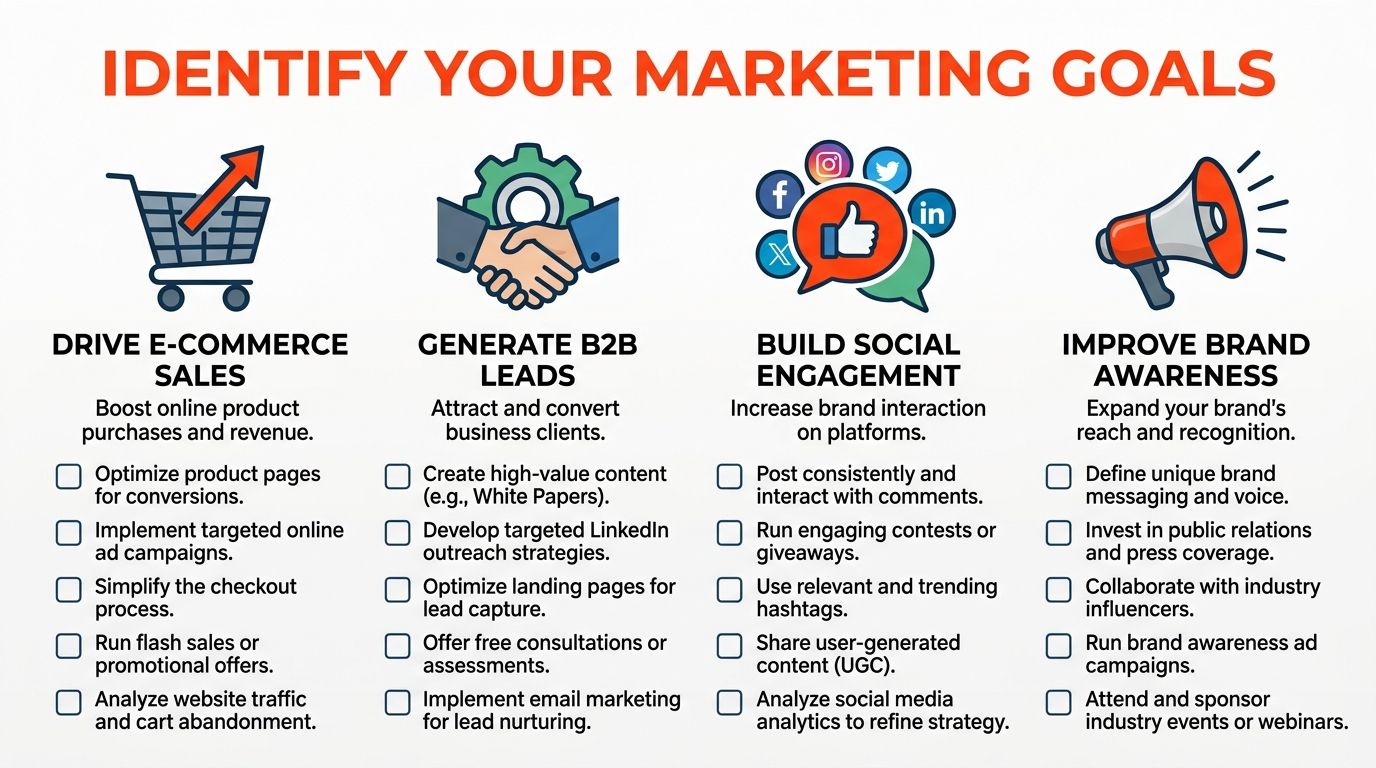
A small business usually hires an agency for one of four reasons:
-
Drive e-commerce sales
You need more transactions, higher average order value, or better repeat purchase behaviour. This usually points toward product feed quality, shopping campaigns, remarketing, and category or product page SEO. -
Generate B2B leads
You need qualified enquiries, booked calls, or form fills from the right decision-makers. That often means search intent, LinkedIn targeting, stronger lead magnets, and tighter CRM handoff. -
Build social engagement
You need attention, trust, or content reach because your sales cycle depends on familiarity. That’s different from chasing vanity metrics. Engagement should support enquiries, email sign-ups, or audience retargeting. -
Improve brand awareness
This matters when buyers don’t know you exist, or when competitors dominate the conversation. Awareness is valid, but it still needs a practical measurement plan.
If you can’t choose one primary outcome, the agency won’t know how to prioritise either.
Audit what’s already in place
Before you ask an agency to solve the problem, check whether the foundations exist.
Use this short checklist.
- Website readiness: Are service pages clear, fast, and built around one action per page?
- Tracking setup: Do you know which enquiries, purchases, calls, or forms come from which channel?
- Creative assets: Do you have usable product images, short videos, proof points, FAQs, or testimonials?
- Sales process: When leads come in, who follows up, how fast, and with what script?
- Offer clarity: Is the promise obvious enough for a stranger to understand in seconds?
A lot of “marketing problems” are really landing page or offer problems. Agencies can help with that, but you’ll save time if you identify it early.
Rank channels by likely impact
Don’t spread a small budget across every platform just to feel present.
A simple way to rank channels is to ask:
| Channel | Best fit when | Warning sign |
|---|---|---|
| SEO | Buyers actively search for what you sell | You expect fast wins from a weak site |
| Google Ads | You need intent-driven traffic quickly | You haven’t set up conversion tracking |
| Meta ads | Visual offers and strong retargeting matter | You’re relying on broad cold traffic alone |
| Your buyer is a professional decision-maker | Your offer is too generic | |
| You already have leads or customers to nurture | You’re using it without segmentation |
An outside perspective helps. Business owners often choose channels they personally use, not channels buyers use when they’re ready to act.
If social is one of your priority channels, this practical piece on social media marketing for small businesses is a strong companion read because it helps translate “we should post more” into actual channel intent.
Build a brief an agency can respond to
Send agencies a one-page summary before the call. It should include:
- Business model
- Primary goal
- Secondary goal
- Main products or services
- Target customer
- Current channels in use
- Known problems
- Internal constraints
- Who approves work
- What success should look like
The clearest briefs usually come from businesses that know their bottleneck. More traffic isn’t a strategy if the real issue is poor conversion after the click.
A sharp brief changes the conversation. Instead of hearing a recycled pitch, you’ll hear whether the agency understands your market, your constraints, and what success requires.
Evaluating Agency Services
A proposal can look impressive and still hide shallow execution. The fastest way to evaluate an agency is to move past the deliverables list and examine the method underneath it.

Ask how the agency plans, builds, tracks, and changes campaigns when results don’t match expectations. That’s where capability shows up.
What strong SEO service looks like
For Australian small businesses, AI-first SEO methodology includes a detailed site audit, buyer persona development, on-page optimisation with Core Web Vitals, off-page link-building targeting .com.au domains, and ongoing monitoring with organic traffic growth benchmarks of 20-40% QoQ**, as noted in this review of why small businesses fail at digital marketing.
That sounds technical, but the practical takeaway is simple. Good SEO work is not a bundle of blog posts. It’s a system.
Look for an agency that can explain:
- How it audits the site: Google Search Console, Ahrefs, crawl diagnostics, page intent review, technical blockers.
- How it prioritises pages: Service pages, category pages, product pages, or location pages based on business value.
- How it uses AI: For research support, content clustering, drafting assistance, and pattern detection. Not for pumping out thin pages at scale.
- How it improves trust signals: Author bios, first-party proof, clear policies, and useful supporting content.
- How it handles local relevance: Especially if your business serves specific Australian markets.
Weak SEO agencies hide behind vague promises like “more visibility” or “content optimisation”. Strong ones can show you the sequence of work.
Questions to ask in the call
Try this script:
“If you audited our site next week, what are the first three things you’d check before recommending more content?”
Then ask:
“How do you decide whether the next priority is technical fixes, service page rewrites, link acquisition, or new content clusters?”
Those two questions flush out a lot. If the answer jumps straight to publishing blogs, you’re probably hearing a templated service.
What strong PPC service looks like
Paid media should feel controlled from day one. Not perfect, but controlled.
A good agency should be able to describe account structure, conversion setup, audience logic, negative keyword management, ad testing, landing page alignment, and budget pacing in plain English. You’re not hiring jargon. You’re hiring decision quality.
Here’s a practical way to compare responses.
| Area | Strong answer | Weak answer |
|---|---|---|
| Campaign setup | Explains campaigns by intent, product, service, or funnel stage | “We’ll launch and optimise” |
| Tracking | Mentions analytics, conversion events, call tracking, form quality | Only talks about clicks or impressions |
| Search terms | Reviews queries and excludes waste early | Assumes platform automation will solve everything |
| Ad testing | Tests offers, headlines, and landing page match | Tests without a clear hypothesis |
| Reporting | Ties spend to leads, sales, or pipeline | Sends screenshots with little interpretation |
This section of the evaluation matters because PPC exposes bad process quickly. Budget disappears faster when structure is weak.
Later in the sales process, ask for a walkthrough of the reporting view. If they won’t show how performance is monitored, don’t assume transparency appears after you sign.
For a broader breakdown of channel capabilities and service stacks, review https://clickclickbangbang.com.au/digital-marketing-services/ and compare what agencies promise against what they can operationalise.
Social and creative evaluation
Small businesses often underestimate the gap between “posting content” and “running social strategically”.
A competent agency should discuss:
- audience segments
- creative testing cadence
- offer angles
- retargeting logic
- landing page match
- content hooks by platform
If the social proposal is mostly about post frequency, treat that carefully. Posting volume only matters when the message and next step are strong.
One useful test is to ask the agency to critique one of your current ads or one competitor ad live on the call. You’ll learn more from that than from a portfolio deck.
Here’s a useful video if you want a quick visual primer before agency interviews.
Analytics and reporting separate good agencies from busy ones
A lot of agencies are active. Fewer are accountable.
Ask to see how they report on:
- Lead quality
- Sales or revenue attribution
- Channel comparison
- Landing page performance
- Search term or audience waste
- Actions taken since the last review
Then ask one blunt question:
“If performance drops for a month, what changes first. Budget, creative, targeting, landing page, or offer?”
That answer reveals whether they optimise from evidence or instinct.
Red flags that shouldn’t be ignored
Some warning signs are obvious. Others sound reassuring at first.
Watch for these:
- Guaranteed rankings or guaranteed lead volumes: Serious agencies don’t promise outcomes they can’t fully control.
- No clear owner on the account: You need to know who thinks, not just who sends reports.
- Reporting without interpretation: Data isn’t useful if no one explains what changed and why.
- A strategy that fits every business: Small business campaigns need prioritisation. Not a generic checklist.
- No questions about your margins or sales process: If the agency doesn’t ask how the business makes money, it can’t manage your spend responsibly.
Agencies earn trust when they tell you a channel isn’t ready yet. That usually means they care more about performance than the retainer.
Shortlisting Agencies and Comparing Pricing
Once proposals start coming in, most small businesses compare the wrong things first. They look at monthly fee, number of platforms, or how polished the deck feels.
That misses the main issue. The cheaper proposal can cost more if it creates weak tracking, poor compliance, or months of confused reporting.
Use a weighted scorecard
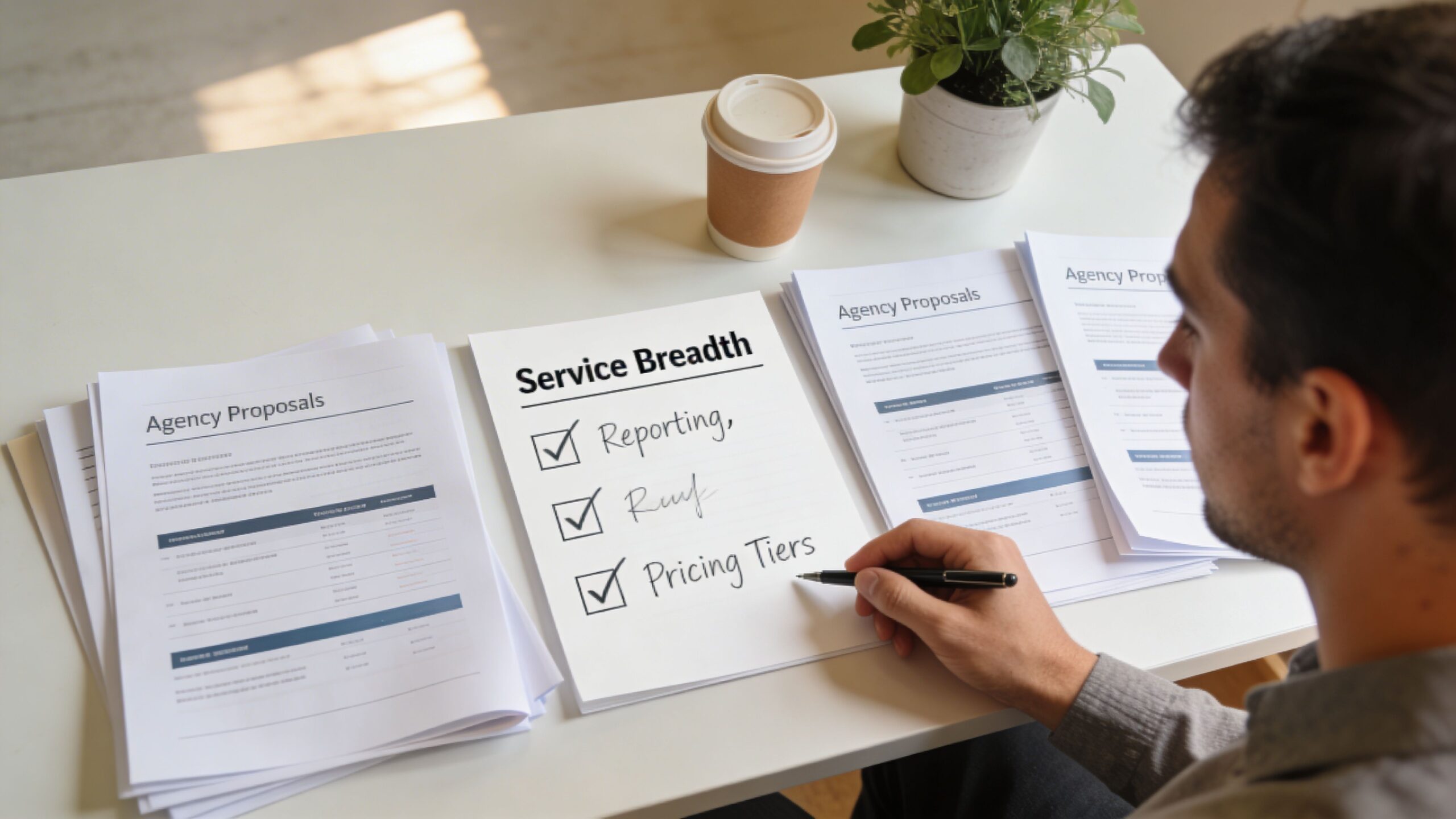
A simple scorecard works better than gut feel. Rate each agency against the same criteria, then look at the total.
You can use a structure like this.
| Criteria | What to look for |
|---|---|
| Strategy fit | Clear understanding of your goal and buyer |
| Service depth | Strong method, not just a list of tasks |
| Reporting clarity | Live visibility, useful monthly analysis |
| Contract flexibility | Trial, exit terms, ownership terms |
| Compliance readiness | Consent, tracking, privacy responsibilities |
| Communication | Response quality, not just speed |
| Commercial sense | Budget recommendation matches reality |
You don’t need a perfect score. You need the least risky fit for the stage your business is in.
Compare pricing by scope, not by headline fee
A starter package on one platform can be the right decision if you need focus and fast learning. A multi-channel plan can be wasteful if your site, offer, or internal process isn’t ready.
When you compare proposals, check:
- What’s included in setup
- Who owns creative production
- Whether landing page support is included
- How often strategy is reviewed
- Whether reporting is live or retrospective
- Who owns ad accounts and analytics assets
Some businesses overbuy. Others underbuy and then wonder why nothing learns. If your spend is too thin across too many channels, optimisation slows down and confidence drops.
Don’t treat compliance as a legal footnote
This matters more in Australia than many proposals acknowledge.
68% of Australian SMBs report privacy compliance as a top barrier to digital ad adoption, yet 42% paused campaigns post-2024 over tracking fears, with non-compliance fines averaging AUD 500,000, according to this discussion of agency selection and compliance concerns at Thrive Agency.
That should change how you read contracts.
Clauses worth checking
Ask agencies to spell out:
- Consent handling responsibility: Who manages platform tags, consent mode, and policy alignment?
- Data ownership: Who owns the ad account, pixel equivalents, analytics access, and historical data?
- Tracking limitations: What happens if privacy settings reduce attribution accuracy?
- Remediation process: If compliance issues are identified, who fixes what and how fast?
- Exit handover: What access, assets, and documentation do you keep if the relationship ends?
A proposal that skips these points is incomplete, even if the media strategy looks strong.
Compliance costs usually appear after launch, not before. Get clear on them before any tags, audiences, or remarketing flows go live.
Where to negotiate
Not every point in a proposal is fixed.
You can often negotiate:
- a shorter initial term
- a structured trial
- a tighter platform scope
- clearer monthly review obligations
- a written handover process
- specific approval checkpoints before new spend is added
What you shouldn’t negotiate away is accountability. If a proposal becomes cheaper because it removes reporting depth, tracking work, or strategy reviews, you may be stripping out the part that makes the service useful.
Running Trial and Onboarding Process
The early weeks tell you almost everything. Not whether the campaign has fully matured, but whether the agency has process, urgency, and discipline.
For Australian small businesses, well-run PPC campaigns deliver ~200% ROI on average, with top performers achieving 300-500% ROAS by integrating analytics and launching ads within 7 days of onboarding, according to digital marketing statistics. The important part isn’t the headline outcome. It’s the operating model underneath it.
What good onboarding looks like
The strongest onboarding flows are structured and quick.
A typical pattern looks like this:
-
Initial questionnaire
The agency gathers business model details, margins, priority products or services, geographic targets, seasonality, approval process, and current pain points. -
Strategist consultation
Goals are narrowed. E-commerce sales, lead generation, or pipeline quality each require different campaign logic. -
Access and integration
Analytics, ad accounts, Business Manager tools, conversion tracking, and any CRM integrations are connected. -
Asset review
Existing landing pages, ads, images, video, copy, feeds, and offers are reviewed for launch readiness. -
Build and launch
Initial campaigns are structured, approved, and launched with reporting in place.
That sequence matters because it reduces guesswork. Agencies that skip straight to launch usually inherit avoidable tracking and messaging problems.
A simple script for the first call
Use direct questions. You don’t need to sound technical.
Try this:
“What do you need from us in the first week to launch cleanly?”
Then:
“What would stop you from launching on time?”
Then:
“What will be live in reporting before the campaigns go live?”
The answers should be specific. If the agency can’t explain dependencies clearly, onboarding may become a long chain of avoidable delays.
What you should prepare before kickoff
A trial works best when the business side is ready too.
Bring these to the table:
- Access list: website, analytics, ad accounts, CRM, tag manager if used
- Offer clarity: best-selling products, highest-value service, seasonal focus
- Creative bank: logos, product shots, videos, testimonials, brand guidelines
- Conversion path: forms, checkout flow, phone handling, booking steps
- Decision-maker availability: someone who can approve quickly
A trial can fail because approvals sit idle for days. That isn’t the agency’s fault, but it still affects results.
Milestones to watch during the trial
A short onboarding timeline should produce visible progress, even before major outcome data arrives.
Check for these signs:
| Trial stage | What you should see |
|---|---|
| Early onboarding | Clear questions tied to business goals |
| Setup phase | Confirmed tracking, account access, asset requests |
| Pre-launch | Campaign structure and messaging for approval |
| Launch | Live ads and reporting access |
| First review | Early observations, exclusions, and next tests |
If the agency misses small operational milestones, be careful about trusting later optimisation promises.
A trial should generate signal, not certainty. What you’re really testing is whether the agency learns fast, reports honestly, and adjusts without drama.
Common onboarding mistakes
These show up often:
- Too many platforms at once: This spreads budget and attention thin.
- Vague internal ownership: Nobody knows who approves ads, copy, or landing pages.
- Weak conversion setup: Leads arrive but quality can’t be measured.
- Late creative delivery: Campaigns launch with placeholders or generic ads.
- No review rhythm: The first two weeks pass without a real performance conversation.
The best trial periods aren’t flashy. They’re organised, evidence-led, and calm.
Measuring ROI and Optimising Campaigns
Once campaigns are live, a lot of businesses look at the wrong dashboard first. They check clicks, impressions, or total leads without asking whether those leads were profitable, qualified, or repeatable.
ROI measurement needs to connect channel activity to business reality.
For regional Australian small businesses, CPCs can be 30-40% higher, yet hyper-local PPC delivers 18% better ROAS over metro-focused strategies, with regional conversions 22% higher, according to the ABS digital economy reference. That tells you something important. Cheap traffic and good traffic are not the same thing.
Start with a usable KPI stack
Your KPI stack should move from surface metrics to commercial metrics.
Use this order:
-
CTR
Useful for checking message-market match. A weak CTR can point to poor targeting, weak copy, or an offer that doesn’t stand out. -
Conversion rate
This tells you whether the landing page, audience, and offer are aligned after the click. -
Cost per acquisition
Spend starts becoming commercially meaningful at this stage. -
ROAS or lead value
E-commerce businesses can track purchase return more directly. Lead generation businesses need a cleaner way to define lead quality and downstream value. -
True ROI
This includes agency fees, creative cost, sales follow-up effort, discounting, and margin reality.
A pretty dashboard can still hide a bad business outcome. That’s why monthly review calls need interpretation, not just screenshots.
For a useful reference on what performance reporting should include, review https://clickclickbangbang.com.au/digital-marketing-performance-metrics/ and compare it with the reporting structure your agency provides.
Regional and metro performance should not be judged the same way
Many campaigns go off track here.
A metro benchmark often distorts the picture for businesses serving regional markets. Higher click costs don’t automatically mean poor performance. If the targeting is tighter and buyer intent is stronger, regional campaigns can still outperform.
That’s why segmentation matters.
Break reports down by:
- Region
- Device
- Audience type
- Landing page
- Campaign objective
- New versus returning visitors
If you lump all traffic together, the best pockets of performance stay hidden.
Monthly optimisation should follow evidence
A disciplined review should answer four questions.
| Review question | What it uncovers |
|---|---|
| Which segment produced the strongest commercial result? | Where to concentrate spend |
| Where did users click but fail to convert? | Landing page or offer problems |
| Which searches or audiences drove weak intent? | Exclusions and targeting changes |
| What should be tested next month? | A real optimisation agenda |
Agencies often show their real value in this area. Not in “monitoring”, but in choosing the next test well.
That next test could involve:
- rewriting headlines to better match intent
- changing the hero section on a landing page
- excluding weak search queries
- splitting branded and non-branded traffic
- adjusting bids by region
- narrowing remarketing windows
- sending stronger follow-up emails after lead capture
How to calculate true ROI without fooling yourself
A lot of small businesses overstate campaign value by counting every enquiry equally.
For service businesses, separate:
- qualified leads
- unqualified leads
- booked calls
- proposals sent
- deals won
For e-commerce, separate:
- first-order sales
- repeat customer value
- returns or cancellations
- margin by product line
Then look at what the campaign produced after all direct costs.
The cleanest ROI conversations happen when both the business and the agency agree on one commercial definition of success before optimisation starts.
Signals that optimisation is working
You don’t always need dramatic swings to know the system is improving.
Good signs include:
- traffic quality improving even if volume is flatter
- landing page conversion increasing after message changes
- more budget moving to the best segment instead of being spread evenly
- fewer irrelevant searches or low-intent clicks
- reports becoming more decisive month by month
That’s what mature campaign management looks like. Less activity for its own sake. More deliberate movement toward the parts of the account that produce return.
Best Practices for Agency Partnerships
The best agency relationships don’t run on hope. They run on clarity.
Set a fixed review cadence. Monthly is usually the minimum. The call shouldn’t be a tour of dashboards. It should answer what changed, why it changed, and what happens next.
Keep data ownership simple and explicit. Your business should retain access to ad accounts, analytics tools, audiences, creative files, and reporting history. If a relationship ends, the handover should feel administrative, not adversarial.
Use a short partnership checklist to keep everyone honest:
- Define success once: Agree on the commercial goal in plain language.
- Approve faster: Delayed feedback creates slow learning and weaker trials.
- Escalate issues early: Tracking errors, lead quality problems, and compliance questions get more expensive when they sit.
- Protect testing budget: If every experiment feels risky, optimisation stalls.
- Review contracts before renewal: Check exit terms, ownership terms, and service scope before they roll over.
A strong agency should challenge weak assumptions, not just execute requests. If you ask for more channels, more ads, or more spend, it should explain whether that’s the right move.
The most productive partnerships are rarely the loudest. They’re the ones where strategy, execution, compliance, and reporting stay aligned month after month.
If you want a partner that specialises in PPC and AI-first SEO for Australian businesses, Click Click Bang Bang offers transparent reporting, flexible plans, and a 30-day risk-free trial so you can test fit before making a long-term commitment.
Read NeXt
Or Read Our Latest
- Manual vs Automated Bidding for PPC Success
- Conversion Tracking Setup: A Complete AU Guide
- Instagram Advertising Australia: Complete 2026 Guide
- Pay Per Click: A Beginner’s Guide for Australian Marketers
- Display Advertising on Google: The Complete Australian Guide
- Stakeholder Communication Plan How to Build One That Works
Click. CLick. Subscribe.
Get our best PPC insights, industry updates, and power moves delivered straight to your inbox. No fluff, just high-caliber strategies that actually work.
Don’t Leave Just Yet
Try Us For 30-Days,
Risk Free!!
We guarantee that you’ll love our work within the first 30 days, if not you’ll get your money back.
What have you got to lose?