

What is a Sitemap: Your 2026 SEO Essential Guide
Last Updated

Your paid campaigns are live. Product pages are polished. Landing pages are tuned for conversions. The reporting dashboard shows clicks coming in, yet some of the pages you care about most barely appear in organic search, or worse, don’t appear at all.
That gap is often a sitemap problem.
Marketing managers usually meet sitemaps only when something breaks. A new product range doesn’t get indexed. A campaign landing page sits invisible. Search Console starts flagging URL issues. Then the question lands on the table: what is a sitemap, and does it matter to revenue?
It does. A sitemap is one of the simplest technical assets on a site, but it has outsized influence on visibility, crawl efficiency, and the way paid and organic channels support each other. If Google can’t consistently find, prioritise, and index the pages behind your campaigns, your ad spend and SEO effort stop reinforcing each other.
Your Website Is a Store with No Front Door
A business can launch a very good website and still struggle to get found.
That happens more often than people expect. The site looks strong in staging. Navigation seems logical to the internal team. Category pages, service pages, blog content, and campaign landing pages all exist. But once the site is live, Google doesn’t see the structure the way your team does.
A crawler doesn’t browse like a customer. It follows signals.
If those signals are weak, pages get missed. Deep product URLs stay buried. Seasonal landing pages sit outside the main navigation. Old URLs remain discoverable while high-intent pages lag behind. From a business perspective, that means less visibility for the pages that generate enquiries and sales.
A sitemap solves that basic discovery problem. It gives search engines a clear list of the URLs you want crawled and indexed, along with supporting metadata that helps them understand page updates and relative importance.
Think about a retailer with hundreds of product pages, or a B2B company running LinkedIn Ads to targeted industry segments. In both cases, the website can become fragmented fast. New pages are added for campaigns, resources, promotions, and location targeting. Without a clean sitemap, some of those pages are effectively hidden in plain sight.
That’s one reason strong site structure and sitemap planning belong together. A site built for visibility performs better from the start, especially when SEO considerations are folded into design rather than patched in later through work like website design for SEO.
A sitemap doesn’t make weak content rank. It does make sure strong content has a fair chance to be found.
That distinction matters. If your site is the store, the sitemap is the front-door signage, floor plan, and directory handed to search engines before they even start walking the aisles.
The Blueprint for Your Digital Presence
A sitemap functions as a blueprint for your site. It shows search engines which URLs matter, how your content is organised, and which pages should be revisited after updates.
That matters most on sites with scale. Ecommerce catalogues, multi-service businesses, and campaign-heavy lead generation sites all create pages faster than navigation alone can explain them.
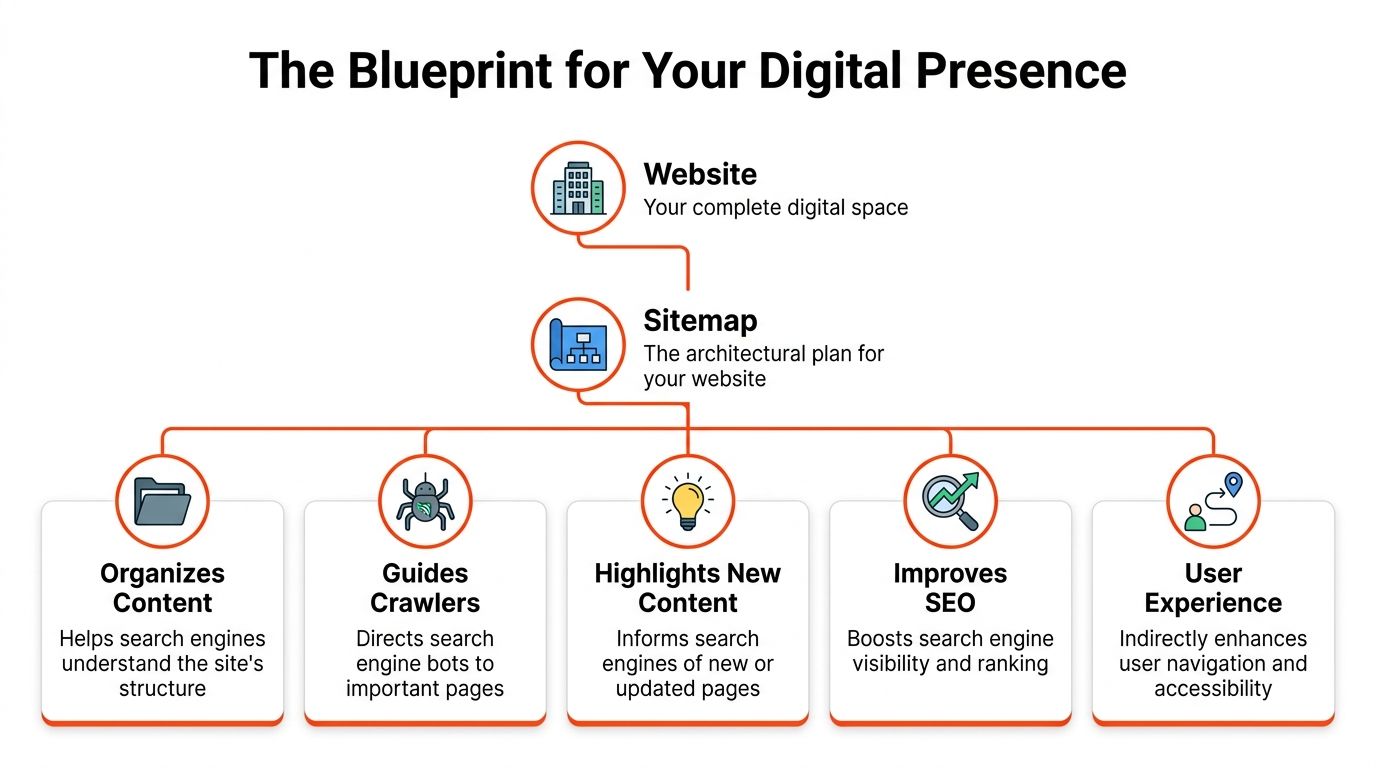
What a sitemap contains
An XML sitemap is the version built for crawlers. It usually includes:
- Page location through the
<loc>tag, which gives search engines the exact URL. - Last modified date through
<lastmod>, which signals when content changed. - Change frequency through
<changefreq>, which suggests how often a page is updated. - Priority through
<priority>, which indicates a page’s relative importance within your own site.
For Australian businesses, this becomes practical fast. Product ranges expand, suburb pages multiply, and paid campaign landing pages go live on tight timelines. The sitemap protocol itself has a long history, originating from an early collaboration between Google, Yahoo!, and Microsoft with the launch of sitemaps.org. Adoption also increased over time. Among the top 10,000 .com.au sites, usage rose from 45% in 2012 to 78% by 2020, according to Concrete CMS on sitemap history and adoption.
Why marketing teams should care
A sitemap affects more than crawl efficiency.
When the file is clean and current, Google can find new commercial pages faster and spend less crawl budget on outdated or low-value URLs. That improves the odds that product pages, service pages, and campaign landing pages are indexed while demand is still active.
There is also a paid media angle that gets missed. PPC teams care about landing page relevance, page quality, and conversion rate. If ad landing pages are hard to discover, incorrectly canonicalised, or left out of the sitemap while duplicate variants stay indexable, the result is often messy signals across paid and organic search. In practice, that can weaken brand consistency, create index bloat around campaign URLs, and make it harder to support strong Quality Scores with relevant, well-maintained landing pages. Better sitemap hygiene does not raise Quality Score by itself, but it supports the page quality and relevance work that improves ad ROI.
Sitemap planning should sit inside the wider search engine optimisation strategy, not as a one-off technical task.
Practical rule: Include indexable, canonical, business-relevant URLs. Leave out duplicate, parameter-based, and low-value pages.
The two core sitemap categories
Most businesses only need to understand two primary types first:
| Sitemap type | Primary audience | Main purpose |
|---|---|---|
| XML sitemap | Search engines | Helps crawlers discover and assess important URLs |
| HTML sitemap | Human visitors | Navigation and internal linking support |
XML supports discovery. HTML supports usability. On well-run sites, both have a clear job.
A Deeper Look at Different Sitemap Types
A sitemap choice affects more than crawling. It influences which pages search engines prioritise, which assets get found, and whether high-value landing pages support both organic visibility and paid traffic efficiently.
That matters when a campaign landing page is carrying media spend. If Google can clearly find the canonical version, understand its supporting assets, and index it without delay, the page is in a better position to reinforce ad relevance, post-click trust, and conversion rate. A sitemap will not improve Quality Score on its own, but it supports the page quality work that helps paid campaigns perform better.
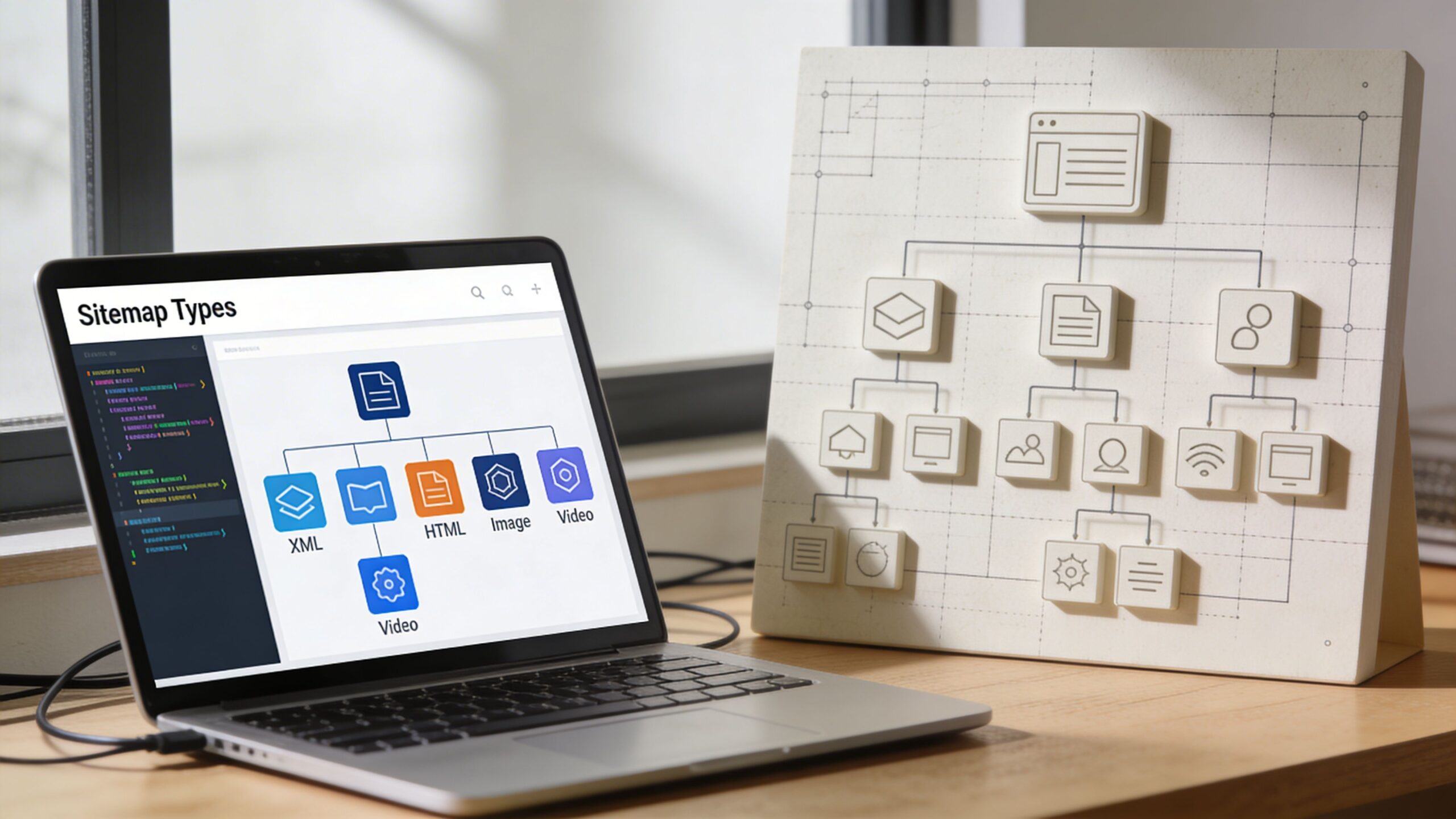
XML sitemaps
XML is the sitemap format built for search engines.
This is the file submitted through Google Search Console. It gives crawlers a clean list of URLs you want considered for indexing. On large sites, scale matters. One XML sitemap can include up to 50,000 URLs and must stay under 50MB uncompressed, as outlined in AwardSpace’s explanation of sitemap specifications.
For ecommerce, publishing, property, and multi-location service sites, XML sitemaps are part of day-to-day search operations. They help keep product pages, location pages, and campaign destinations visible when site structure alone is not enough.
Quality matters more than volume. Include canonical, indexable URLs that serve a commercial purpose. Leave out filtered duplicates, tracking-parameter versions, thank-you pages, staging remnants, and paid landing page variants that should not compete in search.
HTML sitemaps
HTML sitemaps are user-facing pages that expose site structure in plain navigation.
They are useful on B2B lead generation sites, large service sites, and resource-heavy websites where menus and hub pages no longer give a clear overview. On those sites, HTML sitemaps can strengthen internal linking and help visitors reach deeper pages that support evaluation and conversion.
Electrickite reported that B2B lead gen sites with structured HTML sitemaps saw an 18% uplift in organic dwell time and a 12% increase in lead form conversions, according to Electrickite’s sitemap analysis. The same analysis found that sites using both XML and HTML sitemaps achieved 40% faster indexing for new content.
There is also a paid search angle. If PPC traffic lands on one core solution page, HTML sitemap links can help users reach pricing, case studies, service details, and FAQs without relying on internal search or overloaded menus. That can improve assisted conversions from paid sessions, especially on longer B2B buying journeys.
Image sitemaps
Image sitemaps help search engines find image assets associated with a page.
Use them when image visibility matters commercially or when technical implementation makes image discovery less reliable. Common examples include ecommerce product galleries, travel websites, property listings, and design portfolios.
They also help campaign pages that rely on product imagery or branded creative. If those assets support ad-to-page relevance and image search visibility, an image sitemap gives crawlers a clearer route to them.
Video sitemaps
Video sitemaps support pages where video is a real search and conversion asset.
They are useful for product demos, service explainers, webinars, training libraries, and thought leadership content. A proper video sitemap helps search engines understand the video asset and connect it to the right page.
For paid media, this matters on landing pages built around demonstration or education. If a high-intent user clicks an ad, watches a product video, and then converts, that page is doing more than ranking. It is supporting revenue. Video sitemap signals help protect that asset’s discoverability.
XML vs HTML sitemaps at a glance
| Attribute | XML Sitemap | HTML Sitemap |
|---|---|---|
| Primary audience | Search engines | Human visitors |
| Format | Machine-readable XML file | Standard web page |
| Main role | URL discovery and crawl guidance | Navigation and internal linking support |
| Visibility to users | Usually hidden from normal browsing | Publicly accessible |
| Best use case | Any site that wants reliable indexing | Complex sites with many pages or categories |
| Business impact | Better crawl efficiency and index coverage | Better usability and stronger internal link paths |
What to use on which kind of site
A practical setup usually looks like this:
- Small service site: XML sitemap only, unless navigation is hard to use.
- B2B lead gen site with a large content library: XML plus HTML, so search engines and buyers can reach deeper commercial pages.
- Ecommerce site with strong visual merchandising: XML first, then image sitemap support for product discovery.
- Video-led acquisition strategy: XML plus video sitemap support on pages designed to rank and convert.
- PPC-heavy campaign environment: XML for canonical landing pages, then image or video sitemap support where media assets affect ad relevance and post-click performance.
Use the sitemap types that solve a real discovery problem. The best setup reflects how the site earns traffic, supports paid media, and turns visits into revenue.
Why Sitemaps Are Critical for SEO Success
A common paid search problem looks like a PPC issue on the surface. You launch a campaign to a strong landing page, clicks come in, branded searches rise, then Google struggles to surface the same page or its supporting category and product URLs organically. The campaign still spends, but the search result page does less of the selling than it should.
That usually starts with discovery and indexing.
If a page is missing from the index, it cannot attract organic traffic, support branded follow-up searches, or reinforce the message someone saw in an ad. Sitemap health affects more than SEO reporting. It affects how visible your business looks across the full search journey, especially when paid media creates the first touch.
In Australian data covering 5,000 .com.au domains, sites using sitemaps had 92% of submitted URLs indexed compared with 68% for non-users, a 24% uplift, as discussed in Google’s sitemap reporting discussion. In the same discussion, analysts also noted that priority metadata was associated with an average 15-position improvement for high-value pages in SERPs in Google’s sitemap reporting discussion.
For a marketing manager, the commercial implication is straightforward. Better index coverage gives revenue pages more chances to appear when buyers search before clicking, after clicking, or days later when they are comparing options.
That has a direct PPC angle that many SEO guides miss.
Google Ads Quality Score is influenced by landing page experience and relevance. A sitemap does not raise Quality Score by itself, but it helps search engines find, understand, and revisit the canonical landing pages that paid campaigns rely on. When those pages are clearly indexed, supported by related organic URLs, and free from duplication issues, the post-click experience is usually stronger and easier for both Google and users to interpret. That can support ad efficiency over time by reducing friction between the keyword, the ad, and the destination page.
The overlap shows up in a few practical ways:
- Branded follow-up searches convert better: After clicking an ad, buyers often search the brand, product, or service again. If the landing page and its supporting pages are indexed, your brand occupies more of the results page.
- Campaign landing pages hold relevance longer: Seasonal and promotional pages are easier to evaluate when search engines can crawl the intended canonical version quickly.
- Supporting pages strengthen trust: Case studies, category pages, pricing pages, and FAQs often do the work that a single ad landing page cannot do alone.
A sitemap also gives you a clean diagnostic layer inside Google Search Console. You can compare submitted URLs with indexed URLs and spot where Google is pushing back on your page set. If coverage is weak, the cause is usually one of a small group of issues: duplicate URLs, weak internal links, thin templates, canonical conflicts, accidental noindex directives, or pages that should never have been included in the file in the first place.
For this reason, sitemap review belongs in a proper technical SEO audit for indexing and crawl efficiency. It is one of the fastest ways to find pages that should be helping both organic visibility and paid campaign performance but are currently undercut by avoidable technical problems.
A healthy sitemap will not make weak pages rank. It does give your best pages a fair shot at being crawled, indexed, and used across both SEO and PPC journeys.
If you want a practical outside walkthrough, this guide on how to create a website sitemap that boosts UK SEO is a useful companion to the process.
How to Create and Submit Your Sitemap
Creating a sitemap is usually straightforward. Creating a useful sitemap takes more judgement.
The file should reflect your best, indexable URLs. If it blindly includes every page your CMS can generate, it stops being a roadmap and starts becoming clutter.
Choose your creation method
Most businesses use one of three approaches.
CMS-generated sitemap
Platforms like WordPress, Shopify, and many modern site builders can generate sitemaps automatically. This is the fastest option and often the right starting point for small to mid-sized sites.
The risk is convenience. Auto-generation tends to include whatever the platform thinks is eligible, not necessarily what supports your SEO or campaign goals.
Plugin or crawler-assisted setup
Tools like Yoast SEO and Screaming Frog give more control.
Yoast is useful when your site runs on WordPress and you want straightforward management of post types, taxonomies, and exclusions. Screaming Frog is better when you need to audit the indexable footprint of a site before deciding what belongs in the sitemap.
If you want a practical outside walkthrough, this guide on how to create a website sitemap that boosts UK SEO is useful because the process maps closely to how most English-language business sites are set up, even if your target market is Australia.
Manual or custom-generated sitemap
Manual control is best for unusual architectures.
This applies when a site has many campaign landing pages, mixed CMS environments, gated assets, or areas that shouldn’t be exposed in a default sitemap. Development teams often generate custom sitemap logic so only approved URL sets enter the file.
Decide what belongs in the file
Before you publish anything, filter the URL set.
Include pages that are indexable, canonical, strategically important, and capable of ranking or supporting discovery. Exclude pages that waste crawl attention or create mixed signals.
A simple checklist helps:
- Include core commercial pages: Product pages, service pages, category pages, key location pages, and priority content assets.
- Keep canonical URLs only: If several versions of a page exist, list the preferred one.
- Exclude noindex pages: Don’t tell Google to index a page in one place and block it in another.
- Leave out utility clutter: Cart pages, internal search results, staging remnants, and duplicate filtered paths usually don’t belong.
For businesses with active ad accounts, PPC enters the picture here. Campaign landing pages should only go into the sitemap if they’re intended to live as legitimate organic assets. If they’re short-term variants, highly duplicated, or built only for narrow traffic testing, keep them out.
Submit it properly
Once the sitemap is live, submit it in two places.
First, reference it in your robots.txt file so crawlers can discover it easily. Second, submit it directly in Google Search Console, which is the more important step because it gives you reporting on status and indexed coverage.
A deeper technical review often helps at this point, especially if your site has migration history, redirect chains, or indexation issues. Work like technical SEO audits becomes useful in such cases.
Here’s a quick visual overview of the process:
What to check after submission
Don’t stop at “submitted successfully”.
Review whether the right number of pages are being indexed, whether excluded URLs make sense, and whether new content enters the index at a reasonable pace. The sitemap is only doing its job if the indexed set reflects the business pages you care about.
Common Sitemap Mistakes That Hurt Your SEO
A sitemap starts causing problems when it stops reflecting the pages that matter to the business.
I see this after redesigns, campaign launches, and CMS updates. The sitemap still exists, Search Console shows it as submitted, and everyone assumes the job is done. Meanwhile, the file keeps collecting old URLs, thin pages, duplicate variants, and short-term PPC landing pages that were never meant to become long-term organic assets.
Auto-generated bloat
Auto-generated sitemaps are useful, but they are rarely selective enough on their own. Many CMS setups will push almost anything indexable into the file, including tag archives, filtered URLs, internal search results, expired campaign pages, and duplicate parameter versions.
That creates a relevance problem, not just a housekeeping problem. A sitemap should help search engines find and prioritise high-value URLs. If it reads like a raw CMS export, that signal gets weaker.
Paid search teams feel this faster than they expect. If ad traffic lands on pages that are slow to index, poorly canonicalised, or surrounded by duplicate variants, those pages often underperform in organic search and send weaker quality signals overall. That can hurt landing page experience, which is one factor in Google Ads Quality Score. Better sitemap hygiene will not fix a weak PPC campaign by itself, but it does support cleaner crawling, cleaner indexing, and stronger alignment between ad landing pages and the pages you want visible in search.
Indexation conflicts
Some sitemap files include URLs that are set to noindex, canonicalised to another page, redirected, or blocked from useful crawling.
That is a direct contradiction.
You are listing a URL as important while the rest of the site says it should not be indexed as the preferred version. Google can usually work through that, but it wastes time and creates avoidable ambiguity.
Common examples include:
- Redirected URLs: Old pages left behind after a migration or offer change.
- Non-canonical duplicates: Parameter URLs, print pages, or alternate versions instead of the preferred URL.
- Thank-you and confirmation pages: Useful for tracking conversions, but usually poor candidates for search visibility.
- Short-term ad variants: Helpful for testing paid messaging, but not always suitable as permanent organic pages.
A practical rule helps here. If the marketing team would struggle to justify a URL as a useful search result for a real customer, it probably should not be in the sitemap.
Outdated content and broken entries
A clean sitemap should be one of the most reliable URL sets on the site. If it contains deleted pages, 404s, or retired campaign URLs, the issue is usually operational. No one owns the file, so it decays.
Consequently, SEO and PPC often drift apart. Paid teams may keep building new landing pages to support testing and conversion rate gains. SEO teams may be trying to protect index quality and crawl efficiency. Without rules for which campaign pages graduate into the sitemap, the file fills up with temporary assets that add little long-term value.
The result is messy indexing and weaker reporting. It also makes it harder to judge which landing pages deserve more budget, more links, or further optimisation.
Privacy and compliance oversights
Some URLs should stay out of sitemaps because they were never intended for broad discovery. That includes user-specific states, internal tracking flows, gated steps, and pages that expose sensitive process paths.
For Australian businesses, privacy expectations are tightening. The Office of the Australian Information Commissioner explains the Privacy Act review process and reform direction, and that makes sitemap inclusion decisions more than a technical preference. If a URL creates legal, tracking, or user-data risk, do not list it.
A better maintenance routine
The fix is usually simple. Give sitemap ownership to someone who can make commercial decisions, not just technical ones.
Review it on a schedule. Monthly works for active lead generation sites. Weekly may be better for ecommerce or heavy campaign environments. Check which URLs were added, which should be removed, and whether any PPC landing pages have proven valuable enough to become permanent organic assets.
This is also one of the quieter markers of maturity when evaluating agencies and partners. Teams that understand the relationship between crawl efficiency, index quality, landing page experience, and paid performance are usually better at choosing the best SEO company for 2026.
A sitemap should not be a dump file from the CMS. It should be a controlled list of pages that deserve visibility, attract qualified traffic, and support conversion goals across both SEO and PPC.
Advanced Sitemap Optimisation for 2026
A paid campaign goes live, clicks come in, and the landing page converts poorly after the first visit. The usual diagnosis is ad copy, bid strategy, or page design. In practice, I often find a support problem underneath it. Google can reach the ad landing page, but it struggles to discover or trust the surrounding pages that validate the offer, answer objections, and strengthen landing page experience.
Basic sitemap setup gets pages into the crawl queue. Advanced sitemap work helps search engines understand which parts of the site deserve frequent attention, which content supports commercial intent, and how different URL groups contribute to revenue.
The difference shows up fastest on larger sites. Ecommerce catalogues, multi-location businesses, and lead generation sites with campaign assets need more control than a single flat sitemap usually provides.

Use sitemap indexes for scale
Large sites should split sitemaps into logical groups under an index file.
Separate products, categories, blog content, locations, and approved landing pages where that structure matches the business. This makes diagnosis faster. If product URLs are slow to index while blog posts are fine, the issue is easier to isolate. It also helps marketing and SEO teams decide where crawl attention is being wasted and where commercial pages need stronger signals.
I prefer sitemap groupings that reflect reporting lines as well as site architecture. If a paid acquisition team owns campaign pages and a content team owns educational assets, separate sitemap files make accountability clearer.
Make updates dynamic, not manual
Manual sitemap maintenance breaks down once inventory changes often, new articles publish weekly, or campaign pages rotate in and out.
Dynamic sitemap generation is usually the right setup for active websites, but only when the rules are strict. Auto-generated files should include canonicals, indexable URLs, and pages that meet a quality threshold. They should exclude duplicates, thin variants, expired URLs, and anything that should not compete in search.
That trade-off matters. Automation saves time, but bad inclusion rules push low-value URLs into the crawl path and dilute attention from pages that drive pipeline or sales.
Optimise for AI-driven and voice-led discovery
Search behaviour is shifting toward conversational queries, and sitemap strategy needs to support that shift. Octopus.do reports that voice search queries in Australia surged 45% year on year in 2025, while many ecommerce sites still lag on the structured data needed for conversational discovery. The same source says 68% of Australian shoppers now use voice for product discovery, which helps explain why weak indexing and poor page classification can erode high-intent traffic.
The sitemap does not carry schema markup itself. Its job is to expose the right URLs consistently so search engines can crawl, recrawl, and connect those pages with the structured data already on them.
For marketing managers, the commercial impact shows up in three areas:
- Conversational product queries are increasing: Key product, category, and FAQ pages need to be discoverable fast.
- AI-generated answers favour clear site structure: Pages that are easy to crawl and classify have a better chance of being surfaced.
- SEO supports PPC more than many teams realise: If paid visitors click an ad, leave, and then search the brand or product later, indexed support pages can recover that demand and improve total campaign return.
Curate campaign-supporting URLs carefully
Sitemap planning directly connects to PPC performance.
A sitemap will not change Quality Score by itself. Google Ads assesses landing page experience through its own systems. But the underlying inputs overlap more than many teams assume. Clean sitemap inclusion usually sits alongside better internal linking, fewer duplicate URLs, clearer relevance signals, and stronger supporting content around the landing page.
That affects ad ROI in practical ways:
- Buyers who click an ad and research further can find supporting pages that reinforce the offer.
- Product and service pages are more likely to appear for brand and high-intent follow-up searches.
- Google gets a clearer view of which URLs represent the core commercial journey, which can support trust and consistency across paid and organic touchpoints.
I see this most often in account audits where PPC teams are sending traffic into isolated landing pages with no indexed ecosystem around them. Fixing sitemap coverage for comparison pages, FAQs, service detail pages, and location pages does not replace ad optimisation. It gives those clicks a better chance of turning into qualified conversions.
If you’re benchmarking agencies or planning internal capability for the year ahead, a useful broader decision guide is choosing the best SEO company for 2026, especially if you want to assess whether a provider understands technical SEO as part of business performance rather than as a checklist.
Strong sitemap strategy comes down to judgment. Decide which pages deserve crawl attention, indexation, and visibility, then keep the file aligned with that decision.
The sites that gain the most in 2026 will not be the ones with the largest sitemap. They will be the ones with the cleanest commercial signal.
Read NeXt
Or Read Our Latest
- Manual vs Automated Bidding for PPC Success
- Conversion Tracking Setup: A Complete AU Guide
- Instagram Advertising Australia: Complete 2026 Guide
- Pay Per Click: A Beginner’s Guide for Australian Marketers
- Display Advertising on Google: The Complete Australian Guide
- Stakeholder Communication Plan How to Build One That Works
Click. CLick. Subscribe.
Get our best PPC insights, industry updates, and power moves delivered straight to your inbox. No fluff, just high-caliber strategies that actually work.
Don’t Leave Just Yet
Try Us For 30-Days,
Risk Free!!
We guarantee that you’ll love our work within the first 30 days, if not you’ll get your money back.
What have you got to lose?