

Hiring a Digital Marketing Agency Melbourne: Your 2026 Guide
Last Updated

You've probably done some version of this already. You search for a digital marketing agency in Melbourne, open five tabs, and every site says roughly the same thing. Full-service. Data-driven. Growth-focused. SEO, Google Ads, social, content, strategy, reporting.
That doesn't help when you're the one signing the agreement and carrying the commercial risk.
What most Melbourne business owners need isn't a bigger service list. It's a clearer answer to a harder question. Which channel should get your next dollar, and what should wait? If your budget is constrained, a broad “we do everything” plan can dilute spend, slow learning, and make accountability fuzzy. If your budget is healthy but your tracking is weak, even a good agency can produce activity without producing clarity.
Hiring a digital marketing agency in Melbourne should be a commercial decision, not a branding exercise. The right partner helps you prioritise channels, set up measurement properly, and tell you where not to spend. The wrong one sells range when you need focus.
Navigating the Melbourne Digital Agency Landscape
A Melbourne business owner can spend a week comparing agencies and still come away with the wrong shortlist. The problem is not lack of options. It is that too many firms present the same service stack, the same promises, and the same reporting language, even when they solve very different problems.
That matters more in Melbourne than many buyers realise. The agency market is crowded, mature, and easy to misread. IBISWorld describes a large Australian digital advertising and agency sector with thousands of businesses competing for share, which means polished positioning is common and genuine fit is harder to spot. If you want market context, start with IBISWorld's industry research on digital advertising and agency services in Australia.
For an SMB with a constrained budget, the first filter should be simple. Ignore the “full-service” claim and ask how the agency would allocate the next $5,000 to $20,000 of your spend. A good answer usually sounds narrower than buyers expect.
A local service business that depends on nearby intent often needs Google Ads, conversion tracking, and local SEO in Melbourne before it needs brand campaigns, TikTok content, or a long channel rollout. An e-commerce store with decent traffic but weak conversion rates may get more return from fixing feed quality, remarketing, and landing pages than from adding another awareness channel. A B2B firm with long sales cycles might need paid search and CRM attribution before it invests heavily in organic content.
The trade-off is straightforward. Spreading a modest budget across SEO, Google Ads, Meta, LinkedIn, email, content, and CRO sounds impressive, but it usually slows feedback and makes it harder to see what is producing leads or revenue. Concentrated spend creates cleaner data. Cleaner data leads to faster decisions.
Why Melbourne buyers need a sharper filter
In a busy market, weak agencies often sell breadth because breadth is easier to package. Strong agencies are usually more selective. They can explain why one channel should lead, which channels should wait, and what level of spend is too low to judge fairly.
That is the test worth using early.
If an agency cannot explain channel priority in commercial terms, cost per lead, sales cycle length, conversion rate, margin, or payback period, they are unlikely to manage your budget with discipline after the contract starts.
What a strong agency decision usually looks like
The best shortlist usually reflects three practical realities:
- Business model first. A local clinic, a Shopify retailer, and a commercial services firm should not buy the same channel mix.
- Speed to evidence matters. If you need leads this quarter, high-intent channels often deserve priority over slower brand-building activity.
- Internal capacity sets the ceiling. If your team cannot produce creative, approve content quickly, or handle lead follow-up, the media plan has to account for that.
Good agency selection starts with budget logic, not agency size. The right partner will tell you where focus creates return, where broad service lines add cost, and where your money should wait until tracking, sales process, or unit economics are in better shape.
Define Your Goals Before You Search
The biggest mistake in agency selection happens before the first discovery call. A business starts shopping without deciding what success looks like.
That creates a predictable outcome. Agencies fill the vacuum with their preferred package. If they're SEO-led, your solution becomes SEO-heavy. If they're paid-social-led, your solution becomes content, creatives, and Meta campaigns. You end up buying what they sell most comfortably, not what your business needs most urgently.
Start with the commercial outcome
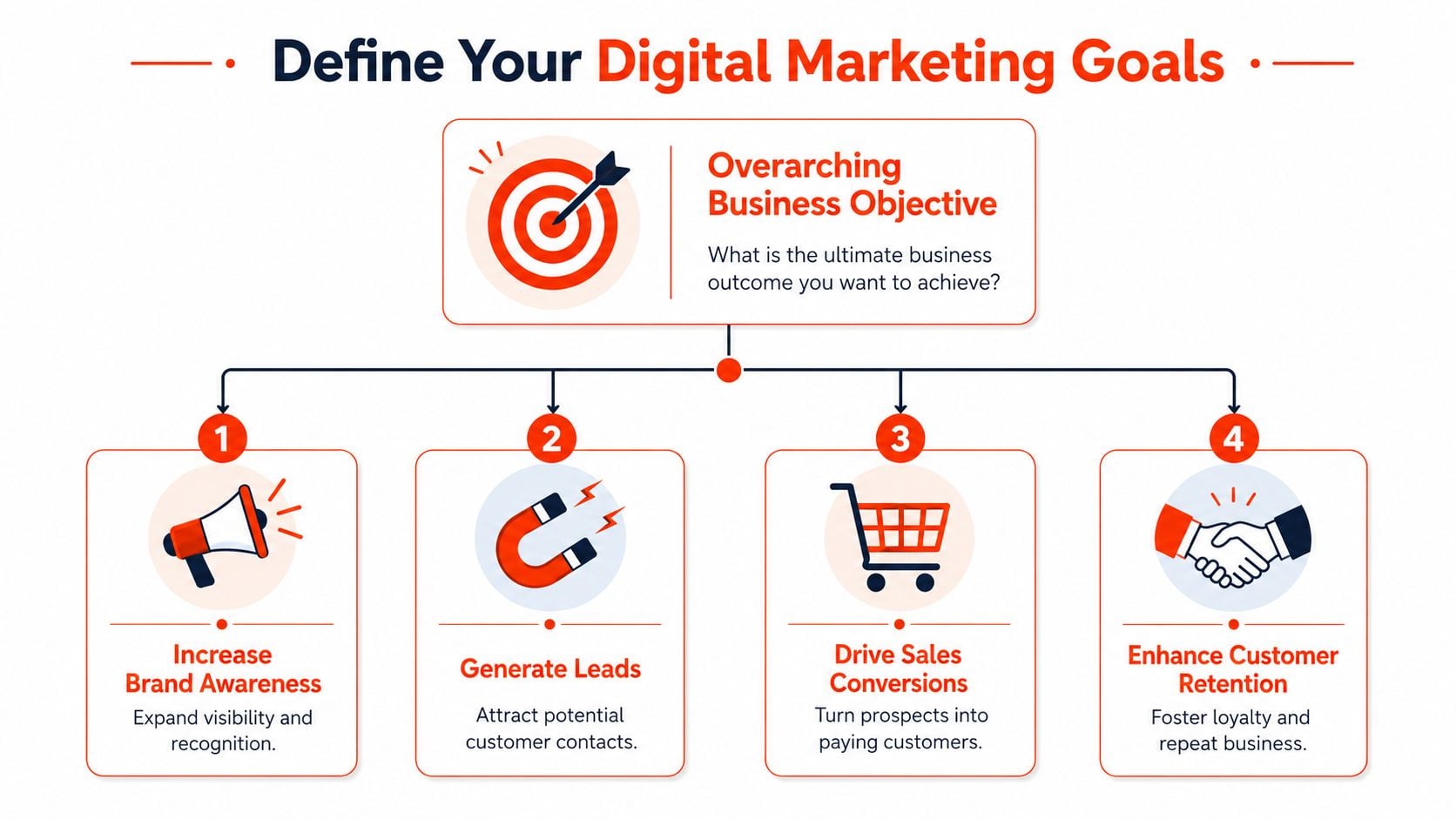
Before you contact any digital marketing agency Melbourne firms, write down one primary objective and one supporting objective. Not six. Not every ambition you have for the year.
Use plain language:
- Primary objective: more qualified leads for the sales team
- Supporting objective: reduce wasted spend across underperforming channels
Or:
- Primary objective: increase online sales from existing product categories
- Supporting objective: build remarketing audiences for repeat purchase activity
If you can't state the objective in one sentence, your brief is still too vague.
A lot of businesses benefit from defining the difference between broad ambitions and measurable business targets before speaking to agencies. A simple resource on goals versus objectives can help sharpen the brief.
The full-service myth costs SMBs money
Most agency content repeats service lists but rarely answers the practical question: what should I spend on each channel, and how do I know if the split is right for my business? That gap is one reason the “full-service” promise deserves scrutiny, as noted in this budget transparency perspective for Australian businesses.
Full-service isn't automatically wrong. It's often wrong first.
If your budget is limited, splitting spend too early across SEO, Google Ads, Meta Ads, LinkedIn, content production, email flows, landing page redesign, CRM automation, and reporting can leave every channel underfed. You get lots of moving parts and not enough signal.
A narrow, high-intent setup usually beats a diluted omnichannel plan when the business needs fast feedback and trackable return.
Match the channel to the buying behaviour
Here's a practical way to think about channel priority.
| Business situation | Channel likely to deserve early budget | Why it often comes first |
|---|---|---|
| Buyers are already searching for the service | Google Search Ads or SEO | Captures active intent |
| Sales value is high and targeting matters | LinkedIn Ads with strong offer pages | Useful for focused B2B outreach |
| Product catalogues and impulse influence matter | Shopping, search, and remarketing | Closer to transactional behaviour |
| The business relies on local discovery | Local SEO and search campaigns | Captures nearby demand |
| The brand is new and demand is weak | Paid social testing plus offer validation | Helps test messaging and audience response |
That's not a universal formula. It's a decision lens.
Questions to settle before you brief agencies
Don't ask an agency to fix ambiguity you still own internally. Settle these first:
- What do we need most right now? Leads, sales, booked appointments, enquiries, or retention.
- What can we measure cleanly? Purchases, form fills, calls, booked demos, store visits.
- How long can we wait for payoff? Some channels reward patience. Others should produce learnings quickly.
- What can the internal team support? Creative approvals, landing pages, CRM follow-up, sales responsiveness.
- What are we not funding yet? This matters as much as what you are funding.
A strong brief makes a strong agency relationship possible. Without that, every proposal looks persuasive because nothing is anchored to a real commercial priority.
How to Identify and Shortlist Potential Agencies
A longlist is easy. A useful shortlist takes discipline.
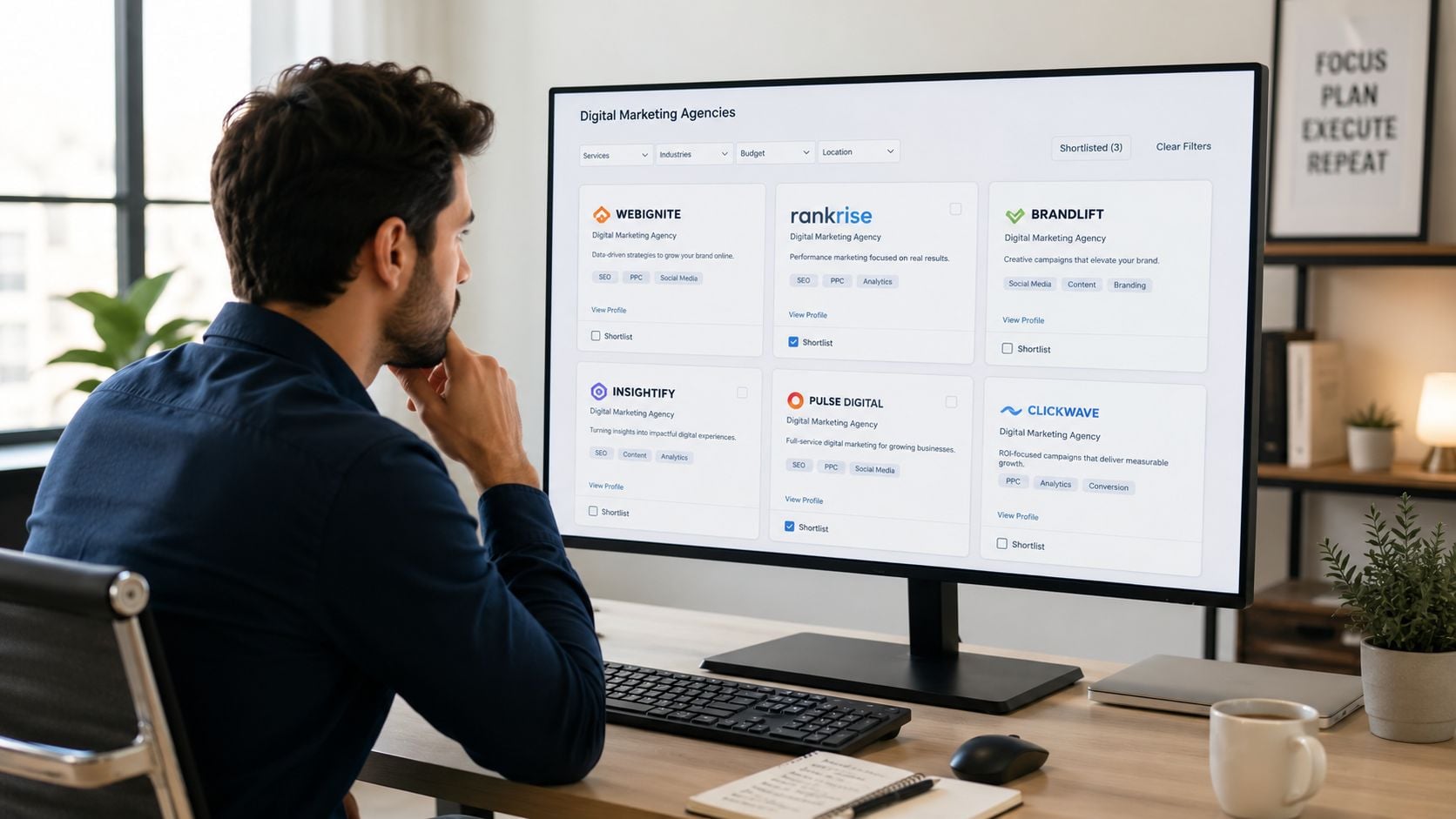
Melbourne is a dense agency market. Semrush's directory identifies 57 digital marketing agencies in the city in 2026, which reinforces how saturated and specialised the local market has become, according to Clutch's Melbourne agency overview. That density is useful if you know what signals to look for. It's distracting if you don't.
Build the longlist with the right sources
Start with directories, then move to agency sites.
Directories help because they show category focus, review patterns, and service positioning in one place. Agency websites help you inspect thinking. A useful starting point is a curated view of digital marketing agencies alongside independent directories and your own search results.
For the first pass, ignore slick branding. Check for fit.
- Service depth: Do they clearly specialise in the channels you need first?
- Industry relevance: Do they show experience with businesses that sell like you sell?
- Commercial language: Do they talk about leads, sales, enquiries, and conversion paths, or just visibility and engagement?
- Measurement maturity: Do they explain tracking, attribution, reporting cadence, and optimisation logic?
What to look for on the website
A good agency site usually reveals how they think. Not just what they sell.
Look for specificity. If an SEO page discusses technical fixes, content structure, search intent, and reporting logic, that's more credible than a page filled with generic promises. If a PPC page explains account structure, search terms, landing page alignment, and conversion tracking, that's a better signal than “we maximise ROI” repeated five times.
Red flags often show up in language before they show up in performance:
- Everything for everyone: If the agency seems built for every industry, every budget, and every channel, caution is warranted.
- No clear point of view: Strong strategists make choices. Weak ones avoid committing.
- Thin proof: If “results” are discussed without detail, expect the proposal to stay vague too.
A short educational video can also help you sharpen your evaluation lens before outreach.
Reduce the list fast
Don't interview ten agencies. That usually creates more confusion, not more confidence.
Use a simple shortlist filter:
| Keep on shortlist if | Remove if |
|---|---|
| Their strongest channels match your first priority | They push broad retainers before understanding your goal |
| They explain reporting and decision-making clearly | They rely on vague claims and generic outcomes |
| They show evidence of strategic trade-offs | They treat every business like it needs the same mix |
| Their communication feels direct and commercially literate | Their process is hard to pin down |
The right shortlist usually has only a few names on it. If too many agencies still look viable, your brief probably isn't sharp enough yet.
The Critical Questions to Ask Every Agency
A Melbourne business with a $6,000 monthly marketing budget cannot afford a vague agency conversation. One wrong hire can burn three months on meetings, broad channel testing, and reports that look busy but do not produce qualified leads.
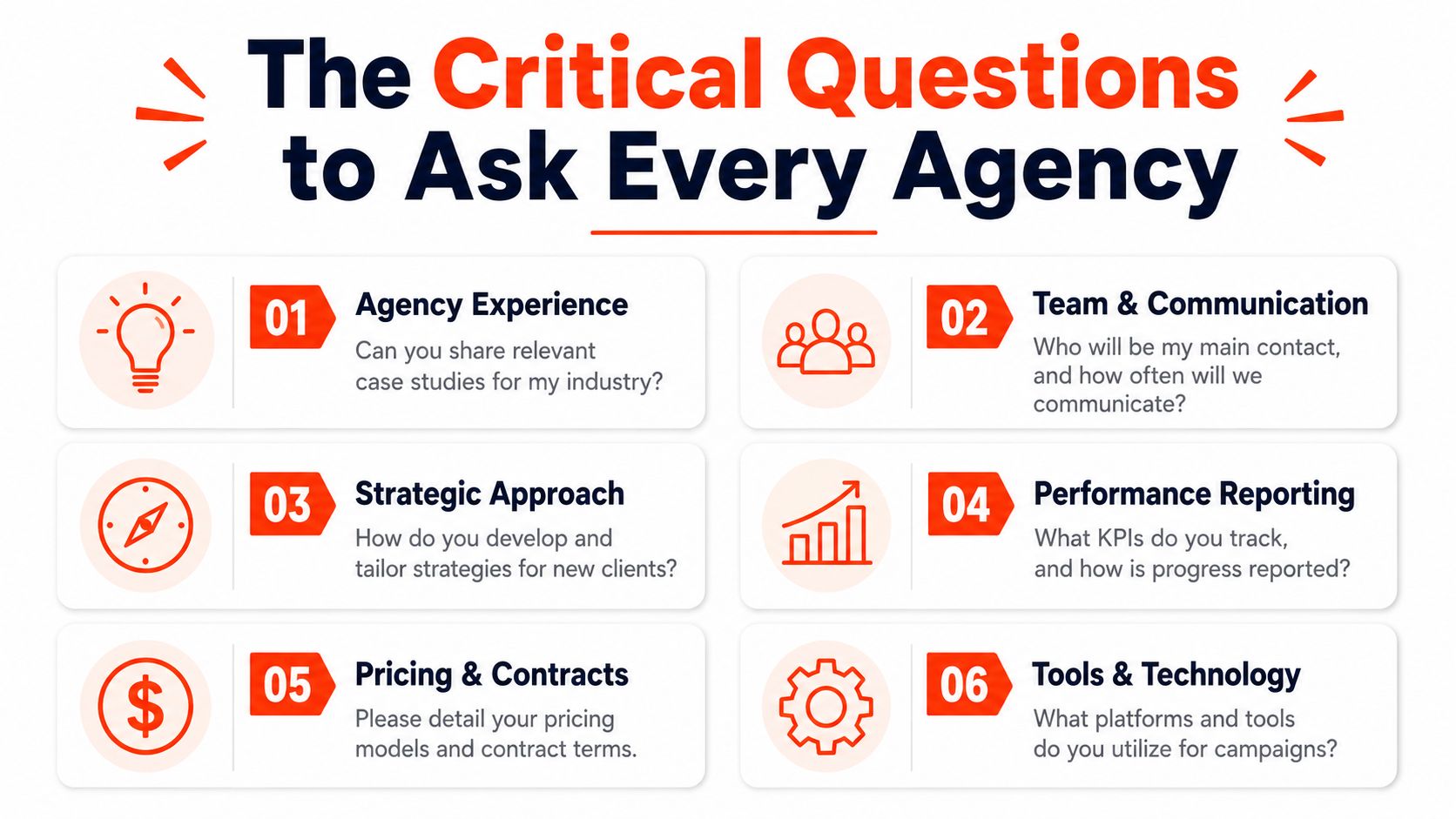
This meeting is about decision quality under pressure. Ask questions that reveal how the agency chooses channels, protects budget, and reacts when early performance is mixed.
Strategy and channel judgement
Start with the question that exposes whether the agency can prioritise.
If budget is tight, what channel would you start with first, what would you delay, and why?
That question matters because many Melbourne SMBs do not need a full-service retainer on day one. They need one channel that can produce measurable signal fast, then a second channel only when the first is under control. A good agency will explain the order clearly. Search may come first if there is existing buyer intent. Paid social may come first if the offer is strong and demand needs to be created. SEO may be delayed if technical fixes, content production, and time-to-result do not match your cash flow.
Useful follow-up questions:
- What channel would you test first for fast, trackable ROI?
- What would you leave out in the first 90 days?
- What would make you shift budget from Google Ads to SEO, or from paid social to landing page work?
- How do you judge whether the problem is demand, targeting, creative, or conversion rate?
- What role does AI play in your SEO or PPC work, and where does human review still matter?
Strong answers include trade-offs. You should hear references to search intent, deal size, sales cycle, CRM tracking, call tracking, landing page quality, and whether your team can follow up leads quickly. Weak answers stay broad because broad advice is easier to sell.
A credible answer sounds like this: “You have clear search demand and a high-value lead. We would start with Google Ads and conversion tracking, keep spend tightly focused, and hold SEO content and paid social until we know which services, suburbs, and search terms generate qualified enquiries.”
Process and operating discipline
Once channel choices are clear, test how the agency runs the work.
Poor agency relationships often fail here. The strategy may be reasonable, but ownership is fuzzy, reporting is weak, and the client ends up managing the agency instead of the other way around.
Ask these directly:
- Who is running the account each week?
- What happens in the first 30 days?
- What access do you need from us, and what can block progress?
- How often will we review results, and what decisions get made in those reviews?
- Can you show a real report with leads, cost per lead, and commentary on what changed?
- What do you do when tracking breaks, approvals stall, or the landing page underperforms?
Look for operational clarity. Names. Roles. Timelines. A reporting cadence. A clear list of dependencies on your side.
If they cannot explain the first month in practical terms, expect confusion after signing. If they cannot show how they report on lead quality, expect a lot of discussion about clicks.
Commercials and accountability
Many business owners lose money when they compare monthly fees before they compare how budget decisions get made.
Ask about commercials in a way that connects fees to output and accountability:
- What is your management fee, and what work does it cover each month?
- What is outside scope?
- How do you separate media spend from strategic and implementation work?
- At what budget level does adding another channel stop making sense?
- If results are weak after the first month, what gets changed first?
- How do you decide whether to improve the campaign, the offer, or the website before asking for more budget?
The right agency will not pretend every problem is solved by adding channels. Sometimes the highest-ROI move is narrowing keyword coverage, rewriting a landing page, fixing form tracking, or pausing a weak campaign before more spend disappears.
As an example of this model, our own agency, Click Click Bang Bang, uses tiered monthly plans, transparent reporting, no long-term commitments, and a 30-day risk-free trial. The point is not the format itself. The point is whether the agency can explain, in plain language, what you are paying for and how decisions are made if performance stalls.
Red-flag answers to listen for
Pay close attention to evasive language. It usually shows up before poor performance does.
| Question area | Healthy answer | Red flag |
|---|---|---|
| Channel priority | Explains sequence, budget logic, and what waits | Says every channel should start at once |
| Budget use | Connects spend to lead goals and tracking confidence | Pushes bigger budgets before proving signal |
| Reporting | Shows leads, cost per lead, sales context, and actions | Fixates on impressions, reach, and traffic only |
| Team access | Names the people doing the work | Keeps delivery ownership vague |
| AI usage | Explains where AI speeds research or drafting, plus review steps | Uses AI as a label without method |
| Underperformance | Describes a diagnosis process across channel, offer, audience, and page | Blames seasonality or the market immediately |
The best agency calls usually feel narrower by the end, not broader. You should leave with a clear view of what they would do first, what they would ignore for now, and how they would protect a constrained budget while chasing measurable growth.
Decoding Pricing Models and Red Flags
A Melbourne business on a constrained budget does not need a prettier proposal. It needs a pricing model that shows where money goes, which channel gets funded first, and how the agency will judge whether the spend is working.
That is where many agency proposals fall apart. Two retainers with the same monthly fee can produce completely different outcomes. One funds senior strategy, disciplined testing, and clear reporting. The other spreads budget across too many channels, hides setup costs inside vague line items, and leaves you guessing which half of the work is being done.

The main pricing models
The pricing structure matters less than the decision logic behind it. Melbourne SMBs usually get better results when the agency matches pricing to the job at hand instead of forcing every client into a full-service arrangement from day one.
| Model | Usually suits | Upside | Watch-out |
|---|---|---|---|
| Monthly retainer | Google Ads, SEO, paid social, email, or ongoing channel management | Steady optimisation and clearer operating rhythm | Easy for scope to blur if deliverables and channel priorities are vague |
| Project fee | Tracking setup, account rebuilds, landing pages, audits | Defined output and easier upfront budgeting | Does not cover the ongoing work needed to improve results over time |
| Performance-based model | Mature lead-gen programs with reliable attribution | Commercial alignment when measurement is tight | Lead quality disputes appear fast if tracking or sales follow-up is weak |
Retainers work best when there is enough data and enough budget to justify ongoing optimisation. They are often the right fit for paid search, SEO, or an account that already has proven demand.
Project work is often the smarter first step. If tracking is broken, landing pages are weak, or the ad account is a mess, paying for a reset before signing up for monthly management can protect cash and shorten the path to usable data.
Performance deals sound attractive to owners who have been burned before. The catch is simple. If nobody can agree on what counts as a qualified lead, who owns the follow-up, or how offline sales are tracked, the pricing model creates arguments instead of accountability.
What good pricing transparency looks like
A strong proposal shows the split between management fees, media spend, setup costs, and optional work. It also shows channel sequencing.
That last point matters. A small business spending $4,000 to $8,000 a month usually cannot afford to run Google Ads, SEO, paid social, email automation, content production, and CRO all at once with real depth. Something has to come first. Something has to wait. Agencies that refuse to make that trade-off are usually selling breadth instead of results.
Ask for the budget in plain English:
- How much goes to agency fees
- How much goes to ad spend
- What setup work is one-off
- Which channel is first priority
- What gets deferred until the first channel proves traction
If they cannot answer that cleanly, the budget will get harder to interpret once campaigns are live.
Contract terms that deserve scrutiny
Some terms are reasonable. Some are there to protect revenue, not performance.
Check these closely:
- Lock-in periods: Long terms increase risk when the agency has not yet proved channel fit.
- Fee layering: Confirm whether reporting, creative, landing pages, and strategy sessions are included or billed separately.
- Asset ownership: Get clarity on ad accounts, GA4, GTM, pixels, creative files, CRM integrations, and dashboards.
- Scope wording: “Ongoing optimisation” should be backed by specific activities, channels, and reporting outputs.
- Change control: Ask what happens if the agreed channel mix stops making sense after 30 or 60 days.
A contract should make it easier to change course when evidence changes. It should not trap you in the original plan after the market proves that plan wrong.
Common red flags
The biggest pricing red flag is forced full-service packaging. If an agency insists you need SEO, PPC, paid social, content, email, and a website refresh before they have shown where the fastest return is likely to come from, they are making budget allocation harder than it needs to be.
Watch for these signs:
- Guaranteed rankings or guaranteed lead volumes: Serious operators explain variables they can influence and the limits they cannot control.
- No line of sight on tracking: If conversion tracking is still fuzzy, no pricing model can be judged fairly.
- Proposal before diagnosis: Templated packages usually lead to templated channel mixes.
- Heavy setup fee with thin explanation: Large upfront costs need a clear list of deliverables and business value.
- Low management fee paired with a wide scope: Cheap retainers often mean junior delivery, slow response times, or very little hands-on optimisation.
Good pricing conversations feel specific. You should finish with a clear view of what you are buying, what will be measured first, and how the agency will protect your budget if the initial channel choice underperforms.
Setting Up for Success Onboarding and KPIs
You sign the agreement on Friday. By the second week, the agency is already asking for budget increases, but conversion tracking is still unclear, reporting is full of platform metrics, and nobody can tell you which channel should earn the next dollar. That is an onboarding failure, not a media problem.
For a Melbourne SMB with a constrained budget, the first 30 days should answer three questions fast. What are we tracking, who owns each decision, and which channel gets tested first for the quickest measurable return. If an agency cannot create that clarity early, the "full-service" promise usually turns into scattered activity across too many channels.
What good onboarding looks like
Strong onboarding starts with commercial context, not admin. The agency should understand margin, sales cycle, lead handling, geographic focus, and what a good customer looks like before it starts pushing campaigns live.
Then the practical work begins:
- Access and asset collection: ad accounts, analytics, CRM, website CMS, call tracking, creative files
- Tracking validation: form fills, calls, purchases, quote requests, and offline sales signals where relevant
- Offer review: what is being sold, why it should convert, and where friction is likely
- Channel priority: which one or two channels get the first budget allocation, and why
- Decision cadence: who approves changes, how often results are reviewed, and what triggers a budget shift
Effective strategy requires explicit trade-offs. A business with a tight budget may be better served by getting Google Ads tracking and landing page performance right before spending anything on paid social. A brand with strong repeat purchase behaviour may justify email and remarketing earlier. Good onboarding makes those choices visible. It does not hide them behind a broad service checklist.
KPIs that belong on the dashboard
The KPI set should reflect how the business makes money. If the dashboard leads with impressions, clicks, and reach, ask what commercial decision those numbers support.
For lead generation, useful KPIs usually include cost per qualified lead, sales acceptance rate, booked appointments, pipeline value, and close rate by source. For e-commerce, the early focus is usually revenue by channel, new customer acquisition cost, gross margin by campaign type, and the split between prospecting, brand capture, and remarketing.
A useful dashboard answers four practical questions:
- What happened in the period?
- Which channel or audience drove the result?
- What did we learn that changes the next budget decision?
- What will be reduced, increased, or tested next?
That last point matters. Reporting should support allocation, not just description.
If SEO is in the mix, the KPI discussion should stay grounded. Track leading indicators such as qualified organic enquiries, commercial landing page visibility, and assisted conversions. Do not let broad traffic growth distract from whether SEO is contributing to leads or sales. The same rule applies to paid media. A cheaper click is irrelevant if lead quality drops.
The best onboarding process creates a clean scoreboard and a short list of priorities. That gives you a way to judge the agency by decisions and outcomes, not by how busy the account looks.
If you're comparing options for a digital marketing agency in Melbourne and want a more transparent discussion about channel mix, budget priorities, PPC, or AI-first SEO, Click Click Bang Bang is one agency you can review. Its approach is built around clear onboarding, transparent reporting, flexible monthly plans, and channel-specific execution rather than vague full-service packaging.
Read NeXt
Or Read Our Latest
- How to Set Up Google Ads in Australia: Complete 2026 Guide
- Google Merchant Center Setup: The Complete 2026 Guide
- Business Manager Setup Facebook: The Complete 2026 Guide
- Google Ads Account Setup: Expert Guide for 2026
- Search Ads Optimisation: A Practical Guide for 2026
- Manual vs Automated Bidding for PPC Success
Click. CLick. Subscribe.
Get our best PPC insights, industry updates, and power moves delivered straight to your inbox. No fluff, just high-caliber strategies that actually work.
Don’t Leave Just Yet
Try Us For 30-Days,
Risk Free!!
We guarantee that you’ll love our work within the first 30 days, if not you’ll get your money back.
What have you got to lose?