

Digital Marketing for Dentistry: 2026 Guide
Last Updated

Some weeks the book looks healthy on Monday and worryingly thin by Thursday. A couple of cancellations land at once. Hygiene is steady, but higher-value treatment acceptance feels uneven. New patient enquiries come in waves, then go quiet. If that sounds familiar, you’re not dealing with a clinical problem. You’re dealing with a marketing system problem.
A lot of dental practices still rely on reputation alone and hope demand stays consistent. Reputation matters, but it rarely creates a predictable pipeline by itself anymore. Patients research on their phones, compare providers in Google results, scan reviews, and make fast decisions based on convenience, trust, and what they see online.
That’s why digital marketing for dentistry has shifted from “nice to have” to operational necessity. In the Australian dental market, paid search ads drive 35% of website traffic, and practices are increasing digital marketing budgets by over 60% to capture online search behaviour that precedes 71% of patient bookings, according to Australian dental marketing statistics.
The practical upside is simple. Digital marketing gives you levers you can control. You can improve visibility, tighten your booking path, track which channels produce calls and form leads, and stop guessing which efforts are worth the spend.
Why Your Dental Practice Needs a Digital Marketing Plan
A dental practice without a plan usually ends up doing disconnected marketing. A boosted Facebook post here. A new website page there. Maybe some Google Ads for a month, then nothing when the results are unclear. That approach burns time and usually creates more confusion than growth.
A plan fixes that because it ties marketing activity to business outcomes. Not vanity metrics. Not generic “brand awareness”. Operational goals, such as filling quiet appointment blocks, attracting more implant consults, increasing hygiene reactivations, or lifting the quality of new patient enquiries.
Unpredictable patient flow is a business risk
Most owners don’t feel the problem as “marketing underperformance”. They feel it in the diary.
You see it when front desk staff are trying to patch cancellations. You see it when one clinician is booked out and another has gaps. You see it when a practice gets plenty of enquiries, but too many are price shoppers, poorly matched, or unlikely to proceed.
Digital marketing works best when it creates consistency. That means:
- Capturing existing demand: Showing up when someone is actively searching for a dentist or a specific treatment.
- Reducing friction: Making it easy to call, enquire, or book without hunting through a clunky site.
- Building confidence before contact: Using reviews, service pages, and local visibility to answer the patient’s objections early.
A plan makes trade-offs clear
Every practice has limits. Budget, staff capacity, chair availability, and growth targets all matter. A proper plan helps you decide what to prioritise first instead of trying to do everything at once.
For example:
- If you need faster lead flow: Paid search is usually the sharper tool.
- If you want stronger long-term visibility: SEO and local optimisation matter more.
- If your website leaks enquiries: More traffic won’t solve the underlying issue.
- If trust is the bottleneck: Reviews and social proof need attention before ad spend scales.
Practical rule: Don’t buy traffic before you’ve fixed the booking path.
That’s the fundamental purpose of digital marketing for dentistry. It isn’t to make your practice look modern. It’s to give you a reliable, measurable patient acquisition system.
Mapping Your Strategy to the Modern Patient Journey
Most dental marketing underperforms because practices think in channels. Patients don’t. They move through a decision process.
A better frame is the patient journey. Someone realises they have a problem, starts comparing options, decides who feels credible, books, experiences the visit, and then either disappears or becomes loyal. Once you see marketing through that lens, channel decisions get easier.
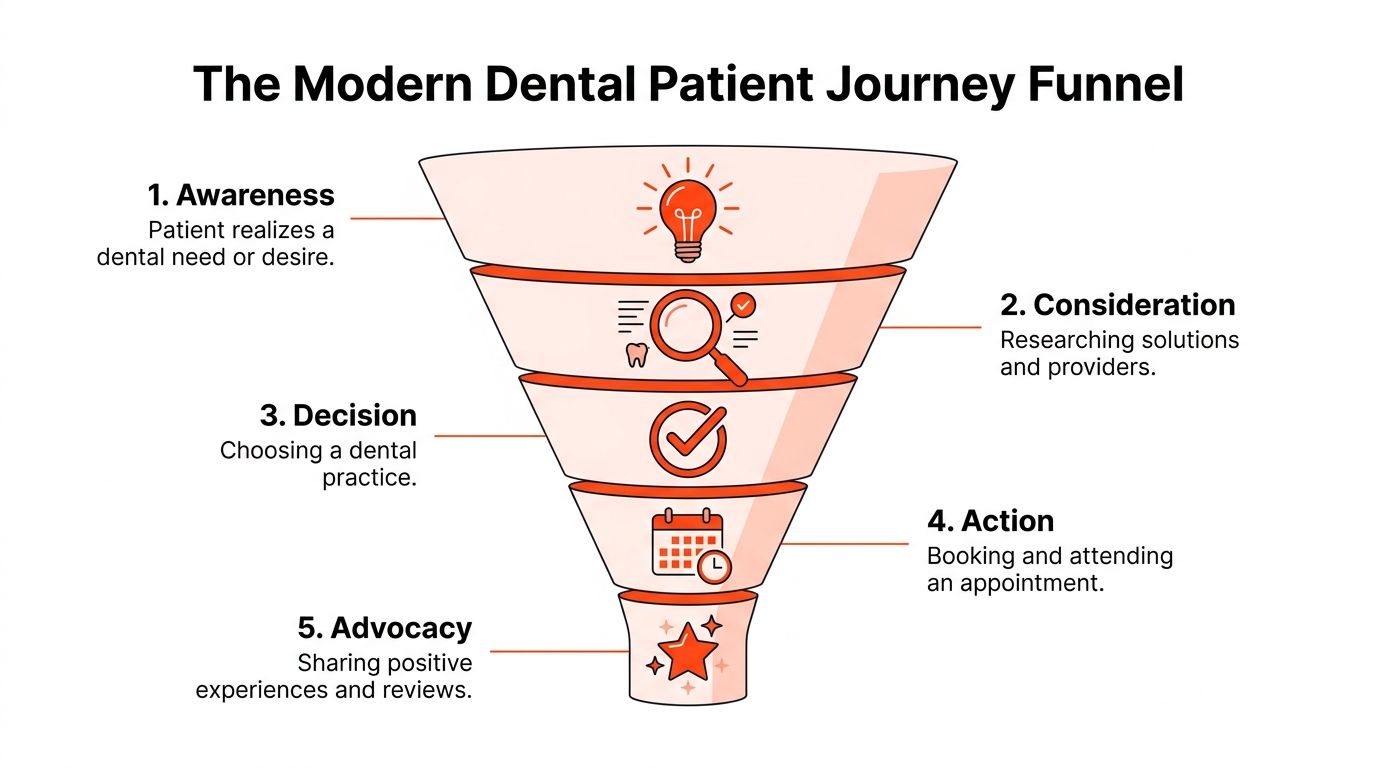
If you want a useful mental model for this, customer journey mapping is a strong framework because it forces you to look at the patient’s questions, friction points, and decision triggers at each stage.
Awareness
This is the moment a person recognises a need. It might be pain, a chipped tooth, overdue hygiene, or cosmetic interest.
At this stage, the patient isn’t always searching for your practice name. They’re searching for a problem, a location, or a service. “Emergency dentist near me.” “Teeth whitening cost.” “Dental implants Brisbane.”
The channels that matter most here are:
- Google Business Profile
- Local SEO
- Google Ads
- Short educational content that answers common questions
The mistake many practices make is speaking too early like the patient has already chosen them. Awareness content should reduce uncertainty first.
Consideration
Now the patient is comparing. Trust gets tested at this stage.
They’ll look at your website, reviews, service pages, photos, practitioner information, and whether your practice feels approachable. They’re not only asking, “Can you do this?” They’re asking, “Do I feel safe booking with you?”
Here, the strongest assets are usually:
- A fast, mobile-friendly website
- Clear treatment pages
- Strong review presence
- Visible contact options
- Consistent branding across Google and social channels
A poor site or weak review profile often kills momentum here, even if the ad or search result did its job.
Decision
This is the point where the patient narrows down to one or two practices. Small details matter a lot.
They’ll notice if your phone number is easy to tap, whether your hours are current, how quickly you respond, and whether the enquiry form is simple. They’ll also compare whether one practice feels organised and another feels vague.
A lot of practices lose patients here because the final step feels harder than it should.
The best-performing campaigns usually don’t win because of clever ads. They win because the practice made booking easy.
Action
The patient books and attends. Marketing doesn’t stop at the form submission or phone call.
If the confirmation process is clunky, if directions are hard to find, if reminders are inconsistent, or if the first visit experience feels disjointed, acquisition costs rise because fewer leads become actual patients.
This stage depends on operations as much as promotion.
Loyalty
Loyalty is where marketing becomes compounding rather than transactional.
A patient who returns, accepts treatment, leaves a review, and refers family is far more valuable than a one-off booking. Your follow-up emails, recall reminders, review requests, and community presence all influence this stage.
Practices that understand the full journey stop asking, “Should we do SEO or social?” and start asking better questions. Such as which stage is leaking patients, and which channel fixes that leak fastest.
Building Your Digital Foundation for Success
Before you spend harder on acquisition, get the basics right. Your website and your Google Business Profile are the two assets most practices underestimate. Together, they act as your digital front door.
If either one is weak, your other marketing channels have to work harder than they should.
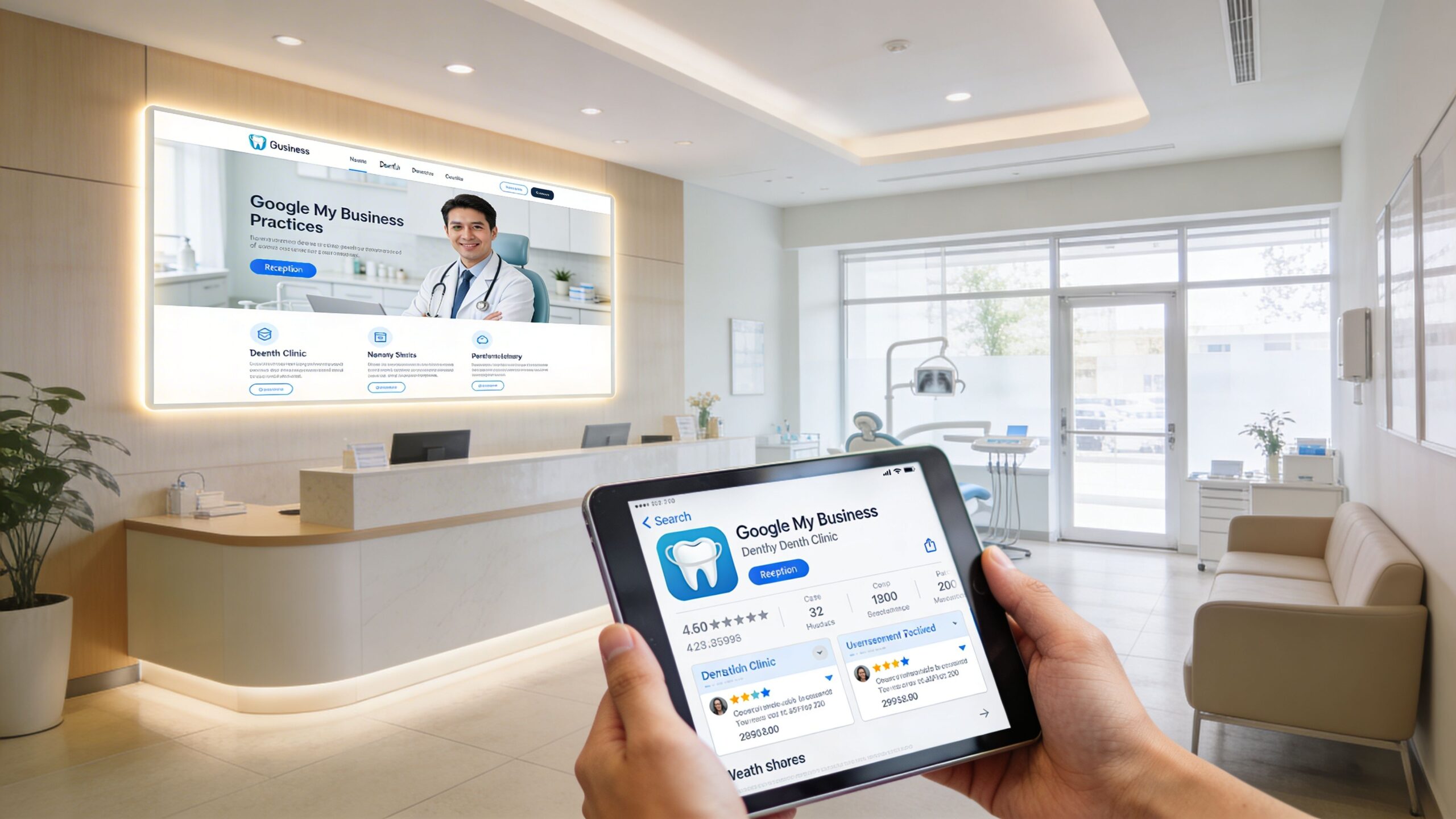
Your website must convert, not just exist
A dental website isn’t a digital brochure. It’s a conversion tool.
That means every important page should help a patient do one of three things quickly:
- Understand the service
- Trust the practice
- Take the next step
The technical side matters more than many owners realise. 61% of website visits originate from mobile devices, and poor mobile user experience increases bounce rates on booking pages and reduces lead generation efficiency, according to RevenueWell’s guidance on dental marketing strategy.
A practical website checklist looks like this:
- Clear calls to action: “Book an appointment”, “Call now”, and “Request a consultation” should be visible without hunting.
- Service-specific pages: Don’t hide implants, Invisalign, emergency care, or cosmetic dentistry inside one generic services page.
- Real trust signals: Dentist bios, clinic photos, accreditations, and review snippets help reduce hesitation.
- Mobile-first layout: Tap-to-call buttons, readable text, and forms that don’t fight the user.
- Fast loading pages: Especially for treatment pages and location pages.
Google Business Profile drives local intent
For many dental searches, your Google Business Profile gets judged before your website does.
Patients want immediate answers. Are you nearby? Open? Taking calls? Offering the treatment they need? If your profile is sparse, outdated, or inconsistent, trust drops before the first click.
Start with the fundamentals:
- Accurate practice name, address, and phone
- Current hours, including holiday changes
- Primary and secondary service categories
- Treatment descriptions in plain language
- Fresh clinic and team photography
- Regular review collection and responses
A fully maintained profile supports your local visibility and gives patients confidence that your practice is active and organised. If you’re refining that local presence, this guide to local SEO for business is a useful next step.
What usually goes wrong
In audits, the same issues show up repeatedly:
| Weak point | What patients experience | Business impact |
|---|---|---|
| Slow mobile site | Frustration and drop-off | Fewer calls and forms |
| Generic service pages | Unclear treatment fit | Lower enquiry quality |
| Outdated profile details | Doubt and confusion | Lost local leads |
| Hard-to-find contact options | Booking friction | Wasted traffic |
Operator’s view: A practice doesn’t need the fanciest site in the suburb. It needs the clearest path from search to booking.
When these foundations are strong, every later channel performs better. SEO ranks more effectively. PPC converts more efficiently. Reviews carry more weight because they land on pages that support the patient’s next step.
Actively Attracting Patients with Search Marketing
Search is where most high-intent acquisition starts. Someone has a need, opens Google, and starts looking for a solution. For a dental practice, that makes search marketing the closest thing to a controllable new-patient engine.
The two core levers are SEO and PPC. They work differently, they mature at different speeds, and they solve different business problems.
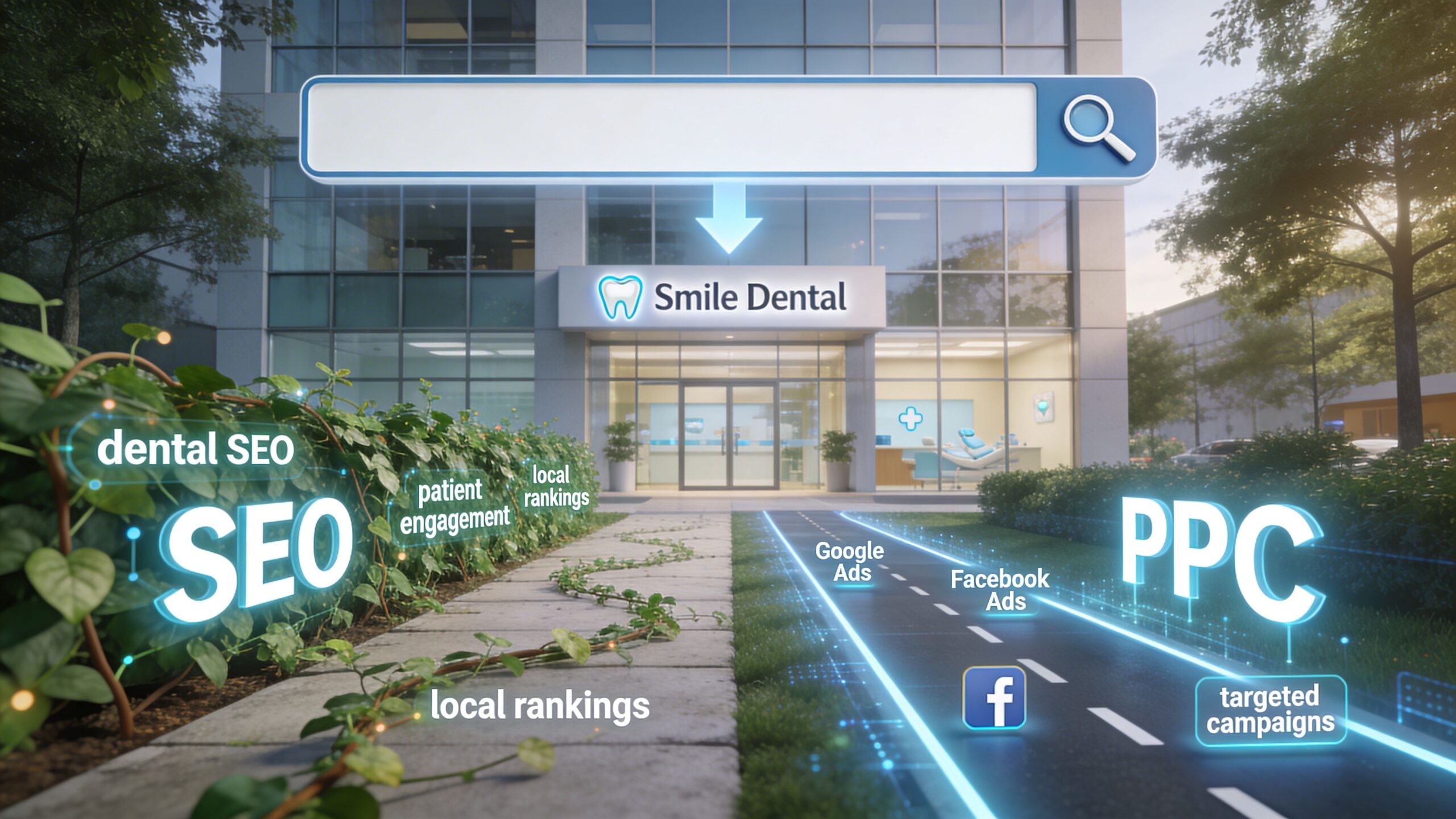
SEO and PPC do different jobs
SEO builds your organic visibility over time. PPC buys immediate visibility for specific searches.
That difference sounds obvious, but many practices still misuse both.
If you expect SEO to fill next week’s gaps, you’ll get frustrated. If you expect PPC to build durable authority on its own, you’ll stay dependent on spend. The smart approach is to use each for its strength.
| Channel | Best use | Time horizon | Common mistake |
|---|---|---|---|
| SEO | Building ongoing visibility and authority | Longer-term | Publishing generic blogs with no local or treatment focus |
| PPC | Capturing immediate high-intent demand | Immediate | Sending ad traffic to weak pages or broad homepages |
If your team needs a plain-English explanation of paid search terminology, this overview of what is SEM is a helpful reference.
Where SEO works best for dental practices
SEO earns its keep when your practice wants steady discovery for local service searches and treatment research. Done properly, it improves visibility for the pages that matter most, not just blog traffic.
Strong dental SEO usually includes:
- Service pages for key treatments: Emergency, implants, Invisalign, veneers, whitening, children’s dentistry, and hygiene.
- Location relevance: Clear suburb or service-area signals where appropriate.
- Google Business Profile alignment: Your site and local presence should reinforce each other.
- Structured content: FAQs, clear headings, and direct answers that search engines can parse easily.
The old habit of publishing thin blog posts every week just to “do SEO” doesn’t hold up well anymore. Practices get better results when they create pages tied to patient demand and booking intent.
The AI-first SEO shift
Search behaviour is getting more conversational. That matters for dental marketing because patients rarely type like marketers.
An AI-first approach means writing and structuring content around the way patients ask questions. It also means formatting pages so search engines can understand the answer quickly.
According to HIPAA Journal’s dental digital marketing guidance, pay-per-click advertising demonstrates a 50% superior conversion rate compared to organic traffic. The same source also notes that conversational queries in Australia have boosted by 35%, and 70% of AU practices underperform in AI rankings due to unoptimised content.
That has real implications for how you build pages.
An AI-first SEO playbook
Three moves tend to outperform the “publish more blogs” approach:
-
Build treatment pages around patient questions
A page on dental implants shouldn’t just describe the procedure. It should answer practical questions about suitability, timing, recovery, and next steps. -
Use FAQ sections naturally
FAQ content helps with clarity and supports AI-style query matching when it’s specific and useful. -
Prioritise clarity over keyword stuffing
Search engines now reward pages that answer the query well. Repeating “best dentist Sydney” twenty times won’t help.
Search rule: If a patient can’t understand the page quickly, Google probably won’t trust it strongly either.
A solid page for Invisalign or implants should read like a well-briefed consult, not a keyword dump.
Where PPC is strongest
PPC is the fastest way to appear for high-intent searches, especially when a patient needs a provider now or is actively comparing options for a specific treatment.
That makes it especially useful for:
- Emergency dentistry
- Implants
- Cosmetic dentistry
- Whitening
- High-margin consult offers
- Filling short-term appointment gaps
Paid search can also be segmented tightly by location, treatment type, and intent. That precision is why it often works well for practices that want control over lead volume.
A practical PPC playbook
The highest-performing dental campaigns usually share the same traits:
Use tightly grouped campaigns
Don’t throw every service into one campaign. Emergency, implants, and general dentistry should have separate ad groups, separate copy angles, and often separate landing pages.
Match the ad to the page
If the ad promises emergency appointments, the landing page should speak directly to emergency patients. Not send them to a generic homepage with six menu choices and no clear next step.
Prioritise commercial intent
Searches from people ready to act are usually more valuable than informational traffic. Terms that signal urgency or treatment interest tend to produce stronger leads than broad education queries.
Track conversions
Measure calls, form submissions, and booked consults. If possible, connect campaign data to patient outcomes, not just clicks.
Here’s a helpful benchmark from the verified industry data. PPC’s average conversion rate hovers around 2%, but it can rise to 10% with optimised landing pages, as noted in the broader Australian dental marketing data cited earlier. That gap explains why so many campaigns look expensive when the core issue is page quality, not the ad platform itself.
A useful mid-funnel format for practice owners who want to understand campaign mechanics is below.
What works and what doesn’t
What works
- Focused campaigns by treatment
- Strong local intent targeting
- Dedicated landing pages
- Fast mobile experience
- Call tracking and form tracking
- Ongoing search term review
What doesn’t
- Broad, mixed campaigns
- Sending paid traffic to the homepage
- Vague ad copy
- No conversion tracking
- Judging performance only by click volume
Search marketing works when strategy and patient intent line up. SEO builds the long game. PPC fills the pipeline faster. Practices that use both with discipline usually avoid the feast-or-famine pattern that causes the most stress.
Engaging Community and Building Unshakeable Trust
Trust is often the deciding factor in digital marketing for dentistry. A patient may discover you through search, but they usually book because your practice feels credible, safe, and human.
That’s where social media and reputation management earn their place. Not as vanity channels. As trust infrastructure.
Social media should support confidence
Many practices expect social media to act like direct-response advertising. That’s usually the wrong expectation.
For dentistry, social performs better when it helps patients get comfortable with the practice before they call. A well-run account can show your team, explain procedures in simple language, answer common concerns, and make the clinic feel less intimidating.
Content that tends to help most includes:
- Team and culture posts: People want to know who they’ll meet.
- Patient education clips: Short explanations of treatment options and expectations.
- Practice updates: New technology, extended hours, or community involvement.
- Behind-the-scenes content: This lowers anxiety more than polished corporate branding.
Used well, social media supports the Consideration stage. It gives patients more reasons to trust what they already found in search.
If your practice is doing something newsworthy, such as opening a new location, launching a community programme, or announcing a significant service update, a clear local media announcement can help. This guide on how to write a press release for dentists is a practical resource for doing that professionally.
Reviews carry the weight of modern word-of-mouth
Word-of-mouth still matters enormously, but digital now amplifies it. According to Mouthwatch’s dental marketing trends, 77.5% of new patient growth stems from word-of-mouth, while 50% of patients view online reviews as equivalent to personal referrals, and 98% read local reviews before booking an appointment.
That combination changes how a practice should treat review collection. Reviews aren’t an optional extra after good service. They are a core part of patient acquisition.
A review system that works
Most practices don’t have a review problem. They have a process problem.
A workable system usually includes:
- A defined moment to ask: Checkout is often the cleanest point.
- A simple request script: Staff should know exactly what to say.
- A direct follow-up link: Fewer steps means more completed reviews.
- A response routine: Thank patients professionally and consistently.
If you want to sharpen that process, this guide on improving your 5-star Google review flow is worth a look.
Patients don’t compare your review profile to perfection. They compare it to the practice down the road.
What not to do
A few habits weaken trust quickly:
- Ignoring negative reviews
- Posting inconsistent or overly polished social content that feels fake
- Using social media only for promotions
- Asking for reviews randomly instead of systematically
A calm, credible digital presence often wins over a louder one. For most dental practices, that’s the better play.
Measuring Performance and Planning Your Budget
If you can’t tell which channel is producing booked patients, your marketing isn’t under control. It’s just active.
Most practice owners don’t need more dashboards. They need a short list of useful KPIs and a budget structure that matches their growth goals. The key is to measure the patient journey, not just traffic.

Track outcomes that affect the appointment book
Start with operationally meaningful questions:
- Are more qualified patients contacting the practice?
- Are calls and forms turning into appointments?
- Which services produce the best leads?
- Which channels are wasting budget?
A good KPI set is usually smaller than people expect.
Dental Marketing KPI and Budget Allocation Template
| Channel | Key KPI | Example Goal | Sample Budget Allocation (Growth Tier) |
|---|---|---|---|
| Google Ads | Cost per lead | Reduce wasted spend while maintaining qualified enquiries | Higher share |
| SEO | Organic rankings for core treatment and location pages | Improve visibility for priority services | Medium share |
| Website | Landing page conversion rate | Increase calls and enquiry submissions from existing traffic | Medium share |
| Google Business Profile | Calls, direction requests, and profile interactions | Lift local discovery and contact actions | Lower share |
| Reviews | Review velocity and response consistency | Maintain a steady flow of fresh patient feedback | Lower share |
| Social media | Engagement quality and enquiry relevance | Support trust and branded searches | Lower share |
| Reporting and analytics | Accurate tracking of calls, forms, and campaign sources | Ensure every major channel can be evaluated properly | Foundational spend |
This table works best when reviewed monthly, not daily. Dental marketing is easier to manage when you look for patterns, not noise.
Budget by business objective
Instead of asking, “What should a dental practice spend?”, ask, “What are we trying to achieve in the next quarter?”
Here’s a practical way to frame it.
Starter budget
This suits a practice that needs a cleaner foundation before scaling.
Focus on:
- Website fixes
- Google Business Profile optimisation
- Conversion tracking setup
- Review process implementation
- A tightly controlled paid search test for one or two high-intent services
Growth budget
This fits a practice that already has demand signals and wants more consistency.
Focus on:
- Ongoing Google Ads for priority services
- SEO for treatment and location pages
- Landing page improvements
- Reputation management
- Monthly reporting tied to leads and appointments
Aggressive budget
This is for practices opening a new location, entering a competitive area, or pushing hard into higher-value procedures.
Focus on:
- Multi-service paid search campaigns
- Dedicated landing pages
- Expanded SEO content and technical work
- Stronger creative support for social proof and retargeting
- Tighter attribution across all lead sources
The trade-offs matter
Budget allocation isn’t just about amount. It’s about timing.
For example:
- If the diary has immediate gaps: Paid search often deserves more budget first.
- If ad costs are climbing but conversion is weak: Invest in landing pages before increasing spend.
- If the practice already has local traction: SEO may compound better over time.
- If trust is limiting conversion: Reviews and website proof elements may outperform extra traffic.
Finance-minded rule: Don’t scale the channel. Scale the system that turns interest into booked treatment.
Keep reporting simple enough to use
A monthly scorecard should let an owner or practice manager answer four things quickly:
- How many leads came in?
- Which channel produced them?
- Which services drew the strongest interest?
- What are we changing next month?
If your reporting can’t support those decisions, it’s too complicated or not connected to the practice properly.
Navigating Compliance in Australian Dental Advertising
Dental marketing has a compliance layer that many generalist marketers underestimate. That’s risky.
A dental practice isn’t promoting shoes or furniture. It’s advertising regulated health services. If your ads, website copy, reviews, offers, or social posts cross the line, the damage isn’t just financial. It can hit reputation, patient trust, and regulatory standing.
Compliance should shape the campaign, not clean up after it
The biggest mistake is treating compliance like a final legal check after the creative is done. In dentistry, compliance needs to sit inside the strategy from the start.
That affects how you write headlines, structure landing pages, request reviews, and describe treatment outcomes. It also affects what you choose not to say.
Practical do and don’t list
Do
- Use accurate, plain-language service descriptions
- Explain treatments without exaggeration
- Keep offers and promotions careful and transparent
- Review website and ad copy regularly
- Train staff on what can and can’t be requested or posted publicly
Don’t
- Make unsubstantiated claims about being the best or superior
- Use advertising language that could mislead patients about likely outcomes
- Treat testimonials casually in ad contexts
- Promise results that depend on individual clinical factors
- Run promotional messaging that pressures health decisions
Testimonials need special care
This is one of the most common traps. Practices often assume that if a patient says something positive, it’s safe to use anywhere. It isn’t that simple in regulated healthcare marketing.
Reviews may be valuable for trust signals in certain platforms and contexts, but advertising use raises separate compliance concerns. That’s why dental practices need a clear approval process before repurposing patient praise in ads, landing pages, or social promotions.
Discounts can create risk if framed badly
Price-led campaigns need caution too.
There’s a difference between clearly stating an available offer and using language that pushes patients toward treatment in a way that could be seen as inappropriate, misleading, or not clinically grounded. In dentistry, urgency-based sales language can create unnecessary exposure.
A compliant campaign usually sounds calmer than a retail campaign. That’s a strength, not a weakness.
The safest marketing is still strong marketing
Compliant advertising doesn’t have to be bland. It just needs discipline.
The best dental campaigns usually focus on clarity, convenience, credibility, and patient education. Those elements are persuasive without crossing ethical lines. In practice, that often means they convert better anyway, because they build trust instead of trying to force action.
Your Digital Marketing Quick-Start Checklist
The fastest way to get traction is to sequence the work properly. Don’t start with everything. Start with the actions that remove friction and improve visibility first.
Use this as a practical rollout list for digital marketing for dentistry.
First 30 days
- Check your website on mobile: Make sure key pages load cleanly, forms work, and phone numbers are tap-to-call.
- Tighten your homepage and service pages: Add clear calls to action and remove vague wording.
- Claim or audit your Google Business Profile: Correct hours, services, phone number, and photos.
- Set up lead tracking: Calls, enquiry forms, and appointment requests should all be measurable.
- Create a review request process: Front desk staff should know when and how to ask.
Next priority actions
- Build separate pages for high-value treatments: Especially services you want to grow.
- Launch a focused paid search campaign: Start with one or two high-intent services, not everything at once.
- Improve local SEO signals: Keep practice details consistent across key listings.
- Respond to every new review: Keep tone professional and timely.
- Post trust-building social content: Team, education, community, and patient-friendly updates.
Ongoing monthly habits
- Review channel performance: Look at leads, lead quality, and booking outcomes.
- Adjust PPC based on search intent and conversion data
- Refine underperforming landing pages
- Keep treatment content current
- Ask for reviews consistently, not occasionally
- Check all advertising copy for compliance
A strong dental marketing system usually looks simple from the outside. The difference is that each part supports the next. Search brings attention. The website and profile create confidence. Reviews reduce hesitation. Tracking shows what’s working. That’s how a practice moves from sporadic enquiries to a steadier appointment book.
If your practice wants a clearer path from search visibility to booked patients, Click Click Bang Bang helps businesses build data-driven PPC and AI-first SEO campaigns with transparent reporting, flexible plans, and a practical focus on conversion.
Read NeXt
Or Read Our Latest
- Manual vs Automated Bidding for PPC Success
- Conversion Tracking Setup: A Complete AU Guide
- Instagram Advertising Australia: Complete 2026 Guide
- Pay Per Click: A Beginner’s Guide for Australian Marketers
- Display Advertising on Google: The Complete Australian Guide
- Stakeholder Communication Plan How to Build One That Works
Click. CLick. Subscribe.
Get our best PPC insights, industry updates, and power moves delivered straight to your inbox. No fluff, just high-caliber strategies that actually work.
Don’t Leave Just Yet
Try Us For 30-Days,
Risk Free!!
We guarantee that you’ll love our work within the first 30 days, if not you’ll get your money back.
What have you got to lose?