

AI SEO Services: How to Boost Your Traffic & ROI in 2026
Last Updated

You’re probably dealing with a familiar tension right now. SEO still matters, paid media still needs to convert, and every month someone asks the same question: what are we getting for the spend?
That pressure is sharper in Australia because search is changing faster than most internal workflows. Marketing managers are expected to improve rankings, support lead generation, feed PPC learnings back into content, and explain performance in commercial terms, not vanity metrics. Manual SEO work struggles under that load. Keyword research gets stale. technical fixes sit in backlogs. Content teams publish pages that rank for the wrong intent. Paid teams end up paying for traffic organic should have captured.
AI SEO services matter because they reduce that drag. Done well, they do not replace strategy. They make strategy executable at a speed manual teams cannot match, while giving you a clearer connection between SEO activity, pipeline, and revenue.
The New SEO Reality in a World of AI
Monday starts with a familiar problem. Your Google Ads campaign is producing search term data, your organic pages are slipping on commercial queries, and the team still has to explain spend against leads by the end of the week. For Australian SMBs, that is no longer a channel issue. It is an operating issue.
Search now shifts too quickly for quarterly SEO plans and isolated reporting cycles. Buyers move between paid and organic before they enquire, compare, or buy. More businesses are investing in SEO as the market grows, which means slower teams lose ground even when they are doing acceptable work, as outlined in Grand View Research's SEO software market outlook.

AI SEO services are now part of how efficient teams handle that pressure. In practice, they help agencies and in-house marketers process search data faster, spot changes earlier, and decide where effort will produce commercial returns across content, technical SEO, and reporting.
What this changes for a marketing manager
SEO stops sitting in its own lane.
The stronger model is shared intelligence between SEO and PPC. Paid search terms can show which queries are driving qualified clicks now. Organic performance can show where you are overpaying for traffic you could earn. Landing page tests from PPC can improve title, copy, and intent matching for SEO pages. Technical fixes such as speed, indexation, and template clean-up often help both rankings and paid conversion rates.
That matters for smaller Australian businesses because budget is tighter and channel overlap is more visible. If an agency offers a risk-free trial or a lower tier plan, the benchmark should be simple. Can they identify one set of pages where organic gains may reduce paid dependency, or one paid campaign where SEO insights improve lead quality within the first reporting cycle? This framing offers an operational advantage, not just a novelty.
If your remit includes B2B as well as search, this broader strategic guide on how to use AI for B2B marketing is useful because it explains AI in terms of execution and commercial priorities.
What good ai seo services deliver
A strong service usually does four things well:
- Prioritises by revenue potential. It starts with pages, keywords, and technical fixes tied to enquiries, sales, or qualified traffic.
- Connects SEO and PPC signals. It uses paid search data to reduce guesswork around intent, messaging, and landing page focus.
- Sets ROI benchmarks early. It defines what success looks like for a trial, a starter tier, or a broader retainer before work begins.
- Keeps human judgement in the loop. AI handles scale and pattern detection. Strategists decide what to change, what to test, and what to ignore.
AI SEO works when it cuts low-value analysis, improves coordination between channels, and gives your team clearer paths to growth.
What Are AI SEO Services Really
A lot of vendors make this sound more mysterious than it is.
Traditional SEO is like sending experienced scouts into a forest with notebooks and compasses. They can do excellent work, but coverage is limited, updates take time, and by the time they return, the terrain may have changed. AI SEO is closer to combining those scouts with satellite imagery, live weather data, and route modelling. The scouts still matter. They just stop wasting time on what machines can already see.
The shift is not automation for its own sake
The strongest ai seo services are not built around bulk output. They are built around better prioritisation.
AI can review search results, classify intent patterns, group related queries, flag technical issues, analyse internal links, compare your content to competitors, and detect shifts in performance faster than a manual workflow. That means your team can spend more time on the hard parts: positioning, differentiation, conversion strategy, and editorial judgement.
The service model matters more than the tool list for this reason. Two agencies can use similar platforms and produce very different outcomes. One floods a site with generic content. The other uses AI to decide which pages deserve attention, what format users expect, and where organic work can reduce paid dependency.
What falls under AI SEO in practice
Most engagements include some mix of these activities:
- Search intent modelling. Grouping keywords by informational, commercial, navigational, and transactional intent.
- Content brief generation. Producing structured recommendations for headings, subtopics, entities, FAQs, and internal links.
- Technical monitoring. Surfacing crawl issues, rendering problems, schema gaps, duplicate pages, and indexation waste.
- SERP analysis. Reviewing how Google presents results for a topic, including local packs, shopping results, AI surfaces, and featured answers.
- Performance pattern detection. Connecting ranking movements with on-page changes, seasonal shifts, and user behaviour.
What AI cannot do well on its own
Many buyers get burned here.
AI can generate language. It cannot reliably understand your commercial reality without guidance. It does not know your margin priorities, your best-fit customers, your sales process, or which offers convert poorly even when traffic looks healthy. It also cannot protect your brand voice unless someone actively edits and directs it.
A strategist still needs to answer questions like:
| Question | Why it matters |
|---|---|
| Which categories deserve SEO investment first | Traffic without commercial relevance wastes time |
| Which pages should support PPC campaigns | Organic and paid can strengthen each other |
| Which topics require subject-matter review | Accuracy matters for trust and conversion |
| Which conversions count | Rankings alone do not pay for marketing |
If a provider talks mostly about AI features and barely mentions commercial priorities, that is a warning sign.
The practical definition is the one worth keeping. AI SEO services combine machine speed with human judgement to improve how you research, produce, optimise, and measure organic search performance.
The Core AI Workflows That Power Your SEO
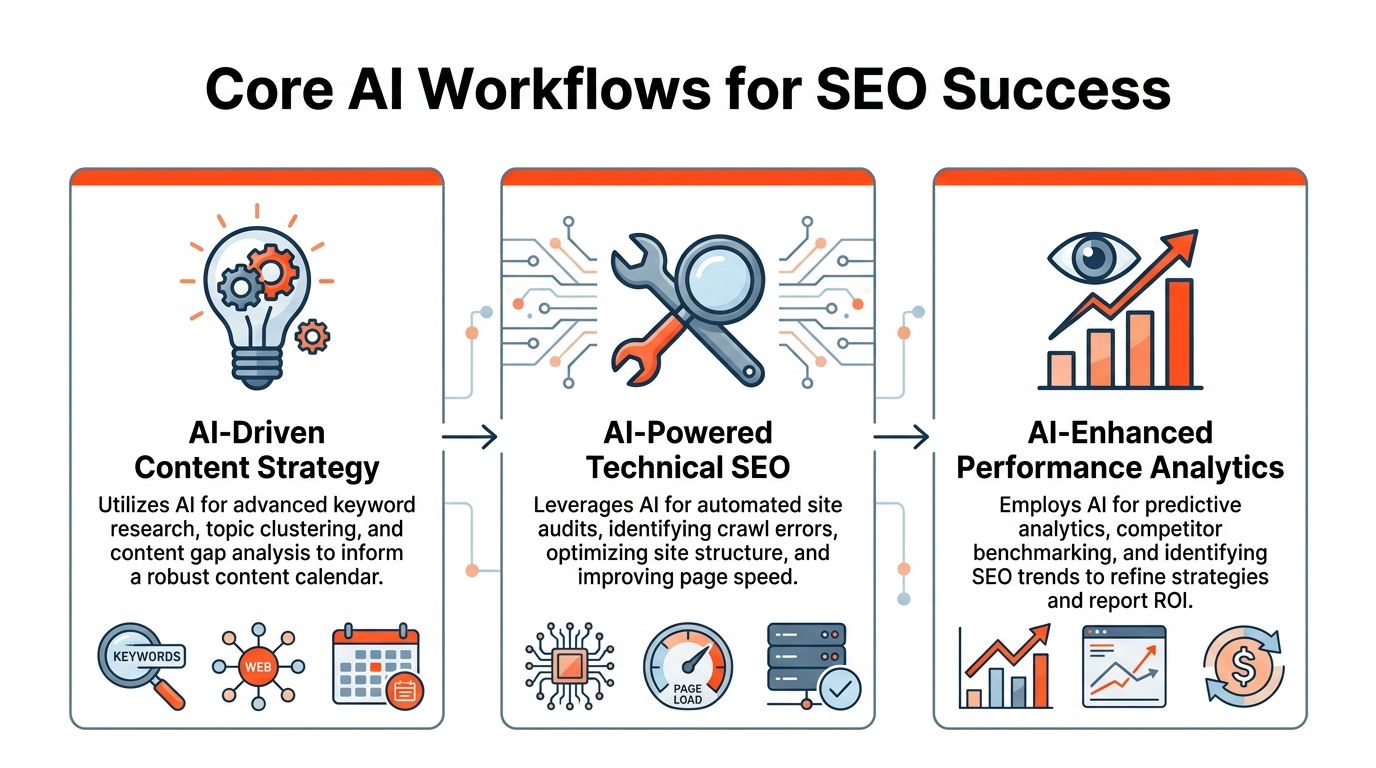
The easiest way to judge ai seo services is to look at the workflows, not the sales pitch. Most productive setups revolve around three connected systems: content strategy, technical SEO, and performance analysis.
AI-driven content strategy
This is usually where clients first notice speed gains.
Instead of building content plans from scattered spreadsheets, AI tools can cluster related queries, compare top-ranking pages, identify missing subtopics, and turn that into a usable brief. Platforms like Surfer SEO, Clearscope, MarketMuse, Frase, and content intelligence layers inside broader SEO suites all help here. If you want a wider view of the software options, this roundup of AI tools for digital marketing is a useful reference.
The part that matters most is not the draft. It is the decision support before the draft.
A good workflow asks:
- What does the searcher want on this query?
- Which page type wins here, category page, service page, guide, comparison, or FAQ?
- Which paid search terms already show buying intent?
- Which objections from PPC landing page data should be answered organically too?
SEO and PPC integration begins to pay off at this point. Google Ads search term reports often reveal stronger commercial language than classic keyword tools. If paid traffic keeps converting on “same day”, “pricing”, “near me”, or “for small business”, your organic pages should not ignore that language.
For teams combining SEO and copy production, a structured process like this works well alongside an integrated SEO and copywriting workflow.
AI-powered technical SEO
Technical AI workflows are less visible to executives, but they often unlock the biggest hidden gains.
In technical SEO, AI tools automate site audits by crawling millions of pages to detect issues like JavaScript rendering delays and missing structured data, which can cause a 25-40% drop in crawl budget efficiency for non-optimised Australian e-commerce sites as outlined in this technical SEO and AI analysis.
That matters because many Australian SMB sites carry technical debt that limits both SEO and paid performance. Slow templates, weak internal linking, inconsistent canonicals, faceted navigation issues, and poor schema do not just confuse search engines. They also create poor landing experiences for paid traffic.
A useful technical workflow typically includes:
- Crawl diagnostics that detect broken paths, duplicate URLs, thin indexable pages, and orphaned content
- Rendering checks for JavaScript-heavy templates
- Schema recommendations for products, services, FAQs, organisations, and local business entities
- Core Web Vitals prioritisation based on revenue-driving page groups
- Change monitoring so issues are caught before rankings slip
AI-enhanced performance analytics
In this area, many providers still underperform.
They report rankings and traffic, but they do not connect SEO work to business movement. AI makes that connection easier by spotting relationships across channels. For example, a rise in non-brand organic entries to product pages may coincide with lower paid search dependency on generic queries. A stronger informational cluster may increase assisted conversions even when the last click still comes from branded search or remarketing.
The best analytics workflow does three things:
- Maps SEO pages to funnel stages
- Compares organic and paid query intent
- Flags where one channel can reduce waste in the other
A simple example. If PPC data shows expensive clicks for high-intent informational phrases, SEO can build pages to capture those searches organically over time. If SEO surfaces terms with strong engagement but weak conversion, PPC can test landing page variants faster.
AI is most valuable when it helps you decide what to do next, not when it gives you a prettier dashboard.
Weighing the Benefits and Recognising the Risks
An Australian SMB often reaches the same point fast. Paid search is producing leads, but generic clicks keep getting more expensive, organic visibility is inconsistent, and the team needs a clearer path to lower acquisition costs without slowing growth.
That is where AI SEO services earn their keep, or waste budget.

Where AI creates genuine advantage
AI improves SEO when it shortens the gap between insight and action. For a business running SEO alongside Google Ads, that matters. Search term shifts, landing page gaps, template issues, and seasonal demand changes can be identified and acted on while campaigns are still active, not after the quarter is over.
The payoff is usually commercial before it is technical.
A disciplined AI workflow can reduce research time, tighten the link between paid intent and organic content, and help teams focus effort on pages that influence leads or sales. For Australian SMBs, that often means using PPC query data to decide which service pages, category pages, and support content deserve SEO investment first.
The strongest benefit is coordination. SEO stops behaving like a slow channel running in parallel with PPC. It starts supporting paid efficiency. If Google Ads shows strong conversion intent on expensive non-brand terms, SEO can build a medium-term path to capture that demand organically. If organic pages attract traffic but underperform on conversion, PPC can test headlines, offers, and landing page angles faster.
That is how AI SEO services contribute to ROI. Not by producing more content. By helping both channels work from the same demand signals.
For budget-sensitive teams, this also makes trial periods easier to assess. A risk-free trial or lower-tier plan should not be judged on rankings alone. It should show whether the provider can find paid-organic overlap, prioritise work by revenue potential, and report against digital marketing performance metrics that connect activity to commercial outcomes.
Where teams get into trouble
The biggest risk is still over-automation.
Some providers use AI to generate large volumes of copy, apply light edits, and present the output as strategy. That usually leads to pages that sound acceptable at a glance but add little original value, miss Australian buying context, and fail to support conversion properly. Rankings can stall. Conversion rates often do.
Another problem is trusting AI outputs because they look structured. Fast recommendations are not the same as commercially sound recommendations. Search demand does not tell you which terms produce qualified leads, which products carry margin, or which landing pages deserve paid support during a promotion.
Channel separation creates its own cost. If SEO and PPC are reported in different silos, teams miss obvious decisions. They keep paying for terms SEO could realistically win. Or they push SEO effort into topics that paid data already shows attract weak buyers.
Google's search results have changed as well. AI Overviews now appear in 7.6% of Google searches in Australia and can reduce organic clicks for some queries by up to 30%, as noted in these SEO statistics on AI Overviews. That raises the bar for what an SEO page needs to do. The page has to target the right intent, present clear entity signals, and strengthen brand preference even when a searcher does not click straight away.
What works versus what does not
Here is the practical split for SMB teams trying to balance growth and risk:
| Works | Does not work |
|---|---|
| Using AI to speed up research, clustering, and page diagnosis | Publishing AI-written pages with minimal human review |
| Using Google Ads search term data to shape SEO briefs | Reporting SEO and PPC separately with no shared prioritisation |
| Prioritising fixes on pages tied to leads, sales, or high-cost paid terms | Treating every technical issue as equally important |
| Testing SEO opportunities through risk-free trials or tiered plans with clear benchmarks | Locking into retainers before proving channel fit |
| Reviewing AI output for accuracy, local context, and conversion intent | Assuming polished wording means the page will perform |
A short explainer can still help internal teams align on the trade-offs before budget is approved.
The safest AI SEO setup has clear human review points, shared SEO and PPC priorities, and success measures tied to revenue, not output volume.
Real-World AI SEO Use Cases and KPIs to Track
Monday morning, the paid search report lands first. Cost per acquisition is up again on the same non-brand terms your site should already be picking up organically. For many Australian SMBs, that is the point where AI SEO stops sounding experimental and starts looking like margin protection.
The useful question is not whether AI can produce more SEO activity. It is whether it can improve the economics of acquisition. In practice, that usually means using paid search data to set SEO priorities, then measuring whether organic growth reduces reliance on expensive clicks over time.
Use case one e-commerce with PPC support
A retailer often hits the same ceiling. Shopping and search campaigns drive sales, but generic category terms stay expensive, product pages do not rank consistently, and the team lacks time to review hundreds of templates by hand.
AI SEO services help by connecting three jobs that are usually handled separately.
The first job is query analysis. Search term reports from Google Ads and Shopping show the modifiers buyers use before purchase, such as size, compatibility, material, urgency, and comparison terms. AI can group those patterns quickly and map them to the right page type, whether that is a category page, collection page, product detail page, buying guide, or FAQ section.
The second job is diagnosis at scale. E-commerce sites accumulate duplicate paths, weak internal linking, thin collection copy, and schema gaps fast. AI-assisted audits help surface those issues sooner, but the commercial filter still matters. Fix the pages tied to revenue and high-cost paid terms first.
The third job is message testing. PPC gives faster feedback than SEO. If ad copy with “same-day dispatch” or “fits Toyota Hilux 2018 to 2023” wins clicks and conversions, that language belongs in titles, headings, product copy, and supporting content where relevant.
Track outcomes that connect SEO work to revenue and paid efficiency:
- Non-brand organic sessions to category and product pages
- Organic revenue from priority collections
- Assisted conversions where organic introduced the customer
- Paid search spend on terms targeted by SEO
- Landing page engagement by source
- Customer acquisition cost by channel mix
For a tighter reporting model, this guide to digital marketing performance metrics is a useful reference.
In e-commerce, AI SEO proves its value when organic visibility starts taking pressure off paid spend on repeatable, high-intent queries.
Use case two B2B lead generation with LinkedIn and Google
B2B SEO has a different job. Search volume is lower, decision cycles are longer, and a single visit rarely creates pipeline on its own.
AI works well here because it speeds up pattern recognition across topics, intent stages, and channel data. A practical setup starts with mapping content to buying stages. Educational pages target category questions. Comparison and use-case pages handle evaluation. Service and solution pages target high-intent searches tied to commercial action.
PPC data sharpens that map. Google Ads shows the terms prospects use when urgency is high. LinkedIn campaigns often reveal role-specific pain points, objections, and language patterns that never show up cleanly in keyword tools. Good AI SEO services use both inputs, then tighten internal linking and page briefs so commercial pages receive support from the rest of the content set.
That matters because B2B teams do not need more traffic that never turns into opportunity. They need better alignment between search intent, page message, and lead quality.
The KPIs should reflect that:
| KPI | Why it matters |
|---|---|
| Qualified organic leads | Indicates whether the traffic matches your target buyer |
| Organic conversion rate on service pages | Shows whether intent and page message line up |
| Assisted pipeline from educational content | Captures SEO influence before the final conversion |
| Branded search lift | Suggests stronger awareness after content exposure |
| Sales-qualified lead rate from organic | Separates useful leads from form-fill noise |
| PPC cost efficiency on overlapping topics | Shows whether SEO support is reducing paid pressure |
The trial-period lens
Risk-free trials and tiered plans are useful because they make performance easier to test without forcing an SMB into a long commitment before channel fit is clear.
The first trial should answer commercial questions. Can the provider connect SEO and PPC data inside one workflow? Can they identify pages that can lower paid dependency or lift lead quality? Can they show early operational gains, such as cleaner query-to-page targeting, faster issue detection, and clearer reporting to stakeholders?
Good trials also set benchmarks up front. That might include a target for reducing paid spend on a small set of overlapping terms, improving organic conversions on priority landing pages, or lifting visibility for product or service pages already proven in PPC.
Instant ranking jumps are not the right benchmark. Evidence of better decisions, tighter execution, and clearer acquisition economics is.
How to Choose the Right AI SEO Services Partner
Most providers can demo tools. Fewer can explain how those tools will change your acquisition economics.
That distinction matters because a weak partner sells outputs. A strong one sells decision quality, execution discipline, and reporting you can defend internally.
A 2025 Deloitte Australia report noted that 67% of SMBs abandon SEO agencies due to unclear ROI, yet AI-first services show 28% higher retention when offering transparent reporting and flexible trial periods according to this analysis of AI SEO strategy and retention.
Start with the operating model
Ask how the provider works, not just what software they use.
Good questions include:
- How do you decide which pages get worked on first?
- How do you use PPC data inside SEO planning?
- What gets reviewed by a human before publication or implementation?
- How do you handle technical recommendations that need dev support?
- What does reporting look like beyond rankings?
You are looking for evidence of a repeatable process. If the answers stay vague, you are likely buying a black box.
Look for channel integration, not channel isolation
This is the missing piece in a lot of AI SEO conversations.
If your business already runs Google Ads, Shopping, Meta, or LinkedIn, your SEO partner should want that data. Paid search terms, ad copy tests, conversion actions, and landing page performance all improve SEO decisions. Likewise, SEO insights should help reduce wasted paid spend over time.
That is why some businesses choose partners that already operate across both disciplines, including providers with a combined SEO outsourcing company model rather than a pure-play content shop.
Red flags to take seriously
These show up often:
- Guaranteed rankings. No credible provider can promise a fixed ranking outcome.
- No mention of editing or review. AI without human oversight is a quality risk.
- Reporting that hides conversion impact. Visibility is not enough.
- Heavy focus on article volume. More pages do not automatically mean better outcomes.
- No technical process. Content alone rarely fixes a weak site.
- No explanation of trial scope. A trial should have clear deliverables and decision points.
How tiered plans should work
For SMBs, tiered plans can be useful if they map to actual business needs.
A lighter plan might focus on technical cleanup, priority page optimisation, and core reporting. A broader plan may add content production, schema work, landing page testing support, and SEO-PPC coordination. The point is not to buy the biggest package. It is to buy the plan that matches your capacity, sales cycle, and margin profile.
One practical option in the Australian market is Click Click Bang Bang, which offers tiered monthly plans, transparent reporting, no long-term commitments, and a 30-day risk-free trial as part of its SEO and PPC service model. That structure is useful for businesses that want a measurable test before expanding scope.
Choose the partner who can explain what happens in the first month, what gets measured, and what would make them change course.
The commercial test
Before you sign, ask one final question: how will this reduce uncertainty in my marketing program?
The right answer should include better prioritisation, clearer reporting, faster testing, and smarter use of paid and organic data together. If you do not hear that, keep looking.
Your Next Move in the AI-Powered Future of SEO
AI has changed SEO, but not in the way most sales pages suggest.
The useful change is not that machines can produce more words. It is that teams can now connect research, technical diagnostics, content planning, and channel performance with far less delay. That gives marketing managers a better shot at proving ROI in a search environment that is noisier and less forgiving.
The businesses getting value from ai seo services are usually doing three things well. They keep human strategy in charge. They connect SEO and PPC instead of treating them as separate budgets. They measure business outcomes, not just visibility.
That matters even more for Australian SMBs. Budgets are tighter, stakeholders want clearer accountability, and the pressure to scale without long lock-ins is real. A risk-free trial or flexible tiered plan can be useful, but only if the provider uses that period to show practical momentum: better targeting, cleaner technical priorities, stronger page strategy, and reporting that ties back to leads or sales.
The next move is straightforward. Audit how your current SEO and PPC efforts interact. If they barely do, that is probably where your biggest opportunity sits. Then assess whether your current provider, or your internal team, can run an AI-assisted workflow with proper oversight.
If the answer is no, change the setup before another quarter disappears into disconnected reporting and reactive fixes.
If you want to see how an AI-first SEO and PPC model works in practice, Click Click Bang Bang is worth reviewing. Their approach is built around transparent reporting, flexible monthly plans, and a 30-day risk-free trial, which makes it easier to test whether better SEO-PPC integration can improve traffic quality, lead flow, and return on spend without locking into a long-term commitment.
Read NeXt
Or Read Our Latest
- Manual vs Automated Bidding for PPC Success
- Conversion Tracking Setup: A Complete AU Guide
- Instagram Advertising Australia: Complete 2026 Guide
- Pay Per Click: A Beginner’s Guide for Australian Marketers
- Display Advertising on Google: The Complete Australian Guide
- Stakeholder Communication Plan How to Build One That Works
Click. CLick. Subscribe.
Get our best PPC insights, industry updates, and power moves delivered straight to your inbox. No fluff, just high-caliber strategies that actually work.
Don’t Leave Just Yet
Try Us For 30-Days,
Risk Free!!
We guarantee that you’ll love our work within the first 30 days, if not you’ll get your money back.
What have you got to lose?