

Digital Marketing for Ecommerce Your Complete Growth Playbook
Last Updated
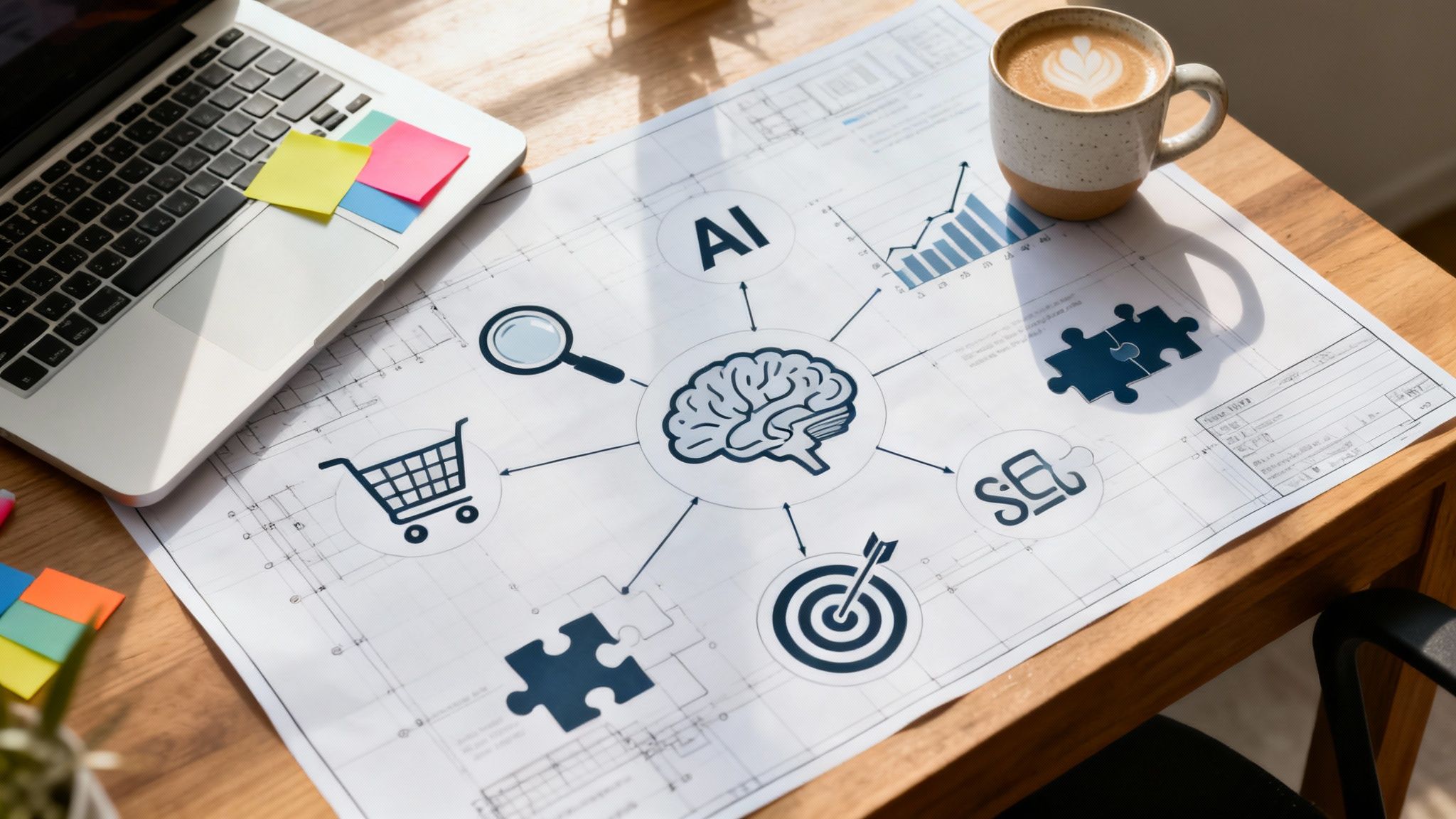
Digital marketing for e-commerce isn't just about placing a few ads and hoping for the best. It's the complete system you build to pull in traffic, turn browsers into buyers, and create die-hard fans of your brand. Think of it as an integrated ecosystem where SEO, paid advertising, and smart analytics all work together to create a reliable engine for growth.
Your Blueprint for Sustainable E-commerce Growth
In a marketplace as crowded as the internet, just having a great product isn't enough to get you noticed. A sharp digital marketing strategy is what powers your growth, moving beyond generic advice to give you a complete system for attracting, converting, and delighting your customers.
This isn't just a laundry list of tactics. It's a connected ecosystem designed to drive real sales and build customer relationships that actually last. This guide is your actionable playbook for cutting through the noise of online retail and achieving profitable, sustainable growth.
At its heart, this system is a continuous cycle: you attract new audiences, convert them into customers, and then delight them so much after the sale that they keep coming back for more.
The Three Pillars of E-commerce Success
Real, lasting growth comes down to mastering three key areas that feed into one another:
- Attraction: This is the first step—getting qualified traffic to your online store. It's all about reaching potential customers who are actively looking for what you sell. This is where strategies like AI-driven SEO and laser-focused paid advertising really shine.
- Conversion: Once you've got visitors on your site, the mission is to turn them into paying customers. This involves everything from optimising your website for a smooth user experience to writing product pages that sell, and making the checkout process dead simple. To really nail this, many online stores are now using advanced visuals like 3D product visualizations to show off their products in a way that’s compelling and true-to-life.
- Delight: The journey doesn't stop once the payment goes through. Smart follow-ups after purchase, loyalty programs, and top-notch customer service are what turn one-time buyers into repeat customers and, even better, brand advocates who do the selling for you.
This visual map shows you exactly how that interconnected journey works, taking a potential customer from first glance to becoming a loyal fan.
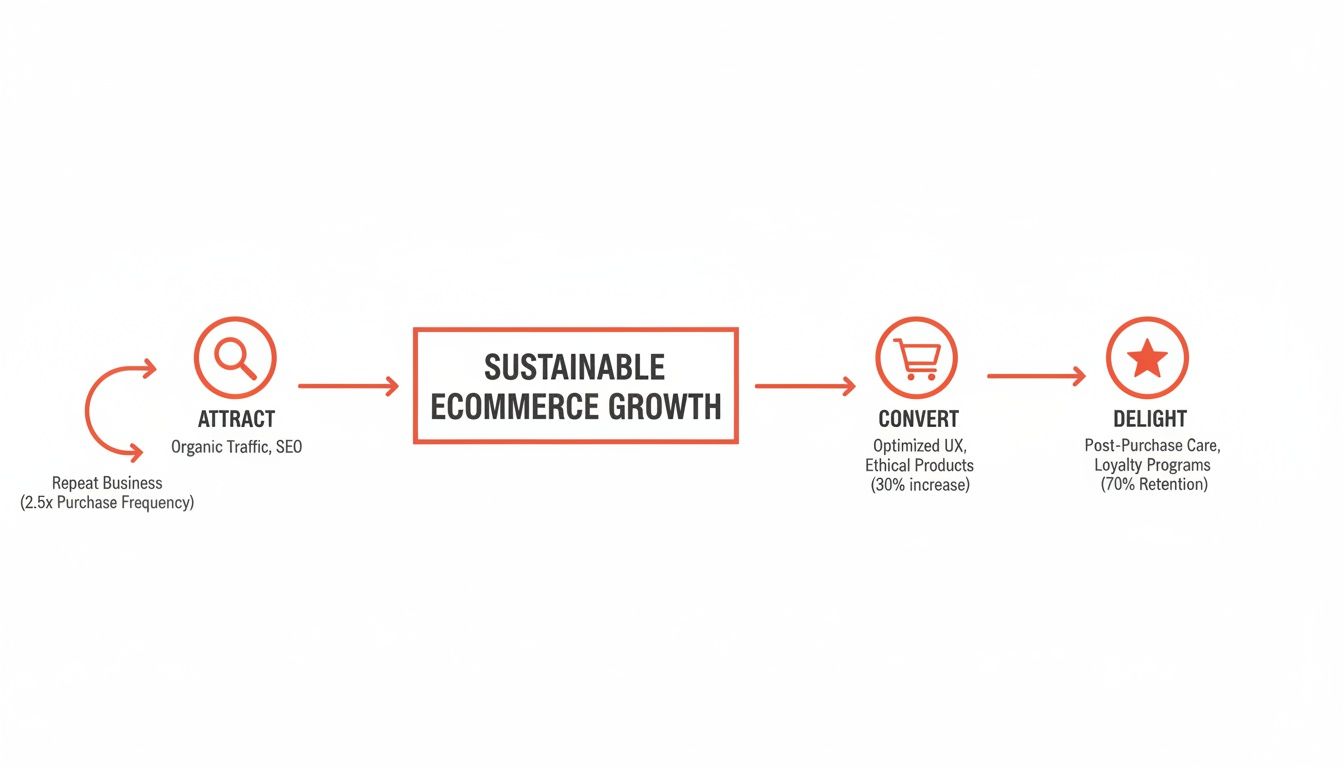
You can see how each stage flows into the next, creating a self-sustaining loop that drives long-term success, not just short-term sales spikes.
And the opportunity here is massive. Australia's e-commerce market is booming, with forecasts predicting it will grow to $49.47 billion by 2028. That incredible upward trend shows just how much potential there is for retailers who get their digital marketing right.
Building a Foundation with an AI-Powered SEO Mindset
Modern e-commerce Search Engine Optimisation (SEO) has moved on. It’s no longer about trying to trick algorithms; it’s about having a meaningful conversation with artificial intelligence. Search engines like Google now act like incredibly smart digital assistants, focused on understanding the intent behind what someone is searching for, not just the exact keywords they type. This is a huge shift, and it completely changes how your online store gets found.
Think of it like this: a customer walks into a brick-and-mortar shop and says, "I need something warm for a winter trip to the mountains." A good salesperson wouldn't just grunt and point to the "jackets" aisle. They'd ask follow-up questions and probably recommend a specific waterproof, insulated parka. AI-powered search engines are doing the exact same thing online, digging into context to serve up the most helpful results.
Your job is to make it ridiculously easy for this AI to see that your product pages are the perfect answer to a shopper's problem. This means going way beyond basic keyword stuffing and adopting a more holistic, helpful approach.
Speaking the Language of Search AI
To get your store on the same page as modern search engines, you need to nail two key areas: semantic relevance and structured data. Don't worry, these aren't just nerdy buzzwords; they're your practical toolkit for getting seen in a seriously crowded marketplace.
Semantic search is all about context. Instead of just optimising a product page for "women's running shoes," you need to think about all the related ideas and questions a real person would have.
What else is that user thinking about?
- Shoe features: "lightweight," "good for trail running," "cushioned support."
- Their problems: "best shoes for flat feet," "running shoes for marathon training."
- Comparisons: "Nike vs. Adidas running shoes."
When you naturally weave these related concepts into your product descriptions, category pages, and blog posts, you send powerful signals to Google that your page isn't just relevant—it's a comprehensive resource. For a much deeper look into this, check out our guide on using AI for SEO.
Key Takeaway: An AI-first SEO strategy is about becoming the most helpful, authoritative answer for a customer's entire problem, not just matching a single keyword. This is how you build trust with both search engines and actual shoppers.
Creating Eye-Catching Rich Snippets
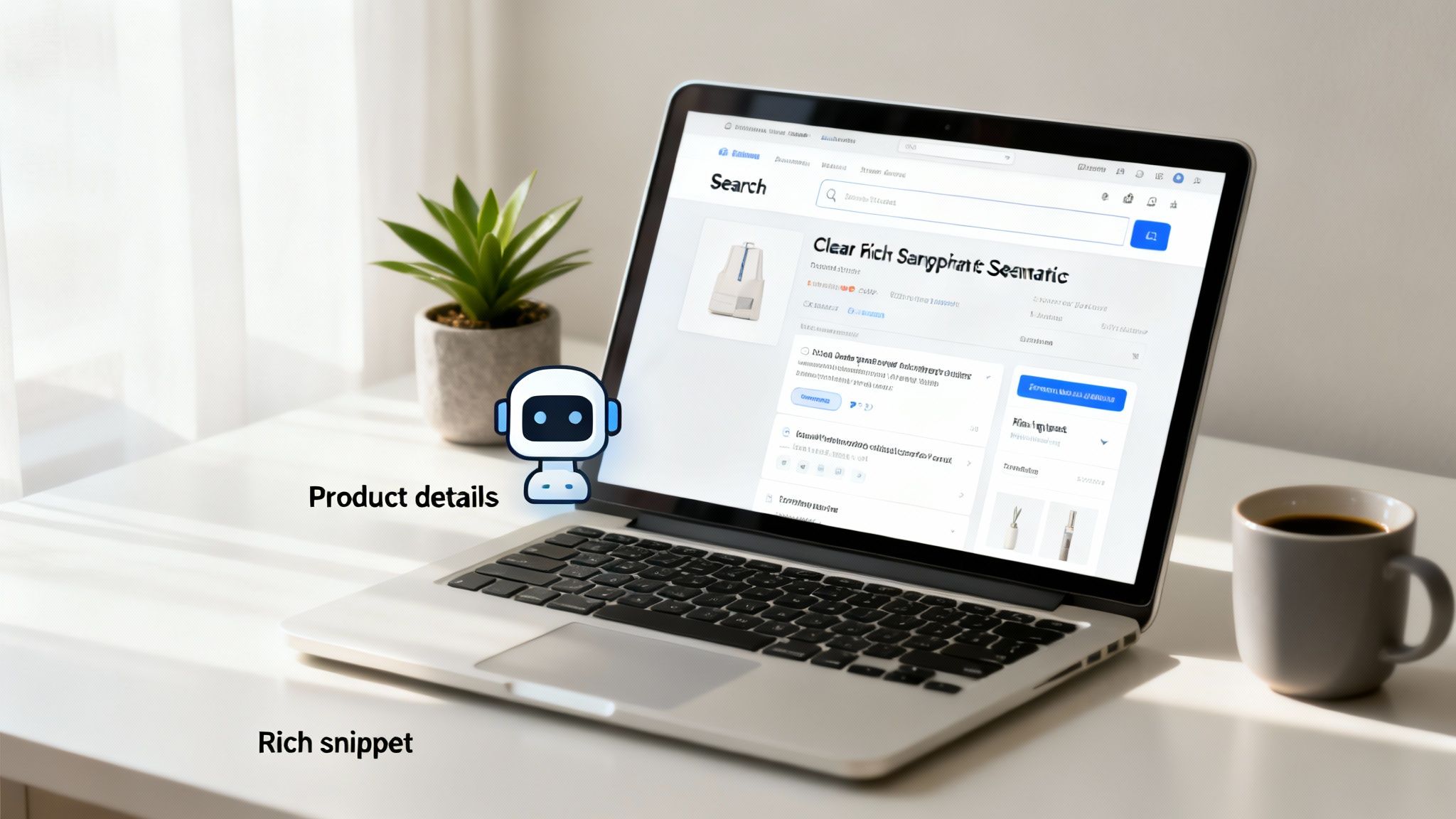
The second piece of the puzzle is structured data, sometimes called schema markup. Think of it as a set of secret 'price tags' or 'labels' you add to your website's code. These labels explicitly tell Google what your content is, leaving absolutely nothing to guesswork.
For an e-commerce site, this is a game-changer. By adding structured data, you can unlock rich snippets in the search results—those beefed-up, visually appealing listings that grab all the attention.
- Product Schema: Slaps the price, availability, and those all-important star ratings right into the search results.
- Review Schema: Shows off your aggregate star ratings, giving shoppers instant social proof before they even click.
- FAQ Schema: Lets you feature common questions and answers in a handy dropdown right under your main search listing.
These aren't just cosmetic tweaks. They make your listing pop off the page, dramatically increasing the odds that a user will click your result over a competitor's plain blue link. Let's be honest, a listing with a 4.8-star rating and a clear price is just far more convincing.
Your Essential Technical SEO Audit Checklist
Before you can get fancy with AI and semantics, your site’s technical foundation has to be rock-solid. A slow, clunky, or broken website is a massive turn-off for both AI crawlers and human visitors.
Run through this practical checklist to make sure your store is technically sound:
- Check Site Speed: Fire up Google's PageSpeed Insights to test your load times. You should be aiming for a mobile score above 70. Slow sites don't just annoy users; they get penalised in rankings and bleed sales. Every second counts.
- Confirm Mobile-Friendliness: Your site has to work flawlessly on a smartphone. No excuses. Use Google's Mobile-Friendly Test to ensure every button, image, and menu is responsive and easy to use on a small screen.
- Find and Fix Broken Links: Broken links (404 errors) are dead ends. They frustrate users and stop search engine crawlers in their tracks. A tool like Screaming Frog or Ahrefs' Site Audit will hunt them down so you can fix them.
- Review Your Site Structure: Your site needs a logical, simple hierarchy. A shopper should be able to get from your homepage to any product in just a few clicks. This clean structure makes it easy for both people and search engines to understand what your site is all about.
Driving Immediate Sales with Paid Advertising
While SEO is your long game, building a solid foundation for the future, paid advertising is your rocket fuel. It’s the fastest, most direct way to get your products in front of people actively looking to buy right now.
Think of it this way: SEO is like building your own flagship store from the ground up—it takes time but creates lasting value. Paid ads are like setting up a pop-up shop in the middle of a packed shopping centre on Boxing Day. You get immediate, high-intent foot traffic from day one.
Unlike organic efforts that need time to build momentum, a well-run paid campaign can start generating sales almost instantly. Let's walk through the essential paid channels every e-commerce business needs to master to get a solid return on ad spend (ROAS).
Mastering Google Shopping and Search Ads
For most online retailers, Google Ads is ground zero. It’s where shoppers with their wallets out begin their search. Two campaign types, in particular, are non-negotiable for e-commerce success.
Google Shopping ads are those visual product listings you see right at the top of the search results. They’re a game-changer because they show an image, price, and your store name before a user even clicks. This pre-qualification means the clicks you get are from people who already like the look and price of your product, often leading to a much higher click-through rate than standard text ads. You can get the full rundown on setting these up in our detailed Google Shopping ads tutorial.
Google Search ads are the classic text ads triggered by specific keywords. The real secret here is to go after “long-tail keywords” that scream buying intent. Don't just bid on a broad, expensive term like "shoes." Instead, target a super-specific phrase like "buy waterproof hiking boots for women." You’ll capture a much smaller, but far more qualified, audience, which translates to higher conversion rates and a healthier ROAS.
Pro Tip: Don't choose one or the other—use both! Run Shopping ads for your core products to catch the eye of visual browsers, and use Search ads to target those niche, problem-solving keywords your competitors are probably ignoring.
Tapping into Social Commerce with Meta Ads
If Google is for capturing active demand, social media is for creating it. Platforms like Facebook and Instagram let you find customers before they even realise they need your product. It’s the digital equivalent of a stunning window display that stops people in their tracks.
Here in Australia, social media advertising is a massive deal. Projected spending is set to hit an incredible AU$7.5 billion in 2025, making up 29% of all digital ad spend. That number alone shows just how vital these platforms are for Aussie e-commerce brands.
Meta (Facebook and Instagram) gives online stores some seriously powerful tools:
- Catalogue Sales Objective: This is your bread and butter. You connect your entire product catalogue, and Meta can run campaigns that dynamically pull in your inventory.
- Dynamic Product Ads (DPA): The workhorse of e-commerce remarketing. DPAs automatically show people ads featuring the exact products they just looked at on your site or added to their cart. It’s a personalised and ridiculously effective nudge to get them to finish the purchase.
- Collection Ads: A slick, mobile-first format. It combines a main video or image with a grid of related products, creating a mini-storefront experience right inside a user’s feed.
For those looking to push the boundaries of direct sales, exploring what’s possible with newer AI-driven tactics can give you a real advantage. Check out how AI affiliate marketing is changing the game.
The Power of Remarketing to Win Back Lost Sales
Get this: around 70% of online shopping carts are abandoned. That's a staggering amount of potential revenue just walking out the door. Remarketing (or retargeting) is your secret weapon for bringing those shoppers back.
It works by placing a tracking pixel on your website. This lets you build lists of people who've visited certain pages, added items to their cart, or even started to check out. Then, you can serve highly targeted ads to these "warm" audiences across Google, Facebook, and Instagram.
A simple yet killer remarketing campaign might offer a small discount or free shipping with a friendly message like, "Still thinking it over? Here's 10% off to help you decide." That tiny nudge is often all it takes to convert someone who was on the fence. It’s one of the highest-returning activities you can do because you're talking to people who have already raised their hand and shown interest.
Integrating Your Tech Stack for Seamless Marketing
An effective digital marketing strategy hinges on a well-connected technology stack. Your e-commerce platform, analytics tools, and ad accounts can't operate in their own little bubbles; they need to talk to each other fluently to give you a clear picture of what's actually working.
Without this connection, you’re basically marketing with a blindfold on. You're spending money, but you can't see which channels are driving real sales.
Think of your tech stack as your business's central nervous system. Your website is the brain, and it needs to get clear signals from your advertising channels (the senses). It then needs to send accurate data to your analytics dashboard (the memory) so you can make smart decisions. A disjointed system just leads to muddled data, wasted ad spend, and a ton of missed opportunities.
The goal is to create a seamless flow of information between your core platforms. This ensures every click, cart addition, and purchase is tracked and attributed correctly. It's the technical foundation of any successful digital marketing strategy for e-commerce.

Connecting Your Core Platforms
For most Aussie e-commerce businesses, the core tech stack boils down to three essential pieces. Getting these three pillars synced up properly is the first—and most critical—step.
-
Your E-commerce Platform (e.g., Shopify, BigCommerce): This is the heart of your operation where the money changes hands. Modern platforms like Shopify have built-in integrations that make connecting to other tools pretty straightforward.
-
Google Analytics 4 (GA4): This is your go-to for understanding website traffic and user behaviour. It tells you where visitors come from, what pages they look at, and how they interact with your store.
-
Meta Business Manager (for Facebook & Instagram): This is the command centre for managing your ads and assets on Meta's platforms. You absolutely need it for running targeted ads and tracking how they perform.
Hooking these up isn't just a technical chore. It's what lets you measure your Return on Ad Spend (ROAS) accurately and understand the complete customer journey, from spotting an ad on Instagram to finalising a purchase on your site.
The Non-Negotiable Role of Tracking Pixels
The magic that ties these platforms together comes from small snippets of code called tracking pixels or tags. For any e-commerce store, the two most important ones are the Google Ads tag and the Meta Pixel.
When installed correctly on your website, these pixels "fire" when users take key actions, sending data back to the ad platforms. This allows you to track specific events, which we call conversions.
Key Insight: A "conversion" isn't just a sale. It can be any valuable action a user takes, like adding a product to their cart, starting the checkout process, or signing up for your newsletter. Tracking these smaller "micro-conversions" helps you understand what your customers are trying to do at every stage.
Installing these pixels is completely non-negotiable for serious digital marketing. Without them, your ad platforms have no clue if the clicks they're sending you are turning into cash. You’re just throwing money into the wind and hoping for the best.
Why Accurate Conversion Tracking Is Everything
When your tracking is set up properly, you unlock the most powerful features of modern advertising platforms. It’s what separates guessing from making data-driven decisions and is the absolute foundation for scaling your online store profitably.
Here’s exactly what accurate tracking gives you:
- Precise ROAS Measurement: You can see exactly which campaigns, ad sets, and even individual ads are generating sales. This lets you double down on what works and kill what doesn’t.
- Algorithmic Optimisation: Ad platforms like Google and Meta use your conversion data to learn who your ideal customer is. Their machine learning algorithms then get to work, automatically finding more people just like them and improving your targeting over time.
- Dynamic Remarketing: This is the real superpower of e-commerce advertising. Tracking pixels let you show hyper-relevant ads to people based on what they did on your site—like showing an ad for the exact product they abandoned in their shopping cart.
Ultimately, integrating your tech stack is about creating a feedback loop. Your website sends clean data to your ad platforms, which then use that data to find better customers and drive more sales, which in turn generates even more data. This virtuous cycle is the engine that drives profitable growth.
Turning Data into Profitable Decisions
Launching your campaigns is really just the first lap. The real art of e-commerce marketing is learning how to use data to steer your strategy, turning cold, hard numbers into actual profit. Without the right metrics, you're just throwing money at the wall and hoping something sticks. With them, you’re making calculated investments.
Think of your marketing data like the dashboard of a race car. It’s giving you constant feedback on your speed, fuel, and engine temp, letting you know when to push harder and when to ease off to avoid a crash. In e-commerce, your dashboard is your set of Key Performance Indicators (KPIs), and they tell you the health and performance of every campaign you run.
Ignoring this data is like trying to drive that race car blindfolded. Sure, you’re moving, but you have no clue if you're heading for the finish line or a concrete barrier. This is what separates the amateurs from the pros—making data-driven decisions is what turns a marketing budget into a profit-generating machine.
The KPIs That Actually Matter for E-commerce
It’s incredibly easy to get lost in a sea of vanity metrics. Clicks and impressions might look great in a report, but they don’t pay the bills. For any online store, you need to laser-focus on the KPIs that are directly tied to your bottom line.
Here are the three most critical metrics you should live and breathe by:
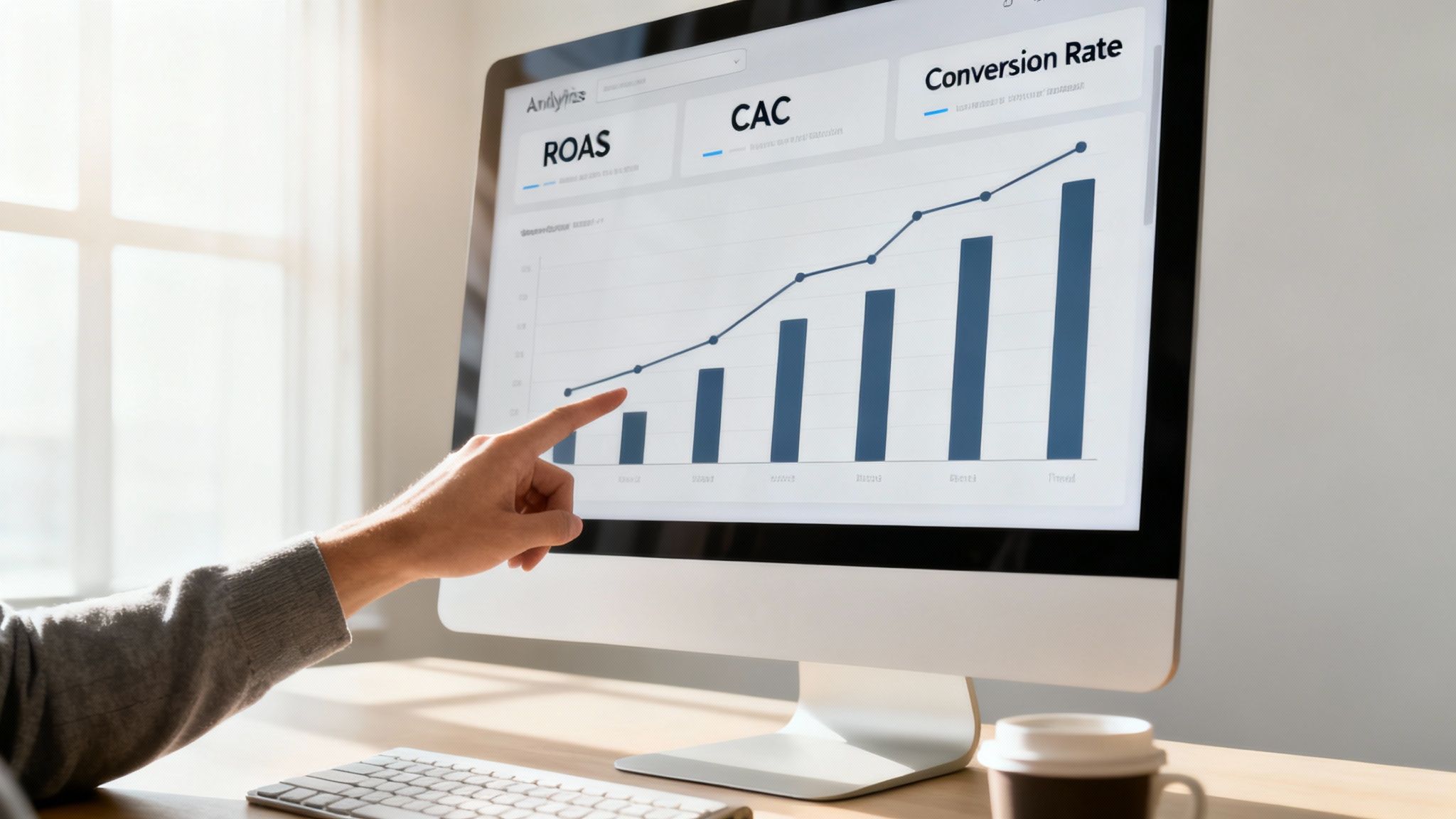
- Return on Ad Spend (ROAS): This is your ultimate profitability gauge. It answers one simple question: "For every dollar I put into ads, how many dollars do I get back in revenue?" A ROAS of 4:1 means you're generating $4 in sales for every $1 of ad spend.
- Customer Acquisition Cost (CAC): This tells you exactly how much it costs to win over a new customer. If you spend $500 on a campaign and get 20 new customers out of it, your CAC is $25. Knowing this number is essential for managing your budget and making sure your business model is actually sustainable.
- Conversion Rate (CVR): This is the percentage of your website visitors who take the action you want them to, which is usually making a purchase. If 100 people visit a product page and two of them buy, your conversion rate is 2%. A stubbornly low CVR can be a red flag for problems with your website, pricing, or even your ad targeting.
Key Takeaway: While dozens of other metrics can provide context, ROAS, CAC, and CVR are the holy trinity. They dictate the financial success of your digital marketing. Everything you do should be aimed at improving these numbers.
A Framework for Analysing Campaign Performance
Looking at a spreadsheet full of data is one thing; knowing what to do with it is something else entirely. Having a simple, repeatable review process helps you diagnose problems and spot opportunities without getting completely overwhelmed. I recommend setting aside a dedicated time each week to run through this framework.
Kick things off by looking at your primary KPI: ROAS. Is it hitting your target? If the answer is yes, fantastic—now look for ways to scale up what’s clearly working. If it’s a no, it’s time to roll up your sleeves and dig a bit deeper to find out why.
Next, you need to investigate the supporting metrics to diagnose the problem. A low ROAS is almost always caused by one of two things: you're paying too much to get customers in the door (high CAC), or the visitors you are getting aren't buying anything (low Conversion Rate). Understanding which digital marketing performance metrics to focus on is the first step towards effective optimisation.
Diagnosing and Fixing Common Problems
Let's break down how you can troubleshoot a struggling campaign using your data. Put on your campaign doctor hat—you're using the symptoms (your metrics) to find the cure.
Scenario 1: High Traffic, Low Sales (Low Conversion Rate)
If you're getting plenty of clicks but the sales aren't following, the problem probably isn't your ad's visibility. It's what happens after the click that needs attention.
- Check Landing Page Relevancy: Does your landing page deliver on the promise of your ad? Someone clicking an ad for "red running shoes" needs to land on a page filled with red running shoes, not your generic homepage. Any mismatch creates friction and kills conversions.
- Analyse Site Speed: A slow-loading site is a conversion killer. People have zero patience. Test your page speed and get your images and code optimised to make it snappy.
- Review User Experience (UX): Is your checkout process clunky, confusing, or just plain annoying? Are there broken links or buttons? Use tools to watch real user sessions and pinpoint exactly where people are getting stuck or dropping off.
Scenario 2: High Costs, Low ROAS (High CAC)
What if your conversion rate is decent, but you're still not profitable? This usually means your ad costs are simply too high for the return you're getting.
- Refine Your Audience Targeting: Are you casting too wide a net? Try narrowing your focus to more specific interests, demographics, or behaviours that align perfectly with your ideal customer profile.
- Test New Ad Creative: Ad fatigue is a real thing. If you've been running the same images and videos for weeks on end, your audience has probably started tuning them out. Test fresh creative with different headlines, visuals, and calls to action to see what resonates now.
- Optimise Your Bidding Strategy: Are you bidding on super competitive, expensive keywords? Look for longer, more specific search terms (often called long-tail keywords). They usually have less competition but much higher purchase intent.
By systematically working through these checks, you stop guessing and start making informed decisions. This is how you directly boost campaign performance and drive profitable, sustainable growth for your e-commerce store.
Your Actionable E-commerce Marketing Checklist
Theory is great, but action is what gets you paid. This checklist is where the rubber meets the road, turning everything we’ve covered into a practical, step-by-step game plan for your digital marketing.
Think of it as your roadmap, broken down into logical phases. Each step builds on the last, helping you construct a powerful, cohesive marketing engine for your online store without missing any of the mission-critical pieces.
Phase 1: Foundation and Setup
Before you even think about launching a single campaign, you need to get your technical and strategic groundwork sorted. This first phase is all about making sure your tracking is accurate and your website is primed to convert the traffic you’re about to send its way.
- Install Tracking Pixels: Get the Meta Pixel and Google Ads tag installed correctly on your website. This is completely non-negotiable for proper conversion tracking and powerful remarketing.
- Complete a Technical SEO Audit: Check your site speed, nail your mobile-friendliness, and hunt down any broken links. A healthy website is the bedrock of every single marketing effort you'll make.
- Integrate Google Analytics 4: Make sure GA4 is properly connected to your e-commerce platform. You need this to effectively track user behaviour and, most importantly, sales data.
Phase 2: Campaign Launch
With a rock-solid foundation in place, you're ready to start driving targeted traffic. This phase is all about activating high-intent channels that can bring in sales quickly, putting your products right in front of people who are actively looking to buy.
- Set Up Your Google Shopping Feed: Submit a clean, optimised product feed to Google Merchant Centre. This is the key to running those visual product ads that dominate the search results.
- Build Your First Meta Campaign: Kick things off with a dynamic product ad campaign. Target people who have visited your website and abandoned their carts. This is almost always the highest-returning first step you can take.
- Launch a High-Intent Google Search Campaign: Go after long-tail, specific keywords that scream "I want to buy this now!" Think phrases like "buy waterproof hiking boots for women."
Actionable Insight: Always prioritise launching campaigns that capture existing demand first (like Search and Shopping). Once those are running, you can move on to channels that create new demand, like broader social media campaigns.
Phase 3: Ongoing Optimisation
Marketing is never a "set and forget" deal. The real secret sauce that separates stagnant stores from the ones that scale is consistent analysis and refinement. This final phase is all about turning data into profitable decisions, week in and week out.
- Review ROAS Weekly: Block out time every single week to analyse your Return on Ad Spend (ROAS) for every campaign. Put more money behind what’s working and hit pause on what isn't. It's that simple.
- Test New Ad Copy Monthly: Fight ad fatigue by rolling out fresh ad creative, new headlines, and different offers at least once a month. This is how you keep your campaigns sharp and effective over the long haul.
Your Questions, Answered
Let's tackle some of the most common questions that pop up when you're diving into digital marketing for an e-commerce store. Getting clarity on budgets, timelines, and priorities from the start makes all the difference.
How Much Should I Actually Budget for Digital Marketing?
This is the big one, isn't it? While there's no magic number that fits everyone, a good way to approach it is by tying your marketing spend to your revenue.
As a general rule of thumb, most e-commerce businesses should plan to invest between 5% and 15% of their total revenue into marketing.
If you're a newer store hungry for aggressive growth, you'll probably want to push towards the higher end of that scale. More established brands might find they can maintain their momentum closer to the 5% mark.
So, if your store is pulling in $500,000 a year, you’d be looking at a marketing budget of somewhere between $25,000 and $75,000. This method keeps your spending in sync with your performance, scaling up as you grow.
How Long Until I See Results from SEO vs. PPC?
Ah, the classic showdown: instant impact versus long-term growth. It’s crucial to know what to expect from both SEO and Pay-Per-Click (PPC) so you can set realistic goals.
-
PPC (The Fast Lane): Paid ads, like Google Shopping or a Meta campaign, are designed for speed. You can start driving traffic and making sales within hours or days of hitting 'launch'. It's direct, it's fast, and it's perfect for hitting immediate sales targets.
-
SEO (The Long Game): Think of SEO as building a long-term asset. It generally takes 4 to 12 months to see a real, significant lift in your organic traffic and rankings. The effort you put in today builds foundational authority that pays you back with sustainable, free traffic for years to come.
A good analogy is that PPC is like renting a storefront in a prime location—instant visibility for as long as you pay. SEO is like buying the land and building your own flagship store; it takes time, but you own it.
Which Channel Should a New E-commerce Store Focus on First?
When you're just starting out and resources are tight, you need to be strategic. The smartest move is to focus on channels that capture customers who are already looking to buy what you sell.
Start with Google Search and Google Shopping ads. These platforms put your products directly in front of people who are actively searching for them. They have what we call 'high purchase intent', which means they're much closer to pulling out their credit card. This is the fastest way to get those initial sales rolling in.
Once you’ve got a reliable stream of revenue coming from these high-intent channels, you can start reinvesting those profits. The next logical step is to broaden your reach and build brand awareness on platforms like Meta (Facebook and Instagram), where you can create new demand and find your next wave of customers.
Ready to build a precision-driven marketing strategy that drives real growth for your e-commerce store? Click Click Bang Bang specialises in AI-first SEO and data-focused PPC campaigns designed to maximise your return. Let's build a profitable campaign together. Learn more at clickclickbangbang.com.au
Read NeXt
Or Read Our Latest
- Manual vs Automated Bidding for PPC Success
- Conversion Tracking Setup: A Complete AU Guide
- Instagram Advertising Australia: Complete 2026 Guide
- Pay Per Click: A Beginner’s Guide for Australian Marketers
- Display Advertising on Google: The Complete Australian Guide
- Stakeholder Communication Plan How to Build One That Works
Click. CLick. Subscribe.
Get our best PPC insights, industry updates, and power moves delivered straight to your inbox. No fluff, just high-caliber strategies that actually work.
Don’t Leave Just Yet
Try Us For 30-Days,
Risk Free!!
We guarantee that you’ll love our work within the first 30 days, if not you’ll get your money back.
What have you got to lose?