

Choosing The Right PPC Agency For Ecommerce Success
Last Updated

So, what exactly is a PPC agency for ecommerce? Think of them as a specialised digital marketing partner that lives and breathes paid advertising for online stores. Unlike a generalist agency, they have deep, hands-on expertise in the platforms that matter for retail, like Google Shopping and Meta Ads. Their world revolves around metrics like Return on Ad Spend (ROAS) and Customer Acquisition Cost (CAC), with one singular goal: driving profitable sales for your brand.
Why A Specialised PPC Agency Is An Ecommerce Non-Negotiable

If your online store’s growth has hit a wall, you’re not alone. Many brands reach a plateau where their current marketing efforts just stop moving the needle. This is often where the limitations of a generalist marketing agency become painfully obvious. While they might grasp the basics of running ads, the world of ecommerce PPC is a completely different battlefield.
Ecommerce advertising isn't just about bidding on a few keywords. It’s a complex ecosystem of product feeds, dynamic remarketing, and platform-specific quirks that can make or break your budget. A generalist might treat a Google Search ad for a local plumber the same way they treat a campaign for a national fashion retailer—a recipe for wasted ad spend.
The Unique Challenges of Ecommerce PPC
Picture this common scenario: an online store selling bespoke leather goods decides to manage its own Google Ads. They target broad keywords like "leather bags," which brings a flood of clicks but almost no sales. Their product feed is a mess, causing their best-sellers to get disapproved on Google Shopping. The result? Their ROAS flatlines.
This is exactly where a specialised PPC agency for ecommerce comes in. Their expertise is laser-focused on solving the specific challenges that generalist agencies often miss:
- Product Feed Mastery: Your product feed is the absolute backbone of any successful Google Shopping campaign. A specialist knows precisely how to optimise titles, descriptions, images, and custom labels to get your most profitable items seen and clicked.
- Platform-Specific Strategies: Running Meta Dynamic Product Ads requires a completely different playbook than a Google Performance Max campaign. An ecommerce expert gets these nuances and builds strategies tailored to each platform’s strengths.
- Profit-Driven Metrics: A generalist might get excited about clicks or impressions. An ecommerce agency, on the other hand, lives and dies by the numbers that directly impact your bottom line, like ROAS, Average Order Value (AOV), and Customer Lifetime Value (LTV).
The distinction is critical: a generalist agency sells clicks, while a specialised ecommerce agency sells products. Their entire focus is on converting ad spend into tangible revenue for your store.
Making Every Dollar Count
In the competitive Australian ecommerce landscape, making your ad budget stretch is everything. The average cost-per-click (CPC) for Google Ads in ecommerce is just $1.82 AUD, a bargain compared to sectors like finance at $13.37 AUD. This affordability creates a massive opportunity, but only if every click is highly targeted.
A savvy PPC agency for ecommerce like Click Click Bang Bang ensures your budget isn't squandered on irrelevant traffic, maximising your reach without killing profitability. You can learn more about local benchmarks in this report on Australian marketing statistics.
Ultimately, partnering with a specialised agency isn't just a smart move; it's a necessary investment for growth. It’s about bringing in a partner who speaks the language of online retail and has a proven playbook for turning advertising into a predictable engine for scaling your business.
Defining Clear Goals To Find The Right Agency Fit
Jumping into the search for a PPC agency without clear goals is like setting sail without a map. You might end up somewhere, but it's probably not where you wanted to go. Before you even start shortlisting agencies, the single most important thing you can do is define what success actually looks like for your business.
Just saying you want "more sales" is a starting point, not a goal. A good agency can't build a strategy on a vague wish. What you need are concrete, measurable targets that give them a clear brief and a benchmark for performance. Honestly, this clarity is the most powerful tool you have for finding the right partner.
Moving Beyond Vague Objectives
To turn a simple wish like "more sales" into something an agency can actually work with, you need to attach numbers and timelines to it. This forces you to get real about your current performance and set targets that are both ambitious and achievable.
Here’s how you can translate those fuzzy desires into sharp, powerful goals:
- Vague: "I want to improve my return on advertising."
- Specific: "Achieve a minimum 5x Return on Ad Spend (ROAS) on all Google Shopping campaigns within 90 days."
- Vague: "We need to sell more of our new product line."
- Specific: "Generate 200 sales for the new winter collection via Meta Ads in Q3, while keeping our Customer Acquisition Cost (CAC) below $45."
- Vague: "I want to grow my customer base."
- Specific: "Increase new customer acquisition by 25% year-on-year, with a focus on capturing market share from our top three competitors."
When you have these specifics defined before you talk to an agency, it completely changes the conversation. It shifts from, "So, what can you do for us?" to, "Here's what we need to achieve. How will you get us there?"
This approach immediately helps you weed out the agencies that just roll out generic, one-size-fits-all strategies. A true ecommerce specialist will lean into these goals, ask smart follow-up questions, and start brainstorming a potential strategy right there in the first call.
Primary vs. Secondary Goals
It's also crucial to have a clear hierarchy for your goals. Not every key performance indicator (KPI) carries the same weight, and a good agency needs to know what you consider non-negotiable.
The Non-Negotiables (Primary Goals)
These are the core financial metrics that directly hit your bottom line. At the end of the day, this is how you'll judge an agency's success.
- Return on Ad Spend (ROAS): The total revenue you get back for every dollar you put into ads.
- Customer Acquisition Cost (CAC): How much it costs, on average, to get a new paying customer through the door.
- Profit on Ad Spend (POAS): This is a more advanced metric that goes beyond revenue. It factors in your Cost of Goods Sold (COGS) to measure actual profit, which is what really matters.
The Supporting Cast (Secondary Goals)
These metrics are vital for diagnosing what's working and what isn't, but they ultimately serve the primary goals. Think of them as the health-check numbers.
- Conversion Rate (CVR): The percentage of ad clicks that turn into a sale.
- Click-Through Rate (CTR): The percentage of people who see your ad and actually click on it.
- Average Order Value (AOV): The average amount a customer spends when they make a purchase.
When you present a potential PPC agency for ecommerce with this kind of structured thinking, you're not just a client—you're a data-driven partner. It allows them to tailor their proposal specifically to you, ensuring they operate less like a vendor and more like an extension of your growth team. If you're looking for benchmarks, checking out some of the top Amazon PPC agency picks can give you a feel for what successful partnerships look like.
Getting this groundwork done ensures that from day one, everyone is aligned and pulling in the same direction toward the same measurable outcomes.
Core Capabilities Of A Top-Tier Ecommerce PPC Agency
Not every agency that runs ads has what it takes to scale an online store. There's a world of difference between a generalist and a true PPC agency for ecommerce. These specialised agencies operate as strategic partners, armed with a deep, almost intuitive, understanding of the retail ecosystem.
Distinguishing between a basic campaign manager and a genuine growth partner means looking closely at their core capabilities. These are the non-negotiables, the skills that separate the top-tier agencies from the rest. Let's break down exactly what you should be looking for.
This framework shows the ideal flow for aligning with an agency partner, covering how to define your goals, measure what matters, and collaborate effectively.
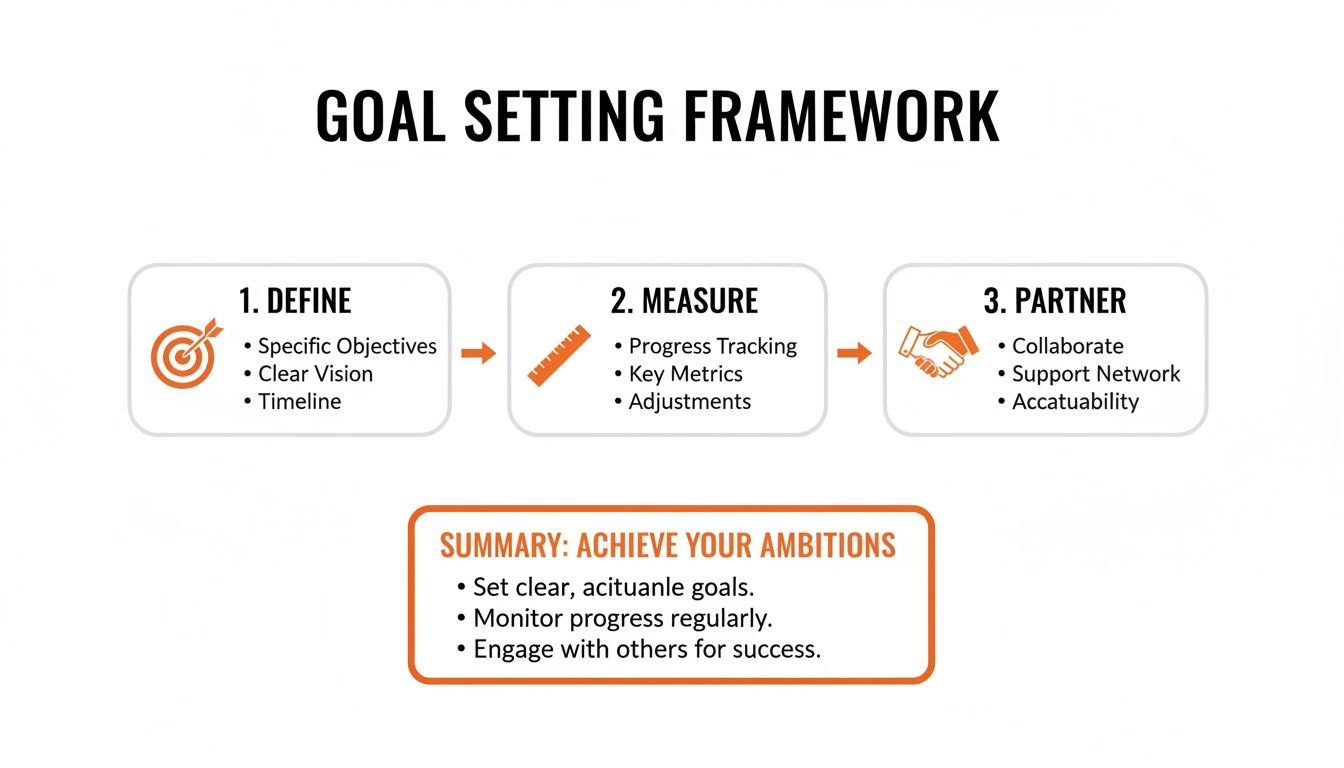
This visual really drives home the need for a structured approach. It ensures both you and your agency are locked in on clear, measurable objectives right from the start.
Mastery Across Key Advertising Platforms
An elite ecommerce agency needs proven expertise on the platforms where your customers are actually shopping and discovering products. This isn't just about being "certified"—it means having a concrete playbook for driving sales on each one.
- Google Ads: This is the cornerstone. Sure, they need to know Search and Display, but the real test is their mastery of Google Shopping and Performance Max. These campaign types are absolutely vital for retail success.
- Meta Ads (Facebook & Instagram): A top agency goes way beyond running simple traffic ads. They must excel at Dynamic Product Ads (DPAs), building sophisticated retargeting funnels, and properly using catalogue sales objectives to drive conversions.
They should be able to walk you through a clear, full-funnel strategy, explaining how these platforms work together to guide a customer from that first moment of awareness to the final purchase and, hopefully, repeat business.
Unparalleled Product Feed Optimisation
For any ecommerce brand, the product feed isn't a technical afterthought—it's the absolute foundation of your paid advertising success, especially on Google Shopping. An agency that doesn’t obsess over your feed is a massive red flag.
A well-optimised product feed is the single most powerful lever you can pull to improve performance in Google Shopping. It directly impacts your ad visibility, click-through rate, and ultimately, your return on ad spend.
A skilled agency will meticulously refine every element of your feed to squeeze every drop of performance out of it. This includes optimising product titles with high-intent keywords, ensuring images are top-notch, and using custom labels to segment products for strategic bidding. If you want to see what this looks like in practice, we break down our specialised approach in our article on finding the right Google Shopping agency.
A Strong Focus On Conversion Rate Optimisation (CRO)
Driving traffic to your website is only half the battle. If that traffic doesn't convert into sales, you're just burning cash. A top-tier PPC agency for ecommerce understands this to its core and extends its expertise beyond ad platforms into Conversion Rate Optimisation (CRO).
They won't just report on a low conversion rate; they'll dig in to find out why it's happening. This involves analysing landing pages, user behaviour, and the checkout process to identify friction points. Their recommendations could include A/B testing headlines, improving the mobile experience, or tweaking calls-to-action. An agency's ability to implement proven strategies to increase ecommerce conversion rates is often what separates the good from the great.
Data Fluency And The Smart Use Of AI
Modern PPC is a data game. Your agency needs to be fluent in analytics, capable of turning raw numbers into actionable insights. They should be masters of tracking, attribution, and reporting, connecting your ad spend directly to revenue.
This data-first mindset is amplified by the intelligent use of Artificial Intelligence. AI isn't just a buzzword; it's a critical tool for gaining a competitive edge. Today’s leading platforms are built on AI, and your agency must know how to work with these systems, not against them.
A forward-thinking agency uses AI for things like:
- Automated Bidding: To optimise bids in real-time for goals like Target ROAS.
- Audience Segmentation: To identify and target your most valuable customer segments.
- Predictive Analytics: To forecast trends and anticipate shifts in consumer behaviour.
When you're evaluating a potential partner, look for these core capabilities. They are the defining traits of an agency that can truly move the needle for your ecommerce business.
To make this easier, we've put together a quick checklist to help you evaluate potential agencies.
PPC Agency Capability Checklist
This table breaks down what separates a capable agency from one that might not have the specialised skills your ecommerce brand needs.
| Capability Area | What to Look For (Good) | Red Flag (Bad) |
|---|---|---|
| Platform Expertise | Deep, proven experience with Google Shopping, PMax, and Meta's DPA campaigns. Can articulate a full-funnel strategy. | Focuses only on basic Search or traffic campaigns. Lacks a clear retail strategy. |
| Product Feed | Obsesses over feed quality. Proactively suggests optimisations for titles, images, and attributes. Uses custom labels strategically. | Treats the product feed as a "set and forget" task. Doesn't understand its impact on performance. |
| CRO Focus | Goes beyond the ad click. Analyses landing pages and user experience. Provides actionable CRO recommendations. | Reports on a low conversion rate without offering solutions. Considers their job done once traffic is delivered. |
| Data & AI | Fluent in analytics and attribution. Leverages AI for bidding, targeting, and insights. Connects ad spend to revenue. | Uses vanity metrics like clicks and impressions. Views AI as a buzzword or uses it without a clear strategy. |
Think of this as your cheat sheet. An agency that ticks all the "Good" boxes is far more likely to become a true growth partner, not just another line item on your marketing budget.
How To Vet Your Shortlist And Spot The Red Flags
Alright, you’ve done the groundwork. You know your goals and what a top-tier PPC agency for ecommerce should bring to the table. Now comes the hard part: taking that shortlist of potential partners and figuring out who’s the real deal.
It’s time to move beyond the polished sales pitch and dig into how they actually operate. This is the vetting stage, and it’s where you separate the genuine experts from the slick presenters.
The right questions will reveal everything about an agency’s experience, strategic mind, and integrity. But generic questions only get you generic, rehearsed answers. You need to ask questions that force them to prove their real-world expertise.
Strategic Questions That Cut Through The Fluff
Forget asking, "Do you have experience with ecommerce?" Of course they'll say yes. You need to get specific and see how they actually think and solve problems.
Here are a few powerful questions designed to get you the insights you really need:
-
"Walk me through a time you turned around a struggling ecommerce account. What was the situation, what steps did you take, and what was the outcome?"
This question is gold. It tests their ability to diagnose a problem and execute a recovery plan. A great answer will involve a detailed process: auditing the account, plugging wasted spend, overhauling the product feed, and testing new strategies, all backed by specific metrics. -
"How do you approach product feed optimisation and management?"
We’ve already established the product feed is king. A top-tier agency will light up when you ask this. They should immediately start talking about title structures, attribute enrichment, using custom labels for bidding, and the specific tools they use. A vague, high-level answer here is a massive red flag. -
"If our ROAS drops by 30% next month, what's your immediate action plan?"
This simulates a crisis and shows you their real process for communication and problem-solving. Look for an answer that involves immediate analysis, checking for technical glitches, digging into competitor activity, and clearly communicating a plan of action to you.
These kinds of questions shift the conversation from a sales pitch to a strategic workshop. They force the agency off-script and make them show you their hands-on expertise.
The quality of an agency's answers is often a direct reflection of the quality of their work. Look for detailed, data-backed responses that demonstrate a deep understanding of ecommerce challenges, not just surface-level PPC knowledge.
Unmistakable Red Flags To Watch Out For
Just as important as asking the right questions is knowing how to spot the warning signs. Some agencies are brilliant at selling but fall flat on delivery. Here are the red flags that should make you pause.
-
Guaranteed Results: This is the big one. No reputable PPC agency for ecommerce can guarantee a specific ROAS or sales figure. The market is just too dynamic. Promises like "We guarantee a 10x ROAS" are a clear sign of either inexperience or dishonesty.
-
Long, Inflexible Contracts: A confident agency doesn't need to lock you into a 12-month contract from day one. Look for agencies offering month-to-month agreements or a short initial commitment, like 90 days. This shows they’re confident their performance will be more than enough to keep your business.
-
Lack of Transparency: You should always own your ad accounts. Period. If an agency insists on creating accounts under their own name, run. It’s a classic tactic to hold your data hostage. They should also be completely open about their strategies and give you access to clear, easy-to-understand reporting dashboards.
-
A "Set and Forget" Attitude: PPC is not a slow cooker. It requires constant monitoring, testing, and tweaking. If an agency talks about setting up campaigns and then just letting them run on autopilot, they lack the active management style needed to actually get results. For a deeper dive into the questions you should be asking, check out our guide to choosing between different PPC marketing agencies.
Ultimately, vetting an agency boils down to trust and evidence. They need to back up every claim with real case studies, client testimonials, and a clear, logical strategy that’s tailored to the goals you’ve already defined. By asking sharp questions and keeping a keen eye out for these red flags, you can confidently choose a partner who operates with integrity and has the proven skills to help your business thrive.
Navigating Contracts And Pricing Models
So, you’ve whittled down your shortlist and think you’ve found a winner. Now comes the part that can feel a bit intimidating: talking numbers and signing on the dotted line. This is where the conversation shifts to contracts and pricing models, and it's easy to get lost in the jargon and fine print.
But getting this right is non-negotiable. A clear, fair agreement isn't just a formality; it's the foundation of a healthy, transparent partnership. It protects both you and the agency, spelling out responsibilities, ownership, and what happens if things need to change. Think of it as the operating manual for your relationship.
Common Pricing Structures Explained
A PPC agency for ecommerce will usually work on one of a few core pricing models. There’s no single "best" one—the right fit depends on your ad spend, how mature your business is, and what you’re trying to achieve.
Here are the most common setups you’ll come across:
-
Percentage of Ad Spend: This is probably the most common model you'll see. The agency's fee is a set percentage—often 10-20%—of your monthly ad spend. It’s simple and scales up or down with your budget. The upside is the agency is incentivised to grow your spend, which should mean they're growing your revenue. The catch? You need to be sure they’re scaling that spend profitably, not just to bump up their fee.
-
Flat Monthly Retainer: Just like it sounds, you pay a fixed fee each month, no matter what your ad spend is. This gives you predictable costs, which makes budgeting a breeze. It’s a great fit for businesses with a steady monthly ad spend or those who just want a clear, unchanging management cost. The key is making sure the retainer genuinely reflects the amount of work going into your account.
-
Hybrid Model (Retainer + Performance): This model is a mix of the two. It usually involves a lower flat retainer plus performance-based bonuses. For instance, an agency might charge a base fee and earn a bonus for hitting a specific ROAS target. We're big fans of this structure because it perfectly aligns incentives—the agency only makes more money when they deliver exceptional results for you.
A good, transparent agency will walk you through these options and recommend the one that makes the most sense for your business. If you encounter an overly complex model with fuzzy terms or hidden fees, take it as a warning sign. Simplicity and clarity are your best friends here.
For a deeper dive, check out our complete guide to understanding PPC pricing models to figure out which structure is the right match for you.
Key Clauses To Scrutinise In Your Contract
A contract is much more than a price tag. It’s the rulebook for your entire partnership. Before you sign anything, you need to slow down and pay close attention to a few critical clauses that can have a massive impact on your business down the road. Trust me, rushing this step is a mistake plenty of businesses live to regret.
Here’s what you absolutely must look for and confirm is spelled out in black and white:
-
Ad Account Ownership: This one is a deal-breaker. The contract must state, without any ambiguity, that you, the client, retain 100% ownership of all your ad accounts (Google, Meta, the lot). An agency that sets up accounts in their own name is waving a giant red flag. If you ever decide to part ways, they could hold your valuable campaign data and history hostage. Don't even consider it.
-
Termination Policy: A confident agency that backs its ability to get results won't need to lock you into an ironclad 12-month contract from day one. Look for flexible terms, like a rolling month-to-month agreement or a simple 30-60 day notice period for termination. This structure ensures they are constantly working to earn your business, month after month.
-
Reporting and Communication Schedule: Your contract should clearly define how often you'll get reports (e.g., weekly check-ins, monthly performance reviews) and exactly what those reports will cover. It should also name your main point of contact and set expectations for their response times. Nailing this down upfront prevents miscommunication and guarantees you’re always in the loop on your campaign performance.
What A Great Onboarding Process Looks Like

The first few weeks with a new agency are everything. This isn't just about paperwork; the onboarding process sets the tone, strategy, and technical foundation for the entire partnership. A slow, disorganised start is a massive red flag and can kill your momentum before a single dollar is spent.
On the flip side, a seamless onboarding process is one of the strongest signs you’ve picked a winner. It tells you the agency has a well-oiled machine for getting new clients up and running, digging into the nuts and bolts of their business, and getting campaigns live efficiently. It's the first real-world test of their expertise.
Kicking Things Off: The Discovery And Strategy Deep Dive
The moment the contract is signed, the clock should start ticking. A great agency won't waste any time, immediately scheduling a deep-dive kick-off call. This isn't just a quick "hello"—it's an intensive session designed to pull every critical detail about your business out of your head and onto their strategy docs.
They should come to the table with sharp questions about your target audience, product profit margins, key competitors, and what has (and hasn't) worked in the past. This is where they translate the goals you've discussed into a concrete action plan. You should walk away from this meeting feeling like they get your business, almost as well as you do.
The Technical Nitty-Gritty: Tracking And Setup
Now for the behind-the-scenes magic, and it needs to happen fast. An experienced agency will give you a simple, clear checklist of all the access they need. Getting this technical phase right is non-negotiable for accurate measurement and, ultimately, campaign success.
Here’s what they’ll be tackling straight away:
- Getting access to your Google Ads, Meta Business Manager, and Google Analytics accounts.
- Auditing or implementing conversion tracking to make sure every single sale is attributed back to the right ad. This is critical.
- Connecting your product feed to their management tools and starting the initial optimisation work.
- Setting up a shared communication hub, like a dedicated Slack channel or project board, to keep everyone in the loop.
A common benchmark for a top-tier agency is to have ads live and gathering data within 5-7 business days of that kick-off call. If it takes longer without a very good reason, it might point to inefficient processes or a lack of urgency.
Your Onboarding Readiness Checklist
To make sure things get off to a flying start, you can do your part by having key info and assets ready to go. Being organised from day one helps your new agency hit the ground running, which means you see results that much faster.
Before your first official call, try to get these things sorted:
- Account Access: Have login details handy (or be ready to grant access) for all the important platforms: your website backend (e.g., Shopify, BigCommerce), Google Analytics, Google Ads, and Meta Business Manager.
- Product Feed: Make sure your product feed is up-to-date and easy to access. If you've had headaches with it before, write down the details so the agency knows what they’re walking into.
- Brand Assets: Create a folder with your logos, brand guidelines, and any high-quality product or lifestyle images you have. This lets them build on-brand creative from day one.
- Past Performance Data: Don't hide the bad stuff. If you have any historical advertising data—even from campaigns that bombed—share it. Knowing what didn't work is often as valuable as knowing what did.
A proactive agency will walk you through all of this, but having these items ready shows you're a serious partner ready for growth. This initial teamwork sets a powerful precedent for a successful, profitable, and long-term relationship.
At Click Click Bang Bang, we’ve refined our onboarding into a science, ensuring your campaigns are live and optimised within seven days. Find out how we can accelerate your growth at https://clickclickbangbang.com.au.
Read NeXt
Or Read Our Latest
- Manual vs Automated Bidding for PPC Success
- Conversion Tracking Setup: A Complete AU Guide
- Instagram Advertising Australia: Complete 2026 Guide
- Pay Per Click: A Beginner’s Guide for Australian Marketers
- Display Advertising on Google: The Complete Australian Guide
- Stakeholder Communication Plan How to Build One That Works
Click. CLick. Subscribe.
Get our best PPC insights, industry updates, and power moves delivered straight to your inbox. No fluff, just high-caliber strategies that actually work.
Don’t Leave Just Yet
Try Us For 30-Days,
Risk Free!!
We guarantee that you’ll love our work within the first 30 days, if not you’ll get your money back.
What have you got to lose?