

Affordable SEO for Small Businesses A Guide to High-Impact Growth
Last Updated

For many small business owners, proper search engine optimisation feels completely out of reach—too complex, too expensive, and way too time-consuming. But the truth is, affordable SEO for small businesses is not only possible, it's highly effective when you prioritise the right high-impact tasks first. This approach is all about chasing foundational wins that deliver real results without needing a massive budget.
Why SEO Feels Overwhelming and How to Get Started
Let's be honest: the world of SEO is drowning in jargon and intimidating technical details. From "backlinks" to "schema markup," it’s easy to feel like you need a specialised degree just to understand the basics. This confusion often leads to paralysis, leaving a huge growth opportunity on the table.
This feeling is incredibly common. While 85% of Australian SMEs have websites, a staggering 64% of owners either don't understand SEO's power or struggle to see how it drives results. Only 36% believe they use it efficiently, which shows just how many businesses are missing out.
Your Simple Starting Framework
Instead of trying to do everything at once, successful and affordable SEO starts with a simple triage plan. You only focus on what moves the needle today. This approach cuts through the noise and helps you build momentum with small, manageable wins.
The process boils down to three core steps: Claim your digital assets, Check your website's health, and Prioritise high-impact tasks.
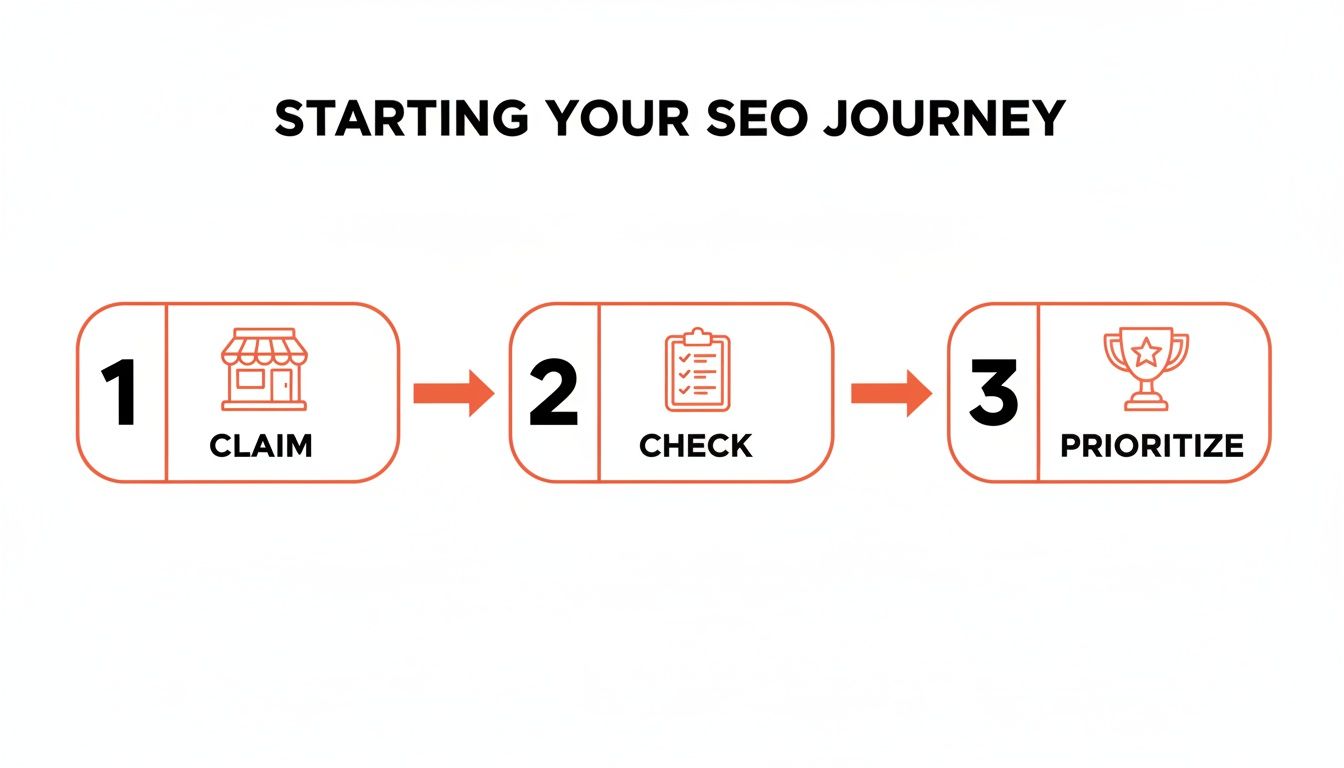
By following this simple process, you build a solid foundation that makes all your future efforts more effective.
The very first step is claiming your essential digital real estate, which costs nothing but your time. This means setting up and fully optimising your Google Business Profile. It’s the single most powerful free tool you have for local visibility.
Think of your Google Business Profile as your digital storefront. It’s often the very first interaction a potential customer has with your brand, especially in local search results. Neglecting it is like leaving your front door locked during business hours.
For a deeper dive into the technical, on-page, and local strategies involved, this guide on Mastering SEO for Your Company is a fantastic resource.
Your High-Impact SEO Starter Checklist
To help you get started, here's a quick look at the most crucial, low-cost tasks that deliver the biggest bang for your buck. These are the foundational items every small business should tackle first.
| SEO Task | Estimated Cost | Potential Impact |
|---|---|---|
| Claim & Optimise Google Business Profile | Free | Very High |
| Basic Keyword Research | Free (with free tools) | High |
| Fix Critical Technical SEO Issues | Low (DIY) / Moderate (Developer) | High |
| On-Page SEO for Key Pages | Low (DIY) | High |
| Create 1-2 High-Value Blog Posts | Low (DIY) / Moderate (Writer) | Medium to High |
| Set Up Google Analytics & Search Console | Free | Very High |
Focusing on these six areas will build immediate momentum without draining your bank account, setting you up perfectly for more advanced strategies down the track.
Building Your Foundation with Technical and On-Page Wins
Before you even think about writing a single blog post, you need to get your website’s technical health and on-page structure sorted. It’s like building a house; you wouldn’t start painting the walls before making sure the foundation is secure.
Getting these foundational elements right are some of the most powerful—and affordable—SEO wins for any small business. They make every other effort you put in, from content to link building, that much more effective.
Diagnose Your Website’s Health
So many small business websites are unknowingly held back by simple, fixable technical problems. A huge one I see all the time is site speed. If your website takes more than a few seconds to load, potential customers will just leave. They won’t wait around to see what you offer. A slow site frustrates users, and search engines penalise it for that exact reason.
The good news is you don't need to be a developer to figure out what's going on. Free tools like Google’s PageSpeed Insights give you a clear, actionable report card on your site's performance. Just pop in your website's URL, and it'll spit out a score for both mobile and desktop users.
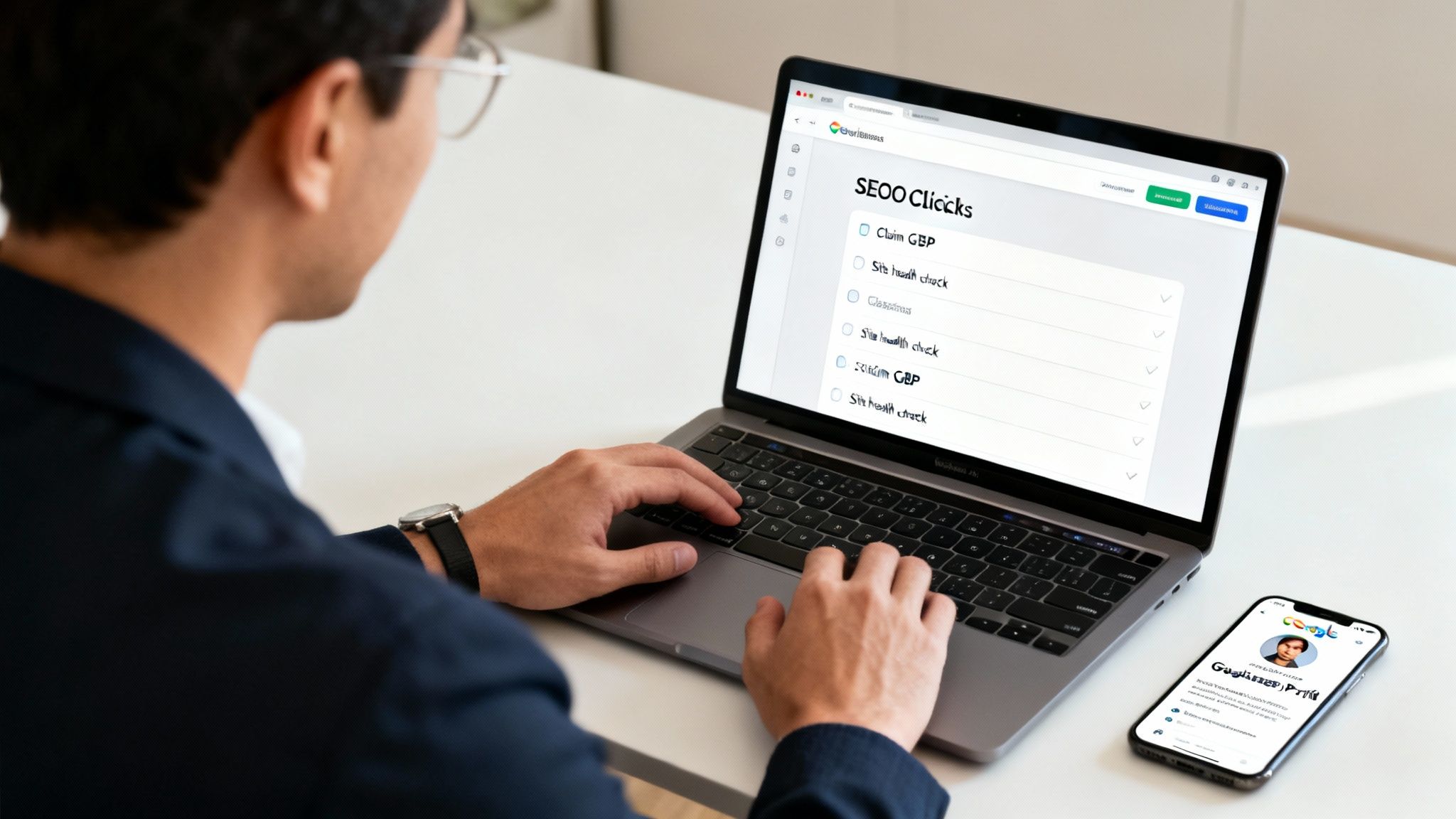
The report turns complex issues into a manageable checklist, highlighting specific things you can fix, like optimising your images or improving server response times.
Another critical technical piece is making sure your site is crawlable. This just means search engines can easily find and understand all your important pages. A vital step here is to learn how to make a sitemap for WordPress and submit it via Google Search Console. It's dead simple, and it's like handing Google a map of your entire website.
Master Your On-Page SEO
Once the technical foundation is stable, it's time to shift your focus to optimising individual pages. This isn't about stuffing keywords everywhere. It’s about creating a clear, logical structure that works for both your visitors and for search engines.
A well-optimised page answers a user's question clearly and quickly. Google's goal is to provide the best answer, so your goal should be to create it. Great on-page SEO is simply great user experience.
For every important page on your site, you should nail these core on-page elements:
- Title Tags: This is the clickable headline people see in the search results. Make it compelling, stick your main keyword in there, and try to keep it under 60 characters.
- Meta Descriptions: That little summary under your title tag. It's not a direct ranking factor, but a good one makes people want to click through to your site.
- Heading Structure: Every page needs one (and only one) H1 tag for the main page title. Then use H2s and H3s to break up your content into logical, scannable sections.
- Image Optimisation: Always compress your images so they load quickly. And don't forget to use descriptive alt text—it’s great for accessibility and helps you show up in image searches.
Getting these technical and on-page fundamentals right is a one-time investment of effort that pays off for years to come. If you're ready for a deeper dive, our guide on how to conduct a technical SEO audit walks you through a much more detailed process.
Win Your Local Market with Hyper-Focused SEO
For most small businesses, the real growth happens on your home turf. Forget trying to compete with national giants; your best customers are often right around the corner, searching for services "near me." This is where affordable SEO truly shines, driving qualified, ready-to-buy customers straight to your door.
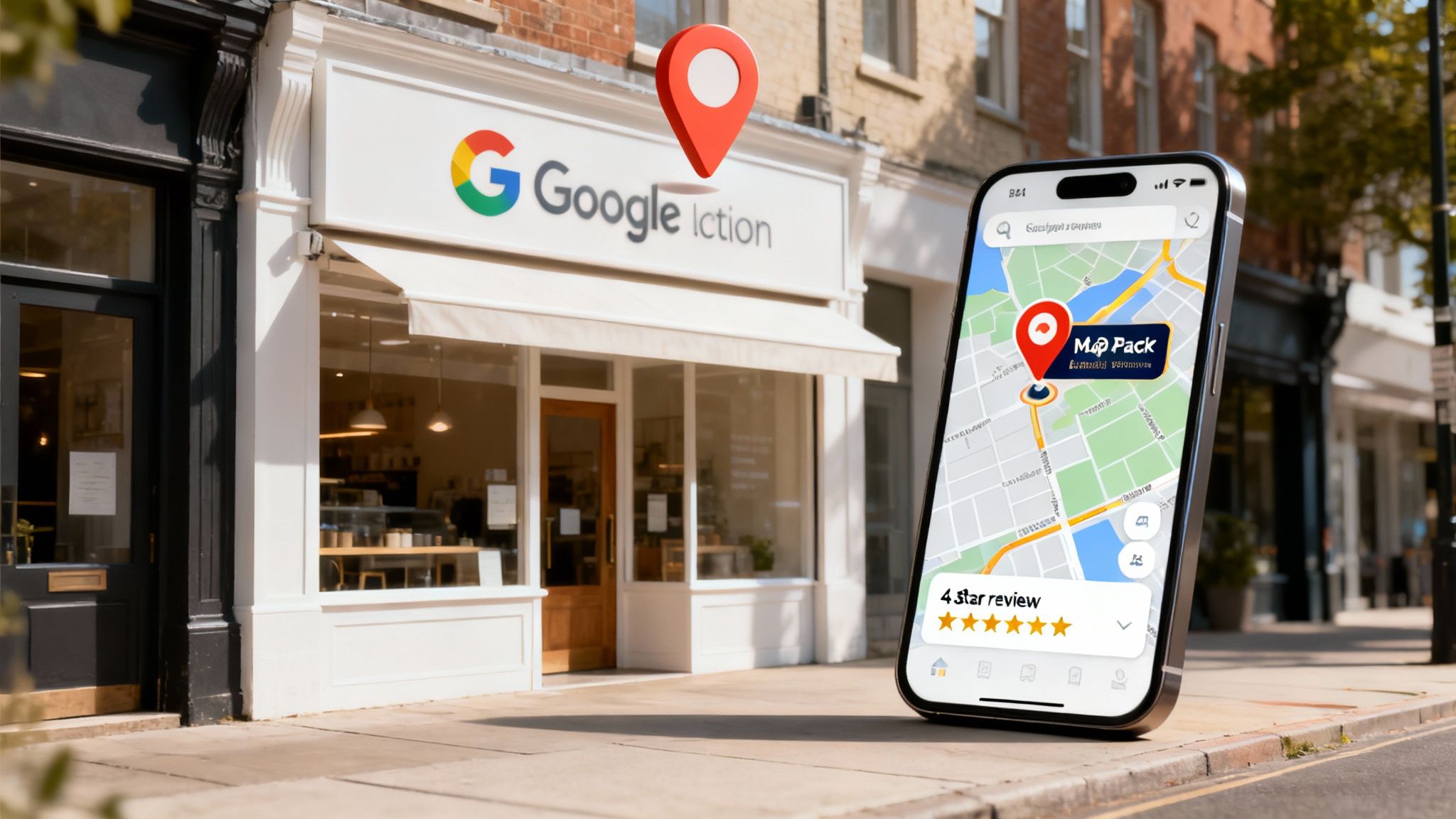
At the heart of any local strategy is your Google Business Profile (GBP). It's not just a listing—it's your digital shopfront on Google Maps and the coveted "Map Pack." Getting this right is probably the single highest-impact, lowest-cost SEO task you can tackle.
Go Beyond the Basics with Your GBP
Just claiming your profile and walking away isn't enough. To really stand out, you need to treat your GBP like an active marketing channel. This means consistently feeding it information that proves to Google your business is active, relevant, and trustworthy.
Here’s how to level up your profile:
- High-Quality Photos: Add crisp, clear photos of your team, your work, and your shop or office. Showing off real projects builds instant trust.
- Detailed Services: Don't just list "Plumber." Get specific with "Emergency Hot Water Repair," "Blocked Drain Clearing," and "Gas Fitting." You want to match the exact terms your customers are typing into Google.
- Regular Posts: Use Google Posts to announce specials, share updates, or highlight a recent job. Think of it as a mini-blog that sits right on your search listing.
One of the most common mistakes I see is business owners setting up a GBP and then completely forgetting about it. An active, frequently updated profile will almost always outperform a static one. It signals to Google that you're open for business and engaged, making you a more reliable result for searchers.
Build Local Authority with Citations
Beyond your GBP, Google scours the web for consistent mentions of your business to verify that you are who you say you are. These mentions are called citations, and they're built on your business Name, Address, and Phone number (NAP).
Consistency here is everything. Your NAP details need to be identical across every single directory, from Yellow Pages to niche industry sites. Even a tiny variation like "St" versus "Street" can muddy the waters for search engines and water down your local authority. A quick audit and cleanup of your top 20 citations is a powerful, one-time fix.
Harness the Power of Customer Reviews
Reviews are a massive ranking signal for local SEO. They don't just influence potential customers; Google uses the quantity, quality, and velocity of your reviews to decide your position in the Map Pack. Make it a habit to actively encourage happy customers to leave feedback—it’s a free and incredibly effective way to boost your visibility. To dig deeper into this, check out our detailed guide on SEO for local businesses.
Considering that 46% of all Google searches have local intent, it's wild that 56% of local businesses still haven't even claimed their Google Business Profile. That’s a huge opportunity left on the table for savvy business owners willing to invest a little time in a solid local SEO strategy.
Creating Smart Content and Links on a Budget
Content and links are the fuel that powers your SEO engine, but you don’t need a massive budget to get results. The secret to affordable SEO for small businesses is to get strategic and prioritise quality over sheer volume. It’s all about creating exactly what your customers are searching for and earning trust signals that Google values.
A lot of small business owners I talk to think "content" means churning out dozens of blog posts every month. That’s just not realistic or effective when you're running lean. Your goal should be to answer the specific questions your ideal customers are typing into Google.
Find Your Low-Hanging Fruit Keywords
Before you write a single word, you need to know what to write about. This all starts with finding "low-hanging fruit" keywords—phrases that are specific, have clear intent, and aren't impossibly competitive. You can uncover these opportunities using free tools.
For example, Google Keyword Planner is a fantastic free resource. While it's designed for ads, its data is invaluable for SEO. You can enter a broad topic like "landscaping Sydney" and discover more specific, long-tail keywords that real people are searching for, such as "low maintenance garden design Sydney" or "best native plants for clay soil."
Here's an example of the kind of data you can discover within the tool.
The tool reveals monthly search volumes and competition levels, letting you prioritise topics that have genuine demand but aren't being targeted by every major competitor.
Once you have a list of these questions and phrases, you can create hyper-relevant content that directly addresses them. This could be a detailed blog post, a helpful FAQ page, or even a simple "how-to" guide.
A single, high-quality blog post that perfectly answers a customer's specific question is infinitely more valuable than ten generic articles that nobody is searching for. Focus on depth and usefulness, not just frequency.
Demystify Link Building on a Budget
Link building often sounds intimidating, but for a small business, it's really about community and relationships, not complex outreach campaigns. A backlink is simply a link from another website to yours, and Google sees them as votes of confidence. Your goal isn't to get hundreds of links; it's to get a handful of relevant, authoritative ones.
Here are some practical, low-cost link-building tactics:
- Local Sponsorships and Events: Sponsoring a local kids' sports team or a community event often comes with a link from their website. This is a powerful local signal and great for brand visibility.
- Industry and Community Forums: Don't spam! Genuinely participate in local forums or online groups where your customers hang out. If you provide a genuinely helpful answer to a question, you can often include a link back to a relevant resource on your site.
- Connect with Local Bloggers or Businesses: Reach out to complementary, non-competing businesses in your area. A local caterer could write a guest post for a wedding venue's blog, for example. It's a win-win that provides value to both audiences.
Building these types of natural, relevant links signals to Google that you are a trusted part of your local business community. This slow and steady approach is far more sustainable and effective than chasing cheap, low-quality links that could end up hurting your site in the long run.
Choosing Your Path: DIY vs. Agency SEO
Okay, so you've got a handle on the high-impact bits of an affordable SEO plan. Now for the big question: who's actually going to do the work?
This is a classic dilemma for any small business owner, and it boils down to a simple trade-off: time versus money. Do you roll up your sleeves and invest your own hours to save cash, or do you carve out a budget for an expert so you can get that time back?
The Do-It-Yourself (DIY) route gives you total control and, on the surface, saves a lot of money. If you’ve got more time than cash and a genuine curiosity for this stuff, it’s a perfectly good option. You’ll also gain a really deep understanding of your own marketing, which will help you make smarter decisions later on.
The catch? The learning curve is steep, and a few wrong moves can set you back. What starts as a money-saving exercise can quickly become a massive time-suck, pulling you away from the million other things you need to do to run your business.
Evaluating an SEO Agency Partnership
On the flip side, bringing in an agency gives you immediate access to expertise, professional tools, and battle-tested processes. A good agency has already made the mistakes, figured out what works, and can implement proven strategies far faster than someone starting from scratch. This is the way to go if your time is better spent actually delivering your service or growing your team.
The trick is finding the right agency. "Affordable" should never mean cheap and nasty. A quality partner will be completely transparent about what they’re doing and why. They'll also focus on the metrics that actually move the needle for your business—leads, phone calls, and sales—not just fluff like vanity rankings. To get your head around what a fair price looks like, it's worth reading up on how much search engine optimisation should cost to set some realistic expectations.
Red Flag Warning: Run a mile from any agency that whispers the words "guaranteed rankings." No one can ethically guarantee a #1 spot on Google. Real SEO professionals talk about sustainable growth and realistic timelines, usually forecasting tangible improvements within 3-6 months.
Making the Right Choice for Your Business
To help you figure this out, let's look at the trade-offs. DIY is light on the wallet but heavy on your calendar, with the risk of slow, frustrating progress. An agency costs more but delivers expert execution and faster results, freeing you up to focus on your core business.
Here's a head-to-head look at the trade-offs between managing SEO in-house and hiring a professional agency.
DIY SEO vs Agency Partnership: A Realistic Comparison
| Factor | DIY SEO | Hiring an Agency |
|---|---|---|
| Upfront Cost | Low (mostly your time) | Moderate to High (monthly retainer) |
| Time Investment | Very High (5-10 hours/week) | Low (a few hours/month for reviews) |
| Speed to Results | Slow and gradual | Faster, more predictable progress |
| Expertise | Built slowly through trial and error | Immediate access to specialists |
| Risk Factor | Risk of strategic mistakes or burnout | Risk of choosing a low-quality partner |
Ultimately, there’s no single "correct" answer here. The best path for you depends entirely on your current resources, your skillset, and what your business needs most right now.
Take a good look at your budget and be brutally honest about how much time you can realistically pour into learning and executing SEO yourself. That clarity will point you straight to the most effective and affordable solution for your business.
Tracking Your SEO Success and Proving ROI
Investing in even the most affordable SEO is pointless if you can’t see what’s working. You wouldn’t run your business without tracking sales, so why fly blind with your marketing?
Measuring success isn’t about drowning in data. It’s about focusing on a few key metrics that prove your efforts are generating a real return on investment (ROI). The best part? The essential tools for this are completely free.
Setting Up Your Tracking Dashboard
Your command centre for SEO data comes down to two powerhouse platforms from Google. Setting them up is a one-off task that takes less than an hour but delivers invaluable insights for years to come.
- Google Search Console (GSC): Think of this as a direct line from Google. It shows you which keywords people are using to find you, flags any technical errors holding your site back, and tells you how many times your site appeared in search results (impressions).
- Google Analytics 4 (GA4): This tool tells you what happens after someone clicks on your site from a search result. It tracks how many people visit from organic search, which pages they look at, and whether they complete important actions, like filling out a contact form (conversions).
Connecting these two gives you a complete picture, from the initial search query right through to a customer enquiry.
Proving ROI is the ultimate goal. You need to show that for every dollar or hour you pour into SEO, you're getting more back in real business value—whether that's leads, sales, or phone calls.
Key Metrics That Actually Matter
Forget vanity metrics like "hits." You need to focus on numbers that directly connect to business growth.
For a local business, that means tracking things like organic traffic (visitors from search engines), keyword rankings for your main services, and most importantly, conversions.
Consider this: organic search results capture 85-90% of clicks compared to just 10-15% for Google Ads. For small businesses, that makes tracking your organic performance absolutely critical. When the average local SEO ROI can hit as high as 500%, this data-driven approach turns SEO from a guessing game into a predictable growth engine.
Discover more about how budget-friendly SEO drives results and see how tracking these simple metrics can make all the difference.
Frequently Asked Questions About Small Business SEO
How Long Does Affordable SEO Take to Show Results?
This is the million-dollar question, and the honest answer is: it depends, but you need to be patient. While some quick wins in local SEO can pop up in just a few weeks, you should realistically budget 4-6 months to see significant traction, like ranking for more competitive search terms.
Think of SEO as a long-term investment. Consistency is what builds momentum and authority in Google's eyes.
What Is the Most Important Part of SEO for a Small Business?
If you're a local business, the single highest-impact thing you can do first is to completely nail your Google Business Profile. It’s free, it’s what powers your visibility in local map searches, and it's how you attract customers who are ready to take action right now.
Get this right before anything else. It's the absolute cornerstone of an affordable and effective SEO strategy.
Can I Really Do SEO Myself Without Technical Skills?
Yes, absolutely. A huge chunk of foundational SEO doesn't require you to be a coding whiz. Tasks like optimising your on-page content, managing your Google Business Profile, and creating useful blog posts are more about strategy and effort than technical know-how.
Modern tools have made the technical side far less intimidating, putting powerful results well within reach for DIY-ers.
At Click Click Bang Bang, we build data-focused SEO and PPC campaigns that deliver real growth, not just reports. Ready to see what a precision-driven strategy can do for your business? Explore our services and start your 30-day risk-free trial.
Read NeXt
Or Read Our Latest
- Manual vs Automated Bidding for PPC Success
- Conversion Tracking Setup: A Complete AU Guide
- Instagram Advertising Australia: Complete 2026 Guide
- Pay Per Click: A Beginner’s Guide for Australian Marketers
- Display Advertising on Google: The Complete Australian Guide
- Stakeholder Communication Plan How to Build One That Works
Click. CLick. Subscribe.
Get our best PPC insights, industry updates, and power moves delivered straight to your inbox. No fluff, just high-caliber strategies that actually work.
Don’t Leave Just Yet
Try Us For 30-Days,
Risk Free!!
We guarantee that you’ll love our work within the first 30 days, if not you’ll get your money back.
What have you got to lose?