

Choosing an Ecommerce SEO Service That Drives Real Growth
Last Updated

At its core, an ecommerce SEO service is a specialised partnership designed to get your online store seen in search results. The whole point is to drive qualified, ready-to-buy traffic straight to your product and category pages—boosting your sales organically, without you having to constantly pay for ads.
What an Ecommerce SEO Service Really Does
Think of your online store like a brick-and-mortar shop. You could have the best products in the world, but if your shop is tucked away in a back alley with no sign, nobody will ever find it. An ecommerce SEO service is the team that moves you out of that alley and sets you up in a flagship store right on the main street—in this case, Google’s search results page.
This isn’t about just fiddling with a few keywords here and there. A proper service lays a solid foundation for long-term, sustainable growth. The entire process is built on three crucial pillars that have to work together to not only attract customers but also convince them to buy.
The Three Pillars of Ecommerce SEO Success
A truly comprehensive ecommerce SEO service looks at every single part of your online presence, making sure no stone is left unturned. These core components are:
- Technical Excellence: This is the digital plumbing of your store. It’s all about making sure your website is fast, secure, and dead simple for search engines to crawl and understand.
- Compelling Content: It's about crafting product descriptions, category pages, and blog posts that actually answer your customers' questions and perfectly match what they’re typing into Google.
- Online Authority: This involves building your store’s reputation and credibility across the web, mainly through earning high-quality backlinks and maintaining a positive brand presence.
This kind of strategic approach is more critical now than ever. The Australian e-commerce market is absolutely booming, with 17.08 million Australians now shopping online every month. That's a staggering 45% jump from 2020. With search engines still being the number one way shoppers discover new products, a dedicated SEO strategy has gone from a "nice-to-have" to a "must-have."
A great ecommerce SEO service doesn't just get you more visitors; it gets you the right visitors. It’s the difference between attracting a crowd of window shoppers and attracting customers who are walking in with their wallets already out, actively looking for what you sell.
Ultimately, teaming up with an expert service is an investment in a long-term asset for your business. Unlike paid ads, which vanish the moment you stop paying, strong organic rankings deliver a steady, continuous stream of valuable traffic. If you're serious about building a resilient and profitable online business, understanding the fundamentals of search engine optimisation is your first step.
The Building Blocks of a Powerful Ecommerce SEO Strategy
A solid ecommerce SEO service doesn’t just sprinkle a few keywords onto your website and call it a day. It’s about building a robust, interconnected strategy where every piece works together to pull in the right customers and guide them smoothly toward a purchase.
Think of it less like decorating a shop window and more like designing the entire store from the ground up—foundations, layout, signage, the lot.
This big-picture approach is non-negotiable. In Australia, organic search is a massive driver for online stores, accounting for around 53% of all website visits in the retail sector. Throw in the fact that mobile commerce now makes up 68% of all ecommerce traffic, and you can see why a strong technical and content foundation isn't just an advantage—it's essential for survival.
This flowchart shows how a successful ecommerce SEO service organises its efforts to hit the ultimate goal: boosting organic sales.
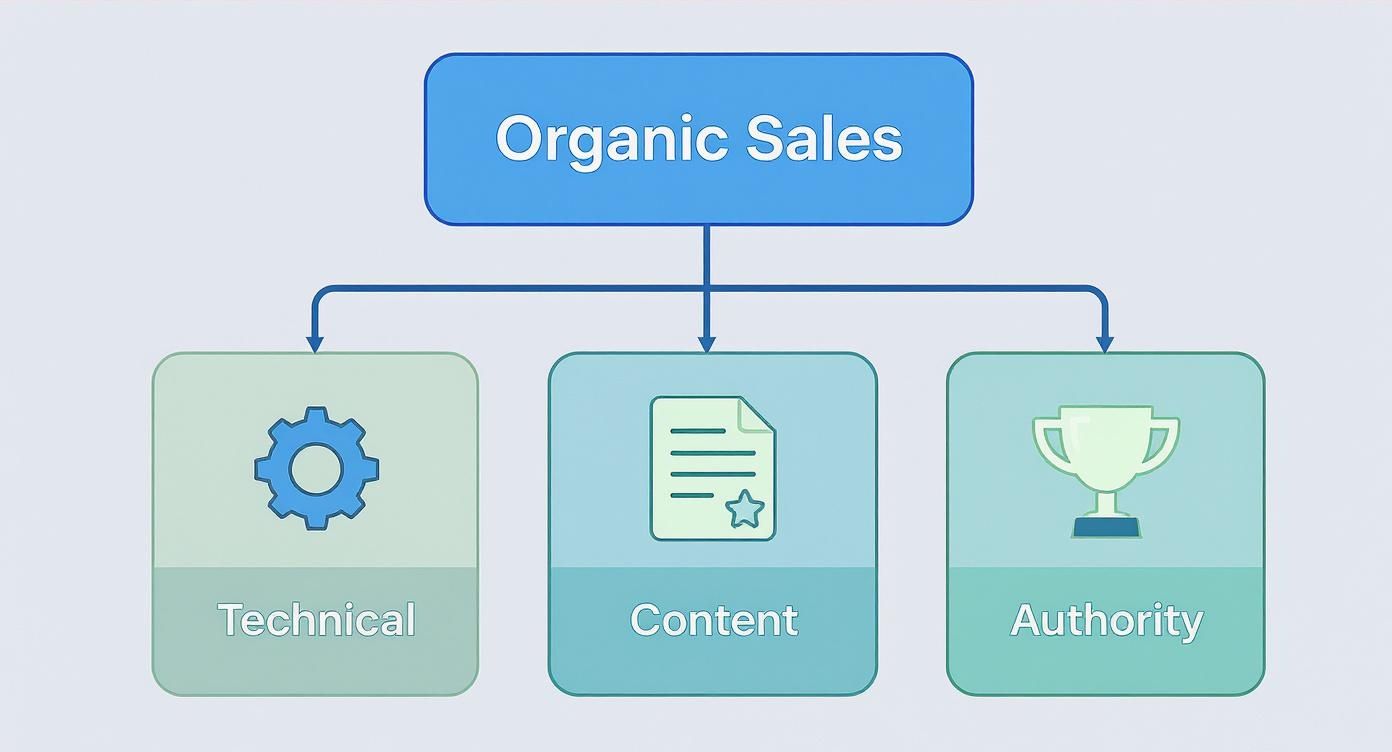
As you can see, sustainable revenue growth stands on three core pillars: a flawless technical base, compelling content, and recognised online authority. Let's break down what that actually means for your store.
A quality ecommerce SEO service is built on several key components, each with a specific job to do. Below is a quick rundown of the essential services and what they aim to achieve.
Core Components of an Ecommerce SEO Service
| Service Component | Primary Goal | Example Tactic |
|---|---|---|
| Technical SEO | Ensure search engines can easily crawl, index, and understand the site. | Improving page load speed and fixing broken links. |
| Product & Collection SEO | Attract qualified buyers by optimising the pages they land on. | Writing unique, keyword-rich product descriptions. |
| Site Architecture | Create a logical site structure that's easy for users and bots to navigate. | Developing a clear "breadcrumb" trail from homepage to product. |
| Schema Markup | Help search engines understand content and earn rich results (like reviews). | Adding product schema with price, stock, and ratings. |
| User Experience (UX) | Keep visitors on-site and guide them towards a purchase. | Streamlining the mobile checkout process. |
| Conversion Optimisation | Increase the percentage of visitors who become customers. | A/B testing the colour and text of an "Add to Cart" button. |
| Analytics & Tracking | Measure what works, what doesn't, and prove ROI. | Setting up goal tracking for sales in Google Analytics. |
Each of these elements is crucial. A fast site with poor product descriptions won't convert, and great content on a site Google can't crawl is invisible. They all have to work in harmony.
1. Technical SEO: The Digital Foundation
Technical SEO is the invisible engine that powers your online store. It’s all the digital plumbing and wiring that, when working perfectly, goes completely unnoticed by customers but makes all the difference to their experience and your search rankings.
If your site is slow, confusing for search engines to read, or broken on mobile, even the best products in the world won't save you.
An expert ecommerce SEO service will obsess over several key technical areas:
- Site Speed: Every second really does count. A tiny one-second delay in page load time can cause a 7% drop in conversions. Technical SEO involves compressing images, cleaning up code, and ensuring servers respond in a flash.
- Mobile-First Design: With most shoppers browsing on their phones, your site has to deliver a flawless mobile experience. This is more than just looking okay; it means easy navigation, tappable buttons, and a simple checkout process on any device.
- Crawlability and Indexability: This is all about making sure Google's bots can easily find, understand, and rank all your important product and category pages without getting lost in dead ends or hitting broken links.
2. On-Page SEO for Products and Collections
Once the technical foundation is solid, the focus shifts to the content on your actual store pages. This is the art and science of optimising your product and collection pages to appeal to both search engines and human shoppers. It’s about creating digital storefronts that are inviting, informative, and persuasive.
This means meticulously crafting every element on the page, from titles and descriptions to images and headings. The goal is to perfectly match the language your customers use when they search. For instance, optimising for "buy black leather ankle boots" is far more valuable than a generic term like "women's shoes."
An effective ecommerce SEO service understands that a product page has two jobs: it must first be found on Google, and then it must convert the visitor into a customer. The copy, images, and layout all work together to achieve both of these goals simultaneously.
Content marketing is a huge piece of the puzzle. If you're looking to scale your content creation, you can explore the top AI tools for content marketing to help generate high-quality, relevant content that attracts and engages your target audience.
3. Logical Site Architecture
Imagine walking into a massive department store with no signs or logical layout. You’d get frustrated and leave pretty quickly. The same goes for your online store.
Site architecture is simply the way your pages are organised and linked together. It acts as the digital signage that guides both your customers and the search engines through your site. A clean, logical structure ensures your most important pages are just a few clicks from the homepage, which helps spread "link equity" (or authority) and signals to Google which pages matter most.
Ultimately, a flat, simple hierarchy makes it easy for customers to find what they need, which reduces bounce rates and, you guessed it, increases sales.
4. Schema Markup and User Experience
Finally, we layer on advanced tactics to give your store a competitive edge. Schema markup is a type of code that helps search engines understand your content on a much deeper level. For ecommerce, this is incredibly powerful.
It's the magic behind the "rich snippets" you see in search results—those eye-catching listings with star ratings, prices, and stock availability right there on the Google results page. They make your products stand out from the crowd and can significantly boost your click-through rates.
In the end, all these elements—technical health, compelling content, and smart architecture—combine to create a superior User Experience (UX). In a crowded market, UX is often the ultimate tie-breaker. A site that’s fast, easy to navigate, and trustworthy will always win against a clunky, confusing competitor. This is where an expert ecommerce SEO service turns traffic into tangible revenue.
How to Measure SEO Success Beyond Traffic
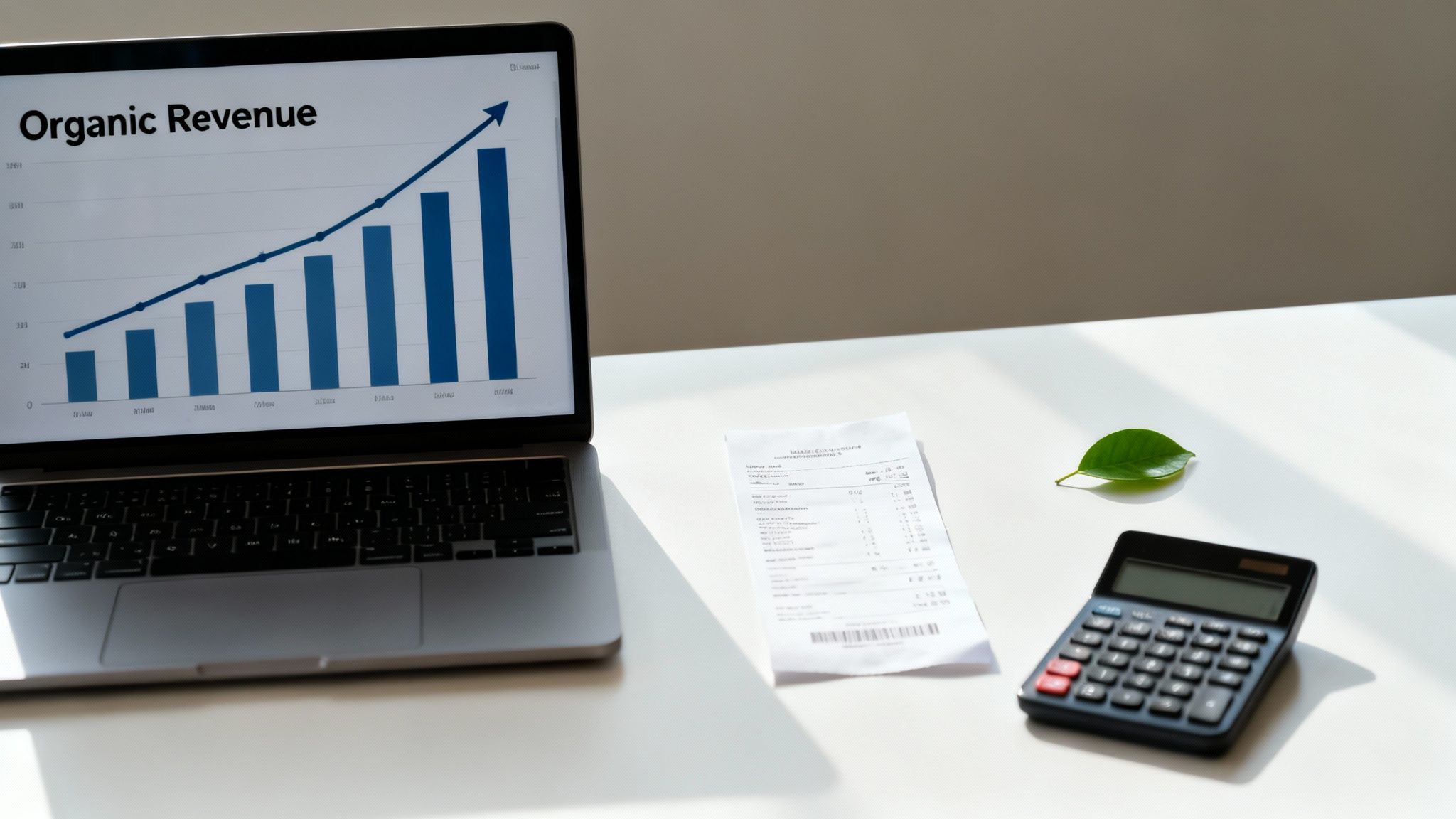
Watching your website traffic climb is a great feeling, but it's a classic vanity metric. A thousand visitors who don't buy anything are far less valuable than ten who do. The real test of a great ecommerce SEO service is its direct impact on your bottom line—turning clicks into cash.
To see the true return on your investment, you need to look past the traffic charts and focus on Key Performance Indicators (KPIs) that actually mean something for business growth. These are the numbers that tell you if your SEO is attracting not just more people, but the right people.
Tracking Organic Revenue
This is it. The big one. Organic revenue is the total income you make from customers who found your store through a non-paid search result. It's the ultimate proof that your SEO strategy is firing on all cylinders.
A solid ecommerce SEO service will help you isolate this number in Google Analytics 4, giving you a crystal-clear picture of how much money your organic presence is actually generating. If this number is consistently trending upwards, you know your investment is paying off.
The goal of ecommerce SEO isn't to win a traffic contest; it's to win more customers. Tracking organic revenue cuts through the noise and shows you the direct financial return of your SEO activities.
Monitoring High-Intent Keyword Rankings
Let's be clear: not all keyword rankings are created equal. Ranking number one for a broad, informational term like "history of boots" might bring in some curious visitors, but it's not going to ring the till. The real gold is in high-commercial-intent keywords.
These are the phrases people type when they've got their wallets out and are ready to buy. Think of terms like:
- "buy black leather boots online"
- "best waterproof hiking shoes Australia"
- "R.M. Williams boots sale"
A top-tier ecommerce SEO service obsesses over improving your rankings for these money-making terms. Progress here is directly tied to getting qualified, purchase-ready traffic to your product and category pages.
Analysing Organic Conversion Rates
Your organic conversion rate tells you exactly what percentage of visitors from search engines actually complete a purchase. This KPI is a powerful health check for your traffic quality. A high conversion rate means your SEO is hitting the bullseye, attracting a highly relevant audience whose search intent perfectly matches what you're selling.
For instance, a 5% organic conversion rate means that for every 100 people who land on your site from Google, five become paying customers. Improving this metric is a core objective, as even a small bump can have a massive impact on your revenue. If you want to really get into the weeds on this, setting up sophisticated website conversion tracking is essential for understanding user behaviour.
Measuring Average Order Value
Finally, don't forget to look at the Average Order Value (AOV) from your organic visitors. This metric tells you the average amount a customer from search spends in a single transaction. It’s another powerful sign of traffic quality.
If the AOV from your organic traffic is higher than from other channels, it suggests that SEO is bringing in more valuable customers. Maybe your content strategy is doing a great job of upselling or cross-selling, or perhaps organic searchers are just more deliberate, well-researched buyers. To really nail this, you need to master these essential ecommerce performance metrics.
By focusing on these bottom-line KPIs, you can move beyond simple traffic counts and accurately measure the true business value your ecommerce SEO service delivers.
Choosing the Right Ecommerce SEO Partner
Picking a partner to handle your online store’s SEO is one of the biggest calls you'll make for your business. This isn't just about hiring another vendor; you're handing over the keys to a critical part of your revenue engine. The right ecommerce SEO service can be a massive growth driver, while the wrong one just burns through your budget and leaves opportunities on the table.
Think of it like choosing a co-pilot for a long-haul flight. You need someone with a proven track record, a clear flight plan, and the skill to navigate any turbulence that comes up. A slick sales pitch isn't enough—you need to see their pilot's licence, check their flight log, and understand exactly how they plan to get you where you want to go.
Look for Platform-Specific Expertise
Your ecommerce platform—whether it's Shopify, BigCommerce, Magento, or WooCommerce—is the very foundation of your online store. Each one has its own architecture, its own strengths, and its own unique SEO quirks. A generic, one-size-fits-all SEO approach just won't cut it.
An agency that specialises in your platform already knows the playbook. They’ll know how to properly optimise collection pages on Shopify, handle faceted navigation in Magento, or work with the specific app ecosystem of BigCommerce without learning on your dime. This kind of specialised knowledge is non-negotiable.
Vet Their Track Record and Case Studies
Words are cheap. Results are what matter. Any reputable ecommerce SEO service will have a portfolio of case studies you can verify, showing real, tangible results for businesses like yours. Don't settle for vague claims about "increased traffic."
Ask for specific, data-backed results. Look for proof of growth in the KPIs that actually move the needle, like organic revenue, conversion rates from search, and rankings for high-intent commercial keywords. A true partner will be proud to show off their wins.
When you’re looking at their case studies, ask yourself:
- Relevance: Are the examples in a similar industry or facing similar challenges to your own?
- Metrics: Do they highlight bottom-line results (e.g., a 28% increase in revenue) or just vanity metrics?
- Transparency: Do they clearly explain the process they used to get those results?
Essential Questions to Ask Potential Partners
Once you've shortlisted a few agencies, it’s time to dig in. Your goal here is to get a feel for their strategic thinking, their communication style, and their technical chops. Arm yourself with a list of pointed questions to really gauge their expertise.
Here are a few crucial questions to have ready:
- Strategy and Approach: How do you approach optimising product and category pages for both users and search engines?
- Backlink Strategy: What's your strategy for earning authoritative, high-quality backlinks in our specific niche?
- Technical SEO: What are the most common technical SEO issues you see with stores on our platform, and how do you fix them?
- Reporting and KPIs: How do you measure success, and what will your monthly reports actually look like?
- Communication: Who will be our main point of contact, and how often will we hear from you?
Their answers should be specific, confident, and tailored to your business, not just recycled SEO jargon. For a deeper dive into what a full-service agency should offer, you can learn more about our comprehensive SEO services here.
Red Flags to Watch Out For
Knowing what to look for is only half the battle; you also need to know what to avoid. The SEO industry has its fair share of dodgy operators, and spotting the red flags early can save you a world of pain (and money) down the track.
Be wary of any agency that:
- Guarantees #1 Rankings: Nobody can guarantee a specific ranking on Google. This is a classic red flag that often points to outdated or straight-up ineffective tactics.
- Has a "Secret Sauce": A trustworthy partner will be transparent about their process. Vague answers or talk of "proprietary methods" usually hides a lack of any real strategy.
- Offers Vague Reporting: If they can't clearly explain how they’ll report on performance and ROI, they probably won't be able to deliver it either.
- Focuses Solely on Link Volume: When it comes to link building, quality beats quantity every single time. An obsession with the number of links, rather than their relevance and authority, is a very dangerous sign.
Choosing the right ecommerce SEO service is a critical step towards sustainable growth. By focusing on platform expertise, proven results, and transparent communication, you can find a true partner who will help your business thrive in a competitive online world.
What to Expect in Your First 90 Days
Working with an ecommerce SEO service is an investment in your store’s future, but it’s not like flicking a switch. Forget about dramatic sales spikes in the first three months. Instead, think of this initial period as laying the groundwork for long-term, sustainable growth. It's like surveying the land, drawing up blueprints, and pouring the concrete before you even think about framing the house.
This initial 90-day period is all about deep analysis, smart planning, and getting the critical setup right. It’s a methodical process that makes sure every move we make is based on solid data, not guesswork. This foundational work is what separates a successful campaign from one that just fizzles out.
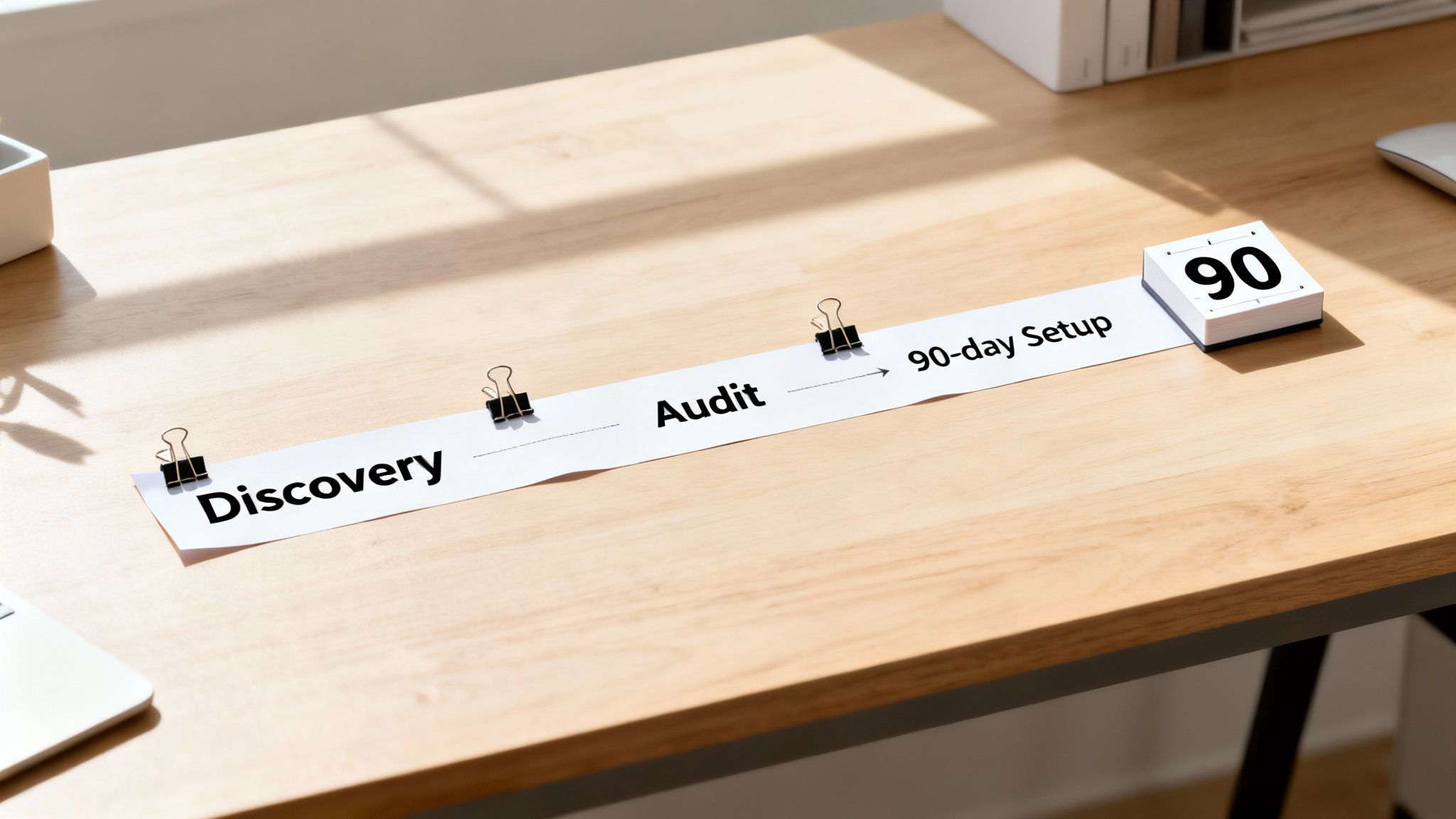
Month 1: The Discovery and Audit Phase
The first 30 days are all about deep immersion and diagnosis. Your new SEO partner essentially becomes a detective, meticulously gathering clues to understand your business, your customers, and where you sit in the competitive landscape. This phase is absolutely crucial for aligning their strategy with your actual business goals.
Here’s what typically happens in month one:
- Discovery & Onboarding: We kick things off with an in-depth call to get the full story—your business history, target audience, best-selling products, and what you want to achieve commercially.
- Comprehensive Technical Audit: We go over your website with a fine-tooth comb, hunting for any underlying issues that could be holding you back. Think slow page speeds, crawl errors, or a clunky mobile experience.
- Analytics & Tracking Setup: We’ll make sure tools like Google Analytics 4 and Google Search Console are perfectly configured to track the KPIs that really matter, like organic revenue and conversion rates.
This first month is the most critical intelligence-gathering phase. A skilled ecommerce SEO service doesn't jump straight into making changes; they listen, analyse, and diagnose before prescribing a solution.
Month 2: Strategy Development and Initial Fixes
With a clear diagnosis from the audit, the second month shifts into strategic planning and tackling the most urgent issues. This is where we finalise the roadmap for the coming months and you'll start to see the first foundational fixes being rolled out on your site.
This is where the strategic blueprint really takes shape. The focus is on prioritising actions that will deliver the biggest bang for your buck. For example, your agency will conduct exhaustive keyword research to pinpoint high-commercial-intent terms your customers are actively searching for.
We’ll also do a thorough competitive analysis to see what’s working for others in your space and find gaps you can exploit. Armed with this intel, we’ll start picking off the "low-hanging fruit" found in the audit—quick technical fixes that can provide an immediate, if small, boost.
Month 3: Foundation Building and Implementation
By the third month, the strategy is in full swing. This is when your SEO partner starts the heavy lifting, implementing the foundational changes that will support future growth. You'll see more tangible work happening on your site's content and structure.
This implementation phase zeroes in on optimising your most valuable pages. It involves rewriting product and category page titles, meta descriptions, and on-page copy to align with the new keyword strategy. A huge part of this is making sure your site offers a flawless mobile experience. Mobile commerce is the defining force in Australian ecommerce, with smartphone users now accounting for 77% of site visits and 68% of orders.
With 95% of Australians having shopped on mobile, a mobile-first approach is non-negotiable for success. You can discover more insights about the dominance of mobile shopping on Supple.
At the end of these 90 days, you won't see page-one rankings overnight. What you will have is a technically sound, strategically aligned website, perfectly poised for sustained organic growth in the months to come.
Your Ecommerce SEO Questions Answered
Dipping your toes into the world of SEO can feel a bit like learning a new language. You know it’s important, but all the moving parts can seem overwhelming. To cut through the noise, we’ve put together answers to the most common questions we hear from Australian ecommerce business owners. Think of this as your straight-talking guide to making confident decisions.
How Long Does It Take to See Results from an Ecommerce SEO Service?
This is always the first question, and for good reason—you want to know when your investment will pay off. While every online store’s journey is different, you can typically expect to see positive leading indicators within the first 3-4 months. These are the early signs that things are moving in the right direction, like improved keyword rankings and a noticeable lift in organic traffic.
But the real, bottom-line impact—the kind you see in your revenue and sales figures—usually becomes clear between the 6 and 12-month mark. SEO is a long-term investment in building a powerful, sustainable asset for your business; it's not a quick fix.
Those first few months are all about laying a solid foundation. We’re talking deep technical audits, fixing site errors, overhauling content, and building a strategy backed by solid data. The powerful, compounding effects of this work build over time, a bit like a snowball rolling downhill.
A word of warning: be very wary of any service promising overnight success or guaranteed number one rankings. These are hallmarks of ineffective or risky tactics that could seriously harm your site in the long run. Real, sustainable growth takes time and a methodical approach.
How Much Should I Budget for an Ecommerce SEO Service in Australia?
In Australia, the cost of a quality ecommerce SEO service really depends on your store's size, how fierce the competition is in your industry, and the scope of work needed. For most small to medium-sized businesses, monthly retainers generally fall in the $1,500 to $5,000+ range.
For larger businesses or those in hyper-competitive niches (like fashion or electronics), costs can easily exceed $10,000 per month. It's vital to see this as an investment in a primary revenue channel, not just another business expense. A reputable service is built to deliver a clear and measurable return on investment (ROI) by systematically growing your organic sales.
When you're comparing proposals from different agencies, don't just look at the price tag. Focus on the value and the strategy they're proposing. A cheap service that delivers zero results is far more expensive in the long run than a premium one that drives consistent, profitable growth.
Can I Do Ecommerce SEO Myself Instead of Hiring a Service?
Look, it's technically possible to handle your own SEO, but for a busy business owner, it’s a massive undertaking. Modern ecommerce SEO is a complex, full-time discipline that demands deep expertise across several specialised areas:
- Technical Analysis: Pinpointing and fixing issues with site speed, crawlability, and mobile-friendliness.
- Content Strategy: Crafting optimised product descriptions, category pages, and blog content that actually connects with what your customers are searching for.
- Authority Building: Earning high-quality backlinks from relevant, authoritative websites in your niche.
- Data Interpretation: Diving into tools like Google Analytics 4 to analyse performance and make smart, strategic adjustments.
A professional ecommerce SEO service brings a dedicated team, access to expensive industry tools (like Ahrefs or Semrush), and years of specialised experience that allows them to execute a comprehensive strategy far more efficiently. For most business owners, hiring experts lets you focus on what you do best—running your business—while they focus on delivering sustainable online growth.
What Is the Difference Between SEO and Running Google Ads?
SEO and Google Ads are two sides of the same digital marketing coin, but they work in completely different ways. Getting your head around the difference is key to building a balanced, powerful marketing strategy for your store.
-
Google Ads (PPC): This is all about immediate visibility. You pay for ad placements that appear right at the top of the search results page. The second you stop paying, your visibility vanishes. It’s like renting a prime retail space; you've got a great location, but only as long as you keep paying the rent.
-
Search Engine Optimisation (SEO): This is the process of earning your spot in the organic, non-paid rankings. It takes longer to build momentum, but the results are sustainable. Once you achieve high rankings, you benefit from a continuous stream of "free" traffic, 24/7. It’s like owning the building; it’s an upfront investment, but it becomes a valuable asset that pays dividends for years to come.
The most effective ecommerce strategies often use both. Google Ads are perfect for generating instant traffic, testing new products, or running targeted promotions. At the same time, SEO works quietly in the background to build long-term brand authority and a highly profitable organic sales channel that you own.
Ready to turn your online store into a powerful, organic sales engine? Click Click Bang Bang specialises in AI-first SEO strategies that deliver measurable results for ecommerce businesses. Stop leaving money on the table and start building a sustainable asset for your brand. Book your free strategy session today and discover how we can drive real growth for your business.
Read NeXt
Or Read Our Latest
- Manual vs Automated Bidding for PPC Success
- Conversion Tracking Setup: A Complete AU Guide
- Instagram Advertising Australia: Complete 2026 Guide
- Pay Per Click: A Beginner’s Guide for Australian Marketers
- Display Advertising on Google: The Complete Australian Guide
- Stakeholder Communication Plan How to Build One That Works
Click. CLick. Subscribe.
Get our best PPC insights, industry updates, and power moves delivered straight to your inbox. No fluff, just high-caliber strategies that actually work.
Don’t Leave Just Yet
Try Us For 30-Days,
Risk Free!!
We guarantee that you’ll love our work within the first 30 days, if not you’ll get your money back.
What have you got to lose?