

A Practical Guide to SEO for Local Businesses
Last Updated
SEO for local businesses is all about making sure you show up when people nearby are searching for what you offer. It’s the art and science of getting your business to pop up in Google’s local map pack and search results, right when potential customers are looking.
Setting the Stage for Local SEO Success
Welcome to your new local SEO playbook. This isn't just another checklist of generic tips; this is a practical guide designed to turn your online visibility into actual foot traffic and paying customers.
Before you touch a single setting or write a single word of content, you need to know where you stand. Real success starts with a clear benchmark. This is why a thorough local SEO audit is the essential first step.
Don’t let the word “audit” scare you. It’s not about getting lost in technical jargon. It’s simply a straightforward look at your current performance to find the opportunities your competitors are missing. So many small business owners skip this part, jumping straight into tactics without a strategy. That’s a recipe for wasted time and money.
Think of it as creating a map before you start a road trip. A good audit will show you:
- Your Visibility Baseline: How easy is it for local customers to find you on Google and Google Maps right now?
- Competitor Strengths: What are the top-ranking local businesses in your area doing that you’re not?
- Key Weaknesses: Are there messy inconsistencies in your business info online? Is your website actually optimised for the terms people in your area are using?
The goal of an audit isn't just to find problems; it's to find the highest-impact opportunities. Focusing on the 20% of actions that will drive 80% of your initial results is key to building momentum.
Auditing Your Local Presence
To give you a clear, actionable starting point, you can quickly run through a self-audit. It's a simple way to get a snapshot of your current local SEO health.
Here’s a simple table to guide you. Be honest with your assessment—it's the first step to making real improvements.
Your Initial Local SEO Health Check
| Audit Area | Key Checkpoint | Current Status (Good/Needs Work) |
|---|---|---|
| Google Business Profile (GBP) | Is your profile fully claimed and optimised? (Photos, services, hours) | |
| Online Reviews | Do you have recent, positive reviews on Google? Are you responding to them? | |
| NAP Consistency | Is your Name, Address, and Phone number identical across all major online directories? | |
| Local Keyword Rankings | Do you rank in the top 10 for your most important local keywords? (e.g., "plumber in Richmond") | |
| On-Page Local SEO | Does your website mention your service areas and have location-specific pages? | |
| Local Link Building | Do you have links from other local businesses, charities, or news sites? |
Once you've filled this out, you'll have a much clearer picture of where the easy wins are and what needs more attention.
This whole process can be visualised with a simple flow: benchmark where you are, find the gaps, and then implement strategies to win.
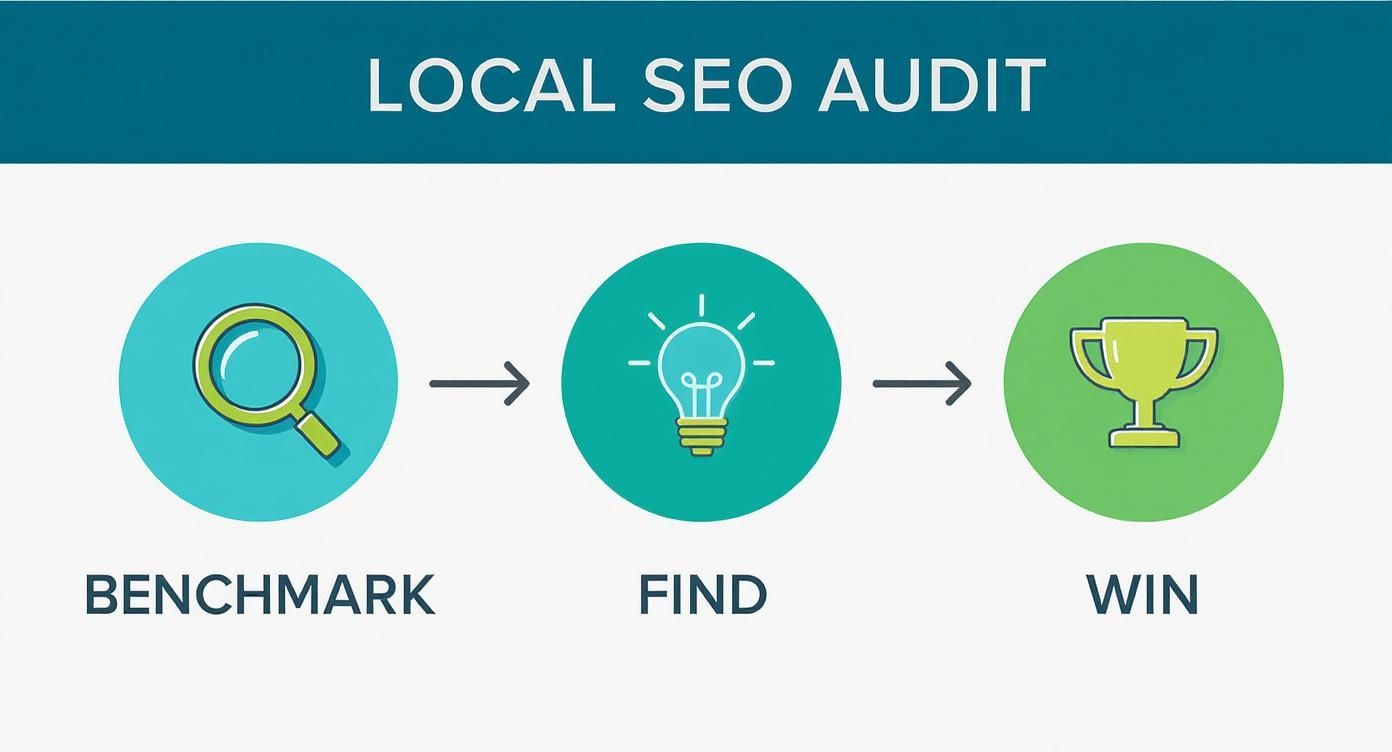
This three-step framework makes what can seem like a complex task much more manageable for any business owner.
This first step is about recognising why a strong local presence is non-negotiable today. Mastering the fundamentals—from your Google Business Profile to understanding local search intent—directly translates into more customers walking through your door. For a deeper dive, check out a comprehensive guide to local SEO best practices.
And while local SEO has its own unique flavour, many of its principles overlap with broader SEO strategies. You can explore those foundational concepts in our guide to SEO for small businesses. With a solid audit in hand, you’re ready to build a presence that doesn't just exist online but actively attracts and converts the customers right in your neighbourhood.
Making Your Google Business Profile a Customer Magnet
Your Google Business Profile (GBP) isn't just a digital business card anymore. It's your frontline sales tool and the absolute cornerstone of local SEO. Think of it as your virtual storefront. Get it right, and it’s what lands you in the coveted Google Maps "local pack" and convinces searchers to choose you over the guy down the street.
Too many businesses just claim their profile, toss in a phone number, and call it a day. This is a massive missed opportunity. In fact, a staggering 56% of Australian local businesses haven't even claimed their Google Business Profile. You can read more about this and other critical local SEO trends to understand just how far ahead you can get by simply paying attention.
Let's move beyond the basics and turn your profile into a genuine customer magnet.
Choosing Your Business Categories Wisely
The first critical choice you'll make is your primary business category. This one selection is huge—it tells Google what you really do and is a massive factor in the searches you show up for.
You have to be specific. Instead of just "Lawyer," choose "Family Law Attorney" or "Criminal Justice Attorney." It makes a world of difference.
Once your primary category is locked in, don't stop. Google lets you add a bunch of secondary categories, and this is where you can hoover up all those specific, long-tail searches.
For example, a local bakery's setup might look like this:
- Primary Category: Bakery
- Secondary Categories: Cake Shop, Coffee Shop, Wedding Bakery, Patisserie
This tells Google you’re not just a place for a loaf of bread. You're also the answer for someone searching "wedding cakes near me" or "best coffee Richmond."
Writing a Compelling Business Description
You get 750 characters for your business description. Treat it like your elevator pitch. It’s the perfect spot to weave in local keywords naturally and tell potential customers what makes you special. Don't just list services; tell a story.
Instead of this dry, generic description:
"We are a plumbing company in Sydney. We offer drain cleaning and hot water repair."
Try something with a bit more personality that’s also keyword-rich:
"Your trusted local plumber in Sydney's Inner West for over 20 years. From emergency blocked drain cleaning in Marrickville to hot water system repairs in Newtown, our family-owned team delivers fast, reliable service. We pride ourselves on quality workmanship and happy customers."
See the difference? This version adds location signals ("Inner West," "Marrickville," "Newtown") and tells a story ("trusted," "family-owned," "fast, reliable service").
Maximising Every Profile Feature
In Google's eyes, a complete profile is a trusted profile. A sparse, half-filled listing looks neglected. A rich, detailed one signals an active, reputable business. Your goal is to fill out every single relevant section you can.
Here’s how to squeeze the most value out of the key features:
- Photos and Videos: Visuals build trust in a heartbeat. Upload high-quality photos of your shopfront (inside and out), your team in action, and your products. A quick video tour or a client testimonial can be incredibly powerful. Make it a habit to add new photos regularly to keep your profile looking fresh.
- Services/Products: Don't just list your main categories here. Use the Services or Products section to detail everything you offer, complete with descriptions and maybe even pricing. If you're a cafe, list your popular menu items. If you're a mechanic, get specific with things like "Brake Pad Replacement" or "Logbook Servicing."
- Google Posts: This feature is basically a mini-blog right on your GBP. Use it to shout about special offers, highlight new products, share news about local events you’re sponsoring, or link to your latest blog post. Posts expire, which is great because it constantly gives you a reason to show your business is active and engaged.
Pro Tip: Before you upload photos, rename the image files to include relevant keywords and your location (e.g., "best-meat-pies-melbourne-cafe.jpg"). It’s a small detail, but these little things add up in your overall local SEO efforts.
Engaging with Customers Through Q&A
The Questions & Answers section is a golden opportunity that most businesses completely ignore. It allows anyone to ask a question about your business, and crucially, anyone can answer. You need to control the narrative here.
Don't wait for people to ask. Proactively populate this section yourself. Brainstorm the most common questions you get from customers, post them, and then answer them immediately from your business account.
Example Q&As to pre-populate:
- Question: "Do you have wheelchair access?"
- Question: "Is there free parking available nearby?"
- Question: "Are you open on public holidays?"
By getting these answers out there upfront, you remove friction for potential customers and show that you're helpful and transparent. Just remember to monitor this section to answer new questions from real users promptly—an unanswered question can look like poor customer service.
Building Local Authority Through Citations and Links
Beyond your Google Business Profile, your local search authority is hugely shaped by how your business shows up across the rest of the web. Think of citations and local links as votes of confidence from the online world. Each time your business is mentioned consistently, it reinforces to Google that you’re a legitimate, active local player.
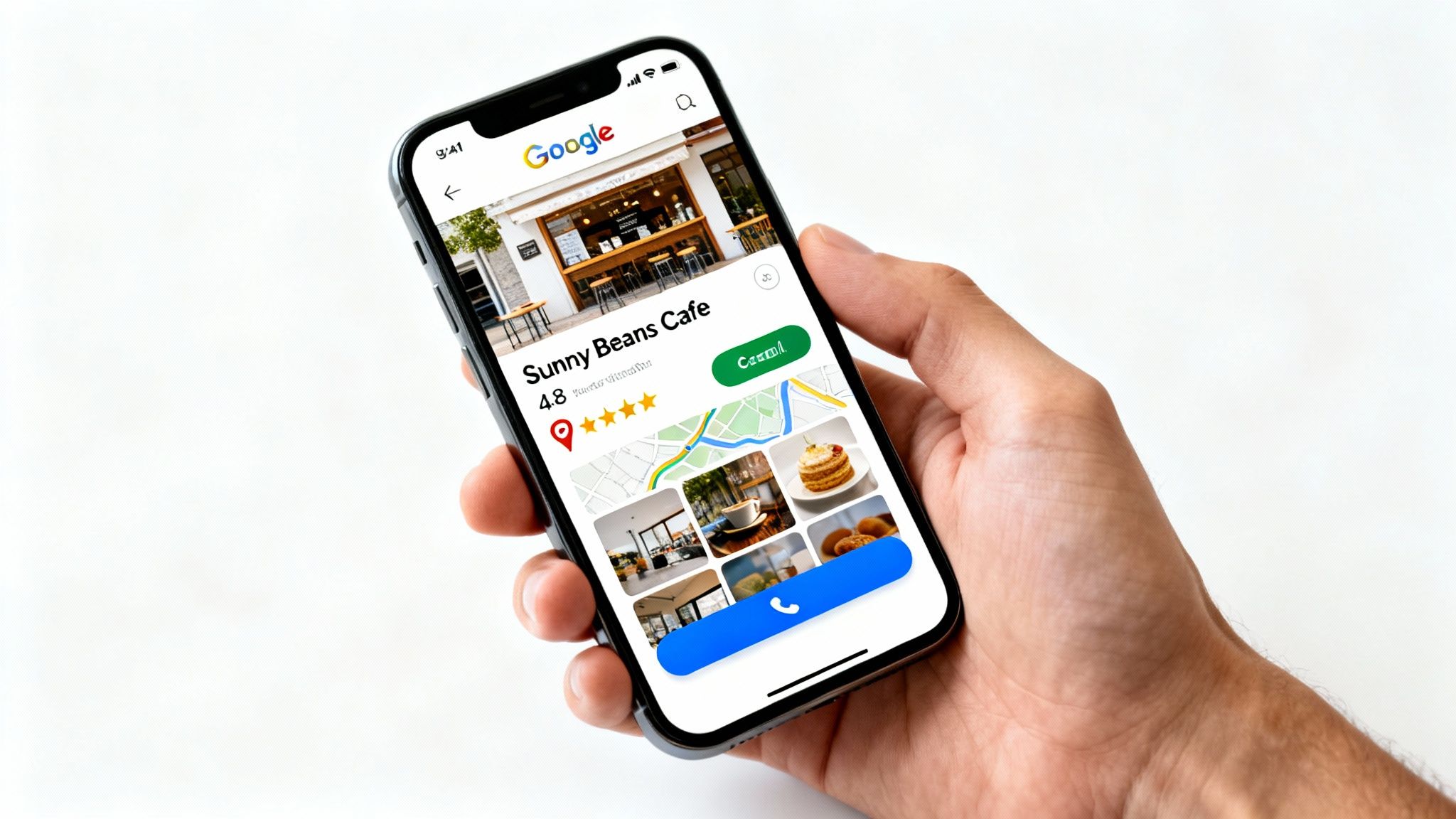
A citation is just an online mention of your business’s Name, Address, and Phone number (what we call NAP in the industry). When your NAP is identical everywhere—from big-name directories to niche industry sites—it sends a powerful signal of trust to search engines.
But inconsistencies can seriously derail your efforts. An old address on one directory and a new one on another creates confusion for both Google and your potential customers. This is why a clean, consistent citation profile isn't just a "nice-to-have"; it's fundamental to solid local SEO.
Mastering Your Citation Profile
First things first: you need a single source of truth for your NAP. This should be the information plastered on your website’s contact page and in your Google Business Profile. Every single citation you build from here on out has to match this exactly.
And I mean exactly. The tiny details matter. "Street" vs. "St." or "Pty Ltd" vs. "Pty Limited" can be enough to throw a spanner in the works. Pick one format and stick to it like glue.
Once you’ve got your master NAP sorted, it's time to build citations. I recommend focusing your energy on these three tiers:
- Top-Tier Australian Directories: These are the heavy hitters like Yellow Pages, TrueLocal, and Yelp Australia. Getting listed correctly here is non-negotiable, as they carry the most authority.
- Industry-Specific Directories: Hunt down the directories that matter in your trade. A builder might look at HiPages, while a restaurant should be on Zomato or TheFork. These listings are super relevant and incredibly valuable.
- Hyper-Local Directories: Start thinking smaller. Get listed on websites for your local chamber of commerce, neighbourhood business groups, or community portals. A mention here screams local relevance to Google.
A classic mistake I see is businesses paying for dozens of low-quality directory submissions. It's far better to have 20-30 high-quality, consistent citations on relevant Australian sites than 200 junk listings on generic, spammy international directories. Always choose quality over quantity.
Auditing and Cleaning Up Existing Citations
Before you rush off to build new citations, you have to find and fix the incorrect ones already floating around online. Inconsistent data tends to pile up over the years, especially if your business has moved or changed phone numbers.
You can start by manually searching for your business name and any old variations to spot rogue listings. For a more efficient approach, tools like BrightLocal or Semrush can run a citation audit for you, quickly flagging inconsistencies across the major platforms. I'd recommend creating a spreadsheet to track the bad listings and methodically work through them, either by logging in to update them yourself or by contacting the site owners.
This cleanup process can be tedious, I won't lie. But it's critical. It’s like weeding a garden before you plant new seeds—it gives your new efforts the best possible chance to grow.
The Power of Local Link Building
While citations are essential, local backlinks are in a league of their own. A backlink is a clickable link from another website to yours. While a citation simply says you exist, a backlink from a respected local source is a direct endorsement.
Think beyond basic directory listings. You need to build real relationships in your community that can translate into valuable links. This effort pays off in a big way, especially when you consider that Australian searchers visit 1.5 billion locations every month that they discovered through Google. Strong local links help ensure your business is one of them. You can discover more insights about the power of local search in Australia.
Here are a few actionable ideas to get you started on earning high-impact local links:
- Sponsor a local sports team or charity event. This almost always gets you a link from their website's sponsor page—a fantastic, highly relevant local signal.
- Host a local workshop or event. Run a free class at your office or shop and get it listed on local event calendars and community noticeboard sites.
- Partner with complementary local businesses. A wedding photographer could write a guest post for a local venue's blog. A personal trainer could get featured on the website of a neighbourhood health food store.
- Join your local Chamber of Commerce. Membership usually comes with a business listing and a link from their directory, which is a source of high local authority.
Earning these kinds of links takes genuine community engagement, but the payoff in local SEO authority is massive. They send a clear message to Google that you’re a trusted and integral part of your local community.
How to Optimise Your Website for Local Searchers
While your Google Business Profile gets you on the map, your website is where the magic happens. It's the engine that turns eyeballs into paying customers. So, let's pop the hood and tune your site so it screams "local relevance" to search engines and, more importantly, to the people in your community.
This isn't just one thing; it's a mix of smart on-page content choices and some technical tweaks behind the scenes. Think of your website as the home base for your entire local presence. Every signal—from your GBP to your online directory listings—points right back here. Nailing your website optimisation is how you cement your authority and start climbing those local search rankings.
Uncovering Local Customer Keywords
First things first: you need to get inside your customers' heads. What are the exact phrases they’re typing (or saying) into Google when they need what you offer right now, right here? This is the heart and soul of good local keyword research.
Throw out generic terms like "roofing contractor." That’s like shouting into a hurricane; you’re competing with national giants. You need to zero in on phrases bubbling with local intent. These almost always mash a service together with a location.
- Service + Suburb: "emergency plumber Parramatta"
- "Near me" variation: "best coffee near me" (Google figures out the location automatically)
- Service + City: "personal training Newcastle"
- Adjective + Service + Location: "affordable lawn mowing Sutherland Shire"
A brilliant starting point is just to brainstorm. List every single service you offer. Then, start pairing each one with the suburbs, neighbourhoods, and wider regions you cover. Tools like Google's Keyword Planner can show you search volumes, but honestly, your own local knowledge is often your sharpest tool.
The most valuable keywords often have lower search volumes but sky-high purchase intent. Someone searching for "24/7 blocked drain plumber Hornsby" is a much hotter lead than someone just googling "plumbing tips."
Once you've got a solid list, it's time to start weaving these phrases into the fabric of your website.
Weaving Keywords into Your Website
Strategic keyword placement is a delicate dance. It’s about being natural, not just jamming terms everywhere you can. Google is incredibly good at spotting awkward, keyword-stuffed text, and it's a turn-off for human readers, too. Your number one job is to create helpful, clear content for people first.
With that in mind, here’s where you should strategically place the main local keyword for any given page:
- Title Tag: This is that blue, clickable link in the search results. Keep it punchy and include your main keyword and location (e.g., "Expert Car Detailing in Geelong | Showroom Finish").
- Meta Description: The short summary under the title tag. It won't directly boost your rank, but a compelling description with your keyword gets people to click (e.g., "Need professional car detailing in Geelong? We offer premium interior and exterior packages to make your car shine. Book online today!").
- H1 Heading: The main headline on the page itself (e.g., "The Most Trusted Car Detailing Service in Geelong").
- Page Content: Your keyword should pop up naturally within the first 100 words or so, and then a couple more times throughout the text, including in subheadings (H2s, H3s).
Here's a pro tip I share with all my clients: create dedicated "service area" or "location" pages. If you're a landscaper covering multiple suburbs, build a unique page for each one—"Landscaping Services in Chatswood," "Garden Design in Lane Cove," you get the idea. This tactic lets you target hyper-local keywords and show you're genuinely committed to that community.
For a deeper dive into these core principles, our complete guide to search engine optimisation is a great next step.
Before we move on, let's clarify the two sides of this coin. On-page SEO is what the user sees—the words, the images, the content. Technical SEO is the stuff under the hood that helps search engines understand it all.
On-Page vs Technical Local SEO Tactics
| SEO Tactic | What It Involves | Why It's Crucial for Local Businesses |
|---|---|---|
| On-Page: Location-Specific Keywords | Researching and using terms like "plumber in Richmond" or "best cafe near me" in your site's content, titles, and headings. | This directly signals to Google and users which geographic areas you serve, making you relevant for local searches. |
| Technical: LocalBusiness Schema | Adding a specific type of code (structured data) to your site's backend that explicitly defines your business name, address, phone (NAP), and hours. | It's like giving Google a perfectly formatted business card. It removes all guesswork and helps you appear correctly in knowledge panels and maps. |
| On-Page: Location Pages | Creating unique pages on your website for each physical location or primary service area you cover (e.g., /sydney-electrician, /parramatta-electrician). | These pages act as powerful, targeted landing spots for hyper-local searches, boosting your relevance for each specific area. |
| Technical: Mobile-Friendliness | Ensuring your website design is responsive, meaning it looks and works perfectly on smartphones and tablets. | The vast majority of "near me" searches happen on mobile devices. A bad mobile experience means losing customers instantly. |
| On-Page: Customer Reviews & Testimonials | Displaying reviews and testimonials (ideally mentioning the location) directly on your website. | This builds trust and social proof. It also adds relevant, location-based content that search engines can pick up on. |
| Technical: Website Speed | Optimising images, code, and server settings to ensure your web pages load as quickly as possible. | Slow-loading sites have higher bounce rates, especially on mobile. Google prioritises fast, user-friendly experiences in its rankings. |
Both on-page and technical SEO are essential. Great content on a slow, broken website won't get you far. Likewise, a technically perfect site with no locally relevant content will be invisible to customers. They work together to build a powerful local presence.
Demystifying Local Schema Markup
Okay, let’s get slightly more technical for a moment, but trust me, this one is a powerhouse: schema markup.
Think of it as a secret language you speak directly to search engines. It's a piece of code you add to your website that translates your content into a format Google can understand perfectly. It leaves nothing to interpretation.
For any local business, the "LocalBusiness" schema is non-negotiable. It allows you to spoon-feed Google all your critical details:
- Your exact business name, address, and phone number (your NAP)
- Your hours of operation
- The types of payment you accept
- Your specific business category (e.g., Plumber, Restaurant, Hair Salon)
By implementing this, you're giving Google the verified, structured data it loves. This dramatically increases your chances of being displayed correctly and prominently in local search features like the map pack and knowledge panels.
While you can write the code by hand, you don't have to be a developer to do this. Tools like Google's Structured Data Markup Helper can walk you through the process, making it much more accessible.
Using Content and Reviews to Win Over Local Customers
If you want to build a truly effective local SEO plan, look no further than your content and your customer reviews. These two elements are the absolute heart and soul of connecting with your community. They work hand-in-hand to build trust, prove you know your stuff, and create a genuine bond with the people you want to serve.
This isn't about just pumping out generic blog posts. It's about creating genuinely useful resources for your local audience, which in turn signals your relevance to Google.
Focusing on both content and your reputation is how you win in the long run. The data doesn't lie: with organic results pulling in 85-90% of clicks compared to a measly 10-15% for paid ads, it’s clear where the real value is. A solid local SEO strategy just delivers a better return, period. You can check out more local search stats for Australia to see the full picture.
Creating Powerful, Hyper-Local Content
To really stand out in local search, your content has to scream "local." Forget the generic service descriptions you see everywhere else. You need to create content that speaks directly to the needs, quirks, and interests of customers in your specific service areas.
A brilliant place to start is by building out dedicated pages on your website for each suburb or neighbourhood you cover. Think about a plumber in Melbourne. Instead of one page, they could have separate, unique pages for "Emergency Plumbing in Richmond," "Hot Water Repair in Fitzroy," and "Blocked Drains in St Kilda." Each page needs its own tailored content – no lazy copy-and-paste jobs allowed.
Once you've got those foundations, you can get creative with content that truly connects:
- Recap Community Events: Did your business sponsor the local fete or have a stall at a weekend market? Write a blog post about it! Post photos, tag other local businesses, and share the vibe. This is fantastic, shareable content and a super-natural way to earn links from event organisers.
- Write Up Local Case Studies: Show off a recent job you nailed for a local client (with their permission, of course). Break down the problem they had, the solution you provided, and the awesome result. This is powerful social proof and is naturally packed with location-specific keywords.
- Create Guides to Local Spots: A café could write a post on "The Best Dog-Friendly Parks in Marrickville." A bike shop could map out the "Top Cycling Routes on the Northern Beaches." This positions you as a helpful local expert, not just another business trying to make a sale.
The best local content answers the questions your customers are actually asking. Think about what people in your community need help with, and become the go-to resource for it. That’s how you build authority and a loyal following at the same time.
Mastering the Art of Review Management
Online reviews are one of the most powerful ranking factors in SEO for local businesses. They give potential customers immediate social proof, have a huge impact on your spot in the local pack rankings, and offer you direct, unfiltered feedback. A proactive plan for getting and managing reviews isn't just a nice-to-have; it's essential.
The simplest way to get more reviews? Just ask.
Seriously, don't be shy. Make the "ask" part of your process when a customer is at their happiest—right after you’ve solved their problem or they’ve had a great experience in your shop. Make it dead simple for them by sending a follow-up email or text with a direct link to your Google review page.
You Must Respond to Every Single Review
How you handle reviews is just as important as getting them in the first place. A thoughtful reply shows everyone—current customers, future customers, and Google—that you're engaged and you care about feedback. This applies to the five-star raves and the one-star rants.
For positive reviews, a quick and personal reply works wonders. "Thanks so much for the kind words, Sarah! We're so glad you loved the new haircut" is perfect. It’s friendly and acknowledges their specific comment.
Negative reviews aren't a disaster; they're an opportunity. A calm, professional, and empathetic response can often turn a bad experience around and shows anyone reading that you take responsibility.
Just follow this simple formula:
- Acknowledge and Apologise: "Hi Mark, we're so sorry to hear your experience didn't meet your expectations."
- Show You Understand: "We get how frustrating it must have been for the delivery to be late."
- Take it Offline: "We'd like to make this right. Please call me directly at [phone number] so we can sort this out."
This approach demonstrates top-tier customer service to every single person who sees that review, building trust even out of a negative situation. When you consistently manage your content and reviews, you create a powerful feedback loop that fuels your growth, boosts your rankings, and builds a loyal customer base right in your own backyard.
Got Questions About Local SEO? Let's Get Them Answered
If you’re diving into local SEO, you’ve probably got a few questions. We hear these all the time from business owners trying to get a handle on where to start and what to expect. Here are the straight answers to clear things up.
How Long Does It Take to See Local SEO Results?
I wish I could give a magic number, but local SEO is a marathon, not a sprint. While you might see some early signs of life within a few weeks—especially after a big Google Business Profile overhaul or a major citation cleanup—you should be thinking in terms of months, not days.
Real, stable results typically take 3 to 6 months to really bed in.
This timeline depends on a bunch of factors. The competitiveness of your industry and your specific suburb plays a huge role. So does how consistently you apply the strategies we've talked about.
The best way to look at SEO for local businesses is as a long-term investment in your visibility, not a one-and-done task.
What Is the Real Difference Between SEO and Local SEO?
They're built on the same foundations, but their goals are worlds apart. Traditional SEO is about casting a wide net, aiming for national or even global visibility. It’s about being the right answer for anyone, anywhere, searching for a broad topic.
Local SEO, on the other hand, is all about winning in your own backyard. It's laser-focused on capturing those "near me" searches and queries that scream local intent, like "best coffee in Melbourne."
The tactics are hyper-specific to local signals: your Google Business Profile, the consistency of your business details across local directories (your NAP), and getting links from other local businesses and organisations. It's about proving you're relevant to a specific community, not the entire web.
Should I Do Local SEO Myself or Hire Someone?
Honestly, you can—and should—do some of it yourself. There are a few high-impact tasks that are perfect for DIY. Things like claiming and regularly updating your Google Business Profile or actively encouraging customers to leave reviews are completely within your control.
Where it gets tricky is the more technical side. Implementing schema markup correctly, building quality local links, or running a deep website audit often needs a specialist's touch. These aren't things you can just pick up in an afternoon.
A smart approach for many businesses is a hybrid one: manage the day-to-day stuff yourself and bring in a pro for the initial strategy, setup, and the more complex, ongoing tasks. It’s a great way to stay effective without blowing the budget.
How Important Are Customer Reviews for Local Rankings?
They are absolutely critical. I can't stress this enough. Customer reviews are one of the most powerful ranking signals for Google's local pack and Maps. A steady flow of recent, positive reviews tells Google that you're a legitimate, trusted business that people in the area actually like.
But it’s not just about the star rating. Google is paying attention to a few things here:
- Review velocity: How frequently are new reviews coming in?
- Owner responses: Are you engaging with feedback, both good and bad?
Actively managing your online reputation isn't just a nice-to-have; it's a core pillar of any solid local SEO strategy. It directly impacts your rankings and how potential customers see you. Understanding what drives these interactions is key, which is why having solid website conversion tracking in place can provide invaluable insights into how your online reputation turns into real business.
Ready to transform your local search presence into measurable results? The team at Click Click Bang Bang uses an AI-first approach to SEO and PPC that puts your business in front of the customers who matter most. Learn how we can help you dominate your local market.
Read NeXt
Or Read Our Latest
- How to Calculate Sample Size for A/B Tests and Campaigns
- How to Fix Google Merchant Center Errors Step by Step
- What Is Pagination and Why It Matters for AU Sites
- What Is Value Proposition? PPC & SEO Guide
- How to Choose a Google Ads Agency Australia
- Influencer Collaboration Playbook for E-Commerce & B2B
Click. CLick. Subscribe.
Get our best PPC insights, industry updates, and power moves delivered straight to your inbox. No fluff, just high-caliber strategies that actually work.
Don’t Leave Just Yet
Try Us For 30-Days,
Risk Free!!
We guarantee that you’ll love our work within the first 30 days, if not you’ll get your money back.
What have you got to lose?