

Hiring Google Ads Consultants in Australia
Last Updated

Google Ads consultants are specialists who manage, optimise, and strategise your pay-per-click campaigns. Let's be clear: hiring the right one means bringing in an expert dedicated to improving your ad performance, cutting down your costs, and boosting your return on investment. In a market as competitive as Australia, that’s not just a nice-to-have, it's essential.
Defining Your Goals Before You Hire

Let’s get one thing straight. Kicking off the hiring process without a crystal-clear definition of success is like setting off on a road trip with no map. You’ll burn through your fuel (the ad budget) but have no clue if you’re even heading in the right direction.
Vague goals like "more clicks" or "more traffic" just don't cut it. They’re vanity metrics that don't tie directly to business growth.
Your first move—before you even think about writing a job post—is to translate your broad business objectives into specific, measurable Key Performance Indicators (KPIs). This isn't just a box-ticking exercise. It's the foundation of every conversation you'll have with a potential Google Ads consultant. When you can tell them exactly what you need to achieve, you empower them to build a strategy that actually delivers.
From Vague Ideas to Concrete KPIs
Moving from fuzzy ideas to hard numbers is simpler than you might think. It’s all about connecting your ad performance to your bottom line. Instead of just wanting more website visitors, ask yourself: what do I need those visitors to do?
Here’s how that shift in thinking looks in the real world:
- From: "I want more leads."
- To: "I need to generate 50 qualified leads per month at a target Cost Per Acquisition (CPA) of under $75."
- From: "I want to increase online sales."
- To: "My goal is to achieve a Return On Ad Spend (ROAS) of 5:1, meaning for every $1 we spend on ads, we need to generate $5 in revenue."
See the difference? These specific KPIs give a consultant clear targets to aim for. They know precisely what success looks like and can build campaigns designed to hit those numbers, removing all the guesswork.
Before you start looking, get clear on why Google Ads is the right channel for you in the first place. A bit of research can help sharpen your objectives, like understanding the specific advantages of Google Ads for service-based businesses.
A well-defined target CPA or ROAS is the single most important piece of information you can give a prospective consultant. It immediately tells them about your business's economics and whether your goals are realistic within your budget.
This simple checklist will help you gather the essential data and define clear objectives before you start your search. It ensures you and any potential consultant are speaking the same language from day one.
Your Pre-Hiring Checklist and KPI Goals
| Checklist Item | Why It Matters | Example KPI/Goal |
|---|---|---|
| Current Monthly Ad Spend | Establishes the budget a consultant has to work with. | $5,000/month |
| Target CPA | Defines the maximum you can afford to pay for a new customer or lead. | Target CPA: <$100 |
| Target ROAS | Sets the revenue goal for every dollar spent on ads (crucial for e-commerce). | Target ROAS: 4:1 |
| Monthly Conversion Goal | Specifies the number of leads or sales needed to hit business targets. | 50 qualified leads/month |
| Customer Lifetime Value (LTV) | Helps justify a higher CPA if customers bring long-term value. | LTV: $2,500 |
| Conversion Rate Baseline | Your current rate of converting clicks into leads/sales. | Current Conv. Rate: 2.5% |
Having these figures ready transforms your initial conversations from vague chats into strategic planning sessions. You're not just hiring someone to "run ads"; you're partnering with an expert to achieve specific business outcomes.
Establishing a Performance Baseline
You can't measure improvement if you don't know where you started. If you already have Google Ads campaigns running, it’s time for a quick internal audit. Don't stress about getting super technical—the goal here is simply to establish a baseline.
Pull up your data from the last 30 to 90 days and focus on these core metrics:
- Total Ad Spend: How much have you invested?
- Total Conversions: How many actual leads or sales did you generate?
- Cost Per Acquisition (CPA): What was the average cost for each conversion? If you're a bit fuzzy on this, our guide on how to calculate customer acquisition cost will get you sorted.
- Click-Through Rate (CTR): What percentage of people who saw your ads actually clicked on them?
- Conversion Rate: Of those who clicked, what percentage turned into a conversion?
This data is your benchmark. When a new consultant takes over, you can compare their results against this baseline to objectively measure their impact. It shifts the conversation from, "I feel like things are better," to, "Our CPA has dropped by 22% in the first 60 days."
This data-driven approach is non-negotiable for holding your consultant accountable and justifying the investment. With these clear goals and a solid performance baseline in hand, you’re finally ready to find a partner who can truly move the needle for your business.
How to Verify a Consultant's Track Record
Anyone can put together a slick presentation and make bold promises. It's easy. But what really separates the genuine experts from the pretenders is a proven history of delivering real, measurable results.
Your job is to dig past the sales pitch and find the hard evidence. This means getting comfortable with dissecting their claims and zeroing in on data that reflects actual business growth, not just flashy numbers.
Start by asking for case studies, but don't just give them a quick skim. You're looking for specifics that relate to a business like yours, especially one operating in the Australian market. A huge win for a software company in the US probably won't mean much for your local retail shop in Melbourne.
Look Beyond Vanity Metrics
It’s easy to get wowed by big numbers like "millions of impressions" or a "50% jump in clicks." While these figures aren’t totally useless, they’re often just vanity metrics. They look impressive on a report, but they don't necessarily translate into more money in your bank account.
You need to train your focus on the metrics that actually hit your bottom line. When you're looking at a case study or a performance report, hunt for this info:
- Return On Ad Spend (ROAS): Did they actually make money? For every $1 spent, did they bring back $4, $5, or even more in revenue?
- Cost Per Acquisition (CPA): How much did it cost to get a real lead or a sale? And was that number sustainable for the client's business model?
- Conversion Rate Improvement: Did they increase the percentage of clicks that turned into genuine business? That’s a sign of smart optimisation.
- Reduction in Wasted Spend: Can they point to exactly how they plugged leaks and stopped the budget from draining away on irrelevant clicks?
These are the numbers that tell the true story. They prove a consultant can do more than just drive traffic; they can drive profitable action. We see this all the time with Australian businesses. For example, a local tradie client with a $1,200 monthly budget was recently able to generate 50-60 calls at just $21 per lead. That led to a 6x return on ad spend in a single month.
Pro Tip: Ask them to walk you through a case study for a business with a budget similar to yours. It’s a great way to see how they perform under realistic financial constraints, not just when they have a massive, enterprise-level spend to play with.
Verify Certifications and Partnerships
Credentials aren't the be-all and end-all, but they do offer a solid baseline for competency and professionalism. The big one in this space is the Google Partner status, with Google Premier Partner being the top tier.
Being a Premier Partner is a big deal—it’s an accolade awarded to only the top 3% of participating companies in a country each year. You can learn more about the importance of hiring a certified Google Partner to understand why this matters. It’s Google’s stamp of approval, recognising an agency for maximising campaign success, driving client growth, and demonstrating up-to-date expertise.
Don't just take their word for it, though. You can and should verify their status yourself directly through the Google Partners directory. It’s a quick check that confirms they’ve met Google’s strict requirements for performance, ad spend, and certifications.
Ask the Right Questions About Their Experience
Once you've looked through their materials, it's time to ask direct questions that really probe their specific experience. Generic questions will only get you generic, rehearsed answers. You need to get specific to your own situation.
Here are a few targeted questions to get the ball rolling:
- "Can you describe your experience with businesses in the [your industry] sector, specifically here in Australia?" This forces them to go beyond generalities and talk about the challenges, competitors, and customer behaviours relevant to your market.
- "What was the single biggest challenge you faced in the case study for [client similar to you], and how exactly did you solve it?" This is a fantastic test of their problem-solving skills and their transparency. A good consultant will be honest about hurdles.
- "How do you approach campaign strategy for a business with our budget size?" Their answer will quickly reveal whether they have a scalable strategy that works for smaller businesses or if they only know how to throw money at a problem with huge budgets.
Their answers should build your confidence that they truly understand the nuances of your industry and have a reliable methodology. If you're weighing up a few different options, our list of top AdWords management companies in Australia can be a handy starting point.
Ultimately, gathering this hard evidence is what separates a smart hiring decision from a costly mistake. You’ll be choosing a partner based on proven ability, not just a polished sales pitch.
Running an Effective Interview and Live Audit

Case studies and references are great, but they only ever tell you about the past. To really figure out if a consultant has the chops, you need to see them think on their feet—with your business challenges. This is where a proper interview, combined with a preliminary account audit, becomes your most powerful tool.
This approach takes things beyond hypotheticals and puts potential Google Ads consultants to a real-world test. It's your best shot at seeing their strategic depth, how they solve problems, and their communication style before you sign on the dotted line.
Crafting Interview Questions That Reveal True Expertise
A great interview isn't an interrogation; it's a strategic conversation. You're trying to uncover how a consultant thinks, not just what they can recite from a textbook. So, ditch the generic stuff like "What's your experience?" and get into scenarios that test their practical skills.
Here are a few questions designed to see how they really operate:
- Scenario-Based Thinking: "Imagine our Cost Per Acquisition (CPA) suddenly doubles with no change in budget. Walk me through the first three things you'd investigate in our account."
- Strategic Alignment: "Our goal is a 4:1 ROAS. Based on that, what campaign types would you prioritise in the first 90 days, and why?"
- Communication & Reporting: "How would you put together a monthly performance report for a stakeholder who isn't a PPC expert? What are the absolute key metrics you'd focus on?"
- Industry Nuance: "What's the single biggest challenge or opportunity you see for a business like ours in the current Australian market?"
Their answers need to be specific and grounded in data. A top-tier consultant won’t just give you a generic reply; they'll ask you clarifying questions to give you a more thoughtful, relevant response.
The best candidates don't just answer your questions—they ask insightful questions of their own. This shows they are already thinking critically about your account and how they can add value, rather than just trying to win the job.
The Power of the Preliminary Account Audit
Asking a finalist to conduct a brief, high-level audit of your Google Ads account is the ultimate litmus test. It’s a chance to see their analytical process in action and judge the quality of their insights before any money changes hands. This isn't about getting free work; think of it as a paid, limited engagement or a crucial part of the final interview stage.
To do this, you'll need to grant them temporary, read-only access to your Google Ads account. This is perfectly safe. It lets them see everything—campaign structure, keywords, ad copy, performance data—without being able to touch or change a single thing.
Once they've had a few days to poke around, schedule a call for them to present their findings. A good audit is more than just a quick look, and if you want to know what to expect, you can learn more about what a thorough Google Ads audit should cover to prepare yourself.
To keep your evaluations fair and objective, I recommend using a simple scorecard. It removes gut feelings from the equation and helps you compare candidates on the metrics that actually matter.
Consultant Interview Scorecard
| Evaluation Criteria | Candidate A Score (1-5) | Candidate B Score (1-5) | Notes/Observations |
|---|---|---|---|
| Strategic Thinking & Problem-Solving | Did they go beyond surface-level answers? | ||
| Communication & Clarity | Could they explain complex ideas simply? | ||
| Account Audit Insights & Depth | Did they find meaningful opportunities? | ||
| Relevance of Experience | Have they worked with similar businesses? | ||
| Proactive Questions & Engagement | Did they show genuine curiosity? | ||
| Overall Score | Total score out of 25. |
This little tool makes the final decision-making process much easier, especially when you have a couple of strong contenders.
What to Look For in Their Analysis
This is where you separate the real strategists from the box-tickers. A weak audit will point out obvious things like low Quality Scores or a missing negative keyword list. A strong audit, however, will deliver strategic insights that connect directly back to your business goals.
Here’s what a high-quality analysis should include:
- Identification of Wasted Spend: They should pinpoint specific campaigns, ad groups, or keywords that are burning through your budget with little to show for it. For instance, they might find you're wasting $500 a month on broad match keywords driving completely irrelevant traffic.
- High-Impact "Quick Wins": Look for smart recommendations that are relatively easy to implement but could deliver a significant positive impact. This could be anything from adjusting bid strategies on a high-performing campaign to reallocating budget from a dud.
- Structural and Strategic Flaws: A great consultant will look deeper than the surface metrics. They might flag fundamental issues with your account structure, conversion tracking setup, or overall campaign strategy that are holding you back from real growth.
- Clear Prioritisation: They shouldn't just hand you a laundry list of problems. The best will present a prioritised action plan, explaining exactly what they would tackle first and the expected impact of those changes.
This live audit gives you a real, tangible preview of what it would be like to work with them. It builds confidence and ensures the consultant you ultimately hire has the strategic vision to not just manage your account, but to truly transform its performance.
Working Out Pricing and Contracts
Figuring out how Google Ads consultants structure their fees is the first step to finding a partner who delivers real value, not just a hefty invoice. In Australia, pricing is anything but one-size-fits-all. It shifts based on the consultant's experience, the amount of work involved, and how competitive your industry is. Getting your head around the common models will help you budget properly and negotiate a fair deal.
Most consultants stick to one of a few core pricing structures. Each has its pros and cons, and the right fit really depends on your business goals, cash flow, and how hands-on you want to be.
Common Pricing Structures Explained
Let's break down the three models you'll most likely run into when looking for a Google Ads consultant in Australia.
- Monthly Retainer: This is a simple, fixed fee you pay each month for ongoing management. It's predictable, which makes budgeting a breeze. This model is a great fit for businesses needing consistent, long-term campaign oversight and optimisation.
- Percentage of Ad Spend: In this setup, the consultant's fee is a percentage of your monthly Google Ads budget, often between 10-20%. This model links the consultant’s earnings to the scale of your advertising. The catch? It can sometimes incentivise them to simply increase your spend rather than dialling in on efficiency.
- Performance-Based Fee: This is a more results-driven approach where you pay based on specific outcomes, like a set fee per lead or a percentage of the revenue generated. It directly ties their paycheque to your success, creating a powerful reason for them to deliver the goods.
There’s no single "best" option here. A startup might feel more comfortable with a predictable monthly retainer, while a large e-commerce store could get more value from a performance-based model that scales up with sales.
Choosing a pricing model isn't just about cost—it's about aligning incentives. A flat retainer encourages steady, consistent management, while a performance fee creates a sharp focus on conversion metrics. Make sure the model you pick directly supports your main business goal.
Budgeting for a Consultant in Australia
So, what should you actually expect to pay? The costs can swing wildly. With industry stats showing 70% of Aussie small businesses are active in digital advertising, Google Ads is a major battleground. Average click costs can hover around AUD 2 to 4, but for cut-throat sectors like legal or finance, this can skyrocket to AUD 30-50 or more per click.
Because of this, many businesses set aside AUD 1,000 to 2,000 monthly for ad spend, while bigger companies might commit anywhere from AUD 5,000 to 20,000+. A sharp consultant can often slash wasted ad spend by 10–30%, making their fee pay for itself pretty quickly. You can dig into more detail on Australian Google Ads costs to see how these benchmarks stack up.
A typical management fee for a quality consultant often starts around AUD 500-1,000 per month and scales up from there, depending on how complex the account is and the ad spend involved.
Key Contract Clauses to Look Out For
Before you sign on the dotted line, you absolutely must review the contract with a fine-tooth comb. A clear, fair agreement protects both you and the consultant and lays the groundwork for a solid partnership.
Make sure these non-negotiable clauses are in there:
- Account Ownership: The contract has to state, in no uncertain terms, that you are the sole owner of your Google Ads account and all its data. This is critical, even if they set it up for you. No exceptions.
- Termination Terms: What’s the notice period? A flexible 30-day notice period is standard and fair. Be very wary of anyone trying to lock you into a long-term contract of six months or more, especially right at the start.
- Reporting Frequency and Detail: The agreement needs to specify how often you'll get reports (weekly or monthly is common) and exactly what metrics will be included. It should focus on the KPIs that matter to you, like CPA and ROAS, which you defined earlier.
- Scope of Work: The contract should clearly list what’s included in the management fee—things like campaign creation, optimisation, keyword research, ad copywriting, and reporting. This stops you from getting hit with surprise charges for work you assumed was covered.
A transparent contract is a sign you’re working with a true professional. If a consultant gets vague on these points or pushes you into a long-term lock-in, see it as the massive red flag it is.
Setting Up Your New Consultant for Success
So, you’ve signed the contract. Pop the champagne? Not just yet. Getting the paperwork sorted is the easy part; the real work starts now. The success of your partnership with a new Google Ads consultant hinges almost entirely on what happens in the first 30 days.
A messy, disorganised handover is a recipe for disaster. It leads to wasted time, heaps of frustration, and a consultant who’s essentially flying blind. But a structured onboarding process? That sets the stage for a relationship built on clarity, trust, and shared goals from day one.
This initial phase is all about arming your new expert with everything they need to get up to speed quickly and start delivering results. It’s more than just handing over logins. You need to give them deep context about your business, your customers, and your unique position in the Australian market. This is what transforms a good consultant into a great strategic partner.
Your 30-Day Onboarding Framework
Think of the first month as a structured orientation, not a free-for-all. The goal is to eliminate guesswork and empower your consultant with a clear roadmap for a fast start. A solid plan ensures all the crucial information is shared, access is granted, and you’ve established a communication rhythm from the get-go.
This period is critical because the initial campaign tweaks and strategies are based on the information you provide. The more comprehensive and accurate this info is, the faster your consultant can move from foundational audits to impactful optimisations.
The visual below illustrates the common pricing models you would have discussed during the hiring process. This now becomes a key part of your ongoing financial management and an important piece of context for your new hire.
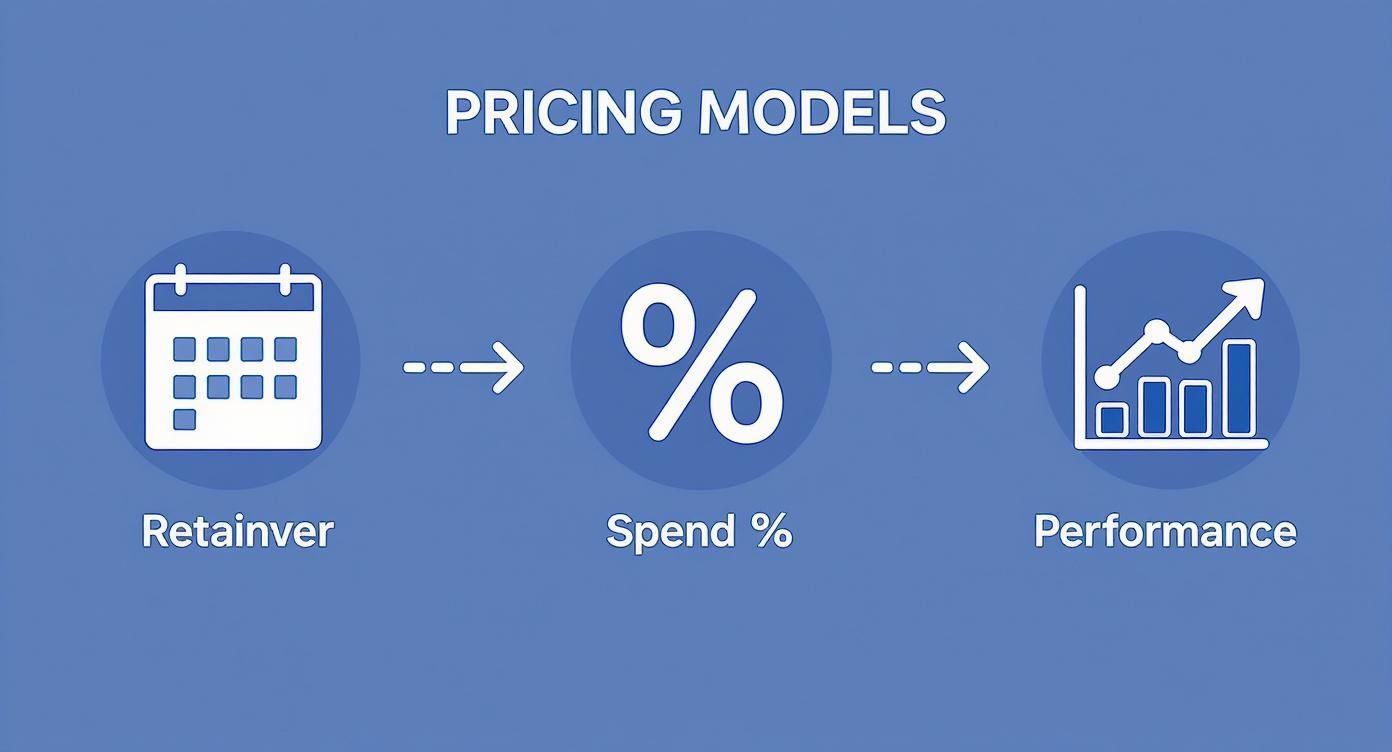
Understanding how your consultant structures their fees ensures the financial side of your new partnership is clear and predictable from the outset, avoiding any awkward conversations down the track.
The Essential Information Handover
Your first week should be dedicated to a complete knowledge dump. Don't hold back; the more context you provide, the better. Your consultant needs to see the full picture—the good, the bad, and the ugly—to make informed strategic decisions.
Here’s a checklist of what you absolutely must provide:
- Full System Access: This one’s non-negotiable. Grant them standard or admin-level access to Google Ads, Google Analytics (GA4), Google Tag Manager, and your Google Merchant Centre if you’re in e-commerce.
- CRM and Sales Data: To connect ad spend to actual revenue, they need a window into your customer relationship management (CRM) system. Even read-only access helps them understand lead quality and sales cycles.
- Historical Performance Reports: Share any past reports or data you have, especially if you’ve worked with other Google Ads consultants or agencies before. This historical context is gold, revealing what’s worked and what’s bombed in the past.
- Brand Guidelines: Provide your logo files, brand colours, and any guidelines on tone of voice. This ensures all ad copy and creative feels like it’s coming from you, not a robot.
Getting this information over to them promptly means they can dig in immediately, conduct their own deep-dive audit, and start forming a strategy based on real data, not assumptions.
A consultant's initial strategy is only as good as the information you give them. The deepest insights often come from understanding not just what happened in the account, but why your business made certain decisions in the past.
Defining Your Ideal Customer and Market Nuances
Beyond the raw data, your consultant needs to understand the human element of your business. To write compelling ad copy and find the right audiences, they need to get inside the head of your ideal customer.
Schedule a dedicated session to walk them through your customer personas. Be specific.
- What are their biggest headaches and pain points?
- What solutions are they desperately searching for?
- What kind of language do they use? Slang, professional jargon?
- Where do they hang out online?
This is also the time to discuss the nuances of the Australian market. For example, the average conversion rate for Google Ads in Australia was approximately 6.96%, far exceeding the global average. But that number means nothing without context—it varies wildly by industry. The finance sector sees conversion rates between 2% and 5%, while the legal sector sits between 1.5% and 4%.
Sharing these benchmarks, along with your own internal data, helps your consultant set realistic goals tailored to your specific competitive landscape. To dive deeper into these figures, you can explore detailed Australian Google Ads benchmarks.
Establishing Communication and Reporting Cadence
Finally, a great partnership runs on clear and consistent communication. Right from the beginning, you need to set expectations for how and when you’ll connect. No one likes guessing games.
Establish a clear framework from day one:
- Set a Regular Meeting Time: A weekly or fortnightly check-in call is essential for reviewing progress, discussing strategy, and making quick decisions. Lock it in.
- Define the Primary Communication Channel: Decide whether you’ll primarily use email, a project management tool like Slack or Asana, or phone calls for day-to-day chats.
- Agree on Reporting Format: Confirm what you want to see in your performance reports. They should be easy to understand and focus on the KPIs you actually care about, like CPA and ROAS, which you should have established during the hiring process.
This structured approach to onboarding removes ambiguity and fosters a collaborative environment. It makes sure your new consultant feels like an integrated part of your team, fully equipped to drive the growth your business needs.
Common Questions About Hiring a Google Ads Consultant
Hiring a Google Ads consultant for the first time? It’s natural to have a few questions. Getting straight answers helps you move forward with confidence and avoid nasty surprises down the track.
Here are the most common queries we see from businesses bringing an expert on board.
How Long Until I See Results from a New Consultant?
While you might see some small, quick wins in the first couple of weeks, you should really be looking at a 60 to 90-day window for significant, stable results. The first month is all about laying the groundwork.
This initial period is for the deep-dive stuff: auditing your account, exhaustive keyword research, sizing up the competition, and launching restructured or brand-new campaigns. The months that follow are for gathering data and making smart, iterative optimisations based on what the numbers are telling us.
Be very wary of anyone promising an immediate, dramatic turnaround. Real, sustainable growth is built on a solid, data-driven strategy, not overnight miracles.
Should I Give a Consultant Full Account Access?
For the initial audit during the interview stage, you should only ever provide read-only access. This lets them analyse performance and strategy without being able to touch anything, keeping your account safe and sound.
Once you’ve signed a contract, they'll need standard or admin-level access to actually do their job. But here's the crucial part: you must always remain the ultimate owner of the account. Your contract needs to state, in no uncertain terms, that the Google Ads account and all its data belong to your business. This is non-negotiable, especially if they offer to build a new account for you from scratch.
What's the Difference Between a Freelancer and an Agency?
Choosing between a freelance consultant and an agency really comes down to your specific needs, budget, and how involved you want to be. Neither is automatically better; they just offer different ways of working together.
- Freelancer/Consultant: You usually get a highly specialised expert who is your direct, personal point of contact. This one-on-one relationship is perfect for businesses that want a deep, hands-on partnership.
- Agency: An agency gives you access to a broader team with a wider skill set, like dedicated copywriters, graphic designers, or data analysts. Your day-to-day communication typically goes through a single account manager.
The right fit often depends on your campaign's complexity. A straightforward search campaign might be perfect for a freelancer, whereas a multi-channel strategy that needs a lot of creative work could benefit from an agency's deeper bench.
What Are the Biggest Red Flags to Watch Out For?
Knowing what to avoid is just as important as knowing what to look for. Keep your eyes peeled for these major red flags during your search, as they often signal a lack of professionalism or genuine expertise.
Here are the key warning signs:
- Guaranteed #1 Rankings: Nobody can guarantee a specific ad position on Google. Period.
- Unrealistic Promises: Vague claims like "we'll double your revenue overnight" are a classic sign of someone who overpromises and underdelivers.
- Lack of Reporting Transparency: If they're cagey about showing you how they measure success or what their reports look like, it's time to walk away.
- High-Pressure Sales Tactics: A good partner is confident in the value they bring. They won't try to rush you into a decision.
You should also be concerned if a candidate is unwilling to provide client references or detailed case studies relevant to your industry, or if their pricing seems way too good to be true. It usually is.
At Click Click Bang Bang, we build partnerships on transparency and proven results. If you're ready to work with a team that sets clear expectations and actually delivers on them, let's have a chat. Explore our PPC management services to see how we can help.
Read NeXt
Or Read Our Latest
- Manual vs Automated Bidding for PPC Success
- Conversion Tracking Setup: A Complete AU Guide
- Instagram Advertising Australia: Complete 2026 Guide
- Pay Per Click: A Beginner’s Guide for Australian Marketers
- Display Advertising on Google: The Complete Australian Guide
- Stakeholder Communication Plan How to Build One That Works
Click. CLick. Subscribe.
Get our best PPC insights, industry updates, and power moves delivered straight to your inbox. No fluff, just high-caliber strategies that actually work.
Don’t Leave Just Yet
Try Us For 30-Days,
Risk Free!!
We guarantee that you’ll love our work within the first 30 days, if not you’ll get your money back.
What have you got to lose?