

Google Ads vs LinkedIn Ads for B2B: Maximize Your 2026 ROI
Last Updated
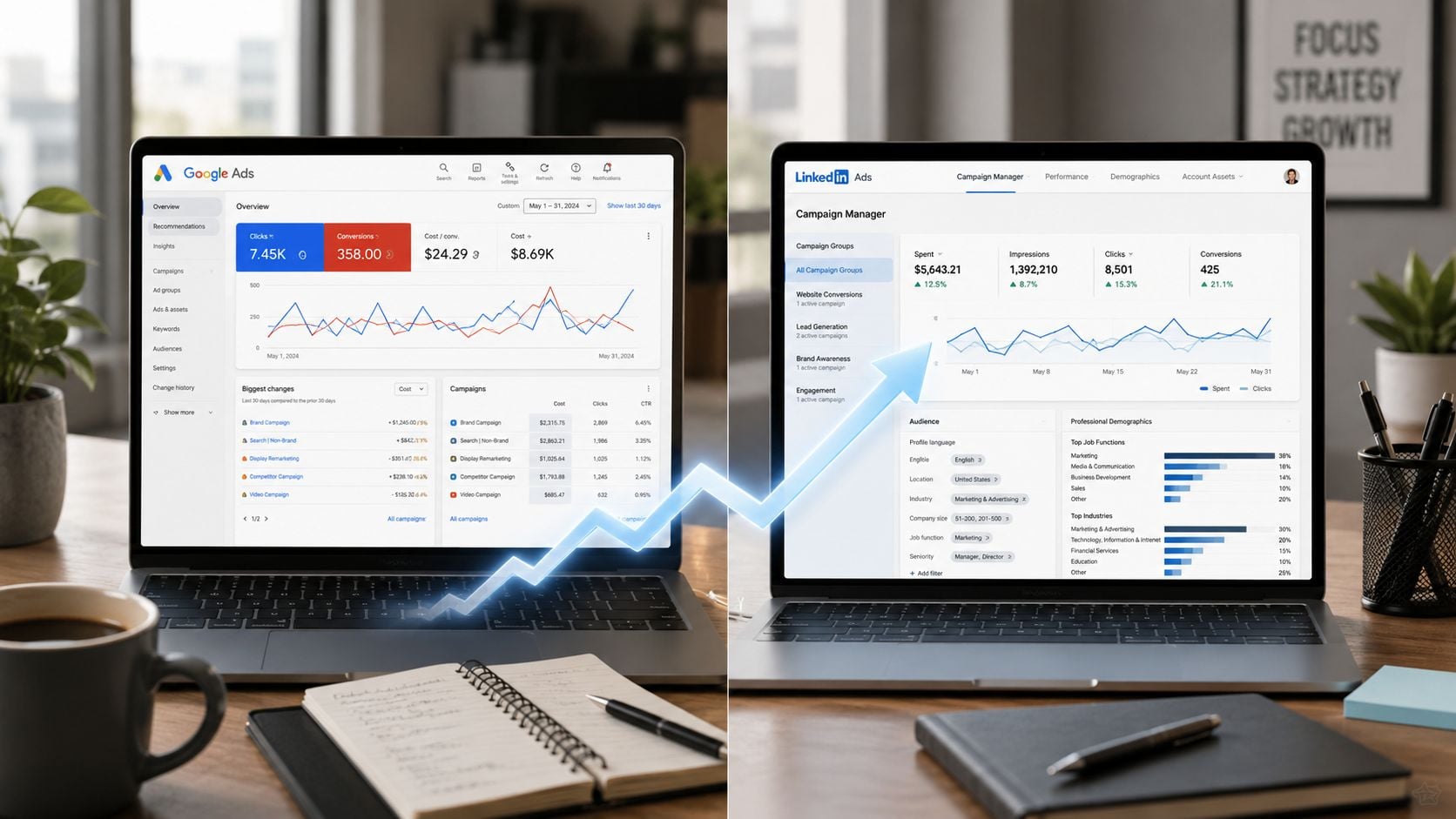
You're probably dealing with the same question most B2B marketing managers in Australia hit after the first planning meeting. Budget isn't unlimited, sales wants better leads, the board wants clearer ROI, and someone has asked whether you should put the next chunk of spend into Google Ads or LinkedIn Ads.
That sounds like a platform question. It usually isn't.
It's a buying journey question. If your prospects already know the problem and are searching for a solution, Google Ads usually gives you the cleaner path to pipeline. If you need to get in front of specific decision-makers before they start searching, LinkedIn Ads usually earns its place. If your market is niche and Australian search volume is thin, you often need both.
The key work in Google Ads vs LinkedIn Ads for B2B is deciding which platform matches your deal size, sales cycle, audience definition, and reporting model. If you want hands-on support building the search side of that equation, Google Ads management is one option to evaluate alongside your in-house capability and current agency setup.
| Decision area | Google Ads | LinkedIn Ads | Best fit |
|---|---|---|---|
| Core strength | Captures active demand | Reaches defined professional audiences | Depends on whether buyers are searching yet |
| Targeting model | Intent and query-led | Identity and company-led | Intent vs role precision |
| Funnel role | Usually strongest lower in funnel | Usually strongest upper to mid funnel | Use by stage, not preference |
| Speed to lead | Often faster | Often slower but more curated | Fast response vs strategic build |
| Best for | Existing demand, solution-aware buyers | ABM, niche audiences, buying committees | Sales motion matters |
| Main risk | More lead noise if targeting is broad | Paying premium media costs without enough deal value | Bad economics if misaligned |
Choosing Your B2B Advertising Battlefield
If you sell into Australian businesses, the first mistake is treating Google and LinkedIn like interchangeable lead engines. They aren't.
Google Ads is where buyers tell you what they want. LinkedIn Ads is where you decide who should see you before they raise their hand. That difference changes everything from landing pages to sales expectations to how long you wait before judging performance.
Start with the business model, not the platform
A lean SaaS team selling a clear solution into an established category usually gets traction from Google faster. A consultancy, enterprise software vendor, or specialist service firm targeting a narrow set of senior roles often needs LinkedIn because the audience matters more than raw volume.
Ask these questions first:
- Are buyers already searching for the category? If yes, Google deserves serious attention.
- Do you need to reach specific roles or named accounts? If yes, LinkedIn becomes much more attractive.
- Is the sales cycle short or long? Shorter cycles generally favour active intent capture. Longer cycles often need education and repeated exposure.
- Does one qualified opportunity justify higher acquisition cost? If yes, LinkedIn's premium can make sense.
Practical rule: Don't pick the platform with the lower click cost. Pick the platform that gives your sales team the better chance of closing the right account.
The Australian context changes the answer
Australian B2B marketers often work in smaller addressable markets, narrower geographies, and categories where search volume looks healthy in a forecast but thin in live campaigns. That's why a generic global answer usually falls apart here.
If your category has enough existing demand, Google Ads can do heavy lifting quickly. If your category needs market education or your ideal buyer is hard to isolate through search alone, LinkedIn can provide a distinct advantage that Google can't. Most of the frustration I see comes from teams asking one platform to do the other platform's job.
Aligning Platforms with Your Marketing Funnel
The cleanest way to compare these channels is by funnel stage. Google is the spear. LinkedIn is the wider net. One captures demand that already exists. The other helps shape demand before it becomes a search.
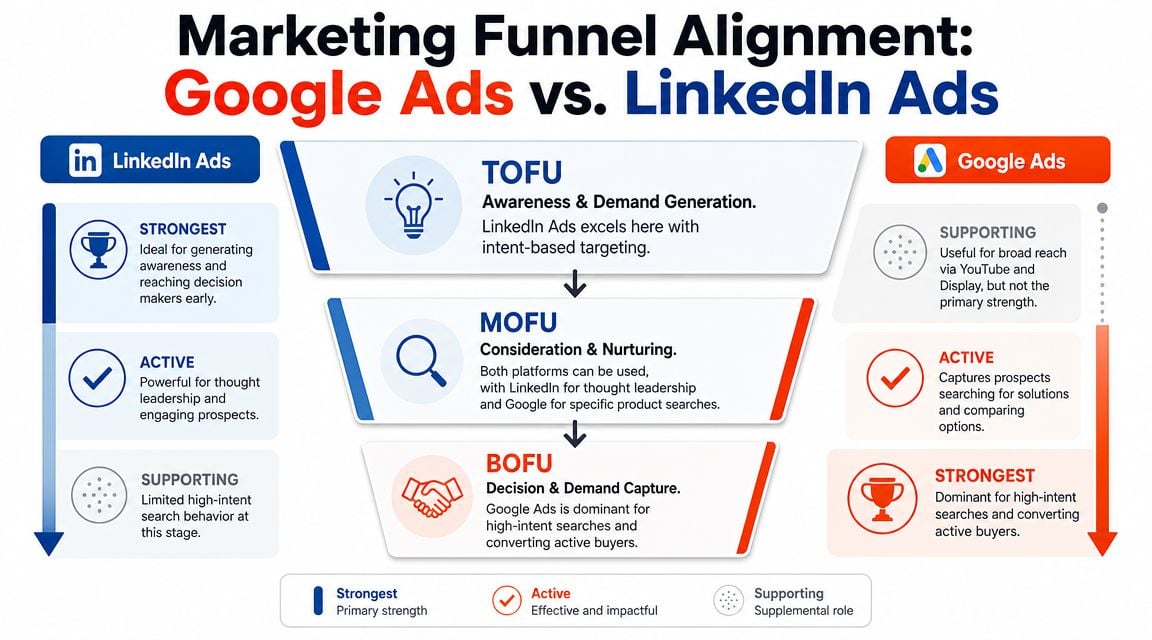
Google wins when intent is already present
For Australia, Google remains the dominant search platform. DataReportal's 2025 Australia figures cited here say Google accounted for 91.0% of desktop search traffic referrals in Australia, while LinkedIn was not a search channel at all. The same source notes Australians spent 6 hours 14 minutes per day online and 1 hour 51 minutes per day on social media, which is a useful reminder that social attention exists, but not all attention is search intent.
That's the practical distinction. Google Ads is built around explicit commercial intent. Someone searches because they have a need, a problem, a shortlist, or a buying deadline. For B2B, that usually makes Google strongest at the point where someone is evaluating vendors, pricing, demos, implementation, or alternatives.
LinkedIn wins when audience definition matters more than query volume
LinkedIn is better used for awareness, education, and selective nurturing. It's where you can push a point of view, introduce a category, or get in front of roles that may influence a deal long before they search.
That usually makes LinkedIn more useful for:
- Thought leadership campaigns
- Webinar or event promotion
- Whitepaper and guide downloads
- Account-based marketing
- Re-engaging a known list of target companies
A simple way to map funnel stages
| Funnel stage | Google Ads role | LinkedIn Ads role |
|---|---|---|
| TOFU | Limited unless people already know the category | Strong for awareness and targeted reach |
| MOFU | Strong for solution, comparison, and category searches | Strong for nurturing and role-specific education |
| BOFU | Usually strongest for demos, pricing, and high-intent actions | Best as supporting pressure on target accounts |
If your team needs leads this quarter, Google usually carries more of the load. If your team needs to shape next quarter's pipeline, LinkedIn usually becomes more important.
Audience Targeting and Quality Showdown
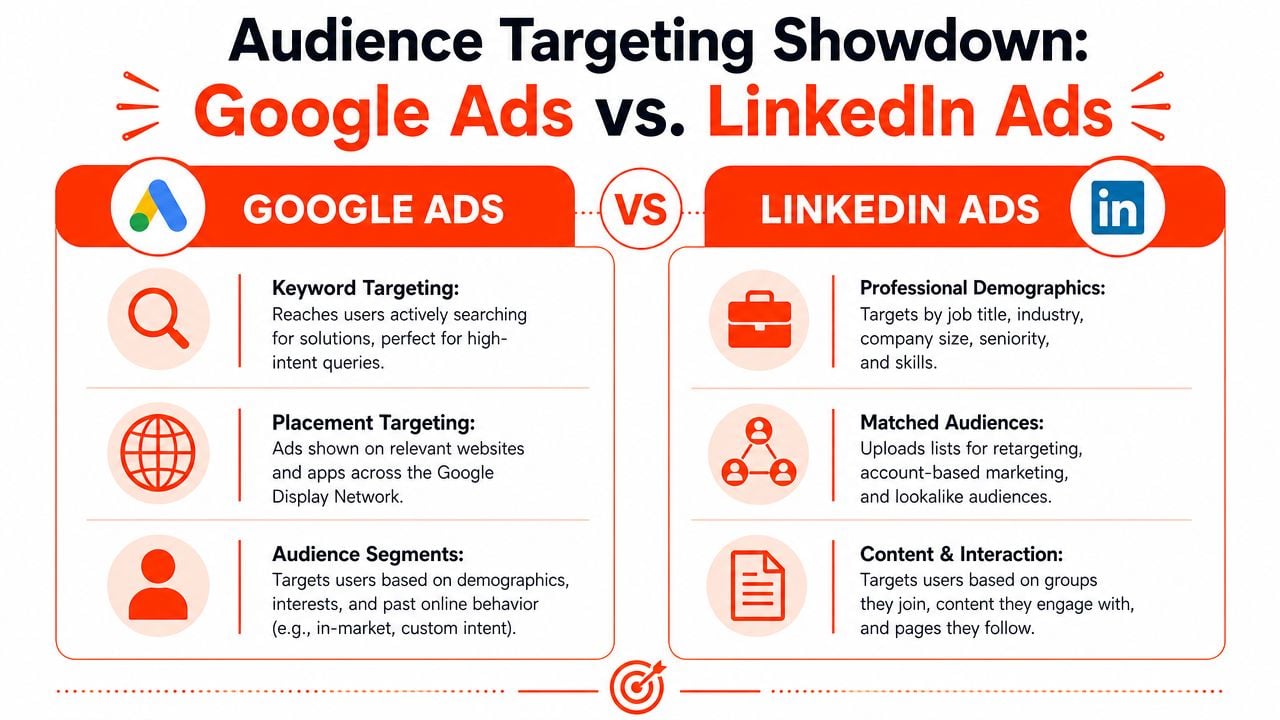
The biggest difference in Google Ads vs LinkedIn Ads for B2B is simple. Google finds the problem. LinkedIn finds the person.
That sounds obvious, but it has major consequences for lead quality, sales acceptance, and how much filtering your team has to do after the lead comes in.
What Google is actually good at
Google Ads works best when the search itself tells you enough about commercial intent. A keyword like software comparison, implementation partner, pricing, demo, provider, or consultant often gives you useful buying signals straight away.
Google can also layer in audience signals and remarketing, but the centre of gravity is still intent. You are mostly inferring who the buyer might be from what they searched.
That approach works well when:
- The problem is urgent
- The category is established
- The buyer knows what type of solution they need
- You don't need to isolate a very specific job function before the click
What LinkedIn is actually good at
For AU-relevant B2B decision-making, the most useful comparison is that Google Ads captures search intent while LinkedIn Ads captures professional identity. This explanation from PBJ Marketing highlights that Google targets users actively searching for solutions, while LinkedIn lets you filter by job title, seniority, industry, company size, and skills, which makes it materially stronger for account-based targeting in complex B2B buying committees.
That matters when your sales team doesn't just want “a lead”. They want the right kind of lead from the right kind of company.
The trade-off in plain terms
Here's the trade-off teams often feel after launch:
| Question | Google Ads answer | LinkedIn Ads answer |
|---|---|---|
| Can I reach people looking now? | Yes | Sometimes, but not because they searched |
| Can I target exact roles? | Limited compared with LinkedIn | Yes, this is the strength |
| Can I support ABM properly? | Only partially | Much better fit |
| Will sales need to qualify hard? | Often yes | Usually less identity mismatch |
| Can I scale with category demand? | Yes, if demand exists | Scale depends on audience size and budget tolerance |
When quality beats volume
If you sell a product that multiple people influence, LinkedIn's targeting can save a lot of wasted follow-up. Instead of collecting broader enquiry volume and filtering later, you can start closer to the ICP.
That doesn't mean LinkedIn automatically produces better outcomes. It means it gives you better control over who sees the message. You still need the right offer, a sensible CTA, and creative that fits colder traffic. Teams that skip that usually blame the platform when the underlying problem is message-to-audience fit.
If you're refining the LinkedIn side of your mix, this guide on mastering B2B lead generation LinkedIn is a useful companion because it focuses on how B2B teams turn role-based targeting into an actual lead generation workflow.
The more specific your buyer committee is, the more LinkedIn earns its premium. The more obvious and searchable your solution is, the more Google earns budget priority.
Analysing Cost Bidding and ROAS Potential
Many teams make the wrong decision here. They compare CPC, decide LinkedIn is expensive, and move on.
For B2B, that's too shallow.
CPC is a misleading first metric
A frequently under-answered question is when LinkedIn's higher CPC is worth paying in Australia once you account for deal size, not just lead volume. This Swydo comparison argues the more useful AU-specific lens is that Google Search is better for shorter sales cycles, while LinkedIn is better for longer ones, and LinkedIn's average ROAS can still exceed Google Search in B2B because it reaches multiple stakeholders within an account.
That's the right framing. Australian B2B teams often don't have the luxury of buying volume for volume's sake. They need to know whether higher media costs can be justified by opportunity quality and downstream revenue.
The metric that actually matters
If you're reporting only on clicks or even cost per lead, you'll usually favour Google. If you report on cost per opportunity, sales acceptance, pipeline contribution, and closed revenue, the answer often changes.
Use this logic instead:
- Google is usually the better fit when your sales cycle is shorter, demand already exists, and buyers can move from search to meeting without much education.
- LinkedIn becomes easier to justify when the contract value is high, the buying group is broad, and your team needs to influence the account before demand is obvious.
- Neither platform is efficient if your offer and landing experience don't match the temperature of the traffic.
What does “worth it” look like in practice
Don't ask whether LinkedIn is more expensive. It is. Ask whether your economics can absorb that premium.
A practical internal review looks like this:
| Commercial factor | Lean towards Google | Lean towards LinkedIn |
|---|---|---|
| Sales cycle | Shorter and direct | Longer and consultative |
| Deal value | Lower or mid-tier | Higher-value deals |
| Buying committee | One or few decision-makers | Several stakeholders |
| Category awareness | Already established | Needs education |
| Budget tolerance | Tight and efficiency-focused | Can invest for account quality |
Commercial lens: If one closed deal covers a lot of paid media, LinkedIn is easier to justify. If you need steady lead flow from existing demand, Google usually gives you cleaner economics.
Bidding and creative still matter
Bad bidding strategy can wreck either platform. So can weak CTR. Improving relevance, offer clarity, and audience-message fit matters well before you start debating channel economics. If you want a practical refresher on ad engagement fundamentals, ButterflAI's guide to better CTR is worth reviewing because stronger click-through rates often expose whether the problem is targeting, creative, or both.
And if your leadership team keeps asking how to judge efficiency properly, this breakdown of what ROAS means helps frame the conversation around return rather than vanity metrics.
Choosing Ad Formats for Your B2B Goals
The platform choice isn't just about targeting. It's also about the ad format that matches the job.
A lot of underperforming campaigns fail because the format and CTA are mismatched. Teams ask cold LinkedIn traffic to book a demo immediately, or they use search-style copy in a feed environment where nobody was actively looking.
Best Google formats for B2B intent capture
Search Ads are still the workhorse for bottom-funnel B2B. They're ideal when someone is looking for a service provider, software category, implementation support, migration help, pricing, or alternatives.
Use them when the action you want is direct:
- Book a demo
- Request a quote
- Speak to sales
- Start an enquiry
- View pricing or capability pages
Display and YouTube play a supporting role. They're useful for remarketing visitors who already hit high-value pages, abandoned a form, or engaged with product content. For B2B, that support role matters more than broad prospecting in most accounts.
Best LinkedIn formats for B2B audience building
Sponsored Content is usually the safest starting point. Single image, video, and carousel formats give you enough room to sell the problem, the point of view, or the offer without demanding too much commitment upfront.
Lead Gen Forms work well when the ask is reasonable. Guide download, webinar registration, benchmark report, or event sign-up are natural fits. They're usually a better match for colder traffic than “talk to sales now”.
Message Ads can work in a narrow set of cases, especially for highly targeted outreach where the audience and offer are tightly aligned. They're not something I'd use broadly. They're better treated like precision outreach than scalable lead volume.
Match format to buying temperature
| Goal | Better Google format | Better LinkedIn format |
|---|---|---|
| Demo request | Search Ads | Retargeted Sponsored Content |
| Whitepaper download | Remarketing Display | Lead Gen Form or Document-led Sponsored Content |
| Webinar sign-up | Search for high-intent related topics | Sponsored Content and Lead Gen Form |
| Executive outreach | Limited | Message Ads or highly targeted Sponsored Content |
| Brand recall with target accounts | Display remarketing | Sponsored Content to defined company groups |
If the audience is already evaluating vendors, Google's direct response formats usually win. If the audience still needs education, LinkedIn's feed-based formats give you more room to warm them up first.
Building a Hybrid Google and LinkedIn Strategy
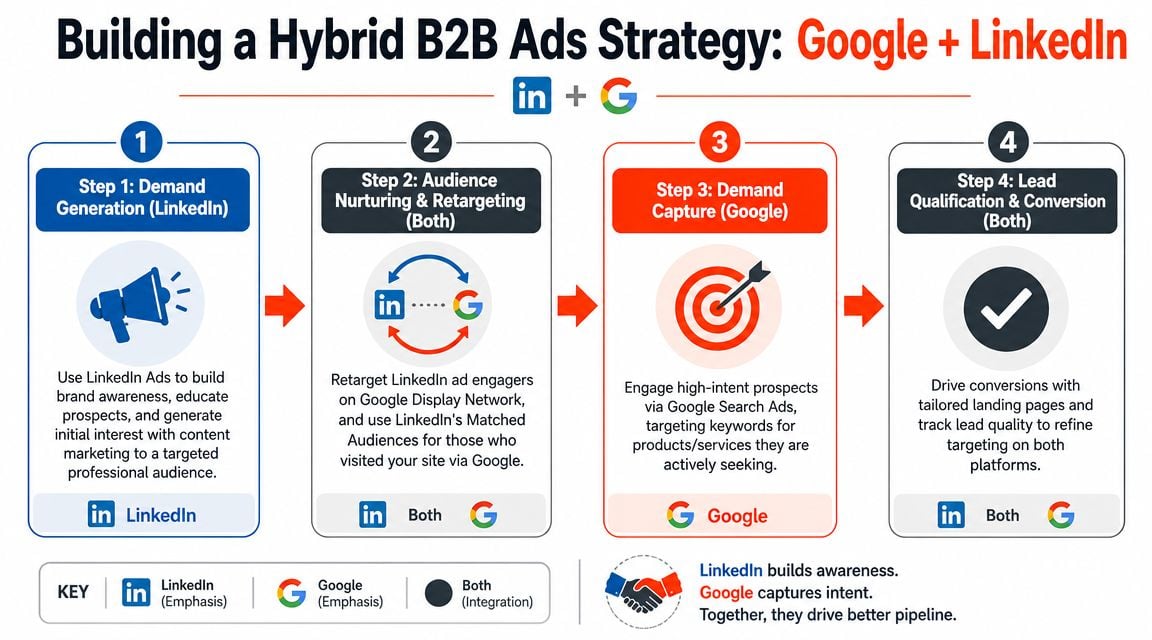
For many Australian B2B companies, the best answer isn't Google or LinkedIn. It's sequencing both properly.
That's especially true when search demand is limited. In smaller B2B niches, Google alone may not scale well enough. LinkedIn alone may build awareness but struggle to convert efficiently on last click. Together, they can do different jobs in the same buying journey.
Use LinkedIn to create the conditions for search
A second underserved angle in Australia is how to use both platforms together during periods of weak demand creation. This comparison from SearchLab points out that many B2B categories have limited search volume, especially outside Sydney and Melbourne, so Google alone may not scale while LinkedIn alone may not convert efficiently. It also raises the measurement problem: how to judge incremental lift when LinkedIn creates interest and Google later captures the search.
That mirrors what happens in practice. A buying committee sees your LinkedIn content, remembers the brand, then one stakeholder searches later and converts through Google. Last-click reporting says Google won. Pipeline reality is usually more complicated.
A practical hybrid playbook
-
Run LinkedIn to a narrow ICP first
Push useful content, problem framing, industry insight, or event offers to the roles and company types you want. -
Build retargeting pools across both platforms
Anyone who engages with content, visits key pages, or returns to the site becomes more valuable on the next touch. -
Keep Google focused on high-intent capture
Prioritise branded, solution-aware, and commercial intent queries. Don't ask Google to do all your awareness work if the market isn't searching enough. -
Judge success at pipeline level
Look at whether target accounts exposed to LinkedIn later convert through Google at a better rate or with higher quality.
Attribution is where teams get this wrong
If you only credit the final click, you'll underfund the platform that helped create the opportunity in the first place. In a hybrid model, reporting has to answer a tougher question: did LinkedIn make Google search traffic more valuable over time?
That's where a proper operational setup matters. If you're outsourcing the social side, LinkedIn Ads management is one example of a service built around B2B campaign execution, audience refinement, and conversion tracking rather than just ad deployment.
If you're also investing in organic thought leadership to support paid demand creation, this guide on how to grow on LinkedIn is useful because strong paid performance often improves when the company's LinkedIn presence already has some credibility behind it.
In small Australian markets, hybrid strategy isn't a nice extra. It's often the only way to build enough demand without wasting budget on one platform doing the wrong job.
Your B2B Advertising Decision Checklist
If you need a working decision tool, use this before shifting budget.
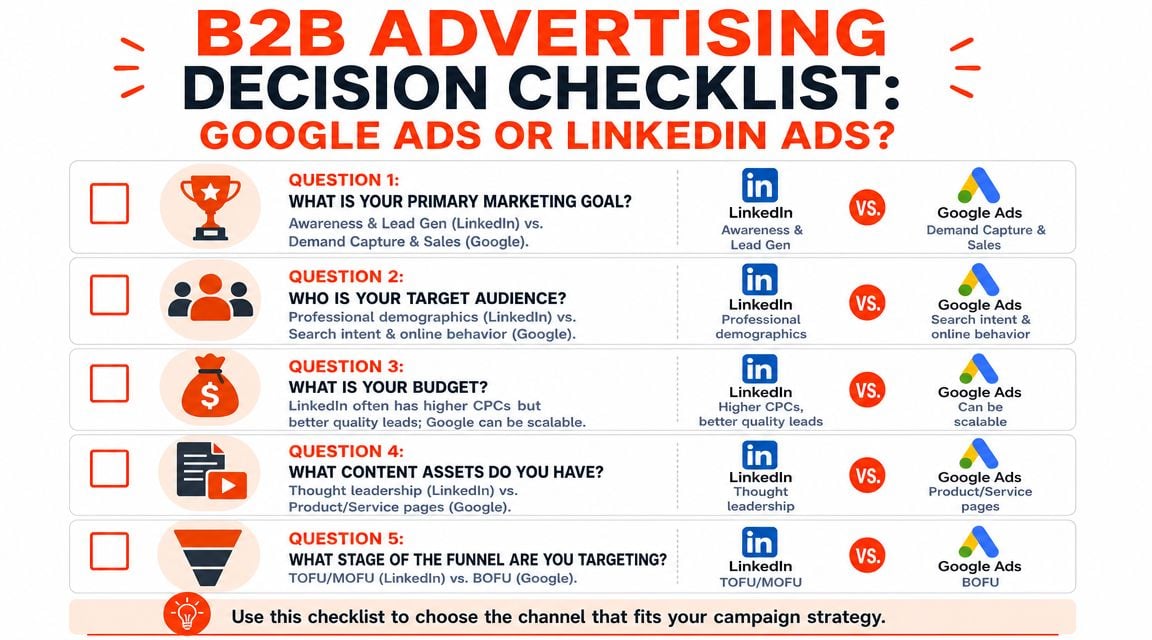
Ask these five questions
-
What's the immediate goal?
If you need demos, enquiries, or sales conversations from existing demand, Google usually gets first call. If you need awareness with a defined professional audience, LinkedIn is often the better starting point. -
How specific is the audience?
If “operations managers in logistics firms” is enough, Google may work. If you need a tighter audience by seniority, company size, and industry, LinkedIn becomes more compelling. -
How long is the sales cycle?
Short and direct cycles lean towards Google. Longer, committee-driven cycles usually need LinkedIn involved somewhere. -
What assets do you have?
Strong service pages, demos, and commercial landing pages support Google. Strong reports, webinars, POV content, and educational creative support LinkedIn. -
How will you judge success?
If you only have lead volume and last-click reporting, Google will look safer. If you can track opportunity quality and account progression, LinkedIn gets a fairer assessment.
Fast recommendations by scenario
| Scenario | Recommendation |
|---|---|
| Clear category demand, urgent lead target, tighter budget | Start with Google Ads |
| Niche audience, higher-value deals, ABM motion | Start with LinkedIn Ads |
| Small Australian market, limited search volume, complex buying group | Build a hybrid model |
| Weak content assets but strong sales pages | Google first |
| Strong thought leadership but low branded demand | LinkedIn first |
Often, the decision is less about channel preference and more about sequencing. Use Google when buyers are already telling you they're in market. Use LinkedIn when you need to shape who enters the market for your brand in the first place.
If you want an external PPC partner to help decide where your B2B budget should go, Click Click Bang Bang works across Google Ads and LinkedIn Ads with a data-led approach, live reporting, and campaign setup built around conversion tracking and ROI measurement.
Read NeXt
Or Read Our Latest
- How to Set Up Google Ads in Australia: Complete 2026 Guide
- Google Merchant Center Setup: The Complete 2026 Guide
- Business Manager Setup Facebook: The Complete 2026 Guide
- Google Ads Account Setup: Expert Guide for 2026
- Search Ads Optimisation: A Practical Guide for 2026
- Manual vs Automated Bidding for PPC Success
Click. CLick. Subscribe.
Get our best PPC insights, industry updates, and power moves delivered straight to your inbox. No fluff, just high-caliber strategies that actually work.
Don’t Leave Just Yet
Try Us For 30-Days,
Risk Free!!
We guarantee that you’ll love our work within the first 30 days, if not you’ll get your money back.
What have you got to lose?