

Find Your Ideal PPC Agency Brisbane: Expert Vetting Guide
Last Updated
You're probably in one of two positions right now. Either you've run Google Ads before and the results felt noisy, expensive, or impossible to trust. Or you haven't started yet, but you know choosing the wrong PPC agency in Brisbane can burn budget fast and leave you with a polished report that says very little about revenue.
That's the tension in this market. PPC can generate demand quickly, but only when the account structure, tracking, landing pages, and decision-making process are tight. A good agency helps you buy profitable attention. A weak one just helps you buy clicks.
Hiring a PPC agency in Brisbane shouldn't feel like guessing. It should feel like a commercial decision with clear inputs, a sensible trial, and a working plan for the first few months.
Laying the Groundwork Before You Search
Before you compare agencies, get your own house in order. Most bad agency relationships start earlier than people think. They start with a vague brief, messy internal ownership, or a business expecting paid traffic to fix a conversion problem that lives on the website or in the sales process.

In Australia, this groundwork matters because digital visibility is already part of normal business operations. The Australian Bureau of Statistics reported that in 2023–24, 100% of businesses with 20 or more employees had internet access, and 96% of businesses used a website or social media presence, while the ACCC noted Google Search remains a critical gateway for discovery and referral traffic. That's why Brisbane agencies tend to pair paid media with broader measurement, not just ad delivery (industry context on Brisbane PPC).
Define the business outcome first
“More leads” isn't a brief. It's a wish.
An e-commerce store usually cares about conversion value, product margin, repeat purchase behaviour, and whether Shopping campaigns are moving profitable items instead of low-margin stock. A B2B service business usually needs lead quality, sales acceptance, booked meetings, and whether the agency can separate genuine pipeline from junk form fills.
Start with these questions:
- What counts as a win: Online sales, booked consultations, qualified calls, demo requests, store visits, or something else?
- What counts as a bad lead: Job seekers, existing customers needing support, irrelevant suburbs, tiny projects, or mismatched industries?
- What can sales realistically handle: There's no point driving demand your team can't call back promptly.
- What timeframe matters: Some businesses need immediate lead flow. Others can accept a slower ramp if tracking and account structure are done properly.
If you haven't clarified who you want to reach, sort that out before agency outreach. A simple customer definition exercise helps. This guide on how to define your target customer is a practical starting point.
Practical rule: If two agencies receive two different verbal briefs from two people inside your company, you don't have an agency problem yet. You have an internal alignment problem.
Set the real budget, not just the media budget
Business owners often ask, “How much should we spend on ads?” The better question is, “What level of testing, learning, and optimisation can we afford without panicking halfway through?”
Your budget has at least three parts:
| Budget area | What it covers | Why it matters |
|---|---|---|
| Ad spend | Media on Google Ads, Meta, LinkedIn, or Shopping | Fuels data collection and demand capture |
| Management fee | Strategy, build, optimisation, reporting, meetings | Pays for the actual expertise |
| Support work | Landing pages, tracking fixes, creative, CRM setup | Prevents weak execution from undermining traffic |
A cheap fee with no measurement discipline usually becomes expensive. So does an ambitious ad budget sent to a weak site.
Decide who owns the relationship internally
Agencies work better when one person owns decisions. That doesn't mean one person does everything. It means someone can approve copy, answer product questions, escalate tracking issues, and stop internal drift.
At minimum, identify:
- A commercial owner who understands revenue goals
- A day-to-day contact who can respond quickly
- A technical contact for website, analytics, and CRM access
- A sales stakeholder if leads need qualification
Without that, even a capable PPC agency Brisbane-side will spend too much time chasing access, clarifying basics, and waiting on approvals.
How to Vet and Shortlist Brisbane PPC Agencies
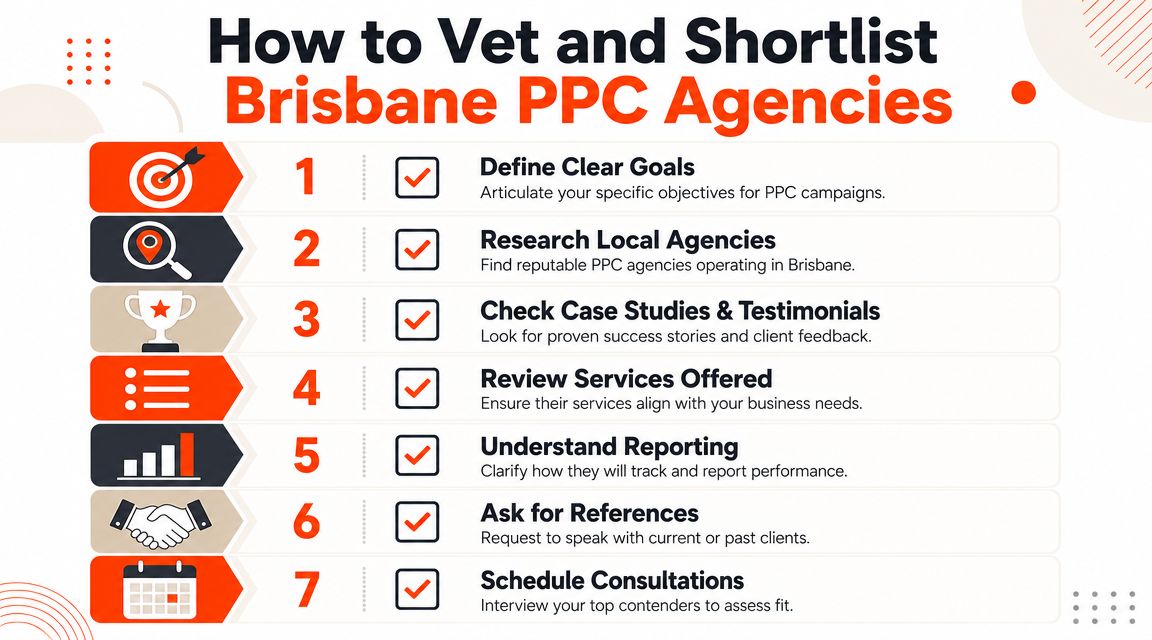
Once your brief is clear, the shortlist gets easier. The mistake most buyers make is choosing from branding signals. Nice website. Big claims. Vague “results-driven” language. That's not enough.
You need a filtering system that tells you whether an agency can manage complexity, communicate clearly, and stay commercially grounded when performance gets messy.
What to look for on the first pass
Start with a broad list, then cut hard.
A credible PPC agency in Brisbane should show clear service lines, realistic language, and evidence they understand the difference between lead generation, e-commerce, and local service campaigns. If every page sounds the same, that's a warning sign. So is a site full of vanity language with no explanation of process.
Use this first-pass checklist:
- Platform fit: Do they clearly handle Google Ads, Google Shopping, Meta, LinkedIn, or remarketing in the mix you need?
- Commercial fit: Do they talk about lead quality, revenue, margin, sales process, or only traffic and click metrics?
- Operational fit: Do they explain reporting cadence, who manages the account, and how optimisation decisions are made?
- Industry fit: They don't need to specialise only in your niche, but they should understand your sales cycle and buying behaviour.
- Tracking maturity: Do they mention conversion tracking, CRM integration, call tracking, or attribution?
For e-commerce brands, especially Shopify stores, it also helps to understand how specialist partners position local support. ECORN's guide to local Shopify agencies is useful because it frames what local agency proximity can and can't solve for a growing online store.
After you've reviewed a few agencies, watch this before booking calls. It'll help you sharpen your shortlist criteria rather than taking every sales pitch at face value.
How to read case studies without getting fooled
Most case studies are written to sell confidence, not to help you evaluate risk. Read them like a buyer, not a fan.
Ask yourself:
- Is the business model similar to yours? A fast-moving e-commerce account doesn't prove lead-gen competence.
- Do they explain what changed? Good case studies show the mechanism, not just the outcome.
- Can you see the constraints? Strong operators talk about tracking gaps, auction pressure, landing page work, or sales quality issues.
- Do they own the full system or just the ads? Some results come from creative, CRO, or CRM fixes outside the media account.
Agencies that only show wins and never explain trade-offs usually struggle when a campaign needs hard decisions.
Build a shortlist you can actually compare
Don't interview ten agencies. You'll lose the thread. Get to three or four serious contenders.
A simple scoring sheet works better than instinct alone:
| Criteria | What good looks like |
|---|---|
| Clarity | They explain strategy in plain English |
| Specificity | They ask detailed questions about your funnel |
| Transparency | They're clear on fees, deliverables, and account access |
| Measurement | They talk about tracking before they talk about scaling |
| Fit | Their communication style matches how your team works |
At this stage, you're not choosing the most impressive presenter. You're choosing the team most likely to make disciplined decisions after the honeymoon phase ends.
Asking the Right Questions During Agency Interviews
The interview is where polished positioning starts to crack. Good agencies don't mind that. They usually welcome it because serious questions create better clients.
Most Brisbane buyers ask versions of the same weak question: “What results can you get us?” That's rarely useful. Any answer will be broad, hedged, or inflated. Better questions test process, judgement, and measurement.
Ask how they handle underperformance
Every account hits friction. Search terms drift. lead quality drops. Landing pages underperform. Sales teams reject enquiries the platform still counts as conversions.
Ask this instead of asking for promises:
- Walk me through a campaign that underperformed in its first month. What did you look at first?
- What would make you cut keywords, pause campaigns, or push back on our landing page?
- How do you separate a traffic problem from a conversion problem?
- What signals tell you the issue is targeting, offer, tracking, or follow-up speed?
The right answer won't be dramatic. It should be methodical.
You want to hear about search terms, match types, negative keywords, device and geo patterns, offer alignment, and lead validation. You also want to hear some version of “we need enough clean data before overreacting.”
Ask who actually does the work
One of the oldest agency traps is buying the senior strategist and getting handed to a junior account manager with too many accounts.
Use plain questions:
- Who will build the campaigns?
- Who reviews search terms and makes optimisation calls each week?
- Who attends reporting meetings?
- If performance drops, who diagnoses the issue?
Then listen for whether the answers are direct or slippery.
A good agency can still use a team model. In fact, many do. The issue isn't whether multiple people are involved. It's whether responsibilities are defined.
Push hard on attribution and offline revenue
Many PPC conversations become shallow. Many agencies can report clicks, forms, and platform conversions. Far fewer can explain how ad spend connects to actual sales outcomes.
That gap matters. A major underserved issue for Brisbane buyers is offline conversion tracking and revenue attribution, especially where leads move through CRM stages, phone calls, booked jobs, and store visits. The ACCC has highlighted ongoing measurement and transparency issues in ad markets, and Google's own approach requires tools such as offline conversion import and enhanced conversions to connect online clicks with real business outcomes (why attribution should be a buying question).
Ask these questions directly:
- How do you connect Google Ads leads to qualified pipeline or closed revenue?
- Can you import offline conversions from our CRM?
- How do you handle phone call tracking and sales feedback loops?
- What happens if platform-reported leads don't match sales reality?
For Shopify merchants, attribution often becomes misaligned because platform, analytics, and ad account data don't line up cleanly. If that's relevant, this breakdown on how to fix attribution for Shopify stores gives you the right language to bring into the conversation.
If you want a benchmark for what a specialist service model looks like, review how a Google PPC company structures channel-specific PPC support and compare that against broader agency pitches.
If an agency can't explain how success moves from click, to lead, to sale, they're asking you to trust reporting that may never reflect the business.
Decoding PPC Agency Pricing Contracts and Trial Offers
Pricing models shape behaviour. That's why buyers get caught out when they focus only on the fee amount and ignore the incentives underneath it.
A PPC agency in Brisbane can be affordable on paper and still expensive in practice if the structure encourages bloated spend, weak strategic input, or constant upsells around basic tracking.
What each pricing model tends to encourage
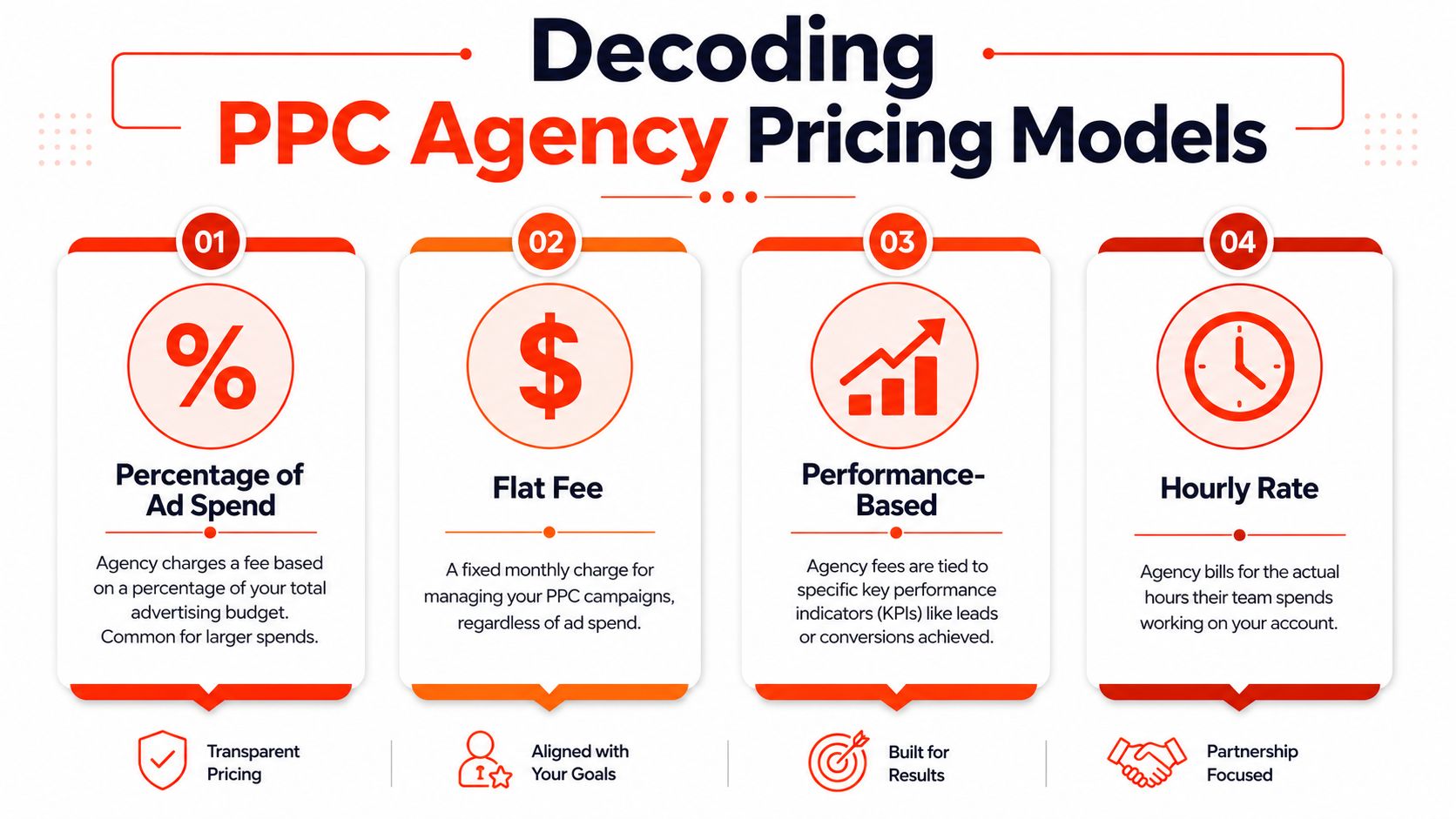
Here's the commercial reality behind the common models:
| Pricing model | Usually works well when | Main risk |
|---|---|---|
| Percentage of ad spend | Spend is high and account complexity rises with budget | Agency income increases when spend increases |
| Flat monthly fee | Scope is stable and expectations are clear | Too much work may get pushed out of scope |
| Performance-based | Conversion definitions are tight and tracking is reliable | Bad incentives if lead quality is weak |
| Hourly rate | You need flexible support, audits, or project work | Can feel uncertain if task scope is vague |
None is automatically right or wrong.
A percentage-of-spend model can work if the agency also cares about efficiency and margin, not just budget growth. A flat fee can be excellent when the deliverables are explicit. Performance pricing sounds attractive, but if the conversion event is poor, the model rewards the wrong thing.
Contract terms that matter more than the sales deck
Most of the important contract points are boring. That's exactly why buyers skip them.
Read for these issues:
- Account ownership: You should know who owns the Google Ads account, historical data, audiences, and creative assets.
- Access rights: You should retain admin-level visibility where appropriate.
- Notice period: Flexibility matters if the relationship turns sour.
- Scope detail: Reporting, meetings, landing page work, setup tasks, and platform coverage should be written down.
- Tracking responsibility: If analytics or CRM integration breaks, who fixes what?
A contract shouldn't just protect the agency. It should make operating expectations clear on both sides.
How to judge a trial properly
A trial period is useful only if you treat it like a diagnostic phase, not a free sample. You're not trying to prove permanent scale in a short window. You're checking whether the agency works in a disciplined way.
Judge the trial on things like:
- How fast they get access and tracking organised
- Whether the account structure reflects your business properly
- How clearly they explain early decisions
- Whether reports answer business questions
- How they respond when the first data is mixed
That's where flexible engagement models can help. For example, Click Click Bang Bang's PPC pricing models outline different ways PPC services can be packaged, including shorter-commitment options. That's useful as a comparison point when you're weighing lock-in contracts against trial-based starts.
Decision lens: A good trial doesn't prove the agency can make every campaign profitable immediately. It proves they can instrument, communicate, and improve with discipline.
Your Agency Onboarding and First 90-Day Roadmap
The first few months tell you almost everything about the relationship. Not final outcomes, but operating quality. Is the agency structured? Are they proactive? Do they fix tracking before scaling? Do they change campaigns based on evidence or on nerves?
That matters because a technically sound PPC workflow starts before launch. Good practice includes setting SMART goals, implementing Google Ads conversion tracking, linking analytics, segmenting campaigns by geography, product, or funnel stage, and using search-term reviews plus negative keyword expansion in a weekly loop. It also helps to allow at least 1–2 weeks and about 100 clicks before treating a change as statistically meaningful (PPC workflow guidance).
What should happen early
A clean onboarding phase is practical, not flashy. It should include access, tracking, commercial context, and audience understanding.
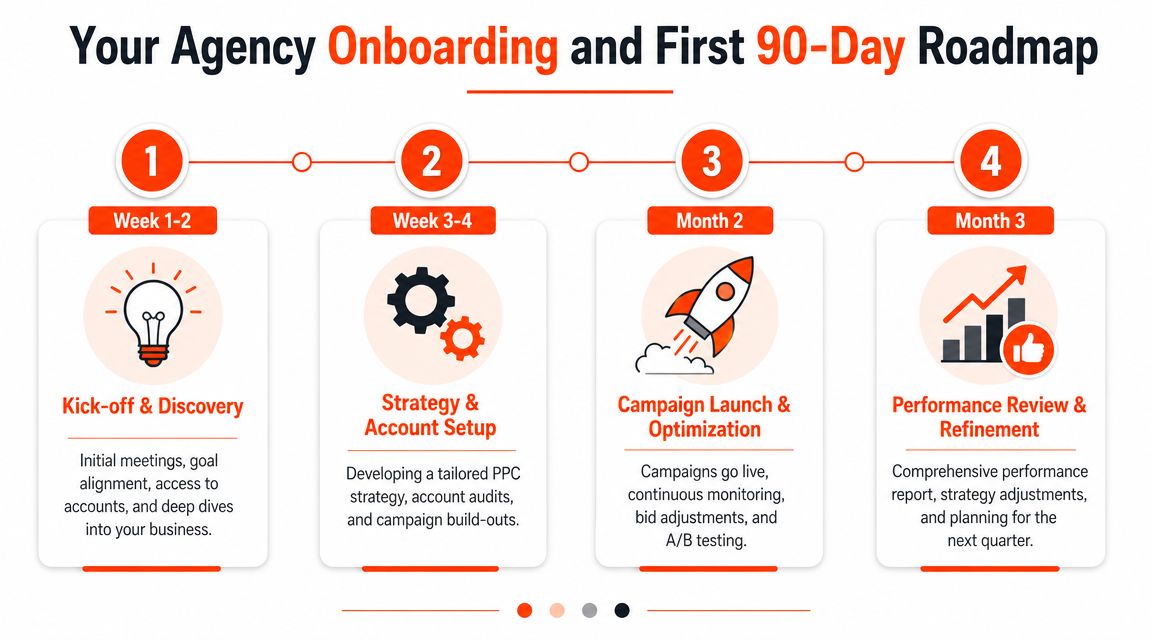
In the opening weeks, expect work like this:
- Account access and audit: Google Ads, Analytics, Google Tag Manager, Meta, Merchant Centre, CRM, call tracking, and landing pages
- Goal confirmation: Not generic KPI language, but agreement on what counts as a qualified action
- Conversion setup: Form submissions, calls, purchases, qualified leads, and where possible, downstream sales events
- Structural decisions: Campaign segmentation by service line, suburb cluster, product range, brand versus non-brand, or funnel stage
If the agency rushes to launch without that groundwork, they're trading speed for control.
What good optimisation looks like in month two
Once campaigns are live, a lot of buyers expect dramatic moves every few days. That usually creates noise.
A competent team will review:
- Search terms to remove irrelevant intent
- Negative keywords to tighten spend
- Ad copy for message match
- Devices and locations for pockets of waste or strength
- Landing pages for conversion friction
- Lead quality feedback from the sales team
Some changes should happen quickly. Others need enough volume to be worth trusting. Agencies that constantly rewrite everything often reset learning before they've earned the right to.
Early optimisation should feel controlled, not frantic.
What a useful 90-day review includes
By the end of the first quarter, you should have more than platform screenshots. You should have a clearer view of economics, constraints, and next steps.
A solid review usually covers:
| Review area | What you should see |
|---|---|
| Performance trend | Which campaigns are producing the strongest commercial signals |
| Lead or sale quality | Whether conversions are turning into real opportunities |
| Tracking confidence | What's measured well and what still needs work |
| Waste reduction | Where irrelevant spend has been cut |
| Next-quarter priorities | Scale, restructure, fix landing pages, or improve attribution |
The first 90 days are not just about proving the agency. They're also about proving whether your internal systems can support paid growth.
Beyond the Contract Building a Profitable Partnership
The strongest PPC relationships don't look like vendor management. They look like a joined-up commercial function.
That's especially important in Australia's search market because Google held about 94% of the search engine market across 2024–2025, which makes Google Ads, Search, Shopping, and remarketing the core paid-search focus for most Brisbane agencies. In a concentrated auction environment like that, keyword selection, Quality Score, conversion tracking, and landing-page relevance heavily influence cost and return, so agency value comes from controlling efficiency and attribution, not just pressing launch (Australian search market context).
A profitable partnership depends on both sides doing their job.
The agency should bring platform judgement, tracking discipline, campaign structure, and candid reporting. Your business should bring sales feedback, margin reality, offer changes, seasonal context, and fast decisions when landing pages or CRM workflows need attention.
That's why “set and forget” PPC rarely stays profitable. Auctions change. Search intent shifts. Competitors react. Offers age. If the agency is left in the dark, they optimise around incomplete signals. If the business ignores reporting and only checks in when spend feels high, strategy gets reactive.
A good PPC agency in Brisbane should challenge you when needed. They should tell you when lead quality is a sales-process issue, not just a media issue. They should tell you when the website is weakening conversion rates. They should also know when not to over-edit a campaign that needs more clean data.
Choose a partner you'd still trust after a rough month, not just one that sounds convincing in a sales call. That's usually the better predictor of long-term return.
If you want a PPC partner that treats tracking, account structure, and commercial outcomes as part of the same system, Click Click Bang Bang is one option to consider. Their model includes channel-specific PPC support, transparent reporting, flexible plans, and a 30-day risk-free trial, which makes them worth evaluating alongside any Brisbane agency shortlist.
Read NeXt
Or Read Our Latest
- How to Set Up Google Ads in Australia: Complete 2026 Guide
- Google Merchant Center Setup: The Complete 2026 Guide
- Business Manager Setup Facebook: The Complete 2026 Guide
- Google Ads Account Setup: Expert Guide for 2026
- Search Ads Optimisation: A Practical Guide for 2026
- Manual vs Automated Bidding for PPC Success
Click. CLick. Subscribe.
Get our best PPC insights, industry updates, and power moves delivered straight to your inbox. No fluff, just high-caliber strategies that actually work.
Don’t Leave Just Yet
Try Us For 30-Days,
Risk Free!!
We guarantee that you’ll love our work within the first 30 days, if not you’ll get your money back.
What have you got to lose?