

Your Guide to a Google Shopping Agency
Last Updated

A Google Shopping agency is a team of specialists who live and breathe product advertising on Google. They're the experts who handle everything from the tricky technical setup in Google Merchant Center to the day-to-day strategic management of your ad budget, all to get your products in front of people actively looking to buy.
What Does a Google Shopping Agency Do?
Think of your e-commerce store as a high-performance race car and the online market as the racetrack. You're busy driving the business forward, focusing on the big picture. A Google Shopping agency is your specialist pit crew—the technicians and strategists working behind the scenes to make sure you don't just compete, but actually win the race for customers and sales.
Partnering with an agency isn't just another operational expense; it's a strategic investment for any e-commerce business that's serious about growth. At its core, an agency's job is to solve the complex puzzle of selling products effectively across Google's massive advertising network.
Navigating Technical Complexities
The Google Shopping ecosystem is surprisingly intricate, with multiple platforms that all need to talk to each other perfectly. A huge part of an agency's role is managing the Google Merchant Center, which is basically the central command hub for all your product information.
They make sure your product data feed—a detailed spreadsheet of all your products and their attributes—is formatted correctly, free of errors, and always in sync with your actual inventory. If this setup isn't right, your products can get disapproved, vanishing from search results and costing you sales. An agency handles these technical headaches, from fixing obscure feed errors to making sure you're staying on the right side of Google's ever-changing policies.
Optimising for Maximum Visibility and Profit
Just getting your products listed on Google is only the first lap. The real value an expert Google Shopping agency brings is in the ongoing optimisation. This means constantly refining every part of your campaigns to squeeze more performance out of every dollar and maximise your return.
Here's where they really focus their energy:
- Product Feed Optimisation: This is way more than just data entry. Experts will enrich your product titles with the keywords real customers are searching for, improve your product images, and add crucial details like colour, size, and material. This helps your products show up for much more specific, high-intent searches.
- Campaign Management: Agencies build and manage sophisticated campaigns, often using Google's powerful Performance Max (PMax) engine. They set strategic bids, allocate budgets smartly across different product categories, and use hard data to decide which products deserve a bigger promotional push.
- Strategic Audience Targeting: It's not just about what you sell, but who you sell to. They identify and target your most valuable customer segments, using audience signals and your own customer data to reach shoppers who are most likely to convert.
In a competitive market like Australia's, this level of specialisation isn't just nice to have—it's essential. Australia’s online shopping market soared to AUD 52.7 billion in 2022. With Google Shopping ads driving around 65% of all Google Ads clicks for retailers, having an expert team managing your campaigns is a massive advantage. You can find more insights on the local impact at Social Season.
An agency's job is to translate raw product data into compelling, highly visible ads and master the complex algorithms that power Google's network. They turn your ad spend from a simple cost into a powerful engine for predictable revenue growth by connecting your products with ready-to-buy customers at the exact moment they're searching.
Inside the Google Shopping Engine Room
To really get what a specialist agency brings to the table, you have to lift the bonnet and look at the engine that drives results. Great Google Shopping isn’t about just uploading your products and hoping for the best. It’s a finely tuned system of interconnected parts, and a skilled Google Shopping agency acts as the master mechanic.
We can break down their technical work into a few core areas. It all starts with your foundational product data, which then flows through a 'supply chain' of information before being deployed through sophisticated, AI-powered campaigns. This structure ensures your products don't just show up on Google—they show up in the most profitable way possible.
The infographic below shows how these three pillars of agency management—data, campaigns, and strategy—work together.
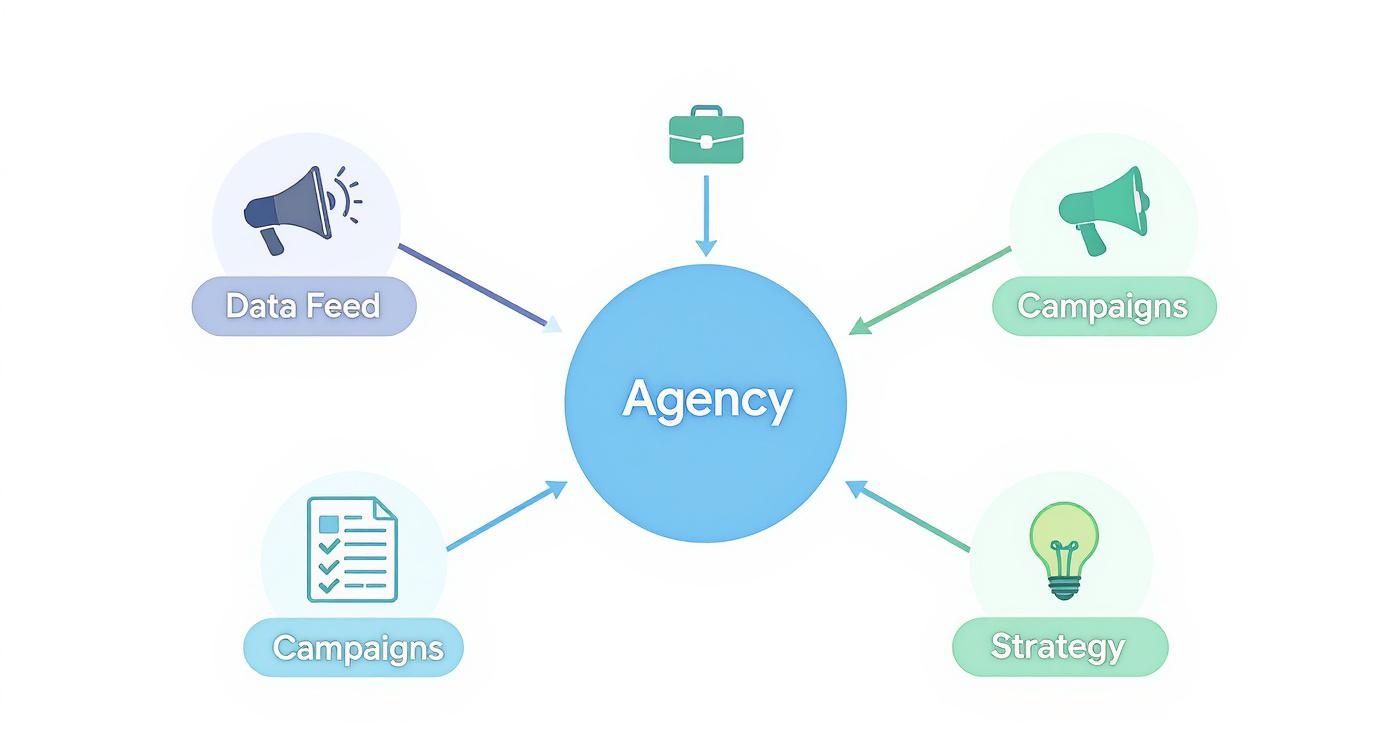
As you can see, a central agency team coordinates the flow of product information into campaign execution, all guided by a clear, overarching strategy.
To get a bit more technical, an agency's work revolves around a few key platforms and processes. We've broken them down in the table below to show how each piece fits into the puzzle.
Key Google Shopping Components Managed by an Agency
| Component | Analogy | Primary Function | Key Agency Activities |
|---|---|---|---|
| Google Merchant Center | Your digital warehouse | Stores, verifies, and organises all product data before it can be used in ads. | Setting up the account, syncing with your e-commerce store, fixing disapprovals, ensuring data quality. |
| Product Feed | The information supply chain | Delivers detailed, accurate product information from your store to Google. | Enriching data, optimising titles with keywords, improving images, resolving feed errors. |
| Performance Max Campaigns | The master merchandiser | Uses Google's AI to place your product ads across all Google networks to find buyers. | Providing high-quality creative assets, defining audience signals, setting clear ROAS targets. |
Let’s dig a little deeper into what the agency actually does with each of these components.
Your Digital Warehouse: Google Merchant Center
The absolute foundation of any Google Shopping effort is the Google Merchant Center (GMC). Think of it as the digital warehouse for your entire product catalogue. Before a single product can appear as an ad, its data must be meticulously organised, verified, and stored here.
An agency's first job is to establish a flawless connection between your e-commerce store and your GMC account. They make sure every piece of product information—from price and availability to brand and product identifiers—is correctly submitted and free from errors that could get you disapproved. It’s a crucial but often tedious process of quality control that stops your products from being sidelined before they even get a chance to sell.
The Product Feed: The Supply Chain of Information
If GMC is the warehouse, the product feed is the supply chain that keeps it stocked with accurate, compelling information. This feed, essentially a detailed spreadsheet of your products, is the single source of truth that Google uses to create your Shopping ads. It is, without a doubt, the most critical element for success.
A top-tier agency doesn’t just submit your feed; they actively manage and optimise it. This is a hands-on, continuous process that involves:
- Data Enrichment: Adding missing attributes like colour, material, or size to make your listings more relevant for specific searches.
- Title Optimisation: Rewriting product titles to include high-intent keywords that potential customers are actually typing into Google.
- Image Quality Control: Ensuring your product images are high-resolution and meet Google's strict guidelines to stand out from the crowd.
- Error Resolution: Proactively identifying and fixing any data discrepancies that Google flags, ensuring your products remain eligible to show.
Proper feed management is a constant effort, not a one-time setup. For a deeper dive, our guide on how to set up your Google Shopping feed provides a step-by-step breakdown of this essential task.
A well-optimised product feed is the difference between showing up for a generic, low-value search and appearing for a highly specific, "ready-to-buy" query. It’s the single most powerful lever an agency can pull to improve your campaign performance.
The Master Merchandiser: Performance Max Campaigns
Once your data is clean and your feed is humming, it's time to put it to work. This is where Performance Max (PMax) campaigns come in. PMax is Google’s AI-powered campaign type that acts like a master merchandiser, strategically placing your products across Google's entire network.
PMax uses your product feed, audience signals, and creative assets to find customers not just on the Shopping tab, but also on:
- YouTube
- Display Network
- Search
- Discover
- Gmail
- Maps
An agency’s role here is to give the AI the right strategic inputs. They supply high-quality creative assets (images and videos), define valuable audience segments (like past purchasers or website visitors), and set clear business goals, such as a target Return On Ad Spend (ROAS). By feeding the machine-learning algorithm the correct data and strategic direction, they guide PMax to find your most profitable customers, wherever they happen to be online.
Connecting Agency Services to Business Growth

This is where the magic happens. Partnering with a Google Shopping agency isn't just about outsourcing technical tasks; it's about turning those tasks into tangible, measurable business growth.
When experts are optimising every last detail of your product feed and campaigns, short-term fixes evolve into long-term strategic advantages. You stop seeing ad spend as a black box and start seeing a clear, predictable return on your investment.
It's not uncommon for retailers to see their click-through rates jump by 20% or more after a proper product feed overhaul. Why? Because better titles and higher-quality images attract more qualified clicks. These kinds of fundamental upgrades have a direct, positive impact on your Return on Ad Spend (ROAS) and, ultimately, your bottom line.
Feed Optimization Boosts Performance
Think of focused feed work as sharpening the blade before a big race. A messy, incomplete product feed is like trying to run with a dull edge—it just won't perform.
When we clean up data fields and enrich product details, we help Google precisely match your products with what customers are actually searching for. This process boosts your ad relevance, cuts down on wasted clicks, and lowers your overall Cost of Sale.
- Title Refinement: We inject high-intent keywords that real shoppers use every day.
- Image Enhancements: We ensure your visuals are crisp, branded, and stand out from the crowd.
- Data Enrichment: We fill in the gaps, adding crucial attributes like size, colour, and stock levels.
“A crisp, error-free feed is the foundation of profitable Google Shopping campaigns.”
Smart feed management often brings hidden gems to the surface, uncovering high-margin products you didn't realise were winners. This allows us to shift budget to your best-sellers and scale them effectively, all while trimming spend on the items that just aren't performing.
Performance Max Uncovers New Segments
When you unleash a well-structured Performance Max campaign, you're giving Google’s AI the keys to explore every corner of its vast network. It runs countless small tests, learning which combinations of your creative assets and audience signals work best.
This isn't just a shot in the dark; it's a data-driven exploration that can increase your total conversion value by 15–30%.
- Define Goals: First, we set clear targets, like a specific ROAS or a total revenue figure.
- Provide Assets: Then, we upload your best images, videos, and audience lists for the algorithm to work with.
- Launch & Learn: Finally, we let the algorithm test, refine, and expand your reach to find new customers.
For example, an agency might discover an entirely new demographic on YouTube that converts at an unexpectedly high rate, opening up a fresh revenue stream you never knew existed.
This matters, especially here. As of 2024, Australian online retail spend hit a massive AUD 69 billion, up 12% year-over-year. With 77% of visits and 68% of orders happening on smartphones, having an optimised presence across all of Google's channels is no longer optional.
Attribution Reveals True Value
How do you know what's really working? Advanced attribution models are the answer. They connect clicks to sales across every single channel, giving you the full picture.
Instead of just crediting the very last click a customer made, you get to see how each touchpoint—from the first ad they saw to the email they opened—contributed to the final sale. This insight makes budget allocation a whole lot smarter.
| Model | Benefit | Insight |
|---|---|---|
| Data-Driven | Custom path analysis | Shows the real impact of each channel. |
| Time Decay | Rewards early touchpoints | Highlights the influence of brand-building ads. |
| Position Based | Shares credit | Balances top-of-funnel and bottom-of-funnel efforts. |
These models bring much-needed clarity to your spending decisions. By understanding the complete customer journey, agencies can fine-tune campaigns for continuous, sustainable improvement.
To ensure that growth is built to last, a great Google Shopping agency will pull from a toolkit of proven digital marketing campaign strategies. This holistic approach keeps your budget efficient and your ROI climbing.
From meticulous feed tweaks to AI-driven campaigns and sophisticated attribution, partnering with a specialist agency like Click Click Bang Bang means every dollar you spend works harder for your brand.
Tracking Key Metrics Over Time
Long-term, sustainable growth is all about measurement. You can't improve what you don't track, which is why a dedicated agency will keep a close eye on the key performance indicators (KPIs) that matter most.
We report on:
- Return on Ad Spend (ROAS): The revenue you gain for every dollar spent.
- Cost of Sale (CoS): A crucial check on your profit margins.
- Click-Through Rate (CTR): A key indicator of your ad relevance and appeal.
- New Customer Acquisition: The rate at which you're expanding your customer base.
- Average Order Value (AOV): A measure of how you're increasing basket size.
Regular check-ins and easy-to-read dashboards help you spot trends early and adapt your strategy on the fly. We then recommend iterative tests on bids, budgets, and creative to keep pushing for continuous gains.
Partnering with Click Click Bang Bang ensures you get more than just data; you get regular insights and actionable plans.
Ready to see your ROI climb? Let's talk.
How to Choose the Right Agency Partner
Choosing a Google Shopping agency is a huge decision. It's one that can genuinely make or break the growth of your e-commerce business. The market is noisy, and let’s be honest, every agency is going to promise you the world. Your job is to cut through the sales pitch and find a partner with real, provable expertise who will operate as a true extension of your team.
What you need is a solid framework for digging in. Don’t just ask generic questions. You need to probe their strategic thinking, get a feel for their technical chops, and understand their communication style. The goal isn’t just to find someone who knows the tools; it’s to find a team that gets your business and knows how to use those tools to hit your specific goals.
The Essential Evaluation Checklist
Before you even think about signing on the dotted line, you have to do your homework. A top-tier agency won't just tolerate detailed questions—they'll welcome them and give you transparent, evidence-backed answers. Use this checklist to separate the real experts from the pretenders.
- Proven Industry Experience: Have they actually worked with businesses in your niche before? Ask for specific examples. An agency that already knows the ins and outs of your industry will get up to speed much faster.
- Case Studies with Similar Businesses: Ask to see case studies from businesses with a similar catalogue size, monthly ad spend, or business model. This proves they can handle the scale and complexity your account demands.
- Clear Strategic Approach: Do they have a documented process for auditing a new account and mapping out a strategy? They should be able to clearly articulate what the first 90 days will look like and what comes after.
- Data and Feed Management Expertise: How do they handle product feed management and optimisation? Their answer needs to go way beyond basic title tweaks. Look for mentions of supplemental feeds, custom labels, and data enrichment.
- Transparent Reporting and Communication: What does their reporting actually look like? Ask for a sample report. It should be laser-focused on business-critical metrics like ROAS and Cost of Sale, not fluff like clicks and impressions.
The most telling sign of a great agency is their obsession with your bottom line. They should be just as focused on your profit margins and customer lifetime value as they are on ad performance. True partners think like business owners, not just marketers.
Questions That Reveal True Expertise
Once you've nailed the basics, it's time to dig deeper. These questions are designed to test an agency's technical knowledge and strategic depth. How they answer will tell you everything about how they think, solve problems, and tackle the real-world complexities of modern e-commerce advertising.
-
"How do you approach product feed optimisation beyond basic title changes?"
- What you're looking for: A great answer will touch on using custom labels to segment campaigns, leveraging supplemental feeds to add new data without messing with the source feed, and optimising for less obvious attributes like product type. This shows a deep, strategic understanding of the feed's power.
-
"What is your methodology for scaling Performance Max campaigns profitably?"
- What you're looking for: They should immediately talk about the importance of high-quality creative assets, providing strong audience signals, and using value-based bidding rules. A sophisticated agency will also discuss structuring campaigns by product category or margin to maintain control.
-
"Can you explain how you would troubleshoot a sudden drop in ROAS?"
- What you're looking for: A systematic, data-driven diagnostic process is key here. They should mention checking for feed errors in Merchant Center, analysing auction insights for new competitors, reviewing search term reports for irrelevant queries, and assessing any recent changes to the website or campaign settings.
-
"How do you integrate a client's business goals, like margin and inventory levels, into your campaign strategy?"
- What you're looking for: The best partners connect ad strategy to business reality. They should talk about using custom labels to bid more aggressively on high-margin products or pulling back on items with low stock. This shows they see the bigger picture beyond just clicks and conversions.
Choosing a partner is about more than just hiring a service provider; it’s about finding an expert team that will drive your business forward. While many companies offer PPC services, finding a specialist is crucial. For more context, our overview of the top AdWords management companies can help you understand the broader agency landscape and what to look for. By asking the right questions, you empower yourself to make a smart decision and build a profitable, long-term partnership.
Understanding Agency Pricing And Onboarding
Transparency underpins every strong collaboration. Before you commit to a Google Shopping Agency, take the time to uncover how their fees are structured and what the first few weeks of working together will look like. When you know what to expect from day one, you step into the partnership with confidence.
Most agencies offer three core pricing models, each with its own advantages and trade-offs. Picking the right one is a bit like choosing the right tool for a job—you want something that suits your budget, goals and risk appetite.
Decoding Common Pricing Models
Here are the three most common fee structures you’ll encounter. A reputable agency will clearly explain why their chosen model fits your business.
- Percentage of Ad Spend: You pay a fixed slice—often 10–20%—of your monthly advertising budget. It’s easy to understand and scales with your investment.
- Flat-Rate Retainer: A set monthly fee covers all services regardless of spend. This predictability helps with budgeting and suits businesses with stable ad budgets.
- Performance-Based Fees: Fees tie directly to results, such as hitting a target ROAS or revenue milestone. It aligns incentives but can take more work to define clearly.
A truly collaborative pricing model rewards the agency for driving profit and growth—not just for increasing your ad spend.
Your Onboarding Journey Step By Step
Signing the agreement kicks off a structured onboarding phase. Think of it as laying the groundwork: get these stages right, and you build a launchpad for long-term success.
In a market like Australia—where Google holds an astonishing 91.13% of search share—nailing the setup is non-negotiable. Here’s a typical four-week roadmap:
-
Discovery And Audit (Week 1):
Your agency conducts a deep-dive workshop to understand margins, audience segments and growth objectives. They also audit your Google Ads and Merchant Centre accounts to spot quick wins and potential roadblocks. -
Technical Setup (Week 1–2):
Behind the scenes, the technical team configures or optimises your Merchant Centre, cleans up product feed errors and adds conversion-tracking codes to your site. This ensures every click is tracked correctly. -
Strategy And Campaign Build (Week 2–3):
Strategists map out the campaign architecture—product groupings, audience definitions and creative requirements for Performance Max. This blueprint guides your ads from go-live. -
Launch And Initial Learning (Week 4):
Campaigns go live and enter Google’s critical “learning phase.” Your agency monitors performance, tweaking bids and budgets as data accumulates and the algorithm optimises toward your goals.
By following this step-by-step approach, you’ll avoid gaps and set your Google Shopping efforts on a solid path to profitable growth.
Measuring Success With The Right KPIs
Any solid partnership with a Google Shopping agency lives and dies on accountability and tangible results. While it’s easy to get distracted by metrics like clicks and impressions, these numbers barely scratch the surface. They don't tell you anything about your business's health or, more importantly, its profitability.
True success is measured by the key performance indicators (KPIs) that directly connect your ad spend to your bottom line.
A great agency shifts the conversation away from these vanity metrics and hones in on what actually drives your business forward. They don't just dump data on you; they translate campaign performance into business intelligence, helping you understand why things happened and what the next strategic move should be.
Focusing on Business-Centric KPIs
To get a real read on performance, you have to track the metrics that reflect actual financial outcomes. A skilled agency will build their entire strategy and reporting framework around these core business drivers.
These are the essential KPIs that should be front and centre in every discussion:
- Return On Ad Spend (ROAS): This is the big one—the ultimate measure of campaign profitability. It shows you the total revenue generated for every dollar spent on ads. A 4:1 ROAS, for instance, means you earned $4 in revenue for every $1 you invested.
- Cost of Sale (CoS) or Advertising Cost of Sale (ACoS): Calculated as ad spend divided by revenue, this metric tells you what percentage of your revenue is being eaten up by advertising. It's absolutely crucial for protecting your profit margins.
- New Customer Acquisition Rate: This KPI tracks how effectively your campaigns are bringing genuinely new buyers into the fold. It’s a vital sign for long-term, sustainable growth.
A top-tier agency doesn’t just report the numbers; they provide context and strategic commentary. They explain the trends behind the data, outline what they're testing next, and tie campaign performance directly to your overarching business objectives.
Understanding Your Performance Report
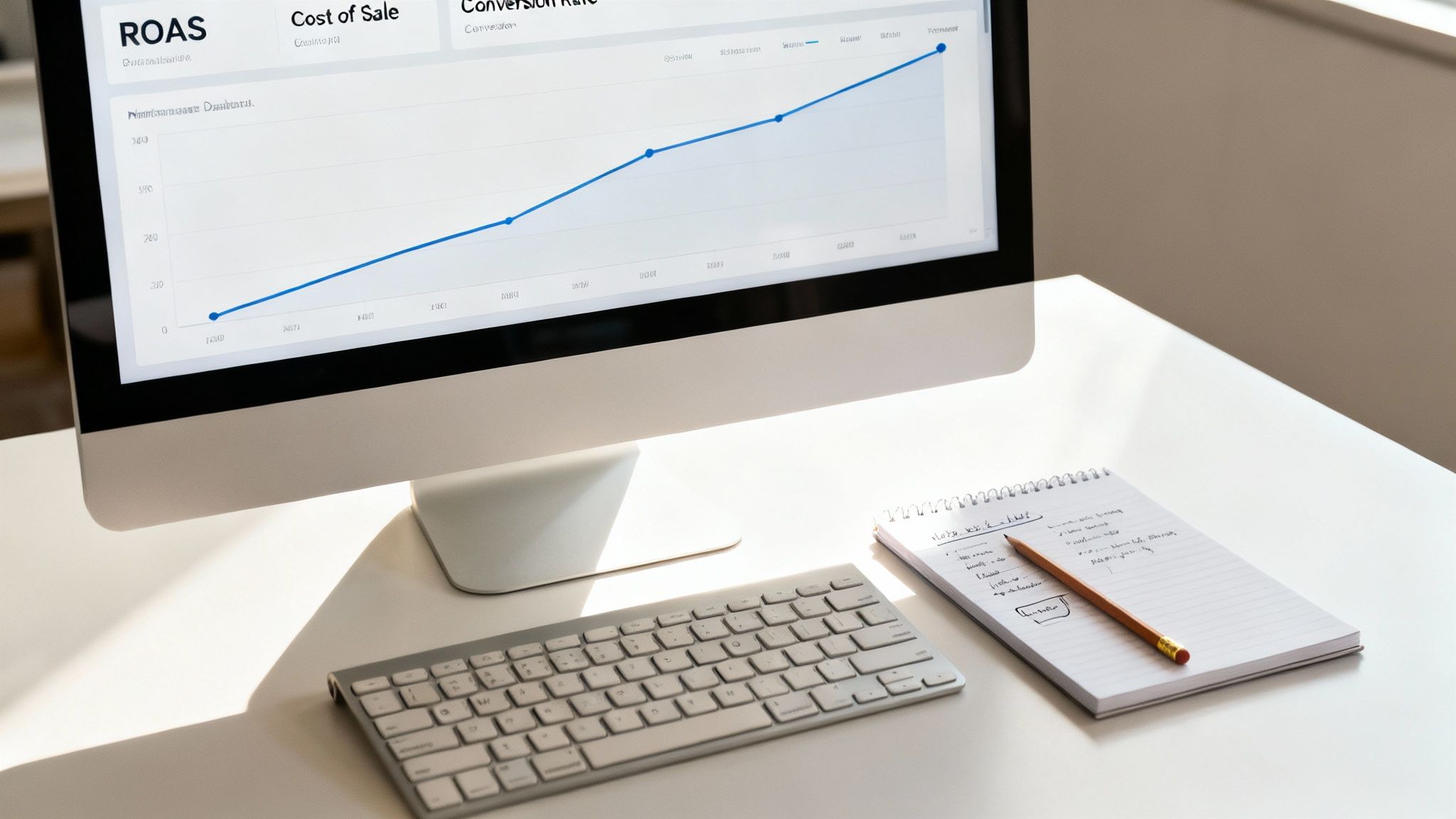
A clear, insightful performance report is your main tool for accountability. It should be easy to digest at a glance, highlighting key trends and providing obvious next steps. An effective report will often feature trend graphs showing performance over time, alongside a dedicated section for the agency's analysis and strategic recommendations.
The goal is to foster a proactive partnership where data drives smarter business decisions. A key part of evaluating your agency's performance is understanding how to measure marketing ROI in a broader sense, ensuring your investment is truly paying off.
For example, a good report might show that while your overall ROAS is steady, one specific product category is knocking it out of the park. The agency’s commentary would then recommend reallocating budget to scale that success.
To get a better handle on this critical metric, our guide explains what is a good ROAS and the benchmarks you should be aiming for. By keeping your focus locked on these business-centric KPIs, you ensure your agency is always working towards what matters most: your growth.
Common Questions About Google Shopping Agencies
Thinking about bringing a Google Shopping agency on board? It's a big decision, and it usually comes with a few questions. Getting these sorted upfront is the key to a good partnership, making sure everyone's on the same page from day one. Here are some of the most common queries we get, answered straight up.
How Long Does It Take to See Results?
Look, anyone promising you overnight success is selling snake oil. Google's algorithms are smart, but they need time to learn and collect data. The first 30 days are really about getting everything set up, launching campaigns, and letting the system find its feet.
You'll typically start seeing real momentum and more stable performance within the first 60 to 90 days. By then, the agency has enough data to make smarter decisions about your bids, budgets, and targeting. That’s when you'll see those consistent, predictable returns start to roll in.
What's the Difference Between Smart Shopping and PMax?
Think of Performance Max (PMax) as the supercharged evolution of Smart Shopping. Smart Shopping was Google's older automated campaign type, which has now been fully replaced by PMax.
While they both rely on automation, PMax has a much, much bigger playground. It lets an agency run your ads across all of Google's channels from a single campaign—that includes YouTube, Display, Search, Discover, Gmail, and Maps. Smart Shopping was mostly stuck with the Shopping network and a bit of remarketing. PMax also gives us more levers to pull with audience signals and creative assets, making it a far more powerful tool in the right hands.
Can an Agency Help with a Disapproved Merchant Center?
Absolutely. A disapproved Google Merchant Center (GMC) account can grind your entire Google Shopping operation to a halt. Sorting this out is a bread-and-butter skill for any decent agency.
An experienced agency can dive in and quickly figure out what's gone wrong—whether it's a policy violation, a messy data feed, or something on your website that Google doesn't like. They have the technical know-how to fix the issues, talk to Google support on your behalf, and get your products back online fast.
How Much of My Time Is Required?
One of the biggest wins of hiring an agency is getting your time back. Right at the start, you should expect to spend a few hours in discovery and strategy sessions. This is crucial for us to really get to know your business, your brand, and what you're trying to achieve.
Once we’re up and running, your time commitment should drop off a cliff. We'll usually just need you for a monthly strategy call and to give the thumbs-up on any new creative ideas or big strategic shifts. A good agency acts as a partner, handling the day-to-day grind so you can get back to running your business.
Ready to get answers tailored to your business? The team at Click Click Bang Bang is here to give you the clarity and strategy you need to win with Google Shopping. Let's connect today!
Read NeXt
Or Read Our Latest
- Manual vs Automated Bidding for PPC Success
- Conversion Tracking Setup: A Complete AU Guide
- Instagram Advertising Australia: Complete 2026 Guide
- Pay Per Click: A Beginner’s Guide for Australian Marketers
- Display Advertising on Google: The Complete Australian Guide
- Stakeholder Communication Plan How to Build One That Works
Click. CLick. Subscribe.
Get our best PPC insights, industry updates, and power moves delivered straight to your inbox. No fluff, just high-caliber strategies that actually work.
Don’t Leave Just Yet
Try Us For 30-Days,
Risk Free!!
We guarantee that you’ll love our work within the first 30 days, if not you’ll get your money back.
What have you got to lose?