

What Is a Sales Funnel for Australian Business
Last Updated

A sales funnel is a marketing model that maps out the journey a potential customer takes on their way to making a purchase. Think of it as a roadmap you create for your customers, guiding them from initial discovery all the way to becoming a paying client. Just like a real funnel, it’s wide at the top and gets narrower at each stage.
Your Quick Guide to the Sales Funnel

Imagine planning a classic Aussie road trip. You don't just jump in the car; you map out the journey from start to finish. A sales funnel does the exact same thing for your business, creating a clear, structured path that turns complete strangers into loyal customers. It’s a way to visualise how you attract a wide audience at the top and then gradually nurture a smaller, more qualified group towards a sale at the bottom.
This framework is essential because it moves marketing from guesswork to a predictable system. Instead of just hoping for sales, you’re building a reliable process designed to generate them consistently. For a deeper dive into how this plays out online, you can explore insights on the modern digital marketing funnel to see how it all connects.
The Core Goal of a Sales Funnel
The real purpose of a sales funnel goes beyond just making sales. It’s about deeply understanding your customer's mindset at each phase of their decision-making process. Once you map this journey, you can deliver the right message at exactly the right time, building trust along the way.
A well-structured sales funnel doesn't just find customers; it creates them by systematically building awareness, trust, and desire. It allows you to pinpoint exactly where potential buyers drop off, so you can fix the leaks and improve your conversion rates.
Ultimately, a sales funnel provides a clear, repeatable, and scalable strategy. This is absolutely crucial for any business owner looking to implement effective digital marketing for small business. It transforms your marketing efforts into a cohesive system where every single action has a purpose, guiding potential customers through four key stages.
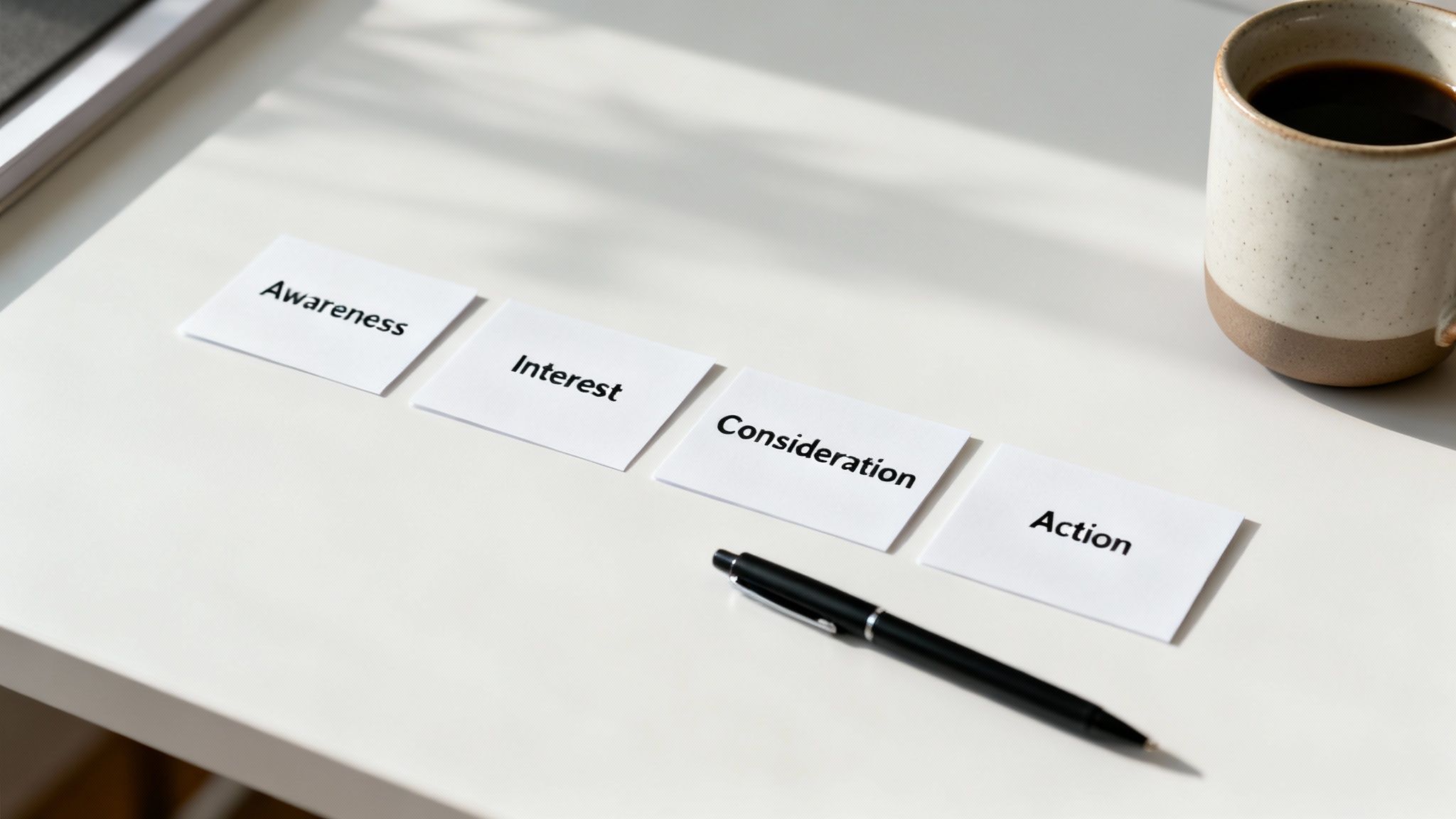
This table breaks down the classic four-stage model, showing what the customer is thinking and what your goal should be at each step.
| Funnel Stage | Customer's Question | Business's Goal |
|---|---|---|
| Awareness | "What is this? I have a problem/need." | Attract attention and introduce your brand. |
| Interest | "This looks interesting. How can it help me?" | Engage them with valuable content and build trust. |
| Consideration | "Is this the best option for me? What about others?" | Nurture the relationship and showcase your solution. |
| Action | "I'm ready to buy. How do I do it?" | Make the purchase process as easy as possible. |
Understanding these stages is the first step to building a funnel that doesn't just attract visitors, but consistently turns them into paying customers who stick around.
Mapping The Customer Journey Stage By Stage
To really get what a sales funnel is, you need to walk through each stage from both your point of view and, more importantly, your customer's. This isn't just some abstract marketing theory; it's a practical map that aligns what you're doing with your customer's mindset as it changes.
Every stage calls for a different approach. Shouting about your latest sale to someone who doesn't even know your brand exists is like proposing on a first date—it’s way too much, too soon. A great funnel nurtures that relationship, one logical step at a time.
Let's break down the classic four stages: Awareness, Interest, Consideration, and Action. This will show you exactly how to guide someone from a casual glance to a confident purchase.
Stage 1: Awareness
This is the very top of the funnel (we call it TOFU), where potential customers bump into your brand for the first time. They aren’t looking to buy anything just yet. They’re simply realising a problem exists, and you might just have a solution for it.
From the customer's side, this could be anything from a general Google search or scrolling through their social feed to stumbling upon a blog post. They're in a passive state, just absorbing information with no immediate plan to buy.
Your goal here is simple: attract a broad audience and make a memorable first impression. You’re not selling; you’re educating and offering value upfront.
Marketing Activities for Awareness:
- Search Engine Optimisation (SEO): Writing blog posts and web content that ranks for those broad, informational keywords people use when they're just starting to research.
- Social Media Marketing: Sharing engaging content like short videos, infographics, or genuinely helpful tips on the platforms where your ideal customers hang out.
- Paid Advertising: Running ads on Google or social media to reach a targeted demographic that has never heard of you before.
Stage 2: Interest
Alright, so they know who you are. The next challenge is to capture their interest. At this point, they've pinpointed a need and are now actively looking for more information. They're comparing, learning, and trying to get their head around the options.
Your job shifts from wide-net attraction to targeted engagement. You need to position your brand as a credible, helpful authority in your space. This is where you start building real trust and showing off your expertise.
This stage is all about proving you understand their problem better than anyone else. It's not about your product's features yet; it's about their challenges and how you can help them think about the solutions.
Marketing Activities for Interest:
- In-Depth Content: Publishing detailed guides, eBooks, or whitepapers that prospects can download in exchange for their email address (your first small "ask").
- Webinars and Workshops: Hosting educational sessions that deliver a ton of value and put your knowledge on full display.
- Email Newsletters: Sending regular, valuable content to the people who’ve raised their hand and shown some initial interest.
Stage 3: Consideration
By the time a prospect hits this stage, things are getting serious. They know they need to make a purchase, and your brand is on their shortlist. They are now actively weighing up your specific solution against your competitors.
Here, your goal is to nurture that lead and convince them that your product or service is the absolute best choice for them. This requires a more direct approach, highlighting what makes you unique and superior. Managing the cost of acquiring these qualified leads is vital, which is why it's important to understand how to calculate customer acquisition cost to ensure your funnel stays profitable.
Marketing Activities for Consideration:
- Case Studies and Testimonials: Showcasing success stories from happy customers provides powerful social proof. Nothing sells like a real-world result.
- Product Demos and Free Trials: Letting prospects experience your solution firsthand is one of the best ways to remove risk and build their confidence.
- Detailed Comparison Guides: Creating content that honestly stacks your offering against competitors can position you as a transparent, trustworthy choice.
Stage 4: Action
This is it—the bottom of the funnel, where the decision is made. The prospect has all the information they need and is ready to pull the trigger. Your final job is to make the purchase process as smooth and painless as possible.
Any friction at this stage—a confusing form, an unexpected shipping cost, a slow-loading page—can lead to an abandoned cart and a lost sale. You’ve worked way too hard to get them here, so don't let a clunky checkout process ruin everything. The call-to-action needs to be clear, compelling, and incredibly easy to follow.
Marketing Activities for Action:
- Optimised Checkout Pages: A simple, intuitive, and secure checkout is completely non-negotiable.
- Clear Pricing and Special Offers: Presenting pricing transparently and using limited-time offers can create a healthy sense of urgency.
- Strong Calls-to-Action (CTAs): Using direct, action-oriented language like "Buy Now" or "Get Started Today" leaves no room for confusion.
Why Your Australian Business Needs a Sales Funnel
Knowing what a sales funnel is gives you a great starting point, but the real question is why it's such a crucial tool for your business. Put simply, a sales funnel is what turns your marketing from hopeful guesswork into a predictable system for growth. It hands you a clear framework to measure what’s working, what isn’t, and where to put your money for the best results.
Without a funnel, your marketing efforts can feel all over the place. You might run a fantastic social media campaign that drives a bit of traffic, but you’ll have no real way of seeing how that initial buzz translates into actual sales. A sales funnel connects all the dots, letting you track a customer's entire journey from their very first click right through to the final purchase.
This kind of visibility is priceless. It lets you forecast sales with far greater accuracy because you start to properly understand your conversion rates at each stage. For example, if you know that for every 100 people who visit your landing page, 10 sign up for your newsletter, and 2 become paying customers, you can begin to build some seriously reliable predictions.
Pinpointing Problems and Boosting ROI
One of the biggest wins you get from a sales funnel is its power as a diagnostic tool. It shows you exactly where potential customers are dropping out of the buying process. Are you losing people after they add an item to their cart? Or maybe they're just not engaging with your emails?
By identifying these "leaks," you can pour your resources into fixing that specific problem instead of randomly overhauling your entire marketing strategy. It’s a far more efficient approach that leads to a much higher return on investment (ROI).
You might discover, for instance, that your checkout process is way too complicated, causing a 50% drop-off right at the final stage. Fixing that one issue could dramatically increase your sales without you needing to spend another dollar on advertising.
A sales funnel turns your customer journey into a set of measurable steps. It transforms abstract goals like "increase sales" into actionable tasks like "improve our email open rate" or "simplify the checkout page."
Thriving in the Australian Market
This structured approach is particularly vital in the competitive Australian online retail market. With total online retail sales hitting $4.7 billion in a single month, every stage of the funnel—from the first website visit to the final purchase—needs to be optimised for conversion. You can get a better handle on these trends by exploring the latest Australian retail trade statistics from the ABS.
Ultimately, a well-defined sales funnel helps you build a more sustainable and profitable business. It gives you the clarity you need to make smarter decisions, allocate your budget more intelligently, and build a reliable system for turning casual interest into solid revenue.
Bringing Your Sales Funnel to Life with Local Examples

The theory behind a sales funnel is a great starting point, but let’s be honest—it’s a bit abstract. The real magic happens when you see these stages in action, especially with local businesses you might already know.
By looking at how successful Aussie companies apply these principles, the whole concept becomes much more concrete and, frankly, easier to copy.
Let's start with a classic product-based ecommerce business. This type of funnel is all about guiding a potential customer from browsing to buying with as little friction as possible.
The Ecommerce Funnel: A Local Success Story
In the world of Australian ecommerce, a sales funnel is simply the step-by-step journey someone takes from discovering your product to hitting that "buy now" button. A fantastic local example is the subscription box brand, Liquor Loot. They have absolutely nailed the art of guiding potential customers through each stage.
If you're keen to see how funnel metrics can directly impact revenue, check out these ecommerce funnel benchmarks from Uncommon Insights.
Here’s a breakdown of how Liquor Loot does it:
- Awareness: They catch your eye with visually stunning social media ads on platforms like Instagram, targeting users who are into craft spirits. This grabs the attention of a wide—but still very relevant—audience.
- Interest: Once you click through, you’re not just hit with a sales page. Instead, you find engaging content like "A Guide to Australian Gin" or clever seasonal cocktail recipes. This builds trust and positions them as experts, not just sellers.
- Consideration: This is where they create a sense of urgency. They use limited-time offers and pre-sale discounts on special edition tasting packs, prompting you to make a decision. This exact strategy was a huge part of their growth, helping them hit an incredible $1 million in monthly sales.
- Action: Finally, a streamlined, mobile-friendly checkout with multiple payment options makes the actual purchase quick and painless. No one wants to fight with a clunky payment form.
By mastering each stage, Liquor Loot doesn't just sell a product; they create a compelling experience that turns casual browsers into loyal, paying subscribers. That's the power of a well-oiled sales funnel.
The Service Business Funnel: It’s All About Trust
Now, let's switch gears to a service-based business, like a local marketing agency or a financial planner. Here, the funnel is less about an immediate transaction and more about building a relationship and proving your value over time.
For a service business, the journey often looks something like this:
- Awareness: They publish genuinely helpful blog posts optimised for local SEO. They're answering the exact questions their ideal clients are Googling, like "best accounting software for Melbourne cafes."
- Interest: Within those posts, they offer something of value—a downloadable checklist or a free webinar—in exchange for an email address. Just like that, they've captured a lead.
- Consideration: The nurturing begins. An automated email series shares client success stories and, crucially, offers a free 15-minute consultation. This no-obligation chat is their chance to demonstrate expertise one-on-one.
- Action: After providing real value on the call, they follow up with a detailed proposal. This makes it incredibly easy for the now-qualified lead to sign on the dotted line and become a client.
How to Optimise Your Funnel for More Conversions
Alright, so you’ve mapped out your sales funnel. That’s a great first step, but the real magic happens next. A truly effective funnel isn't something you set and forget; it’s a living system that needs constant attention and fine-tuning to get the best results.
Think of optimisation as plugging the leaks in your funnel—those spots where potential customers lose interest and disappear. It’s all about making small, smart, data-backed changes that can lead to massive boosts in conversions. This is how you turn your existing website traffic into real revenue, getting a much better return without just throwing more money at ads.
Focus on High-Impact Strategies
Let's talk about what really moves the needle in the Australian market. With local online shopping expected to hit a staggering $57.7 billion, you have to focus on what actually drives sales. For example, a massive 45% of ecommerce sales now happen on mobile. If your site isn't a dream to use on a phone, you're leaving a huge pile of cash on the table.
Understanding local payment habits is another game-changer. 'Buy Now Pay Later' (BNPL) options are unbelievably popular here, making up 13% of all online payments. Adding services like Afterpay can slash friction at checkout and convince hesitant buyers to click "complete purchase."
These are just a couple of the most effective tactics you can use to seal up those leaks and get your funnel converting like a well-oiled machine.
Key Takeaway: Funnel optimisation isn't a guessing game. It's a methodical process of testing, measuring, and refining every single stage of the customer journey to make sure as many leads as possible become paying customers.
Sharpen Your Landing Pages with A/B Testing
Your landing pages are often the first big test in your funnel. This is where a visitor makes a snap judgement: stay and explore, or hit the back button. Vague headlines, confusing layouts, or a weak call-to-action (CTA) will absolutely destroy your conversion rates.
The best way to fix this? A/B testing. It’s simple in theory: you create two versions of a page (an 'A' and a 'B') with one small difference, like the headline text or the button colour. Then you show each version to different groups of visitors to see which one performs better.
- Test Your Headline: Does a headline that screams a benefit outperform one that asks a question?
- Refine Your CTA: Experiment with different button text. Does "Get Started" work better than "Claim Your Free Trial"?
- Simplify Your Forms: Only ask for what you absolutely need. Every single extra field you add is another reason for someone to give up.
A properly tuned landing page with a single, clear purpose can hit an average conversion rate of 13.5%. For a full rundown of what to test, our landing page optimization checklist gives you a clear, step-by-step guide.
Leverage Social Proof and Simplify the Checkout
Once a potential customer is seriously considering a purchase, trust is everything. This is where social proof—things like customer reviews, testimonials, and case studies—becomes your superpower. Weaving these trust signals into your pages can lift conversion rates to an average of 12.5%.
Finally, your checkout process has to be completely painless. The moment someone sees a surprise shipping cost or a ridiculously long form, they're gone. Cart abandonment is the silent killer of online sales.
Top Checkout Optimisation Tips:
- Offer Guest Checkout: Don’t force people to create an account. It's a huge turn-off.
- Display Trust Seals: Show off security badges to make people feel safe.
- Integrate BNPL: Include popular options like Afterpay or Zip.
- Simplify the Process: If you can get everything onto a single page, do it.
To help you put all of this into action, it's worth digging into these proven 10 Conversion Optimization Best Practices. By constantly refining each stage, you transform your funnel from a simple roadmap into a high-performance engine that drives serious business growth.
Your Top Sales Funnel Questions, Answered
Even with a clear map of the stages and optimisation tactics, a few common questions always seem to pop up when businesses start getting serious about their sales funnel. Let's tackle some of the most frequent ones to give you that last bit of clarity before you dive in.
Think of this as a quick-fire round to make sure you have a solid foundation to build on.
How Is a Sales Funnel Different from the Customer Journey?
This is a fantastic question, and it's easy to see why people get them mixed up. The two concepts are closely related, but they look at the process from completely different angles.
Think of the customer journey as a wide, sprawling map of every single interaction a person has with your brand, all from their perspective. It’s often messy and non-linear, covering everything from the first time they hear your name to their experience with customer support and even them telling their friends about you.
A sales funnel, on the other hand, is the specific, structured path you create within that bigger journey. It’s your business-focused roadmap designed to guide someone from a curious browser to a paying customer.
In short: The customer journey is your customer's entire, often unpredictable, experience with you. The sales funnel is the focused, strategic path you design to drive a sale within that journey. One describes what happens (the journey), the other prescribes what you want to happen (the funnel).
Does Every Business Really Need a Sales Funnel?
Yep. Absolutely. While the complexity and specific stages might look wildly different, every single business that sells something has a process for turning strangers into customers—whether they’ve formally defined it or not.
An ecommerce store has a very obvious funnel, from a product page click to a completed checkout. A B2B service provider has a much longer one involving consultations, proposals, and negotiations. Even your local cafe has a funnel: it starts with someone seeing their sign (Awareness) and ends with them buying a flat white (Action).
Defining your sales funnel just means making that process intentional, measurable, and repeatable.
How Long Does It Take to Build a Funnel?
The honest answer? It varies—a lot. You could get a basic funnel for a single product up and running in a few days. That might just involve a simple landing page, a few automated follow-up emails, and a checkout page.
But a more sophisticated, multi-stage funnel with heaps of content for each stage—think blog posts, lead magnets, webinars, and detailed email sequences—could easily take several weeks or even months to build and fine-tune.
Here’s a rough guide:
- Basic Funnel (1-2 weeks): A simple landing page, an email sequence, and a direct offer.
- Intermediate Funnel (3-6 weeks): Includes creating new content like blog posts or a lead magnet, plus more detailed email nurturing.
- Advanced Funnel (2+ months): A comprehensive system with multiple content assets, A/B testing, and segmentation for different customer types.
The key is to start simple. Get a basic version running, then add layers of complexity and optimise as you start gathering real data on what resonates with your audience.
Ready to build a predictable system for growth with a high-performance sales funnel? At Click Click Bang Bang, we specialise in creating data-driven SEO and PPC campaigns that guide customers through every stage, turning clicks into conversions. Start your 30-day risk-free trial and see the results for yourself.
Read NeXt
Or Read Our Latest
- How to Set Up Google Ads in Australia: Complete 2026 Guide
- Google Merchant Center Setup: The Complete 2026 Guide
- Business Manager Setup Facebook: The Complete 2026 Guide
- Google Ads Account Setup: Expert Guide for 2026
- Search Ads Optimisation: A Practical Guide for 2026
- Manual vs Automated Bidding for PPC Success
Click. CLick. Subscribe.
Get our best PPC insights, industry updates, and power moves delivered straight to your inbox. No fluff, just high-caliber strategies that actually work.
Don’t Leave Just Yet
Try Us For 30-Days,
Risk Free!!
We guarantee that you’ll love our work within the first 30 days, if not you’ll get your money back.
What have you got to lose?