

LinkedIn Marketing Agency: A 2026 Guide for Growth
Last Updated

You’re probably in one of two situations right now.
Either LinkedIn is already on your channel list, but it’s underperforming because it’s being run in isolation. Or you’re considering a linkedin marketing agency and trying to work out whether the cost is justified when Google Ads, Meta, SEO, remarketing, and sales enablement all compete for the same budget.
That’s the right question to ask.
LinkedIn can be a strong B2B growth channel, but it’s rarely the whole answer on its own. In practice, the businesses that get the most from it don’t treat it like a standalone social platform. They use it as one part of a full-funnel PPC system, where LinkedIn creates demand, Google captures intent, and remarketing keeps the buying committee moving.
A good agency understands that difference. A weak one talks about impressions, clicks, and “brand awareness” without showing how LinkedIn supports pipeline, qualified leads, or downstream revenue. That gap matters even more in Australia, where many businesses need every dollar of spend to pull weight across multiple platforms.
Why LinkedIn Is a B2B Marketing Powerhouse
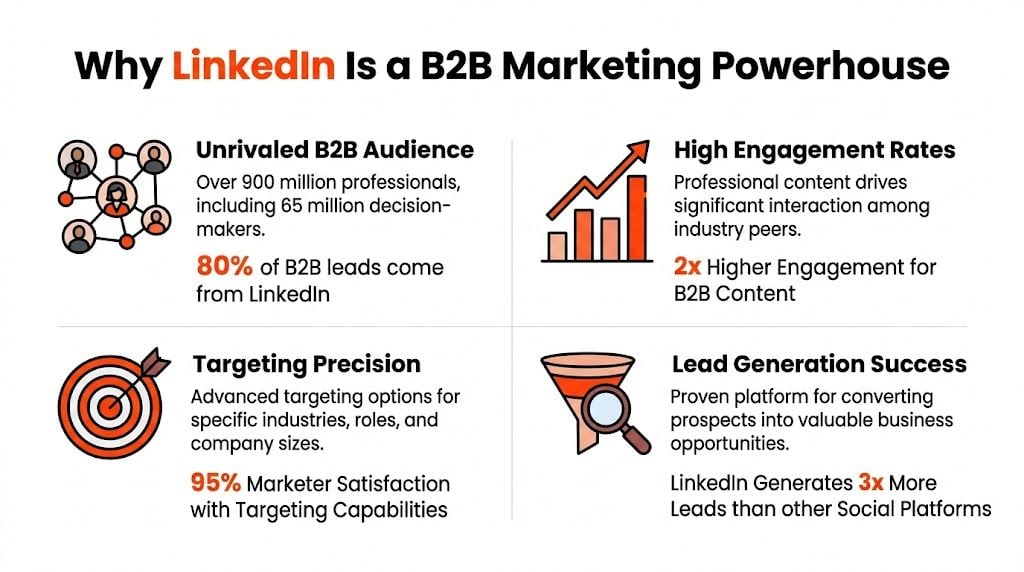
LinkedIn earns attention because it sits in a very different context from most paid social channels. People aren’t there to browse casually. They’re there as professionals, which changes how targeting, messaging, and lead generation work.
In Australia, LinkedIn has become a core B2B prospecting platform. 53% of B2B marketers use LinkedIn to identify prospects and source contact details, and LinkedIn has been cited as 277% more effective for lead generation than other major social platforms according to LinkedIn lead generation statistics. Those two points explain why serious B2B advertisers keep coming back to it, even when the media cost looks higher on the surface.
The quality of context matters
The main reason LinkedIn works is context. You can target by professional attributes and place your offer in front of people while they’re thinking about work, growth, vendors, hiring, operations, and strategy.
That sounds obvious, but it changes campaign performance in practical ways:
- Audience fit: You can align messaging to job function, seniority, industry, and company profile.
- Offer fit: Webinars, demos, consultations, white papers, and capability-led offers make more sense here than broad consumer-style creative.
- Sales fit: The leads often require nurturing, but they’re usually better aligned with higher-value B2B services and longer sales cycles.
A business owner comparing LinkedIn to Meta often focuses on media cost first. That’s understandable, but it misses the bigger issue. Cheap traffic isn’t useful if it doesn’t map to the right buyer.
Practical rule: Judge LinkedIn by lead quality, buying committee access, and contribution to pipeline. Don’t judge it by cheap clicks alone.
Australian marketers are using it for a reason
In local B2B campaigns, LinkedIn often fills a gap that search can’t. Google Search captures active demand. LinkedIn helps create and shape it earlier, before the prospect starts comparing providers.
That matters for businesses selling specialised services, software, consulting, wholesale solutions, logistics, compliance, finance, manufacturing support, or high-consideration professional offers. Buyers in those categories rarely convert from one touch. They research, compare, revisit, and involve other stakeholders.
If you’re running lean internal marketing, it also helps to understand the platform from a practical adoption angle. A useful primer on LinkedIn for small businesses can help frame where organic activity, authority building, and paid distribution fit together.
Why it needs specialist handling
LinkedIn isn’t hard because the interface is confusing. It’s hard because the margin for lazy strategy is small.
The wrong audience filters, weak lead magnet, generic creative, or poor follow-up process can burn budget quickly. The right setup can put your offer in front of people who influence budgets, procurement, or vendor selection.
That’s why choosing a linkedin marketing agency isn’t really about outsourcing ad setup. It’s about hiring someone who understands where LinkedIn fits in a broader growth system and how to make the channel support commercial outcomes, not just campaign activity.
What a LinkedIn Marketing Agency Actually Does
A proper linkedin marketing agency does far more than launch ads and tweak bids. The easiest analogy is a specialist doctor. A generalist can identify the broad problem. A specialist knows which tests matter, what to ignore, and how one issue affects the rest of the system.
LinkedIn is similar. The platform has depth, but that depth only helps if someone knows how to turn business goals into campaign structure, audience logic, creative direction, conversion tracking, and reporting that means something.
With over 1.15 billion members globally, 40% of active monthly users engaging daily, and 74.24% of Australian visits coming from desktop devices, the platform rewards more detailed B2B content and campaign planning, as noted in these LinkedIn usage statistics. That desktop-heavy behaviour is one reason long-form landing pages, stronger proof points, and considered offers often outperform lightweight social-style messaging.
Strategy before ad setup
The first job is strategic diagnosis.
A capable agency starts by asking what LinkedIn is supposed to do inside the full acquisition mix. Is it generating marketing-qualified leads? Feeding sales conversations? Building account awareness in a named list? Supporting retargeting? Reaching a category of buyers that search isn’t reaching consistently?
If the agency jumps straight to audience creation and ad formats without answering those questions, it’s operating tactically, not strategically.
In our work, the strongest LinkedIn campaigns usually begin with a simple decision: should the platform create demand, capture existing interest, or accelerate warm prospects already in the funnel? The answer shapes everything that follows.
Audience architecture and offer design
The next layer is audience planning. Many campaigns often fail at this stage.
LinkedIn gives advertisers enough targeting precision to build very narrow audiences, but narrow doesn’t always mean smart. If targeting becomes too tight, delivery suffers. If it’s too broad, you lose relevance and the message stops landing.
A good agency balances several variables at once:
- Role relevance: Job title, seniority, function, or skill signals.
- Commercial relevance: Industry, company size, growth stage, or target account list.
- Offer relevance: Matching the ask to the audience’s level of awareness.
- Funnel relevance: Cold, warm, and returning users shouldn’t all see the same message.
This is also where creative strategy gets sharper. A decision-maker seeing a top-of-funnel education piece needs different copy from someone who has already visited a pricing or service page.
Most poor LinkedIn performance isn’t caused by the platform. It’s caused by a mismatch between audience temperature, offer strength, and sales follow-up.
Execution, optimisation, and analytics
Campaign management is the visible part of the work, but it’s not the whole thing. Yes, the agency handles campaign builds, ad variations, exclusions, budget controls, and lead form setup. More importantly, it interprets behaviour and decides what to change.
That includes reading platform signals in context. A lower click-through rate with stronger lead quality can be acceptable. A campaign that generates form fills but no sales conversations usually needs a deeper fix than creative refreshes.
The analytics piece is where a specialist agency earns its keep. You want someone who can connect LinkedIn traffic with CRM outcomes, sales feedback, and assisted conversions from other channels. Otherwise, the reporting stays shallow.
A linkedin marketing agency should be able to answer questions like these without hesitation:
- Which audience segments are producing qualified leads, not just cheap leads?
- What happens after the click? Landing page, form, follow-up, and CRM handoff all matter.
- How does LinkedIn interact with search, remarketing, and branded demand over time?
If they can’t answer those, they’re managing a platform. They’re not managing growth.
Decoding LinkedIn Ads Campaigns and Targeting
Most LinkedIn campaigns underperform because the objective, ad format, and audience logic don’t line up. The platform gives you a lot of options, but more options don’t mean better outcomes unless each one has a job.
The practical way to think about LinkedIn is simple. Start with the business outcome. Then choose the campaign objective. Then choose the ad format that suits that stage of the funnel. Finally, set targeting tight enough to stay relevant, but not so tight that delivery collapses.
Matching campaign goals to business outcomes
Not every campaign should chase a lead form immediately. For some businesses, that works. For others, it creates low-intent enquiries that waste sales time.
A workable LinkedIn structure often looks like this:
- Awareness campaigns: Used when the market doesn’t know your brand, service category, or point of difference. The goal is reach inside the right professional audience.
- Traffic campaigns: Useful when you want users on a landing page with more context, such as service details, case examples, or a webinar registration page.
- Lead generation campaigns: Best when the offer is strong enough to justify a form completion, such as a consultation, audit, demo, or downloadable resource.
- Remarketing layers: Important when you want to bring previous visitors back with a narrower, more commercial message.
A full-funnel mindset is key. LinkedIn often performs best when it introduces your brand or offer, then other channels help close the loop. If that’s part of your acquisition plan, structured LinkedIn ad management should connect with search, remarketing, and conversion tracking from the start.
LinkedIn ad format comparison
The ad format should fit the message, not the other way around.
| Ad Format | Best For | Key Feature | Example Use Case |
|---|---|---|---|
| Single Image | Clear offers and focused value propositions | Simple, direct creative with one message | Promoting a consultation or downloadable guide |
| Carousel | Multi-point storytelling | Multiple cards to explain stages, features, or use cases | Showing how a service works across discovery, strategy, and implementation |
| Video | Education and trust building | Better for explaining complex offers or showing expertise | Introducing a niche B2B solution or category problem |
| Message Ads | Direct outreach to a defined professional audience | More personal delivery inside LinkedIn’s messaging environment | Inviting a narrow audience to an event, consultation, or targeted offer |
| Lead Gen Forms | Reducing friction on conversion | Form submission without sending users off-platform | Capturing enquiries from busy decision-makers with limited time |
What the benchmarks actually tell you
In APAC, LinkedIn campaigns show a benchmark cost per lead of $80 USD, while Single Image ads average 0.56% CTR, and Message Ads deliver 3% CTR with 30% open rates, based on LinkedIn ad benchmarks. Those are useful guideposts, but they’re not a promise.
The practical takeaway isn’t that one format is “best”. It’s that each format behaves differently and should be judged by the role it plays.
For example, Message Ads can look strong at the engagement layer, but that doesn’t automatically make them the right option for every audience. Single Image ads can look plain, yet often work well when the offer is sharp and the audience definition is disciplined.
Targeting is LinkedIn’s real advantage
The strongest part of the platform is professional targeting. This professional targeting distinguishes LinkedIn from broader social channels.
A solid audience plan might use combinations such as:
- Job-based targeting: senior marketers, operations leaders, procurement roles, founders, or finance decision-makers
- Company-based filtering: target by company size, industry, or specific account list
- Function and seniority layers: useful when titles vary too much across businesses
- Skills and member traits: helpful in niche categories where title targeting alone misses relevant users
What doesn’t work well is throwing every relevant filter into one audience and assuming more precision equals better results. In practice, over-segmentation often restricts delivery and gives you too little data to learn from.
Build audiences around buying relevance, not around how many filters the platform allows you to stack.
Another common mistake is using the same copy for every targeting cluster. A founder, a head of sales, and an operations manager may all influence the same purchase, but they care about different risks. Good agencies write to those differences.
Budgeting Pricing and Calculating LinkedIn ROI
The first budgeting mistake is lumping everything into one number. There are always at least two separate costs in play. One is the media spend paid to LinkedIn. The other is the agency fee for strategy, setup, creative direction, optimisation, tracking, and reporting.
Those are different investments and should be evaluated differently.

How agencies usually price the work
Most linkedin marketing agency pricing falls into a few broad models.
- Monthly retainer: Best when you need ongoing strategic input, creative iteration, and regular optimisation.
- Percentage of ad spend: Common when campaign volume changes and management effort scales with budget.
- Hybrid model: A base fee plus a spend component. This can work well if reporting and account complexity vary month to month.
- Project or setup fee: Useful for account audits, tracking implementation, landing pages, or campaign rebuilds.
None of those models is automatically right or wrong. The key question is whether the scope matches the fee. If an agency says it manages LinkedIn but doesn’t handle conversion tracking, CRM alignment, or landing page input, the price may be lower because the service is thinner.
What ROI should actually include
LinkedIn ROI gets misunderstood when businesses judge it on platform metrics alone. Clicks, impressions, open rates, and even form fills are only part of the picture.
A more useful commercial lens includes:
- Lead quality: Are the enquiries sales-relevant?
- Sales acceptance: Does the pipeline team consider these leads valuable?
- Lead-to-opportunity movement: Are conversations progressing?
- Assisted value: Does LinkedIn influence branded search, direct traffic, or return visits through other channels?
- Time to conversion: Some LinkedIn leads take longer, especially in B2B and higher-ticket categories.
That’s why we track beyond front-end platform metrics whenever possible. If LinkedIn helps create the first touch, but Google Search closes the conversion later, LinkedIn still matters. A siloed view misses that.
A practical explainer on what ROAS means in PPC is useful here, especially if your team is trying to separate channel-level efficiency from overall business return.
Benchmarks help, but they don’t replace judgement
In APAC, the benchmark cost per lead is around $80 USD, with Single Image ads at 0.56% CTR, and Message Ads at 3% CTR with 30% open rates, according to the benchmark data referenced earlier. Those figures are helpful for context, but they shouldn’t drive decisions in isolation.
Use them to ask better questions:
- Is our CPL acceptable for our average deal size and close rate?
- Are we using the right ad format for the right audience stage?
- Are we forcing a lead form when the market needs education first?
- Is poor ROI coming from ad performance, weak landing pages, or weak follow-up?
A campaign can hit benchmark CTR and still fail commercially if the offer attracts the wrong buyer.
The strongest budgeting decisions come from contribution analysis, not vanity metrics. If LinkedIn brings fewer leads but better-fit leads, or supports search demand that converts later, that channel may deserve more budget than a cheaper platform producing noise.
How to Choose the Right LinkedIn Marketing Agency
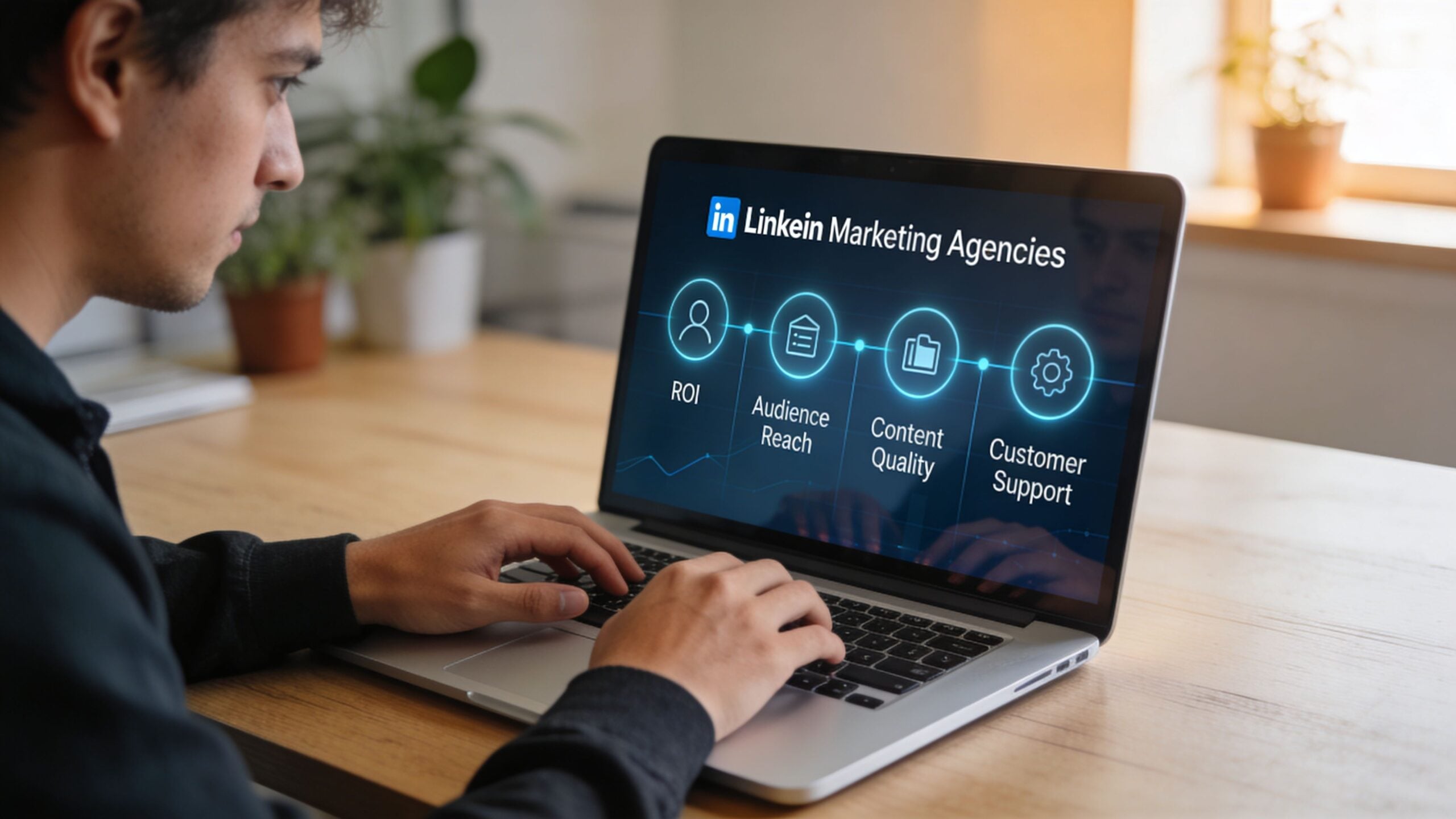
Most agency selection advice stays too shallow. It focuses on years in business, certifications, and whether they “know LinkedIn”. Those things matter, but they don’t answer the question that affects revenue most. Can this agency make LinkedIn work inside the rest of your funnel?
That’s the gap many buying guides miss. A more useful evaluation starts with integration. As noted in this buyer’s guide to LinkedIn marketing agencies, one of the most important questions for Australian businesses is how the agency coordinates LinkedIn with Google Search and Meta to create cohesive customer journeys.
Questions that separate operators from strategists
If you’re speaking with a potential agency, ask direct questions. The quality of the answers tells you more than any sales deck.
-
How do you decide whether LinkedIn should drive awareness, leads, or remarketing support?
A strong answer will mention business model, sales cycle, offer maturity, and how LinkedIn interacts with intent-based channels. -
How do you attribute value when LinkedIn introduces the lead but another channel closes it?
You want to hear about CRM visibility, assisted conversions, and multi-touch thinking, not just platform dashboards. -
How do you split budgets across LinkedIn, Google Search, Meta, and remarketing?
Good agencies won’t give you a canned ratio. They’ll explain the trade-offs based on audience intent and funnel stage. -
What happens after a lead submits a form?
This question catches a lot of weak operators. Great ad management can still fail if the follow-up process is loose. -
Who writes the creative and who owns the landing page recommendations?
If those are disconnected from campaign strategy, performance usually suffers.
For businesses in technical or niche categories, reviewing curated lists like best LinkedIn agencies for software development companies can help you compare specialisation models and service positioning before you start shortlisting.
What good reporting looks like
An agency shouldn’t just show you dashboard numbers. It should explain what changed, why it changed, and what decision comes next.
Useful reporting usually includes:
- Platform performance: spend, clicks, lead volume, ad-level engagement
- Quality signals: qualified lead feedback, CRM status, sales relevance
- Cross-channel context: whether LinkedIn is supporting brand search, returning visitors, or remarketing performance
- Planned actions: what will be tested, cut, or expanded next
If the reporting never moves beyond CTR and cost per click, the agency is probably managing channel activity rather than commercial performance.
To compare service scope, some businesses also look at broader providers such as a B2B marketing agency that handles LinkedIn alongside search and paid social. That model can be useful when attribution, messaging consistency, and budget allocation need to be managed under one strategy.
Red flags worth taking seriously
Some warning signs show up early.
One is guaranteed outcomes. LinkedIn has too many moving parts for any credible agency to promise exact results upfront. Another is a platform-only mindset, where the agency talks about LinkedIn as though your buyers never touch Google, email, direct visits, or remarketing.
Here’s another common issue: they present “qualified leads” as a solved problem without asking how your sales team defines qualification. That’s usually a sign they haven’t managed the full path from click to revenue.
A good linkedin marketing agency should feel commercially literate. They should understand sales friction, buying committees, delayed conversion, and budget trade-offs. If they only sound like ad platform technicians, keep looking.
This short walkthrough is also worth reviewing if you want to hear another perspective on assessing agency fit before signing.
The Agency Partnership Process Onboarding to Reporting
The work starts well before the first campaign goes live. A solid onboarding process should feel structured, not rushed, because the setup decisions affect everything that follows.
The first stage is usually discovery. That means a detailed questionnaire, a strategist conversation, and a review of your offer, sales cycle, existing traffic sources, and conversion points. If the agency doesn’t ask about your CRM, lead handling, and current channel mix, it’s already missing important context.
What gets set up first
The next step is technical and operational alignment.
That often includes account access, campaign architecture, conversion tracking, analytics connections, audience planning, and landing page review. If LinkedIn is part of a broader PPC program, the setup should also account for Google Ads, Meta, and remarketing audiences so the data can be read in context later.
For agencies operating like Click Click Bang Bang, campaigns can launch within 7 days post-onboarding, with analytics integration and conversion tracking included as part of the operating model described by the publisher profile. That speed is useful, but only if the foundations are handled properly.
What the first reporting cycle should tell you
The first reporting window shouldn’t be treated as a verdict on the whole channel. It’s usually a learning period.
What matters most early on is signal quality. Are the right audience segments engaging? Are people completing forms or reaching key pages? Are sales teams seeing relevant enquiries, or are the leads mismatched? Those insights usually matter more than whether the first few weeks produced perfect efficiency.
The best client relationships are built on clear instrumentation first. Scaling comes after the tracking, messaging, and follow-up path are trustworthy.
How ongoing management should feel
A mature agency relationship feels collaborative, not mysterious.
You should know what’s being tested, what’s been ruled out, and how LinkedIn is affecting the wider funnel. Regular summaries should connect campaign activity to business outcomes, while live reporting access can help marketing teams monitor movement without waiting for a monthly PDF.
The strongest partnerships also get sharper over time. Sales feedback improves targeting. CRM patterns improve offers. Cross-channel data improves budget allocation. That’s when LinkedIn stops being “another platform” and starts acting like a useful part of a broader acquisition system.
Tailored Next Steps for Your Business
For B2B service businesses
If you sell a high-consideration service, don’t start by asking how many leads LinkedIn can generate. Start by defining who the ideal buyer is, what problem they already recognise, and what offer would justify a response.
The strongest first move is usually an audit. Review your current landing pages, follow-up process, CRM stages, and any previous paid traffic data. If those pieces are weak, even good LinkedIn targeting won’t save the campaign.
For e-commerce and wholesale-focused brands
LinkedIn usually isn’t the first platform people think of for e-commerce, but it can make sense when you sell into trade buyers, procurement teams, stockists, distributors, or commercial accounts.
Your first step should be identifying whether the platform is for direct lead capture, account-based outreach, or assisted demand generation. If your real goal is wholesale growth or larger commercial buyers, LinkedIn may belong higher in the mix than you think.
For startups
Startups often need credibility before they need scale. LinkedIn can help with that if the message is clear and the audience is narrow.
The best place to begin is with positioning. Tighten the problem statement, define the segment you want to reach, and build one offer that’s easy to understand. Don’t launch broad campaigns with generic messaging and hope the algorithm figures it out.
A linkedin marketing agency is worth considering when you want LinkedIn to do more than generate surface-level engagement. Significant value emerges when the agency can place the platform inside a broader funnel, connect the data properly, and make budget decisions based on actual commercial outcomes.
If you want a practical second opinion on whether LinkedIn should play a bigger role in your acquisition mix, Click Click Bang Bang can help assess where it fits across PPC, remarketing, and broader full-funnel strategy.
Read NeXt
Or Read Our Latest
- Manual vs Automated Bidding for PPC Success
- Conversion Tracking Setup: A Complete AU Guide
- Instagram Advertising Australia: Complete 2026 Guide
- Pay Per Click: A Beginner’s Guide for Australian Marketers
- Display Advertising on Google: The Complete Australian Guide
- Stakeholder Communication Plan How to Build One That Works
Click. CLick. Subscribe.
Get our best PPC insights, industry updates, and power moves delivered straight to your inbox. No fluff, just high-caliber strategies that actually work.
Don’t Leave Just Yet
Try Us For 30-Days,
Risk Free!!
We guarantee that you’ll love our work within the first 30 days, if not you’ll get your money back.
What have you got to lose?