

Marketing Agency Lead Generation: Proven Ways to Convert
Last Updated

Effective marketing agency lead generation isn’t about frantically chasing every prospect that moves. It's about engineering a predictable system that consistently attracts the right kind of clients—the ones you love working with and who see immense value in what you do.
This foundational work is all about defining who you serve and crafting a message that makes your agency the only logical choice. Get this right, and every dollar and minute you spend on marketing will be far more effective.
Build a Foundation for Predictable Growth
Before you even think about launching an ad or hitting publish on a blog post, you have to lay the groundwork. This is where so many agencies trip up. They cast a wide net, hoping to catch anyone with a pulse and a budget, which is a surefire recipe for disaster.
This scattered approach burns through resources, brings in low-quality leads, and fills your portfolio with clients who are neither profitable nor enjoyable. It’s a fast track to burnout.
Real, sustainable growth comes from precision. It all starts by getting laser-focused and building a razor-sharp Ideal Client Profile (ICP). This goes way beyond basic demographics like company size or industry. You need to dig into the deep-seated business pains you are uniquely equipped to solve.
Define Your Ideal Client Profile
Forget just listing job titles. You need to get into the psychographics and buying triggers that signal a client is ready to invest in a solution now. What specific challenges are keeping them awake at night? Are they fed up with their current agency’s lack of results, or are they struggling to scale a channel that used to work wonders?
When building out your ICP, think about these factors:
- Business Pains: What specific, costly problems are they facing? Maybe it's a stagnant lead flow, a declining ROI from their ad spend, or a complete inability to rank for money-making keywords.
- Buying Triggers: What events push them to finally look for help? This could be a fresh round of funding, a new product launch, or intense pressure from the board to show measurable marketing ROI.
- Values Alignment: Do they see marketing as a critical investment or just another expense line? Partnering with clients who truly value your expertise leads to much smoother, more successful relationships.
This whole process is about creating a strategic foundation. You move from profiling your ideal client to defining your unique value, which then creates a clear roadmap for all your lead generation efforts.
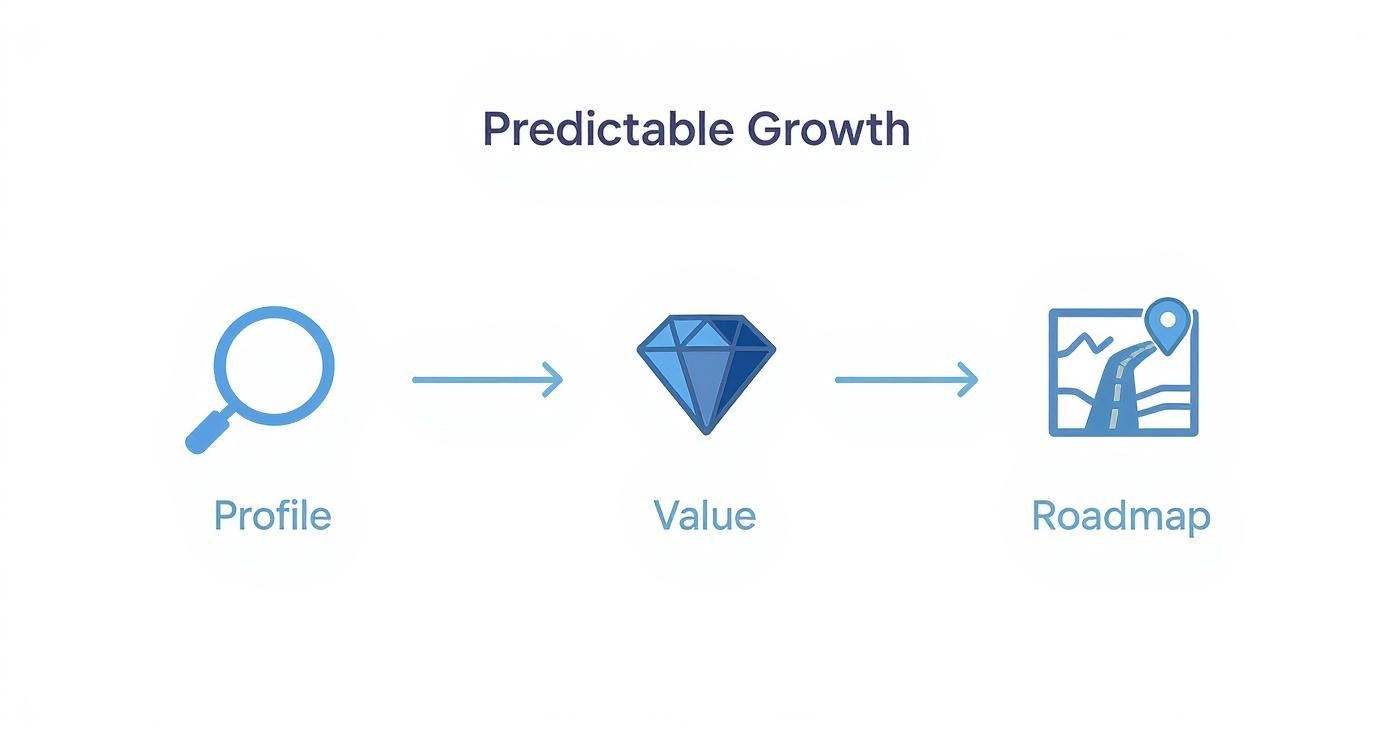
As you can see, understanding your client (Profile) and articulating your worth (Value) directly informs every single step of your lead generation (Roadmap).
Craft a Compelling Unique Value Proposition
Once you have a crystal-clear ICP, you can finally craft a Unique Value Proposition (UVP) that actually resonates. This isn't just marketing fluff or a generic promise of "great results." A powerful UVP is a clear, punchy statement that tells your ideal clients why you’re the only agency for them.
Your UVP should answer one simple question from your ideal client's perspective: "Why should I work with your agency instead of any other?" If you can't answer this clearly and quickly, you can bet your prospects won't be able to either.
For instance, instead of the bland, "We are a full-service digital marketing agency," a much stronger UVP would be, "We help B2B SaaS companies with Series A funding build a qualified demo pipeline using hyper-targeted LinkedIn Ads." See the difference? The second one is specific, speaks directly to an ICP’s goals, and immediately sets the agency apart.
This foundational work acts as your strategic map. It ensures every subsequent effort is focused, efficient, and attracts the high-value clients you actually want. A solid foundation also makes it easier to forecast your growth and costs. A great next step is learning how to calculate customer acquisition cost, a metric that's absolutely critical for any growing agency.
To really get this down, I recommend diving deeper into effective lead generation for agencies to discover more proven strategies. Putting in this effort upfront pays off massively, creating a sustainable engine for high-quality leads that fuels your agency's long-term success.
Attract Qualified Leads with Content and SEO

While paid advertising gets you speed, a solid inbound engine built on content and SEO delivers sustainable, long-term growth. It’s the difference between hunting for your next meal and building a farm that feeds you reliably.
This approach stops the endless chase for clients. Instead, you create a system where they come to you, already warmed up and convinced of your value.
The core idea is simple but incredibly powerful: solve your ideal client's problems publicly and consistently. When they're frantically searching for answers to their biggest marketing challenges, your agency's content should be right there, providing clarity and proving you know your stuff. This builds immense trust long before they even think about booking a call.
Uncover High-Intent Topics
Look, effective content marketing for agencies starts with understanding what your ideal clients are actually searching for. Forget generic keyword lists. You need to dig into the specific, problem-aware questions they’re typing into Google, often late at night when the pressure is on.
Think beyond surface-level terms like "digital marketing agency." Get into the painful specifics that come before they even know they need an agency. For example, a founder of a struggling e-commerce store isn't just Googling "marketing help."
They're searching for things like:
- "Why is my Shopify cart abandonment rate so high?"
- "How to lower my Facebook ad CPA?"
- "My Google Shopping ads are not converting."
These are the golden nuggets for your content strategy. Each one is a real pain point you can build a piece of high-value content around. This is foundational to effective search engine optimisation, where nailing user intent is everything. By addressing these precise queries, you attract prospects who are actively looking for the solutions you provide.
Develop High-Impact Content Pillars
Once you’ve found those pain points, it's time to create definitive content that positions your agency as the ultimate authority. Don't just write another blog post. Aim to create the best resource on the internet for that specific problem. This is how you build authority and attract high-quality backlinks, which are crucial for SEO.
High-impact content formats include things like:
- Definitive Guides: Comprehensive, long-form articles that cover a topic from every single angle. Think something like, "The Ultimate Guide to Meta Ads for B2B SaaS."
- Original Research: Surveying your industry or analysing data to produce unique insights. A report on "The State of E-commerce Marketing in Australia" can quickly become a go-to resource.
- Insightful Webinars: Hosting live sessions that tackle a pressing issue, complete with a Q&A. This doesn't just generate leads; it lets you build a personal connection with your audience.
The goal isn’t to create more content; it’s to create better content. One exceptional, in-depth guide that genuinely helps someone will generate far more qualified leads than a dozen mediocre blog posts.
This strategic approach is particularly potent here in Australia. In fact, within the Australian B2B sector, content marketing generates three times as many leads as traditional marketing, and at a significantly lower cost. That stat alone should tell you everything you need to know about building a robust inbound strategy. You can discover more insights about B2B marketing statistics on leadagency.com.au.
Map Out a Realistic Distribution Plan
Creating brilliant content is only half the battle. Getting it in front of the right people is the other, equally important half. A classic mistake is hitting "publish" and just hoping for the best. You need a proactive distribution plan to squeeze every drop of value out of your hard work.
Your distribution plan should be a multi-channel effort designed to surround your ideal client with your valuable insights. Don't just share a link; repurpose and adapt your core content for each platform.
Here’s a practical example of a distribution workflow for that new guide you just wrote:
- Email Newsletter: Announce the new guide to your subscriber list, highlighting the key problems it solves. This is your most engaged audience, so treat them like gold.
- Social Media Promotion: Create a series of posts for platforms like LinkedIn. This could include a carousel summarising key takeaways, a short video of the author discussing the main points, or text posts asking thought-provoking questions related to the guide's topic.
- Strategic Guest Posts: Write articles for other relevant blogs that serve a similar audience but aren't direct competitors. Within your guest post, you can naturally reference and link back to your definitive guide as a further resource.
- Community Engagement: Head to where your ideal clients hang out online—think forums or industry groups. Share your guide as a genuinely helpful resource to solve a common problem, not just a self-promotional link drop.
This system ensures your content doesn't just sit on your blog gathering dust. It actively works to attract, engage, and convert qualified leads, turning your website into a 24/7 client acquisition machine.
Accelerate Lead Flow with Paid Advertising

While content and SEO are brilliant for building a long-term, sustainable asset, sometimes you just need to turn on the tap and fill your pipeline now. This is exactly where paid advertising shines. It gives you the speed and control to generate a predictable flow of leads while your inbound engine is still warming up.
For most marketing agencies, the two undisputed heavyweights in the paid advertising ring are Google Ads and LinkedIn Ads. They each serve a very different purpose in a well-rounded marketing agency lead generation strategy, letting you capture high-intent prospects and proactively get in front of key decision-makers.
Mastering LinkedIn Ads for B2B Targeting
When it comes to targeting B2B clients, LinkedIn is an absolute goldmine. Its targeting capabilities are second to none, allowing you to sidestep gatekeepers and put your message directly in front of the exact C-suite executives, marketing directors, or founders you want to work with.
The precision is incredible—you can slice and dice audiences by job title, company size, industry, seniority, and even specific company names.
When you're building a LinkedIn Ads campaign, though, think beyond just pushing a "contact us" page. Decision-makers are busy and, frankly, pretty sceptical. Your offer has to provide immediate, tangible value.
Here are a few high-value offers that actually work on LinkedIn:
- Industry-Specific Case Studies: Run an ad promoting a detailed case study like, "How We Grew a Melbourne-Based SaaS Firm's MQLs by 150% in 90 Days." This speaks directly to a niche audience and their specific pain points.
- Webinar or Live Event Invitations: Target heads of marketing with an exclusive invitation to a webinar on a forward-thinking topic, such as "AI's Role in B2B Lead Nurturing for 2025."
- State-of-the-Industry Reports: Offer a downloadable report based on your own original research. This positions you as a genuine authority and works as a powerful lead magnet.
The trick is to match your offer to the sophistication of your audience. A generic "free consultation" will probably get scrolled past. A specific, valuable resource that solves a real problem? That's far more likely to earn a click and a conversion.
Capturing High-Intent Leads with Google Ads
If LinkedIn is all about proactively finding your ideal client, Google Ads is about being found the moment they're actively looking for a solution. This is bottom-of-funnel marketing at its finest, targeting prospects who have high commercial intent.
Your success here lives and dies by your keyword selection. You need to zero in on phrases that signal someone is ready to hire an agency, not just learn about a topic.
Forget broad terms like "digital marketing." Instead, focus on long-tail, high-intent keywords that scream "I need to hire someone." Think phrases like "google ads agency for e-commerce" or "b2b seo services sydney."
This level of specificity cuts down on unqualified clicks and makes sure your budget is spent on prospects who are much further down the buying journey. To really tighten things up, effective Google Ads management involves using negative keywords to filter out people looking for jobs (e.g., "agency jobs") or free tools.
Your ad copy then needs to speak directly to the searcher’s pain point and offer a clear solution. If they searched for "lead generation for law firms," your ad headline should reflect that exact need. This tight alignment between the keyword, ad, and landing page is critical for a high Quality Score and, ultimately, a lower cost per lead.
Before we move on, let's quickly compare the main paid channels you'll likely be considering.
Choosing Your Paid Lead Generation Channel
Deciding where to put your ad spend depends entirely on your goals. Are you trying to capture immediate demand, or are you proactively hunting for your ideal client profile? This table breaks down the core strengths of the top platforms for agency lead generation.
| Channel | Best For Targeting | Typical Lead Quality | Speed to Results |
|---|---|---|---|
| Google Ads | Users with active, commercial intent (searching for solutions). | High intent, as they are actively seeking your service. | Very fast – can generate leads within hours of launch. |
| LinkedIn Ads | Specific job titles, industries, company sizes, and seniority. | High quality, as you can pre-qualify your audience. | Fast – can see leads within a few days of optimisation. |
| Meta (Facebook/Instagram) | Demographics, interests, and lookalike audiences based on existing clients. | Varies – can be lower intent but great for brand awareness. | Fast – results often appear within a few days. |
| Microsoft Ads (Bing) | Similar to Google Ads but often with an older, more professional demographic. | Good quality, often at a lower cost-per-click than Google. | Fast – similar speed to Google Ads. |
Ultimately, the best strategy often involves a mix. Use Google Ads to mop up existing demand and LinkedIn Ads to create new demand by targeting your dream clients.
Designing Landing Pages That Convert
Driving traffic from your ads is only half the battle. The destination—your landing page—is where the real work happens. A truly effective paid ads landing page has one job and one job only: to convert the visitor into a lead.
This means you need to be ruthless about removing distractions. Get rid of the main navigation menu, footer links, and anything else that could pull the visitor away from your primary call-to-action (CTA).
Make sure your landing page includes these essential elements:
- A Compelling Headline: It must mirror the promise made in your ad and clearly state the value of your offer. No surprises.
- Benefit-Oriented Copy: Use bullet points to quickly communicate what the prospect will actually gain by filling out the form.
- Social Proof: Include client logos, short testimonials, or powerful case study statistics to build instant credibility.
- A Simple Form: Only ask for the information you absolutely need. Name, email, and company are often more than enough to start a conversation.
- A Clear CTA Button: Use action-oriented text like "Download Your Guide Now" or "Book Your Free Strategy Call." Make it unmissable.
By optimising these paid channels and their dedicated landing pages, you create a powerful, fast-acting system. This approach provides the immediate lead flow needed to fuel your agency's growth while your long-term organic strategies take root.
Scale Your Agency with Partnerships and Outreach
If you're only relying on your own marketing channels, you're doing all the heavy lifting yourself. The ultimate growth hack for marketing agency lead generation is to start tapping into other people's established networks. This is where strategic partnerships and smart, personalised outreach come together to build a powerful, scalable referral engine.
This isn’t about cold, spammy tactics. It’s about building genuine, mutually beneficial relationships with other businesses that serve the exact same clients you do, just in a different way. When you get this right, you create a steady stream of warm, high-converting leads that are practically pre-sold on your value.
Building a Powerful Referral Engine
The first move is to identify non-competing businesses that share your Ideal Client Profile (ICP). Think of them as your strategic allies. Their client base is your target audience, making any referral they send incredibly qualified and ready for a conversation.
Take a look at the professional ecosystem surrounding your ideal client. If you serve e-commerce brands, your best partners might be:
- Web Development Agencies: They build the sites; you market them. A perfect match.
- SaaS Companies: Think email marketing platforms, inventory management tools, or shipping solutions that your clients use daily.
- Business Consultants: They advise on high-level growth strategy; you execute the marketing component.
- Accounting Firms: They manage the finances of growing businesses that need to scale their marketing.
Once you have a list of potential partners, don't just ask for leads. That's a rookie mistake. You need to offer value first. The strongest partnerships are built on a foundation of mutual benefit, not a one-sided request.
A partnership proposal should immediately answer the question, "What's in it for them?" Frame your entire offer around how you can help their business grow. This could be a referral commission, co-hosting a webinar for their audience, or providing your expertise to help their existing clients.
For instance, you could set up a simple reciprocal referral agreement with a web developer. You send them clients who need a new website, and they send you clients who need digital marketing after their site goes live. It's a natural, value-driven exchange that helps both agencies grow.
Crafting Outreach That Actually Starts Conversations
Beyond formal partnerships, direct outreach can be a goldmine when it’s highly personalised and research-driven. Forget those generic, copy-paste templates that get deleted on sight. The goal here is to start a real conversation, not just blast your sales pitch into the void.
Effective outreach always starts with deep research into your prospect. Before you even think about writing an email, you need to know the answers to questions like these:
- What is their company’s biggest recent achievement or challenge?
- What specific marketing problem are they likely facing right now?
- Have they recently hired for a new marketing role or received a round of funding?
This research lets you craft a message that is hyper-relevant and immediately cuts through the noise. Instead of a generic "I can help you with your marketing," you can open with something far more compelling: "I saw your company just launched a new product line—congratulations. Often, the biggest challenge after a launch is driving targeted traffic. Is that something on your radar?"
Your message should pinpoint a specific problem and hint at a solution, positioning you as a helpful expert, not just another salesperson.
Following Up Without Being Annoying
That first message is just the start; the real magic often happens in the follow-up. A well-structured follow-up cadence builds the relationship over time without ever coming across as desperate or annoying.
A proven, low-pressure follow-up sequence might look something like this:
- Day 3: A gentle nudge that simply references your initial email.
- Day 7: Share a valuable resource, like a relevant case study or a blog post that directly addresses one of their likely pain points. No ask, just value.
- Day 14: A final, friendly check-in with a soft call-to-action, giving them an easy way to close the loop or express interest.
This strategy respects their time while keeping your agency top-of-mind. It’s a method that builds trust and demonstrates your value long before they ever see a contract.
While direct outreach is powerful, partnering with influencers can also amplify your reach significantly. In Australia, influencer marketing is a massive industry, with ad spending projected to hit AUD $929 million. Given that 46% of Australians have bought something after an influencer promotion, it’s clear that trusted recommendations are a potent force. Read the full marketing statistics for Australia on eloquent.com.au.
By combining these partnership and outreach frameworks, you create a diversified and robust system for marketing agency lead generation that doesn't solely depend on ad spend or search rankings.
Turn More Leads into Clients
Generating a list of potential leads is one thing. Consistently turning those names into signed contracts is what separates the successful agencies from the pack. The real work always begins after that first touchpoint. This is all about refining your sales process so that valuable opportunities don't just slip through the cracks.
It starts with prioritisation. Let's be honest, not all leads are created equal. Treating them like they are is a fast track to burning out your sales team and wasting precious hours on prospects who were never going to convert anyway. That’s why a simple lead scoring system is non-negotiable.
Implement a Simple Lead Scoring System
Lead scoring is just a way of assigning points to leads based on who they are and what they do, helping you instantly see who is sales-ready and who needs a bit more warming up. Think of it as a filter that automatically pushes your hottest prospects right to the top of the list.
You can assign points based on a mix of firmographic data (who they are) and behavioural triggers (what they've done).
For instance:
-
Firmographic Data:
- Industry: +10 points if they're in your target vertical (e.g., B2B SaaS).
- Company Size: +15 points if they match your ideal client size (e.g., 50-200 employees).
- Job Title: +20 points for a C-suite or Director-level contact.
-
Behavioural Triggers:
- Visited Pricing Page: +25 points. This is a massive indicator of buying intent.
- Downloaded a Case Study: +15 points, showing they're interested in your results.
- Opened 3+ Emails: +10 points for consistent engagement.
Once a lead hits a certain score—let's say 50 points—they get flagged as a Sales Qualified Lead (SQL) and are automatically passed over to your sales team for immediate follow-up. This data-driven approach means your team focuses its energy where it really counts.
Design Automated Lead Nurturing Sequences
So, what about the leads who aren't quite ready for a sales call? That's where automated lead nurturing comes into play. These are pre-built email sequences designed to build trust and keep your agency top-of-mind by delivering value over time, not just sales pitches.
A good nurturing sequence is an educational journey. For a lead who downloaded a guide on SEO, a simple three-part sequence could look like this:
- Email 1 (Day 2): Share a related blog post, like "5 Common SEO Mistakes E-commerce Brands Make."
- Email 2 (Day 5): Send them a relevant case study showing how you helped a similar company boost its organic traffic.
- Email 3 (Day 10): Invite them to a free, no-obligation "SEO Opportunity Audit" to chat about their specific goals.
This approach positions you as a helpful expert, not a pushy vendor. It warms up cooler leads so that when they are ready to buy, your agency is the first one they think of. This is a game-changer, especially since a top pain point for B2B companies in Australia is finding high-quality leads that actually fit their ideal customer profile. Thoughtful nurturing helps qualify prospects and stops you from wasting resources on those who aren't a good fit. You can learn more about B2B lead generation pain points from Marketing Eye.
Track Key Metrics to Fix Leaks in Your Funnel
You can't improve what you don't measure. A truly optimised sales process is built on data, letting you identify and plug the leaks in your funnel where prospects are dropping off.
Stop guessing where your process is broken. Tracking a few key metrics will give you a clear, objective roadmap for improvement, turning your sales efforts from an art into a science.
Here are the essential metrics every agency should be tracking:
- Lead-to-Meeting Rate: What percentage of your qualified leads actually agree to a discovery call? A low rate here could signal a problem with your initial outreach or the value proposition.
- Meeting-to-Proposal Rate: Of those initial meetings, how many move on to a formal proposal? If this number is low, you might need to refine your discovery process to better qualify prospects during the call.
- Proposal-to-Close Rate: What percentage of proposals turn into signed clients? A drop-off here could point to issues with your pricing, the scope of work, or how you're presenting your value.
- Average Sales Cycle Length: How long does it take, on average, to move a lead from first contact to a closed deal? Tracking this helps you forecast revenue more accurately and spot bottlenecks that are slowing things down.
By keeping a close eye on these numbers, you can pinpoint the exact stage that needs attention and make targeted improvements. This is how you build a smooth, repeatable, and highly effective process that turns more of your hard-earned leads into profitable, long-term clients.
Common Agency Lead Generation Questions
Getting a steady stream of leads is the lifeblood of any agency, but it’s a process that always sparks a ton of questions. Agency owners I talk to, whether they're just starting out or have been in the game for years, all wrestle with the same challenges in building a predictable pipeline.
So, let's tackle some of the most common queries I hear. The goal here is to give you direct, no-fluff answers to help you sharpen your own lead generation strategy and make smarter decisions that actually drive growth.
How Long Does It Take to See Results from SEO for a Marketing Agency?
Look, anyone who tells you SEO delivers overnight results is selling you snake oil. SEO is a long game—it's about methodically building a valuable, long-term asset for your agency, not flipping a switch.
Realistically, you can expect to see the first green shoots of progress within 3 to 6 months of consistent, focused effort. This is when you'll start noticing things like improved keyword rankings and a small but welcome uptick in organic traffic.
But that initial phase is just the warm-up. It requires a serious commitment to publishing high-quality, expert-led content and actively building your website’s authority. To get to the point where you have a significant, predictable flow of high-quality organic leads, you’re usually looking at a 6 to 12-month timeline.
Think of your SEO efforts as getting a heavy flywheel spinning. It takes a lot of grunt work to get it moving, but once it picks up momentum, it’ll generate a steady stream of low-cost, high-intent leads for years with surprisingly little ongoing effort.
What Is a Realistic Marketing Budget for Agency Lead Generation?
There's no magic number here; your marketing budget should be a direct reflection of your revenue and how aggressively you want to grow.
For an established agency aiming for steady, sustainable growth, a good rule of thumb is to reinvest 5-10% of your total revenue back into your own marketing. It's about practising what you preach.
If you're a newer agency hungry for growth, you'll need to be more aggressive. Pushing that figure up to 10-15% is far more realistic if you want to gain traction and make some noise. So, for an agency pulling in $500k in annual revenue, that translates to a marketing budget of between $25k and $50k per year.
The key isn't just the amount, but how you spend it. A smart budget balances short-term wins from channels like paid ads with long-term asset building through content and SEO. And for goodness sake, track your Customer Acquisition Cost (CAC) obsessively to make sure every dollar you spend is pulling its weight.
Which Lead Generation Tactic Has the Best ROI for a New Agency?
When you're a brand-new agency, the activities with the highest return on investment almost always involve sweat equity, not a fat chequebook. Your first move should be to leverage your most valuable assets: your time and your expertise.
Forget about complex funnels and big ad spends for a moment. Focus on these two high-impact, low-cost strategies:
- Direct, Targeted Outreach: Get on LinkedIn and start identifying your ideal clients. Don't just spam them with a generic pitch. Start genuine, one-on-one conversations that show you've done your homework. This is how you build a reputation and land those first critical case studies.
- Referral Partnerships: This is a goldmine that too many new agencies ignore. Form strategic alliances with complementary businesses that already serve your target clients—think accounting firms, business coaches, or web developers. A warm referral from a trusted partner is worth ten cold leads any day of the week.
While paid ads can certainly bring in leads fast, they demand a budget for testing and optimisation that's often better spent elsewhere in the early days. Prioritising these hands-on, relationship-driven methods will help you generate that crucial initial revenue without burning through cash.
Ready to accelerate your lead flow with precision-driven PPC and AI-first SEO? At Click Click Bang Bang, we build campaigns that deliver measurable results. Let's create a strategy that fuels your growth.
Read NeXt
Or Read Our Latest
- Manual vs Automated Bidding for PPC Success
- Conversion Tracking Setup: A Complete AU Guide
- Instagram Advertising Australia: Complete 2026 Guide
- Pay Per Click: A Beginner’s Guide for Australian Marketers
- Display Advertising on Google: The Complete Australian Guide
- Stakeholder Communication Plan How to Build One That Works
Click. CLick. Subscribe.
Get our best PPC insights, industry updates, and power moves delivered straight to your inbox. No fluff, just high-caliber strategies that actually work.
Don’t Leave Just Yet
Try Us For 30-Days,
Risk Free!!
We guarantee that you’ll love our work within the first 30 days, if not you’ll get your money back.
What have you got to lose?