

Finding the Right PPC Marketing Agencies in Australia
Last Updated

Before you even think about looking for PPC marketing agencies, the most important work needs to happen in-house. A great partnership is built on a solid foundation of clear goals, a sensible budget, and a website that’s actually ready to convert the traffic your new agency is about to send your way.
Preparing Your Business For an Agency Partnership

Hiring a PPC agency without getting your own house in order is like hiring a world-class chef to cook in an empty kitchen. To get real results, you need to provide the right ingredients first. This means figuring out what success actually looks like for your business long before the first ad campaign ever goes live.
Translate Business Goals into PPC Objectives
Your big-picture business goals—like "grow revenue by 20%" or "get more qualified leads"—need to be translated into specific, measurable PPC objectives. An agency can't work with vague targets.
You need to hand them concrete key performance indicators (KPIs) that will shape their entire strategy. These should include:
- Target Cost Per Acquisition (CPA): How much are you willing to pay to get one new customer? If you’re an e-commerce store selling a $150 product with a 50% margin, your target CPA has to be under $75 to be profitable. Simple as that.
- Target Return On Ad Spend (ROAS): For every dollar you put into ads, how many dollars do you need back in revenue? A common goalpost is a 4:1 ROAS, which means $4 in revenue for every $1 of ad spend.
Defining these numbers gives potential agencies a clear brief and sets the performance benchmark from day one. To get a better handle on what agencies can do, it’s worth exploring some of the best proven PPC marketing strategies to see what's possible.
Audit Your Website's Conversion Readiness
Driving thousands of clicks to a website that can’t convert is just an expensive way to burn money. A "leaky bucket" website will drain your ad budget with absolutely nothing to show for it. Before you spend a single dollar on ads, do a quick audit of your conversion pathways.
A critical mistake I see all the time is businesses pouring money into paid traffic before optimising their own digital storefront. Make sure your landing pages are clear, your calls-to-action are compelling, and your checkout or contact process is dead simple. A 1% improvement in your conversion rate can have a much bigger impact than a 10% increase in ad budget.
Think about the essentials: page load speed, mobile experience, and the clarity of your value proposition. Is it blindingly obvious what a visitor should do next? Having solid analytics is non-negotiable here. You can get up to speed on the fundamentals by checking out this detailed guide on website conversion tracking.
Establish a Realistic and Scalable Budget
Your budget talks with PPC agencies will go a lot smoother if you show up with a clear financial plan. Your total budget really has two parts: the agency's management fee and the actual ad spend that goes to platforms like Google or Meta.
A great way to start is by figuring out your customer lifetime value (LTV) and your maximum allowable CPA. This data-driven approach takes the guesswork out of it and ties your budget directly to your growth goals. Armed with this groundwork, you’re in a much better position to find a partner who can build on your foundation and deliver the results you're after.
How To Source and Shortlist Top PPC Agencies
Alright, you’ve done the internal homework. Now for the fun part: finding your external partner. Sourcing a top-tier PPC marketing agency means going deeper than a quick Google search. The goal here isn't to find every agency under the sun; it's to build a tight shortlist of 3-5 genuine contenders who could actually be the one.
The sheer number of agencies out there can feel overwhelming. Don't let it be. Focus your efforts in a few key places to get the best results. The absolute best place to start? Your own professional network. A recommendation from a trusted colleague who’s been in the trenches with an agency is worth its weight in gold.
Beyond personal connections, you'll want to dig into dedicated industry directories. Platforms like Clutch and Sortlist are fantastic resources, but don't forget Google’s own Partner Directory. These sites provide vetted lists of agencies, complete with real client reviews and verified credentials, letting you filter by location, budget, and industry to quickly narrow down the field.
Look Beyond the Sales Pitch
Once you have an initial list, it’s time to put on your detective hat. Every agency website will promise you the moon. Your job is to find out if they actually have a rocket ship. The first place to look for proof is their case studies.
You need to dissect these with a critical eye. Ignore the vanity metrics like clicks and impressions. A truly compelling case study will show you:
- Industry Relevance: Have they worked with businesses like yours? An agency that crushes it for e-commerce might be completely lost with a B2B SaaS product. You need a team that speaks your language.
- Measurable Impact: Do they highlight the KPIs that actually matter to your bottom line? Look for tangible results like a lower Cost Per Acquisition (CPA) or a higher Return On Ad Spend (ROAS).
- Clear Timelines: How long did it take to get those results? This is crucial for setting realistic expectations for your own campaigns.
An agency that showcases real business outcomes, not just fluffy campaign metrics, is one that understands what truly drives growth.
Verify Credentials and Expertise
Official certifications are a simple, powerful signal of an agency’s technical skill and their relationship with the ad platforms. The big one you want to look for is the Google Premier Partner badge.
This isn't just a participation trophy. The Premier Partner status is only awarded to the top 3% of participating companies in a given country.
A Google Premier Partner badge means the agency has met higher ad spend requirements, passed advanced certification exams, and consistently delivered strong client growth. It’s a massive stamp of approval from Google itself.
This credential is an immediate quality filter. It tells you they’re experienced, trusted, and managing significant budgets successfully. Top-tier PPC marketing agencies will display this badge with pride.
Evaluate Their Own Marketing Efforts
Finally, do something that most people overlook: take a hard look at how the agency markets itself. This is often the most telling sign of all.
Are they practising what they preach? Do they rank for their own target keywords? Is their own website a lead-generating machine? Are their social ads actually good?
If an agency’s own digital marketing is a mess, that’s a massive red flag. It’s hard to trust an agency to grow your business if they can’t even grow their own. To get a feel for what a professional, structured approach to PPC ad management looks like, it's worth exploring detailed service offerings from agencies that clearly lay out their process.
By following this sourcing method, you'll move from an endless list of possibilities to a curated shortlist of highly qualified contenders. Then, you'll be ready for the crucial interview stage.
Right, let's talk money and contracts. Getting this part right is the foundation of a solid agency partnership.
The way an agency charges for its services says a lot about its incentives. Your goal is to find a structure where their success is directly tied to yours. If you get this wrong, you'll spend the whole relationship wondering if they're really on your team or just cashing a cheque.
https://www.youtube.com/embed/3mryZuRhG6c
As you start talking to different PPC marketing agencies, you’ll find there’s no single, universal pricing menu. Most good agencies have a preferred model, but it’s crucial to understand how each one works so you can pick the one that makes the most sense for your budget, business type, and growth ambitions.
Common Agency Pricing Structures
Most PPC agencies in Australia use one of a few common pricing models. Let's walk through them so you know what to expect and can figure out which one feels like the right fit for you.
- Percentage of Ad Spend: This is probably the most common model you'll see. The agency takes a cut of your monthly ad budget as its management fee. For example, they might charge 15% for budgets under $10,000/month, but that rate might drop to 10% once you start spending more. The logic here is simple: the more you spend (and hopefully, the more you grow), the more they make. It encourages them to scale your campaigns.
- Flat Monthly Retainer: Just like it sounds, you pay a fixed fee every month, no matter what your ad spend is. This is a great option for businesses that need predictable costs. It’s typically used when the scope of work is pretty consistent month-to-month, like managing a stable set of campaigns without huge swings in budget or complexity.
- Performance-Based Fees: This model is really appealing on the surface but is less common in practice. The agency's fee is tied directly to results—maybe a percentage of revenue generated or a flat fee per qualified lead. It creates a powerful alignment of goals, but it usually comes with a higher base retainer to help the agency cover its own risk.
Here in the Australian market, you’ll see these models everywhere. Depending on the complexity of the campaigns, management fees can range anywhere from AUD 8,000 to AUD 40,000 a month. For the percentage-of-spend model, you can expect rates to hover between 10-15% for smaller accounts, potentially dropping to 5-8% for the really big players.
The best pricing model is the one that makes the agency feel like a true partner in your growth, not just a vendor. If their financial success is directly tied to yours, you’ve found a winning formula.
To help you get your head around the different fee structures, here’s a quick breakdown of how they stack up against each other.
Comparing Common PPC Agency Pricing Models
A breakdown of typical agency fee structures to help you understand which model best suits your business needs and budget.
| Pricing Model | How It Works | Best For | Potential Pitfalls |
|---|---|---|---|
| Percentage of Ad Spend | Agency fee is a set percentage of your monthly ad budget (e.g., 15%). | Businesses focused on scaling their ad spend and results together. | Can incentivise spending more, not necessarily more efficiently. Watch out for agencies pushing budget increases without clear ROI. |
| Flat Monthly Retainer | You pay a fixed fee each month, regardless of ad spend. | Businesses needing predictable monthly costs and a consistent scope of work. | Scope creep. If your needs grow, the retainer may no longer cover the work required, leading to renegotiation or under-servicing. |
| Performance-Based | Fee is tied directly to KPIs like revenue, leads, or sales. | Businesses with very clear, trackable conversion goals and a high-trust partnership. | Can be complex to set up and track. May lead to a focus on quantity over quality of leads if not structured carefully. |
Each model has its place, and the right one depends entirely on your situation. If you want to dig a bit deeper into the pros and cons, we've got a complete guide on PPC pricing models that breaks it all down.
Decoding the Fine Print in Your Contract
Once you've settled on pricing, it's time for the contract. Don't just skim it—this document is the rulebook for your entire partnership. A little bit of diligence now can save you a world of pain later.
Here are the clauses you absolutely have to pay attention to:
- Contract Length and Termination: A lot of agencies will ask for an initial 6- or 12-month commitment. That’s fair enough; it takes time to get real results. But you need an out. Make sure there’s a reasonable termination clause. A 30-day notice period is standard and gives you the flexibility to walk away if things go sour.
- Account and Data Ownership: This is a big one. It's non-negotiable. You must own your ad accounts—Google Ads, Meta, the lot—and all the data inside them. If an agency wants to run campaigns through their own accounts, that's a massive red flag. If you leave, they take all your valuable campaign history with them. You'd be starting from scratch.
- Scope of Work and Deliverables: The contract needs to be crystal clear about what the agency will actually be doing each month. This isn't just about managing campaigns; it should detail reporting frequency, communication cadence (like weekly check-ins or monthly strategy calls), and any other specific tasks they're responsible for.
Taking the time to scrutinise these terms ensures everyone is on the same page from day one. A transparent, easy-to-understand contract is a great sign you're dealing with a confident and trustworthy partner.
Key Questions to Ask Before You Hire a PPC Agency
Once you’ve whittled down your list to a few top contenders, it’s time for the interview. This is where you get to peek behind the curtain, moving past the polished case studies to see who the real strategic partners are. Asking generic questions will only get you generic, rehearsed answers. To truly separate the pros from the pretenders, you need to dig deeper into how they think, communicate, and solve problems.
The goal isn't to put them on the spot, but to get a feel for what it would actually be like to work together. You want to see how they handle a bit of pressure, their process for tackling unexpected challenges, and, most importantly, who you'll be collaborating with every day.
Who Will Actually Be Working on My Account?
It’s the classic agency bait-and-switch. You’re blown away by the senior director in the sales pitch, only to be handed off to a junior account manager the day after the contract is signed. To avoid this common pitfall, you need to get crystal clear on who is actually doing the work.
Your main point of contact is your lifeline. This person needs to have the experience, authority, and bandwidth to drive your account forward.
Get straight to the point with these questions:
- Who will be my primary day-to-day contact? Get their name and title. Can you meet them during the interview process?
- And who will be in the weeds, building and optimising my campaigns? This is often a different person, like a PPC specialist.
- How many clients does this account manager typically handle? An AM juggling 20+ clients is a huge red flag. They simply won't have the time to give your account the strategic attention it needs.
- What’s your agency’s employee turnover rate like? High turnover can signal internal chaos, which inevitably leads to instability and inconsistent results for your account.
Knowing exactly who you’ll be working with from day one sets clear expectations for communication and accountability.
Test Their Strategic Chops with Real-World Scenarios
The best PPC agencies are proactive problem-solvers, not just reactive button-pushers. The only way to really gauge this is to throw them a few curveballs. Give them a hypothetical (but realistic) scenario and see how they think on their feet. This reveals far more about their strategic depth than any canned answer could.
So, instead of a soft question like, "How do you optimise campaigns?", frame it as a specific challenge. This forces the conversation out of the theoretical and into a practical demonstration of their expertise.
An agency’s real value isn’t just in setting up campaigns that work. It’s in how they react when things inevitably go wrong. Their response to a crisis tells you everything about their experience and proactivity.
Try a few of these to get the ball rolling:
- "Let's imagine our lead quality suddenly tanks by 30%, but our lead volume stays the same. What are the first three things you'd investigate?"
- "A new, deep-pocketed competitor just stormed into the market. They're bidding aggressively on our top keywords, and our costs are spiking. What’s your immediate plan of action?"
- "We want to test a new channel, like LinkedIn Ads, but we only have a small, experimental budget. How would you design a pilot campaign to prove its value—or kill it—quickly?"
Listen for methodical, data-driven answers. You want an agency that talks about diagnosing the root cause first—digging into search term reports, analysing audience data, or reviewing landing page analytics—before jumping straight to solutions.
How Do You Communicate Performance and Results?
Finally, you need to understand their reporting style and communication cadence. Vague, fluffy reports are another major red flag. You're looking for a partner who delivers clear insights and ties every metric back to your actual business goals.
Client satisfaction and measurable results are the cornerstones of a great PPC partnership. The best agencies in Australia pride themselves on high client retention, which is always backed by transparent, meaningful reporting. You'll often see case studies highlighting real-world wins, like a 43% year-on-year traffic increase or generating over 20 qualified leads per month. You can discover more insights on PPC agency performance in Australia at clutch.co.
Drill down into their process with these questions:
- Could you share a sanitised example of a monthly performance report?
- How do you communicate wins, losses, and key learnings? Is it all in the report, or do you proactively call us?
- What’s the cadence for meetings? How often will we have a proper strategic call versus a quick check-in?
A top-tier agency won't just email you a link to a dashboard. They'll provide context, explain the "why" behind the data, and give you clear, actionable recommendations for what to do next. That proactive communication is what turns a simple vendor relationship into a true growth partnership.
A 90-Day Roadmap For A Successful Agency Launch
So, you’ve signed the contract. Nice one. But that’s just the starting line, not the finish. The first three months with your new PPC agency are absolutely critical. This is the period that sets the tone, pace, and strategic direction for everything that follows.
A great onboarding process isn’t about just handing over account logins and wishing them luck. It’s a structured plan designed to build momentum from day one.
Having a clear 30/60/90-day plan keeps everyone on the same page. It holds both you and your agency accountable and keeps everyone focused on hitting those early milestones. This is how you turn that initial excitement into real, data-driven progress.
This timeline breaks down the crucial stages—from strategy and team collaboration to reporting—that underpin a successful agency partnership.
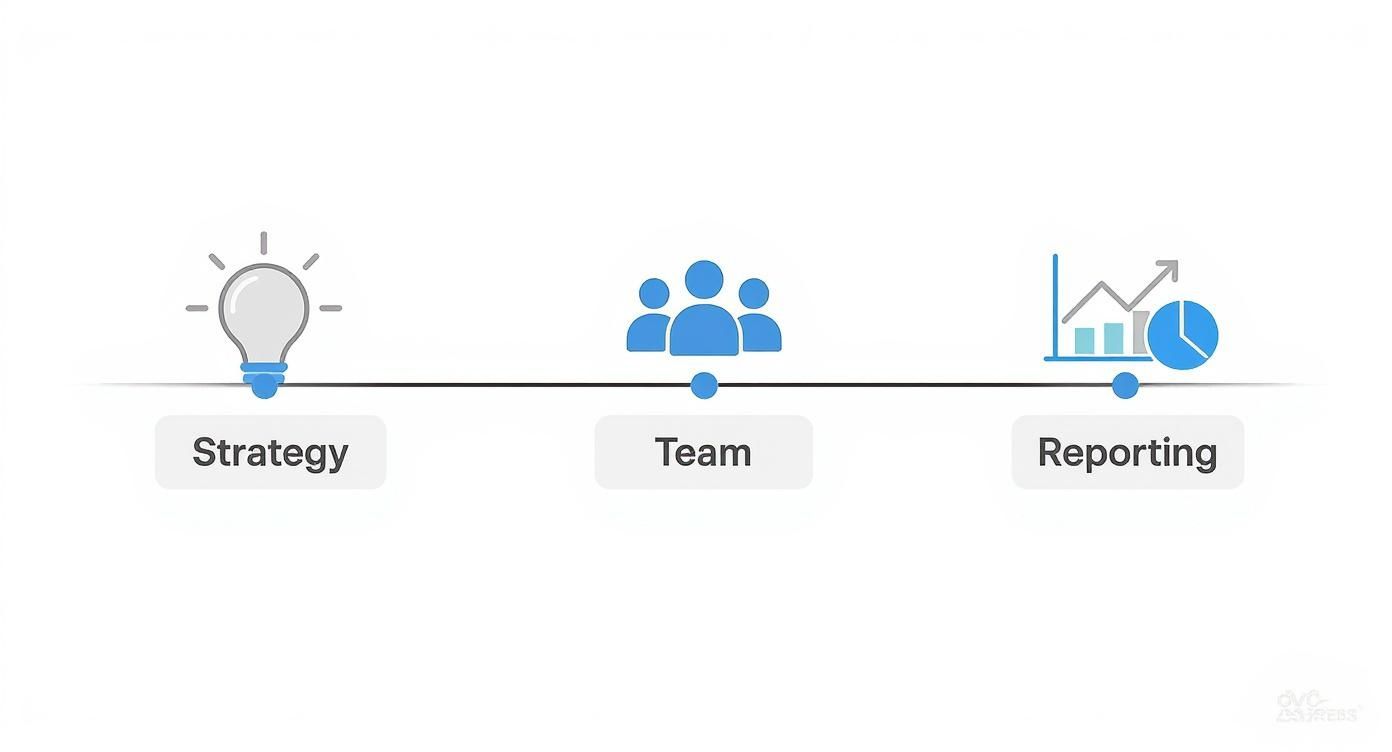
As you can see, a solid partnership starts with a strong strategic foundation, moves into collaborative execution, and is held together by transparent, regular reporting.
Month One: Deep Discovery and Technical Setup
The first 30 days are all about deep immersion and getting the technical plumbing right. Your new agency should be acting like a sponge, absorbing everything they can about your business, your customers, and the competitive landscape. This isn't just a casual chat; it's a forensic audit of your market position and digital assets.
Expect this phase to be heavy on communication. The agency will need access to your analytics, ad accounts, and CRM. They’ll also want to speak with your sales and marketing teams to really understand your ideal customer profile and the nuances of your sales cycle.
Key activities for the first 30 days usually look something like this:
- Comprehensive Kick-off Meeting: This is where you align on business goals, nail down target KPIs (like CPA or ROAS), and define the exact scope of work. No ambiguity allowed.
- Technical Audit and Implementation: This is non-negotiable. The agency will either verify or install all necessary conversion tracking pixels, set up Google Tag Manager correctly, and ensure your analytics platforms are capturing clean data. Without accurate tracking, everything else is just guesswork.
- Initial Campaign Builds: Based on their initial research, the team will start building out the foundational campaigns. This involves solid keyword research, audience segmentation, and drafting the first round of ad copy variations.
By the end of the first month, all technical tracking should be flawless, and the initial campaigns should be built out and ready for launch. You should feel confident that the agency has a firm grasp of your business fundamentals.
Month Two: Launch, Learn, and Optimise
The second month is where the rubber meets the road. With all the foundational work complete, it’s time to launch the first campaigns and start gathering real-world performance data. This phase is less about hitting massive home runs and more about rapid learning and iteration.
The data that comes in during these first few weeks is gold. It will immediately start to prove or challenge the initial strategic assumptions. A good agency won’t just "set and forget"; they'll be in the accounts daily, making small, calculated adjustments.
The focus shifts to active management and tweaking what’s live:
- Campaign Launch: The first ads go live. The agency should be glued to the screen, monitoring initial metrics like click-through rates (CTR), cost-per-click (CPC), and any early conversion signals.
- Data Analysis and First Learnings: What ad copy is resonating? Which keywords are driving qualified traffic, and which are duds? The agency should be sharing these early insights, explaining what the data means in plain English.
- Agile Optimisations: Based on the data, the agency starts making moves. This could mean pausing underperforming ad groups, shifting budget to early winners, or testing new ad creative. As your agency guides you through this process, you can get a head start on your creative strategy by learning how to create high-converting video ads to support your campaigns.
Month Three: Scaling Success and Strategic Planning
By day 90, the partnership should be hitting a solid rhythm. The learning phase of month two gives way to a more confident scaling phase. Your agency should now have enough data to identify the clear top performers and start making bigger, more decisive strategic moves.
This is also when you should start looking ahead. Your agency should be using the data from the first 90 days to co-create a strategic plan for the next quarter. It shows they're thinking beyond the immediate tasks and are invested in your long-term growth.
The final phase of onboarding is all about expansion:
- Identifying Top Performers: The agency should present a clear breakdown of which campaigns, ads, and audiences are driving the best results against your core KPIs.
- Budget Reallocation for Scale: With clear winners identified, the strategy will shift to scaling up. This means allocating more budget to proven strategies to maximise your return.
- Quarterly Business Review (QBR): A formal meeting should be on the books to review the first 90 days' performance, discuss key learnings, and present a strategic roadmap for the coming quarter.
To give you a clearer picture, here’s what a typical 30/60/90-day plan might look like in a more structured format. This table outlines the key activities and what success looks like at each stage, ensuring a smooth and effective onboarding process.
Sample 30/60/90-Day Onboarding Plan
| Phase | Key Activities | Success Metrics |
|---|---|---|
| First 30 Days: Foundation & Setup | – Kick-off meeting & goal alignment – Full access granted to all platforms – Technical audit of tracking & analytics – Initial keyword & competitor research – Build-out of foundational campaigns |
– All tracking pixels firing correctly – Shared dashboard is live and functional – Both teams are clear on primary KPIs – Initial campaigns are approved & ready for launch |
| Next 30 Days: Launch & Optimisation | – Launch initial campaigns – Daily monitoring of performance metrics – A/B testing ad copy & landing pages – Weekly performance check-in calls – Identify early winners & underperformers |
– Stable daily ad spend – Positive trends in CTR & conversion rate – First set of actionable insights shared – Budget reallocated based on initial data |
| Final 30 Days: Scaling & Strategy | – Scale budget for top-performing campaigns – Expand to new channels or audiences – Develop a strategic roadmap for the next quarter – Conduct a formal 90-day review (QBR) – Refine reporting based on client feedback |
– Clear improvement in ROAS or CPA – A documented plan for the next 90 days – Agency demonstrates a deep understanding of the business – Strong, collaborative working relationship established |
This structured approach ensures your investment starts paying dividends quickly. More importantly, it builds a strong, collaborative foundation for what will hopefully be a long and profitable partnership.
Your PPC Agency Questions, Answered
Jumping into a partnership with a PPC agency always kicks up a few questions. That's a good thing. Getting clear, honest answers is the foundation for a solid relationship built on trust and realistic expectations.
Let's tackle some of the most common questions businesses have when they're thinking about bringing in the pros.
How Long Until I See Results from PPC?
This is the million-dollar question, and the only honest answer is: it depends. You'll see initial data like clicks and impressions almost immediately, but real, meaningful business results? That takes a little more time.
As a rule of thumb, give it about three months to see significant, data-backed outcomes.
- Month 1 is all about setup, deep-dive research, and gathering that crucial initial data.
- Month 2 is where the learning begins, with the first round of optimisations based on what the data is telling us.
- Month 3 is when a skilled agency starts to scale what's working and can deliver a much more predictable return.
Anyone promising you huge profits from day one is selling snake oil. Real success in PPC is a methodical process of testing, learning, and refining.
Do I Still Need SEO If I'm Doing PPC?
Absolutely. One of the biggest mistakes we see is thinking of SEO and PPC as an either/or decision. They're two sides of the same search marketing coin, and they work best when they're working together to completely dominate the search results page.
PPC gets you immediate traffic and gives you priceless keyword data, fast. SEO builds that long-term, organic authority and trust that money can't buy. The insights from your PPC campaigns—like which keywords actually convert—can be fed directly into your SEO strategy, making it far more effective from the get-go.
Don't treat PPC and SEO as separate line items on your budget. View them as a single, unified search marketing investment. A strong presence in both the paid and organic results doesn't just double your visibility; it builds incredible brand credibility with anyone searching for what you offer.
What Is a Good Return on Ad Spend (ROAS)?
There's no magic number here. A "good" ROAS is completely relative to your industry, business model, and most importantly, your profit margins.
For an e-commerce store with healthy margins, a 4:1 ROAS (that's $4 in revenue for every $1 in ad spend) could be fantastic. But for a business with razor-thin margins, they might need to hit a 10:1 ROAS just to be profitable.
The average conversion rate on the Google Search Network hovers around 3.75%, but that figure varies wildly. The legal industry, for example, can see averages close to 7%, while e-commerce is often nearer to 2.8%. A top-tier agency won't lean on generic benchmarks; they'll work with you to define a target ROAS based on your specific financial goals.
Who Owns the PPC Account and All the Data?
This one is non-negotiable. You, the client, must always own your ad accounts and all the historical data inside them.
Any reputable agency will insist on this. They should be granted manager-level access to work within your accounts.
If an agency suggests running campaigns through their own master account, it's a massive red flag. This tactic creates vendor lock-in. If you ever decide to part ways, they walk away with your valuable campaign history, performance data, and all the learnings you paid for, forcing you to start again from scratch. Your data is one of your most valuable marketing assets—make sure your contract states, in no uncertain terms, that you retain full ownership.
How Much Communication Should I Expect from My Agency?
The right amount of communication strikes a balance between keeping you in the loop and avoiding micromanagement. A professional agency will set a clear, predictable communication rhythm right from the start.
This usually looks something like this:
- Weekly Check-ins: Often a quick email or call to update you on performance trends and any immediate tweaks being made.
- Monthly Performance Reports: A detailed report paired with a strategy call to dive into the results, what was learned, and the game plan for the next month.
- Proactive Alerts: A great partner won't wait for the monthly meeting. They'll reach out immediately if they spot any significant performance spikes, drops, or juicy opportunities.
Clear, consistent, and insightful communication is the bedrock of a successful partnership with any of the top PPC marketing agencies.
Ready to stop asking questions and start getting results? Click Click Bang Bang offers precision-driven PPC campaigns with transparent reporting and a 30-day risk-free trial. See how our data-focused strategies can grow your business by visiting us at https://clickclickbangbang.com.au.
Read NeXt
Or Read Our Latest
- Manual vs Automated Bidding for PPC Success
- Conversion Tracking Setup: A Complete AU Guide
- Instagram Advertising Australia: Complete 2026 Guide
- Pay Per Click: A Beginner’s Guide for Australian Marketers
- Display Advertising on Google: The Complete Australian Guide
- Stakeholder Communication Plan How to Build One That Works
Click. CLick. Subscribe.
Get our best PPC insights, industry updates, and power moves delivered straight to your inbox. No fluff, just high-caliber strategies that actually work.
Don’t Leave Just Yet
Try Us For 30-Days,
Risk Free!!
We guarantee that you’ll love our work within the first 30 days, if not you’ll get your money back.
What have you got to lose?