

adwords management service: Maximise ROI with expert PPC
Last Updated

So, what exactly is an AdWords management service? At its heart, it’s a team of specialists who take the controls of your Google Ads account to get you the best possible results for your money. Instead of trying to master the incredibly complex world of Google Ads yourself, you hand the keys over to professionals who live and breathe this stuff every day. Their job is simple: turn your ad spend into profitable growth.
What an AdWords Management Service Actually Does
Think of it like hiring a professional fund manager, but for your advertising budget. You wouldn't be expected to expertly navigate the stock market without years of experience, and the same logic applies to Google Ads. It’s a massive, ever-changing ecosystem where tiny mistakes can be incredibly costly, and expert insights can lead to huge wins.
A proper management service goes way beyond just launching a few ads and hoping for the best. It's a continuous cycle of strategy, execution, and relentless refinement, all designed to hit specific business goals. Their core function is to manage every single part of your Google Ads campaigns to make sure your investment is generating the highest possible return. Put simply, they make your advertising dollars work smarter, not just harder.
The Three Pillars of Professional Management
The work of a dedicated service really breaks down into three key areas. Each one is critical for building a successful advertising presence that lasts.
- Strategic Planning: This is the foundation. Before a single dollar is spent, they need to deeply understand your business goals, pinpoint your ideal customer, and see what your competitors are up to. This all feeds into a clear roadmap for success.
- Active Optimisation: This is the daily grind. It involves managing keyword bids, constantly testing different ad copy and images, refining who sees your ads, and making non-stop adjustments based on how things are performing in real-time.
- Transparent Reporting: This is all about accountability. A good service provides clear, easy-to-digest reports that show you exactly how your campaigns are performing against the metrics that matter, like conversions and return on ad spend (ROAS).
At its core, an AdWords management service transforms your advertising from a speculative expense into a predictable and scalable revenue driver. It replaces guesswork with a data-driven process aimed at one thing: growth.
This professional approach has become absolutely vital for Australian businesses. The local Google Ads management scene has seen explosive growth, which really shows how effective it is. To put it in perspective, back in 2016, only 26% of Australian SMBs were running active PPC campaigns. That number is projected to jump to a staggering 65% by 2025—that's almost a threefold increase in under a decade. You can explore more data on this trend and its impact on Australian businesses to see just how critical professional management has become. This shift highlights a clear message: to compete effectively today, you need an expert in your corner.
The Engine Room of a Professional Google Ads Service
Think of a professional Google Ads management service like the engine room of a high-performance vehicle. It’s not just one single part that delivers speed and power, but a whole system of interconnected components working in perfect harmony. Each element plays a distinct and crucial role, from the initial diagnostic checks to the final acceleration towards your business goals.
So, let's pop the bonnet and look at the core activities that form the engine of a successful campaign. These are the non-negotiable, day-in-day-out tasks that separate a thriving advertising strategy from one that just burns through your cash. Understanding what’s going on in here helps you see the true value an expert team brings to the table.
This diagram shows how the core functions of a Google Ads management service—Strategy, Optimisation, and Reporting—all work together as a continuous loop of improvement.
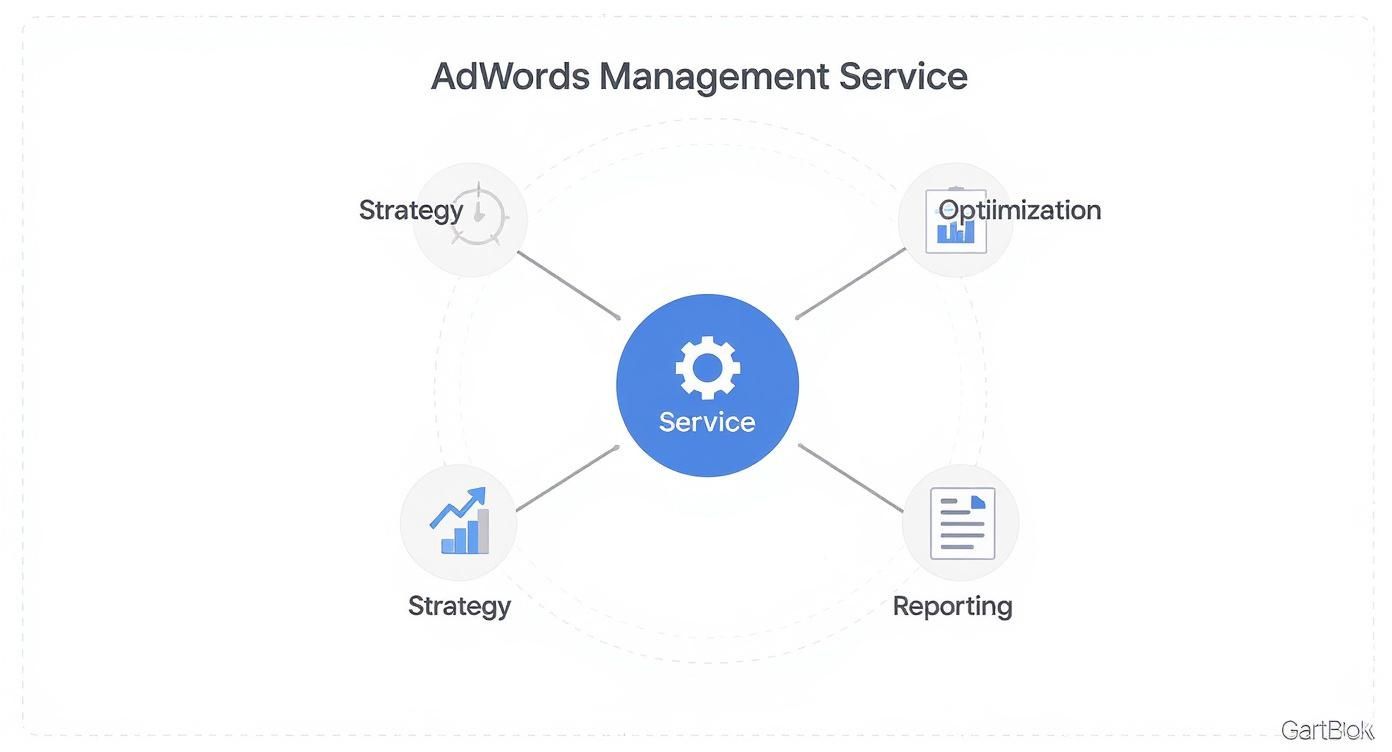
As you can see, strategy provides the direction, optimisation drives the performance, and reporting delivers the accountability. Now, let's break down the key activities that make it all happen.
To give you a clearer picture, here’s a quick breakdown of the key activities you should expect from any managed campaign, split between the initial setup and ongoing work.
Key Activities in a Managed Google Ads Campaign
| Phase | Core Activity | Business Impact |
|---|---|---|
| Initial Setup | Comprehensive Account Audit | Identifies wasted spend and uncovers hidden opportunities in existing campaigns. |
| Initial Setup | Deep Keyword Research | Targets high-intent customers, avoiding tyre-kickers and saving budget. |
| Initial Setup | Ad Creative & Copywriting | Grabs attention, communicates value, and drives higher click-through rates. |
| Initial Setup | Landing Page Review | Ensures the traffic you pay for has the best possible chance of converting. |
| Ongoing Optimisation | Advanced Bid Management | Pays the right price per click to maximise Return On Ad Spend (ROAS). |
| Ongoing Optimisation | A/B Testing of Ads & Pages | Continuously improves campaign performance through data-driven experiments. |
| Ongoing Optimisation | Negative Keyword Refinement | Stops ads showing for irrelevant searches, plugging budget leaks. |
| Ongoing Optimisation | Performance Reporting | Provides clear insights into what's working and holds the service accountable. |
This table illustrates that a managed service isn't a "set and forget" deal. It's a dynamic process where the initial groundwork paves the way for continuous, intelligent adjustments that drive real business growth.
Comprehensive Account Audits
Before a single new ad is launched, any reputable service starts with a deep diagnostic check. A thorough account audit involves a meticulous review of your existing or past Google Ads campaigns to pinpoint strengths, weaknesses, and untapped opportunities. It's like a master mechanic checking every wire and hose before tuning the engine.
This process uncovers critical issues like wasted ad spend on irrelevant keywords, a poor ad group structure that’s tanking your Quality Scores, or conversion tracking errors that feed you misleading data. The findings from this audit create the baseline for all future work, making sure the new strategy is built on solid ground.
Deep Keyword Research and Strategy
Keywords are the very fuel for your advertising engine. Getting them right is the difference between reaching genuinely interested customers and attracting casual browsers with no intention of ever buying. An expert service doesn't just skim the surface by picking a few obvious terms; they conduct exhaustive research.
This involves:
- Identifying High-Intent Keywords: Finding the specific phrases people type when they're ready to make a purchase or enquiry. These are the money terms.
- Analysing Competitor Keywords: Understanding what terms your rivals are bidding on and, more importantly, finding the gaps you can exploit.
- Developing Negative Keyword Lists: Building extensive lists of terms to exclude. This stops your ads from showing up for irrelevant searches and saves you a fortune. For example, a luxury furniture store would add "free" and "cheap" as negative keywords to filter out the wrong audience.
A robust keyword strategy isn't just about finding what to target; it's equally about defining what not to target. This precision is where professional management delivers immediate cost savings and improved lead quality.
This strategic approach ensures your budget is channelled directly towards the audience most likely to convert, maximising your advertising efficiency from day one.
Persuasive Ad Copywriting and Creative Development
Once you’ve got the right keywords, you need ads that actually grab attention and compel people to click. Professional ad copywriting is a perfect blend of art and science, focused on creating messages that resonate deeply with your target audience while navigating Google's strict guidelines.
A skilled copywriter crafts headlines and descriptions that shout your unique selling proposition (USP), build trust, and include a strong call-to-action (CTA). But they don't stop there. A good agency will constantly A/B test different ad variations—tweaking headlines, descriptions, and CTAs—to find the winning combinations that produce the highest click-through rates (CTR) and conversions.
Advanced Bid Management
Bid management is the art of paying the right price for each click. A Google Ads management service uses sophisticated strategies to optimise your bids, ensuring you get the most valuable ad placements without overpaying. This goes far beyond just setting a maximum cost-per-click and hoping for the best.
It involves adjusting bids based on a huge range of factors, such as:
- Device type (mobile vs. desktop)
- Time of day or day of the week
- Geographic location
- Audience demographics
By using a combination of automated bidding strategies and sharp manual oversight, an agency can dynamically adjust bids in real-time. This ensures your budget is allocated to the clicks most likely to result in a sale, dramatically improving your overall return on ad spend (ROAS).
Landing Page Optimisation
Finally, the journey doesn't end when someone clicks your ad. The landing page—the webpage they arrive on—is where the magic happens. A brilliant ad pointing to a confusing, clunky, or slow-loading page is the perfect recipe for wasted ad spend. A key part of any professional service is making sure this final, critical step is flawless.
This often involves providing data-backed recommendations to improve your landing page's design, messaging, and user experience. Simple changes, like clarifying a headline, simplifying a contact form, or improving mobile responsiveness, can lead to a massive uplift in your conversion rates. This critical link ensures the traffic you paid for actually turns into tangible business results.
How Australian Agencies Price Their Services
Figuring out how a Google Ads management service is going to charge you is one of the most important parts of picking the right partner. In Australia, agencies generally stick to a few core pricing models, and each comes with its own pros and cons.
Getting your head around how they work is the key to finding a structure that fits your budget, your business goals, and how much risk you’re comfortable with. Let's break down these common setups so you can walk into any agency conversation feeling like you know the score.
Flat Monthly Retainer Fee
This is probably the most straightforward and common model you’ll come across. With a flat monthly retainer, you pay the agency a fixed fee every single month. It doesn't matter what your ad spend is or how the campaigns are performing that month – the price is the price.
This model is all about paying for the agency's time, their expertise, and the consistent effort needed to keep your account running smoothly. It’s wonderfully predictable, which makes budgeting a breeze. The fee itself is usually based on how complex your account is, the scope of work involved, and the level of service you need.
A flat retainer is often a perfect fit for businesses that need stable, predictable marketing expenses. It separates the management fee from your ad spend, which means when an agency suggests you increase your budget, it's based on a real opportunity, not on boosting their own pay cheque.
Percentage of Ad Spend
Another very popular model is charging a percentage of your total monthly ad spend. This fee typically falls somewhere between 10% and 20%. Often, the percentage gets smaller as your ad spend goes up. For instance, an agency might charge 15% on the first $10,000 of spend, then drop to 10% for anything above that.
The appeal here is that the fee scales with your marketing efforts. As you invest more, the agency dedicates more resources to your account. The main thing to watch out for is making sure the agency stays focused on driving profitable results, not just encouraging you to spend more to inflate their fee.
Performance-Based Pricing
This one is less common, but it can be a seriously attractive option. In a performance-based model, the agency's fee is tied directly to the results they get for you. That could be the number of leads, sales, or hitting a specific Cost Per Acquisition (CPA) target.
You might agree to pay a certain amount for every qualified lead the campaigns generate. This structure creates a true partnership where the agency is directly incentivised to deliver tangible business outcomes. Your goals are perfectly aligned – they only make good money when you do. For a deeper look at these structures, check out our guide on common PPC pricing models.
Hybrid and Custom Models
These days, many Aussie agencies are getting creative and offering hybrid models that mix and match elements from the structures above. A popular combo is a base flat retainer plus a smaller performance bonus for smashing specific targets. This gives the agency some stable income to work with while still motivating them to push for those standout results. To get a broader sense of how different providers price their offerings, it's also worth exploring resources on various pricing models for ad management tools and services.
It’s also crucial to understand what's happening with costs in the Australian market. Recent data shows that Google Ads costs have climbed, with the average cost-per-click (CPC) jumping by 12.88% year-over-year. The good news? Australian CPCs, averaging around $4.42, are still about 5% cheaper than in the US.
Of course, costs swing wildly by industry—from a hefty $8.58 for legal services to just $1.82 for e-commerce. But the average return on ad spend (ROAS) sits at a healthy 200%, meaning businesses are typically making $2 for every $1 they spend. A well-managed campaign is clearly still a powerful investment, even as costs rise.
Measuring What Matters for Campaign Success

It’s easy to get excited by big numbers like clicks and impressions on a report. But honestly? They're often just vanity metrics. They show activity, not achievement.
True campaign success isn’t about how many people saw your ad, but how many valuable actions they took because of it. Any professional AdWords management service worth its salt knows this and zeroes in on the Key Performance Indicators (KPIs) that actually drive your bottom line.
Think of it this way: clicks are like people wandering into your shop. Conversions are the ones who pull out their wallets and buy something. An expert service isn't trying to fill your store with window shoppers; they're working to attract qualified buyers ready to make a purchase.
This pivot from tracking activity to measuring real outcomes is what separates a professional strategy from a DIY effort. It’s about asking the right questions—not just "how many clicks did we get?" but "how much did it cost us to land a paying customer?" and "what was our total return on this investment?"
The Core Metrics That Define Profitability
To get a crystal-clear picture of your campaign's health, a skilled agency tracks a handful of crucial KPIs. These metrics cut through the noise and tell the real story of your advertising performance.
-
Conversion Rate: This is the percentage of clicks that turn into something you want—a sale, a form submission, a phone call. A high conversion rate is a great sign that your ads and landing pages are perfectly in sync with what your audience is looking for.
-
Cost Per Acquisition (CPA): This number tells you exactly how much you're paying to get one new customer or lead. Knowing your CPA is fundamental to making sure your campaigns are profitable and can be scaled up.
-
Return on Ad Spend (ROAS): This is the ultimate measure of success. It calculates the total revenue you've generated for every single dollar you've spent on advertising. A 400% ROAS means you made $4 for every $1 you invested.
Getting your head around these core metrics is the first step. For a much deeper dive, you can learn more about how to measure advertising effectiveness in our in-depth guide. This knowledge will empower you to read reports with confidence and have more strategic chats with your agency.
From Data Points to Strategic Decisions
A top-tier AdWords management service doesn’t just report these numbers; they use them to actively steer your campaigns toward better profitability. If the CPA creeps too high, they dig into the data to figure out why. Are we targeting the wrong keywords? Is the ad copy falling flat? Is the landing page making it hard for people to convert?
This diagnostic approach turns raw data into actionable insights. For example, if one ad campaign is crushing it with a high conversion rate, the agency will analyse its components—the headline, the offer, the audience targeting—and apply those winning elements across other campaigns. To really squeeze the most out of your budget, an expert service might also use top video ad optimization tools to boost ROAS, constantly refining campaigns based on what the performance data is telling them.
A great performance report isn't just a summary of what happened. It's a roadmap for future success. It should tell a clear story, highlighting what worked, what didn’t, and outlining the strategic tweaks planned for the next period.
This continuous cycle of analysis, testing, and refinement is where professional management really pays off, turning your ad budget into a highly efficient growth engine.
What to Expect From a High-Quality Report
Australian Google Ads management agencies have become proven performance drivers for local businesses. In fact, leading specialists have seen clients achieve an average 35% lift in conversion rates within just 90 days of professional management. While around 78.2% of advertisers still struggle to hit profitability on their own, a staggering 95% of Australian businesses that invest in proper management report a positive ROI.
A high-quality report should make this kind of performance easy to see and understand. It needs to be clear, concise, and laser-focused on your business goals.
Here’s what you should always look for:
- An Executive Summary: A quick, top-level overview of how the campaigns performed against your main objectives.
- KPI Dashboard: A visual snapshot of your most important metrics like CPA, ROAS, and Conversion Rate.
- Detailed Breakdowns: Performance data segmented by campaign, ad group, and even individual keywords so you can see what’s really working.
- Actionable Insights and Recommendations: Clear commentary explaining what the data means and outlining the next steps for optimisation.
This level of transparent reporting makes sure you're not just a passenger on this journey, but a well-informed partner in your own success.
Choosing the Right Australian Agency Partner

Picking an AdWords management service is one of the most important marketing decisions you’ll make. This isn't just about hiring a supplier; you're choosing a partner who will become a key driver of your business growth.
Get it right, and you'll see incredible results. Get it wrong, and you can burn through your budget and stall your progress fast. The trick is to go in with a clear strategy and a healthy dose of due diligence. You need to look past the slick sales pitch and really dig into what a potential agency is made of. This means asking the right questions, seeing hard proof of past success, and making sure their whole approach clicks with your business goals.
Questions That Reveal True Expertise
When you're interviewing agencies, you need to push past the surface-level stuff. Your real goal is to get a feel for their process, their experience, and how they actually define success. A great agency will welcome these tough questions and give you clear, confident answers.
Here are a few essential questions to have locked and loaded:
-
"Can you show us case studies from businesses in our industry?" Experience in your specific sector is a massive advantage. An agency that knows your market already gets your customers, your competitors, and the unique challenges you’re up against.
-
"Who will be my day-to-day contact, and what is their experience?" This is crucial. You want to know if you'll be working directly with a seasoned expert or being handed off to a junior account manager. Direct access to an experienced strategist is invaluable for making smart, agile decisions.
-
"How do you approach communication and reporting?" You're looking for a clear, proactive communication schedule. Will you get weekly updates? A detailed monthly report? Access to a live dashboard? Vague answers are a big red flag.
-
"What is your process for the first 90 days?" A professional service will have a structured plan for onboarding and initial optimisation. They should be able to walk you through exactly what they’ll do in the first three months to get your campaigns firing on all cylinders.
Spotting the Red Flags
Knowing what to look for is only half the battle; knowing what to avoid is just as important. Some agencies make bold promises they simply can't keep. Recognising these warning signs early can save you a world of time, money, and frustration.
Be wary of any agency that guarantees specific results, like a #1 ranking or a 50% cost reduction overnight. The Google Ads auction is a dynamic and unpredictable beast; absolute guarantees are completely unrealistic and a sure sign of inexperience or dishonesty.
Here are a few common red flags to watch for:
- Lack of Transparency: If they're secretive about their methods or won't grant you full access to your own Google Ads account, walk away. It's your account, your data.
- "Secret Sauce" Claims: There are no secret tricks in Google Ads. There's only proven strategy, hard work, and continuous, rigorous testing.
- Long-Term Lock-In Contracts: Confident agencies don’t need to trap clients. Look for flexible, month-to-month agreements that motivate them to earn your business every single day.
For a comprehensive list of vetted providers, our guide to the best AdWords management companies is an excellent place to start your research.
The Agency Vetting Checklist
To make the comparison process a bit more objective, it helps to use a structured checklist. This approach helps you evaluate each potential partner against the same critical criteria, taking emotion out of the equation and focusing on what truly matters for your business.
Agency Vetting Checklist
| Evaluation Criterion | What to Look For | Red Flags to Avoid |
|---|---|---|
| Industry Experience | Demonstrable success with businesses similar to yours. | Generic case studies that aren't relevant to your market. |
| Communication | A clear, proactive reporting schedule and a dedicated point of contact. | Vague promises about "staying in touch" or infrequent updates. |
| Transparency | Full ownership and admin-level access to your Google Ads account. | Refusal to grant access or hiding key performance data. |
| Strategy | A customised plan based on your specific business goals. | A cookie-cutter, one-size-fits-all approach for every client. |
| Contract Terms | Flexible, month-to-month agreements with a clear cancellation policy. | Long-term contracts with hefty penalties for early termination. |
By using this structured approach, you can confidently vet potential partners and select an AdWords management service that is genuinely equipped to help you smash your goals. It’s all about building a strong foundation for a profitable and long-lasting collaboration.
A Few Common Questions
Stepping into a partnership with an AdWords management service is a big move, and it's smart to have questions before you commit. To help clear up any final uncertainties, we've put together answers to some of the most common queries we hear from Aussie business owners.
How Quickly Can I Actually Expect to See Results?
This is always the first question, and the honest answer is: it varies. While you can start getting traffic and clicks almost immediately after your campaigns go live, meaningful business results—the stuff that really matters—take a bit longer.
Think of it less like flipping a switch and more like planting a garden. It needs time to grow and mature.
Generally, the first 30 days are all about gathering data, learning what works for your specific audience, and making those crucial initial optimisations. By the 60 to 90-day mark, you should start seeing a clear, positive trend in key metrics like your lead volume, cost per acquisition (CPA), and return on ad spend (ROAS). This is when all that strategic groundwork really begins to pay off.
What Level of Involvement Is Needed from Me?
The whole point of hiring an AdWords management service is to free up your time, but your involvement is still absolutely crucial for success—especially at the start. No one knows your customers, products, and industry better than you do. That expertise is invaluable.
Here’s what you can typically expect:
- Initial Onboarding: This is a deep-dive session where you’ll share your business goals, target audience insights, and what makes you different from the competition.
- Ongoing Collaboration: You'll be needed for quick approvals on things like ad copy or campaign direction. We'll also have regular check-in meetings (often monthly) to review performance and talk strategy.
- Feedback Loop: This one is vital. Letting your agency know which leads are converting into actual customers helps them refine targeting and attract more of the right people.
Beyond that, the agency handles the day-to-day heavy lifting.
Your role shifts from being the hands-on campaign operator to the strategic business advisor. You provide the essential business context, and the agency translates that into a high-performing advertising strategy.
What Does the Transition Process Look Like if I'm Switching?
Moving over from a DIY approach or another provider should be a smooth, organised process. A professional agency will manage the entire transition to minimise any disruption and make sure no valuable data gets lost.
The typical steps look something like this:
- Initial Account Access: You grant the new agency the necessary permissions to your existing Google Ads account. They will never ask for your personal login details.
- Comprehensive Audit: The team dives deep into your current setup to identify what’s working, what isn’t, and where the immediate opportunities for improvement lie.
- Strategy Presentation: Based on the audit and your goals, they’ll present a clear strategic plan for the first 90 days.
- Campaign Restructure: The agency will pause any underperforming campaigns and start launching newly structured ones based on best practices, all without interrupting your lead flow.
This structured handover ensures a seamless transition, allowing your campaigns to be optimised and improved from day one without missing a beat.
Ready to see what a professional, data-driven approach can do for your business? At Click Click Bang Bang, we specialise in creating high-performance PPC campaigns that deliver real, measurable results. Start your risk-free trial today and let's build your growth strategy together.
Read NeXt
Or Read Our Latest
- Manual vs Automated Bidding for PPC Success
- Conversion Tracking Setup: A Complete AU Guide
- Instagram Advertising Australia: Complete 2026 Guide
- Pay Per Click: A Beginner’s Guide for Australian Marketers
- Display Advertising on Google: The Complete Australian Guide
- Stakeholder Communication Plan How to Build One That Works
Click. CLick. Subscribe.
Get our best PPC insights, industry updates, and power moves delivered straight to your inbox. No fluff, just high-caliber strategies that actually work.
Don’t Leave Just Yet
Try Us For 30-Days,
Risk Free!!
We guarantee that you’ll love our work within the first 30 days, if not you’ll get your money back.
What have you got to lose?