

How to Increase Online Sales with Proven Tactics
Last Updated

If you want to boost your online sales, you need a solid strategy that polishes every single customer touchpoint, from the moment they click an ad to the final checkout screen. The core formula is pretty straightforward: get high-intent traffic to your site, optimise that site for conversions, and then use data to make smarter decisions. It’s all about turning casual window shoppers into loyal, repeat customers.
The New Reality of Australian eCommerce
The way Australians shop online has completely changed. We're not just seeing more growth post-pandemic; we're seeing a fundamental shift in how people buy. The days of focusing only on big, one-off purchases are over. Today's market is all about more frequent, smaller transactions.
And the data backs this up. The Australian online retail scene has exploded, now accounting for 16.8% of all retail spending—that's a massive 68% jump from before the pandemic. With almost 9.8 million households now shopping online, the digital customer base isn't just huge; it's incredibly active.
But here’s the kicker: the average basket size has dipped slightly. This points directly to that trend of smaller, more regular buys, which makes earning customer loyalty more important than ever.
A Framework for Sustainable Growth
To navigate this new environment, you need a clear, actionable plan. A huge part of this is getting your logistics sorted. In this new reality of smaller, more frequent orders, something as simple as finding a cheap courier in Australia can give you a serious competitive edge by protecting your profit margins.
This visual roadmap breaks down the four essential pillars for growing your online sales.
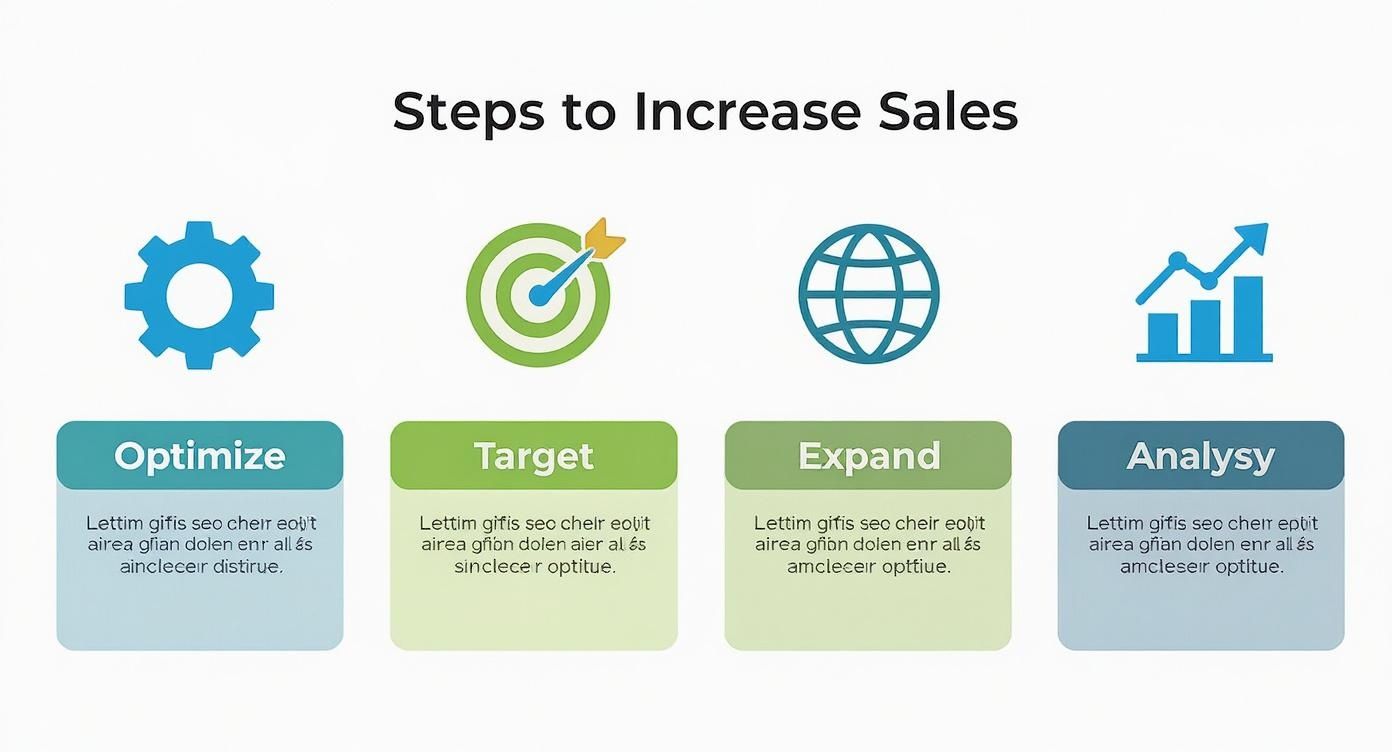
As you can see, it’s a continuous cycle. You have to consistently fine-tune your website and ads, target the right people with laser precision, show up on all the channels they use, and then analyse your performance to fuel the next round of improvements.
Success is no longer just about having a great product; it’s about mastering the entire digital customer journey. Your ability to adapt to these new shopping habits will determine your growth trajectory in today's competitive market.
To thrive, you need a structured approach that hits every stage. We’ve summarised the key strategies into a quick-reference table to give you a bird's-eye view of what's involved.
Quick Guide to Boosting Online Sales
| Strategy Area | Key Focus | Primary Goal |
|---|---|---|
| Website Optimisation | Create a frictionless checkout and seamless mobile experience. | Maximise conversion rates on existing traffic. |
| Targeted Traffic | Use paid campaigns to attract customers with clear buyer intent. | Improve return on ad spend (ROAS). |
| Channel Expansion | Leverage popular marketplaces and social commerce. | Meet customers where they already are. |
| Data Analysis | Track meaningful KPIs to make informed decisions. | Achieve sustainable, data-driven growth. |
Each of these areas is a critical piece of the puzzle. Let’s break down the core strategies you need to implement to make it happen:
- Website Optimisation: This is all about making the buying process as smooth as possible. Think frictionless checkouts and a mobile experience that just works.
- Targeted Traffic: You'll use paid campaigns to attract customers who are actively looking to buy, which is the key to a healthy return on your ad spend.
- Channel Expansion: Don't just wait for customers to find you. Go where they are by using popular marketplaces and tapping into social commerce.
- Data Analysis: Stop guessing. Start tracking the right KPIs to make smart, informed decisions that lead to real, sustainable growth.
Turn Your Website into a Sales Engine
Think of your website as more than just a digital brochure. It’s your hardest-working salesperson, clocking in 24/7. To seriously increase online sales, you need to treat it like a well-oiled machine, engineered for one single purpose: turning visitors into customers. This goes way beyond slick aesthetics; it’s about getting under the hood to fine-tune the mechanics of what makes people actually click "buy."
A great place to start is by mapping out the typical customer journey on your site. Where do people land first? Which pages do they browse before they buy? And, most importantly, where are they dropping off? Pinpointing these friction points is the first real step to plugging a leaky sales funnel.
More often than not, the biggest leaks spring up right at the very end. A clunky, confusing, or painfully slow checkout process is a guaranteed conversion killer. Every unnecessary form field, every unexpected shipping cost, and every second of loading lag gives a potential customer a perfectly good reason to bail.
Simplify the Path to Purchase
Making it ridiculously easy for customers to buy from you is non-negotiable. Your website navigation has to be intuitive, guiding users effortlessly from discovery to decision. If someone has to think too hard to find what they're looking for, you’ve probably already lost them.
This principle is even more critical when it comes to the mobile experience. With a huge chunk of your traffic coming from smartphones, a site that isn’t optimised for smaller screens is actively turning away money. You need to test every single button, form, and page on mobile to make sure the experience is completely seamless.
Here are a few quick wins to streamline the user journey:
- Implement a prominent search bar with auto-complete functionality to help users find products faster.
- Use high-quality product images and videos that showcase your items from every conceivable angle.
- Simplify your navigation menu with clear, logical categories that mirror how your customers actually shop.
By dialling in on these elements, you’re removing roadblocks and paving a smoother path to conversion. For a deeper dive, our landing page optimization checklist offers a detailed guide to refining your most critical pages: https://clickclickbangbang.com.au/landing-page-optimization-checklist/
Build Trust to Drive Conversions
In eCommerce, trust is the ultimate currency. Without it, even the most interested shopper will hesitate before handing over their credit card details. This is where social proof becomes your most powerful asset.
Displaying authentic customer reviews, testimonials, and user-generated content (like photos of customers loving your products) builds instant credibility. It signals to new visitors that real people have bought from you and had a great experience.
Your goal is to make the decision to buy feel both safe and smart. By showcasing genuine feedback and providing a flawless user experience, you build the confidence needed to turn a hesitant visitor into a loyal customer.
The importance of a seamless digital experience is backed by broader market trends. Australian online sales are on a steady climb, with a projected industry revenue of $64.9 billion in 2025. This growth is directly fuelled by retailers improving their website design, navigation, and payment processes—all of which build consumer confidence in eCommerce.
And remember, a high-performing sales engine also relies on exceptional support after the sale. To build loyalty and encourage repeat business, it's crucial to follow best practices in customer service.
Drive High-Intent Traffic with Smart Ad Campaigns
Getting more website visitors is easy. Getting the right visitors—the ones actually ready to buy—is a completely different game. If you really want to increase online sales, you need to stop chasing sheer traffic volume and start focusing on traffic quality. This means building smart, targeted ad campaigns that put your products right in front of customers who are itching to make a purchase.
Pouring money into ads without a solid strategy is like casting a massive net into the ocean hoping to catch a marlin. Sure, you’ll catch something, but most of it won’t be what you’re after. A much better approach is to use data to find exactly where your ideal customers are swimming and use the perfect bait to reel them in. This is the absolute core of profitable paid advertising, whether you're on Google or Instagram.
Uncover Keywords That Actually Convert
Effective keyword research is all about getting inside the heads of your customers. You need to understand the exact phrases they’re typing into Google when they’re looking to buy something, not just when they’re casually browsing. It’s a subtle but crucial difference.
Think about the gap between a broad search like "running shoes" and a high-intent, long-tail keyword like "best trail running shoes for wide feet Australia". The first is just research; the second is a clear signal from someone who's got their wallet out. Focusing your ad spend on these specific, purchase-driven keywords is the first real step toward a higher return.
- Go Beyond the Obvious: Use keyword research tools to dig up long-tail keywords. They often have less competition and much higher conversion potential.
- Spy on Your Competitors: See what terms your competitors are bidding on. This can be a goldmine for spotting opportunities you might have missed.
- Think Like Your Customer: Brainstorm the problems your product solves. Instead of just targeting "handbags," try something like "durable leather work tote with laptop compartment." See the difference?
Target Your Audience with Precision
Once you know what people are searching for, the next job is to make sure you're targeting the right individuals. Modern ad platforms give you incredibly powerful tools to slice and dice your audience based on their real interests and past behaviours, making sure your message actually resonates.
Forget about broad demographics like "women aged 25-40". These days, you can get way more specific. For example, a business selling premium coffee beans could target users who have recently browsed websites for home espresso machines, follow specialty coffee roasters on Instagram, and live in metro areas. For an even deeper dive into this, our guide on how to optimise Google Ads gets right into advanced targeting strategies.
The goal is to move from interruption to relevance. When your ad feels less like a sales pitch and more like a helpful solution to a specific problem, you’ve hit the sweet spot for driving conversions.
Align Your Ad Copy with Your Landing Page
Here's a classic mistake that absolutely kills conversion rates: a disconnect between the ad and the landing page. It happens all the time. If your ad screams "50% Off Flash Sale on Winter Coats," the landing page better reinforce that exact offer, front and centre.
Any inconsistency, no matter how small, creates confusion and erodes trust. It’s the fastest way to get someone to hit the back button. Your ad copy and landing page need to work together as a seamless one-two punch. The ad makes a compelling promise, and the landing page delivers on it instantly. This alignment is what turns expensive clicks into profitable revenue.
Sell Where Your Customers Already Are
https://www.youtube.com/embed/xDie2m4OR4Q
Here’s a powerful way to boost your online sales: stop trying so hard to force customers to find you. Instead, go meet them where they already are.
It’s easy to get tunnel vision and focus solely on driving traffic to your own website. But by expanding into established marketplaces and social media platforms, you can open up massive new revenue streams. Think of it as casting a wider net. You're putting your products right in front of built-in audiences who are already in a buying mindset, piggybacking on the trust and traffic these giants have already built.
Tap into Major Online Marketplaces
For most Australian businesses, ignoring marketplaces like Amazon and eBay just isn't an option anymore. They've become the default search engines for products. If you're not there, you're effectively invisible to a huge slice of active shoppers.
The numbers don't lie. In Australia, a staggering 54% of online shoppers bought something from Amazon in the past year, with eBay not far behind at 41%. This is all part of a bigger, permanent shift in consumer behaviour where convenience is king. You can dig deeper into these trends in this report on Australian online shopping habits.
Of course, there are trade-offs. You'll be paying commission fees on every sale and have less control over your branding than you do on your own site. But the sheer volume of high-intent traffic can easily make it a worthwhile investment, especially if you're looking to scale up quickly.
The real strategic question isn't if you should be on these marketplaces, but how you can use them to complement your own direct sales channels without cannibalising your core business.
Turn Social Feeds into Sales Channels
Social commerce is another absolute game-changer. It's transformed platforms like Instagram and Facebook from simple brand awareness tools into legitimate points of sale. By setting up shops directly on these platforms, you can create a completely frictionless buying journey for your customers.
Picture this: a customer is scrolling through their feed, sees your product, taps to get the details, and buys it right there within the app. They never have to leave. That kind of immediacy is perfect for capturing impulse buys and engaging with a younger crowd that values convenience above everything else.
- Instagram Shopping: This is all about making your feed a visual storefront. Use product tags in your posts and stories so people can just tap and shop instantly.
- Facebook Shops: This lets you build a customisable online store that lives right on your Facebook Page. It’s integrated across the whole Meta ecosystem, giving your products a much wider reach.
By selling where your customers already hang out, you dramatically reduce the friction and effort it takes for them to make a purchase. This strategy doesn't replace your website; it supercharges it by creating multiple new pathways for customers to discover and buy from you, giving your potential to increase online sales a serious boost.
Use Data to Drive Your Sales Strategy
Stop guessing what works and start knowing for sure. If you want to sustainably increase online sales, you absolutely have to let data lead your decisions. Gut feelings are expensive; raw numbers, when you know how to read them, are the fastest path to profit. This isn't about getting buried in spreadsheets—it's about focusing on the metrics that actually move the needle.
Too many businesses fall into the trap of tracking "vanity metrics" like website visits or social media likes. Sure, they feel good, but they don't tell you if you're making more money. The real goal is to turn raw data into confident, strategic moves that directly boost your bottom line.
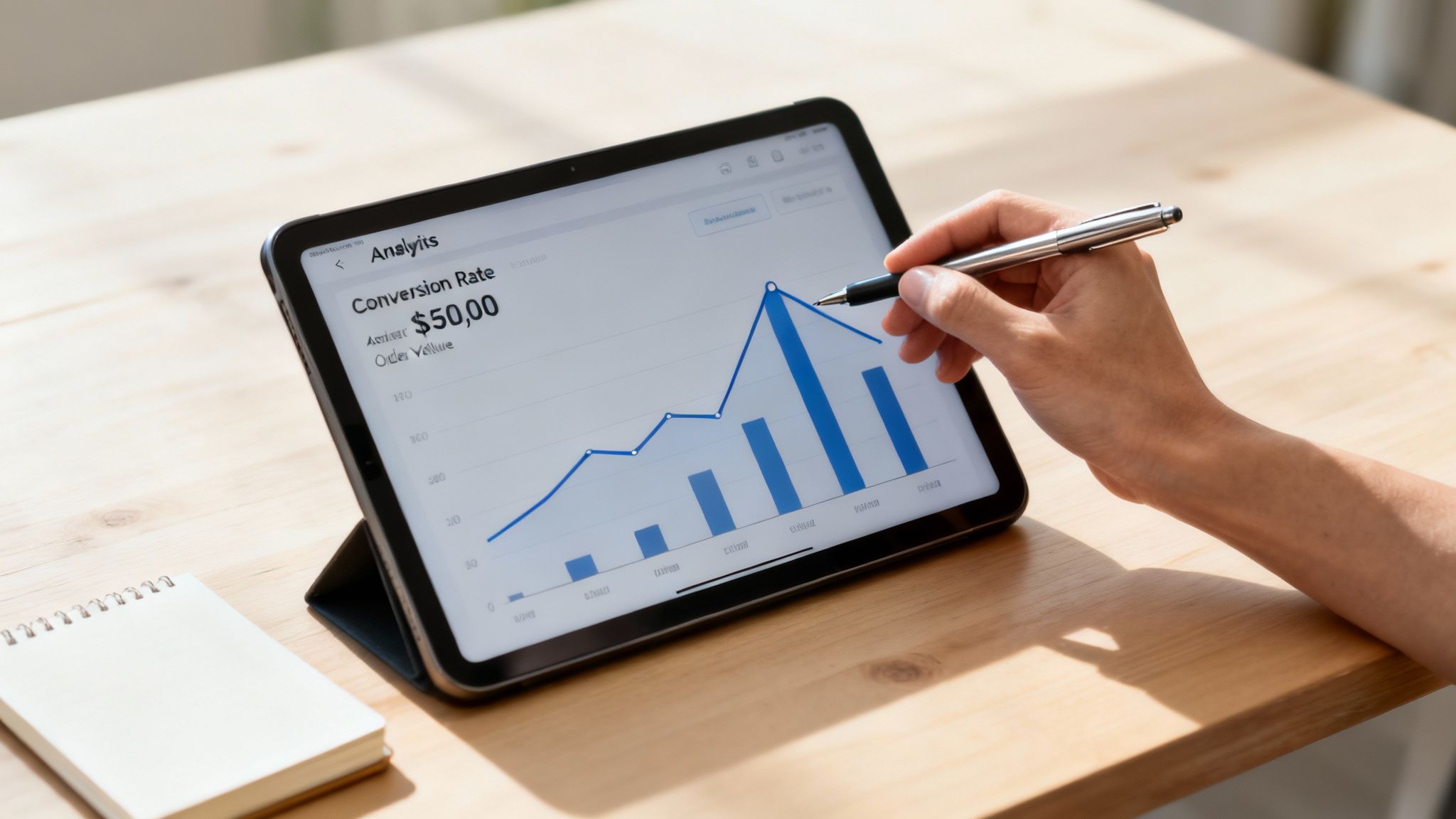
A dashboard like this one in Google Analytics 4 is your command centre. It gives you a clear snapshot of how people are interacting with your site, helping you see beyond simple traffic counts and into user behaviour—which is where the real gold is hiding.
Focus on Key Performance Indicators That Matter
To cut through the noise, you need to zero in on the Key Performance Indicators (KPIs) that have a direct line to your revenue. These are the numbers that tell the true story of your business's health.
Here are the essential KPIs you should have your eyes on:
- Conversion Rate: This is the big one—the percentage of your website visitors who actually complete a desired action, which for most of us means making a purchase. It’s the ultimate measure of how well your site turns browsers into buyers.
- Average Order Value (AOV): This metric tells you, on average, how much customers are spending each time they buy from you. Nudging this number up is one of the quickest ways to grow revenue without needing more traffic.
- Customer Lifetime Value (CLV): This is the total revenue you can realistically expect from a single customer over their entire relationship with you. A high CLV is a fantastic sign of strong customer loyalty and a solid retention strategy.
- Customer Acquisition Cost (CAC): This is simply how much it costs you, on average, to win a new customer. The game is to keep your CAC significantly lower than your CLV. That's the formula for a profitable business.
Keeping these metrics in one place is non-negotiable. For a bit of inspiration on how to structure your reporting, check out these excellent marketing KPI dashboard examples that show you how to visualise this data effectively.
By consistently monitoring these core metrics, you create a feedback loop. You stop launching campaigns and just hoping for the best. Instead, you're making calculated adjustments based on what the real-world performance data is telling you.
Turning Data into Actionable Insights
Knowing your numbers is only half the battle. The real magic happens when you use that data to answer critical questions and guide your next move.
For instance, is your cart abandonment rate alarmingly high? That could point to a clunky checkout process or sticker shock from unexpected shipping costs. Is your AOV a bit underwhelming? Maybe it's time to test out some product bundling or upselling strategies at checkout.
What if your data shows that one particular marketing channel is bringing in customers with a sky-high CLV? That’s a massive green light telling you exactly where to double down on your investment.
By adopting a data-first mindset, you shift from reactive problem-solving to proactive optimisation. You start building a more resilient, predictable, and profitable online business.
Got Questions About Boosting Your Sales?
When you're trying to grow revenue, it's easy to get bogged down. Everyone's got an opinion, but getting clear, straight answers is what actually helps you focus your efforts where they'll make a real difference. Let's tackle some of the most common questions we hear from business owners looking to ramp up their online sales.
How Can I Increase Online Sales Quickly?
For a near-immediate boost, you've got to go for the low-hanging fruit. Your best bet is to run a targeted promotion aimed squarely at your existing email list and social media followers. Think a flash sale or a compelling free shipping offer. These are people who already know and trust you, making them the most likely to jump on a good deal fast.
At the same time, you need to take a hard look at your checkout process. It's a real conversion killer. Studies show that a staggering $4 trillion in merchandise gets left in abandoned carts. You can reclaim some of that lost revenue almost overnight by simplifying this final step—get rid of unnecessary form fields and be totally transparent about shipping costs from the get-go.
What Is a Good Online Conversion Rate in Australia?
This varies a lot depending on your industry, but a typical eCommerce conversion rate in Australia usually sits somewhere between 1% and 3%. If you're consistently hitting north of that 3% mark, you're doing great.
But here’s the thing: don't get too fixated on a universal number. The most productive way to think about it is to benchmark against yourself. Focus on a strategy of continuous improvement. A/B testing your pages and constantly tweaking the user experience will deliver far more value than chasing some arbitrary industry average. A small, steady increase in your own baseline rate is the real win.
Should I Lower My Prices to Get More Sales?
Look, dropping your prices can definitely give you a short-term sales spike, but it's a dangerous game to play long-term. You can easily devalue your brand in the eyes of your customers and absolutely crush your profit margins, making sustainable growth a much harder slog.
A far more effective approach is to increase the perceived value of what you're selling.
- Bundle related products together to create a package that feels like a great deal.
- Offer exceptional customer service that turns one-time shoppers into loyal advocates.
- Provide free and fast shipping—this is a massive decision-making factor for most online shoppers.
- Clearly highlight what makes your products unique and why their quality is superior.
When you compete on the value you provide, not just the price tag, you build a stronger, more resilient brand that people are happy to pay a premium for.
What's More Important for Sales: SEO or Paid Ads?
The honest answer? They're both vital, and they work best when you use them together as part of a coordinated strategy. Think of them as two different engines powering your growth.
SEO is your long-game investment. It builds organic, high-trust traffic and cements your brand's authority over time. The return is fantastic, but it's not instant.
Paid ads, on the other hand, deliver immediate, highly targeted traffic right now. They're perfect for testing new offers, pushing seasonal sales, and getting instant feedback from the market. A balanced approach uses both to make sure you're visible everywhere, driving consistent, reliable sales from all angles.
Ready to stop guessing and start driving predictable, profitable growth? The team at Click Click Bang Bang specialises in data-driven PPC and AI-first SEO campaigns that deliver real results. Let's build a strategy that turns your ad spend into serious revenue. https://clickclickbangbang.com.au
Read NeXt
Or Read Our Latest
- Search Ads Optimisation: A Practical Guide for 2026
- Manual vs Automated Bidding for PPC Success
- Conversion Tracking Setup: A Complete AU Guide
- Instagram Advertising Australia: Complete 2026 Guide
- Pay Per Click: A Beginner’s Guide for Australian Marketers
- Display Advertising on Google: The Complete Australian Guide
Click. CLick. Subscribe.
Get our best PPC insights, industry updates, and power moves delivered straight to your inbox. No fluff, just high-caliber strategies that actually work.
Don’t Leave Just Yet
Try Us For 30-Days,
Risk Free!!
We guarantee that you’ll love our work within the first 30 days, if not you’ll get your money back.
What have you got to lose?