

Search Engine Marketing vs SEO a 2026 AU Business Guide
Last Updated
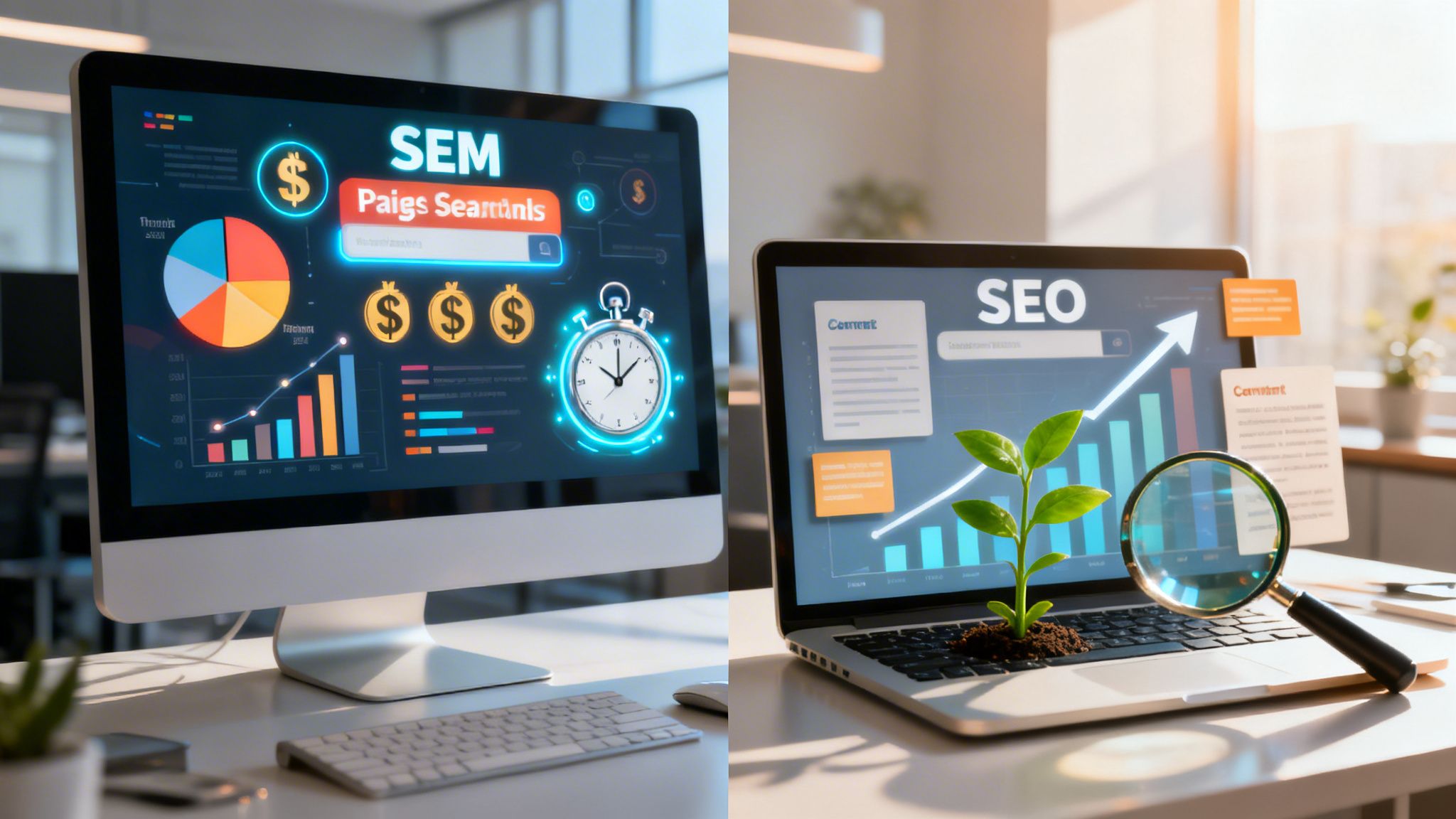
Let's get one of the most common points of confusion in digital marketing out of the way first. When people talk about SEM vs. SEO, what they’re really comparing is paid search ads against organic search results.
Technically, Search Engine Marketing (SEM) is the umbrella term for everything you do on a search engine, both paid and organic. But over the years, the industry has adopted 'SEM' as shorthand for the paid side of things—think Google Ads, or pay-per-click (PPC).
So for this guide, when we say SEM, we mean paid search. The easiest way to think about it is renting vs. owning. With paid search, you’re renting the top spots for instant visibility. With SEO, you’re building your own digital asset for long-term, sustainable traffic.
Understanding the Core Definitions
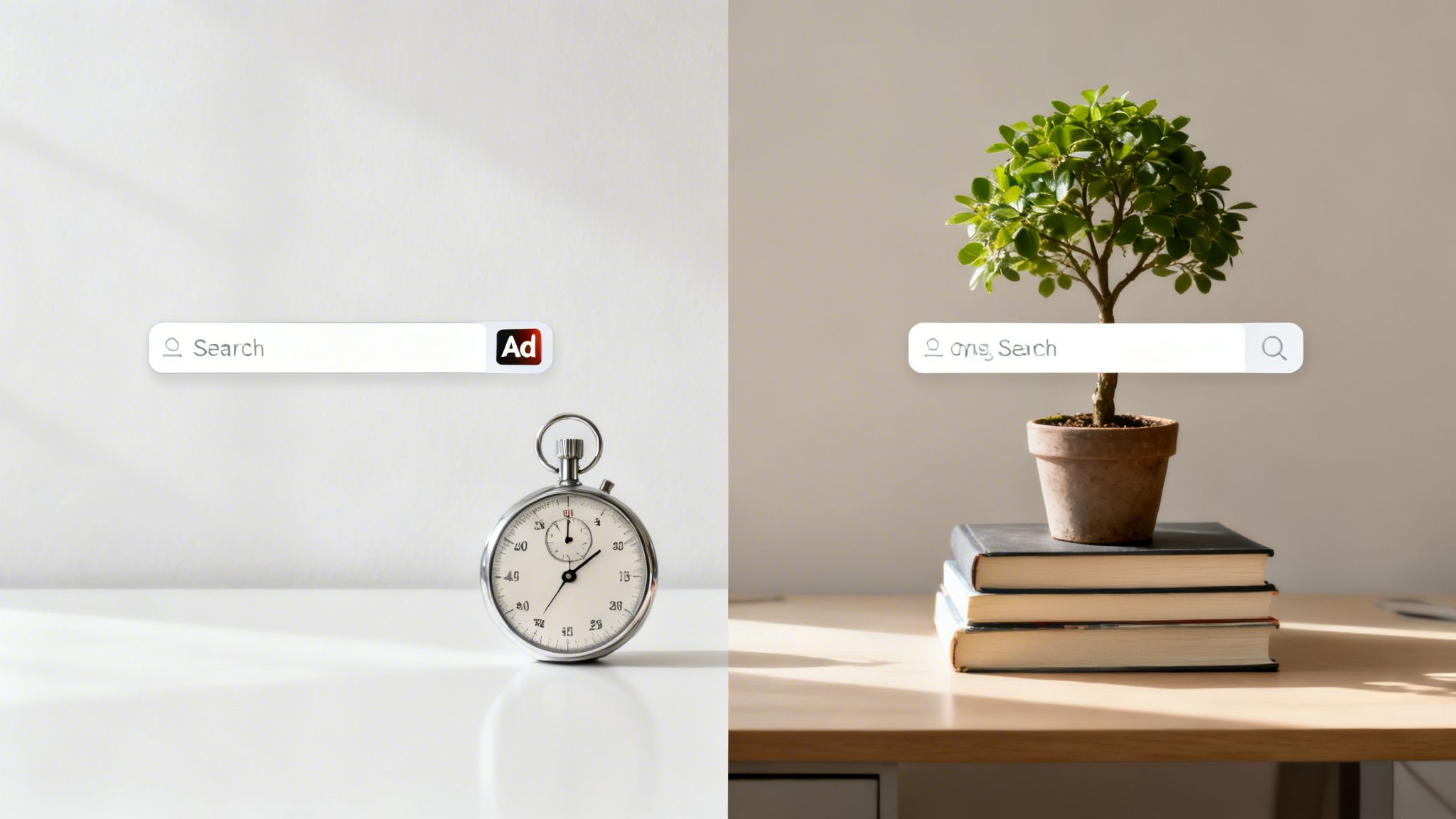
To make smart decisions about your budget, you need to be crystal clear on what each channel involves. They are two fundamentally different paths to getting your business on the search engine results page (SERP).
Paid search lets you buy your way to the top. SEO requires you to earn your spot through trust and relevance. For a great primer on the latter, you can read What Is Search Engine Optimization Explained.
Paid Search (Often Called SEM)
This is all about paying search engines like Google to display your ads when people search for specific keywords. It runs on a pay-per-click (PPC) model, meaning you only get charged when someone actually clicks your ad.
It’s an incredibly powerful tool for generating immediate results. We see it work best for:
- Driving instant traffic for a new product launch or a big sale.
- Quickly testing market demand for a new service before you go all-in.
- Zeroing in on very specific customer demographics or locations.
The number one advantage here is speed. You can have a campaign live and sending visitors to your website in a matter of hours. For a deeper look, check out our guide on what SEM truly entails.
Search Engine Optimisation (SEO)
SEO, on the other hand, is the long game. It’s the process of optimising your website to rank higher in the unpaid, organic search results.
This is a multi-faceted effort that involves everything from fixing technical site issues and creating genuinely helpful content to building your site's authority with backlinks from other reputable sites. User trust is the real currency here.
In the Australian digital landscape of 2026, a striking 70% of clicks on search engine results pages go to organic results, while only 30% head to paid ads.
SEO is about building a sustainable asset. It takes time and patience, but the traffic you earn is consistent and, crucially, doesn't disappear the moment you turn off your ad spend.
Quick Comparison SEO vs Paid Search
To make the differences even clearer, here's a high-level breakdown of how the two channels stack up against each other. Think of this as your cheat sheet for understanding the core trade-offs.
| Attribute | SEO (Organic Search) | Paid Search (PPC/SEM) |
|---|---|---|
| Placement | Unpaid organic listings in the main body of the SERP. | Paid ad placements, usually at the very top or bottom of the SERP. |
| Cost Model | Investment in resources (content, technical work, time). No direct payment to the search engine. | Direct payment per click (PPC). You pay for every visit. |
| Speed to Results | Slower and gradual. Expect to wait 6-12 months for significant results. | Immediate. You can see traffic within hours of launching a campaign. |
| Sustainability | Long-term and compounding. Traffic can be durable and grow over time, even if you pause investment. | Short-term. Traffic stops the moment you stop paying. |
| User Trust | Generally higher. Users often perceive organic results as more credible and authentic. | Lower. Users know it's a paid advertisement, which can lead to scepticism. |
Ultimately, neither channel is inherently "better"—they just serve different strategic goals. The best approach often involves using both in a coordinated way, but we'll get to that later.
Analysing Visibility and Traffic Quality
When you're weighing up search engine marketing vs SEO, simply counting clicks is a rookie mistake. The real game is about understanding the quality and intent behind that traffic. Paid and organic search don't just show up in different spots on the page; they attract fundamentally different types of users and engagement.
SEO is your engine for building long-term brand authority. It’s how you capture people at every single stage of their journey, from the moment they type in a broad, top-of-funnel question (like "what is the best camera for vlogging?") right down to a hyper-specific, wallet-out query (like "buy Sony ZV-1 Melbourne").
For this to work, a top ranking isn’t just a nice-to-have—it’s everything. In Australia, where Google dominates 90.83% of the search market share, being on page one is the only way to be seen. The brutal reality is that page two and beyond get less than 0.83% of all organic clicks. If you're not on page one, you're practically invisible.
SEM and Surgical Precision
Paid search, on the other hand, gives you a completely different kind of power: surgical precision. If SEO is casting a wide net to build an audience over time, SEM is like a finely-tuned spear aimed directly at your ideal customer, right now.
Platforms like Google Ads let you get incredibly granular with your targeting. You can zero in on users based on:
- High-Intent Keywords: Targeting only those actively searching for terms that scream "I'm ready to buy."
- Demographics: Pinpointing prospects by their age, location, income level, and more.
- Past Behaviour: Retargeting people who’ve already visited your site, browsed specific pages, or even abandoned their shopping cart.
This level of control is what makes SEM so potent for driving immediate action. Got a new product launch? A limited-time webinar? Paid search lets you jump the queue and appear instantly in front of a hand-picked audience.
The Psychology of the Click
It’s crucial to understand the difference between an organic click and a paid one. User perception plays a huge role here, and the psychological gap between the two has a direct impact on the quality of the leads you get.
A paid ad is often seen for what it is: a commercial solicitation. It's a direct pitch from a business. An organic result, however, is perceived as a credible endorsement from the search engine itself. It carries an implied sense of authority and trust that has been earned, not bought.
This isn't just a theoretical difference; it has very real consequences for your conversion rates. For any business built on trust and expertise—think a financial advisory firm or a medical specialist—the authority that comes from a top organic ranking can be far more valuable than the instant visibility of a paid ad.
Traffic Quality and Your Business Model
So, which traffic source is "better"? The only honest answer is: it depends entirely on your business model and what you need to achieve right now. There’s no single winner in the search engine marketing vs SEO debate.
| Business Model | Primary Channel Fit | Rationale for Traffic Quality |
|---|---|---|
| High-Trust Services (e.g., Legal, Finance) | SEO | Builds long-term credibility and attracts clients looking for authoritative, expert advice. Organic traffic is often more qualified and ready to build a relationship. |
| E-commerce & Retail (e.g., Fashion, Electronics) | Hybrid (SEO & SEM) | SEM drives immediate sales for specific products and promotions. SEO captures a huge range of shoppers, from those just starting their research to those ready to buy. |
| B2B with Long Sales Cycles | SEO | Creates a library of valuable content that nurtures leads over months. It positions the company as a thought leader, attracting high-quality leads through whitepapers and case studies. |
| Lead Generation for Local Services | SEM | Geo-targeted ads deliver instant visibility to users who need help now (e.g., "emergency plumber near me"). The traffic is highly transactional and time-sensitive. |
Ultimately, SEM traffic is brilliant for validating a new offer and generating immediate leads from people with clear buying intent. SEO traffic, in contrast, is more about building brand equity, nurturing prospects over the long haul, and creating a sustainable, and often more loyal, customer base. The most sophisticated marketers don't choose one over the other; they use both in harmony, playing to the strengths of each to build an unstoppable presence in search.
Comparing Costs, Budgeting, and ROI Timelines
When it comes down to choosing between SEM and SEO, money is almost always the deciding factor. It's easy to fall for the myth that SEO is "free" just because you aren't paying for each click. But that completely ignores the real investment in expertise, content creation, and technical resources needed to get results.
On the other hand, the cost of Search Engine Marketing (SEM) is direct and easy to grasp. It's a pure pay-to-play model where your budget directly fuels your visibility and traffic. To allocate your marketing dollars wisely, you need a firm handle on how the money flows and when you can expect a return from each channel.
The Financial Model of an SEO Investment
Think of SEO as an investment in a digital asset, not unlike buying a piece of commercial real estate. You’re putting money upfront to build a solid foundation (technical SEO), furnish the inside with valuable content, and then build its reputation in the neighbourhood (link building). This isn't free—it demands a consistent budget for skilled professionals, high-quality content, and specialised tools.
The real difference is in the payoff. Once your website builds authority and starts ranking for valuable keywords, it generates a steady stream of organic traffic without a per-click cost. That traffic doesn't just disappear if you need to pause your efforts for a month.
SEO is a long-term asset. The work you do today on content and technical optimisation can continue to pay dividends in the form of organic traffic and leads for months, even years, to come. It’s an investment in compounding returns.
For example, a detailed guide on a niche industry topic might take 20 hours to research and write. But that single piece of content can keep attracting qualified leads for the next three years. That's the power of building a digital asset versus just renting ad space.
The Financial Model of SEM Spend
SEM, or paid search, runs on a straightforward spending model. You set a daily or monthly budget and pay a Cost Per Click (CPC) every single time someone clicks your ad. This gives you incredible control and predictability; you know exactly what you're spending to get each visitor through the door.
This model is like renting a prime storefront in a bustling shopping centre. As long as you keep paying the rent, you get a premium location with guaranteed foot traffic. The moment you stop paying, your store vanishes, and the flow of customers stops dead.
Here’s how that budgeting plays out in the real world:
- An e-commerce startup could set a $50 daily budget to drive immediate traffic to its new products using Google Shopping ads. They can measure sales directly and calculate their Return On Ad Spend (ROAS) from day one.
- A B2B consultancy might allocate a $3,000 monthly budget to target C-suite executives on LinkedIn with a valuable whitepaper. They can precisely track their cost per lead and monitor the quality of those leads as they come in.
Comparing ROI Timelines and Budgeting
The fundamental difference between SEO and SEM really boils down to how quickly you can expect to see a return on your investment. Neither one is automatically better; their value depends entirely on your business goals and cash flow. For a deeper dive into financial planning for organic growth, you can learn more about how much search engine optimisation costs.
SEO ROI Timeline:
SEO is a marathon, not a sprint. You won't see meaningful results overnight. It typically takes a good 6 to 12 months to see a significant lift in organic traffic and leads for competitive keywords. The first few months are all about laying the groundwork, with the returns starting to accelerate as your site's authority compounds over time.
SEM ROI Timeline:
SEM delivers almost instant results. You can launch a campaign in the morning and start seeing traffic, leads, and even sales by the afternoon. This makes it the perfect tool for:
- Testing a new product or service offering.
- Driving traffic for a short-term promotion or sale.
- Generating immediate cash flow to fund other marketing channels (like SEO!).
The trade-off, of course, is sustainability. The costs are perpetual, and your growth is directly tethered to your ad spend. While SEO is a slower burn, it builds a far more profitable and defensible asset over the long term, often delivering a much higher ROI once it hits its stride.
Measuring Success with the Right KPIs
If you can’t measure it, you can’t improve it. That old saying is the gospel truth when it comes to search marketing. To figure out whether SEO or SEM is the right move for you, you need to track the right Key Performance Indicators (KPIs).
The metrics for each channel are completely different because their goals and timelines are worlds apart. SEO measurement is about tracking the slow, steady build of a long-term asset. SEM, on the other hand, gives you an immediate, crystal-clear feedback loop on whether you’re making money or not.
Sure, seeing your site hit page one feels great, but rankings alone don't pay the bills. The real measure of success lies in the tangible business outcomes you can trace back to your search efforts.
How to Measure SEO Success
Tracking SEO isn't about a single number; it's about looking at a collection of metrics that, together, tell a story of growing authority and sustained traffic. These KPIs show your website's health, how your audience is engaging, and whether you're attracting the right kind of visitors.
- Organic Traffic Growth: This is your foundation. Are you seeing a steady, month-over-month increase in visitors from non-paid search? You'll track this in Google Analytics, and it's the clearest sign that your strategy is gaining traction.
- Non-Branded Keyword Visibility: This metric tells you if you’re being discovered by people who don't already know your brand name. Getting found for these informational or commercial terms means you’re successfully capturing a new audience at the top of the funnel.
- Backlink Profile and Authority: High-quality links from other respected sites are one of the most powerful ranking signals for Google. To properly gauge this, understanding what is Domain Authority in SEO and how it works is crucial for assessing your site’s ranking potential.
- Organic Conversion Rate: This is the bottom line. Are the people finding you through organic search actually turning into leads or customers? Tracking goal completions ties your SEO work directly to revenue.
How to Measure SEM Success
With SEM, performance is all about immediate efficiency and return on your ad spend. The data is financial and action-oriented, giving you everything you need to make quick, data-backed decisions to refine your campaigns. There’s no ambiguity—every dollar is accountable.
- Click-Through Rate (CTR): This shows how compelling your ad is. A high CTR means your ad copy, targeting, and offer are hitting the mark with your audience.
- Cost Per Acquisition (CPA): How much does it cost you to get one lead or one sale? This is the critical metric for understanding if your campaigns are actually profitable.
- Return On Ad Spend (ROAS): For every dollar you put into your ads, how many dollars in revenue are you getting back? This is the ultimate measure of success for any e-commerce or lead-gen campaign.
- Quality Score: This is a Google-specific metric that scores the relevance of your keywords, ads, and landing pages. A higher Quality Score is rewarded with lower costs and better ad positions, so it's a key lever for efficiency.
To properly evaluate your search campaigns, you need to be tracking the right set of KPIs for the right channel. SEO metrics prove you're building a valuable long-term asset, while SEM metrics confirm you're generating profitable results right now.
To help you get a clearer view, here's a table breaking down the most important KPIs for each channel.
Primary KPIs for SEO and SEM Campaigns
| Channel | Primary KPIs | What It Measures |
|---|---|---|
| SEO | Organic Traffic, Keyword Rankings, Backlinks, Organic Conversion Rate, Bounce Rate | The long-term growth of your website's visibility, authority, and its ability to attract and convert free traffic over time. |
| SEM | Click-Through Rate (CTR), Cost Per Click (CPC), Cost Per Acquisition (CPA), Return On Ad Spend (ROAS), Quality Score | The immediate efficiency and profitability of your paid ad campaigns, focusing on direct return on investment. |
Tracking these distinct metrics gives you a complete picture of your search marketing performance. If you want to dive deeper into measurement across all your digital marketing efforts, check out our comprehensive guide to digital marketing performance metrics.
When to Use SEO, SEM, or Both
The whole SEO vs. SEM debate isn't about crowning a champion. It’s about picking the right tool for the right job, at the right time. Your business model, your immediate needs, and where you want to be in a few years will dictate the right play. Getting this strategic choice right is far more important than just knowing the definitions.
To cut through the noise, this decision tree helps map out the initial choice. It all starts with your primary goal: are you building a long-term asset or do you need to drive sales, like, yesterday?
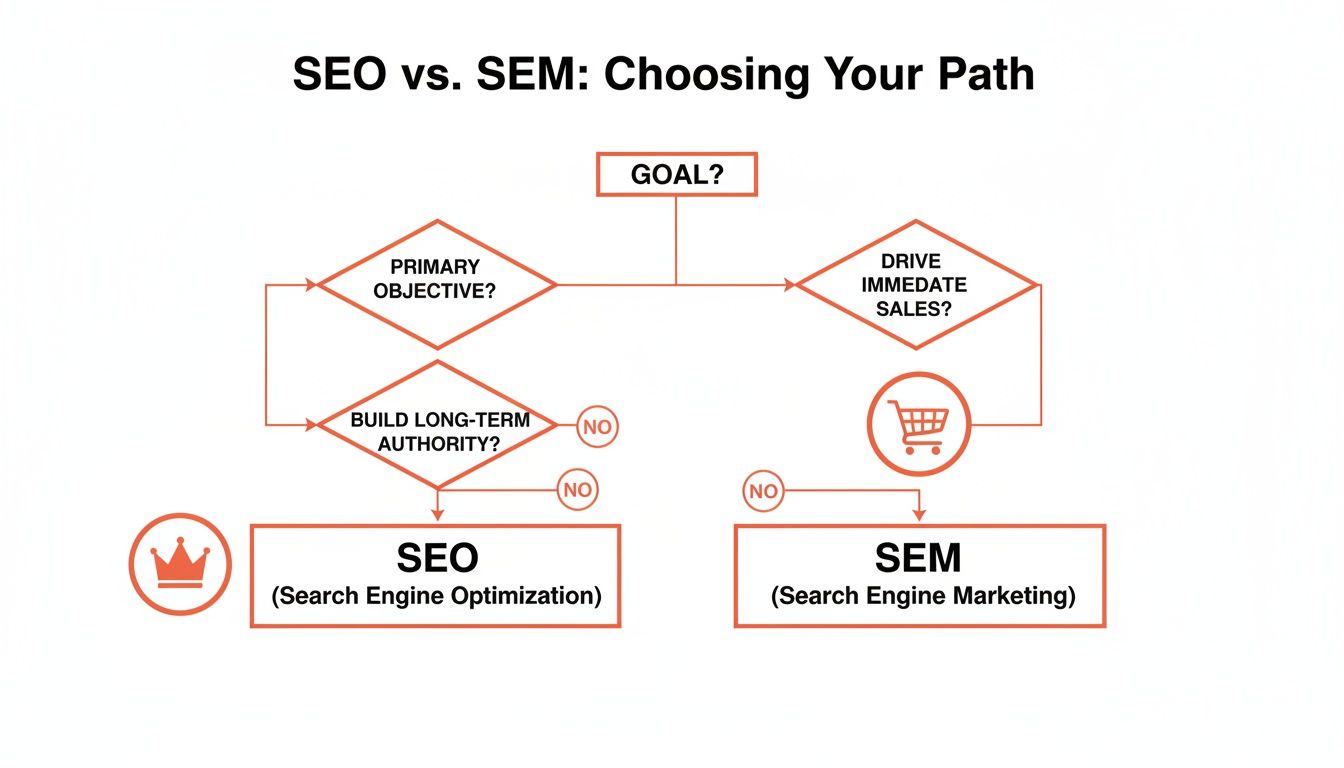
As you can see, if brand credibility and sustainable traffic are the endgame, SEO is your cornerstone. But if you need to generate leads and sales quickly and predictably, SEM is the most direct path to get there.
Scenarios to Use SEM for Immediate Impact
Think of SEM as the accelerator pedal. It's the go-to when you need speed, control, and immediate data. Waiting months for organic traction just isn’t an option in some situations.
Paid search really shines in scenarios like these:
- An e-commerce brand staring down the barrel of the holiday season. They need sales now, not in six months. A well-oiled Google Shopping campaign can get their products in front of motivated buyers at the exact moment they're ready to purchase.
- A startup testing a new software idea. Before sinking a massive budget into development, they can run a lean SEM campaign to see if anyone actually wants what they're building. The instant feedback on messaging and features is gold.
- A local plumber running a flash sale on emergency hot water repairs. With geo-targeted SEM, they can reach customers in their immediate service area who are searching for help right now.
Scenarios to Prioritise SEO for Long-Term Growth
SEO, on the other hand, is the foundation of your digital presence. It's a long-term play for businesses focused on building a sustainable, authoritative brand that can stand the test of time and algorithm updates.
Here’s when you should be leaning heavily into an SEO strategy:
- A B2B consultancy that wants to be seen as the go-to expert in its field. By publishing high-value, in-depth content like whitepapers and case studies, they build trust and attract high-quality leads over years, not days. Their expertise becomes their best marketing channel.
- A media site or affiliate blog. For these businesses, organic traffic isn't just a marketing channel—it's the entire business model. Consistent, high-volume organic traffic is the lifeblood of their operation.
- Any business that wants to cut its dependency on paid ads. Strong organic rankings generate a steady stream of traffic that isn’t tied to your daily ad spend, creating a more profitable and resilient business in the long run.
The Hybrid Approach: The Smartest Strategy of All
For almost every business we work with, the conversation isn't really "SEO or SEM?". It's "how do we make them work together?". The most powerful approach is an integrated one, where SEO and SEM create a feedback loop that makes both channels stronger.
With an integrated strategy, you can dominate the search results page from top to bottom. SEM delivers the immediate sales and invaluable data, while SEO quietly builds your long-term, cost-effective growth engine in the background.
The real power comes from a feedback loop. Use SEM's keyword and conversion data to prioritise your SEO content strategy. Use SEO's brand authority to improve your SEM Quality Scores, which lowers your ad costs.
This hybrid model is becoming even more essential as search continues to evolve. While research suggests AI will reshape search and that organic search may offer 5.66% more opportunity than paid by 2026, you can't ignore the present. SEM's immediacy on platforms like Meta and LinkedIn gives you a critical edge for scaling quickly. You can explore more on how SEO is changing in Australia at Distl.
Ultimately, a smart hybrid strategy allows a brand to both defend its turf with a strong organic presence and aggressively capture new market share with surgical paid campaigns. It's the most complete way to maximise your visibility and build a truly sustainable growth machine.
Taking Action on Your Search Marketing Strategy
Knowing the difference between SEM and SEO is one thing, but turning that knowledge into a plan that actually drives results is where the real work begins. Moving from theory to execution demands a structured approach, one that ties your search marketing directly to your business goals.
The first step is getting crystal clear on what you actually want to achieve. Are you hunting for more qualified leads for your sales team? Is the goal to drive direct online sales through your e-commerce store? Or maybe you need to build brand awareness from scratch in a new market. Each of these objectives calls for a completely different mix of SEO and SEM. Without that clarity, you’re just spending money without a purpose.
Building Your Foundational Plan
Once your primary goal is defined, you need to ground your strategy in data. This means rolling up your sleeves and diving into keyword and competitor analysis to figure out what your audience is searching for and how your rivals are positioning themselves. This foundational research informs everything that comes next, from your content strategy to your ad campaign targeting.
With this data in hand, you can set a realistic budget and timeline. Remember, SEO is a long-term investment that requires patience, while SEM offers more immediate, scalable results tied directly to your ad spend. A well-defined budget stops you from overspending and ensures your resources are pointed at the channels that will have the biggest impact on your goals.
The most common point of failure isn’t choosing the wrong channel; it’s launching either SEO or SEM without a clear goal, a realistic budget, or a deep understanding of the competitive landscape. Strategy must always precede action.
Choosing Your Execution Partner: In-House vs. Agency
With a plan in place, you face a critical decision: do you build an in-house team or partner with a specialised agency? An in-house team offers deep product knowledge and alignment with your company culture, but hiring, training, and retaining top-tier SEO and SEM talent can be expensive and time-consuming.
An agency, on the other hand, gives you immediate access to a team of specialists, advanced tools, and cross-industry experience. They can get campaigns off the ground quickly and bring fresh perspectives. If you're leaning towards an agency, it’s vital to ask the right questions to make sure they’re a true partner, not just a vendor.
Here’s a checklist of questions to ask a potential agency partner:
- Strategy and Customisation: How will you develop a strategy tailored specifically to our business goals, not just a one-size-fits-all template?
- Transparency and Reporting: What level of access will we have to our campaign data, and what do your performance reports actually include?
- Communication: Who will be our main point of contact, and how often will we have strategy meetings?
- Experience: Can you share case studies or results from clients in a similar industry or with similar challenges?
Taking these deliberate steps transforms the "SEO vs. SEM" debate from an academic question into a powerful, actionable business strategy. It gives you a clear path forward, empowering you to invest confidently and drive tangible results.
Frequently Asked Questions
As you start to weigh up search engine marketing against SEO, a few common questions almost always pop up. Let's tackle some of the big ones that businesses wrestle with when mapping out their growth strategy.
Should I Do SEO and SEM Myself or Hire an Agency?
While you can definitely get your head around the basics, getting real, competitive results in today's market is a full-time job that demands deep expertise. SEO is a careful mix of technical skill, smart content strategy, and authority building. SEM, on the other hand, requires non-stop bid management and creative optimisation to avoid burning through your budget.
For most businesses, the return on investment is far higher when you partner with experts. An agency brings specialised knowledge, access to advanced tools, and a coordinated strategy to the table. This saves you from a massive time sink and the kind of costly mistakes that are all too easy to make, letting you focus on what you do best: running your business.
How Long Does SEO Really Take to Show Results in Australia?
Think of SEO as a long-term investment, not a quick fix. You might spot some small ranking improvements within the first three months, but for significant, business-moving gains in organic traffic—especially for competitive keywords—you should be looking at a 6 to 12 month timeframe.
Of course, this timeline depends heavily on how competitive your industry is, your website's current authority, and how consistently you work at it. This is a massive contrast to SEM, which can start funnelling targeted traffic to your site within hours of a campaign launch, really highlighting the core difference in how they operate.
The patience SEO demands pays off with sustainable, long-term traffic that isn't tied to your daily ad spend. You're building a digital asset, not just renting visibility.
Which Is Better for a New E-Commerce Website?
For a brand-new e-commerce site, a hybrid approach is almost always the smartest move. Start with SEM right away while you build out your SEO foundation. Paid search, particularly through channels like Google Shopping, can drive immediate traffic and, most importantly, sales.
This initial SEM push gives you priceless data on which products are selling and what keywords actually convert. You can then feed these insights directly into your SEO strategy, focusing your content and optimisation efforts on terms you already know generate revenue. At the same time, you invest in foundational SEO—the technical setup, on-page optimisation, and rich category page content—to build organic authority for the long haul and cut down your future reliance on paid ads. It's a powerful one-two punch for sustainable growth.
Ready to stop guessing and start growing with a data-driven search marketing strategy? Click Click Bang Bang specialises in creating precision-targeted PPC and AI-first SEO campaigns that deliver measurable results. Start your risk-free trial today and see the difference an expert partner can make.
Read NeXt
Or Read Our Latest
- Manual vs Automated Bidding for PPC Success
- Conversion Tracking Setup: A Complete AU Guide
- Instagram Advertising Australia: Complete 2026 Guide
- Pay Per Click: A Beginner’s Guide for Australian Marketers
- Display Advertising on Google: The Complete Australian Guide
- Stakeholder Communication Plan How to Build One That Works
Click. CLick. Subscribe.
Get our best PPC insights, industry updates, and power moves delivered straight to your inbox. No fluff, just high-caliber strategies that actually work.
Don’t Leave Just Yet
Try Us For 30-Days,
Risk Free!!
We guarantee that you’ll love our work within the first 30 days, if not you’ll get your money back.
What have you got to lose?