

Seo Audit Services: seo audit services to grow rankings fast
Last Updated

Think of an SEO audit as a full diagnostic health check for your website. It's a deep-dive process designed to uncover every hidden strength, weakness, and—most importantly—every massive opportunity for growth. A professional audit delivers a clear, actionable roadmap to improve your search engine rankings, drive more organic traffic, and ultimately, generate more leads and sales.
Your Website’s Essential Health Checkup

Too many businesses treat their website like a finished product. In reality, it’s more like a living, breathing thing that needs regular attention to stay healthy and perform at its peak. An SEO audit is the first, non-negotiable step in any serious digital marketing strategy because it replaces guesswork with a data-backed plan of attack. It’s not just about spotting what’s broken; it’s about getting the complete picture of your site's performance.
This process involves a meticulous examination of every single factor that influences how search engines like Google see your site. Without this foundational analysis, any other marketing you do—from content creation to paid ads—is built on shaky ground. You could be pouring thousands of dollars into a site with underlying technical problems that are holding it back from ever ranking properly.
The Four Pillars of a Professional SEO Audit
A proper audit isn't a single checklist; it's a multi-faceted investigation. To make sense of it all, we break it down into four core pillars, each giving us a unique lens to view your website's performance.
| Audit Component | Primary Focus | Example Issue Uncovered |
|---|---|---|
| Technical Health | The "under the bonnet" elements of your site, like speed, mobile-friendliness, and crawlability. | Slow page load times that cause visitors to leave before the content even appears. |
| Content Effectiveness | The quality, relevance, and structure of your on-page content and its alignment with user intent. | High-quality blog posts that fail to rank because they aren't targeting the right keywords. |
| Backlink Quality | The authority and trustworthiness of other websites linking to yours, which acts as a "vote of confidence." | A high number of links from low-quality or "spammy" sites that damage your credibility. |
| User Experience (UX) | How easily and intuitively visitors can navigate your site to find what they need. | A confusing menu structure that makes it difficult for users to find key products or services. |
When you put these pillars together, you get a 360-degree view of your site's current state and its real potential for the future.
An SEO audit provides the "why" behind your performance metrics. It connects the dots between a drop in traffic and a specific technical error, or links a low conversion rate to a poor user experience.
The fight for online visibility has never been fiercer. The Australian SEO market is projected to hit a staggering $1.5 billion in value by 2025, driven by 12% year-over-year growth. In a market this competitive, an audit is your first strategic move. Yet, data shows that nearly 47% of Aussie businesses struggle to measure their ROI from SEO because they don't act on the critical Core Web Vitals and content gaps an audit uncovers. You can dig into more insights from the State of SEO and Marketing in Australia 2025 report.
What Does an SEO Audit Process Actually Look Like?
Getting a professional SEO audit isn't like buying a product off the shelf; it's more like bringing in a master architect to draw up the blueprints before you build a house. It’s a collaborative process designed to go from your big-picture business goals down to the nitty-gritty technical details, making sure every single recommendation is tied directly to what you're trying to achieve.
The whole thing kicks off with a discovery phase. This is way more than just a quick kickoff call. It's a proper deep dive where we get on the same page about what success actually means for your business. Are you trying to boost e-commerce sales, get more B2B leads through the door, or just completely own the local search results? Your answers here set the stage for the entire audit and define the key performance indicators (KPIs) we'll use to track progress.
The Analysis and Deep Dive
Once we're crystal clear on your goals, the real analysis begins. This part of the process is a blend of powerful, specialised software and the irreplaceable insight of a human expert. Automated tools are brilliant at crawling thousands of pages to spot patterns and flag technical issues at scale—things like broken links, slow pages, or crawl errors. They can chew through huge amounts of data in no time, giving us a solid foundation to work from.
But tools can't understand context or strategy. That's where the manual review becomes absolutely critical. An experienced SEO strategist will sit down and manually go through your key pages, assess the user experience, poke around at what your competitors are doing, and figure out the real intent behind your content.
This two-pronged approach ensures nothing slips through the cracks. For instance:
- An automated tool might flag a page for having a "low word count."
- A manual review reveals that the page is a highly effective, visual-first product category page, and adding more text would actually make the user experience worse.
Without that human oversight, you could easily end up with a to-do list full of "problems" that aren't really problems at all.
A great audit isn’t just a list of errors. It's a strategic roadmap that synthesises data from multiple sources into a prioritised action plan, showing you exactly where to focus your efforts for maximum impact.
Turning Findings into an Actionable Roadmap
The final, and most crucial, phase is pulling all the findings together. All the data we've collected—from technical crawls, content reviews, backlink analysis, and competitor snooping—is organised into a comprehensive report that’s actually easy to understand. This isn't some 100-page document loaded with jargon; it's a clear, prioritised plan of attack.
We typically categorise the recommendations to give you a clear sense of direction. A common structure looks like this:
- Quick Wins: High-impact, low-effort tasks you can knock over for some immediate improvements.
- Core Technical Fixes: Foundational issues that need to be sorted out to ensure the long-term health of your SEO.
- Content and On-Page Optimisations: Strategic advice for improving the content you already have and planning for new stuff.
- Long-Term Initiatives: The bigger-picture projects, like overhauling your site structure or running a sustained backlink-building campaign.
This structured approach turns a complex analysis into a step-by-step guide for growth. If you want to get a sense of the sheer level of detail involved, a complete website audit checklist can be a real eye-opener.
Ultimately, the process gives you a clear path forward. It takes the guesswork out of your digital marketing, ensuring every move you make is backed by data and perfectly aligned with your most important business goals. That strategic clarity is the real value you get from expert SEO audit services.
The Critical Components of a Website Health Check
Think of a proper SEO audit less like a single task and more like a series of specialised inspections. It's like a GP referring a patient to a cardiologist or neurologist for specific issues. A complete health check for your website means diving deep into several critical areas, each giving us a unique angle on its performance. When you put them all together, you get a complete picture that shows not just what’s broken, but where your biggest opportunities for growth are hiding.
A genuinely effective audit breaks your site down into five core pillars. If you ignore any one of these, it's like servicing your car's engine but forgetting to check the brakes; you're only getting a partial—and potentially misleading—view of its real condition. Professional SEO audit services are built around this multi-faceted approach to make sure no stone is left unturned.
This infographic breaks down the typical phased approach we take, moving from initial discovery all the way through to delivering a strategic action plan.
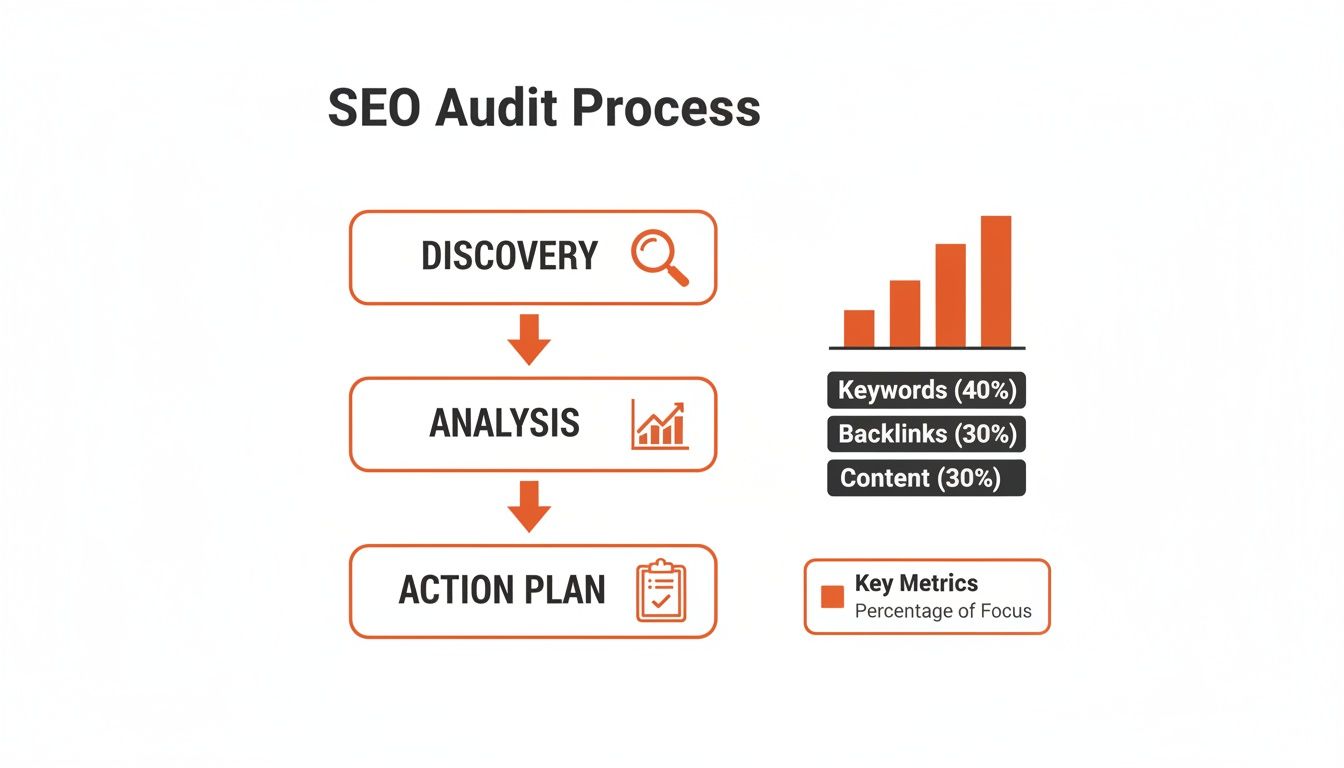
As you can see, a successful audit is a structured process. It ensures the final recommendations we hand over are built on a solid foundation of thorough analysis and your business goals.
Technical SEO Health
This is the bedrock of your entire online presence. Simple as that. If your website’s technical SEO is weak, everything else you do—from writing brilliant content to building great links—will be fighting an uphill battle. Think of it as the foundation of a house. If it has cracks, it doesn’t matter how beautifully you decorate the rooms inside. The whole structure is compromised.
A technical audit digs into the behind-the-scenes stuff that helps search engine crawlers find, understand, and index your website efficiently.
- Crawlability and Indexability: Can search engines even get to your content? We hunt for issues like dodgy
robots.txtfiles or straynoindextags that might be accidentally blocking important pages from Google. - Site Speed: Slow-loading pages are a killer for user experience and a red flag for Google. We pinpoint exactly what’s causing the lag, whether it’s oversized images or clunky code.
- Mobile-Friendliness: With most searches now happening on phones, a clunky mobile experience just isn’t an option anymore.
- Site Architecture: A logical site structure helps both users and search engines find their way around your content without getting lost.
Fixing these foundational issues is often the first, and most impactful, step in turning a website's performance around. For a much deeper dive, you can check out our guide on what a technical SEO audit really entails.
On-Page and Content Effectiveness
Once the technical foundation is solid, we shift focus to what’s actually on your pages. This part of the audit is all about figuring out if your content is relevant, well-structured, and actually lines up with what your target audience is searching for. It’s about making sure your message is not only top-notch but also speaks the language search engines understand.
Here’s what we’re typically looking at:
- Keyword Optimisation: Are you targeting the right keywords? And are they used naturally in your page titles, headings, and body copy?
- Content Quality and Relevance: Does your content properly answer the user’s question? Is it unique and valuable, or is it thin, duplicated, or just plain unhelpful?
- Meta Tags: Are your title tags and meta descriptions compelling enough to actually earn the click when someone sees you on a search results page?
- Internal Linking: Are you linking related pages together? This helps spread authority around your site and guides users to discover more of your great content.
It’s not enough to just have content. An audit makes sure your content is working for you, actively pulling in and engaging your ideal customers by directly answering what they’re looking for.
Backlink Profile Analysis
If technical SEO is your foundation and content is your interior design, then your backlink profile is your professional reputation. Backlinks are simply links from other websites to yours, and search engines see them as votes of confidence. But not all votes are created equal.
A backlink analysis separates the good from the bad. A high-quality link from a respected industry site can give your authority a massive boost. On the flip side, a heap of links from spammy, low-quality sites can actually drag your rankings down. This part of the audit meticulously reviews every single referring domain to sniff out toxic links that need to be disavowed and to find opportunities for earning more authoritative links.
The demand for SEO audit services in Australia is climbing fast, mirroring the growth of the SEO software market, which hit $2.1 billion in 2024 and is on track for $5.2 billion by 2030. This tech surge gives agencies powerful tools to analyse sites for complex factors like AI integrations and voice search readiness. While large companies have traditionally led this investment, small and medium businesses are now catching up, eager to fix the technical problems that 42% of businesses face with Google updates.
User Experience and Core Web Vitals
At the end of the day, Google wants to rank websites that give people a great experience. This goes way beyond just having good content; it’s about how that content is presented and how easy the site is to use. This part of the audit looks at your site through the eyes of a first-time visitor.
Key metrics we analyse include:
- Core Web Vitals: These are Google’s official metrics for measuring user experience, covering loading speed (LCP), interactivity (FID), and visual stability (CLS).
- Navigation and Usability: Is your site a breeze to get around? Can users find what they’re looking for in just a couple of clicks?
- Readability: Is the text easy to read on all devices? Are there annoying pop-ups getting in the way?
A site that’s frustrating to use will have a high bounce rate, which sends a strong signal to search engines that something’s not right.
Analytics and Conversion Tracking
Finally, an audit has to verify that your tracking is set up correctly. Without accurate data, you’re flying blind. This final check ensures that tools like Google Analytics and Google Search Console are properly configured to capture the data you need to measure SEO success. We also review your conversion tracking to make sure you can accurately attribute leads and sales to your organic traffic, which is critical for proving the ROI of your efforts.
Calculating the Real Value of an SEO Audit
When people start looking into professional SEO audit services, the first question is almost always about the price tag. It's a natural starting point, but it's also the wrong one.
The smarter approach is to flip the question entirely. Instead of asking, "What does it cost?", you should be asking, "What's the potential return?". An SEO audit isn't just another marketing expense—it’s a strategic investment in your website's ability to make money, now and in the future.
Of course, the price of an audit can swing pretty wildly. The biggest factors are the size and complexity of your website. A small local business with maybe 20 pages needs a completely different level of analysis than a national e-commerce store juggling 20,000 product pages and multiple subdomains.
Common Pricing Models for Audits
Understanding how agencies charge for audits helps you find the right fit for your goals and budget. Generally, you’ll come across two main approaches.
- One-Off Project Fee: This is a fixed price for a complete, deep-dive audit. It’s perfect for businesses that need a comprehensive health check before kicking off a major SEO campaign or a website redesign.
- Included in a Monthly Retainer: Many agencies roll regular health checks and audits into their ongoing monthly SEO services. This model works best for businesses looking for a long-term partner focused on continuous improvement.
For a more detailed look at the numbers, our guide on how much search engine optimisation costs breaks it all down.
Sample SEO Audit Pricing Tiers
To give you a clearer picture of what to expect, here’s a sample breakdown of typical pricing tiers for SEO audits. Think of this as a general guide to connect your investment level with the scope of work you can anticipate.
| Tier | Typical Price Range (One-Off) | Best For | Common Inclusions |
|---|---|---|---|
| Essential | $1,500 – $3,000 | Small businesses, local services, startups | Core technical checks (crawl, index), on-page analysis, basic keyword gap, competitor snapshot. |
| Comprehensive | $3,000 – $7,500 | SMBs, e-commerce stores, growing businesses | All Essential items plus deep backlink analysis, content audit, user experience (UX) review, log file analysis. |
| Enterprise | $7,500+ | Large e-commerce sites, national brands, complex websites | All Comprehensive items plus international SEO, advanced site speed forensics, schema markup review, full site migration plan. |
Ultimately, the right tier depends on your specific needs. A smaller site doesn't need an enterprise-level dissection, while a large, complex site would miss critical opportunities with just a basic check-up.
From Cost to Investment: An E-commerce Example
To really get a feel for the ROI, let's step away from abstract pricing and walk through a real-world scenario.
Imagine you run an online store bringing in $50,000 a month. Traffic is decent, but you have a nagging feeling it could be much, much better.
You decide to invest in a professional SEO audit. The report lands, and one finding stands out: your product pages are painfully slow to load, especially on mobile. This poor performance is directly causing a high cart abandonment rate—shoppers are getting impatient and leaving before they can check out.
The audit doesn't just point out the problem; it gives you a clear, prioritised to-do list of technical fixes. You get to work implementing the recommendations: compressing images, cleaning up code, and improving server response times.
The result? Your average page load speed improves by two seconds. That seemingly small tweak leads to a 10% drop in cart abandonment, boosting your monthly revenue by $5,000.
In this case, an audit that might have cost a few thousand dollars paid for itself in the very first month. And it keeps generating that extra profit, month after month. That is the real power of a well-executed audit—it uncovers the hidden friction points that are quietly costing you money.
Understanding the Financial Impact in Australia
Across Australia, businesses are catching on and actively investing in SEO audit services to get a leg up on the competition. Monthly retainers that include comprehensive audits typically range from $1,000 to over $5,000.
Smaller businesses might spend around $1,200-$1,350 monthly for foundational work, while more established companies invest $18,000-$42,000 annually for the kind of deep analysis that can triple their organic traffic. These strategic investments often produce a powerful 200-275% ROI, which translates to as much as $2.75 in profit for every dollar spent.
The data paints a clear picture. An SEO audit is a direct investment in revenue growth. It hands you a roadmap to fix the issues that are actively holding your website back from generating the leads and sales it should be.
How to Choose the Right SEO Audit Partner

Picking a partner for your SEO audit is a massive decision. It can genuinely define the success of your entire digital strategy for years to come.
Get it right, and you’ll walk away with a crystal-clear, actionable roadmap. Get it wrong, and you're left with a generic, jargon-filled report that gathers dust on a virtual shelf. To make the smart choice, you have to look past the sales pitch and ask the tough questions that reveal true expertise.
The goal here isn't just to find someone who can run a report. It's to find a partner who gets the unique challenges and opportunities of your business. That means their process has to be a blend of powerful automated tools and sharp, insightful manual analysis. An agency that only uses software will miss the nuances of user intent and your competitive landscape, while one without the right tech simply can't handle the sheer scale of a proper technical review.
Questions That Uncover True Expertise
When you're vetting potential partners, having a list of specific, probing questions is your best defence against a bad investment. Generic questions get generic answers. You need to dig into their methodology, their transparency, and their strategic thinking.
Here are the essential questions you absolutely must ask:
- "Can you show me a sanitised sample audit report?" This is non-negotiable. It lets you see the depth of their analysis, the clarity of their communication, and whether their recommendations are specific and genuinely actionable or just cookie-cutter advice.
- "What does your manual review process look like, alongside your automated tools?" A great answer will detail how their experts manually check key user journeys, analyse competitor content, and assess the real-world context that software just can't grasp.
- "How do you prioritise your recommendations?" The best SEO audit services don’t just dump a massive to-do list in your lap. Look for an agency that prioritises tasks based on a clear system, like impact versus effort, to show you where to focus for the quickest and most meaningful wins.
An SEO audit should feel less like a transaction and more like the beginning of a strategic partnership. The right partner is invested in your success, not just in delivering a document.
What to Look for in Their Answers
The answers you get to these questions will tell you everything. A confident, transparent agency will welcome this level of scrutiny and give you detailed, thoughtful responses. They should be able to articulate their process clearly and connect their audit activities directly to your business goals, like traffic growth and lead generation.
On the other hand, be wary of agencies that are vague, defensive, or dismissive. If they can't or won't share a sample report, that’s a massive red flag.
Likewise, if they downplay the importance of manual analysis or can’t explain their prioritisation method, it probably means they’re running a superficial, one-size-fits-all operation.
Ultimately, your audit partner should be a guide. Their job is to translate complex data into a clear plan that your team can execute with confidence. Finding that kind of strategic partner starts with asking the right questions. For more guidance on what to expect from a high-level strategic partnership, explore our expert search engine optimisation consulting services.
Turning Your Audit into Action
An SEO audit is more than just a report card for your website; it's the strategic blueprint for your future growth. All the data, analysis, and insights lead to this single, crucial point: turning knowledge into measurable results. The most valuable SEO audit services are the ones that don’t just hand you a list of problems but provide a clear, prioritised roadmap to solve them.
This whole process kicks off with a deep consultation. We need to make sure every recommendation aligns with your core business objectives, whether that's boosting e-commerce sales or generating qualified B2B leads. It’s this alignment that transforms a technical checklist into a powerful business strategy.
An expert-led approach also uncovers the subtle yet critical issues that automated tools almost always miss, giving you a genuine competitive advantage.
From Report to Revenue
Let's be clear: the real value is moving beyond a simple diagnosis to effective implementation. A professional audit delivers an actionable plan that separates the high-impact quick wins from the essential long-term projects. This clarity allows your team to focus its resources where they’ll drive the most significant returns.
This often means tackling foundational issues first. For instance, once an SEO audit flags performance bottlenecks, the very next step is to implement strategies to optimize website performance. A faster, more user-friendly experience has a direct and immediate impact on conversions.
An audit’s ultimate goal isn't just to find flaws. It’s to provide a step-by-step guide that empowers you to build a stronger, faster, and more profitable online presence, ensuring every action you take is a confident step toward growth.
Let's Build Your Roadmap
Understanding your website's untapped potential is the first step. The next is taking decisive action. Our comprehensive SEO audits are designed to give you the clarity and direction you need to start dominating your market.
We dive deep into your site's data to uncover the hidden opportunities that will drive real, tangible results. If you're ready to stop guessing and start growing with a data-backed strategy, then we should talk.
Book a no-obligation strategy session with our experts today, and let's map out your path to success.
Common Questions About SEO Audits
If you're looking into professional SEO audit services, you've probably got a few questions. That’s a good thing. Getting straight answers is the only way to make a decision you can feel good about, so let's get into the most common queries we hear from business owners and marketing managers.
Most of these questions boil down to time, value, and frequency. Understanding them helps you see where a proper audit fits into your bigger picture and why it’s a genuine investment, not just another line item on a spreadsheet.
How Long Does a Professional SEO Audit Take?
A comprehensive SEO audit isn’t a quick, one-day job. The timeline really depends on the size and complexity of your website.
For a small to medium business with a few hundred pages, a really thorough audit usually takes somewhere between two to four weeks. This gives us enough time for deep data collection, careful manual analysis by an actual expert, and crafting a detailed report that prioritises what to do next. A bigger e-commerce site with thousands of product pages and international targeting? That could easily take up to six weeks.
A rushed audit is a major red flag. A proper analysis needs time to uncover the kind of deep-seated issues and opportunities that those quick, automated scans will always miss. Real strategic insights aren't brewed up in an afternoon.
Can I Just Use an Online Tool to Audit My Own Website?
Those free online SEO audit tools are great for a quick health check. They can spit out a list of surface-level issues like broken links or missing meta descriptions in seconds, and that's definitely useful. But they absolutely cannot replace the strategic brain of a human expert.
Here's an analogy: an online tool is like a thermometer. It tells you that you have a fever, but it can’t diagnose what’s making you sick or write you a prescription to get better.
A professional audit provides the critical context that a tool just can't:
- Prioritisation: An expert will look at the 50 issues the tool flagged and tell you which three will actually move the needle for your business, and which ones are just noise.
- Nuance: A tool might flag a page for "thin content," but a human analyst will recognise it as a high-converting landing page that’s working perfectly and shouldn't be touched.
- Strategy: An expert connects the dots between the audit findings and your specific business goals, creating a roadmap that’s built for you, not a generic checklist.
How Often Should I Get an SEO Audit?
For most businesses, we recommend a deep, comprehensive SEO audit at least once a year. Think of it as an annual check-up to make sure your site is keeping up with the latest search engine algorithm changes and evolving best practices.
But there are times when you'll need one more often:
- Before a website redesign or migration: This is critical to make sure you don't accidentally throw away years of valuable SEO equity.
- After a significant, unexplained drop in traffic: An audit can diagnose the root cause so you can fix it fast.
- When you’re entering a new market: You’ll need to adapt your strategy to a whole new competitive landscape.
Regular audits keep your website healthy and stop small issues from snowballing into massive problems that could seriously hurt your bottom line.
Ready to get the clarity you need to grow? The team at Click Click Bang Bang specialises in data-driven SEO audits that deliver a clear, actionable roadmap. Book a no-obligation strategy session to uncover your website's true potential.
Read NeXt
Or Read Our Latest
- Manual vs Automated Bidding for PPC Success
- Conversion Tracking Setup: A Complete AU Guide
- Instagram Advertising Australia: Complete 2026 Guide
- Pay Per Click: A Beginner’s Guide for Australian Marketers
- Display Advertising on Google: The Complete Australian Guide
- Stakeholder Communication Plan How to Build One That Works
Click. CLick. Subscribe.
Get our best PPC insights, industry updates, and power moves delivered straight to your inbox. No fluff, just high-caliber strategies that actually work.
Don’t Leave Just Yet
Try Us For 30-Days,
Risk Free!!
We guarantee that you’ll love our work within the first 30 days, if not you’ll get your money back.
What have you got to lose?