

SEO Marketing for Lawyers The Australian Playbook
Last Updated

When someone needs a lawyer, their first move isn't picking up the Yellow Pages anymore. It's a Google search. This is where SEO marketing for lawyers comes in. It's the strategic work of getting your law firm seen at the top of search results, right when potential clients are looking for the exact help you provide.
The process involves a mix of keyword research, local SEO, content creation, and technical website optimisation. When done right, it builds a reliable pipeline of high-quality leads straight from platforms like Google, without you having to chase them down.
Why SEO Is Your Firm's Strongest Witness

In the Australian legal world, reputation and expertise are everything. But what good is that expertise if potential clients can't find you online? SEO for law firms acts as your digital advocate, making sure your practice shows up as the most credible, relevant answer to a client’s urgent legal problem. It's no longer enough to just have a website; that website needs to be working for you 24/7.
Think about it from your client's perspective. When they need a family lawyer or a commercial litigation expert, they’re turning to Google. A strong SEO strategy puts your firm front and centre at that critical moment, building trust and authority before you've even had a single conversation.
The Untapped Opportunity in Australian Legal SEO
Here's the thing: many law firms in Australia are falling behind online. While 74% of firms have a website, a tiny 28% invest in professional SEO support. This gap is a massive competitive advantage for any practice ready to commit to a proper digital strategy.
This isn't just about getting more clicks. It's about connecting with real people actively looking for legal help. A well-executed SEO campaign delivers on a few key fronts:
- Builds Authority: High search rankings signal to both people and Google that your firm is a trusted leader in its practice area.
- Generates Qualified Leads: SEO attracts people searching for specific legal services, meaning the leads that come through are far more likely to become clients.
- Creates a Lasting Asset: Unlike paid ads that vanish the moment you stop paying, the authority and rankings you build through SEO are a long-term asset that keeps delivering value.
A smart SEO approach isn't a 'nice-to-have'—it becomes the engine driving client acquisition. It’s the difference between passively waiting for referrals and actively building a predictable stream of new cases.
Understanding Your Future Client's Journey
To win at SEO, you need to get inside your client's head. What words are they typing into Google? What urgent questions do they need answered? Their decision-making process is the bedrock of your entire strategy.
For example, understanding the thought process behind topics like how to choose a personal injury attorney allows you to create content that speaks directly to their needs at the right time.
This playbook is designed to give you a clear, actionable framework to do just that. We’re moving past the theory and into the practical steps you need to get results. If you want a bit more background on the fundamentals, checking out a guide on search engine optimisation can give you some helpful context.
Now, let’s start building your case for digital dominance.
Dominate Your Local Market with Precision SEO

While building a national reputation sounds impressive, the bread and butter for most Australian law firms are clients right in their own backyard. This is where a razor-sharp local SEO strategy becomes your most potent tool for bringing new clients through the door.
Local SEO isn't just theory; it’s the practical science of making your firm the default choice when someone searches for legal help in your city or suburb.
The goal isn’t just to be found, it’s to be chosen. When a potential client types "family lawyer in Parramatta" or "conveyancing solicitor in Geelong" into Google, their intent couldn't be higher. They have an urgent need, and your firm must instantly appear credible, trustworthy, and easy to contact. This is the entire point of a focused local strategy within your broader SEO marketing for lawyers plan.
Your Google Business Profile Is Your Digital Front Door
Let's be blunt: your Google Business Profile (GBP) is often the very first interaction a potential client has with your firm. It's not just a listing; it's a dynamic storefront that can either attract new business or send it running to your competitors. Neglecting it is like having a messy, unwelcoming reception area.
A fully optimised GBP is like a mini-website that lives directly on Google's results page. To turn it into a client-generating machine, you have to go beyond just listing your name and address.
- Complete Every Single Section: Fill out the Q&A with common questions, add professional photos of your team and office, and use Google Posts to share firm news or quick legal insights.
- Pick the Right Categories: Get specific. Instead of just "Lawyer," choose "Family Law Attorney," "Criminal Justice Attorney," or "Personal Injury Attorney" to pull in the right kind of enquiries.
- Turn on Messaging: Allowing potential clients to message you straight from your GBP listing removes a barrier and can capture leads who are hesitant to pick up the phone.
Think of your GBP as the summary of your firm's case, presented to the jury of potential clients. Every detail, from your opening hours to your client reviews, builds an impression of professionalism and reliability.
The impact here is real. Nearly 97% of users search online to find local services, including legal help. Law firms that nail their local SEO see an average 71% increase in local traffic, a number that speaks for itself.
The Power of Reviews and Consistent Citations
In the legal world, social proof is everything. Positive client reviews are one of the most powerful trust signals you can possibly have, directly influencing both potential clients and your local search rankings. Actively and systematically asking satisfied clients for reviews needs to be a core part of your process.
Just as critical is the consistency of your firm’s basic information online. This is known as your NAP (Name, Address, Phone number). Search engines see consistency as a massive trust signal. When your firm's NAP details are identical across major Australian legal directories (like FindLaw Australia) and other local business listings, it confirms to Google that you are a legitimate, established local practice.
Inconsistent or old information creates confusion and hurts your authority. A thorough audit of your firm's online citations is a non-negotiable first step. Find every discrepancy—an old address, a disconnected phone number, a slight variation in your firm’s name—and fix it.
This table breaks down the essentials for getting your local presence in order.
Local SEO Priority Checklist for Law Firms
| Task | Priority Level | Primary Goal | Example Tactic |
|---|---|---|---|
| Google Business Profile Optimisation | High | Maximise visibility in local search and map pack | Fully complete all sections, add weekly Google Posts, and select specific legal service categories. |
| Client Review Generation | High | Build social proof and trust signals | Implement an automated email/SMS sequence to request reviews from satisfied clients post-case. |
| NAP & Citation Consistency Audit | Medium | Establish authority and trust with search engines | Use a tool like BrightLocal to find and correct inconsistencies across all online directories. |
| Localised On-Page SEO | Medium | Rank for "[service] in [city]" keywords | Create city-specific service pages (e.g., "Family Law Sydney") with localised content and schema. |
| Local Link Building | Ongoing | Boost local authority and referral traffic | Sponsor a local event or charity to earn a link from a respected community website. |
This foundational work is what separates firms that show up in the valuable local map pack from those that don't. It's a key principle detailed in many guides on SEO for small businesses for a simple reason: it works.
Crafting Content That Wins Cases and Clients

Think of your website's content as your firm's digital advocate. It's out there 24/7, working to attract and persuade potential clients. For it to actually work, it needs to do more than just exist. Your content has to be purpose-built to answer specific questions, calm deep-seated anxieties, and show up when people search for help.
This is about getting past generic descriptions of your services. The heart of a winning content strategy in seo marketing for lawyers lies in understanding your client's mindset. You need to know the exact words they type into Google when they’re in the middle of a legal crisis and build everything around those phrases.
Uncovering Client Intent with Keyword Research
Before you write a single word, you need to get your hands dirty with keyword research. This isn’t about stuffing your pages with obscure legal jargon; it's about discovering the real-world language your potential clients use when they need help. The goal here is to find phrases that signal clear commercial intent—in other words, the desire to hire a solicitor.
Start by brainstorming the core services you offer, like "family law" or "commercial litigation." Then, dig deeper into the specific problems your clients are trying to solve.
- A person searching for "divorce lawyer cost Sydney" has a much more urgent, immediate need than someone just Googling "what is a no-fault divorce."
- Similarly, "unfair dismissal lawyer near me" shows a high intent to hire, whereas a general query like "employee rights Australia" is purely informational.
Use tools like Google Keyword Planner or Ahrefs to find these terms, but pay special attention to "long-tail keywords." These are longer, more specific phrases. They might have lower search volumes, but their conversion rates are often much higher because they come from people who are much further along in their decision-making process.
Your keyword research should give you a clear map of client questions. This map doesn't just guide your content; it becomes the blueprint for your entire website structure, making sure every single page has a distinct job to do.
Building High-Converting Practice Area Pages
Your practice area pages are the money pages. They are the most important commercial content on your website, designed to do one thing: convert a visitor into a client. A great practice area page isn't a legal textbook; it’s a compelling argument for why your firm is the best choice to solve their specific problem.
To build a page that actually converts, you have to organise it to address a visitor's most pressing concerns right away. Someone landing on your "Wills and Estates" page isn't just looking for a definition; they're often feeling anxious about protecting their family's future.
Your page should include:
- A Clear Headline: State exactly what you do and who you help (e.g., "Expert Wills & Estates Lawyers Helping Sydney Families Plan for the Future").
- An Empathetic Opening: Acknowledge the client's emotional state and the weight of the decision they're facing.
- Specific Services: Clearly list the services you provide, like will drafting, testamentary trusts, and estate litigation, weaving in the keywords you found earlier.
- Social Proof: Don't hide testimonials on a separate page. Integrate client reviews and case results directly into the page to build instant trust.
- A Strong Call-to-Action (CTA): Make it ridiculously easy for them to take the next step, like "Schedule a Confidential Consultation."
Establishing Authority with Topic Clusters
While those core practice area pages are critical, you can build much deeper authority and capture a wider net of search traffic by using a topic cluster model. This strategy involves creating a central "pillar" page for a core practice area and surrounding it with "cluster" content that dives into related, more specific questions.
Let’s stick with the "Wills and Estates" example.
- Pillar Page: This is your main "Wills and Estates Lawyers" service page.
- Cluster Content: This is a series of blog posts or detailed FAQ pages that answer niche questions, with each one linking back to that main pillar page.
| Cluster Topic Example | Search Intent Addressed |
|---|---|
| How to Choose an Executor for Your Will | Informational, seeking guidance |
| What Happens if You Die Without a Will in NSW? | Problem-aware, looking for consequences |
| The Cost of Making a Will in Australia | Transactional, comparing options |
This model sends a powerful signal to Google that you have comprehensive expertise on the entire topic of Wills and Estates, not just a superficial understanding. Each piece of cluster content acts as a new doorway into your website, drawing in visitors who might never have found your main service page directly.
It transforms your content from a random collection of articles into a highly organised, authority-building asset. This is a fundamental part of an advanced SEO marketing strategy for lawyers that drives sustained, long-term growth by proving your expertise to both potential clients and the search engines.
Using PPC and AI to Accelerate Your Growth
While a solid SEO strategy is busy building you an invaluable, long-term asset, sometimes you just need to get in front of potential clients right now. This is where supplementing your SEO with Pay-Per-Click (PPC) advertising and the latest AI tools creates a seriously powerful partnership for growth.
Think of SEO as building a courthouse brick by brick—it's strong, permanent, and commands respect over time. PPC, on the other hand, is like hiring a town crier to announce your services in the busiest part of town today. You get instant attention for your most competitive keywords while your courthouse is still under construction.
Securing Immediate Visibility with Google Ads
When someone searches for "urgent family law advice" or "best criminal lawyer in Melbourne," their need is immediate. They aren't waiting around. While your SEO efforts are working to get your practice area pages climbing the ranks, Google Ads can place your firm at the very top of the search results for those high-intent queries from day one.
This isn’t about replacing SEO; it's about giving it a massive head start.
- Target High-Value Keywords: You can bid on the most competitive, commercially-focused keywords that might take months, or even years, to rank for organically.
- Generate Immediate Leads: A well-structured ad campaign can start driving qualified calls and form submissions within hours of launching. This provides crucial cash flow and gets new cases in the door while your organic presence matures.
- Test and Refine Messaging: PPC is the ultimate testing ground. You can quickly trial different headlines and calls-to-action to see what truly resonates with your ideal clients. Apply those learnings to your organic listings and on-page content, and you’ll see better results across the board.
PPC is a fantastic data-gathering tool. The keyword and conversion data from a paid campaign provides priceless intelligence that you can feed back into your long-term SEO strategy, helping you prioritise what to focus on next.
For firms looking to harness this immediate impact, expert guidance can make all the difference. Nailing the nuances of campaign setup is key, and you can explore more about how a focused approach to Google Ads management can accelerate your lead generation.
Re-Engaging Prospects with Smart Remarketing
What happens to all those potential clients who visit your website, read about your services, but leave without getting in touch? Remarketing is your second chance to make a lasting impression.
This strategy involves showing targeted ads to people who have already visited your site as they browse other websites, watch YouTube videos, or scroll through social media. It’s a gentle, persistent reminder of your firm’s expertise, keeping you top-of-mind. For law firms, this is especially powerful because the decision to hire a lawyer is rarely impulsive.
Adapting to the New AI-Powered Search Landscape
The way potential clients find legal help is fundamentally changing. The game is no longer just about ranking number one. Recent industry reports show that around 35% of Australians now use AI assistants to research legal questions before they even think about looking at a firm's website.
This shift means potential clients are getting answers, summaries, and recommendations directly from AI, often without clicking through to a single website. Your firm's content absolutely must be structured to be the source for these AI-driven answers.
Here’s how you get there:
- Create Clear, Concise Answers: Structure your content in a Q&A format that directly answers common legal questions. Think less like a textbook and more like an expert giving a straight answer.
- Use Schema Markup: This is technical, but crucial. Implementing structured data helps search engines understand the context of your content, making it far easier for them to pull it into AI-generated results.
- Build Topical Authority: A deep and well-organised library of content on a specific practice area signals to Google’s AI that you are a definitive, trustworthy source of information on that topic.
To dig deeper into this, it's worth seeing how specific AI tools for personal injury lawyers are already transforming how firms operate.
By pairing PPC for immediate results with an SEO strategy adapted for an AI-first world, your firm builds a resilient marketing engine—one designed for both today’s search habits and tomorrow’s.
Measure What Matters: Turn Traffic into Retainers
All the traffic in the world is meaningless if it doesn't translate into signed retainers. A successful SEO marketing for lawyers strategy isn't just about climbing the rankings; it's about turning that visibility into tangible business growth. This is where measurement and optimisation become your most important tools.
Without clear metrics, your SEO efforts are flying blind. You need a way to connect your online performance directly to your firm’s bottom line. That means moving beyond vanity metrics like total website visits and zeroing in on the data that truly signals client acquisition.
Setting Up Your Analytics Foundation
Before you can measure anything, you need the right instruments in place. For any modern law firm, two free tools from Google are non-negotiable: Google Analytics 4 (GA4) and Google Search Console. They are the bedrock of performance tracking.
Google Search Console is your direct line of communication with Google. It tells you exactly which search queries are bringing people to your site, how often your pages show up in search results, and what your click-through rate is. It’s also where you’ll be alerted to critical technical issues that might be holding your site back.
Google Analytics 4, on the other hand, shows you what people do after they arrive. You can see which pages are most engaging, how long visitors stick around, and—most importantly—which pages are driving conversions like phone calls or contact form submissions.
Your SEO strategy is only as good as the data you use to guide it. Setting up GA4 and Search Console correctly isn't just a technical step; it’s the foundation for making intelligent, revenue-focused marketing decisions.
This timeline gives you a sense of how legal marketing has evolved, showing how foundational SEO paved the way for the more complex digital strategies we use today.
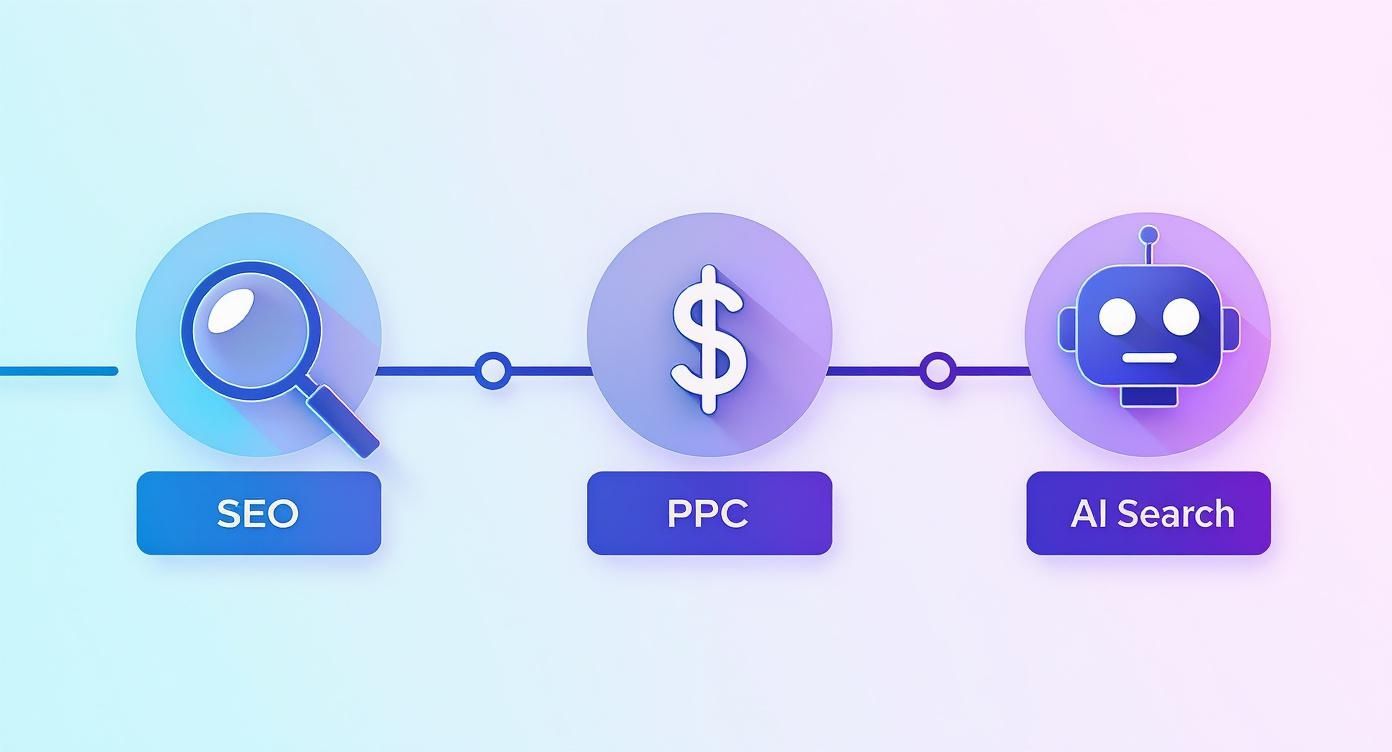
This progression from SEO to PPC and now to AI-driven search really underscores why a modern, integrated measurement approach is so critical.
From Traffic to Consultations with CRO
Once your tracking is in place, the focus shifts to Conversion Rate Optimisation (CRO). This is the art and science of making it as easy as possible for a website visitor to take the action you want them to take—namely, contacting your firm. It's all about removing friction and building trust.
Start by digging into user behaviour. Use heatmaps or session recording tools to see where people are clicking, how far they scroll down a page, and where they get stuck or drop off. Are they struggling to find your phone number? Is your contact form too long and intimidating?
Every element on your key pages should be scrutinised:
- Calls-to-Action (CTAs): Instead of a generic "Contact Us," try something more specific and compelling, like "Request a Confidential Case Review." Make your buttons stand out with colours that contrast with the rest of the page.
- Contact Forms: Keep them simple. Only ask for the absolute essentials: name, email, phone number, and a brief message. Every extra field you add is another reason for someone to give up.
- Trust Signals: Strategically place testimonials, case results, and legal association badges near your CTAs. These elements reassure potential clients at the exact moment they're deciding whether to reach out.
Key Performance Indicators for Law Firm SEO
To figure out what’s working and where you need to adjust your strategy, you need to track the right Key Performance Indicators (KPIs). For a law firm, this means focusing on the metrics that have a direct impact on your ability to generate new cases.
Here’s a breakdown of the KPIs that truly matter for law firms and what they tell you about your SEO performance.
Key Performance Indicators for Law Firm SEO
| Metric | What It Measures | Why It Matters For Lawyers | Tool To Track |
|---|---|---|---|
| Organic Traffic | The number of visitors arriving from non-paid search results. | Indicates the overall health and reach of your SEO efforts. | Google Analytics 4 |
| Keyword Rankings | Your website's position in search results for specific legal terms. | Shows your visibility for high-intent keywords that drive qualified leads. | Google Search Console |
| Goal Completions | The number of times users complete a desired action (e.g., form fills, calls). | The ultimate measure of whether your SEO is generating actual business leads. | Google Analytics 4 |
| Click-Through Rate (CTR) | The percentage of people who see your site in search and click on it. | A low CTR might signal that your page titles and meta descriptions need work. | Google Search Console |
By consistently monitoring these metrics and refining your website based on real user behaviour, you close the loop. You transform your website from a simple online brochure into a predictable, efficient client acquisition engine—one that delivers a measurable return on your SEO investment.
Common Questions on SEO Marketing for Lawyers
When law firms start digging into an SEO strategy, a few practical questions always come up. How fast can we expect the phone to ring? What's a realistic budget? Can our team just do this ourselves?
Let's cut through the noise and give you some straight answers based on our experience with Australian law firms. Getting your head around these key points will help you make smarter decisions and align your investment with real-world expectations.
How Long Does Law Firm SEO Take to Show Results?
While you might see some early movement from local SEO tweaks within 1-3 months, it's critical to see the bigger picture. SEO isn't a tap you turn on for instant leads.
You'll typically start seeing meaningful, consistent growth in organic traffic and—more importantly—qualified client enquiries within 6 to 12 months. The exact timeline really depends on a few things:
- Practice Area Competition: Trying to rank for "personal injury lawyer Sydney" is a completely different ball game than "notary public in Dubbo." The competition level sets the pace.
- Website Health: If your site is bogged down with technical problems or has very little content, there's foundational work to do first before you can expect to climb the rankings.
- Effort & Intensity: The resources and consistency you pour into creating content, building authoritative links, and fixing technical issues directly speed up your results.
Think of SEO as an investment in a durable, self-sustaining client acquisition channel for your firm. The authority you build is an asset that pays dividends for years, unlike paid ads that vanish the moment you stop the spend.
Can I Do SEO for My Firm Myself?
Absolutely. You can definitely tackle many foundational SEO tasks in-house. Things like updating your Google Business Profile, writing blog posts on recent legal developments, or asking clients for reviews are all valuable and make a positive difference.
But here’s the reality: the legal space is one of the most competitive online arenas. A specialist agency brings deep expertise in the areas that are tough to master part-time, like technical SEO audits, advanced keyword research for specific legal niches, and analysing what your competitors are doing to earn backlinks.
Many firms find a hybrid model works best. The internal team handles the content and client-facing tasks they know best, while an expert partner manages the highly technical and strategic side of things to get results faster and more effectively.
What Part of SEO Is Most Crucial for a Local Firm?
While a comprehensive strategy always wins, for the vast majority of Australian law firms, local SEO is hands down the most critical element. Most of your clients aren't looking for a lawyer anywhere in the country; they need one right in their city or suburb.
Getting your firm into the top local search results and the Google "map pack" for terms like "criminal lawyer in Melbourne" will deliver the biggest bang for your buck. This comes down to three key things:
- A perfectly optimised Google Business Profile.
- A consistent, steady stream of positive client reviews.
- Content on your website that speaks directly to your local area.
This focus connects you with potential clients nearby who are ready to take action, making it the most direct path to new business from search.
What Is a Realistic SEO Budget for an Australian Law Firm?
There's no single price tag. SEO budgets for Australian law firms can vary massively depending on your location, the practice areas you're targeting, and how aggressively you want to grow.
A small practice in a regional town might see great results investing $1,500 – $3,000 AUD per month. On the other hand, a firm in a major city like Melbourne, going after a high-value practice area, could easily budget $5,000 – $10,000+ AUD each month.
It’s better to frame this as an investment in client acquisition, not just a cost. Your budget should be a reflection of the competitive landscape and what your firm's goals are for bringing in new cases and boosting revenue.
At Click Click Bang Bang, we specialise in creating data-driven SEO and PPC strategies that deliver measurable results for businesses. If you're ready to turn your online presence into a powerful client-generation engine, explore our services at https://clickclickbangbang.com.au.
Read NeXt
Or Read Our Latest
- Manual vs Automated Bidding for PPC Success
- Conversion Tracking Setup: A Complete AU Guide
- Instagram Advertising Australia: Complete 2026 Guide
- Pay Per Click: A Beginner’s Guide for Australian Marketers
- Display Advertising on Google: The Complete Australian Guide
- Stakeholder Communication Plan How to Build One That Works
Click. CLick. Subscribe.
Get our best PPC insights, industry updates, and power moves delivered straight to your inbox. No fluff, just high-caliber strategies that actually work.
Don’t Leave Just Yet
Try Us For 30-Days,
Risk Free!!
We guarantee that you’ll love our work within the first 30 days, if not you’ll get your money back.
What have you got to lose?