

SEO Services for Ecommerce The Ultimate Guide
Last Updated

At its core, ecommerce SEO is a specialised field of digital marketing. It’s all about fine-tuning your online store to climb the ranks in search engine results, pulling in more of the right kind of traffic—people who are actually looking to buy what you sell. This means optimising everything from your product pages and site architecture to your content, making sure you’re the first brand customers see.
Why Ecommerce SEO Is Your Greatest Competitive Advantage

In Australia's cutthroat online market, having a beautiful website and amazing products just isn't enough anymore.
Think of it this way: without SEO, your online store is like a brilliant new shop tucked away in a quiet back alley. A few people might stumble upon it by chance, but that’s it. With a powerful SEO strategy, you’ve just moved your shop to a prime spot on the busiest high street in town, right in front of a constant stream of customers ready to buy.
This visibility isn't just a nice-to-have; it's fundamental to survival and growth. Specialised seo services for ecommerce act as your digital megaphone, making sure your brand isn’t just another hidden gem but a dominant player in your market.
The Booming Australian Online Marketplace
The shift to online shopping in Australia is no longer a trend—it's the new standard. And because the opportunity is so massive, the competition is fierce.
Australian eCommerce has seen explosive growth. Online spending hit a record $69 billion in 2024, a mind-boggling jump from the $28.5 billion spent just before the pandemic. This isn't a small change; it's a complete transformation in how Australians shop.
Just look at the numbers:
- Shopper Growth: The number of Aussies shopping online every month has skyrocketed from 11.78 million in 2020 to 17.08 million in 2024.
- Mobile Dominance: Smartphones are now the go-to shopping tool, driving 77% of all site visits and a massive 68% of orders.
The data is crystal clear: your customers are online, they're on their phones, and they're ready to spend. You can find more insights into this massive shift in the Australian eCommerce landscape.
The critical question is no longer if your customers are online, but if they can find you when they are ready to purchase. A targeted SEO strategy is the bridge connecting their search query directly to your product page.
Without a deliberate plan to show up in search results, you are essentially invisible to the millions of potential buyers searching for your products every single day. This is where a dedicated ecommerce SEO strategy becomes your most valuable asset, turning search engine traffic into a predictable and profitable revenue stream.
So, what do you actually get when you pay for professional ecommerce SEO services?
Let's use an analogy. Imagine you're building a new flagship retail store from the ground up. You wouldn't just hire a construction crew and hope for the best. You'd bring in an architect to design the structure, an interior designer to craft the customer experience, and a retail strategist to make sure the whole thing is actually designed to sell.
They’d map out the store layout for a natural customer flow, decide exactly where products should sit on the shelves for maximum visibility, and create signage that pulls people in from the street. Professional ecommerce SEO works the exact same way. It’s not about one single trick; it’s a coordinated strategy to build a powerful online store that’s engineered for sales.
More Than Just Keywords
While general SEO is about getting a website seen, ecommerce SEO is ruthlessly focused on one thing: driving profitable revenue. Every single tactic, whether it’s a small technical fix or a new blog post, is tied directly to making your products more visible, improving the shopping experience, and ultimately, ringing the cash register.
It's the difference between attracting casual window shoppers and bringing in serious buyers, credit card in hand.
This specialised focus means bringing together a whole suite of services that work in harmony. Think of them as the different experts on your store construction team, each handling a critical part of turning your digital storefront into a sales machine. For anyone wanting to brush up on the basics, getting familiar with the broader field of search engine optimisation gives you a great foundation for understanding these more specialised services.
The Core Components of Ecommerce SEO
Professional services will almost always bundle several key disciplines into one cohesive strategy. Each one tackles a different part of how your online store performs in search engines.
Here’s a look at what each member of that "construction team" actually does:
-
On-Page SEO (The Interior Designer): This is all about optimising the elements your customers see and interact with on your product and category pages. It involves writing compelling product titles and descriptions, structuring pages so they're a breeze to navigate, and placing your keywords perfectly to attract the right kind of shopper.
-
Technical SEO (The Architect & Engineer): This is the bedrock of your store. It’s about making sure search engines can easily crawl, understand, and index your site. Key jobs include boosting site speed (a slow site absolutely kills sales), adding structured data so your products get those fancy rich snippets in search results, and making sure your site works flawlessly for mobile shoppers.
-
Content Marketing (The Signage & Sales Staff): This is how you attract customers before they even know they're ready to buy. It’s about creating genuinely helpful buying guides, product comparison articles, and blog posts that answer your customers' most pressing questions, positioning your brand as an authority they can trust.
-
Off-Page SEO (The Public Relations Team): This is all about building your store’s reputation and authority across the web. The main game here is link building—earning links from other credible websites. Every high-quality backlink acts like a strong vote of confidence, telling search engines your store is a trustworthy and valuable place for shoppers to visit.
When you put them all together, these pillars form a comprehensive strategy. If you neglect one, it’s like building a beautiful store on a shaky foundation—it might look impressive at first, but it won’t stand the test of time or deliver the sustainable growth your business needs.
The Four Pillars of a Winning Ecommerce SEO Strategy
A solid ecommerce SEO strategy isn’t built on a single tactic. Think of it more like a sturdy building supported by four distinct but interconnected pillars. If you neglect any one of them, it’s like trying to build a house with only three walls—it simply won’t stand strong against the competition.
Getting your head around how these pillars work together is the secret to creating a sustainable, traffic-driving machine for your online store.
This infographic breaks down the core components that professional SEO services for ecommerce focus on.
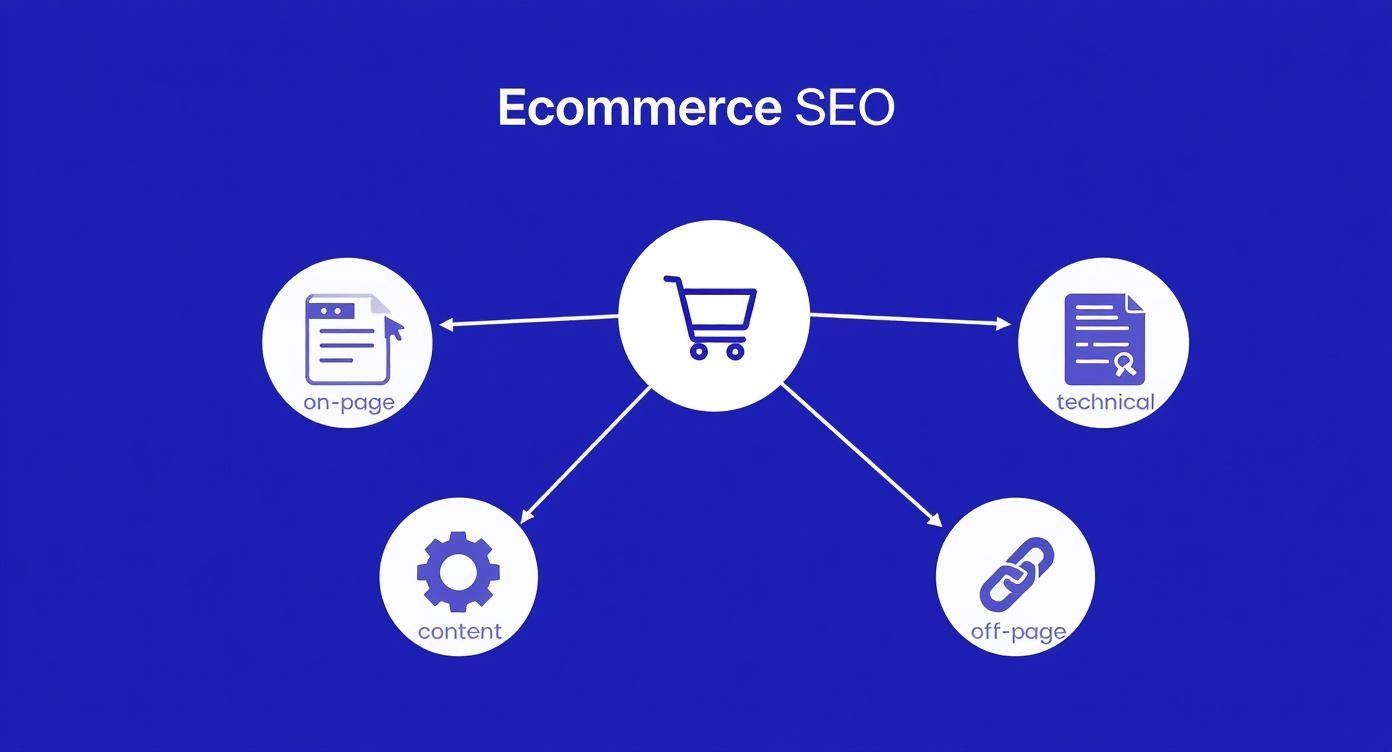
Each pillar—On-Page, Technical, Content, and Off-Page—tackles a unique part of your store's search visibility. Together, they create a complete and robust optimisation plan. Let's dive into what each one involves and how it directly impacts your bottom line.
To give you a quick overview, here’s how the four pillars break down:
Core Components of an Ecommerce SEO Service
| Pillar of SEO | Key Activities | Primary Goal |
|---|---|---|
| On-Page SEO | Product & category page optimisation, keyword research, internal linking, meta descriptions, image alt text. | Make individual pages highly relevant and compelling for both search engines and human shoppers. |
| Technical SEO | Site speed optimisation, mobile-friendliness, structured data (schema), sitemaps, crawlability fixes. | Ensure the website's foundation is solid, fast, and easily understood by search engine crawlers. |
| Content Marketing | Blogging (buying guides, how-to articles), creating video content, developing resource hubs. | Attract potential customers early in their buying journey, build authority, and earn trust. |
| Off-Page SEO | Link building (earning backlinks), digital PR, brand mentions, local SEO citations. | Build the website's reputation and authority across the web, signalling trustworthiness to Google. |
Now, let's explore what this looks like in practice.
On-Page SEO: The Art of the Perfect Sales Pitch
On-Page SEO is all about optimising the elements that customers and search engines see directly on your website. Think of it as merchandising your digital shelves. It’s about making your product and category pages as clear, compelling, and relevant as possible.
This goes way beyond just stuffing keywords into your product descriptions. It’s about crafting titles that grab attention in search results and writing descriptions that not only answer a user's query but also convince them to click "add to cart."
Effective On-Page SEO for an online store includes:
- Optimised Product Titles: Creating clear, keyword-rich titles like "Men's Waterproof Hiking Boots – Size 11" instead of a generic "Hiking Shoe."
- Compelling Product Descriptions: Writing unique, benefit-driven copy that answers customer questions and includes relevant keywords naturally.
- Logical Category Page Structure: Organising products into intuitive categories (e.g., Clothing > Men's > Shirts > T-Shirts) to improve user navigation and help search engines understand your site hierarchy.
- High-Quality Imagery with Alt Text: Using descriptive alt text for product images to improve accessibility and provide search engines with context.
Technical SEO: The Unshakeable Foundation
If On-Page SEO is the merchandising, Technical SEO is the store's architecture and engineering. It's the behind-the-scenes work that makes sure your website is fast, secure, and easy for search engine crawlers to understand. A poor technical foundation can sabotage all your other efforts, no matter how great your products are.
For instance, a slow-loading product page is a massive conversion killer. Studies consistently show that even a one-second delay can significantly increase bounce rates. Technical SEO fixes this and other critical issues that hurt both user experience and search rankings.
Key technical tasks often include:
- Improving Site Speed: Compressing images and optimising code to ensure pages load almost instantly.
- Mobile-Friendliness: Guaranteeing a flawless shopping experience on smartphones, where the majority of online shopping now happens.
- Implementing Structured Data: Adding special code (schema markup) that helps search engines display rich results like star ratings, price, and stock availability directly in search listings. This can make your products stand out from competitors.
- Optimising Product Feeds: Ensuring your product information is correctly submitted to platforms like Google Merchant Center. This is a crucial step, and you can learn more about how to set up a Google Shopping feed to maximise your visibility.
Technical SEO ensures that search engines can not only find your pages but also understand them deeply. This clarity allows them to confidently present your products to the right shoppers at the exact moment they are ready to buy.
Content Marketing: Attracting Customers Before They Search for Products
Content Marketing is your game plan for engaging potential buyers before they're even looking for a specific product. It’s about creating valuable, helpful content—like buying guides, comparison articles, and how-to posts—that answers your audience’s questions and builds trust in your brand.
Imagine someone is just starting to research a new hobby, like camping. They might search for "beginner's guide to camping gear." If your outdoor supply store has a comprehensive blog post on that topic, you've just introduced your brand as a helpful authority. When they are ready to buy a tent or sleeping bag, your store will be their first stop.
Off-Page SEO: Building Your Digital Reputation
Finally, Off-Page SEO is all about building your store's authority and credibility across the web. The main tactic here is earning high-quality backlinks—links from other reputable websites pointing to yours.
Think of each backlink as a vote of confidence. When a popular industry blog or a respected product review site links to your product page, it signals to search engines that your store is trustworthy and a valuable resource. This is immensely powerful for improving your rankings, especially in a crowded marketplace.
This focus on search visibility is critical, as organic search is the lifeblood of Australian online retail. Data shows that an incredible 53.3% of all traffic to local eCommerce platforms comes from organic search. To truly implement a winning ecommerce SEO strategy, it's essential to stay updated on and apply the latest ecommerce SEO best practices.
Winning The Local Battle With Targeted SEO
Even if your ecommerce store ships products Australia-wide, ignoring local search is like ignoring a crowd of highly motivated customers standing right on your doorstep. Think of a big pizza chain; they deliver across entire cities, but they still need to dominate searches for 'pizza near me'.
Local SEO is your secret weapon to capture this exact kind of high-intent, geographically-focused traffic. It’s a huge deal in Australia, where local intent drives a massive slice of all search activity.
In fact, a staggering 46% of all Google searches have a local component. That translates to billions of daily queries from people looking for products and services in their immediate area. For online retailers, this is a golden opportunity to connect with buyers who are often ready to purchase on the spot.
Why Local SEO Matters For Online Stores
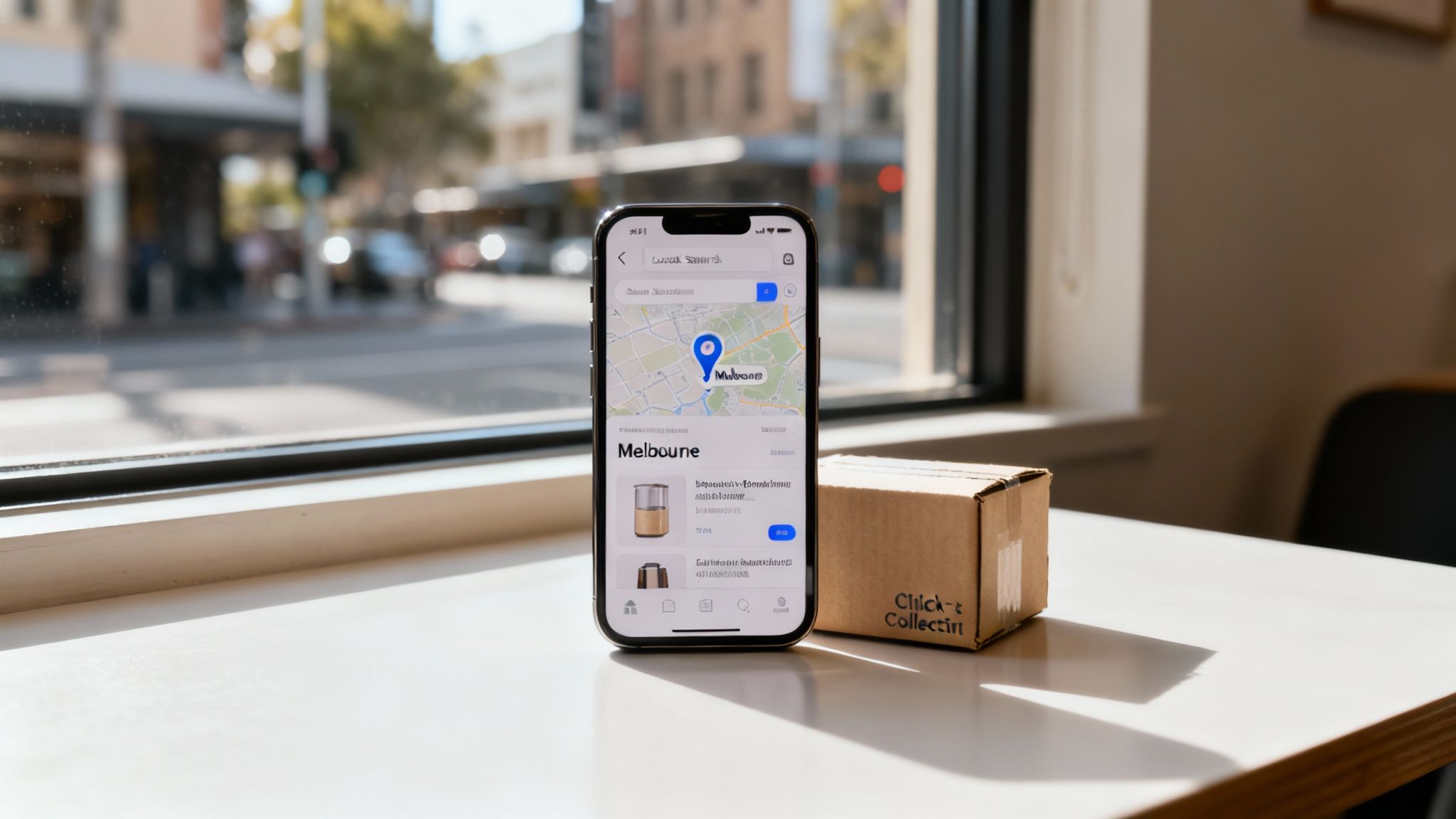
You might not have a physical shopfront, but local signals still build immense trust and relevance with both Google and your customers. When someone in Melbourne searches for "same-day tech delivery," Google’s algorithm will naturally prioritise businesses that show strong local relevance to that city.
This is where you can gain a serious advantage over larger, faceless national competitors who lack a specific local presence. It’s your chance to be the local hero.
By focusing on local optimisation, you tap into a segment of the market that converts at a much higher rate. Research shows that 18% of local smartphone searches lead to a purchase within one day, compared to just 7% for non-local searches. The link between local relevance and immediate sales is crystal clear.
Local SEO isn't just about being found; it's about being chosen. It tells local customers that you are part of their community, understand their needs, and can serve them faster and more personally than a distant, generic online megastore.
Practical Tactics For Local Ecommerce SEO
So, how do you put this into action for your online store? It all starts with sending the right signals about your local relevance to search engines and potential customers.
For ecommerce businesses with physical locations or those targeting specific geographical areas, this comprehensive local SEO for ecommerce guide offers some brilliant strategies to boost local sales.
Here are three core tactics that drive real results:
-
Optimise Your Google Business Profile
Even without a physical store, you can set up a Google Business Profile (GBP) with a designated service area. This is absolutely crucial for appearing in the local map pack. Make sure your profile is complete with high-quality product photos, accurate business hours, and actively encourage customer reviews. Getting customers to mention local suburbs in their reviews can also provide a powerful ranking boost. -
Create City-Specific Landing Pages
Develop dedicated landing pages for the major cities you serve, like 'Handmade Leather Goods Sydney' or 'Organic Skincare Perth'. These pages should feature locally-tailored content, perhaps mentioning local landmarks or events, and include testimonials from customers in that specific area. This simple step makes your store hyper-relevant to city-based searches. -
Gather Powerful Local Reviews
Actively chase reviews from customers that mention their location. A review stating, "Fastest delivery I've ever had in Brisbane!" is pure SEO gold. It provides instant social proof and reinforces your local service credentials directly within the search results, building trust before a customer even clicks through to your site.
Choosing the Right Ecommerce SEO Agency
Picking a partner for your ecommerce SEO services is one of the biggest calls you'll make for your online store. This isn't just about hiring another supplier; you’re looking for a strategic partner who’ll become an extension of your team, someone genuinely invested in seeing you grow.
The right agency can unlock serious revenue. The wrong one can burn through your budget and, even worse, do lasting damage to your site's reputation.
Making the right choice means having a clear process and knowing exactly what to look for. Think of it like hiring a specialist surgeon. You wouldn't pick one based on the cheapest price or the flashiest promises. You’d look for proven experience, a solid plan, and transparent communication. That same level of care is exactly what you need when vetting an SEO agency.
Questions You Must Ask Potential Agencies
Before you even think about signing a contract, you need to do some digging to separate the real experts from the pretenders. A great agency will welcome tough questions and give you detailed, confident answers. Their responses will tell you everything about their expertise, their process, and whether they actually get the unique challenges of online retail.
Here are the essential questions to bring to the table:
-
Can you show us ecommerce-specific case studies? Ask to see examples of online stores similar to yours. You're looking for proof of real results—things like increased organic revenue, higher conversion rates from search traffic, and better rankings for valuable "money" keywords, not just meaningless metrics.
-
How do you measure and report on success? A sharp agency focuses on business outcomes, period. Their reports should go way beyond simple traffic numbers and keyword rankings. They need to connect their SEO work directly to your KPIs, like organic conversion rate, average order value, and—the big one—revenue generated from search.
-
What is your approach to link building? This question is a big one. A quality agency will talk about earning high-authority links through digital PR, creating great content, and doing strategic outreach. If anyone mentions buying links or using private blog networks (PBNs), that's your cue to be wary. Those tactics can get you slapped with a nasty Google penalty.
-
Who will be working on our account? Get to know who your day-to-day contact will be and the experience of the team doing the actual work. The last thing you want is to be handed off to a junior account manager right after the sales pitch is over.
Red Flags That Signal Trouble
Knowing what to look for is only half the battle. You also need to recognise the warning signs of a low-quality or even dangerous SEO provider. These red flags should make you hit the brakes immediately, as they often lead to poor results and long-term damage to your website’s authority.
An SEO agency that guarantees a #1 ranking on Google isn't confident; they are dishonest. Search engine algorithms are complex and always changing, making such guarantees impossible for anyone to ethically make.
Keep a sharp eye out for these common warning signs:
-
Guaranteed #1 Rankings: This is the oldest trick in the book. No one can guarantee specific rankings on Google. An agency that claims they can is either clueless or deliberately trying to mislead you.
-
Lack of Transparency: If an agency is cagey about their methods, calling them "proprietary," run for the hills. A trustworthy partner will be completely open about their strategies for on-page optimisation, technical fixes, and how they acquire links.
-
One-Size-Fits-All Packages: Every ecommerce business is different, with its own products, customers, and competitors. An agency offering a generic, fixed-price SEO package without a custom audit isn’t giving you a strategy—they’re just selling a product.
-
Focus on Vanity Metrics: Be careful if their sales pitch is all about boosting traffic or ranking for obscure keywords. The whole point of seo services for ecommerce is to drive profitable growth, not just pump up numbers that don't affect your bottom line.
Choosing the right agency is about committing to a partnership built on trust, transparency, and the shared goal of growing your revenue. By asking the right questions and watching for these critical red flags, you can confidently pick a partner who will help your ecommerce store truly thrive.
How to Measure Your Ecommerce SEO Investment
Let's get one thing straight: effective seo services for ecommerce aren’t just about getting more traffic. They're about making more money. Seeing your keyword rankings climb is a nice little ego boost, but that metric doesn't pay the bills. The real measure of success is connecting your SEO activities directly to your bottom line.
To do this, you have to stop focusing on vanity metrics and start looking at the Key Performance Indicators (KPIs) that actually matter for an online store. These are the numbers that reveal the financial impact of your SEO spend, letting you see exactly what you're getting back for every dollar you put in.
Moving Beyond Rankings to Revenue
The first step is to break the obsession with hitting number one for a single keyword. Instead, you need to concentrate on the metrics that directly influence sales and profit. A great SEO campaign improves the entire customer journey, from the moment they discover you to the final checkout click, and your measurements need to reflect that.
For any ecommerce business, these are the KPIs that count:
- Organic Traffic: The total number of people landing on your site from unpaid search results. Think of this as the top of your funnel.
- Organic Conversion Rate: The percentage of those organic visitors who actually buy something. This tells you if your SEO is attracting qualified, ready-to-buy customers.
- Average Order Value (AOV) from Organic Search: The average amount spent by customers who found you through organic search. A rising AOV is a brilliant sign you're attracting higher-value shoppers.
- Total Organic Revenue: This is the big one. It's the total income generated directly from visitors who found your store through a search engine.
Tracking these figures properly means having a rock-solid analytics setup. Implementing website conversion tracking is completely non-negotiable here, as it gives you the raw data needed to measure performance accurately.
True SEO success isn't just about being found; it's about being profitable. Tying every SEO effort back to revenue is the only way to make intelligent, data-driven decisions about your marketing budget.
Calculating Your SEO Return on Investment
Once you have reliable data flowing in on your core ecommerce KPIs, calculating your Return on Investment (ROI) becomes surprisingly simple. This calculation turns abstract SEO efforts into a clear financial result, showing you whether your investment is actually paying off.
You can use this simple framework to measure your ROI:
Step 1: Calculate Your SEO Gain
First, work out the total revenue you've generated from organic search over a specific time, like a quarter. Then, subtract what you spent on SEO services during that same period.
(Organic Revenue) - (SEO Investment) = SEO Gain
Step 2: Calculate Your ROI
Next, just divide your SEO Gain by your initial SEO Investment. To get a percentage, multiply the result by 100.
(SEO Gain / SEO Investment) x 100 = SEO ROI (%)
For instance, if you generated $30,000 in organic revenue after spending $5,000 on SEO services, your ROI would be a very healthy 500%. This simple bit of maths gives you a powerful, unambiguous measure of your campaign's financial success. It’s the kind of number that justifies your marketing spend and gives you the confidence to scale up your efforts, knowing they're contributing directly to business growth.
Got Questions About Ecommerce SEO? We’ve Got Answers
Stepping into the world of professional SEO for your online store can feel like a big move, and it's totally normal to have a few questions rattling around. Here are some of the most common ones we hear from Aussie ecommerce owners, with straight-up answers.
How Long Does Ecommerce SEO Actually Take to Work?
Unlike flicking on a paid ad for instant traffic, SEO is more of a long game—one that builds real, lasting momentum. You’ll probably start to see some positive signs and little ranking jumps within the first 3 to 4 months.
But the real, game-changing impact on your organic traffic and sales? That usually takes shape between 6 to 12 months.
Think of it like laying the foundations for a house. The first few months are all about getting the groundwork right—fixing technical issues, sorting out your on-page optimisation, and making sure the site is solid. The visible structure comes later, but because the foundation is strong, it's built to last for years.
What's the Difference Between Ecommerce SEO and Regular SEO?
While they both stem from the same core principles, their goals are worlds apart. General SEO might be about getting a blog post to rank or just boosting brand awareness. Ecommerce SEO, on the other hand, is ruthlessly focused on one thing: making you money.
Every single task is tied directly to driving sales. This means we're constantly dialled in on:
- Optimising product and category pages for keywords that scream "I'm ready to buy!"
- Using technical wizardry like structured data to get those eye-catching product details in search results.
- Designing a site structure that effortlessly guides visitors from a search query to the checkout button.
Ecommerce SEO doesn't just see website visitors; it sees potential customers. Every search ranking isn't just a number; it's a direct opportunity to generate revenue. The end goal isn't just traffic—it's profitable traffic.
Can I Just Do Ecommerce SEO Myself?
Absolutely. You can definitely get the ball rolling on your own. Things like writing unique product descriptions, tweaking your page titles, and kicking off a blog are fantastic first steps. But be warned: the ecommerce world is fierce, and the technical side of SEO can get seriously complex, fast.
Bringing in an agency gives you immediate access to a team of specialists, expensive industry tools, and years of hard-won experience. It means a comprehensive strategy gets rolled out much quicker, letting you focus on what you do best—running your business—while the experts wrestle with search algorithms and keep an eye on your competitors.
Ultimately, hiring a pro is an investment in speeding up your growth and getting a much bigger return down the track.
Ready to turn your search engine traffic into a predictable, profit-making machine? Click Click Bang Bang is a specialised SEO agency that lives and breathes ecommerce growth. Explore our SEO services and get your free proposal today!
Read NeXt
Or Read Our Latest
- Push vs Pull Marketing: A 2026 Decision Guide
- Ad Relevance Score Explained: How It Impacts PPC Performance
- Best ROI Digital Marketing: 10 Channels Ranked for 2026
- Localization Strategy: How to Win in Any Market
- Phone Call Tracking: Methods, Metrics, and Best Practices
- Supplier Relationship Management: Strategic Guide 2026
Click. CLick. Subscribe.
Get our best PPC insights, industry updates, and power moves delivered straight to your inbox. No fluff, just high-caliber strategies that actually work.
Don’t Leave Just Yet
Try Us For 30-Days,
Risk Free!!
We guarantee that you’ll love our work within the first 30 days, if not you’ll get your money back.
What have you got to lose?