

Grow with seo for small companies: practical tactics
Last Updated
Feeling a bit lost in the world of SEO? I get it. For small companies, search engine optimisation can feel like another complicated thing on an already long to-do list. But here’s the thing: it’s the single most powerful tool you have to compete against bigger businesses, without needing a massive budget.
It’s all about making your business more visible to the exact people searching for what you do. Think of it as turning your website into a magnet for genuine, ready-to-buy customers.
Why SEO Is Your Greatest Digital Asset

A lot of small business owners see SEO as a technical puzzle best left to experts with deep pockets. The reality is much simpler than that.
Think of SEO as digital word-of-mouth. It’s the process of proving to search engines like Google that your business is a trustworthy, helpful, and relevant answer to a potential customer's question or problem.
When it's done right, SEO for small companies delivers far more than just a bump in website traffic. It builds a sustainable foundation for growth by attracting the right kind of visitors—those actively looking for your products or services. With over 53% of all website traffic coming from organic search, your ideal customers are already out there looking for you. The goal is just to make sure they find you first.
The True Value for Your Business
Let's cut through the confusing jargon for a moment and talk about what really matters: practical outcomes. A smart SEO strategy can transform your online presence and deliver measurable results that directly impact your bottom line. It’s not just about chasing rankings; it’s about hitting real business goals.
Here’s what that looks like:
- Increased Visibility: Showing up on the first page of Google puts your brand directly in front of motivated buyers. It builds awareness and gets your name recognised.
- Building Credibility and Trust: A high search ranking is a powerful endorsement. It sends a signal to people that you're an authority in your field—someone they can rely on.
- A High Return on Investment: Unlike paid ads that vanish the moment you stop paying, good SEO builds long-term digital assets. The work you do today can continue to generate leads and sales for years to come.
SEO levels the playing field. It gives small businesses the ability to compete with, and often outrank, bigger competitors by being smarter, more focused, and more helpful to a specific audience.
Before diving into the nuts and bolts of SEO, it’s critical to make sure your online foundation is solid. This guide on web development for small businesses is a great place to start, ensuring your site is ready to perform.
Ultimately, SEO is a cornerstone of any successful strategy for digital marketing for small business, helping you attract, engage, and convert the customers you want.
The Three Core Pillars of Modern SEO
To build a solid search engine optimisation strategy, you first need to get your head around its three main parts. Think of your website as a physical shop. For customers to find it, walk in, and actually buy something, a few things need to work together perfectly. Modern SEO is no different—it stands on three core pillars that support each other.
These pillars are On-Page SEO, Off-Page SEO, and Technical SEO. While the names might sound a bit technical, the ideas behind them are pretty straightforward. Getting how they interact is the key to building an online presence that lasts and consistently brings in the right kind of customers.
On-Page SEO: Your Digital Storefront
On-Page SEO covers everything you do on your website's pages to make them more appealing to both search engines and actual humans. It’s exactly like setting up your physical shop. You need clear signs, well-organised shelves, and helpful product descriptions so people know what you're about the second they step inside.
This means optimising the things your visitors can see, like your content, but also the behind-the-scenes code that search engines crawl through. A well-optimised page sends a crystal-clear message about its purpose, making it dead simple for Google to understand and rank it for the right searches.
Key On-Page SEO activities include:
- Keyword Research: Pinpointing the exact words and phrases your ideal customers are typing into Google when they're looking for what you sell.
- High-Quality Content: Creating blog posts, articles, and service pages that are genuinely useful, answer real questions, and show off your expertise.
- Title Tags and Meta Descriptions: Writing the headlines and short summaries that show up in search results, making them so compelling that people can't help but click.
- Header Tags (H1, H2, H3): Using clear headings to structure your content, which improves readability for both your visitors and Google's bots.
At its heart, On-Page SEO is about creating content that speaks your customers' language while also giving search engines all the right signals to rank your site. It’s a bit of an art form.
Off-Page SEO: Building Your Reputation
Off-Page SEO is all about the actions taken outside of your website to build up its authority and reputation. If On-Page SEO is your storefront, Off-Page SEO is your word-of-mouth reputation around town. It’s the good reviews, the mentions in local news, and the recommendations you get from other respected businesses.
These outside signals tell search engines that your website is trustworthy, authoritative, and valuable to others. The biggest piece of the Off-Page puzzle is backlinks—links from other websites that point back to yours. Every high-quality backlink is like a vote of confidence, telling Google your content is worth recommending.
Building this kind of authority doesn't happen overnight, but it's an absolutely critical part of any successful SEO plan.
Technical SEO: The Engine Room
Finally, there’s Technical SEO. This is the crucial, behind-the-scenes stuff—the plumbing, wiring, and foundation of your digital shop. Your customers might never see it, but if it’s not working right, the whole experience falls apart.
This pillar makes sure that search engines can find, crawl, and index your website without running into any roadblocks. A technically sound website is fast, secure, and easy for search engine bots to navigate. All the amazing content and backlinks in the world won't matter much if your technical SEO is a mess.
Important elements of Technical SEO include:
- Website Speed: Making sure your pages load in a snap. Slow sites frustrate users and get penalised in rankings. In fact, 47% of consumers expect a webpage to load in two seconds or less.
- Mobile-Friendliness: Ensuring your site looks and works perfectly on smartphones and tablets, which is where most searches happen these days.
- Site Architecture: Organising your website in a logical way so that both users and search engines can easily find what they're looking for.
- XML Sitemaps: Creating a roadmap of your website that helps search engines discover all of your important pages.
Mastering Local SEO to Attract Nearby Customers
For most small businesses, your most valuable customers aren't on the other side of the country; they're right around the corner. This is where local SEO becomes your secret weapon. It’s the art and science of making your business pop up for people searching for products and services in your immediate neighbourhood.
Think about it. When someone whips out their phone and searches for "cafe near me" or "plumber in Richmond," local SEO is what puts your business in that prized map pack at the very top of the search results. It’s all about catching customers with high intent, right at the moment they need you most.
Local SEO isn’t a separate beast; it’s a specialised focus within the bigger SEO picture, blending on-page optimisation, off-page reputation, and a solid technical base.
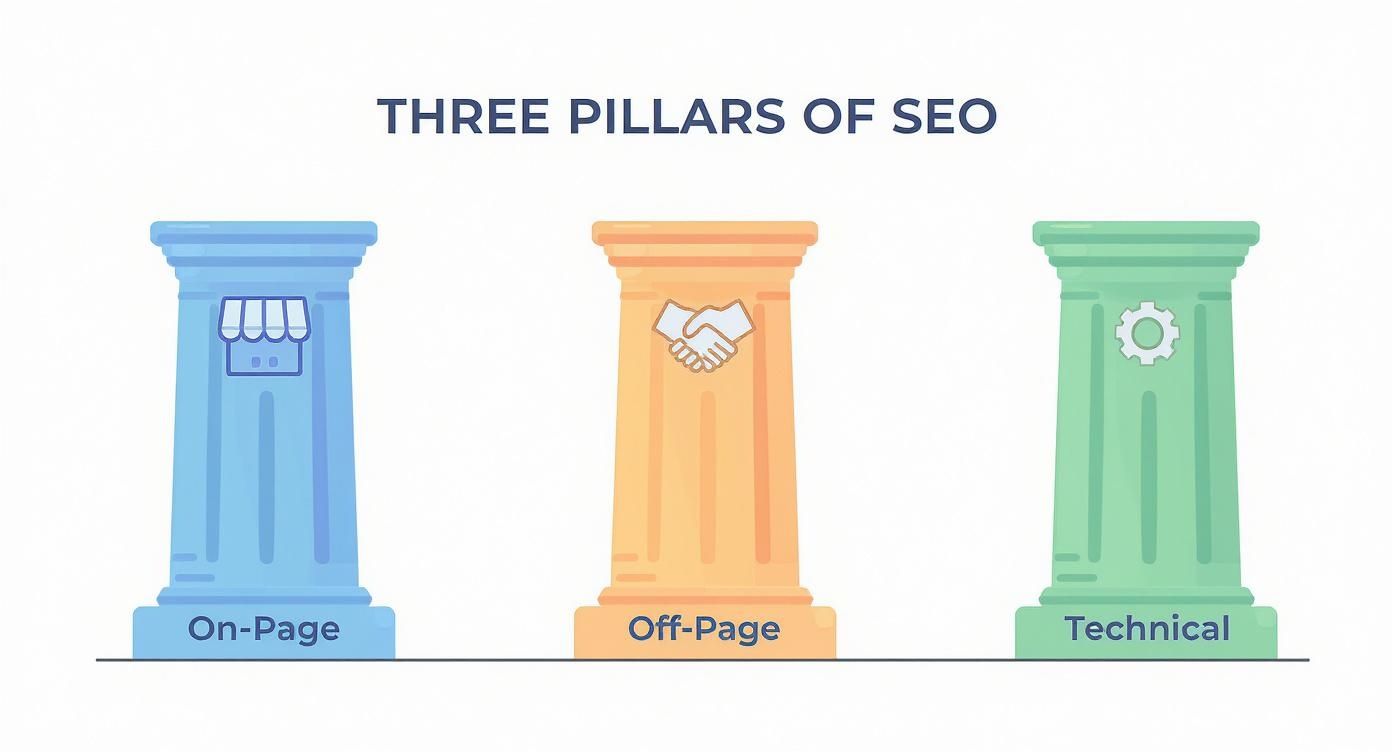
This just shows that a strong local presence comes from optimising your website (On-Page), building your reputation in the community (Off-Page), and making sure everything works flawlessly for the user (Technical).
Your Digital Welcome Mat: Google Business Profile
If there’s one place to start, it’s with your Google Business Profile (GBP). This is the cornerstone of any local SEO effort. It’s that free, dynamic listing that shows up in Google Maps and the local search results. Getting this right isn't just a good idea; it's the single most impactful thing you can do to get nearby customers through your door.
Your GBP is basically your digital shopfront. A potential customer searching online should be able to see who you are, what you do, and why they should choose you in a heartbeat.
To turn your profile into a customer magnet, you need to nail these basics:
- Claim and Verify It: This is step one. It proves to Google you own the business and gives you control over the information displayed.
- Fill Out Everything: Don't leave any section blank. The more details you provide—from your opening hours and services to accessibility info—the better Google can match you with the right searches.
- Add High-Quality Photos: Show off your space, your team, and your products. Profiles with photos get 42% more requests for driving directions. A picture really is worth a thousand words here.
The Power of NAP Consistency
One of the most crucial, yet surprisingly easy to mess up, parts of local SEO is NAP consistency. This stands for your business Name, Address, and Phone number. Search engines like Google are looking for confidence, and seeing the exact same information everywhere online gives it to them.
Little inconsistencies—like using "St." in one directory and "Street" in another, or having an old phone number floating around—create confusion. This confusion can erode Google’s trust in your location data and directly hurt your chances of showing up in the local map pack.
Maintaining consistent NAP information across all online directories, social media profiles, and your website is a foundational trust signal for Google. It confirms you are who and where you say you are.
A huge part of this is mastering business listing management to ensure your data is accurate and consistent across the web.
Building Trust with Customer Reviews
Reviews are the new word-of-mouth. They are a massive ranking factor for local search and act as powerful social proof that helps potential customers make a decision. Google wants to recommend the best local businesses, and a steady stream of genuine, positive reviews is one of the strongest signals that you're one of them.
You need a simple, non-pushy way to ask happy customers to leave you a review. This could be a follow-up email, a QR code at your checkout, or just a friendly request. Responding to all reviews—good and bad—is just as important. It shows you’re engaged and that you care about your customers' experience.
Local SEO is now a massive competitive advantage for small businesses in Australia. Consider this: local searches make up 46% of all Google queries, and a staggering 78% of people who search for something local on their phone make a purchase or visit a store within 24 hours. The opportunity is huge.
Ready to get started? Here’s a simple checklist to keep you focused on the tasks that will move the needle the most for your local visibility.
Your Local SEO Action Plan
| Action Item | Primary Goal | Why It Matters for Growth |
|---|---|---|
| Claim & Fully Optimise Your GBP | Maximise visibility in Google Maps and local search results. | This is your digital storefront; a complete profile attracts more views and actions. |
| Ensure NAP Consistency | Build trust and authority with search engines. | Consistent data across the web confirms your location and legitimacy, boosting rankings. |
| Generate a Steady Stream of Reviews | Increase social proof and improve local ranking signals. | Positive reviews directly influence both customer decisions and Google's algorithm. |
| Respond to All Customer Reviews | Show you are an engaged and customer-focused business. | Engagement builds community trust and encourages more customers to leave feedback. |
| Add Localised Content to Your Website | Target geographically-specific keywords and service areas. | "Near me" content helps you rank for specific local searches and proves your relevance. |
By focusing on these core local SEO tactics, you put your business squarely in the path of nearby customers who are ready to buy. It's about turning those online searches into real-world foot traffic, calls, and sales.
Building Your Online Authority with Backlinks
If your website is your digital storefront, then backlinks are like word-of-mouth referrals from other respected businesses around town. They're one of the most powerful signals you can send to search engines, basically proving your business is a legitimate, authoritative voice in its field. When another website links to yours, it's a huge vote of confidence.
This process is often called "link building," which might sound a bit technical, but really, it's just about building genuine relationships. It's a cornerstone of any decent SEO strategy for small companies because it directly builds your online reputation. Google sees these links as endorsements, and the more high-quality "votes" you collect, the more trustworthy your website looks.
And that trust? It translates directly into higher search rankings, helping more potential customers find their way to you.
Quality Always Beats Quantity
Here’s the thing: not all backlinks are created equal. A single link from a well-respected industry blog or a local news site is worth far more than a hundred links from spammy, irrelevant directories. Search engines are smart; they understand the context and authority of the site linking to you.
Imagine you own a local bakery. A link from a popular food blogger's glowing review of your croissants is a massive win. It tells Google you're a big deal in the local food scene. On the other hand, a random link from a dodgy, unrelated website can actually damage your reputation.
The goal is to focus on earning links that are:
- Relevant: They come from websites related to your industry, your services, or your local community.
- Authoritative: The site linking to you has a strong reputation of its own and is trusted by search engines.
- Natural: The link makes sense where it's placed. It’s not just jammed into a massive list of other links.
Practical Link Building for Small Businesses
You don’t need a massive PR budget to start earning valuable backlinks. The best strategies for small businesses are all about community engagement and creating stuff that’s genuinely useful. It’s less about technical wizardry and more about being a valuable part of your digital neighbourhood.
Start by thinking about the connections you already have or could easily build. This relationship-first approach makes link building feel a lot less like a chore and more like natural business networking.
Here are a few actionable ideas to get you started:
- Partner with Other Local Businesses: Team up with a complementary, non-competing business in your area. For instance, a wedding photographer could write a guest post for a local florist’s blog about choosing the perfect bouquet, complete with a link back to their own portfolio.
- Get Featured in Community News: Are you celebrating a business anniversary, running a charity drive, or launching a unique new product? Reach out to local news outlets, community newsletters, or neighbourhood bloggers and share your story. A feature almost always comes with a valuable link back to your site.
- Sponsor a Local Event or Team: Sponsoring a local fun run, a junior sports team, or a community festival is a great way to get your business name out there. It also usually gets you a link on their website’s sponsor page.
Building backlinks is really about creating assets and relationships that make other people want to talk about you. Think of it as an investment in your brand's authority that pays off in search rankings.
The power of backlinks is no secret, especially for small businesses in Australia. Research shows a staggering 81.6% correlation between backlinks and organic traffic. This link is so strong it makes link building a top priority for any Aussie business serious about getting found online. You can learn more about these Australian local SEO findings to see the full picture.
Creating Content People Want to Link To
One of the most sustainable ways to earn backlinks is simply to create content so good that other websites link to it naturally. Some people call this "link bait," but a better way to think of it is as creating a community resource. When you provide real value, others are happy to share it.
This doesn't have to be a massive, time-sucking project. It's about figuring out what your audience needs and giving them the best possible answer.
Consider creating one of these content types:
- The Ultimate Local Guide: Put together a detailed guide on something your customers care about. A real estate agent, for example, could create "The Complete Guide to Moving to Newcastle," covering everything from schools to neighbourhoods and local attractions.
- Helpful How-To Articles: A local hardware store could write a definitive blog post on "How to Build the Perfect Backyard Deck," complete with diagrams and a checklist of materials.
- Original Data or Case Studies: Have you surveyed your customers about a local issue? Or maybe you achieved amazing results for a client? Share that data in a compelling case study. Original information is incredibly linkable.
By focusing on these practical, relationship-driven tactics, any small business can start building a strong backlink profile. It isn’t about finding shortcuts; it's about earning your authority and becoming a trusted resource in your community, one link at a time.
Creating Content That Attracts and Converts

If backlinks are your online reputation, then your content is your voice. It’s how you prove you know your stuff, answer your customers' most urgent questions, and build a relationship long before they even think about buying. For SEO for small companies, creating genuinely helpful content isn't just a nice-to-have; it's the engine that drives your entire strategy.
Think of your blog posts and service pages as your most patient, knowledgeable employees. They’re on the job 24/7, answering the same questions over and over, showing your value, and gently guiding potential customers to the right solution. The goal isn't just to rank on Google—it's to become the go-to resource in your field.
Finding What Your Customers Are Asking
The best content always starts with listening. Before you even think about writing, you need to get inside the head of your ideal customer and figure out what they’re typing into that search bar. What’s bugging them? What problems are they trying to solve?
This whole process is called keyword research, and it’s basically your content roadmap. It uncovers the exact words and phrases your customers use, so you can create content that speaks directly to their needs. For instance, a local electrician shouldn't just target a generic term like "electrician services." That’s way too broad.
Instead, they should be creating content that answers very specific questions like:
- "How much does it cost to install a ceiling fan?"
- "Signs you need to upgrade your switchboard"
- "Is it safe to fix a flickering light myself?"
Each one of these is an opportunity to provide a genuinely helpful answer and pull a highly motivated customer straight to your website.
Adapting to the Age of AI Search
The game is changing. People are getting answers from search engines differently now, with AI-powered summaries popping up right at the top of the results. Simply ranking number one isn't the golden ticket it used to be, which makes the quality and clarity of your content more critical than ever.
It’s no longer just about getting someone to click through to your site. It's about giving Google's AI the best, most direct answer so it sees your content as the most authoritative source on the topic. We're already seeing a big drop in organic click-through rates. In Australia, when new AI Overviews appear, clicks to that top spot fall by an extra 34.5%. You can get the full picture from these critical AI SEO statistics for Aussie businesses.
To win in modern search, your content needs to be structured to give quick, clear, and comprehensive answers. Think less about flowery, long-winded prose and more about becoming the definitive, easy-to-digest resource for a specific topic.
How to Create Content That Converts
Creating content that not only gets eyeballs but also turns visitors into customers requires a bit of strategy. It’s all about building trust and showing off your expertise in a way that feels helpful, not like a hard sell.
1. Solve a Specific Problem
Every single piece of content needs a clear purpose. Focus on solving one specific problem for your reader, whether it’s a simple how-to guide, a product comparison, or an explanation of something complex in your industry.
2. Structure for Readability
Nobody wants to read a giant wall of text. Seriously. Use formatting to make your content easy to scan and digest, especially on a mobile phone.
- Short Paragraphs: Stick to 1-3 sentences max. Break it up.
- Clear Headings: Use H2 and H3 subheadings to organise your content into logical chunks.
- Bulleted Lists: These are perfect for highlighting key steps or takeaways.
- Bold Text: Make important terms, stats, and phrases stand out.
3. Show, Don't Just Tell
Incorporate real-world examples, case studies, or customer stories to make your content feel more credible and relatable. If you're a painter, show before-and-after photos of a job you just finished. If you're a consultant, share a quick story about how you helped a client succeed. This kind of proof builds trust and helps potential customers see themselves using your services.
Measuring Your SEO Success to Fuel Growth
You’ve put in the time and effort to get your SEO strategy off the ground. That’s great, but how do you know if any of it is actually working? Measuring your success isn’t about drowning in data; it’s about tracking a few key metrics that tell you you’re moving in the right direction.
This is how you turn SEO from a guessing game into a predictable way to grow your business.
The best part? You don’t need any fancy or expensive software to get started. The free tools from Google are more than powerful enough for most small businesses. They give you all the insights you need to make smarter decisions and double down on what’s working.
Think of SEO data as a compass for your business. It doesn't just tell you where you've been; it guides you on where to go next, ensuring your efforts are always pointed toward growth and customer acquisition.
Key Metrics That Matter
Instead of getting lost in dozens of different metrics, just focus on the handful that directly impact your bottom line. These indicators will give you a clear, no-nonsense picture of your SEO performance.
Here are the essentials to keep an eye on:
- Organic Traffic: This is simply the number of people landing on your website from search engine results. A steady increase here is a massive sign that your SEO is paying off and more people are discovering you organically.
- Keyword Rankings: Tracking your position for your most important keywords shows how your visibility is growing. Seeing your business climb the rankings for the exact terms your customers are searching for means you're becoming a more authoritative voice in your space.
- Conversion Rate: This is the ultimate measure of success. It tracks how many of your visitors take a valuable action, like filling out a contact form, signing up for a newsletter, or making a purchase. You can learn more about setting this up with effective website conversion tracking to make sure you're capturing this crucial data.
By monitoring these key areas, you can see the real-world impact of your work and make informed adjustments to keep the growth coming.
Your Small Business SEO Questions Answered
Jumping into the world of SEO often feels like opening a can of worms—suddenly, you’re drowning in technical jargon and confusing advice. But here’s the thing: the core ideas behind getting found on Google are far more straightforward than you might think.
Let’s cut through the noise and tackle the questions I hear most from small business owners. Getting your head around these fundamentals will give you a clear path forward, helping you put your energy where it’ll make a real difference.
How Long Does It Take for SEO to Work?
This is easily the number one question, and for good reason. The honest answer? SEO is a marathon, not a sprint. You might see some small wins within the first 1-3 months, like climbing a few spots for less competitive search terms, but the real magic takes time.
For consistent organic traffic that actually generates leads and makes a dent in your bottom line, you should realistically expect a timeframe of 6 to 12 months. This gives search engines enough time to recognise the improvements you’ve made, for your content to gain traction, and for your online authority to build. The payoff for this patience is sustainable, long-term growth that keeps delivering value for years.
SEO is an investment in your digital assets. Unlike paid ads that vanish the moment you stop paying, the authority and rankings you build through SEO can generate leads for years to come.
Can I Do SEO Myself for My Small Business?
Absolutely. In fact, many of the most important SEO tasks are perfect for a DIY approach, especially when you're just starting out. Local SEO, in particular, is a goldmine for small businesses, and it’s something you can make huge progress on yourself.
Here are the best places to channel your energy first:
- Optimise Your Google Business Profile: This is your most powerful free tool. Fill out every single section, upload high-quality photos, and make use of the Q&A feature to answer common customer questions.
- Gather Customer Reviews: Don't be shy. Actively and ethically encourage your happy customers to leave feedback on your Google profile. Social proof is huge.
- Create Genuinely Helpful Content: Start writing blog posts and service pages that directly answer the questions your local customers are typing into Google. Think like your customer.
As your business grows, you might decide to bring in a specialist for the more complex stuff, like in-depth technical audits or building high-quality backlinks. But you can build an incredibly strong foundation all on your own.
Ready to stop guessing and start growing? Click Click Bang Bang specialises in creating data-driven SEO strategies that deliver real results for small businesses. Start your journey to the top of search results today!
Read NeXt
Or Read Our Latest
- Manual vs Automated Bidding for PPC Success
- Conversion Tracking Setup: A Complete AU Guide
- Instagram Advertising Australia: Complete 2026 Guide
- Pay Per Click: A Beginner’s Guide for Australian Marketers
- Display Advertising on Google: The Complete Australian Guide
- Stakeholder Communication Plan How to Build One That Works
Click. CLick. Subscribe.
Get our best PPC insights, industry updates, and power moves delivered straight to your inbox. No fluff, just high-caliber strategies that actually work.
Don’t Leave Just Yet
Try Us For 30-Days,
Risk Free!!
We guarantee that you’ll love our work within the first 30 days, if not you’ll get your money back.
What have you got to lose?